
Where Dostoevsky’s Main Quotes Came From
“Beauty will save the world,” “If there is no God, everything is permitted,” “Am I a trembling creature or do I have the right?”: we analyze the stories behind the most common phrases of the writer and the heroes of his works.
-
Buy eBook
 Editor's Pick
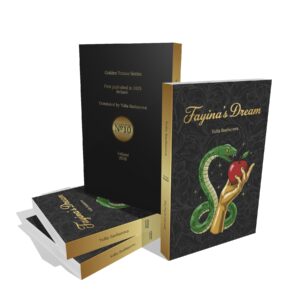
Fayina’s Dream by Yulia Basharova
Page Count: 395Year: 2025Products search A mystical, satirical allegory about the war in Grabland, featuring President Liliputin. There is touching love, demons, and angels. Be careful! This book changes your thinking! After reading it, you’ll find it difficult to sin. It is a combination of a mystical parable, an anarchy manifesto, and a psychological drama, all presented in […]
$10.00 Login to Wishlist
“Beauty will save the world”
“Is it true, Prince [Myshkin], that you once said that ‘beauty’ will save the world? Gentlemen,” he [Ippolit] shouted loudly to everyone, “the Prince asserts that beauty will save the world! And I assert that he has such playful thoughts because he is now in love. Gentlemen, the Prince is in love; I became convinced of it just as he entered. Don’t blush, Prince, I will pity you. What beauty will save the world? Kolya told me this… Are you a zealous Christian? Kolya says you call yourself a Christian. The Prince looked at him attentively and did not answer him.” — The Idiot (1868)
The phrase about beauty saving the world is spoken by a secondary character—the consumptive youth Ippolit. He asks if Prince Myshkin truly said this, and, receiving no answer, begins to elaborate on the thesis. The main character of the novel does not use such formulations to discuss beauty, only once clarifying about Nastasya Filippovna whether she is good: “Ah, if only she were good! Everything would be saved!”
In the context of The Idiot, the focus is primarily on the power of inner beauty—which is how the writer himself suggested interpreting the phrase. While working on the novel, Dostoevsky wrote to the poet and censor Apollon Maykov that his goal was to create the ideal image of a “perfectly beautiful man,” referring to Prince Myshkin. However, the novel’s drafts also contain the entry: “The world will be saved by beauty. Two examples of beauty,” after which the author reflects on Nastasya Filippovna’s beauty. For Dostoevsky, it was important to assess the salvific power of both a person’s internal, spiritual beauty and their external appearance. In the plot of The Idiot, however, we find a negative answer: the beauty of Nastasya Filippovna, like the purity of Prince Myshkin, does not improve the lives of other characters or prevent the tragedy.
Later, in The Brothers Karamazov, the characters will again speak of the power of beauty. Dmitry Karamazov no longer doubts its salvific power: he knows and feels that beauty can make the world better. But in his understanding, it also possesses a destructive force. The hero will suffer because he cannot understand where the boundary between good and evil lies.
“Am I a trembling creature or do I have the right”
“And it wasn’t money, mainly, that I needed, Sonya, when I killed; it wasn’t money so much as something else… I know all this now… Understand me: perhaps if I followed the same path, I would never repeat the murder again. I needed to find out something else, something else was pushing me by the hand: I needed to find out then, and quickly find out, am I a louse, like everyone else, or am I a man? Will I be able to step over or not! Will I dare to bend down and take or not? Am I a trembling creature or do I have the right…” — Crime and Punishment (1866)
Raskolnikov first speaks of a “trembling creature” after meeting a burgher who calls him a “murderer.” The hero is frightened and plunges into reflections on how some “Napoleon”—a representative of the higher human “category” who can calmly commit a crime for the sake of his goal or whim—would react in his place: “Right, right is the ‘prophet’ when he sets a good battery somewhere across the street and fires at the righteous and the guilty, not deigning even to explain himself! Obey, trembling creature, and — do not desire, because — it is not your business!…” Raskolnikov most likely borrowed this image from Pushkin’s poem “Imitations of the Quran,” where Surah 93 is loosely interpreted:
“Be courageous, despise deceit, Boldly follow the path of truth, Love the orphans and preach my Quran To the trembling creature.”
In the original Surah text, the recipients of the sermon should be people, not “creatures,” who should be told about the blessings that Allah can bestow. Raskolnikov consciously mixes the image from “Imitations of the Quran” with episodes from Napoleon’s biography. Of course, it was the French commander, not the Prophet Muhammad, who set a “good battery across the street.” This is how he suppressed the Royalist uprising in 1795. For Raskolnikov, they are both great men, and each of them, in his opinion, had the right to achieve their goals by any means. Everything Napoleon did could be realized by Muhammad or any other representative of the higher “category.”
The last mention of the “trembling creature” in Crime and Punishment is Raskolnikov’s accursed question: “Am I a trembling creature or do I have the right…” He utters this phrase at the end of a long explanation with Sonya Marmeladova, finally abandoning justifications involving noble impulses and difficult circumstances, and directly stating that he killed for himself, to understand which “category” he belonged to. Thus ends his final monologue; through hundreds and thousands of words, he has finally reached the very essence. The significance of this phrase is given not only by its sharp wording but also by what happens to the hero next. After this, Raskolnikov no longer delivers long speeches: Dostoevsky leaves him with only short remarks. Readers will learn about Raskolnikov’s inner turmoil, which ultimately leads him to confess in the square and at the police station, from the author’s explanations. The hero himself will no longer narrate anything—for he has already asked the main question.
“Should the world perish, or should I not drink tea”
“…In fact, you know what I need: that you perish, that’s what! I need peace. Yes, I would sell the whole world for a kopeck right now, just so I am not disturbed. Should the world perish, or should I not drink tea? I will say that the world should perish, but that I should always drink tea. Did you know this or not? Well, I know that I am a scoundrel, a villain, a self-lover, a lazy man.” — Notes from Underground (1864)
This is part of the monologue of the unnamed hero of Notes from Underground, which he delivers to a prostitute who unexpectedly comes to his house. The phrase about tea is spoken as proof of the insignificance and selfishness of the Underground Man. These words have a curious historical context. Tea as a measure of prosperity first appears in Dostoevsky’s Poor Folk. Here is how the hero of the novel, Makar Devushkin, speaks about his financial situation:
“And my apartment costs me seven rubles in assignats, and the table five rubles: that’s twenty-four and a half, but before I paid exactly thirty, but for that I denied myself many things; I didn’t always drink tea, but now I’ve saved up for tea and sugar. You know, my dear, it’s somehow shameful not to drink tea; everyone here is well-to-do, so it’s shameful.”
Dostoevsky himself experienced similar anxieties in his youth. In 1839, he wrote from St. Petersburg to his father in the countryside:
“Well; if you don’t drink tea, you won’t die of hunger! I’ll manage somehow! <…> The camp life of every student of military educational institutions requires at least 40 rubles in money. <…> I do not include such necessities as, for example: having tea, sugar, etc., in this sum. This is necessary anyway, and necessary not only for decency but out of need. When you are soaked in wet weather in the rain under a canvas tent, or in such weather, having come tired and chilled from exercise, you can get sick without tea; which happened to me last year on a campaign. But still, respecting your need, I will not drink tea.”
Tea in Tsarist Russia was indeed an expensive product. It was transported directly from China along the only land route, and the journey took about a year. Due to transportation costs, as well as huge duties, tea in Central Russia cost several times more than in Europe. According to the Vedomosti of the St. Petersburg City Police, in 1845, prices for a pound (0.45 kilograms) of product at the Chinese tea shop of merchant Piskarev ranged from 5 to 6.5 rubles in assignats, and the cost of green tea reached 50 rubles. At the same time, a pound of prime beef could be bought for 6–7 rubles. In 1850, Otechestvennye Zapiski wrote that the annual consumption of tea in Russia was 8 million pounds—although it is impossible to calculate how much per person, as this commodity was popular mainly in cities and among the upper class.
“If there is no God, everything is permitted”
“…He concluded by asserting that for every private person, such as we are now, for example, who believes neither in God nor in their immortality, the moral law of nature must immediately change to the complete opposite of the former, religious one, and that egoism, even to the point of villainy, should not only be permitted to man, but even recognized as necessary, the most rational, and almost the noblest outcome in his situation.” — The Brothers Karamazov (1880)
Dostoevsky’s most important words are usually spoken not by the main characters. For example, the theory of dividing humanity into two categories in Crime and Punishment is first voiced by Porfiry Petrovich, and only then by Raskolnikov; the question of the salvific power of beauty in The Idiot is raised by Ippolit. Similarly, Pyotr Alexandrovich Miusov, a relative of the Karamazovs, notes that God and the salvation He promises are the only guarantee that people will observe moral laws. Miusov refers to his brother Ivan, and only then do other characters discuss this provocative theory, debating whether Karamazov could have invented it. Dmitry Karamazov finds it interesting, the seminarist Rakitin finds it vile, and the gentle Alyosha finds it false. But the phrase “If there is no God, everything is permitted” is not uttered by anyone in the novel. This “quote” was later constructed by literary critics and readers from various remarks.
Five years before the publication of The Brothers Karamazov, Dostoevsky had already tried to speculate about what humanity would do without God. The hero of the novel The Adolescent (1875), Andrei Petrovich Versilov, claimed that clear proof of the absence of a higher power and the impossibility of immortality would, on the contrary, make people love and value each other more, because there would be no one else to love. This fleeting remark grows into a theory in the next novel, and that, in turn, is tested in practice. Tormented by god-defying ideas, Ivan Karamazov violates moral laws and permits his father’s murder. Unable to endure the consequences, he practically goes mad. By allowing himself everything, Ivan does not cease to believe in God—his theory does not work, because he could not even prove it to himself.
“Masha is lying on the table. Will I see Masha again?”
“April 16. Masha is lying on the table. Will I see Masha again? To love a person as oneself, according to Christ’s commandment, is impossible. The law of personality on earth binds. The I prevents it. Only Christ could, but Christ was the eternal ideal from time immemorial, to which man strives and, by the law of nature, must strive.” — From the Notebook (1864)
Masha, or Maria Dmitrievna (née Konstants, first husband Isaeva), was Dostoevsky’s first wife. They married in 1857 in the Siberian city of Kuznetsk, and later moved to Central Russia. Maria Dmitrievna died of consumption on April 15, 1864. In recent years, the couple had lived separately and rarely communicated. The illness and death of his wife greatly affected him. A few hours after her death, Dostoevsky recorded in his notebook his thoughts on love, marriage, and the goals of human development. In short, their essence is this: The ideal to strive for is Christ, the only one who could sacrifice himself for others. Man, however, is selfish and incapable of loving his neighbor as himself. Nevertheless, paradise on earth is possible: with proper spiritual work, each new generation will be better than the previous one. Having reached the highest stage of development, people will abandon marriages because they contradict the ideal of Christ. The family union is the selfish isolation of a couple, and in a world where people are ready to give up their personal interests for the sake of others, this is unnecessary and impossible. Moreover, since the ideal state of humanity will only be reached at the last stage of development, people can stop reproducing.
“Masha is lying on the table…” is an intimate diary entry, not a thought-out literary manifesto. But it is in this text that the ideas that Dostoevsky would later develop in his novels are outlined. The selfish attachment of man to his “I” will be reflected in Raskolnikov’s individualistic theory, and the unattainability of the ideal—in Prince Myshkin, who was called “Prince Christ” in the drafts, as an example of self-sacrifice and humility.
“Constantinople—sooner or later, must be ours”
“Pre-Petrine Russia was active and strong, although it was slowly forming politically; it worked out its unity and prepared to secure its borders; it understood itself that it carried within itself a treasure that was nowhere else—Orthodoxy, that it was the guardian of Christ’s truth, but already the true truth, the genuine image of Christ, which had become obscured in all other faiths and in all other nations. <…> And this unity is not for conquest, not for violence, not for the destruction of Slavic personalities before the Russian colossus, but to recreate them and place them in the proper relationship to Europe and to humanity, to finally give them the opportunity to rest and recover after their countless centuries of suffering… <…> Naturally, and for the same purpose, Constantinople—sooner or later, must be ours…” — A Writer’s Diary (June 1876)
In 1875–1876, Russian and foreign press were inundated with ideas about the capture of Constantinople. At that time, revolts of Slavic peoples were flaring up one after another in the Ottoman Empire, which the Turkish authorities brutally suppressed. The situation was heading towards war. Everyone expected Russia to defend the Balkan states: it was predicted to win, and the Ottoman Empire—to disintegrate. And, of course, everyone was concerned about who would get the ancient Byzantine capital. Various options were discussed: that Constantinople would become an international city, that the Greeks would occupy it, or that it would be part of the Russian Empire. The last option did not suit Europe at all, but was very popular with Russian conservatives, who saw primarily a political advantage in it.
These questions also concerned Dostoevsky. Entering the polemic, he immediately accused all participants in the dispute of being wrong. In A Writer’s Diary, from the summer of 1876 to the spring of 1877, he constantly returns to the Eastern Question. Unlike the conservatives, he believed that Russia sincerely wanted to protect fellow believers, to liberate them from the Muslim yoke, and therefore, as an Orthodox power, had an exclusive right to Constantinople. “We, Russia, are truly necessary and inevitable both for all Eastern Christianity and for the entire fate of future Orthodoxy on earth, for its unity,” Dostoevsky wrote in the Diary for March 1877. The writer was convinced of Russia’s special Christian mission. He had previously developed this idea in Demons. One of the heroes of that novel, Shatov, was convinced that the Russian people were the God-bearing people. The famous Pushkin Speech, published in A Writer’s Diary in 1880, would also be dedicated to the same idea.
Sources
Berdyaev N. A. Dostoevsky’s Worldview. Moscow, 2001.
Dostoevsky F. M. Poor Folk. Moscow, 2015.
Dostoevsky F. M. Collected Works in 15 vols. Vol. 14. St. Petersburg, 1995.
Dostoevsky F. M. Complete Collected Works in 30 vols. Vols. 5–9, 14, 15, 21, 22, 28. Leningrad, 1973, 1974, 1976, 1980, 1981, 1985.
Mikhailovsky N. K. Literary Criticism. Articles on Russian Literature of the XIX — Early XX Century. Leningrad, 1989.
Mochulsky K. V. Gogol. Solovyov. Dostoevsky. Moscow, 1995.
Subbotin A. P. Tea and the Tea Trade in Russia and Other States. St. Petersburg, 1892.
Tikhomirov B. N. “Lazarus! Come Forth.” F. M. Dostoevsky’s Novel “Crime and Punishment” in a Modern Reading: A Commentary Book. St. Petersburg, 2005.
Tunimanov V. A. Dostoevsky’s Work. 1854–1862. Leningrad, 1980.
Fridlender G. M. Dostoevsky’s Aesthetics. In: Dostoevsky — Artist and Thinker. Moscow, 1972.