
The Petty Demon by Fyodor Sologub: Read FREE Full Text Online (English Translation)
You can now read the full text for free of Fyodor Sologub’s notorious The Petty Demon. This essential Russian classic novel and masterpiece of Russian Symbolism is available for online reading here in a high-quality English translation.
Dive into this captivating exploration of moral decay and provincial life, and experience one of the most significant works by a major Russian author. Start reading instantly without any download required. This exclusive free access is your gateway to essential Russian literature.
You can also buy this book from us in the paperback edition via the link below.
-
Buy eBook
 Editor's Pick
Fayina’s Dream by Yulia Basharova
Page Count: 466Year: 2025Products search A mystical, satirical allegory about the war in Grabland, featuring President Liliputin. There is touching love, demons, and angels. Be careful! This book changes your thinking! After reading it, you’ll find it difficult to sin. It is a combination of a mystical parable, an anarchy manifesto, and a psychological drama, all presented in […]
€10.00 Login to Wishlist -
Buy Book
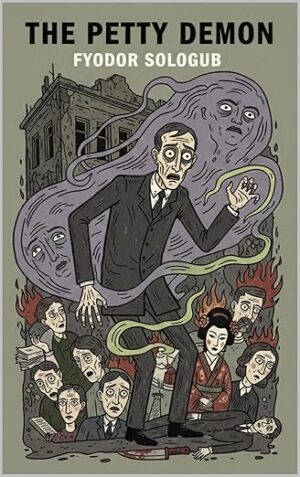
The Petty Demon by Fyodor Sologub
Page Count: 352Year: 1907READ FREEProducts search This unsettling masterpiece of Russian symbolism centers on Ardalion Peredonov, a paranoid and cruel provincial high school teacher whose descent into madness mirrors the moral decay of his entire community. Obsessed with securing a promotion and a comfortable marriage, Peredonov finds his trivial ambitions twisted by suspicion, filth, and escalating fear. He begins […]
€22.00 Login to Wishlist
First published in 1905, “Voprosy Zhizni”
Magazine, Russian Empire
This book is in the public domain
Reprint by Publishing House №10 2025
Publication date July 17, 2025
Translation from Russian
369 Pages, Font 12 pt, Bookman Old Style
Electronic edition, File size 663 KB
Cover design, Translate by Yulia Basharova
Copyright© Yulia Basharova
Table of Contents
I
After the festive liturgy, the parishioners dispersed to their homes. Some lingered in the churchyard, behind white stone walls, under old linden and maple trees, and chatted. Everyone was dressed up for the holiday, looked at each other amiably, and it seemed that in this town, people lived peacefully and amicably. And even cheerfully. But all this was only an illusion.
The gymnasium teacher Peredonov, standing in a circle of his friends, glumly looking at them with his small, swollen eyes from behind gold-rimmed glasses, told them:
“Princess Volchanskaya herself promised Varya, that’s for sure. As soon as, she says, she marries him, I’ll immediately get him the position of inspector.”
“But how can you marry Varvara Dmitrievna?” asked the red-faced Falastov, “She’s your sister! Has a new law come out that allows marrying sisters?”
Everyone burst out laughing. Peredonov’s usually rosy, indifferent-sleepy face turned ferocious.
“Third cousin…” he grumbled, looking angrily past his interlocutors.
“Did the princess promise you herself?” asked the dapper, pale, and tall Rutilov.
“Not me, but Varya,” Peredonov replied.
“Well, and you believe it,” Rutilov said animatedly. “Anyone can say anything. Why didn’t you go to the princess yourself?”
“Understand, Varya and I went, but we didn’t find the princess, we were only five minutes late,” Peredonov recounted, “She went to the village, will be back in three weeks, and I absolutely couldn’t wait, I had to come here for the exams.”
“Something’s doubtful,” Rutilov said and laughed, showing his decaying teeth.
Peredonov fell into thought. His companions dispersed. Only Rutilov remained with him.
“Of course,” Peredonov said, “I can marry anyone I want. Varvara isn’t the only one.”
“Naturally, any girl would go for you, Ardalyon Borysyich,” Rutilov confirmed.
They left the churchyard and walked slowly across the unpaved, dusty square. Peredonov said:
“But what about the princess? She’ll get angry if I ditch Varvara.”
“Well, what about the princess!” said Rutilov. “You’re not raising kittens with her. Let her give you the position first – you’ll have time to settle down. Otherwise, it’s just for nothing, seeing nothing!”
“That’s true…” Peredonov agreed thoughtfully.
“You tell Varvara that,” Rutilov persuaded. “First the position, otherwise, I don’t really believe it. Get the position, and then marry whoever you want. You’d better take one of my sisters – three of them, choose any. The young ladies are educated, smart, no flattery, not a match for Varvara. She’s not fit to tie their shoelaces.”
“Well-l…” Peredonov mumbled.
“True. What’s your Varvara? Here, smell this.”
Rutilov bent down, tore off a woolly stem of henbane, crumpled it with its leaves and dirty-white flowers, and, rubbing it all with his fingers, brought it to Peredonov’s nose. Peredonov winced at the unpleasant, heavy smell. Rutilov said:
“Rub it and throw it away – that’s your Varvara. She and my sisters – that, brother, is a big difference. Lively young ladies, energetic – take any, she won’t let you sleep. And young, too – the oldest is three times younger than your Varvara.”
Rutilov said all this, as was his custom, quickly and cheerfully, smiling, but he, tall and narrow-chested, seemed frail and fragile, and from under his new and fashionable hat, his sparse, short-cropped light hair stuck out rather sadly.
“Well, three times as young,” Peredonov weakly retorted, taking off and wiping his gold glasses.
“Yes, it’s true!” Rutilov exclaimed. “Look, don’t miss out while I’m alive, otherwise, they have their pride too – later you’ll want to, but it’ll be too late. But each of them would go for you with great pleasure.”
“Yes, everyone here falls in love with me,” Peredonov said with gloomy self-praise.
“Well, you see, so seize the moment,” Rutilov urged.
“The main thing for me would be that she’s not scrawny,” Peredonov said with longing in his voice. “I’d like a plump one.”
“Oh, don’t you worry about that,” Rutilov said ardently. “They are plump young ladies even now, and if they haven’t quite filled out, that’s only for a while. They’ll get married and they’ll get plump, like the eldest. Larisa, as you know, has become quite a pie.”
“I would marry,” Peredonov said, “but I’m afraid Varya will make a big scandal.”
“If you’re afraid of a scandal, then do this,” Rutilov said with a cunning smile: “Marry today, or tomorrow: you’ll come home with a young wife, and that’s that. Truly, if you want, I’ll arrange it, tomorrow evening? With whichever one you want?”
Peredonov suddenly burst out laughing, in short, loud bursts.
“Well, agreed? Is it a deal?” Rutilov asked.
Peredonov as suddenly stopped laughing and glumly said, softly, almost in a whisper:
“She’ll report me, the scoundrel.”
“She won’t report anything, there’s nothing to report,” Rutilov reassured him.
“Or she’ll poison me,” Peredonov whispered fearfully.
“Just rely on me for everything,” Rutilov ardently persuaded him, “I’ll arrange everything so subtly for you…”
“I won’t marry without a dowry,” Peredonov shouted angrily.
Rutilov was not at all surprised by this new jump in his gloomy interlocutor’s thoughts. He retorted with the same animation:
“Fool, are they dowerless? Well, is it a deal? Well, I’ll run, I’ll arrange everything. But mum’s the word, understand, not a peep to anyone!”
He shook Peredonov’s hand and ran off. Peredonov silently watched him. The Rutilov young ladies came to his mind, cheerful, mocking. An immodest thought forced a foul semblance of a smile onto his lips – it appeared for a moment and disappeared. A vague unease arose within him.
“What about the princess?” he thought. “Those girls have no money, and no patronage, but with Varvara, you’ll become an inspector, and then they’ll make you a director.”
He looked after the fussily scurrying Rutilov and thought maliciously: “Let him run around.”
And this thought gave him a sluggish and dull pleasure. But he grew bored because he was alone; he pulled his hat down over his forehead, furrowed his light eyebrows, and hastily set off home along the unpaved, empty streets, overgrown with creeping moss with white flowers, and watercress, a weed trampled in the mud.
Someone called him in a quiet and quick voice:
“Ardalyon Borysyich, come visit us.”
Peredonov raised his gloomy eyes and looked angrily over the fence. In the garden, behind the gate, stood Natalya Afanasyevna Vershina, a small, thin, dark-skinned woman, all in black, with black eyebrows and black eyes. She was smoking a cigarette in a dark cherry wood mouthpiece and smiling slightly, as if she knew something that isn’t spoken, but is smiled at. Not so much with words, but with light, quick movements, she invited Peredonov into her garden: she opened the gate, stepped aside, smiled entreatingly and at the same time confidently, and motioned with her hands – come in, why are you standing there.
And Peredonov entered, obeying her as if enchanting, silent movements. But he immediately stopped on the sandy path, where fragments of dry branches caught his eye, and looked at his watch.
“Time for breakfast,” he grumbled.
Although he had owned the watch for a long time, he still, as always when people were present, looked with pleasure at its large gold covers. It was twenty minutes to twelve. Peredonov decided he could stay a little while. He walked glumly behind Vershina along the paths, past the empty bushes of black and red currants, raspberries, and gooseberries.
The garden was yellow and mottled with fruits and late flowers. There were many fruit trees and ordinary trees and bushes: low spreading apple trees, round-leaved pears, linden trees, cherry trees with smooth shiny leaves, plum, honeysuckle. Red berries ripened on elderberry bushes. Siberian geranium bloomed thickly near the fence – small, pale pink flowers with purple veins.
Thistles poked their prickly purple heads from under the bushes. To one side stood a wooden house, small, greyish, with a single dwelling, and a wide porch leading to the garden. It seemed charming and cozy. And behind it, a part of the vegetable garden was visible. There, dry poppy pods swayed, and large, white-yellow daisy caps, yellow sunflower heads drooped before wilting, and among the useful herbs, umbrellas rose: white ones of wild parsnip and pale purple ones of spotted hemlock, light yellow buttercups and low spurges bloomed.
“Were you at the liturgy?” Vershina asked.
“I was,” Peredonov replied glumly.
“And Martha just came back,” Vershina recounted. “She often goes to our church. I even laugh: for whom, I say, Martha, do you go to our church? She blushes, stays silent. Let’s go, let’s sit in the arbor,” she said quickly and without any transition from what she had been saying before.
In the middle of the garden, in the shade of sprawling maples, stood an old, greyish arbor – three steps up, a moss-covered platform, low walls, six turned, bulging columns, and a six-slope roof.
Martha sat in the arbor, still dressed up from the liturgy. She wore a light dress with bows, but it didn’t suit her. The short sleeves exposed sharp, red elbows and strong, large hands. Martha, however, was not bad-looking. Her freckles didn’t spoil her. She was even considered pretty, especially among her own people, the Poles – there were quite a few of them living here.
Martha was rolling cigarettes for Vershina. She impatiently wanted Peredonov to look at her and be delighted. This desire revealed itself on her simple face with an expression of restless friendliness. However, it didn’t stem from Martha being in love with Peredonov: Vershina wanted to find her a match, the family was large – and Martha wanted to please Vershina, with whom she had been living for several months, since the funeral of Vershina’s old husband – to please her for herself and for her gymnasium student brother, who was also visiting here.
Vershina and Peredonov entered the arbor. Peredonov glumly greeted Martha and sat down – he chose a spot where a column would protect his back from the wind and where drafts wouldn’t blow into his ears. He looked at Martha’s yellow shoes with pink pom-poms and thought that they were trying to catch him as a groom. He always thought this when he saw young ladies who were amiable with him. He noticed only flaws in Martha – many freckles, large hands, and rough skin. He knew that her father, a nobleman, leased a small village about six versts from the town. The income was small, there were many children: Martha had finished pro-gymnasium, her son was studying in gymnasium, other children were even younger.
“May I pour you some beer?” Vershina asked quickly.
On the table were glasses, two bottles of beer, fine sugar in a tin box, a nickel silver spoon, soaked in beer.
“I’ll drink it,” Peredonov said curtly.
Vershina looked at Martha. Martha poured a glass, pushed it to Peredonov, and at the same time, a strange smile, half-frightened, half-joyful, played on her face. Vershina said quickly, as if spilling words:
“Put sugar in your beer.”
Martha pushed the tin with sugar to Peredonov. But Peredonov said irritably:
“No, that’s disgusting, with sugar.”
“What are you saying, it’s delicious,” Vershina dropped monotonously and quickly.
“Very delicious,” Martha said.
“Disgusting,” Peredonov repeated and looked angrily at the sugar.
“As you wish,” Vershina said and in the same voice, without stopping or transitioning, began to talk about something else: “Cherpnin is bothering me,” she said and laughed.
Martha also laughed. Peredonov looked on indifferently: he took no part in other people’s affairs – he didn’t like people, didn’t think about them except in connection with his own advantages and pleasures. Vershina smiled complacently and said:
“He thinks I’ll marry him.”
“Awfully cheeky,” Martha said, not because she thought so, but because she wanted to please and flatter Vershina.
“He was peeking through the window yesterday,” Vershina recounted. “He climbed into the garden when we were having supper. A tub stood under the window, we had put it out for the rain – it was full. It was covered with a board, the water wasn’t visible, he climbed onto the tub and looked into the window. And our lamp was on – he saw us, but we didn’t see him. Suddenly we heard a noise. We were scared at first, ran out. And it was him, he had fallen into the water. But he got out before us, ran away all wet – a wet trail on the path. And we recognized him by his back.”
Martha laughed with a thin, joyful laugh, like well-behaved children laugh. Vershina recounted everything quickly and monotonously, as if pouring it out – as she always said – and immediately fell silent, sitting and smiling with the corner of her mouth, and because of this, her whole dark and dry face wrinkled, and her teeth, blackened from smoking, slightly parted. Peredonov thought and suddenly burst out laughing. He always reacted slowly to what he found funny – his perceptions were slow and dull.
Vershina smoked cigarette after cigarette. She couldn’t live without tobacco smoke in front of her nose.
“We’ll be neighbors soon,” Peredonov announced.
Vershina cast a quick glance at Martha. She blushed slightly, looked at Peredonov with fearful anticipation, and then immediately looked away into the garden again.
“Are you moving?” Vershina asked. “Why?”
“Far from the gymnasium,” Peredonov explained. Vershina smiled distrustfully. More likely, she thought, he wants to be closer to Martha.
“But you’ve been living there for a long time, for several years,” she said.
“And the landlady’s a bitch,” Peredonov said angrily.
“Really?” Vershina asked distrustfully, and smiled crookedly.
Peredonov livened up a bit.
“She put up new wallpaper, but badly,” he recounted. “The pieces don’t match. Suddenly in the dining room, above the door, there’s a completely different pattern, the whole room has swirls and little flowers, but above the door it’s stripes and little nails. And the color is completely wrong. We almost didn’t notice, but Falastov came, he laughed. And everyone laughed.”
“Of course, such an outrage,” Vershina agreed.
“Only we’re not telling her that we’re moving out,” Peredonov said, lowering his voice. “We’ll find an apartment and leave, and we won’t tell her.”
“Naturally,” Vershina said.
“Otherwise, she’ll probably make a scandal,” Peredonov said, and fearful anxiety was reflected in his eyes. “And then I’ll have to pay her for a month, for such nastiness.”
Peredonov burst out laughing with joy that he would move out and not pay for the apartment.
“She’ll demand it,” Vershina remarked.
“Let her demand, I won’t give it,” Peredonov said angrily. “We went to Petersburg, so we didn’t use the apartment during that time.”
“But the apartment remained yours,” Vershina said.
“So what! She has to do repairs, so are we obliged to pay for the time we don’t live there? And most importantly – she’s awfully cheeky.”
“Well, the landlady is cheeky because your… sister is too fiery a person,” Vershina said with a slight hesitation on the word “sister.”
Peredonov frowned and stared ahead dully with half-sleepy eyes. Vershina started talking about something else. Peredonov pulled a caramel from his pocket, unwrapped it, and began to chew. He accidentally glanced at Martha and thought that she was envious and also wanted a caramel.
“Should I give her one or not?” Peredonov thought. “She’s not worth it. Or maybe I should give her one – so they don’t think I’m stingy. I have a lot, my pockets are full.”
And he pulled out a handful of caramels.
“Here,” he said and offered the candies first to Vershina, then to Martha, “good bonbons, expensive, thirty kopecks a pound.”
They each took one. He said:
“Take more. I have a lot, and good bonbons – I won’t eat bad ones.”
“Thank you, I don’t want any more,” Vershina said quickly and expressionlessly.
And Martha repeated the same words after her, but somewhat hesitantly. Peredonov looked at Martha distrustfully and said:
“Well, how can you not want any! Here.”
And he took one caramel for himself from the handful, and placed the rest in front of Martha. Martha smiled silently and bowed her head.
“Rude,” Peredonov thought, “doesn’t know how to thank properly.”
He didn’t know what to talk about with Martha. She wasn’t interesting to him, like all objects with which no pleasant or unpleasant relationships had been established for him by someone.
The rest of the beer was poured into Peredonov’s glass. Vershina looked at Martha.
“I’ll bring it,” Martha said. She always guessed without words what Vershina wanted.
“Send Vladya, he’s in the garden,” Vershina said.
“Vladislav!” Martha called out.
“Here,” the boy replied so close and so quickly, as if he had been eavesdropping.
“Bring two bottles of beer,” Martha said, “in the chest in the hallway.”
Soon Vladislav quietly ran up to the arbor, handed Martha the beer through the window, and bowed to Peredonov.
“Hello,” Peredonov said grimly, “how many bottles of beer have you guzzled today?”
Vladislav forced a smile and said:
“I don’t drink beer.”
He was a boy of about fourteen, with a freckled face like Martha’s, resembling his sister, awkward and sluggish in his movements. He was dressed in a coarse linen blouse.
Martha whispered to her brother. Both of them laughed. Peredonov looked at them suspiciously. When people laughed in his presence and he didn’t know why, he always assumed they were laughing at him. Vershina grew worried. She was about to call out to Martha. But Peredonov himself asked in an angry voice:
“What are you laughing at?”
Martha flinched, turned to him, and didn’t know what to say. Vladislav smiled, looking at Peredonov, and blushed slightly.
“That’s rude, in front of guests,” Peredonov reproached. “Are you laughing at me?” he asked.
Martha blushed, Vladislav was scared.
“Excuse me,” Martha said, “we weren’t laughing at you at all. We were talking about our own business.”
“A secret,” Peredonov said angrily. “It’s rude to talk about secrets in front of guests.”
“No, it’s not a secret,” Martha said, “but we were laughing because Vladya is barefoot and can’t come in here – he’s embarrassed.”
Peredonov calmed down, started inventing jokes about Vladya, then also treated him to a caramel.
“Martha, bring my black shawl,” Vershina said, “and while you’re at it, look in the kitchen, see how the pie is doing.”
Martha obediently left. She understood that Vershina wanted to talk to Peredonov, and she was glad, being lazy, that there was no hurry.
“And you go further away,” Vershina told Vladya, “there’s no need for you to hang around here.”
Vladya ran, and the sand could be heard rustling under his feet. Vershina cautiously and quickly looked sideways at Peredonov through the continuous smoke she exhaled. Peredonov sat silently, gazing straight ahead with a hazy look and chewing a caramel. He was pleased that they had left – otherwise, they might have laughed again. Although he now knew for sure that they weren’t laughing at him, a feeling of annoyance remained in him – just as after touching stinging nettle, the pain lingers and grows, even though the nettle is far away.
“Why aren’t you getting married?” Vershina suddenly spoke quickly and often. “What are you waiting for, Ardalyon Borysyich! Your Varvara is not a match for you, forgive me, I’ll say it directly.”
Peredonov ran his hand through his slightly dishevelled chestnut hair and said with gloomy solemnity:
“There’s no match for me here.”
“Don’t say that,” Vershina objected and smiled crookedly. “There’s much better here than her, and any girl would go for you.”
She flicked the ash from her cigarette with a decisive movement, as if putting an affirmative mark on something.
“I don’t need just any,” Peredonov replied.
“It’s not about just any,” Vershina said quickly. “And you don’t need to chase a dowry, as long as the girl is good. You yourself earn enough, thank God.”
“No,” Peredonov objected, “it’s more advantageous for me to marry Varvara. The princess promised her patronage. She’ll give me a good position,” Peredonov said with gloomy animation.
Vershina smiled slightly. Her whole wrinkled and dark face, as if smoke-stained, expressed condescending disbelief. She asked:
“Did she tell you that, the princess?” with emphasis on the word “you.”
“Not me, but Varvara,” Peredonov admitted, “but it’s all the same.”
“You rely too much on your sister’s words,” Vershina said maliciously. “Well, tell me, is she much older than you? By fifteen years? Or more? She’s almost fifty, isn’t she?”
“Oh, where on earth,” Peredonov said irritably, “she’s not even thirty yet.” Vershina laughed.
“Please tell me,” she said with unconcealed mockery in her voice, “but she looks much older than you. Of course, it’s none of my business, but from the outside, it’s a pity that such a good young man has to live not as he deserves according to his beauty and spiritual qualities.”
Peredonov self-satisfiedly surveyed himself. But there was no smile on his rosy face, and it seemed that he was offended that not everyone understood him as Vershina did. And Vershina continued:
“You’ll go far even without patronage. Surely the authorities will appreciate you! Why cling to Varvara! And you shouldn’t take a wife from the Rutilov girls either: they are frivolous, and you need a steady wife. Why don’t you take my Martha.”
Peredonov looked at his watch.
“Time to go home,” he said and began to say goodbye.
Vershina was sure that Peredonov was leaving because she had touched a raw nerve, and that he only didn’t want to talk about Martha now out of indecision.
II
Varvara Dmitrievna Maloshina, Peredonov’s cohabitant, awaited him, sloppily dressed but carefully powdered and rouged.
Pies with jam were baking for breakfast; Peredonov loved them. Varvara waddled around the kitchen on high heels, hurrying to prepare everything for his arrival. Varvara feared that the maid, Natalya, a pockmarked, stout girl, would steal a pie, or even more. Therefore, Varvara stayed in the kitchen and, as usual, scolded the maid. A grumbling, greedy expression perpetually lay on her wrinkled face, which still bore traces of her former beauty.
As always upon returning home, Peredonov was seized by discontent and melancholy. He entered the dining room noisily, tossed his hat onto the windowsill, sat down at the table, and shouted:
“Varya, serve!”
Varvara carried dishes from the kitchen, quickly shuffling on her high heels, worn for show, and waited on Peredonov herself. When she brought the coffee, Peredonov leaned towards the steaming glass and sniffed. Varvara became anxious and timidly asked him:
“What is it, Ardalyon Borysyich? Does the coffee smell of anything?”
Peredonov glanced at her glumly and said angrily:
“I’m sniffing to see if there’s poison in it.”
“Oh, Ardalyon Borysyich!” Varvara exclaimed, startled. “God be with you, why would you think that?”
“You’ve stirred up a storm!” he grumbled.
“What profit is it to me to poison you?” Varvara argued, “Stop playing the fool!”
Peredonov continued sniffing for a long time, finally calmed down and said:
“If there’s poison, you’ll definitely smell a heavy odor, you just have to sniff closer, into the very steam.”
He was silent for a moment and then suddenly said with malice and mockery:
“The princess!”
Varvara became agitated.
“What princess? What about the princess?”
“The princess is this,” Peredonov said, “no, let her first give me the position, and only then will I marry. You write her that.”
“But you know, Ardalyon Borysyich,” Varvara began in a persuasive voice, “that the princess only promises when I get married. Otherwise, it’s awkward for her to ask for you.”
“Write that we’re already married,” Peredonov said quickly, pleased with his invention. Varvara was taken aback at first, but quickly recovered and said:
“Why lie — the princess can check. No, you’re better off setting a wedding date. And it’s time to sew the dress.”
“What dress?” Peredonov asked glumly.
“Are we going to get married in this drab outfit?” Varvara cried. “Give me money, Ardalyon Borysyich, for the dress.”
“Are you preparing for your grave?” Peredonov asked maliciously.
“You brute, Ardalyon Borysyich!” Varvara exclaimed reproachfully.
Suddenly, Peredonov wanted to tease Varvara. He asked:
“Varvara, do you know where I was?”
“Well, where?” Varvara asked anxiously.
“At Vershina’s,” he said and burst out laughing.
“Found yourself some company,” Varvara cried maliciously, “nothing to say!”
“I saw Martha,” Peredonov continued.
“All freckled,” Varvara said with growing malice, “and a mouth from ear to ear, you could sew it onto a frog.”
“But she’s prettier than you,” Peredonov said. “I’ll just go and marry her.”
“Just you marry her,” Varvara shouted, red and trembling with anger, “I’ll burn her eyes out with acid!”
“I want to spit on you,” Peredonov said calmly.
“You won’t spit!” Varvara cried.
“Oh yes, I will,” Peredonov said.
He stood up and, with a dull and indifferent expression, spat in her face.
“Pig!” Varvara said rather calmly, as if the spit had refreshed her.
And she began to wipe herself with a napkin. Peredonov was silent. Lately, he had become ruder than usual with Varvara. And even before, he had treated her badly. Encouraged by his silence, she spoke louder:
“Truly, a pig. Hit me right in the face.”
A bleating, almost sheep-like voice was heard from the hallway.
“Don’t shout,” Peredonov said, “guests.”
“Oh, that’s Pavlushka,” Varvara replied with a smirk.
Pavel Vasilyevich Volodin, a young man who, both in face and mannerisms, remarkably resembled a lamb, entered with a joyful, loud laugh: his hair was curly like a lamb’s, his eyes bulging and dull—everything about him was like a cheerful lamb—a foolish young man. He was a carpenter, had previously studied at a trade school, and now served as a craft teacher at the city school.
“Ardalyon Borysyich, old friend!” he cried joyfully. “You’re home, drinking coffee, and here I am, right here.”
“Natashka, bring the third spoon!” Varvara shouted.
From the kitchen, the clinking of Natalya’s single remaining teaspoon could be heard; the others were hidden.
“Eat, Pavlushka,” Peredonov said, and it was clear he wanted to feed Volodin. “And I, brother, will soon be an inspector – the princess promised Varya.”
Volodin cheered and laughed.
“Ah, the future inspector drinking coffee!” he shouted, slapping Peredonov on the shoulder.
“And you think it’s easy to become an inspector? They’ll report you – and that’s the end of it.”
“What is there to report?” Varvara asked with a smirk.
“Plenty. They’ll say I read Pisarev – and that’s it!”
“And you, Ardalyon Borysyich, put that Pisarev on the back shelf,” Volodin advised, giggling.
Peredonov looked at Volodin warily and said:
“Maybe I never even had Pisarev. Want a drink, Pavlushka?”
Volodin protruded his lower lip, made a significant face of a man who knew his worth, and, inclining his head like a sheep, said:
“If it’s for company, I’m always ready to drink, but otherwise – not at all.”
And Peredonov was always ready to drink too. They drank vodka and had sweet pies for a snack.
Suddenly, Peredonov splashed the remaining coffee from his glass onto the wallpaper. Volodin’s sheep-like eyes widened, and he looked around in surprise. The wallpaper was stained and torn. Volodin asked:
“What’s wrong with your wallpaper?”
Peredonov and Varvara burst out laughing.
“To spite the landlady,” Varvara said. “We’re moving out soon. Just don’t you chatter.”
“Excellent!” Volodin cried and laughed joyfully.
Peredonov walked to the wall and began to beat it with his soles. Volodin, following his example, also kicked the wall. Peredonov said:
“We always mess up the walls when we eat – let her remember.”
“What messes he’s made!” Volodin exclaimed with delight.
“Irishka will be dumbfounded,” Varvara said with a dry and wicked laugh.
And all three, standing before the wall, spat on it, tore the wallpaper, and beat it with their boots. Then, tired and satisfied, they stepped away.
Peredonov bent down and picked up the cat. The cat was fat, white, and ugly. Peredonov tormented it — pulling its ears, its tail, shaking it by the neck. Volodin laughed joyfully and suggested to Peredonov what else could be done.
“Ardalyon Borysyich, blow in its eyes! Stroke it against the fur!”
The cat hissed and tried to break free but dared not show its claws — for that, it was severely beaten. Finally, Peredonov grew bored with the game, and he threw the cat.
“Listen, Ardalyon Borysyich, what I wanted to tell you,” Volodin began. “I kept thinking the whole way not to forget, and I almost did.”
“Well?” Peredonov asked glumly.
“You love sweets,” Volodin said joyfully, “and I know a dish that will make you lick your fingers.”
“I know all the tasty dishes myself,” Peredonov said.
Volodin made an offended face.
“Perhaps,” he said, “you, Ardalyon Borysyich, know all the tasty dishes made in your homeland, but how can you know all the tasty dishes made in my homeland if you’ve never been to my homeland?”
And, pleased with the convincingness of his retort, Volodin laughed, bleating.
“In your homeland, they eat dead cats,” Peredonov said angrily.
“Excuse me, Ardalyon Borysyich,” Volodin said in a squeaky, laughing voice, “perhaps it’s in your homeland that they choose to eat dead cats, we won’t touch upon that, but you’ve never eaten yearly.”
“No, I haven’t,” Peredonov admitted.
“What kind of dish is that?” Varvara asked.
“Well, it’s this,” Volodin began to explain, “do you know kutya?”
“Well, who doesn’t know kutya?” Varvara replied with a smirk.
“So, millet kutya, with raisins, with sugar, with almonds — that’s yearly.”
And Volodin recounted in detail how “yearly” was cooked in his homeland. Peredonov listened with melancholy. Kutya – was Pavlushka trying to mark him for the deceased or something?
Volodin suggested:
“If you want everything to be just right, you give me the ingredients, and I’ll cook it for you.”
“Let the goat into the garden,” Peredonov said glumly.
“He’ll probably sprinkle something else in,” he thought. Volodin was offended again.
“If you think, Ardalyon Borysyich, that I’ll steal your sugar, then you’re mistaken,” he said, “I don’t need your sugar.”
“Oh, stop playing the fool,” Varvara interrupted. “You know he’s picky about everything. Just come and cook it.”
“You’ll be the one eating it yourself,” Peredonov said.
“Why’s that?” Volodin asked, his voice trembling with offense.
“Because it’s disgusting.”
“As you wish, Ardalyon Borysyich,” Volodin said, shrugging, “but I only wanted to please you, and if you don’t want it, then as you wish.”
“And how did the general brush you off?” Peredonov asked.
“Which general?” Volodin replied with a question, blushing and pouting his lower lip in offense.
“Oh, we heard, we heard,” Peredonov said.
Varvara smirked.
“Excuse me, Ardalyon Borysyich,” Volodin began hotly, “you heard, but perhaps you didn’t hear everything. I’ll tell you how it all happened.”
“Well, tell me,” Peredonov said.
“It was the day before yesterday,” Volodin recounted, “around this very time. In our school, as you know, repairs are being done in the workshop. And so, if you please, Veriga comes with our inspector to inspect, and we are working in the back room. Good. I won’t touch on why Veriga came, what he needed – that’s not my business. Let’s say I know he’s the marshal of the nobility and has no connection to our school – but I won’t touch on that. He comes – and let him, we don’t bother them, we work little by little – suddenly they enter our room, and Veriga, if you please, is wearing a hat.”
“He showed you disrespect,” Peredonov said glumly.
“If you please,” Volodin eagerly picked up, “we have an icon hanging, and we ourselves are hatless, but he suddenly appears like a Mameluke. And I took the liberty of telling him, quietly, nobly: your Excellency, I said, please take off your hat, because, I said, there is an icon here. Did I say it correctly?” Volodin asked and widened his eyes inquiringly.
“Clever, Pavlushka,” Peredonov shouted, “he deserved it.”
“Of course, why let them get away with it,” Varvara supported him. “Well done, Pavel Vasilyevich.”
Volodin, with the air of a wrongly offended man, continued:
“And he suddenly took it upon himself to say to me: every cricket knows its hearth. He turned and left. That’s how it all happened, and nothing more.”
Volodin still felt like a hero. Peredonov, as a consolation, gave him a caramel.
Another guest arrived, Sofya Efimovna Prepolovenskaya, the forester’s wife, a plump woman with a good-naturedly cunning face and graceful movements. She was seated for breakfast. She slyly asked Volodin:
“Why are you, Pavel Vasilyevich, visiting Varvara Dmitrievna so often?”
“I did not come to Varvara Dmitrievna,” Volodin replied modestly, “but to Ardalyon Borysyich.”
“Haven’t you fallen in love with someone?” Prepolovenskaya asked, chuckling.
Everyone knew that Volodin was looking for a bride with a dowry, had proposed to many, and had been rejected. Prepolovenskaya’s joke seemed inappropriate to him. In a trembling voice, reminding everyone by his whole demeanor of an offended lamb, he said:
“If I have fallen in love, Sofya Efimovna, it concerns no one but myself and that person, and you should step aside in such a manner.”
But Prepolovenskaya wouldn’t stop.
“Look,” she said, “if you make Varvara Dmitrievna fall in love with you, who will bake sweet pies for Ardalyon Borysyich then?”
Volodin pouted his lips, raised his eyebrows, and no longer knew what to say.
“Well, why wouldn’t she want to,” Prepolovenskaya replied, “you’re too modest at the wrong time.”
“And maybe I won’t want to either,” Volodin said coyly. “Maybe I don’t want to marry other people’s sisters. Maybe I have a cousin growing up in my homeland.”
He had already started to believe that Varvara wouldn’t mind marrying him. Varvara was angry. She considered Volodin a fool; besides, he earned four times less than Peredonov. Prepolovenskaya, however, wanted to marry Peredonov to her sister, a plump priest’s daughter. Therefore, she tried to cause a quarrel between Peredonov and Varvara.
“Why are you matchmaking for me?” Varvara said irritably, “You’d better matchmake your youngest for Pavel Vasilyevich.”
“Why would I try to win him away from you!” Prepolovenskaya playfully objected.
Prepolovenskaya’s jokes gave a new turn to Peredonov’s slow thoughts; and the “yearly” had firmly settled in his head. Why did Volodin invent such a dish? Peredonov didn’t like to reflect. In the first moment, he always believed whatever he was told. So he also believed in Volodin’s infatuation with Varvara. He thought: they’ll get him tangled up with Varvara, and then, when they go to the inspector’s position, they’ll poison him on the road with yearly and replace him with Volodin: he’ll be buried as Volodin, and Volodin will be the inspector. What a clever plan!
Suddenly, a noise was heard in the hallway. Peredonov and Varvara were frightened: Peredonov fixed his narrowed eyes motionlessly on the door. Varvara crept to the living room door, barely opened it, peered in, then just as quietly, on tiptoes, balancing with her hands and smiling confusedly, returned to the table. Squealing shouts and noise came from the hallway, as if someone was fighting there. Varvara whispered:
“Yershikha is completely drunk, Natashka isn’t letting her in, but she’s pushing into the living room.”
“What should we do?” Peredonov asked, frightened.
“We need to move to the living room,” Varvara decided, “so she doesn’t get in here.”
They went into the living room, closing the doors tightly behind them. Varvara went into the hallway with a faint hope of detaining the landlady or seating her in the kitchen. But the brazen woman burst into the living room anyway. With hands on hips, she stopped at the threshold and spewed abusive words as a general greeting. Peredonov and Varvara bustled around her, trying to seat her on a chair closer to the hallway and further from the dining room. Varvara brought her vodka, beer, and pies from the kitchen on a tray. But the landlady wouldn’t sit down, wouldn’t take anything, and kept trying to get into the dining room, but she couldn’t find the door. She was red, disheveled, dirty, and reeked of vodka from afar. She shouted:
“No, you seat me at your table. Why are you bringing me things on a tray! I want to eat on the tablecloth. I’m the landlady, so you respect me. Don’t look at me just because I’m drunk. But I’m honest, I’m my husband’s wife.”
Varvara, smirking timidly and insolently, said:
“Oh, we know.”
Yershova winked at Varvara, chuckled hoarsely, and defiantly snapped her fingers. She became increasingly brazen.
“Sister!” she cried, “we know what kind of sister you are. And why doesn’t the directress visit you, huh? What?”
“Don’t shout,” Varvara said. But Yershova shouted even louder:
“How can you tell me what to do! I’m in my own house, I do what I want. If I want to, I’ll kick you out right now, and not a trace of your spirit will remain. But I am merciful to you. Live, it’s fine, just don’t be impudent.”
Meanwhile, Volodin and Prepolovenskaya sat modestly by the window and remained silent. Prepolovenskaya smiled slightly, glancing askance at the brawler, while pretending to look out at the street. Volodin sat with an offended, significant expression on his face.
Yershova momentarily became good-natured and said to Varvara in a friendly manner, smiling at her drunkenly and cheerfully, and patting her on the shoulder:
“No, you listen to me, I’ll tell you something – you seat me at your table, and give me some noble conversation. And give me some sweet jams, respect the mistress of the house, that’s it, my dear girl.”
“Here are your pies,” Varvara said.
“I don’t want pies, I want noble jams,” Yershova shouted, waving her arms and smiling blissfully, “the gentry eat tasty jams, oh, they’re tasty!”
“I don’t have any jams for you,” Varvara replied, growing bolder as the landlady became more cheerful, “here, they’re giving you pies, so eat them.”
Suddenly, Yershova found the door to the dining room. She roared furiously:
“Get out of the way, you viper!”
She pushed Varvara away and lunged for the door. They didn’t manage to stop her. Head bowed, fists clenched, she burst into the dining room, flinging the door open with a crash. There, she stopped near the threshold, saw the stained wallpaper, and whistled piercingly. She put her hands on her hips, boldly stuck out her leg, and shouted furiously:
“Ah, so you really want to move out!”
“What are you doing, Irinya Stepanovna,” Varvara said with a trembling voice, “we’re not even thinking of it, stop fooling around.”
“We’re not going anywhere,” Peredonov confirmed, “we’re fine here.”
The landlady didn’t listen, approached the bewildered Varvara, and waved her fists in her face. Peredonov stood behind Varvara. He would have run away, but he was curious to see the landlady and Varvara fight.
“I’ll stand on one leg, pull the other, tear you in half!” Yershova screamed fiercely.
“What are you doing, Irinya Stepanovna,” Varvara pleaded, “stop it, we have guests.”
“Bring the guests here!” Yershova shouted, “It’s your guests I want!”
Yershova, staggering, rushed into the living room and, suddenly changing her speech and her whole demeanor completely, humbly said to Prepolovenskaya, bowing low to her, almost falling to the floor:
“My dear lady, Sofya Efimovna, forgive me, a drunken woman. But listen to what I’ll tell you. You visit them, but do you know what she says about your sister? And to whom? To me, a drunken shoemaker! Why? So I would tell everyone, that’s why!”
Varvara turned crimson and said:
“I didn’t tell you anything.”
“You didn’t tell me? You foul filth?” Yershova shouted, approaching Varvara with clenched fists.
“Well, shut up,” Varvara mumbled, embarrassed.
“No, I won’t shut up,” Yershova cried maliciously and turned to Prepolovenskaya again. “That she supposedly lives with your husband, your sister, that’s what she told me, the vile creature.”
Sofya flashed angry and cunning eyes at Varvara, stood up, and said with a feigned laugh:
“Thank you very much, I didn’t expect that.”
“You’re lying!” Varvara shrieked at Yershova.
Yershova angrily grunted, stamped her foot, waved her hand at Varvara, and immediately turned to Prepolovenskaya again:
“And what about you, dear lady, what does the master say about you! That you supposedly used to run around, and then got married! These are the kind of people they are, the vilest people! Spit in their faces, good lady, don’t get involved with such vile people.”
Prepolovenskaya blushed and silently went to the hallway. Peredonov ran after her, making excuses.
“She’s lying, don’t believe her. I only once said in front of her that you’re a fool, and that was out of spite, but honestly, I said nothing else – she made it all up herself.”
Prepolovenskaya calmly replied:
“Oh, Ardalyon Borysyich! I see she’s drunk, she doesn’t even remember what she’s blabbering about. But why do you allow all this in your house?”
“Go figure,” Peredonov replied, “what can you do with her!”
Prepolovenskaya, embarrassed and angry, was putting on her jacket. Peredonov didn’t think to help her. He was still muttering something, but she was no longer listening to him. Then Peredonov returned to the living room. Yershova began to noisily reproach him. Varvara ran out onto the porch and comforted Prepolovenskaya:
“You know what a fool he is – he doesn’t know what he’s saying himself.”
“Oh, come now, why are you worrying,” Prepolovenskaya replied. “A drunken woman can blurt out anything.”
Near the house, in the yard, where the porch led out, there was dense, tall nettle growing. Prepolovenskaya smiled slightly, and the last shadow of dissatisfaction left her white and full face. She became as amiable and kind to Varvara as before. The offense would be avenged without a quarrel. Together, they went into the garden to wait out the landlady’s invasion.
Prepolovenskaya kept looking at the nettle, which grew abundantly along the fences in the garden as well. She finally said:
“You have so much nettle. Don’t you need it?”
Varvara laughed and replied:
“Well, what do I need it for!”
“If you don’t mind, I should gather some from you, because we don’t have any,” Prepolovenskaya said.
“But what do you need it for?” Varvara asked with surprise.
“Oh, I need it,” Prepolovenskaya said, chuckling.
“Sweetheart, tell me, what for?” begged the curious Varvara.
Prepolovenskaya, leaning towards Varvara’s ear, whispered:
“Rubbing yourself with nettle – you won’t lose weight. That’s why my Genichka is so plump from nettle.”
It was known that Peredonov preferred plump women and criticized thin ones. Varvara was distressed that she was thin and kept losing weight. How to gain more fat? – this was one of her main concerns. She asked everyone: do you know any remedies? Now Prepolovenskaya was sure that Varvara, following her instructions, would diligently rub herself with nettle, and thus punish herself.
III
Peredonov and Yershova went out into the yard. He mumbled:
“Well, I’ll be.”
She was screaming at the top of her lungs and was cheerful. They were about to dance. Prepolovenskaya and Varvara slipped through the kitchen into the drawing-rooms and sat by the window to see what would happen in the yard.
Peredonov and Yershova embraced and started dancing on the grass around the pear tree. Peredonov’s face remained as dull as before and expressed nothing. Mechanically, as if on an inanimate object, his gold spectacles bounced on his nose and his short hair on his head. Yershova squealed, shrieked, waved her arms, and swayed all over.
She called out to Varvara through the window:
“Hey, you, haughty one, come out and dance! Are you too good for our company?”
Varvara turned away.
“To hell with you! I’m tired!” Yershova cried, then flopped onto the grass and dragged Peredonov down with her.
They sat embraced, then danced again. And so it repeated several times: they would dance, then rest under the pear tree, on a bench, or directly on the grass.
Volodin was genuinely amused, watching the dancers from the window. He laughed, made hilarious faces, writhed, bent his knees upwards, and exclaimed:
“Look at them go! What fun!”
“That cursed bitch!” Varvara said angrily.
“Bitch,” Volodin agreed, laughing, “just you wait, dear landlady, I’ll fix you. Let’s mess up the living room too. It doesn’t matter now, she won’t be back today, she’ll get tired out there on the grass, go to sleep.”
He burst into bleating laughter and bounced around like a ram. Prepolovenskaya egged him on:
“Of course, mess it up, Pavel Vasilyevich, why bother looking out for her. If she does come, you can tell her she did it herself with drunken eyes.”
Volodin, jumping and laughing, ran into the living room and began to scuff his soles on the wallpaper.
“Varvara Dmitrievna, give me a rope!” he cried.
Varvara, waddling like a duck, went through the living room into the bedroom and brought back a frayed and knotted end of a rope. Volodin made a loop, placed a chair in the middle of the room, and hung the loop on the lamp hook.
“This is for the landlady!” he cried. “So she has something to hang herself on out of spite when you leave!”
Both ladies shrieked with laughter.
“Give me a scrap of paper!” Volodin cried, “And a pencil.”
Varvara rummaged further in the bedroom and brought out a torn piece of paper and a pencil. Volodin wrote: “for the landlady” and attached the paper to the loop. He did all this with comical grimaces. Then he again began to jump furiously along the walls, kicking them with his soles and shaking all over. The whole house was filled with his squeals and bleating laughter. The white cat, ears pressed back in fear, peered out from the bedroom and, apparently, didn’t know where to run.
Peredonov finally broke free from Yershova and returned home alone – Yershova was indeed tired and had gone home to sleep. Volodin met Peredonov with joyful laughter and a shout:
“We messed up the living room too! Hooray!”
“Hooray!” Peredonov shouted and laughed loudly and in short bursts, as if firing off his laughter.
The ladies also shouted “hooray.” General merriment began. Peredonov shouted:
“Pavlushka, let’s dance!”
“Let’s go, Ardalyosha,” Volodin replied, giggling foolishly.
They danced under the loop, both clumsily kicking their legs high. The floor trembled under Peredonov’s heavy feet.
“Ardalyon Borysyich has really danced up a storm,” Prepolovenskaya remarked, smiling slightly.
“Don’t even mention it, he has all sorts of whims,” Varvara replied grumblingly, yet admiring Peredonov.
She genuinely thought he was handsome and a fine fellow. His most foolish actions seemed appropriate to her. He was neither funny nor repulsive to her.
“Chant the funeral service for the landlady!” Volodin cried. “Bring a pillow!”
“What won’t they think of!” Varvara said, laughing.
She threw a pillow in a dirty chintz pillowcase from the bedroom. The pillow was placed on the floor for the landlady, and they began to chant her funeral service with wild, squealing voices. Then they called Natalya, made her crank the orchestrion, and all four of them danced a quadrille, making absurd contortions and kicking their legs high.
After the dance, Peredonov became generous. A dull and gloomy animation shone on his swollen face. A resolution, almost mechanical, seized him – perhaps a result of intense physical activity. He pulled out his wallet, counted out several banknotes, and, with a proud and boastful face, threw them in Varvara’s direction.
“Take it, Varvara!” he cried. “Sew yourself a wedding dress.”
The banknotes scattered across the floor. Varvara quickly picked them up. She was not at all offended by such a method of giving. Prepolovenskaya thought maliciously: “Well, we’ll see who wins,” and smiled cunningly. Volodin, of course, didn’t think to help Varvara pick up the money.
Soon Prepolovenskaya left. In the hallway, she met a new guest, Grushina.
Maria Osipovna Grushina, a young widow, had a somewhat prematurely worn appearance. She was thin, and her dry skin was covered in small, as if dusty, wrinkles. Her face was not devoid of pleasantness, but her teeth were dirty and black. Her hands were thin, her fingers long and tenacious, with dirt under her nails. At a glance, she didn’t seem particularly dirty, but she gave the impression that she never washed, only shook herself out along with her clothes. One might think that if you hit her several times with a cane, a column of dust would rise to the sky.
Her clothes hung in crumpled folds, as if just taken out of a tightly tied knot where they had long lain crumpled. Grushina lived on a pension, small commissions, and lending money against the security of real estate. She mostly engaged in immodest conversations and attached herself to men, hoping to find a groom. Someone from the single civil servants always rented a room in her house.
Varvara greeted Grushina joyfully: she had business with her. Grushina and Varvara immediately began to talk about servants and whispered. The curious Volodin sat next to them and listened. Peredonov sat glumly and alone at the table, kneading the end of the tablecloth with his hands.
Varvara complained to Grushina about her Natalya. Grushina pointed out a new servant to her, Klavdia, and praised her. They decided to go for her right away, to Samorodina River, where she was currently living with an excise officer who had recently been transferred to another city. Varvara was only stopped by the name. She asked in bewilderment:
“Klavdia? But what am I to call her? Klashka, perhaps?”
Grushina advised:
“You call her Klavdyushka.”
Varvara liked this. She repeated:
“Klavdyushka, dyushka.”
And she laughed with a creaky laugh. It should be noted that “dyushka” in our town is what pigs are called. Volodin grunted. Everyone burst out laughing.
“Dyushka, dyushenka,” Volodin babbled between fits of laughter, contorting his foolish face and pouting his lips.
And he grunted and played the fool until he was told he was annoying. Then he walked away with an offended face, sat next to Peredonov, and, bowing his steep forehead like a sheep, stared at the stain-covered tablecloth.
At the same time, on the way to Samorodina River, Varvara decided to buy fabric for the wedding dress. She always went shopping with Grushina: she helped her make a choice and haggle.
Stealthily from Peredonov, Varvara stuffed various dishes, sweet pies, and treats into Grushina’s deep pockets for her children. Grushina guessed that her services would be much needed by Varvara today for something.
Varvara’s narrow shoes and high heels didn’t allow her to walk much. She quickly got tired. Therefore, she more often rode in cabs, although there were no great distances in our town. Recently, she had been frequenting Grushina’s. The cab drivers had already noticed this; there were only about twenty of them in total. When Varvara got in, they no longer even asked where to take her.
They settled into the gig and rode to the home of the gentlemen with whom Klavdia was living, to inquire about her. The streets were almost everywhere dirty, although it had rained only yesterday evening. The gig only occasionally rattled over the stone paving and then again got stuck in the sticky mud of the unpaved streets.
But Varvara’s voice rattled continuously, often accompanied by Grushina’s sympathetic chatter.
“My goose was at Marfushka’s again,” Varvara said.
Grushina replied with sympathetic malice:
“They’re trying to catch him. Of course, he’s quite a catch, especially for her, Marfushka. She wouldn’t even dream of such a thing.”
“I really don’t know what to do,” Varvara complained, “he’s become so prickly, it’s just dreadful. Believe me, my head is spinning. If he gets married, I’ll be out on the street.”
“Oh, darling, Varvara Dmitrievna,” Grushina comforted, “don’t think that. He’ll never marry anyone but you. He’s used to you.”
“Sometimes he leaves at night, and I can’t fall asleep,” Varvara said. “Who knows, maybe he’s getting married somewhere. Sometimes I suffer all night. Everyone is after him: and the three Rutilov mares – they cling to everyone – and Zhenka, the fat-faced one.”
And Varvara complained for a long time, and from all her conversation, Grushina saw that she had something else, some request, and rejoiced in advance at the prospect of earning.
Klavdia was liked. The excise officer’s wife praised her. She was hired and told to come this evening, as the excise officer was leaving today.
Finally, they arrived at Grushina’s house. Grushina lived in her own small, rather untidy house, with her three small children, ragged, dirty, stupid, and mean, like scalded puppies. The frank conversation only now began.
“My fool Ardalyoshka,” Varvara began, “demands that I write to the princess again. But why should I write to her for nothing! She won’t answer, or she’ll answer something unpleasant. Our acquaintance isn’t that great.”
Princess Volchanskaya, with whom Varvara had once lived as a household seamstress for simple tasks, could have patronized Peredonov: her daughter was married to Privy Councilor Shchepkin, an important person in the educational department. She had already written to Varvara in response to her requests last year that she would not ask for Varvara’s fiancé, but for a husband – that was a different matter, on occasion it might be possible to ask. That letter did not satisfy Peredonov: it only gave vague hope, and did not state directly that the princess would definitely get Varvara’s husband an inspector’s position. To clarify this misunderstanding, they had gone to Petersburg today; Varvara had visited the princess, then brought Peredonov to her, but deliberately delayed this visit so that they did not find the princess: Varvara understood that the princess would at best limit herself to advice to marry sooner and a few vague promises to ask on occasion – promises that would be completely insufficient for Peredonov. And Varvara decided not to show the princess to Peredonov.
“I rely on you as on a rock,” Varvara said, “help me, my dear Maria Osipovna.”
“How can I help, darling Varvara Dmitrievna?” Grushina asked. “You know, I’m ready to do anything for you that’s possible. Don’t you want me to tell your fortune?”
“Oh, I know your fortune-telling,” Varvara said with a laugh, “no, you must help me differently.”
“How?” Grushina asked with anxious and joyful anticipation.
“Very simply,” Varvara said, smirking, “you write a letter, as if from the princess, in her hand, and I’ll show it to Ardalyon Borysyich.”
“Oh, darling, what are you saying, how can that be!” Grushina began, pretending to be frightened, “If they find out about this, what will happen to me?”
Varvara was not at all embarrassed by her answer, pulled a crumpled letter from her pocket and said:
“Here, I even took the princess’s letter for you as a sample.”
Grushina refused for a long time. Varvara clearly saw that Grushina would agree, but that she wanted to get more for it. And Varvara wanted to give less. And she carefully increased her promises, promised various small gifts, an old silk dress, and finally Grushina saw that Varvara would not give anything more. Pitiful words simply poured from Varvara’s tongue. Grushina pretended that she was agreeing only out of pity, and took the letter.
IV
The billiard room was smoky and filled with cigarette fumes. Peredonov, Rutilov, Falastov, Volodin, and Murin—a landowner of enormous stature, with a foolish appearance, owner of a small estate, a shrewd and wealthy man—all five of them, having finished their game, were preparing to leave.
It was evening. On the dirty plank table stood many empty beer bottles. The players, who had drunk a lot during the game, were flushed and boisterously drunk. Rutilov alone maintained his usual sickly pallor. He also drank less than the others, and even after heavy drinking, he would only become paler.
Crude words hung in the air. No one was offended by this: it was friendly banter.
Peredonov had lost, as almost always. He played billiards poorly. But he maintained an unperturbed gloom on his face and paid reluctantly. Murin shouted loudly:
“Fire!”
And aimed a cue at Peredonov. Peredonov cried out in fear and ducked. A foolish thought flashed through his mind that Murin wanted to shoot him. Everyone burst out laughing. Peredonov muttered irritably:
“I can’t stand such jokes.”
Murin already regretted scaring Peredonov: his son studied at the gymnasium, and therefore he considered it his duty to please the gymnasium teachers in every way possible. Now he began to apologize to Peredonov and treated him to wine and seltzer.
Peredonov said glumly:
“My nerves are a bit frayed. I’m unhappy with our director.”
“The future inspector lost,” Volodin shouted in a bleating voice, “pity about the money!”
“Unlucky in cards, lucky in love,” Rutilov said, chuckling and showing his decaying teeth.
Peredonov was already in a bad mood from losing and from fright, and now they started teasing him about Varvara.
He shouted:
“I’ll get married, and Varvara out!”
His friends laughed and taunted him:
“Oh no, you wouldn’t dare.”
“Oh yes, I would. I’ll go propose tomorrow.”
“A bet! Is it on?” Falastov suggested, “Ten rubles.”
But Peredonov felt bad about the money – if he lost, he’d have to pay. He turned away and remained glumly silent.
At the garden gate, they parted ways and went in different directions. Peredonov and Rutilov walked together. Rutilov began to persuade Peredonov to marry one of his sisters immediately.
“I’ve arranged everything, don’t worry,” he insisted.
“There was no announcement,” Peredonov countered.
“I’ve arranged everything, I tell you,” Rutilov insisted. “I found a priest who knows you’re not related.”
“There are no groomsmen,” Peredonov said.
“Well, there aren’t any. We’ll get groomsmen right away, I’ll send for them, and they’ll come straight to the church. Or I’ll go pick them up myself. We couldn’t do it earlier, your sister would have found out and interfered.”
Peredonov fell silent and looked around wistfully at the dark, silent houses beyond sleepy little gardens and rickety fences.
“Just wait at the gate,” Rutilov said persuasively, “I’ll bring out any one you want. Well, listen, I’ll prove it to you right now. Two times two is four, isn’t it?”
“Yes,” Peredonov replied.
“Well, there you go, two times two is four, so you should marry my sister.”
Peredonov was astonished.
“That’s true,” he thought, “of course, two times two is four.” And he looked with respect at the reasonable Rutilov. “I’ll have to get married! I can’t argue with him.”
At this time, the friends approached Rutilov’s house and stopped at the gate.
“You can’t just barge in,” Peredonov said angrily.
“What an oddball, they’re waiting impatiently,” Rutilov exclaimed.
“But maybe I don’t want to.”
“Well, you don’t want to, you freak! What, are you going to live alone your whole life?” Rutilov confidently retorted. “Or are you going to a monastery? Or has Varvara not become disgusting to you yet? No, just think what a face she’ll make if you bring home a young wife.”
Peredonov gave a short, abrupt laugh, but immediately frowned and said:
“And maybe they don’t want to either.”
“Well, why wouldn’t they, you oddball!” Rutilov replied. “I give you my word.”
“They’re proud,” Peredonov invented.
“What do you care! Even better.”
“They’re mockers.”
“But not of you,” Rutilov persuaded.
“How do I know!”
“Well, just believe me, I won’t deceive you. They respect you. After all, you’re not some Pavlushka to be laughed at.”
“Yes, I believe you,” Peredonov said distrustfully. “No, I want to assure myself that they’re not laughing at me.”
“What an oddball,” Rutilov said in surprise, “but how dare they laugh? Well, how do you want to assure yourself, then?”
Peredonov thought and said:
“Let them come out onto the street right now.”
“Well, fine, that can be done,” Rutilov agreed.
“All three of them,” Peredonov continued.
“Okay, fine.”
“And let each one say how she will please me.”
“Why is that?” Rutilov asked in surprise.
“That’s how I’ll see what they want, otherwise you’ll lead me by the nose,” Peredonov explained.
“No one will lead you by the nose.”
“Maybe they want to make fun of me,” Peredonov reasoned, “but let them come out, and then if they want to laugh, I’ll laugh at them too.”
Rutilov thought, shifted his hat to the back of his head and then back to his forehead, and finally said:
“Well, wait, I’ll go tell them. What a miracle-worker! Just come into the yard for now, otherwise, someone else might walk down the street and see you.”
“I don’t care,” Peredonov said, but still followed Rutilov through the gate.
Rutilov went into the house to his sisters, and Peredonov remained waiting in the yard.
In the living room, a corner room facing the gate, sat all four sisters, all alike, all resembling their brother, all pretty, rosy-cheeked, cheerful: the married Larisa, calm, pleasant, plump; the fidgety and quick Darya, the tallest and thinnest of the sisters; the giggling Lyudmila; and Valeriya, small, delicate, fragile in appearance. They were enjoying nuts and raisins and, evidently, waiting for something, and therefore were more agitated and laughing more than usual, recalling the latest town gossip and ridiculing acquaintances and strangers.
They had been ready to go to the altar since morning. All that remained was to put on a suitable wedding dress and pin on the veil and flowers. The sisters did not mention Varvara in their conversations, as if she did not exist. But the mere fact that they, merciless mockers, picking apart everyone, did not utter a single word about Varvara all day long, proved that the awkward thought of her was stuck like a nail in each sister’s head.
“He’s here!” Rutilov announced, entering the living room, “He’s standing at the gate.”
The sisters rose excitedly and all at once began to talk and laugh.
“There’s just one snag,” Rutilov said, chuckling.
“What, what is it?” Darya asked. Valeriya frowned irritably with her beautiful, dark eyebrows.
“I don’t know if I should say?” Rutilov asked.
“Well, quickly, quickly!” Darya urged.
With some embarrassment, Rutilov related Peredonov’s desire. The young ladies shrieked and began to scold Peredonov, vying with each other. But gradually their indignant shouts were replaced by jokes and laughter. Darya made a glumly expectant face and said:
“That’s how he stands at the gate.” It came out similar and amusing.
The young ladies began to look out the window towards the gate. Darya slightly opened the window and shouted:
“Ardalyon Borysyich, can one say it from the window?”
A grim voice was heard:
“No.”
Darya hastily slammed the window shut. The sisters burst into ringing and uncontrollable laughter and ran from the living room to the dining room so Peredonov wouldn’t hear them. In this cheerful family, they knew how to transition from the angriest mood to laughter and jokes, and a cheerful word often settled matters.
Peredonov stood and waited. He was sad and afraid. He thought of running away, but he didn’t dare do that either. Music was heard from somewhere far away: probably the marshal’s daughter was playing the piano. Faint, tender sounds flowed through the quiet, dark evening air, inducing sadness, giving rise to sweet dreams.
Initially, Peredonov’s dreams took an erotic turn. He imagined the Rutilov young ladies in the most seductive positions. But the longer the wait continued, the more irritated Peredonov became—why were they making him wait? And the music, barely touching his deadened, crude feelings, died for him.
And around him, night descended, quiet, rustling with ominous approaches and whispers. And everywhere seemed even darker because Peredonov stood in a space illuminated by a lamp in the living room, the light from which fell in two strips onto the yard, widening towards the neighbor’s fence, beyond which dark log walls were visible. In the depths of the yard, the trees of Rutilov’s garden darkened suspiciously and whispered about something. On the streets, somewhere nearby, slow, heavy footsteps were heard for a long time on the boardwalks. Peredonov began to fear that while he stood there, he would be attacked and robbed, or even killed. He pressed himself against the very wall, into the shadow, so as not to be seen, and waited timidly.
But then long shadows ran across the illuminated strips in the yard, doors slammed, and voices were heard beyond the door on the porch. Peredonov brightened. “They’re coming!” he thought joyfully, and pleasant dreams of the beautiful sisters lazily stirred in his head again—the wretched offspring of his meager imagination.
The sisters stood in the hallway. Rutilov went out into the yard to the gate and looked around, to see if anyone was coming down the street.
No one was seen or heard.
“No one’s here,” he said in a loud whisper to his sisters, cupping his hands.
He remained on guard in the street. Peredonov also went out into the street with him.
“Well, now they’ll tell you,” Rutilov said.
Peredonov stood right by the gate and looked through the crack between the gate and the gatepost. His face was grim and almost frightened, and all dreams and thoughts had died in his head and were replaced by a heavy, objectless lust.
Darya was the first to approach the slightly ajar gate.
“Well, how can I please you?” she asked.
Peredonov remained grimly silent. Darya said:
“I will bake you delicious pancakes, hot ones, just don’t choke.”
Lyudmila, from behind her shoulder, cried:
“And every morning I’ll walk around the town, collect all the gossip, and then tell you. It’ll be great fun.”
Between the cheerful faces of the two sisters, Valerochka’s capricious, thin face appeared for a moment, and her fragile voice was heard:
“And I will never tell you how I’ll please you—guess for yourself.”
The sisters ran off, bursting into laughter. Their voices and laughter died down behind the doors. Peredonov turned away from the gate. He was not entirely satisfied. He thought: they blurted something out and left. They should have given me notes instead. But it was too late to stand there and wait.
“Well, did you see?” Rutilov asked. “Which one for you?”
Peredonov fell into thought. Of course, he finally realized, he should choose the youngest one. Why would he marry an old maid!
“Bring Valeriya,” he said decisively.
Rutilov went home, and Peredonov again entered the yard.
Lyudmila peeked stealthily through the window, trying to hear what was being said, but heard nothing. Then footsteps sounded on the boardwalk in the yard. The sisters quieted down and sat agitated and embarrassed. Rutilov entered and announced:
“He chose Valeriya. She’s waiting,” he said, “standing at the gate.”
The sisters made a noise, laughed. Valeriya paled slightly.
“There, there,” she repeated, “I really want to, I really need to.”
Her hands trembled. They began to dress her – all three sisters fussed around her. She, as always, minced and lingered. Her sisters hurried her. Rutilov chattered tirelessly, joyfully and excitedly. He liked that he had arranged all this so cleverly.
“Did you get the cabs ready?” Darya asked, concerned.
Rutilov replied with vexation:
“How could I? The whole town would have gathered. Varvara would have dragged him back by his hair.”
“So how will we manage?”
“Like this: we’ll walk to the square in pairs, and hire them there. Very simple. First you with the bride, and Larisa with the groom – and not right away, lest someone in town see. And I’ll pick up Falastov with Lyudmila, they’ll go together, and I’ll also grab Volodin.”
Peredonov, left alone, sank into sweet dreams. He dreamed of Valeriya in the enchantment of the wedding night, undressed, modest, but cheerful. All thin and delicate.
He dreamed, while at the same time pulling stray caramels from his pocket and sucking on them.
Then it occurred to him that Valeriya was a coquette. She, he thought, would demand clothes and furnishings. Then, perhaps, he would have to not only not save money each month, but also spend what he had accumulated. And his wife would become finicky, and perhaps wouldn’t even look after the kitchen. And they might even put poison in his food in the kitchen – Varvara, out of spite, would bribe the cook. “And in general,” Peredonov thought, “Valeriya is too delicate a thing. You wouldn’t know how to approach her. How would you scold her? How would you shove her? How would you spit on her? She’d cry her eyes out, shame him all over town. No, it’s scary to get involved with her. Lyudmila, on the other hand, is simpler. Should he take her?”
Peredonov went to the window and tapped on the frame with his stick. Half a minute later, Rutilov poked his head out the window.
“What do you want?” he asked with concern.
“Changed my mind,” Peredonov grumbled.
“What!” Rutilov cried, startled.
“Bring Lyudmila,” Peredonov said.
Rutilov withdrew from the window.
“That bespectacled devil,” he muttered and went to his sisters.
Valeriya was delighted.
“Your luck, Lyudmila,” she said cheerfully.
Lyudmila began to laugh — she fell into an armchair, leaned back, and laughed and laughed.
“What should I tell him?” Rutilov asked, “Is she agreed?”
Lyudmila couldn’t say a word from laughing and just waved her hands.
“Yes, she’s agreed, of course,” Darya said for her. “Tell him quickly, otherwise he’ll leave foolishly, won’t wait.”
Rutilov went into the living room and said in a whisper through the window:
“Wait, she’ll be ready soon.”
“Be quicker,” Peredonov said angrily, “what are they dawdling for!”
Lyudmila was dressed quickly. In about five minutes, she was completely ready.
Peredonov thought about her. She was cheerful, sweet-natured. But she laughed too much. She might laugh at him, he thought. Scary. Darya, though lively, was still more sedate and quieter. And beautiful too. Better to take her. He knocked on the window again.
“He’s knocking again,” Larisa said, “is he looking for you, Darya?”
“That devil!” Rutilov cursed and ran to the window.
“What now?” he asked in an angry whisper, “Changed your mind again?”
“Bring Darya,” Peredonov replied.
“Well, wait,” Rutilov whispered fiercely.
Peredonov stood and thought about Darya — and again, his brief admiration for her in his imagination was replaced by fear. She was too quick and bold. She’d overwhelm him. And why stand here and wait? he thought: you’ll catch a cold. In the ditch on the street, in the grass under the fence, maybe someone is hiding, they might suddenly jump out and kill him. And Peredonov became melancholic. After all, they were dowerless, he thought. They had no connections in the educational department. Varvara would complain to the princess. And the director was already holding a grudge against Peredonov anyway.
Peredonov became annoyed with himself. Why was he getting entangled with Rutilov here? As if Rutilov had bewitched him. Yes, perhaps he really had bewitched him. He needed to ward off the evil spell quickly.
Peredonov spun around, spat in all directions, and mumbled:
“Chur-churashki, churki-bolvashki, buki-bukashki, vedi-tarakaashki. Chur me. Chur me. Chur, chur, chur. Chur-perechur-raschur.”(This is a Russian proverb that wards off evil spirits. Translator’s note.)
His face showed strict attention, as during the performance of an important ritual. And after this necessary action, he felt safe from Rutilov’s obsession. He decisively tapped on the window with his stick, muttering angrily:
“I should report them—they’re luring me in. No, I don’t want to get married today,” he announced to Rutilov, who had poked his head out.
“But Ardalyon Borysyich, everything’s already ready,” Rutilov tried to persuade.
“I don’t want to,” Peredonov said decisively, “let’s go to my place and play cards.”
“That devil!” Rutilov cursed. “He doesn’t want to get married, he’s scared,” he announced to his sisters. “But I’ll still talk the fool into it. He’s inviting me to his place to play cards.”
The sisters all cried out at once, scolding Peredonov.
“And you’re going to that scoundrel?” Valeriya asked with vexation.
“Well, yes, I’ll go and collect a fine from him. And he won’t get away from us yet,” Rutilov said, trying to maintain a confident tone, but feeling very awkward.
The vexation with Peredonov quickly turned into laughter for the young ladies. Rutilov left. The sisters ran to the windows.
“Ardalyon Borysyich!” Darya cried, “Why are you so indecisive? This won’t do.”
“Sourpuss Sourpuss-ovich!” Lyudmila cried with laughter.
Peredonov became annoyed. In his opinion, the sisters should have been crying from sorrow that he had rejected them. “They’re pretending!” he thought, silently leaving the yard. The young ladies ran to the street-facing windows and shouted mocking words after Peredonov until he disappeared into the darkness.
V
Peredonov was consumed by melancholy. There were no more caramels in his pocket, which saddened and annoyed him. Rutilov spoke almost the entire way alone, continuing to praise his sisters. Peredonov only once joined the conversation. He angrily asked:
“Does a bull have horns?”
“Well, yes, so what?” said a surprised Rutilov.
“Well, I don’t want to be a bull,” Peredonov explained.
An annoyed Rutilov said:
“You, Ardalyon Borysyich, will never be a bull, because you are a complete pig.”
“You’re lying!” Peredonov said grimly.
“No, I’m not lying, and I can prove it,” Rutilov said gleefully.
“Prove it,” Peredonov demanded.
“Wait, I’ll prove it,” Rutilov replied with the same malicious glee in his voice.
Both fell silent. Peredonov waited timidly, consumed by anger towards Rutilov. Suddenly Rutilov asked:
“Ardalyon Borysyich, do you have a snout?”
“Yes, but I won’t give it to you,” Peredonov replied maliciously.
Rutilov burst out laughing.
“If you have a snout, then how are you not a pig!” he cried joyfully.
Peredonov, horrified, clutched his nose.
“You’re lying, what snout do I have, I have a human face,” he mumbled.
Rutilov laughed. Peredonov, looking angrily and timidly at Rutilov, said:
“You deliberately led me astray with that ‘stupefying’ talk today and stupefied me to marry me off to your sisters. One witch isn’t enough, to marry three at once!”
“Freak, how come I wasn’t stupefied?” Rutilov asked.
“You know the trick,” Peredonov said. “Maybe you breathed through your mouth and didn’t let it into your nose, or you said certain words, and I don’t know anything about how to counter magic. I’m not a sorcerer. Until I warded it off, I stood there completely stupefied.”
Rutilov laughed.
“How did you ward it off?” he asked.
But Peredonov was already silent.
“Why are you so fixated on Varvara?” Rutilov said. “Do you think it will be good for you if you get a position through her? She’ll saddle you.”
This was incomprehensible to Peredonov.
“She’s trying for herself,” he thought. “It’ll be better for her when he’s a boss and gets a lot of money. So, it’s not he who should be grateful to her, but she to him. And in any case, it’s more convenient for him with her than with anyone else.”
Peredonov was used to Varvara. He was drawn to her, perhaps as a result of his pleasant habit of mocking her. He wouldn’t find another witch like her, even if he ordered one.
It was already late. The lamps in Peredonov’s apartment were lit, the windows brightly outlined in the street’s darkness.
Guests were sitting around the tea table: Grushina – who was now with Varvara daily – Volodin, Prepolovenskaya, her husband, Konstantin Petrovich, a tall man approaching forty, sallow-faced, dark-haired and unusually silent. Varvara had dressed up, wearing a white dress. They drank tea and conversed. Varvara, as always, was worried that Peredonov had not returned for a long time. Volodin, with cheerful bleating laughter, recounted that Peredonov had gone somewhere with Rutilov. This increased Varvara’s anxiety.
Finally, Peredonov appeared with Rutilov. They were met with shouts, laughter, and foolish, immodest jokes.
“Varvara, where’s the vodka?” Peredonov cried angrily.
Varvara dashed from the table, smiling guiltily, and quickly brought the vodka in a large, coarsely faceted decanter.
“Let’s drink,” Peredonov invited grimly.
“Wait,” Varvara said, “Klavdyushka will bring snacks. Move it, you slowpoke,” she called into the kitchen.
But Peredonov was already pouring vodka into glasses and mumbling:
“What are we waiting for? Time waits for no one.”
They drank and had snacks with blackcurrant jam pies. Peredonov, to entertain his guests, only had cards and vodka in reserve. Since they couldn’t play cards yet – they had to drink tea – only vodka remained.
Meanwhile, the snacks were brought, so they could have another drink. Klavdia, leaving, did not close the door, and Peredonov became anxious.
“Always leaving doors wide open,” he grumbled.
He was afraid of drafts – one could catch a cold. Therefore, the apartment was always stuffy and foul-smelling.
Prepolovenskaya picked up an egg.
“Good eggs,” she said, “where do you get them?”
Peredonov said:
“These are nothing. At our estate, my father’s hen laid two large eggs a day, all year round.”
“So what,” Prepolovenskaya replied, “what a marvel, something to boast about! In our village, we had a hen that laid two eggs and a spoonful of butter a day.”
“Yes, yes, and we did too,” Peredonov said, not noticing the mockery. “If others lay, then she laid too. Ours was outstanding.”
Varvara laughed.
“They’re playing the fool,” she said.
“My ears are wilting from the nonsense you’re spouting,” Grushina said.
Peredonov looked at her fiercely and replied with bitterness:
“And if they wilt, they should be torn off.”
Grushina was embarrassed.
“Oh, Ardalyon Borysyich, you always say such things!” she said plaintively.
The others laughed sympathetically. Volodin, narrowing his eyes and shaking his forehead, laughingly explained:
“If your ears are wilting, then you need to tear them off, otherwise it’s not good if they wilt and just flop around, back and forth, back and forth.”
Volodin showed with his fingers how limp ears would flop. Grushina snapped at him:
“Well, you too, you can’t come up with anything yourself, you just take what’s ready-made!” Volodin took offense and said with dignity:
“I can do it myself, Maria Osipovna, but since we’re having such a pleasant time in company, why not support someone else’s joke! And if you don’t like it, then as you wish – as you treat us, so we will treat you.”
“Reasonable, Pavel Vasilyevich,” Rutilov approved with a laugh.
“Pavel Vasilyevich can stand up for himself,” Prepolovenskaya said with a sly smile.
Varvara cut a piece of bread and, engrossed in Volodin’s elaborate speeches, held the knife in her hand. The blade sparkled. Peredonov became frightened—what if she suddenly stabbed him? He cried out:
“Varvara, put down the knife!”
Varvara flinched.
“Why are you shouting, you scared me!” she said and put down the knife. “You know, he has all sorts of whims,” she explained to the silent Prepolovensky, seeing him stroke his beard and about to say something.
“That happens,” Prepolovensky began in a sweet and sad voice, “I had an acquaintance, he was afraid of needles, always afraid he’d be pricked and the needle would go into his insides. And he was terribly afraid, imagine, when he saw a needle…”
And, once he started talking, he couldn’t stop and kept repeating the same thing in different ways until someone interrupted him by talking about something else. Then he sank back into silence.
Grushina shifted the conversation to erotic topics. She recounted how her deceased husband had been jealous of her and how she had cheated on him. Then she told a story, heard from a metropolitan acquaintance, about the mistress of a high-ranking official, how she was driving down the street and met her patron.
“She shouts to him: Hello, Zhanchik! And this is in the street!” Grushina narrated.
“Well, I’ll report you,” Peredonov said angrily: “How can one gossip such nonsense about such eminent persons?”
Grushina stammered nervously:
“But what am I? That’s what they told me. I’m selling it for what I bought it for.”
Peredonov remained grimly silent and drank tea from his saucer, leaning his elbows on the table. He thought that in the house of a future inspector, it was inappropriate to speak disrespectfully of grandees. He was angry at Grushina. Volodin also annoyed him and was suspicious to him: why did he keep calling Peredonov a “future inspector” so often? Once Peredonov even said to Volodin:
“What, brother, jealous, I bet! Yes, you won’t be an inspector, but I will.”
To this, Volodin, giving his face an imposing expression, retorted:
“To each his own, Ardalyon Borysyich—you’re a specialist in your field, and I in mine.”
“And our Natasha,” Varvara announced, “went straight from us to the gendarme’s place.”
Peredonov flinched, and his face expressed horror.
“Are you lying?” he asked questioningly.
“Well, why would I lie?” Varvara replied, “Go ask him yourself.”
This unpleasant news was confirmed by Grushina. Peredonov was stunned. She might say things that weren’t true, and the gendarme would remember it and perhaps write to the ministry. That was bad.
At this very moment, Peredonov’s eyes fell on the shelf above the dresser. Several bound books stood there: thin ones by Pisarev and thicker ones, “Otechestvennye Zapiski.” Peredonov paled and said:
“These books need to be hidden, otherwise they’ll report us.”
Before, Peredonov kept these books in plain sight to show that he had liberal opinions – though in reality, he had neither opinions nor even a desire for reflection. And he only kept these books; he didn’t read them. He hadn’t read a single book in a long time – he said he had no time – he didn’t subscribe to newspapers, and he learned the news from conversations. However, there was nothing for him to learn – nothing in the outside world interested him. He even mocked newspaper subscribers as wasteful of money and time. His time, he thought, was so precious to him!
He went to the shelf, mumbling:
“Our town is such that they’ll report us right away. Help me, Pavel Vasilyevich,” he said to Volodin.
Volodin approached him with a serious and understanding face and carefully took the books Peredonov handed him. Peredonov took a smaller stack of books for himself, gave Volodin a larger one, and went into the living room, with Volodin following him.
“Where are you going to hide them, Ardalyon Borysyich?” he asked.
“You’ll see,” Peredonov replied with his usual grimness.
“What are you carrying, Ardalyon Borysyich?” Prepolovenskaya asked.
“Strictly forbidden books,” Peredonov replied on the move. “They’ll report us if they see them.”
In the living room, Peredonov squatted in front of the stove, piled the books onto a metal sheet – and Volodin did the same – and began to forcefully shove book after book into the narrow opening. Volodin squatted beside him, slightly behind, and handed him books, maintaining a profound and understanding expression on his sheepish face with lips pursed importantly and a steep forehead bowed from an excess of understanding. Varvara peered at them through the doorway. With a laugh, she said:
“He’s playing the fool again!”
But Grushina stopped her:
“Oh, darling, Varvara Dmitrievna, don’t say that – there could be big trouble for that, if they find out. Especially if he’s a teacher. The authorities are terribly afraid that teachers will teach boys to rebel.”
They drank tea and sat down to play “stukolka,” all seven of them around the card table in the living room. Peredonov played with enthusiasm, but poorly. Every twentieth turn, he had to pay tribute to his fellow players, especially Prepolovensky; he received for himself and his wife. The Prepolovskys were most often winning. They had agreed-upon signs – tapping, coughing – by means of which they exchanged information about their cards. Today Peredonov was unlucky from the start. He was in a hurry to win back, while Volodin delayed dealing and carefully evened out the cards.
“Pavlushka, deal,” Peredonov cried impatiently.
Volodin, feeling himself an equal to all others in the game, made a significant face and asked:
“What do you mean ‘Pavlushka’? As a friend or how?”
“As a friend, as a friend,” Peredonov answered carelessly, “just deal faster.”
“Well, if as a friend, then I’m glad, I’m very glad,” Volodin said with joyful and foolish laughter, dealing the cards, “you’re a good person, Ardasha, and I love you very much. But if it weren’t as a friend, that would be a different conversation. But if as a friend, then I’m glad. I dealt you an ace for that,” Volodin said and revealed the trump.
The ace was indeed Peredonov’s, but it wasn’t a trump, and it led him to a penalty.
“Dealt!” Peredonov grumbled angrily, “An ace, but not the right one. You speak under your breath. It should have been a trump, but what did you deal? What good is a tick-ace to me?”
“What good is a tick-ace to you, when your own belly is growing,” Rutilov chimed in with a laugh.
“The future inspector’s tongue is getting twisted — ‘ace, ace, fatso’.”
Rutilov chattered incessantly, gossiped, told anecdotes, sometimes of a very delicate nature. To tease Peredonov, he began to assert that the gymnasium students behaved badly, especially those who lived in rented rooms: they smoked, drank vodka, and pursued girls. Peredonov believed him. And Grushina supported him. These stories gave her particular pleasure: she herself had wanted, after her husband’s death, to keep three or four gymnasium students in her apartment, but the director did not allow her, despite Peredonov’s intercession – Grushina had a bad reputation in the town. Now she began to scold the landladies of the apartments where the gymnasium students lived.
“They bribe the director,” she declared.
“All landladies are bitches,” Volodin said, convinced, “take mine, for example. We had an agreement when I rented the room that she would give me three glasses of milk in the evening. Fine, for a month, another month, they served me that.
“And you didn’t get drunk?” Rutilov asked with a laugh.
“Why would I get drunk!” Volodin retorted, offended. “Milk is a healthy product. I got used to drinking three glasses at night. Suddenly, I see they bring me two glasses. This, I ask, why? The servant says: Anna Mikhailovna, she says, asks to be excused, that their cow, she says, is giving little milk today. But what do I care! An agreement is more important than money. What if their cow gives no milk at all, will they not feed me? Well, I say, if there’s no milk, then tell Anna Mikhailovna that I ask for a glass of water. I’m used to drinking three glasses, two glasses are not enough for me.”
“Pavlushka is our hero,” Peredonov said. “Tell us, brother, how you clashed with the general.”
Volodin willingly repeated the story. But now he was ridiculed. He stuck out his lower lip offendedly.
At supper, everyone got drunk, even the women. Volodin suggested messing up the walls again. Everyone rejoiced: immediately, before finishing their meal, they set to work and amused themselves furiously. They spat on the wallpaper, poured beer on it, shot paper arrows with oiled tips into the walls and ceiling, and molded devils out of chewed bread onto the ceiling. Then they came up with the idea of tearing strips from the wallpaper as a game — who could pull the longest. The Prepolovskys won about another ruble and a half from this game.
Volodin lost. From this loss and intoxication, he suddenly grew sad and began to complain about his mother. He made a reproachful face and, pushing his hand down for some reason, said:
“And why did she give birth to me? What was she thinking then? What kind of life do I have now! She’s not my mother, but only my biological parent. Because a real mother takes care of her child, but mine just gave birth to me and gave me to state upbringing from my earliest years.”
“But you got an education, you became someone,” Prepolovenskaya said.
Volodin stared down at his forehead, shaking his head, and said:
“No, what a life mine is — the very worst life. And why did she give birth to me? What was she thinking then?”
Yesterday’s grunts suddenly came back to Peredonov. “Here,” he thought about Volodin, “he’s complaining about his mother, why she gave birth to him — he doesn’t want to be Pavlushka. It seems he really is envious. Maybe he’s already thinking of marrying Varvara and stepping into my shoes,” Peredonov thought and looked wistfully at Volodin.
If only he could marry him off to someone.
At night, in the bedroom, Varvara said to Peredonov:
“Do you think all these girls who are clinging to you, young as they are, are pretty? They’re all trash, I’m prettier than all of them.”
She hastily undressed and, grinning impudently, showed Peredonov her lightly made-up, slender, beautiful, and supple body.
Although Varvara swayed from intoxication and her face, to any sober person, would have aroused disgust with its flabby, lustful expression, her body was beautiful, like the body of a delicate nymph, with the head of a fading harlot attached to it by some contemptible magic. And this delightful body was for these two drunk and dirty people only a source of low temptation. Thus it often happens — and truly in our age, beauty must be trampled and defiled.
Peredonov laughed grimly, looking at his naked companion.
All that night he dreamed of naked and vile ladies of all kinds.
Varvara believed that the nettle rubbing, which she had done on Prepolovenskaya’s advice, had helped her. It seemed to her that she immediately began to gain weight. She asked everyone she knew:
“It’s true, isn’t it, I’ve gained weight?”
And she thought that now, surely, Peredonov, seeing her gaining weight and also receiving the fake letter, would marry her.
Peredonov’s expectations were far from pleasant. He had long since become convinced that the director was hostile to him – and in fact, the gymnasium director considered Peredonov a lazy, incompetent teacher. Peredonov thought that the director ordered the students not to respect him – which was, understandably, Peredonov’s own absurd invention. But this instilled in Peredonov the confidence that he needed to defend himself from the director. Out of anger at the director, he often began to abuse him in the senior classes. Many gymnasium students liked such conversations.
Now, when Peredonov wanted to become an inspector, the director’s hostile attitude towards him was especially unpleasant. Suppose the princess wished it; her patronage would overcome the director’s intrigues. But still, they were not safe.
And there were other people in town — as Peredonov had noticed in recent days — who were hostile to him and wanted to hinder his appointment to the inspector’s position. There was Volodin: it was no coincidence that he kept repeating the words “future inspector.” After all, there had been cases where people usurped someone else’s name and lived as they pleased. Of course, it would be difficult for Volodin to replace Peredonov himself — but a fool like Volodin could have the most absurd schemes. And then there were the Rutilovs, Vershina with his Martha, colleagues out of envy — all glad to harm him. And how to harm him? Clearly, they would discredit him in the eyes of the authorities, portray him as an unreliable person.
So, Peredonov had two concerns: to prove his reliability and to protect himself from Volodin — to marry him off to a rich woman.
And so, one day Peredonov asked Volodin:
“Do you want me to arrange a marriage for you with the Adamenkov lady? Or are you still missing Martha? Can’t you console yourself for a whole month?”
“Why should I miss Martha!” Volodin replied. “I made her an honorable proposal, and if she doesn’t want it, then what can I do! I’ll find another — are there no more brides for me? There’s plenty of that everywhere.”
“Yes, but Martha pulled a fast one on you,” Peredonov teased.
“I don’t know what kind of groom they’re waiting for,” Volodin said offendedly, “even if there was a large dowry, but they’ll give pennies. She’s fallen for you, Ardalyon Borysyich.”
Peredonov advised:
“If I were you, I’d smear her gate with tar.”
Volodin giggled, but immediately calmed down and said:
“If they catch you, there could be trouble.”
“Hire someone, why do it yourself,” Peredonov said.
“And it’s right, by God, it’s right,” Volodin said with enthusiasm. “Because if she doesn’t want to enter into a legal marriage, but incidentally lets young men into her window, then what is that! That means the person has no shame, no conscience.”
VI
The next day, Peredonov and Volodin set off for Miss Adamenko’s house. Volodin had dressed up – he put on his brand new narrow frock coat, a clean starched shirt, a colorful necktie, greased his hair with pomade, perfumed himself – and his spirits soared.
Nadezhda Vasilievna Adamenko lived with her brother in the city in her own red brick house; she had an estate not far from the city, which was leased out. The year before last, she had finished her studies at the local gymnasium, and now she spent her time lying on the sofa, reading books of all kinds, and tutoring her eleven-year-old gymnasium student brother, who escaped her strictness only by angrily declaring:
“It was better with Mama. Mama only made me stand in the corner.”
Nadezhda Vasilievna lived with her aunt, an impersonal and decrepit being who had no say in household matters. Nadezhda Vasilievna was particular about her acquaintances. Peredonov rarely visited her, and only his slight acquaintance with her could have been the reason for the assumption that this young lady might marry Volodin.
Now she was surprised by the unexpected visit but received the uninvited guests cordially. Guests had to be entertained – and it seemed to Nadezhda Vasilievna that the most pleasant and convenient conversation for a Russian language teacher was about the state of education, gymnasium reform, child-rearing, literature, symbolism, and Russian magazines. She touched upon all these topics, but received nothing in return except bewildering replies, which revealed that her guests were not interested in these questions. She saw that only one conversation was possible – town gossip. But Nadezhda Vasilievna still made one more attempt.
“Have you read Chekhov’s ‘The Man in a Case’?” she asked. “Isn’t it so apt?”
As she addressed this question to Volodin, he grinned pleasantly and asked:
“Is that an article or a novel?”
“A short story,” Nadezhda Vasilievna explained.
“Mr. Chekhov, you said?” Volodin inquired.
“Yes, Chekhov,” Nadezhda Vasilievna said and smiled.
“Where was it published?” Volodin continued to inquire.
“In ‘Russian Thought’,” the young lady replied kindly.
“In which issue?” Volodin pressed.
“I don’t remember exactly, some summer issue,” Nadezhda Vasilievna replied, still kindly, but with some surprise.
The little gymnasium student poked his head out from behind the door.
“It was published in the May issue,” he said, holding onto the door and surveying the guests and his sister with cheerful blue eyes.
“It’s too early for you to read novels,” Peredonov said angrily, “you should be studying, not reading lewd stories.”
Nadezhda Vasilievna looked sternly at her brother.
“How sweet it is to stand behind doors and listen,” she said and, raising both hands, put the tips of her little fingers together at a right angle.
The gymnasium student frowned and disappeared. He went to his room, stood in the corner there, and began to look at the clock; two little fingers at an angle – that was a sign to stand in the corner for ten minutes. “No,” he thought irritably, “it was better with Mama: Mama only put the umbrella in the corner.”
Meanwhile, in the living room, Volodin comforted the hostess with the promise to certainly get the May issue of “Russian Thought” and read Mr. Chekhov’s story. Peredonov listened with an expression of obvious boredom on his face. Finally, he said:
“I haven’t read it either. I don’t read trifles. They write all sorts of nonsense in novellas and novels.”
Nadezhda Vasilievna smiled amiably and said:
“You are very strict about modern literature. But good books are being written now.”
“I read all the good books earlier,” Peredonov declared. “I’m not going to read what they’re composing now.”
Volodin looked at Peredonov with respect. Nadezhda Vasilievna sighed lightly and – there was nothing else to do – began to talk nonsense and gossip, as she knew how. Although she didn’t like such conversation, she maintained it with the skill and cheerfulness of a brisk and composed young lady.
The guests livened up. She was unbearably bored, but they thought she was exceptionally kind to them, and attributed it to the charm of Volodin’s lovely appearance.
When they left, Peredonov congratulated Volodin on his success in the street. Volodin laughed joyfully and jumped. He had already forgotten all the girls who had rejected him.
“Don’t kick,” Peredonov told him, “you’re jumping around like a ram. Just wait, they’ll make a fool of you.”
But he said this jokingly, and he himself fully believed in the success of the planned matchmaking.
Grushina dropped in on Varvara almost every day, and Varvara visited her even more often, so they were almost inseparable. Varvara was agitated, while Grushina delayed, assuring her that it was very difficult to copy the letters to make them look exactly alike.
Peredonov still didn’t want to set a wedding date. Again, he demanded to be given an inspector’s position first. Remembering how many available brides he had, he often, as he had last winter, threatened Varvara:
“I’ll go get married right now. I’ll come back in the morning with my wife, and you’ll be out. This is your last night here.”
And with these words, he would leave – to play billiards. From there, he sometimes came home in the evening, but more often caroused in some dirty den with Rutilov and Volodin. On such nights, Varvara couldn’t sleep. Therefore, she suffered from migraines. It was a good thing if he returned at one or two in the morning – then she would breathe freely. If he only appeared in the morning, Varvara greeted the day completely ill.
Finally, Grushina prepared the letter and showed it to Varvara. They examined it for a long time, comparing it with the princess’s letter from last year. Grushina assured her: it looked so similar that the princess herself wouldn’t notice the forgery. Although in reality there was little resemblance, Varvara believed her. Besides, she understood that Peredonov couldn’t remember the unfamiliar handwriting well enough to notice a fake.
“Well, there,” she said joyfully, “finally. I’ve been waiting and waiting, and I’ve lost hope. But what about the envelope? If he asks, what will I say?”
“You can’t fake the envelope,” Grushina said, “the postmark,” she chuckled, looking at Varvara with sly, mismatched eyes: the right one bigger, the left one smaller.
“So what then?”
“Sweetheart Varvara Dmitrievna, just tell him you threw the envelope in the stove. What do you need the envelope for?”
Varvara’s hopes revived. She told Grushina:
“If only he’d marry me, then I wouldn’t run around for him. No, I’ll sit, and let him run around for me.”
On Saturday after lunch, Peredonov went to play billiards. His thoughts were heavy and sad. He thought:
“It’s nasty to live among envious and hostile people. But what can be done – not everyone can be an inspector! It’s a struggle for existence!”
At the corner of two streets, he met a gendarme staff officer. An unpleasant encounter!
Lieutenant Colonel Nikolai Vadimovich Rubovsky, a short, stout man with thick eyebrows, cheerful gray eyes, and a limping gait that made his spurs jingle unevenly and loudly, was very amiable and therefore liked in society. He knew everyone in town, all their affairs and relationships, loved to listen to gossip, but he himself was modest and silent as a grave, and caused no unnecessary trouble to anyone.
They stopped, greeted each other, and chatted. Peredonov frowned, looked around cautiously, and said anxiously:
“I heard our Natasha lives with you; don’t believe what she says about me, she’s lying.”
“I don’t gather gossip from servants,” Rubovsky said with dignity.
“She’s a bad one herself,” Peredonov continued, ignoring Rubovsky’s objection, “she has a lover, a Pole; maybe she deliberately came to you to steal something secret.”
“Please, don’t worry about that,” the lieutenant colonel replied dryly, “I don’t keep fortress plans.”
The mention of fortresses puzzled Peredonov. It seemed to him that Rubovsky was hinting that he could imprison Peredonov in a fortress.
“Well, what fortress,” he mumbled, “that’s far off, but generally, they say all sorts of foolish things about me, mostly out of envy. Don’t believe any of that. They’re reporting me to deflect suspicion from themselves, but I can report them too.”
Rubovsky was perplexed.
“I assure you,” he said, shrugging his shoulders and jingling his spurs, “I haven’t received any denunciations against you from anyone. Someone must have jokingly threatened you, – but many things are said sometimes.”
Peredonov didn’t believe him. He thought the gendarme was being secretive – and he became scared.
Every time Peredonov passed by Vershina’s garden, Vershina would stop him and lure him into the garden with her enchanting movements and words.
And he would enter, involuntarily submitting to her quiet spell. Perhaps she would have achieved her goal sooner than the Rutilovs – after all, Peredonov was equally distant from all people, and why shouldn’t he marry Martha legally? But it seems the swamp Peredonov had fallen into was sticky, and no magic could stir him into another.
And now, when Peredonov, having parted ways with Rubovsky, walked past, Vershina, dressed, as always, all in black, lured him in.
“Martha and Vladya are going home for the day,” she said, looking kindly at Peredonov through the smoke of her cigarette with her brown eyes, “you should visit the village with them. A worker has come for them in a cart.”
“It’s crowded,” Peredonov said grimly.
“Well, there you go, crowded,” Vershina retorted, “you’ll fit perfectly. And crowding won’t be a problem, it’s not far, six versts to go.”
At that moment, Martha ran out of the house to ask Vershina something. The pre-departure bustle had stirred her laziness a little, and her face was livelier and more cheerful than usual. Again, both of them began to invite Peredonov to the village.
“You’ll sit comfortably,” Vershina assured him, “you and Martha in the back, and Vladya and Ignatiy in the front. Look, the cart is in the yard.”
Peredonov followed Vershina and Martha into the yard, where the cart stood, and near it, Vladya was bustling about, packing something. The cart was spacious. But Peredonov, grimly inspecting it, announced:
“I won’t go. It’s crowded. Four people, plus things.”
“Well, if you think it’s crowded,” Vershina said, “then Vladya can walk.”
“Of course,” Vladya said, smiling restrainedly and kindly, “I’ll walk there perfectly in an hour and a half. If I start now, I’ll be there before you.”
Then Peredonov declared that it would be bumpy, and he didn’t like bumps. They returned to the gazebo. Everything had already been packed, but the worker Ignatiy was still eating in the kitchen, slowly and thoroughly satisfying himself.
“How is Vladya studying?” Martha asked.
She couldn’t think of any other conversation with Peredonov, and Vershina had already reproached her more than once for not knowing how to engage Peredonov.
“Badly,” Peredonov said, “he’s lazy, doesn’t listen to anything.”
Vershina liked to grumble. She began to scold Vladya. Vladya blushed and smiled, shrugged his shoulders as if from cold, and, as was his habit, raised one shoulder higher than the other.
“Well, the year has just begun,” he said, “I still have time.”
“You have to study from the very beginning,” Martha said in an elder sister’s tone, blushing slightly at her own words.
“And he’s mischievous,” Peredonov complained, “yesterday he was so rowdy, just like street boys. And he’s rude, he said something impudent to me on Thursday.”
Vladya suddenly flushed and spoke hotly, but still smiling:
“No impudence at all, I just told the truth, that you missed five mistakes in other notebooks, but you underlined everything in mine and gave me a two, and mine was better written than those you gave a three to.”
“And you still said something impudent to me,” Peredonov insisted.
“No impudence at all, I just said I’d tell the inspector,” Vladya said heatedly, “why should I get a bad grade for nothing…”
“Vladya, don’t forget yourself,” Vershina said angrily, “instead of apologizing, you’re repeating yourself again.”
Vladya suddenly remembered that Peredonov should not be irritated, that he might become Martha’s suitor. He blushed even more, nervously tightened the belt on his blouse, and said timidly:
“Excuse me. I just wanted to ask you to correct it.”
“Silence, silence, please,” Vershina interrupted him, “I can’t stand such reasoning, I can’t stand it,” she repeated and barely perceptibly trembled with her whole slender body. “When you’re being reprimanded, you keep quiet.”
And Vershina showered Vladya with many reproachful words, puffing on her cigarette and smiling crookedly, as she always smiled, no matter what the topic was.
“I’ll have to tell your father to punish you,” she finished.
“He needs a whipping,” Peredonov decided and looked angrily at Vladya, who had offended him.
“Of course,” Vershina confirmed, “he needs a whipping.”
“He needs a whipping,” Martha also said and blushed.
“I’ll go to your father today,” Peredonov said, “and tell him to whip you in front of me, and thoroughly.”
Vladya was silent, looked at his tormentors, shrugged his shoulders, and smiled through his tears. His father was harsh. Vladya tried to comfort himself by thinking that these were just threats. Surely, he thought, they wouldn’t really want to spoil his holiday? After all, a holiday is a special, marked, and joyful day, and everything festive is completely out of proportion with everything school-related, everyday.
And Peredonov liked it when boys cried – especially if he was the one who made them cry and confess. Vladya’s embarrassment and suppressed tears in his eyes, and his timid, guilty smile – all this pleased Peredonov. He decided to go with Martha and Vladya.
“Well, all right, I’ll go with you,” he told Martha.
Martha was delighted, but somewhat frightened. Of course, she wanted Peredonov to go with them — or rather, Vershina wanted it for her and had bewitched this desire into her with her quick incantations. But now that Peredonov said he was coming, Martha felt awkward for Vladya — she pitied him.
Vladya also felt eerie. Was Peredonov really coming for him? He wanted to appease Peredonov. He said:
“If you think it will be cramped, Ardalyon Borysyich, I can walk.”
Peredonov looked at him suspiciously and said:
“Well, yes, if we let you go alone, you might run off somewhere. No, we’ll take you to your father instead, let him give you a good thrashing.”
Vladya blushed and sighed. He felt so awkward and wistful, and annoyed with this tormenting and gloomy man. To nevertheless soften Peredonov, he decided to arrange a more comfortable seat for him.
“Well, I’ll do it this way,” he said, “so you’ll sit perfectly.”
And he hurriedly went to the cart. Vershina looked after him, smiling crookedly and puffing smoke, and said softly to Peredonov:
“They all fear their father. He is very strict with them.”
Martha blushed.
Vladya wanted to take his new English fishing rod, bought with saved money, to the village with him, and he wanted to take some other things, but all of it would have taken up a lot of space in the cart. And so Vladya carried all his belongings back into the house.
It wasn’t hot. The sun was setting. The road, wet from the morning rain, was not dusty. The cart rolled smoothly over the fine gravel, carrying four riders out of the city; the well-fed grey mare ran as if she didn’t notice their weight, and the lazy, silent worker Ignatiy controlled her pace with movements of the reins noticeable only to an experienced eye.
Peredonov sat next to Martha. So much space had been cleared for him that Martha was quite uncomfortable. But he didn’t notice this. And even if he had, he would have thought it was only right: after all, he was a guest.
Peredonov felt very pleasant. He decided to speak to Martha amiably, to joke, to amuse her. He began:
“Well, what, are you going to rebel soon?”
“Why rebel?” Martha asked.
“You, Poles, you’re all going to rebel, but it’s useless.”
“I’m not even thinking about it,” Martha said, “and no one here wants to rebel.”
“Well, yes, you just say that, but you hate Russians.”
“We don’t even think about it,” Vladya said, turning to Peredonov from the front seat, where he sat next to Ignatiy.
“We know how you don’t think about it. Only we won’t give you back your Poland. We conquered you. We did so many good deeds for you, but it seems, no matter how much you feed a wolf, he always looks towards the forest.”
Martha didn’t object. Peredonov was silent for a bit and then suddenly said:
“Poles are brainless.”
Martha blushed.
“There are all kinds, Russians and Poles,” she said.
“No, that’s how it is, that’s true,” Peredonov insisted. “Poles are stupid. They only put on airs. Jews, now they’re smart.”
“Jews are swindlers, not smart at all,” Vladya said.
“No, Jews are a very smart people. A Jew will always trick a Russian, but a Russian will never trick a Jew.”
“And there’s no need to trick anyone,” Vladya said, “is that the only intelligence, to trick and swindle?”
Peredonov looked angrily at Vladya.
“And intelligence is about studying,” he said, “and you don’t study.”
Vladya sighed and again turned away and began to look at the horse’s steady trot. And Peredonov said:
“Jews are smart in everything, in studies, and in everything. If Jews were allowed to be professors, all professors would be Jews. And all Polish women are slobs.”
He looked at Martha and, noticing with satisfaction that she was blushing deeply, said out of politeness:
“But don’t think I’m talking about you. I know you’ll be a good hostess.”
“All Polish women are good housekeepers,” Martha replied.
“Well, yes,” Peredonov countered, “housekeepers, clean on top, but dirty skirts. Well, but why did you have Mickiewicz? He’s superior to our Pushkin. He hangs on my wall. Before, Pushkin hung there, but I took him to the outhouse – he was a chamber-lackey.”
“But you’re Russian,” Vladya said, “why would you care about our Mickiewicz? Pushkin is good, and Mickiewicz is good.”
“Mickiewicz is superior,” Peredonov repeated. “Russians are fools. They invented only the samovar, and nothing else.”
Peredonov looked at Martha, narrowed his eyes, and said:
“You have many freckles. It’s unattractive.”
“What can I do,” Martha said, smiling.
“I have freckles too,” Vladya said, turning on his narrow seat and bumping the silent Ignatiy.
“You’re a boy,” Peredonov said, “it’s nothing, a man doesn’t need beauty, but with you,” he continued, turning to Martha, “it’s not good. No one will marry you like that. You should wash your face with cucumber brine.”
Martha thanked him for the advice.
Vladya, smiling, looked at Peredonov.
“Why are you smiling?” Peredonov said, “Just you wait, when we arrive, you’ll get a good thrashing.”
Vladya, turning in his seat, looked intently at Peredonov, trying to guess if he was joking or speaking truthfully. And Peredonov couldn’t stand being stared at.
“Why are you staring at me?” he asked rudely. “I don’t have patterns on me. Or do you want to give me the evil eye?”
Vladya was frightened and looked away.
“Excuse me,” he said timidly, “I didn’t mean to.”
“And do you believe in the evil eye?” Martha asked.
“You can’t give the evil eye, it’s a superstition,” Peredonov said angrily, “but it’s terribly impolite to stare and examine.”
An awkward silence continued for several minutes.
“You are poor, after all,” Peredonov suddenly said.
“Yes, not rich,” Martha replied, “but still not so poor. We all have something saved up.”
Peredonov looked at her distrustfully and said:
“Well, yes, I know you’re poor. You walk barefoot at home every day.”
“We do that not out of poverty,” Vladya said animatedly.
“What then, out of wealth, perhaps?” Peredonov asked and gave an abrupt laugh.
“Not out of poverty at all,” Vladya said, blushing, “it’s very good for health, we harden our health, and it’s pleasant in summer.”
“Well, you’re lying,” Peredonov rudely retorted. “Rich people don’t walk barefoot. Your father has many children, and he earns pennies. You can’t buy enough boots.”
VII
Varvara knew nothing of Peredonov’s whereabouts. She had spent a cruelly restless night.
But even upon returning to town in the morning, Peredonov did not go home. Instead, he ordered to be driven to church, as Mass was beginning. It now seemed dangerous to him not to attend church often — they might report him, perhaps.
Meeting a pretty little gymnasium student with a rosy, innocent face and pure blue eyes at the church gate, Peredonov said:
“Ah, Mashenka, hello, you little girl.”
Misha Kudryavtsev flushed painfully. Peredonov had already teased him several times, calling him Mashenka — Kudryavtsev didn’t understand why, and didn’t dare to complain. Several comrades, silly little ones, crowding nearby, laughed at Peredonov’s words. They also found it amusing to tease Misha.
The church of the Prophet Elijah, old, built during the reign of Tsar Michael, stood in the square opposite the gymnasium. Therefore, on holidays, gymnasium students were obliged to gather here for Mass and Vespers and stand on the left side, by the chapel of Saint Catherine the Great Martyr, in rows — with one of the class tutors’ assistants placed behind for supervision. Nearby, closer to the center of the church, stood the gymnasium teachers, the inspector, and the director, with their families. Almost all Orthodox gymnasium students usually gathered, except for a few who were permitted to attend their parish churches with their parents.
The choir of gymnasium students sang well, and therefore the church was frequented by first-guild merchants, officials, and gentry families. There were not many common folk, especially since Mass here was served, according to the director’s wishes, later than in other churches.
Peredonov took his usual place. He could see all the choristers from there. Squinting his eyes, he looked at them and thought that they were standing disorderly and that he would discipline them if he were the gymnasium inspector. There was the swarthy Kramarenko, small, thin, fidgety, constantly turning this way and that, whispering something, smiling — and no one would calm him down. As if no one cared.
“Disgraceful,” Peredonov thought, “these choristers are always scoundrels; the dark-faced boy has a clear, ringing descant — so he thinks he can whisper and smile even in church.”
And Peredonov frowned.
Next to him stood the inspector of public schools, Sergei Potapovich Bogdanov, who arrived later, an old man with a dull brown face that perpetually wore an expression as if he wanted to explain something to someone that he himself couldn’t quite grasp. No one was as easily surprised or frightened as Bogdanov: as soon as he heard something new or alarming, his forehead would wrinkle from an inner, painful effort, and disorderly, confused exclamations would fly from his mouth.
Peredonov leaned towards him and whispered:
“One of your teachers walks around in a red shirt.”
Bogdanov was startled. His white goatee trembled timidly on his chin.
“What, what are you saying?” he whispered hoarsely, “Who, who is it?”
“That loud one, that fat one, what’s her name, I don’t know,” Peredonov whispered.
“Loud one, loud one,” Bogdanov recalled in confusion, “That’s Skobochkina, yes.”
“Well, yes,” Peredonov confirmed.
“But how, how so!” Bogdanov exclaimed in a whisper, “Skobochkina in a red shirt, huh? Did you see it yourself?”
“I saw it, and they say she flaunts it at school too. And sometimes it’s worse: she puts on a sundress, walks around just like a common girl.”
“Ah, tell me! I must, I must find out. That’s unacceptable, unacceptable. She should be fired for this, fired,” Bogdanov stammered. “She was always like that.”
Mass ended. They left the church. Peredonov said to Kramarenko:
“You, Blacky-stub, why were you smiling in church? Just you wait, I’ll tell your father.”
Peredonov sometimes addressed gymnasium students who were not nobles with “ty” (informal “you”); for nobles, he always used “vy” (formal “you”). He would find out their social standing at the office, and his memory clung stubbornly to these distinctions.
Kramarenko looked at Peredonov with surprise and silently hurried past. He belonged to that group of gymnasium students who found Peredonov rude, foolish, and unjust, and therefore hated and despised him. These were the majority. Peredonov thought that these were the ones the director incited against him, if not directly, then through his sons.
Volodin approached Peredonov — already outside the fence — with a joyful giggle, his face like that of a birthday boy, blissful, a bowler hat on the back of his head, a cane swinging.
“You know what I’m going to tell you, Ardalyon Borysyich,” he whispered joyfully, “I convinced Cherepnin, and he’ll tar Martha’s gate in a few days.”
Peredonov was silent for a moment, thinking something over, and then suddenly chuckled grimly. Volodin stopped grinning just as quickly, assumed a modest expression, adjusted his bowler hat, and, looking at the sky and swinging his cane, said:
“Good weather, but it might rain in the evening. Well, let it rain, the future inspector and I will stay home.”
“I can’t stay home too much,” Peredonov said, “I have errands in town today.”
Volodin put on an understanding face, though, of course, he didn’t know what sudden errands Peredonov had found. And Peredonov thought that he would need to make several visits. Yesterday’s accidental encounter with the gendarme officer had given him an idea that seemed very practical: to visit all the significant people in town and assure them of his loyalty. If this succeeded, then, in case anything happened, Peredonov would have defenders in town who would testify to his proper way of thinking.
“Where are you going, Ardalyon Borysyich?” Volodin asked, seeing Peredonov turn off the path he always took to return home, “Aren’t you going home?”
“No, I am going home,” Peredonov replied, “but today I’m afraid to walk on that street.”
“Why?”
“There’s a lot of jimsonweed growing there, and the smell is heavy; it strongly affects me, it stupefies me. My nerves are weak today. All these troubles.”
Volodin again gave his face an understanding and sympathetic expression.
On the way, Peredonov picked a few thistle heads and put them in his pocket.
“What are you collecting those for?” Volodin asked with a grin.
“For the cat,” Peredonov replied grimly.
“Are you going to stick them in its fur?” Volodin inquired businesslike.
“Yes.”
Volodin giggled.
“Don’t start without me,” he said, “it’s amusing.”
Peredonov invited him to come over now, but Volodin said he had business: he suddenly felt that it was somehow indecent to have no business at all; Peredonov’s words about his errands spurred him on, and he realized that it would be good to visit Miss Adamenko on his own now and tell her that he had new and very elegant designs for frames, and wouldn’t she like to see them. Incidentally, Volodin thought, Nadezhda Vasilievna would treat him to coffee.
So Volodin did. And he also came up with another intricate trick: he offered Nadezhda Vasilievna to do needlework with her brother. Nadezhda Vasilievna thought that Volodin needed to earn money and immediately agreed. They arranged to meet three times a week for two hours, for thirty rubles a month. Volodin was delighted: money and the opportunity for frequent meetings with Nadezhda Vasilievna.
Peredonov returned home gloomy, as always. Varvara, pale from a sleepless night, grumbled:
“You could have said yesterday that you wouldn’t be coming.”
Peredonov, teasing her, told her he had gone to Martha’s. Varvara remained silent. In her hands was the princess’s letter. Though fake, still…
At breakfast, she said, smirking:
“While you were messing around with Marfushka, I received an answer from the princess without you.”
“Did you write to her?” Peredonov asked.
His face brightened with a faint glimmer of anticipation.
“Well, he’s playing the fool,” Varvara replied with a laugh, “you told me to write yourself.”
“Well, what does she write?” Peredonov asked anxiously.
“Here’s the letter, read it yourself.”
Varvara rummaged in her pockets as if searching for a misplaced letter, then pulled it out and handed it to Peredonov. He abandoned his food and eagerly seized the letter. He read it and rejoiced. At last, a clear and positive promise. No doubts arose in him. He quickly finished breakfast and went to show the letter to acquaintances and friends.
Grimly animated, he quickly entered Vershina’s garden. Vershina, as almost always, stood by the gate and smoked. She was pleased: before, he had to be lured, now he came on his own. Vershina thought:
“This is what it means to have ridden with the young lady, to have been with her – that’s why he came running! Could he be coming to propose?” she thought anxiously and joyfully.
Peredonov immediately disappointed her – he showed her the letter.
“You all doubted,” he said, “but here, the princess herself writes. Read it, you’ll see for yourself.”
Vershina looked at the letter distrustfully, quickly puffed tobacco smoke onto it several times, smiled crookedly, and asked quietly and quickly:
“Where’s the envelope?”
Peredonov was suddenly scared. He thought Varvara might have deceived him with the letter — she just wrote it herself. He had to demand the envelope from her as soon as possible.
“I don’t know,” he said, “I need to ask.”
He hastily bid Vershina farewell and quickly went back towards his house. It was necessary to ascertain the origin of this letter as soon as possible — the sudden doubt was so tormenting.
Vershina, standing by the gate, watched him, smiling crookedly, and hurriedly puffed on her cigarette, as if rushing to finish the assigned lesson for the day.
With a frightened and desperate face, Peredonov ran home and cried out from the hallway, his voice hoarse with agitation:
“Varvara, where’s the envelope?”
“What envelope?” Varvara asked with a trembling voice.
She looked at Peredonov insolently, but would have blushed if she hadn’t been wearing makeup.
“The envelope, from the princess, that letter brought today,” Peredonov explained, looking at Varvara fearfully and angrily.
Varvara laughed tensely.
“Here, I burned it, what do I need it for?” she said. “What, am I supposed to collect envelopes, make a collection? They don’t pay money for envelopes. They only give money back for bottles at the pub.”
Peredonov, gloomy, walked through the rooms and grumbled:
“Princesses are all kinds. We know. Maybe this princess lives here.”
Varvara pretended not to guess his suspicions, but was terribly afraid.
When Peredonov passed by Vershina’s garden in the evening, Vershina stopped him.
“Did you find the envelope?” she asked.
“But Varya says she burned it,” Peredonov replied.
Vershina laughed, and thin white clouds of tobacco smoke swayed before her in the quiet and warm air.
“Strange,” she said, “how careless your sister is — a business letter, and suddenly without an envelope! After all, the postmark would have shown when and from where the letter was sent.”
Peredonov was severely annoyed. In vain Vershina called him to come into the garden, in vain she promised to tell fortunes with cards — Peredonov left.
But he still showed this letter to his friends and boasted. And his friends believed him.
And Peredonov didn’t know whether to believe or not to believe. Just in case, he decided to start his justificatory visits to important people in the town on Tuesday. He couldn’t do it on Monday — it was a bad day.
VIII
As soon as Peredonov left to play billiards, Varvara went to Grushina’s. They talked for a long time and finally decided to fix the matter with a second letter. Varvara knew that Grushina had acquaintances in Petersburg. Through their mediation, it wouldn’t be difficult to send a letter, prepared here, back and forth.
Grushina, just like the first time, refused for a long time, pretending.
“Oh, darling Varvara Dmitrievna,” she said, “I tremble all over from just one letter, I’m so scared. If I see the precinct officer near the house, I’ll just faint away – I think: they’re coming for me, they want to put me in prison.”
Varvara persuaded her for a solid hour, promising gifts and giving her some money upfront. Finally, Grushina agreed. They decided to do this: first, Varvara would say that she had written a reply to the princess, an expression of gratitude. Then, after a few days, a letter would arrive, supposedly from the princess. That letter would state even more definitively that there were positions in view, and that if he married soon, one of them could be secured for Peredonov immediately. Grushina would write this letter here, just like the first one – they would seal it, stick a seven-kopeck stamp on it, Grushina would enclose it in a letter to her friend, and that friend in Petersburg would drop it into a mailbox.
And so, Varvara and Grushina went to a small shop at the farthest end of town and bought a pack of narrow envelopes with colored linings and colored paper. They chose paper and envelopes that were no longer available in the shop – a precaution conceived by Grushina to conceal the forgery. They chose narrow envelopes so that the forged letter could easily fit into another.
Back home at Grushina’s, they composed the letter from the princess. When, two days later, the letter was ready, they perfumed it with chypre. The remaining envelopes and paper were burned to destroy any evidence.
Grushina wrote to her friend, specifying the exact day to mail the letter – they calculated it so that it would arrive on Sunday, then the postman would deliver it when Peredonov was present, which would be additional proof of the letter’s authenticity.
On Tuesday, Peredonov tried to return earlier from the gymnasium. Chance helped him: his last lesson was in a classroom whose door opened into the corridor near where the clock hung and the watchman, a brave reserve non-commissioned officer who rang the bell at appointed times, was on duty. Peredonov sent the watchman to the teachers’ room for the class register, and he himself moved the clock forward by a quarter of an hour – no one noticed.
At home, Peredonov refused breakfast and said that dinner should be made later – he supposedly had errands to run.
“They’re confusing things, confusing things, and I have to untangle them,” he said angrily, thinking of the intrigues his enemies were plotting against him.
He put on his rarely used tailcoat, in which he already felt tight and awkward: his body had grown heavier over the years, the tailcoat was shrinking. He was annoyed that he had no order. Others had them – even Falastov from the city school had one – but he didn’t. All the director’s tricks: he never wanted to present him. Ranks come, the director cannot take that away – but what good are they if no one sees them? Well, it will be visible with the new uniform. It’s good that there will be epaulets according to rank, not according to class of position. That will be important – epaulets, like a general’s, and one large star. Everyone will immediately see that a state councilor is walking down the street.
“I need to order a new uniform soon,” Peredonov thought.
He went out into the street and only then began to think with whom he should start.
It seemed that the most essential people for his situation were the police commissioner and the prosecutor of the district court. He should start with them. Or with the marshal of the nobility. But Peredonov became scared to start with them. Marshal Veriga was a general, aiming for governorship. The police commissioner, the prosecutor – these were terrifying representatives of the police and the court.
“For a start,” Peredonov thought, “I need to choose a simpler authority and observe there, get a feel for things – then I’ll see how they feel about him, what they say about him.” Therefore, Peredonov decided, it would be smartest to start with the mayor. Although he was a merchant and had only studied at the district school, he was everywhere, and everyone visited him, and he enjoyed respect in the city, and in other cities and even in the capital he had quite important acquaintances.
And Peredonov resolutely headed to the mayor’s house.
The weather was overcast. Leaves fell from the trees, submissive, tired. Peredonov was a little scared.
The mayor’s house smelled of recently polished parquet floors and something else, barely perceptible, pleasantly edible. It was quiet and boring. The master’s children, a gymnasium student son and an adolescent girl – “she goes to a governess,” the father would say – were properly in their rooms. It was cozy, peaceful, and cheerful there, the windows looked out onto the garden, the furniture was comfortable, there were various games in the rooms and in the garden, children’s voices rang out.
However, in the front rooms facing the street on the upper floor, where guests were received, everything was taut and stiff. The mahogany furniture seemed magnified many times, like toy furniture. It was uncomfortable for ordinary people to sit on it – you’d sit down as if falling onto a stone. But the stout owner – nothing, he’d sit, make himself a place, and sit comfortably. The archimandrite of the suburban monastery, who often visited the mayor, called these armchairs and sofas “soul-saving,” to which the mayor would reply:
“Yes, I don’t like those ladies’ soft touches, like in some houses: you sit on springs and you shake – you shake yourself and the furniture shakes – what’s good about that? And besides, doctors don’t approve of soft furniture either.”
The mayor, Yakov Anikiyevich Skuchaev, met Peredonov at the threshold of his living room. He was a thick, tall, dark-haired man, with closely cropped hair; he carried himself with dignity and amiability, not without a certain contempt for people with little money.
Sitting bolt upright in a wide armchair and answering the host’s initial polite questions, Peredonov said:
“I’ve come to you on business.”
“With pleasure. How can I help?” the host inquired amiably.
A contemptuous spark flickered in his shrewd black eyes. He thought Peredonov had come to borrow money, and decided he wouldn’t lend more than a hundred and fifty rubles. Many officials in town owed Skuchaev more or less significant sums. Skuchaev never reminded them about returning the debt, but on the other hand, he did not extend further credit to defaulting debtors. The first time, he lent readily, according to his available cash and the applicant’s solvency.
“You, Yakov Anikiyevich, as the mayor – the first person in town,” Peredonov said, “so I need to talk to you.”
Skuchaev assumed an important air and bowed slightly, sitting in his armchair.
“All sorts of nonsense are being spread about me in town,” Peredonov said grimly, “they’ll make up things that never happened.”
“You can’t put a scarf on someone else’s mouth,” the host said, “and besides, in our parts, it’s well-known, what else are gossips to do but wag their tongues.”
“They say I don’t go to church, but that’s not true,” Peredonov continued, “I do go. And as for not being there on Elijah’s Day, my stomach hurt then, otherwise I always go.”
“That’s right,” the host confirmed, “I can say that, I’ve seen you. And besides, I don’t always go to your church. I mostly go to the monastery. That’s how it’s been in our family.”
“They’re talking all sorts of nonsense,” Peredonov said. “They say I tell nasty things to gymnasium students. That’s nonsense. Of course, sometimes you tell something funny in class to liven things up. You have a son who’s a gymnasium student yourself. He hasn’t told you anything like that about me, has he?”
“That’s right,” Skuchaev agreed, “nothing of the sort happened. But then again, those boys are a very cunning lot: what’s not needed, they won’t say. Of course, mine is still young, he might blurt something out foolishly, but he hasn’t said anything like that.”
“Well, in the older grades, they all know everything themselves,” Peredonov said, “and I don’t say bad words there either.”
“That’s just how it is,” Skuchaev replied, “the gymnasium is not a marketplace, after all.”
“And we have such people,” Peredonov complained, “they’ll babble things that never happened. So, I came to you: you are the mayor.”
Skuchaev was very flattered that they had come to him. He didn’t quite understand why and what the matter was, but for political reasons, he didn’t show that he didn’t understand.
“And they speak ill of me too,” Peredonov continued, “that I live with Varvara. They say she’s not my sister, but my mistress. But she’s truly my sister, only a distant one, a fourth cousin; one can marry such relatives. I will marry her.”
“Indeed, indeed, of course,” Skuchaev said, “and besides, marriage puts an end to the matter.”
“And it couldn’t have been done earlier,” Peredonov said, “I had important reasons. It was impossible. But I would have married long ago. You must believe me.”
Skuchaev straightened up, frowned, and tapping his plump, white fingers on the dark tablecloth, said:
“I believe you. If so, then that’s a different matter indeed. Now I believe you. To tell you the truth, it was questionable how you were living with your, if I may say so, companion without being married. It is questionable, you know, because children are a sharp bunch; they pick up on anything bad. It’s hard to teach them good things, but bad things come naturally. So it was questionable, indeed. But then again, whose business is it — that’s how I see it. And that you have honored me with your visit, that flatters me, because even though we’re simple folk, we haven’t seen beyond the district school, well, still, I’m honored by the trust of society, I’m in my third term as mayor, so my word among the townspeople is worth something.”
Skuchaev spoke and got more and more tangled in his thoughts, and it seemed to him that the endless stream of words crawling from his tongue would never end. And he cut short his speech and thought wistfully:
“But then again, it’s like pouring from an empty into a full. Trouble with these learned people,” he thought, “you can’t understand what he wants. In books, everything is clear to a learned man, but as soon as he pulls his nose out of a book, he gets stuck and gets others stuck.”
He stared at Peredonov with wistful perplexity, his keen eyes dulled, his stout body sagged, he no longer seemed the vigorous man he had been earlier, but simply a foolish old man.
Peredonov also remained silent for a moment, as if enchanted by the host’s words, then said, squinting his eyes with an indistinctly grim expression:
“You are the mayor, so you can say that all this is nonsense.”
“That is, about what?” Skuchaev inquired cautiously.
“Well,” Peredonov explained, “if they report to the district that I don’t go to church or something else, then, if they come and ask questions.”
“We can do that,” the mayor said, “you can certainly be assured of our reliability. If anything happens, we will stand up for you – why not put in a good word for a good person. We can even present you with an address from the Duma, if necessary. We can do all of that. Or, for example, the title of honorary citizen – why not, if needed, anything is possible.”
“So I will rely on you,” Peredonov said grimly, as if replying to something not entirely pleasant for him, “otherwise the director keeps oppressing me.”
“Sh-sh, you don’t say!” Skuchaev exclaimed, shaking his head sympathetically, “it must be, one must assume, due to slander. Nikolai Vlasyevich, it seems, is a thorough gentleman, he wouldn’t offend anyone for no reason. How so, I see it by his son. A serious gentleman, strict, gives no allowances and makes no distinctions, in a word – a thorough gentleman. Nothing else but slander. Why do you have conflicts with him?”
“We don’t see eye to eye on our views,” Peredonov explained. “And I have envious people in the gymnasium. Everyone wants to be inspectors. And Princess Volchanskaya promised to secure an inspector’s position for me. So they’re angry out of envy.”
“Indeed, indeed,” Skuchaev said cautiously. “But then, why are we having such a dry conversation? We need to have a bite and a drink.”
Skuchaev pressed the electric bell button near the hanging lamp.
“A convenient thing,” he told Peredonov. “You should move to another department. Dashenka, please prepare something for us,” he said to the pretty, athletically built girl who entered at the sound of the bell, “some snacks and hot coffee, you understand?”
“Yes, sir,” Dashenka replied, smiling, and left, walking with surprising lightness for her build.
“To another department,” Skuchaev turned to Peredonov again. “Even to the spiritual, for example. If you were to take holy orders, you would make a serious, thorough priest. I can assist. I have good acquaintances among the revered bishops.”
Skuchaev named several diocesan and vicar bishops.
“No, I don’t want to be a priest,” Peredonov replied, “I’m afraid of incense. Incense makes me nauseous and gives me a headache.”
“In that case, the police are also good,” Skuchaev advised. “Join the rural police, for example. What’s your rank, if I may ask?”
“I am a State Councilor,” Peredonov said importantly.
“Well, I’ll be!” Skuchaev exclaimed, “Tell me, what high ranks they give you. And this is for teaching children? Tell me, what does science mean! But then, although some gentlemen attack science nowadays, you can’t live without science. I myself only studied in the district school, but I’m sending my son to the university. Through the gymnasium, of course, almost by force, with a rod, and then he’ll go by himself. I, you know, never flog him, but if he gets lazy or misbehaves in some way, I’ll take him by the shoulders, lead him to the window – we have birches in our garden there. I’ll show him a birch – ‘this,’ I say, ‘do you see it?’ ‘I see it, Papa, I see it,’ he says, ‘I won’t do it again.’ And indeed, it helps, the boy straightens up as if he had actually been flogged. Oh, children, children!” Skuchaev concluded with a sigh.
Peredonov stayed at Skuchaev’s for about two hours. The business conversation was followed by an abundant feast.
Skuchaev entertained – and everything he did – very decorously, as if engaged in an important matter. Moreover, he tried to do it with some sly quirks. Mulled wine was served in large glasses, just like coffee, and the host called it coffee. Shot glasses for vodka were served with chipped and smoothed bottoms, so they couldn’t be placed on the table.
“This is what I call: pour and drink,” the host explained.
Then came the merchant Tishkov, a grey-haired, short, cheerful and dashing man, in a long frock coat and bottle-shaped boots. He drank a lot of vodka, spoke all sorts of nonsense in rhyme very cheerfully and quickly, and was obviously very pleased with himself.
Peredonov finally realized it was time to go home and started to say goodbye.
“Don’t rush,” the host said, “stay a bit.”
“Stay, keep us company,” Tishkov said.
“No, I must go,” Peredonov replied, preoccupied.
“He must go, his sister’s waiting,” Tishkov said and winked at Skuchaev.
“I have business,” Peredonov said.
“To those with business, we give praise,” Tishkov immediately replied.
Skuchaev accompanied Peredonov to the front hall. They embraced and kissed goodbye. Peredonov was satisfied with this visit.
“The mayor is on my side,” he thought confidently.
Returning to Tishkov, Skuchaev said:
“They talk nonsense about the man.”
“They talk nonsense, they don’t know the truth,” Tishkov immediately chimed in, dashingly pouring himself a shot of English bitters.
It was clear that he wasn’t thinking about what was being said to him, but only catching words for rhyming.
“He’s alright, a soulful fellow, and not a fool when it comes to drinking,” Skuchaev continued, pouring himself a drink as well and ignoring Tishkov’s rhyming.
“If he’s not a fool at drinking, then he’s a fellow of sorts,” Tishkov briskly shouted and downed the shot.
“And what’s with the mademoiselle he’s entangled with, what about that!” Skuchaev said.
“From mademoiselle, bedbugs in the bed,” Tishkov replied.
“Who hasn’t sinned against God, isn’t guilty before the Tsar!”
“We all sin, we all want to love.”
“And he wants to cover up his sin with a crown.”
“They’ll cover sin with a crown, then fight and howl.”
This is how Tishkov always talked, if the conversation wasn’t about his own business. He would have been terribly annoying to everyone, but they had gotten used to him and no longer noticed his briskly uttered patter; only on a fresh person would they sometimes unleash him. But Tishkov didn’t care whether they listened to him or not; he couldn’t help but seize others’ words for rhyming and acted with the unwavering regularity of a cunningly devised vexing machine. Looking at his quick, distinct movements for a long time, one might think that he was not a living person, that he had already died, or had never lived, and saw nothing in the living world and heard nothing but ringing, dead words.
VIII
The following day, Peredonov went to Prosecutor Avinovitsky’s.
Again, the weather was overcast. The wind blew in gusts, carrying dusty whirlwinds through the streets. Evening was drawing near, and everything was illuminated by a sad, as if not sunny, light filtered through the cloudy mist. A sense of longing emanated from the quiet streets, and it seemed that these pathetic, hopelessly dilapidated buildings, timidly hinting at the impoverished and boring lives hidden within their walls, had arisen for no purpose. People appeared – and they walked slowly, as if nothing spurred them on, as if they barely overcame the drowsiness inclining them to rest. Only children, the eternal, tireless vessels of God’s joy over the earth, were alive and ran and played – but already inertia pressed upon them, and some faceless and invisible monster, nesting behind their shoulders, sometimes peered with eyes full of threats at their suddenly dulling faces.
Amidst this languor in the streets and houses, under this alienation from the sky, on the unclean and impotent earth, Peredonov walked, tormented by vague fears – and there was no consolation for him in the sublime, and no joy in the earthly – because even now, as always, he looked at the world with lifeless eyes, like some demon, languishing in gloomy solitude, with fear and longing.
His feelings were dull, and his consciousness was a corrupting and deadening apparatus. Everything that reached his consciousness was transformed into abomination and filth. He noticed flaws in objects and they delighted him. When he walked past a straight and clean pillar, he wanted to bend it or defile it. He laughed with joy when something was dirtied in his presence. He despised and persecuted clean, well-groomed gymnasium students. He called them “petting-boys.” Sloppy people were more understandable to him. He had no favorite objects, just as he had no favorite people – and therefore nature could only act on his feelings in one way, only to depress them. The same applied to encounters with people, especially strangers and unknowns, to whom he could not be rude. For him, being happy meant doing nothing and, secluded from the world, pleasing his belly.
But now, against his will, he had to go and explain himself, he thought. What a burden! What a nuisance! And if only he could play a trick where he was going, but he didn’t even have that comfort.
The prosecutor’s house intensified and defined Peredonov’s oppressive moods in a feeling of wistful fear. And truly, this house had an angry, malicious look. The high roof frowned down over the windows, pressed close to the ground. Both the plank siding and the roof had once been painted brightly and cheerfully, but with time and rain, the paint had become gloomy and gray. The gates, enormous and heavy, taller than the house itself, as if designed to repel enemy attacks, were constantly locked. Behind them, a chain rattled, and a dog barked with a deep bass at every passerby.
Around stretched vacant lots, gardens, some crooked shacks. Opposite the prosecutor’s house was a long, hexagonal square, sunken in the middle, overgrown with grass, entirely unpaved. Right by the house stood a lamppost, the only one in the entire square.
Peredonov slowly, reluctantly climbed the four gentle steps onto the porch, covered with a plank-roofed gable, and grasped the blackened copper doorknob. The bell rang somewhere nearby, with a sharp and prolonged rattling. Soon, stealthy footsteps were heard. Someone approached the door on tiptoes and stopped there very, very quietly. Must have been looking through some inconspicuous crack. Then an iron hook clanked, the door opened — a dark-haired, gloomy, pockmarked girl stood on the threshold, with suspiciously scanning eyes.
“Who do you want?” she asked.
Peredonov said he had come to Alexander Alexeevich on business. The girl let him in. Stepping over the threshold, Peredonov crossed himself silently. And it was a good thing he hurried: he hadn’t even taken off his coat when Avinovitsky’s sharp, angry voice was heard from the living room. The prosecutor’s voice was always intimidating – he spoke no other way. And so now, with an angry and scolding voice, he shouted a greeting and an expression of joy from the living room that Peredonov had finally come to see him.
Alexander Alexeevich Avinovitsky was a man of gloomy appearance, as if naturally suited to scolding and denouncing. A man of indestructible health – he bathed from ice to ice – he seemed, however, lean, so heavily overgrown was he with a black beard with a bluish tint. He instilled in everyone, if not fear, then a feeling of awkwardness, because, tirelessly, he would denounce someone, threaten someone with Siberia and hard labor.
“I’m here on business,” Peredonov said, embarrassed.
“To confess? Murdered someone? Started an arson? Robbed the mail?” Avinovitsky shouted angrily, ushering Peredonov into the hall. “Or have you yourself become a victim of a crime, which is more than possible in our town? Our town is rotten, and the police in it are even worse. I’m still surprised why there aren’t dead bodies lying around this square every morning. Well, please sit down. So, what’s the business? Are you a criminal or a victim?”
“No,” Peredonov said, “I haven’t done anything like that. The director would be glad to put me away, but I’ve done nothing of the sort.”
“So you’re not confessing?” Avinovitsky asked.
“No, I haven’t done anything like that,” Peredonov mumbled timidly.
“Well, if you haven’t done anything like that,” the prosecutor said with fierce emphasis on the words, “then I’ll offer you something like this.”
He took a bell from the table and rang it. No one came. Avinovitsky grabbed the bell with both hands, rang it furiously, then threw the bell to the floor, stamped his feet, and cried out with a wild voice:
“Malanya! Malanya! Devils, demons, goblins!”
Unhurried footsteps were heard, and Avinovitsky’s son, a gymnasium student, a dark-haired, stocky boy of about thirteen, with very confident and independent manners, entered. He bowed to Peredonov, picked up the bell, placed it on the table, and only then said calmly:
“Malanya went to the garden.”
Avinovitsky instantly calmed down and, looking at his son with a tenderness so unsuited to his overgrown and angry face, said:
“So, son, run to her, tell her to prepare us something to drink and eat.”
The boy walked unhurriedly out of the room. His father watched him with a proud and joyful smile. But as the boy was already at the door, Avinovitsky suddenly frowned fiercely and shouted in a terrible voice so that Peredonov shuddered:
“Quickly!”
The gymnasium student ran, and the sound of swiftly opened and loudly slammed doors was heard. The father listened, smiled joyfully with his thick, red lips, then again spoke in an angry voice:
“An heir. Good, isn’t he? What will become of him, huh? What do you think? He might be a fool, but a scoundrel, a coward, a wimp — never.”
“Yes, well,” Peredonov muttered.
“People nowadays are a parody of the human race,” Avinovitsky thundered. “They consider health vulgar. A German invented the quilted jacket. I would send that German to hard labor. What if my Vladimir were to wear a quilted jacket! Why, he never once wore boots all summer in the village, and a quilted jacket for him! He would run naked from the bathhouse into the frost, roll in the snow, and a quilted jacket for him! A hundred lashes for that cursed German!”
From the German who invented the quilted jacket, Avinovitsky moved on to other criminals.
“Capital punishment, my dear sir, is not barbarism!” he cried. “Science has recognized that there are innate criminals. This, my dear fellow, says it all. They must be exterminated, not fed at the state’s expense. He is a villain, and he is guaranteed a warm corner in a hard labor prison for life. He killed, set fire, corrupted, and the taxpayer pays out of his pocket for his upkeep. No, hanging is much more just and cheaper.”
In the dining room, a round table was set with a white tablecloth with a red border, and on it were plates with greasy sausages and other dishes, salted, smoked, marinated, and decanters and bottles of various calibers and shapes with all sorts of vodkas, tinctures, and liqueurs. Everything was to Peredonov’s taste, and even a certain untidiness of the arrangement was pleasing to him.
The host continued to rant. Regarding the food, he attacked shopkeepers, and then for some reason began to talk about heredity.
“Heredity is a great thing!” he furiously shouted. “To raise peasants to nobility is stupid, ridiculous, uneconomical, and immoral. The land is impoverished, cities are filled with swindlers, crop failures, ignorance, suicides – does this please you? Teach the peasant as much as you want, but don’t give him ranks for it. Otherwise, the peasantry loses its best members and will forever remain commoners, cattle, and the nobility also suffers from the influx of uncultured elements. In his village, he was better than others, but into the noble class, he brings something coarse, unchivalrous, ignoble. His main focus is profit, base interests. No, my dear sir, castes were a wise arrangement.”
“Well, even in our gymnasium, the director lets in all sorts of riff-raff,” Peredonov said angrily, “there are even peasant children, and many commoners.”
“A fine thing, I must say!” the host shouted.
“There’s a circular not to let in any riff-raff, but he does it his own way,” Peredonov complained, “he hardly refuses anyone. ‘Life is cheap in our town,’ he says, ‘and there are so few gymnasium students anyway,’ he says. So what if there are few? Let there be even fewer. Otherwise, you can’t correct enough notebooks. No time to read books. And they purposely write dubious words in their compositions – I always have to consult Grot.”
“Have some Yerofeyich,” Avinovitsky suggested. “What business do you have with me?”
“I have enemies,” Peredonov mumbled, gloomily examining the glass of yellow vodka before drinking it.
“Only pigs live without enemies,” Avinovitsky replied, “and even they get slaughtered. Eat, it was a good pig.”
Peredonov took a piece of ham and said:
“They’re spreading all sorts of nonsense about me.”
“Yes, I can say, when it comes to gossip, there’s no worse town!” the host shouted fiercely. “What a town! Whatever nastiness you do, all the pigs will squeal about it right away.”
“Princess Volchanskaya promised to secure an inspector’s position for me, and now suddenly they’re gossiping. This could harm me. And it’s all out of envy. The director also let the gymnasium go to pot: gymnasium students living in rented rooms smoke, drink, pursue female students. And there are some locals like that too. He let it go to pot himself, but he oppresses me. Maybe they’ve slandered me to him. And then they’ll go on to slander me further. It will reach the princess.”
Peredonov recounted his fears at length and incoherently. Avinovitsky listened angrily and from time to time exclaimed furiously:
“Scoundrels! Rogues! Children of Herod!”
“What kind of nihilist am I?” Peredonov said, “it’s even ridiculous. I have a cap with a cockade, but I don’t always wear it – he wears a hat too. And as for Mickiewicz hanging in my room, I hung him for his poetry, not because he rebelled. And I haven’t even read his ‘Kolokol’.”
“Well, you’ve taken that from a different opera,” Avinovitsky said unceremoniously. “Herzen published ‘Kolokol,’ not Mickiewicz.”
“That’s another ‘Kolokol’,” Peredonov said, “Mickiewicz also published ‘Kolokol’.”
“I don’t know, sir. You should publish that. A scientific discovery. You’ll become famous.”
“I can’t publish that,” Peredonov said angrily. “I’m not allowed to read forbidden books. And I never do. I’m a patriot.”
After long complaints, in which Peredonov poured out his heart, Avinovitsky realized that someone was trying to blackmail Peredonov and for this purpose was spreading rumors about him with the intention of frightening him and thus preparing the ground for a sudden demand for money. The fact that these rumors had not reached Avinovitsky, he explained to himself by the fact that the blackmailer was cleverly operating in the circle closest to Peredonov – after all, he only needed to influence Peredonov. Avinovitsky asked:
“Whom do you suspect?”
Peredonov pondered. Grushina accidentally came to mind, a vague memory of a recent conversation with her, when he had cut short her story with a threat to report her. The fact that he had threatened Grushina with a report became confused in his head into a dull idea of a report in general. Whether he would report, or whether he would be reported – it was unclear, and Peredonov did not want to make an effort to remember precisely – one thing was clear, that Grushina was an enemy. And, worst of all, she had seen where he had hidden Pisarev. He would have to re-hide it. Peredonov said:
“There’s a Grushina here.”
“I know, a first-class scoundrel,” Avinovitsky briefly decided.
“She always comes to our house,” Peredonov complained, “and she always snoops around. She’s greedy, she wants everything. Maybe she wants me to pay her money so she won’t report that I had Pisarev. Or maybe she wants to marry me. But I don’t want to pay, and I have another bride – let her report, I’m not guilty. But it’s unpleasant for me that a scandal will break out, and this could harm my appointment.”
“She’s a known charlatan,” the prosecutor said. “She was dabbling in fortune-telling here, fooling fools, but I told the police that it had to stop. This time they were smart, they listened.”
“She still tells fortunes,” Peredonov said, “she laid out cards for me, and it always showed a long journey and an official letter.”
“She knows who to say what to. Just wait, she’ll start making trouble, and then she’ll start extorting money. Then you come straight to me. I’ll give her a hundred hot ones,” Avinovitsky said his favorite proverb.
It should not be taken literally – it simply meant a good dressing down.
Thus Avinovitsky promised Peredonov his protection. But Peredonov left him, agitated by undefined fears; Avinovitsky’s loud, menacing speeches strengthened them within him.
Every day Peredonov made one such visit before dinner – he couldn’t manage more than one, because everywhere he had to give detailed explanations. In the evening, as usual, he went to play billiards.
As before, Vershina lured him with her enchanting calls, and Rutilov continued to praise his sisters. At home, Varvara urged him to marry sooner – but he made no decision. “Of course,” he sometimes thought, “marrying Varvara would be most advantageous – but what if the princess deceives me? People in town will laugh,” he thought, and this stopped him.
The pursuit of brides, the envy of his comrades, more imagined by himself than real, someone’s suspected intrigues against him – all this made his life boring and sad, like this weather, which for several days in a row had been gloomy and often resolved into slow, dull, but long and cold rains. Life was going badly, Peredonov felt – but he thought that soon he would become an inspector, and then everything would change for the better.
IX
On Thursday, Peredonov went to the Marshal of the Nobility.
The Marshal’s house resembled a spacious dacha somewhere in Pavlovsk or Tsarskoe Selo, a dacha perfectly suitable for winter living as well. Luxury didn’t strike the eye, but the newness of many things seemed excessively superfluous. Alexander Mikhailovich Veriga awaited Peredonov in his study. He made it seem as if he was rushing to meet his guest and had only coincidentally failed to meet him earlier.
Veriga held himself unusually straight, even for a retired cavalryman. They said he wore a corset. His smoothly shaven face was uniformly rosy, as if painted. His head was shorn with the lowest setting on the clippers – a technique convenient for softening baldness. His eyes were grey, amiable, and cold. In his manner, he was very polite to everyone, and in his views, resolute and strict. Good military bearing was felt in all his movements, and the manners of a future governor sometimes shone through.
Peredonov explained to him, sitting opposite him at an oak carved table:
“There are all sorts of rumors going around about me, so I, as a nobleman, am turning to you. All sorts of nonsense is being said about me, Your Excellency, things that never happened.”
“I haven’t heard anything,” Veriga replied, and, smiling expectantly and amiably, fixed his attentive grey eyes on Peredonov.
Peredonov stubbornly looked into a corner and said:
“I have never been a socialist, and as for sometimes saying something excessive, well, who doesn’t get worked up in their youth? But now I don’t think anything of the sort.”
“So you were indeed a great liberal?” Veriga asked with an amiable smile. “You desired a constitution, didn’t you? We all desired a constitution in our youth. Would you care for one?”
Veriga pushed a cigar box towards Peredonov. Peredonov was afraid to take one and refused; Veriga lit a cigar.
“Of course, Your Excellency,” Peredonov confessed, “at university, I too, but even then I wanted a different kind of constitution than others.”
“Namely?” Veriga asked, with a hint of approaching displeasure in his voice.
“One that has a constitution, but without a parliament,” Peredonov explained, “otherwise, in parliament, they just fight.”
Veriga’s gray eyes lit up with quiet delight.
“A constitution without a parliament!” he said dreamily. “That’s practical, you know.”
“But that was a long time ago,” Peredonov said, “and now I’m nothing.”
And he looked at Veriga with hope. Veriga let out a thin stream of smoke from his mouth, was silent for a moment, and then slowly said:
“You are an educator, and by my position in the district, I have to deal with schools too. From your point of view, which schools do you prefer: church-parish schools or these so-called zemstvo schools?”
Veriga flicked the ash from his cigar and stared directly at Peredonov with an amiable but overly attentive gaze. Peredonov frowned, looked around the corners, and said:
“Zemstvo schools need to be disciplined.”
“Disciplined,” Veriga repeated in an indeterminate tone, “yes, sir.”
And he lowered his eyes to his smoldering cigar, as if preparing to listen to long explanations.
“The teachers there are nihilists,” Peredonov said, “and the female teachers don’t believe in God. They stand in church and blow their noses.”
Veriga quickly glanced at Peredonov, smiled, and said:
“Well, you know, sometimes that’s necessary.”
“Yes, but she blows it like a trumpet, so the choristers laugh,” Peredonov said angrily. “She does it on purpose. That’s Skobochkina.”
“Yes, that’s not good,” Veriga said, “but with Skobochkina, it’s more from lack of upbringing. She’s a girl with absolutely no manners, but a diligent teacher. But, in any case, it’s not good. Someone should tell her.”
“She also walks around in a red shirt. And sometimes she even walks barefoot, and in a sundress. She plays tricks with the boys. They’re very free in their schools,” Peredonov continued, “no discipline whatsoever. They don’t want to punish at all. And you can’t treat peasant children like noble children. They need to be flogged.”
Veriga looked calmly at Peredonov, then, as if feeling awkward from the tactlessness he had just heard, he lowered his eyes and said in a cold, almost gubernatorial tone:
“I must say that I have observed many good qualities in rural school pupils. Undoubtedly, in the vast majority of cases, they are quite diligent in their work. Of course, as with children everywhere, there are misdeeds. Due to the poor upbringing of their environment, these misdeeds can take quite crude forms there, especially since in the rural population of Russia, feelings of duty and honor and respect for others’ property are generally poorly developed. The school is obliged to treat such misdeeds attentively and strictly. If all measures of persuasion are exhausted or if the misdeed is great, then, of course, to avoid dismissing the boy, extreme measures should also be resorted to. However, this applies to all children, even noble ones. But I generally agree with you that in schools of this type, upbringing is not entirely satisfactory. Madam Stefen, in her very, by the way, interesting book… have you had the pleasure of reading it?”
“No, Your Excellency,” Peredonov said, embarrassed, “I never had time, too much work at the gymnasium. But I will read it.”
“Well, it’s not that necessary,” Veriga said with an amiable smile, as if allowing Peredonov not to read the book. “Yes, so Madam Stefen recounts with great indignation how two of her pupils, boys of about seventeen, were sentenced to flogging by the volost court. They, you see, are proud, these boys – and we, if you please, suffered greatly while the shameful sentence hung over them – it was later overturned. And I tell you, in Madam Stefen’s place, I would have been ashamed to tell all of Russia about this incident: after all, they were condemned, can you imagine, for stealing apples. Please note, for theft! And she even writes that these are her best pupils. But they still stole apples! Good upbringing! One can only frankly admit that we deny the right to property.”
Veriga rose from his seat in agitation, took two steps, but immediately composed himself and sat down again.
“If I become the inspector of public schools, I’ll handle things differently,” Peredonov said.
“Ah, you mean?” Veriga asked.
“Yes, Princess Volchanskaya promised me.”
Veriga made a pleasant face.
“I’ll be pleased to congratulate you. I have no doubt that the matter will benefit in your hands.”
“But here, Your Excellency, in town, they’re gossiping all sorts of trifles,” he said, “perhaps someone will report to the district, it will hinder my appointment, and I haven’t done anything of the sort.”
“Whom do you suspect of spreading false rumors?” Veriga asked.
Peredonov was flustered and mumbled:
“Whom to suspect? I don’t know. They say. And I, actually, because it could harm me in my service.”
Veriga thought that he didn’t need to know exactly who was talking: after all, he wasn’t yet governor. He again assumed the role of marshal and delivered a speech, which Peredonov listened to with fear and longing:
“I thank you for the trust you have placed in me by resorting to my (Veriga wanted to say ‘patronage,’ but refrained) mediation between you and society, in which, according to your information, unfavorable rumors about you are circulating. These rumors have not reached me, and you can console yourself with the thought that the slanders spread about you dare not rise from the lower echelons of urban society and, so to speak, crawl in darkness and secrecy. But I am very pleased that you, being appointed to service, nonetheless highly appreciate both the importance of public opinion and the dignity of your position as an educator of youth, one of those to whose enlightened care we, parents, entrust our most precious possession, our children. As an official, you have your superior in the person of your esteemed director, but as a member of society and a nobleman, you are always entitled to count on… the assistance of the marshal of the nobility in matters concerning your honor, your human and noble dignity.”
Continuing to speak, Veriga stood up and, leaning firmly on the edge of the table with his right hand, looked at Peredonov with that indifferently amiable and attentive expression with which one looks at a crowd while delivering benevolent, authoritative speeches. Peredonov also stood up and, with his hands clasped over his stomach, gloomily stared at the carpet under the host’s feet. Veriga said:
“I am glad that you turned to me, also because in our time it is especially useful for members of the privileged class to always and everywhere first of all remember that they are nobles, to cherish their belonging to this class – not only their rights, but also the duties and honor of a nobleman. Nobles in Russia, as you, of course, know, are primarily a serving class.
Strictly speaking, all state positions, except for the very lowest, of course, should be in noble hands. The presence of commoners in state service is, of course, one of the reasons for such undesirable phenomena as the one that disturbed your peace of mind. Slander and wrangling are the tools of people of a lower sort, not brought up in good noble traditions. But I hope that public opinion will speak clearly and loudly in your favor, and you can fully count on all my assistance in this regard.”
“I humbly thank you, Your Excellency,” Peredonov said, “so I shall hope.”
Veriga smiled amiably and remained standing, indicating that the conversation was over. Having delivered his speech, he suddenly felt that it had been entirely inappropriate and that Peredonov was none other than a cowardly seeker of a good position, knocking on doors in search of patronage. He dismissed Peredonov with cold disdain, which he was accustomed to feeling towards him due to his dishonorable life.
Dressing with the help of the footman in the hall and hearing the distant sounds of the piano, Peredonov thought that people in this house lived like lords, proud people, who held themselves in high esteem. “He’s aiming for governor,” Peredonov thought with respectful and envious surprise.
On the staircase, he met the Marshal’s two small sons returning from a walk with their tutor. Peredonov looked at them with gloomy curiosity.
“How clean they are,” he thought, “not a speck of dirt even in their ears. And so lively, but well-trained, walking in a straight line. Probably,” Peredonov thought, “they are never flogged.”
And Peredonov looked after them angrily, while they quickly ascended the stairs and talked cheerfully. And Peredonov was surprised that the tutor was with them as an equal, did not frown or shout at them.
When Peredonov returned home, he found Varvara in the living room with a book in her hands, which was rare. Varvara was reading a cookbook — the only one she sometimes opened. The book was old, tattered, with a black cover. The black cover caught Peredonov’s eye and depressed him.
“What are you reading, Varvara?” he asked angrily.
“What? A cookbook, of course,” Varvara replied. “I don’t have time to read trifles.”
“Why a cookbook?” Peredonov asked in horror.
“Why? I’ll be cooking for you, you’re always so picky,” Varvara explained, smirking proudly and complacently.
“I won’t eat from a black book!” Peredonov declared decisively, quickly snatched the book from Varvara’s hands, and carried it into the bedroom.
“A black book! And to cook dinners from it! – he thought with fear. – That’s all that was missing, that they openly tried to destroy him with black magic! This terrible book must be destroyed,” he thought, ignoring Varvara’s rattling grumbling.
On Friday, Peredonov visited the chairman of the district zemstvo administration.
In this house, everything spoke of a desire to live simply, well, and work for the common good. Many things reminded one of the countryside and simplicity: an armchair with a curved back and axe-shaped arms, inkwells shaped like horseshoes, an ashtray shaped like a bast shoe. In the hall, there were many small measures — on the windows, on the tables, on the floor — with samples of different grains, and here and there pieces of “famine bread” — nasty lumps resembling peat. In the living room, there were drawings and models of agricultural machines. The study was cluttered with cabinets filled with books on agriculture and school matters. On the table were papers, printed reports, cardboard boxes with cards of various sizes. A lot of dust and not a single painting.
The host, Ivan Stepanovich Kirillov, was very concerned with being, on the one hand, amiable, Europeanly amiable, but on the other hand, not to lose his dignity as a host in the district. He was entirely strange and contradictory, as if soldered together from two halves. From all his surroundings, it was clear that he worked much and effectively. But if you looked at him, it seemed that all this zemstvo activity was just a pastime for him, and he was occupied with it for now, while his real concerns lay somewhere ahead, to where his lively, but as if inanimate, tin-gleaming eyes sometimes darted. As if a living soul had been taken out of him by someone and put aside, and in its place a not living, but skillful bustling device had been inserted.
He was short, thin, and youthful — so youthful and rosy that he sometimes seemed like a boy who had glued on a beard and adopted adult manners, quite successfully. His movements were precise and quick. When greeting, he bowed quickly, shuffled his feet, and slid on the soles of his elegant shoes. One wanted to call his clothes a “suitlet”: a gray jacket, a starched cambric shirt with a turned-down collar, a rope-like blue tie, narrow trousers, gray socks. And his conversation, always exquisitely polite, was also somewhat dual: he would speak with dignity — and suddenly a childishly naive smile, some boyish trick, and a minute later, behold — he would calm down again and become modest. His wife, a quiet and sedate woman who seemed older than her husband, entered the study several times when Peredonov was there and each time asked her husband for some precise information about district affairs.
Their household in town was run in a complicated manner – people were constantly coming on business and constantly drinking tea. And Peredonov, as soon as he sat down, was brought a glass of not very warm tea and rolls on a plate.
There was already a guest sitting before Peredonov. Peredonov knew him – and who in our town doesn’t know everyone? Everyone knows each other – only some have become unacquainted through quarreling.
It was the zemstvo doctor Georgy Semenovich Trepetov, a small man — even smaller than Kirillov — with a pimply, sharp, and insignificant face. He wore blue glasses and always looked down or to the side, as if burdened by looking at his interlocutor. He was unusually honest and never compromised a single kopeck for someone else’s benefit. He deeply despised everyone in government service: he would still shake hands upon meeting, but stubbornly avoided conversations. For this, he was known as a bright mind, like Kirillov, although he knew little and treated poorly. He was always planning to simplify his life and for that purpose observed how peasants blew their noses, scratched their heads, wiped their lips with their palms, and sometimes imitated them in private — but he always postponed simplification until next summer.
Peredonov here too repeated all his usual complaints of recent days about city gossip, about envious people who wanted to prevent him from obtaining the inspector’s position. Kirillov at first felt flattered by this address to him. He exclaimed:
“Yes, now you see what kind of provincial environment it is? I always said that the only salvation for thinking people is to unite, and I am glad that you have come to the same conviction.”
Trepetov snorted angrily and offendedly. Kirillov looked at him timidly. Trepetov said disdainfully:
“Thinking people!” – and snorted again. Then, after a short silence, he spoke in a thin, offended voice:
“I don’t know if thinking people can serve stale classicism!”
Kirillov said hesitantly:
“But you, Georgy Semenovich, don’t take into account that it’s not always up to a person to choose their activity.”
Trepetov snorted disdainfully, which completely defeated the amiable Kirillov, and plunged into deep silence.
Kirillov turned to Peredonov. Upon hearing him speak about the inspector’s position, Kirillov became anxious. It seemed to him that Peredonov wanted to be an inspector in their district. And in the district zemstvo, a proposal was brewing to establish the position of their own school inspector, elected by the zemstvo and approved by the educational authorities.
Then Inspector Bogdanov, who had schools in three districts under his jurisdiction, would move to one of the neighboring towns, and the schools in their district would go to the new inspector. For this position, the zemstvo had a person in mind, a teacher at the teacher training seminary in the nearby town of Safat.
“I have connections there,” Peredonov said, “but here the director is messing things up, and others too. They’re spreading all sorts of nonsense. So, in case of any inquiries about me, I’m warning you that everything they’re saying about me is nonsense. Don’t believe these gentlemen.”
Kirillov replied hastily and briskly:
“Ardalyon Borysyich, I don’t have time to delve deeply into city affairs and rumors; I’m up to my neck in work. If my wife didn’t help, I don’t know how I’d manage. I don’t go anywhere, I see no one, I hear nothing. But I am fully confident that everything they’re saying about you — I haven’t heard anything, believe me — it’s all nonsense, I fully believe it. But this position doesn’t depend on me alone.”
“They might ask you,” Peredonov said.
Kirillov looked at him in surprise and said:
“Of course they’ll ask, undoubtedly. But the thing is, we have in mind…”
At that moment, Mrs. Kirillova appeared at the threshold and said:
“Ivan Stepanych, just a moment.”
Her husband went out to her. She whispered anxiously:
“I think it’s better not to tell this individual that we have Krasilnikov in mind. This individual seems suspicious to me — he might do something nasty to Krasilnikov.”
“You think so?” Kirillov whispered quickly. “Yes, yes, perhaps. So unpleasant.”
He clutched his head. His wife looked at him with businesslike sympathy and said:
“It’s better not to tell him anything about it at all, as if there’s no position.”
“Yes, yes, you’re right,” Kirillov whispered. “But I must go. It’s awkward.”
He ran into the study, where he began to shuffle his feet vigorously and shower Peredonov with polite words.
“So, if anything…” Peredonov began.
“Be calm, be calm, I’ll keep it in mind,” Kirillov said quickly. “We haven’t quite settled this matter yet.”
Peredonov didn’t understand what matter Kirillov was referring to, and felt anxiety and fear. And Kirillov said:
“We are drawing up a school network. We’ve hired a specialist from Petersburg. We worked all summer. It cost us nine hundred rubles. Amazingly thorough work: all distances calculated, all school points marked.”
And Kirillov spoke at length and in detail about the school network, that is, about dividing the district into such small areas, with a school in each, so that the school would not be far from any village. Peredonov understood nothing and got tangled in tight thoughts in the verbal loops of the network that Kirillov skillfully and briskly wove before him.
Finally, he said goodbye and left, hopelessly despondent. In this house, he thought, they didn’t want to understand him or even listen. The host babbled something incomprehensible. Trepetov snorted for some reason, the hostess came in, wasn’t amiable, and left – strange people live in this house, Peredonov thought – A lost day!
X
On Saturday, Peredonov prepared to go to the police superintendent. Though not as important a figure as the Marshal of the Nobility, Peredonov thought, he could nevertheless do the most harm; or, if he wished, he could help with his report to the authorities. The police were an important matter.
Peredonov took out his cap with the cockade from a cardboard box. He decided that from now on he would wear only it. It was fine for the director to wear a hat — he was in good standing with the authorities — but Peredonov still needed to secure the inspector’s position; there was no relying on patronage, he had to show himself in the best possible light in everything. He had thought this several days ago, before beginning his rounds to the authorities, but the hat had always been conveniently at hand. Now Peredonov arranged it differently: he threw the hat onto the stove — that way it was less likely to be found.
Varvara was not home; Klavdia was washing the floors in the rooms. Peredonov went into the kitchen to wash his hands. On the table, he saw a bundle of blue paper, and a few raisins spilled out of it. It was a pound of raisins, bought for a tea cake — it was baked at home. Peredonov began to eat the raisins as they were, unwashed and uncleaned, and he ate the entire pound quickly and greedily, standing by the table, glancing at the door so that Klavdia wouldn’t enter accidentally. Then he carefully folded the thick blue wrapper, carried it out under his coat to the front hall, and put it in his coat pocket to throw out on the street and thus destroy the evidence.
He left. Soon, Klavdia missed the raisins, became frightened, and started looking — but couldn’t find them. Varvara returned, learned of the missing raisins, and lashed out at Klavdia with curses: she was sure Klavdia had eaten the raisins.
Outside, it was windy and quiet. Only occasionally did small clouds scud across the sky. The puddles were drying. The sky rejoiced faintly. But Peredonov’s soul was heavy with longing.
On the way, he stopped by the tailor’s to urge him on — to finish sewing the new uniform he had ordered three days ago.
Passing by the church, Peredonov took off his cap and crossed himself thrice, earnestly and broadly, so that everyone who might see the future inspector passing by the church would notice. He had not done this before, but now he had to be vigilant. Perhaps some spy was quietly following him, or someone was lurking behind a tree, observing.
The police superintendent lived on one of the distant city streets. At the wide-open gates, Peredonov encountered a policeman — a meeting that had been depressing Peredonov in recent days. Several peasants were visible in the yard, but they were not like those elsewhere — these were somehow special, unusually meek and silent. The yard was dirty. Carts covered with matting stood there.
In the dark hallway, Peredonov encountered another policeman, a short, thin man with an executive yet gloomy appearance. He stood motionless, holding a book in a black leather binding under his arm. A tattered, barefoot girl ran out of a side door, took Peredonov’s coat, and led him into the living room, saying:
“Please come in, Semyon Grigoryevich will be out in a moment.”
The living room had low ceilings. They pressed down on Peredonov. The furniture was tightly pressed against the wall. Rope mats lay on the floor. From behind the walls, whispers and rustles were heard from the right and left. Pale women and scrofulous boys peered out of the doorways, all with greedy, shining eyes. From the whispers, louder questions and answers sometimes emerged.
“Brought…”
“Where to carry?”
“Where shall I put it, sir?”
“From Yermoshkin, Sidor Petrovich.”
Soon the superintendent came out. He was buttoning his uniform coat and smiling sweetly.
“Forgive the delay,” he said, shaking Peredonov’s hand with both his large and grasping hands, “there are various visitors on business. Our service is such, it tolerates no delay.”
Semyon Grigoryevich Minchukov, a tall, stout, dark-haired man with thinning hair in the middle of his head, held himself slightly bent, arms down, fingers like rakes. He often smiled with an expression as if he had just eaten something forbidden but pleasant and was now licking his lips. His lips were bright red, thick, his nose fleshy, his face covetous, diligent, and stupid.
Peredonov was disturbed by everything he saw and heard there. He mumbled incoherent words and, sitting in the armchair, tried to hold his cap so that the superintendent could see the cockade. Minchukov sat opposite him, on the other side of the table, and his grasping hands moved quietly on his knees, clenching and unclenching.
“They’re talking God knows what,” Peredonov said, “things that never happened. And I myself can report them. I haven’t done anything, but I know about them. Only I don’t want to. They say all sorts of nonsense behind my back, and laugh to my face. Agree yourself, in my position it’s sensitive. I have protection, and they’re messing things up. They’re tracking me for no reason, just wasting time, and making me uncomfortable. Wherever you go, it’s already known all over town. So I hope that if anything happens, you’ll support me.”
“Of course, of course, please, with the greatest pleasure,” Minchukov said, extending his broad palms forward, “of course, we, the police, must know if someone is unreliable or not.”
“I, of course, don’t give a damn,” Peredonov said angrily, “let them talk, but I’m afraid they’ll mess up my service. They’re cunning. Don’t let them fool you with all their talk, take Rutilov, for example. And how do you know, maybe he’s digging under the treasury. That’s just putting the blame on the wrong person.”
Minchukov initially thought Peredonov had been drinking and was talking nonsense. Then, listening intently, he realized that Peredonov was complaining about someone slandering him and asking him to take some measures.
“Young people,” Peredonov continued, thinking of Volodin, “think highly of themselves. They plot against others, and they themselves are not pure. Young people, as you know, get carried away. Some even serve in the police, and they also get involved in that.”
And he spoke at length about young people, but for some reason did not want to name Volodin. As for young policemen, he mentioned them just in case, so that Minchukov would understand that he also had some unfavorable information about police employees. Minchukov decided that Peredonov was hinting at two young police department officials: very young, giggling, pursuing young ladies. Peredonov’s confusion and obvious fear involuntarily infected Minchukov.
“I will keep an eye on them,” he said, concerned, pondered for a moment, and then began to smile sweetly again. “I have two young clerks, still very green. One of them, believe it or not, his mother still puts him in the corner, by God.”
Peredonov laughed abruptly.
Meanwhile, Varvara had visited Grushina, where she learned a surprising piece of news.
“My dear Varvara Dmitrievna,” Grushina began hastily, as soon as Varvara crossed the threshold of her house, “I have such news for you, you’ll simply gasp.”
“Well, what’s the news?” Varvara asked with a smirk.
“No, just think, what low people there are in the world! What tricks they resort to just to achieve their goal!”
“But what’s the matter?”
“Well, wait, I’ll tell you.”
But the cunning Grushina first began to treat Varvara to coffee, then chased her children out of the house into the street, with the eldest girl stubbornly refusing to go.
“Oh, you worthless wretch!” Grushina shouted at her.
“You’re the wretch,” the defiant girl replied, stamping her feet at her mother.
Grushina grabbed the girl by the hair, threw her out of the house into the yard, and locked the door…
“A capricious creature,” she complained to Varvara, “these children are simply a disaster. I’m alone, there’s no way to manage them. They need a father.”
“When you get married, they’ll have a father,” Varvara said.
“Well, you never know what kind of one you’ll get, my dear Varvara Dmitrievna,” the other will start to tyrannize them.
At this moment, the girl ran in from the street, threw a handful of sand into the window, and showered her mother’s head and dress with it. Grushina leaned out the window and shouted:
“You wretch, I’ll give you a whipping — just you come home, I’ll give it to you, you lousy wretch!”
“You’re the wretch, you wicked fool!” the girl shouted in the street, hopping on one leg and showing her mother her dirty fists.
Grushina yelled to her daughter:
“Just you wait!”
And closed the window. Then she sat down calmly, as if nothing had happened, and began to speak:
“I wanted to tell you the news, but I don’t know anymore. You, my dear Varvara Dmitrievna, don’t worry, they won’t succeed in anything.”
“What is it?” Varvara asked fearfully, and the saucer with coffee trembled in her hands.
“You know, a new gymnasium student has enrolled, right into the fifth grade, a Pyilnikov, supposedly from Ruban, because his aunt bought an estate in our district.”
“Oh, I know,” Varvara said, “I’ve seen him, of course, he and his aunt came, such a pretty boy, looks like a girl, and he blushes all the time.”
“My dear Varvara Dmitrievna, how could he not look like a girl, it’s a lady in disguise!”
“What are you saying!” Varvara exclaimed.
“They deliberately came up with this to trick Ardalyon Borysyich,” Grushina said, speaking rapidly, waving her hands, and excitedly agitated by delivering such important news. “You see, this young lady has an orphaned cousin, he used to study in Ruban, so this young lady’s mother took him out of the gymnasium, and the young lady enrolled here using his papers. And note, they placed him in lodgings where there are no other gymnasium students, he’s alone there, so everything’s hush-hush, they thought it would remain so.”
“And how did you find out?” Varvara asked incredulously.
“My dear Varvara Dmitrievna, the earth is full of rumors. And it immediately seemed suspicious: all boys are like boys, but this one is quiet, walks around as if dejected. But to look at his face — he should be a fine fellow, ruddy, broad-chested. And so modest, his classmates notice: they say a word to him, and he already blushes. They even tease him as a girl. Only they think it’s just to make fun, they don’t know it’s the truth. And imagine how cunning they are: even the landlady knows nothing.”
“How did you find out?” Varvara repeated.
“My dear Varvara Dmitrievna, what won’t I find out! I know everyone in the district. After all, everyone knows that they still have a boy living at home, the same age as this one. Why didn’t they send them to the gymnasium together? They say he was sick in the summer, so he’ll rest for a year, and then he’ll enroll in the gymnasium again. But all this is nonsense — this is the gymnasium student. And again, it’s known that they had a young lady, and they say she got married and left for the Caucasus. And again they’re lying, she didn’t leave at all, but lives here disguised as a boy.”
“But what’s their motive?” Varvara asked.
“What motive!” Grushina said animatedly. “She’ll ensnare some teacher, we have plenty of bachelors, or just someone. Under the guise of a boy, she can come to lodgings, and who knows what else can happen.”
Varvara said, frightened:
“She’s a pretty girl.”
“Of course, a stunning beauty,” Grushina agreed, “she’s just shy, but wait, once she gets used to it, gets comfortable, she’ll turn everyone in town’s heads. And imagine how cunning they are: as soon as I found out about such things, I immediately tried to meet his landlady – or her landlady – you don’t even know how to say it.”
“A complete shapeshifter, ugh, God forgive me!” Varvara said.
“I went to the all-night vigil in their parish, to Panteleimon, and she is devout. Olga Vasilievna, I say, why do you only have one gymnasium student living with you now? After all, I say, it’s not profitable for you with just one. And she says: ‘What do I need more for?’ she says, ‘it’s too much trouble with them.’ And I say: ‘You used to keep two or three in previous years, I say.’ And she says – imagine, my dear Varvara Dmitrievna! – ‘they’ve agreed,’ she says, ‘that Sashenka should live alone with me.’ ‘They,’ she says, ‘are not poor people, they paid more, and besides,’ she says, ‘they’re afraid he’ll get spoiled with other boys.’ How about that?”
“What rascals!” Varvara said maliciously. “So what did you tell her, that it’s a girl?”
“I said to her: ‘Look, Olga Vasilievna, I said, aren’t they trying to pass off a girl as a boy to you?'”
“Well, and what did she say?”
“Well, she thought I was joking, she laughed. Then I said more seriously: ‘My dear Olga Vasilievna, I said, you know, they say it’s a girl.’ But she just doesn’t believe it: ‘Nonsense,’ she says, ‘how can it be a girl, I’m not blind, after all…'”
This story struck Varvara. She completely believed that it was all true and that an attack on her fiancé was being prepared from yet another side. She needed to expose the disguised young lady as quickly as possible. They deliberated for a long time on how to do this, but for now, they came up with nothing.
At home, the disappearance of the raisins upset Varvara even more.
When Peredonov returned home, Varvara hastily and excitedly told him that Klavdia had made a pound of raisins disappear somewhere and wouldn’t admit it.
“And she came up with something else,” Varvara said irritably, “she says, ‘Maybe the master ate them.’ She says, ‘He went into the kitchen for something when I was washing the floors, and he stayed there for a long time,’ she says.”
“And not for long at all,” Peredonov said gloomily, “I just washed my hands, and I didn’t even see any raisins there.”
“Klavdyushka, Klavdyushka!” Varvara shouted, “the master says he didn’t even see the raisins — that means you had already hidden them somewhere then!”
Klavdia showed her flushed face, swollen from tears, from the kitchen.
“I didn’t take your raisins,” she cried in a sobbing voice, “I’ll buy them back for you, but I didn’t take your raisins!”
“And you will buy them back! And you will buy them back!” Varvara cried angrily, “I’m not obliged to feed you with raisins.”
Peredonov burst out laughing and shouted:
“Dyushka devoured a pound of raisins!”
“Bullies!” Klavdia cried and slammed the door.
At dinner, Varvara could not help but relay what she had heard about Pyilnikov. She did not consider whether it would be harmful or beneficial to her, or how Peredonov would react to it — she simply spoke out of malice.
Peredonov tried to recall Pyilnikov, but somehow he couldn’t clearly visualize him. Until now, he had paid little attention to this new student and despised him for his prettiness and cleanliness, for his modest behavior, good academic performance, and for being the youngest among the fifth-grade students. Now, however, Varvara’s story ignited a lascivious curiosity in him. Indecent thoughts slowly stirred in his dark mind…
“I need to go to the all-night vigil,” he thought, “to see this disguised girl.”
Suddenly, Klavdia ran in, triumphant, threw a crumpled blue wrapping paper onto the table, and cried out:
“They said I ate the raisins, and what’s this? As if I need your raisins, really.”
Peredonov guessed what was going on; he had forgotten to throw the wrapper out on the street, and now Klavdia had found it in his coat pocket.
“Oh, damn it!” he exclaimed.
“What is this, where is it from?” Varvara cried.
“I found it in Ardalyon Borysyich’s pocket,” Klavdia replied maliciously, “he ate them himself, and then slandered me. It’s well-known, Ardalyon Borysyich has a sweet tooth, but why blame others when you yourself…”
“Well, there you go,” Peredonov said angrily, “and you’re lying about everything. You put it on me, I didn’t take anything.”
“Why would I put anything on you, God forbid,” Klavdia said in confusion.
“How dare you rummage through his pockets!” Varvara cried. “Are you looking for money there?”
“I don’t rummage through pockets at all,” Klavdia replied rudely. “I took the coat to clean, it was all dirty.”
“And why did you reach into the pocket?”
“Well, it just fell out of the pocket itself, why would I rummage through pockets?” Klavdia defended herself.
“You’re lying, Dyushka,” Peredonov said.
“What ‘Dyushka’ am I to you, what kind of jesters are you!” Klavdia cried. “To hell with you, I’ll buy you back your raisins, choke on them — you ate them yourselves, and I have to buy them back! And I will buy them back — you clearly have no conscience, no shame in your eyes, and you still call yourselves gentry!”
Klavdia went into the kitchen, crying and cursing. Peredonov laughed abruptly and said:
“She really flared up.”
“And let her buy them back,” Varvara said, “if you let them get away with everything, they’ll eat everything, those hungry devils.”
And for a long time afterward, both of them teased Klavdia about having eaten a pound of raisins. The money for these raisins was deducted from her wages, and they told all their guests about these raisins.
The cat, as if attracted by the shouting, came out of the kitchen, creeping along the walls, and sat near Peredonov, looking at him with greedy and malevolent eyes. Peredonov bent down to catch it. The cat hissed furiously, scratched Peredonov’s hand, ran away, and squeezed under the cupboard. It peered out from there, and its narrow green pupils gleamed.
“Just like a werewolf,” Peredonov thought fearfully.
Meanwhile, Varvara, still thinking about Pyilnikov, said:
“Instead of going to play billiards every evening, you should sometimes visit the gymnasium students in their lodgings. They know that teachers rarely look in on them, and you don’t see an inspector even once a year, so all sorts of shenanigans happen there, gambling and drinking. And you should go see that disguised girl. Go later, when they’re getting ready for bed; who knows how you might expose and embarrass her then.”
Peredonov thought and burst out laughing.
“Varvara is a cunning rogue,” he thought, “she’ll teach me.”
XI
Peredonov went to the all-night vigil at the gymnasium church. There, he stood behind the students and watched their behavior carefully. Some, it seemed to him, were misbehaving, pushing, whispering, laughing. He noticed them and tried to remember them. There were many, and he reproached himself for not having thought to bring paper and a pencil from home to write things down. It made him sad that the gymnasium students were behaving so poorly, and no one paid attention, even though the director and the inspector, with their wives and children, were right there in the church.
In reality, the gymnasium students stood orderly and modestly — some crossed themselves unconsciously, thinking of something extraneous to the church, others prayed diligently. Rarely did anyone whisper something to a neighbor — two or three words, almost without turning their head — and the other replied just as briefly and quietly, or even with just a quick movement, a glance, a shrug, a smile. But these small movements, unnoticed by the assistant class mentors on duty, gave Peredonov’s agitated but dull senses the illusion of great disorder. Even in his calm state, Peredonov, like all crude people, could not accurately assess minor phenomena: he either did not notice them or exaggerated their significance. Now, when he was agitated by expectations and fears, his senses served him even worse, and little by little, all reality was shrouded before him in a haze of unpleasant and wicked illusions.
Indeed, what had gymnasium students been to Peredonov before? Were they not merely an apparatus for spreading ink on paper with a pen and for retelling in a dry language what had once been said in human language? Throughout his teaching career, Peredonov sincerely did not understand or consider that gymnasium students were people just like adults. Only bearded gymnasium students with awakened attractions to women suddenly became his equals in his eyes.
After standing at the back and gathering enough sad impressions, Peredonov moved forward, to the middle rows. There, at the very end of the row, on the right, stood Sasha Pyilnikov; he prayed modestly and often knelt. Peredonov watched him, and it was especially pleasant for him to watch when Sasha knelt, like someone punished, and looked straight ahead, towards the radiant altar doors, with a worried and pleading expression on his face, with supplication and sadness in his dark eyes, overshadowed by long, bluish-black eyelashes. Swarthy, slender — which was especially noticeable when he knelt calmly and upright, as if under someone’s strictly observing gaze — with a high and broad chest, he seemed to Peredonov to be entirely like a girl.
Now Peredonov finally decided to go to his lodgings today after the all-night vigil.
They began to leave the church. They noticed that Peredonov was wearing a cap with a cockade, not a hat as always before. Rutilov asked, laughing:
“Ardalyon Borysyich, why are you parading around with a cockade today? That’s what it means when a man is aiming for inspector.”
“Should soldiers now salute you?” Valeria asked with feigned innocence.
“Oh, what nonsense!” Peredonov said angrily.
“You don’t understand anything, Valerochka,” Darya said, “what soldiers! Now Ardalyon Borysyich will receive much more respect from gymnasium students than before.”
Lyudmila laughed. Peredonov hurried to say goodbye to them to escape their taunts.
It was still too early for Pyilnikov, and he didn’t want to go home. Peredonov walked through the dark streets, trying to figure out where to spend an hour. There were many houses, lights burned in many windows, sometimes voices were heard from open windows. People walked along the streets, dispersed from the church, and the opening and closing of gates and doors were heard. Everywhere people lived, strangers, hostile to Peredonov, and some of them, perhaps, were even now plotting against him. It seemed to Peredonov that someone was stalking him and creeping behind him. He felt anxious. He walked quickly, aimlessly.
He thought that everyone here had their own deceased at home. And everyone who lived in these old houses fifty years ago, they all died. Some of the deceased he still remembered.
“When a person dies, the house should be burned too,” Peredonov thought wistfully, “otherwise it’s very scary.”
Olga Vasilyevna Kokovkina, where the gymnasium student Sasha Pyilnikov lived, was a treasurer’s widow. Her husband had left her a pension and a small house, in which she had so much space that she could set aside two or three rooms for lodgers. But she preferred gymnasium students. It had become a custom that the most modest boys, who studied diligently and finished the gymnasium, were always placed with her. In other student lodgings, a significant portion were those who drifted from one educational institution to another, and thus ended up as dropouts.
Olga Vasilyevna, a slender old woman, tall and straight, with a good-natured face which she, however, tried to give a strict expression, and Sasha Pyilnikov, a well-fed boy, strictly brought up by his aunt, sat at the tea table. Today it was Sasha’s turn to provide the jam from the village, and therefore he felt like a host, gravely treated Olga Vasilyevna, and his dark eyes sparkled.
The doorbell rang, and then Peredonov appeared in the dining room. Kokovkina was surprised by such a late visit.
“I came to see our gymnasium student,” he said, “how he lives here.”
Kokovkina offered Peredonov refreshments, but he refused. He wanted them to finish their tea quickly so he could be alone with the gymnasium student. They finished their tea, moved to Sasha’s room, but Kokovkina did not leave them and talked endlessly. Peredonov looked gloomily at Sasha, who remained shyly silent.
“Nothing will come of this visit,” Peredonov thought with annoyance.
The maid called Kokovkina for some reason. She left. Sasha looked after her wistfully. His eyes dimmed, partially covered by his eyelashes — and it seemed that these eyelashes, too long, cast a shadow over his entire face, swarthy and suddenly pale. He felt uncomfortable with this gloomy man. Peredonov sat next to him, awkwardly put his arm around him, and, without changing the fixed expression on his face, asked:
“Well, Sashenka, did you pray well to God?”
Sasha looked at Peredonov shyly and frightened, blushed, and remained silent.
“Eh? What? Well?” Peredonov asked.
“Well,” Sasha finally said.
“Look at that, what a blush on your cheeks,” Peredonov said, “confess, aren’t you a girl? A rogue, a girl!”
“No, I’m not a girl,” Sasha said, and suddenly, angry at himself for his shyness, he asked in a ringing voice: “How am I like a girl? It’s your gymnasium students who are like that, they’ve decided to tease me because I’m afraid of bad words; I’m not used to saying them, I can’t say them for anything, and why say nasty things?”
“Will your mamma punish you?” Peredonov asked.
“I don’t have a mother,” Sasha said, “Mama died long ago; I have an aunt.”
“So, will your aunt punish you?”
“Of course she will punish me if I start speaking nasty things. Is it good?”
“And how will your aunt find out?”
“I don’t want to myself,” Sasha said calmly. “And my aunt can find out in many ways. Maybe I’ll let it slip myself.”
“And which of your comrades uses bad words?” Peredonov asked. Sasha blushed again and remained silent.
“Well, come on, speak,” Peredonov insisted, “you are obliged to tell, you cannot cover it up.”
“No one speaks,” Sasha said embarrassedly.
“You just complained yourself.”
“I didn’t complain.”
“Why are you denying it?” Peredonov said angrily.
Sasha felt caught in some foul trap. He said:
“I only explained to you why some of my comrades tease me as a girl. And I don’t want to tattle on them.”
“Oh, so that’s why?” Peredonov asked with malice.
“Well, it’s not good,” Sasha said with an annoyed smirk.
“Well, I’ll tell the director then, and they’ll make you,” Peredonov said maliciously.
Sasha looked at Peredonov with eyes that burned with anger.
“No! Please, don’t tell him, Ardalyon Borysyich,” he pleaded.
And in the breaking sounds of his voice, it was audible that he was making an effort to plead, that he wanted to shout insolent, threatening words.
“No, I’ll tell. Then you’ll see how to cover up nasty things. You should have complained yourself right away. Just you wait, you’ll get what’s coming to you.”
Sasha stood up and nervously fiddled with his belt. Kokovkina entered.
“Your quiet one is quite something, I must say,” Peredonov said maliciously.
Kokovkina got scared. She hastily approached Sasha, sat next to him — her legs always gave way from agitation — and asked timidly:
“What is it, Ardalyon Borysyich? What did he do?”
“Ask him,” Peredonov replied with gloomy malice.
“What is it, Sashenka, what have you done wrong?” Kokovkina asked, touching Sasha’s elbow.
“I don’t know,” Sasha said and burst into tears.
“What is it, what’s wrong with you, why are you crying?” Kokovkina asked.
She placed her hands on the boy’s shoulders, bent him towards her, and did not notice that he was uncomfortable. And he stood, stooping, and covered his eyes with a handkerchief. Peredonov explained:
“They teach him bad words there, at the gymnasium, and he doesn’t want to say who. He shouldn’t conceal it. Otherwise, he’s learning bad habits himself and covering for others.”
“Oh, Sashenka, Sashenka, how could you! How could you! Aren’t you ashamed!” Kokovkina said in confusion, letting go of Sasha.
“I didn’t do anything,” Sasha replied, sobbing, “I didn’t do anything bad. They tease me for that very reason, that I can’t say bad words.”
“Who uses bad words?” Peredonov asked again.
“No one does!” Sasha exclaimed in despair.
“You see how he lies,” Peredonov said, “he needs to be punished properly. He needs to reveal who is saying nasty things, otherwise our gymnasium will get a bad name, and we won’t be able to do anything.”
“Please forgive him, Ardalyon Borysyich!” Kokovkina said, “How can he tell on his comrades? They won’t let him live then.”
“He is obliged to tell,” Peredonov said angrily, “it will only be beneficial. We will take measures to correct them.”
“But they’ll beat him, won’t they?” Kokovkina said hesitantly.
“They wouldn’t dare. If he’s a coward, let him tell in secret.”
“Well, Sashenka, tell me in secret. No one will know you told.”
Sasha cried silently. Kokovkina drew him to her, hugged him, and whispered something in his ear for a long time. He shook his head negatively.
“He doesn’t want to,” Kokovkina said.
“But if you take a birch rod to him, he’ll speak,” Peredonov said ferociously. “Bring me a rod, I’ll make him talk.”
“Olga Vasilievna, but why!” Sasha exclaimed.
Kokovkina stood up and hugged him.
“Well, stop blubbering,” she said tenderly and sternly, “no one will touch you.”
“As you wish,” Peredonov said, “but then I must tell the director. I thought about it as a family matter, it would be better for him. Perhaps your Sashenka is also corrupted. We don’t even know why they tease him as a girl — perhaps for something completely different. Perhaps he isn’t being taught, but rather corrupting others.”
Peredonov angrily left the room. Kokovkina followed him out. She said reproachfully:
“Ardalyon Borysyich, how can you embarrass the boy like that for no reason! It’s a good thing he doesn’t even understand your words.”
“Well, goodbye,” Peredonov said angrily, “but I will tell the director. This needs to be investigated.”
He left. Kokovkina went to comfort Sasha. Sasha sat sadly by the window and looked at the starry sky. His dark eyes were now calm and strangely mournful. Kokovkina silently stroked his head.
“It’s my own fault,” he said, “I blurted out why they tease me, and he latched on. He’s the rudest. None of the gymnasium students like him.”
The next day, Peredonov and Varvara finally moved to their new apartment. Yershova stood at the gate and fiercely cursed at Varvara. Peredonov hid from her behind the carts.
At the new apartment, a moleben (prayer service) was immediately held. According to Peredonov’s calculations, it was necessary to show that he was a religious man. During the moleben, the smell of incense, making him dizzy, evoked a vague, prayer-like mood in him.
One strange circumstance bothered him. From somewhere, a small creature of indeterminate shape ran in — a small, grey, nimble Nedotykomka (an untameable, intangible being). It giggled and trembled and spun around Peredonov. When he reached out his hand to it, it quickly slipped away, ran out the door or under the cupboard, and a minute later reappeared, trembling and teasing — grey, featureless, nimble.
Finally, as the moleben was ending, Peredonov understood and whispered a charm. The Nedotykomka hissed very softly, crumpled into a small ball, and rolled out the door. Peredonov sighed with relief.
“Yes, it’s good if it rolled away completely. But maybe it lives in this apartment, somewhere under the floor, and will start coming back and teasing again.”
Peredonov felt anxious and cold.
“And why is all this evil in the world?” he thought.
When the moleben ended, when the guests had departed, Peredonov pondered for a long time where the Nedotykomka might be hiding. Varvara had gone to Grushina’s, and Peredonov set out to search, beginning to rummage through her belongings.
“Did Varvara carry it away in her pocket?” Peredonov thought. “How much space does it need? It’ll hide in a pocket and sit there until its time comes.”
One of Varvara’s dresses caught Peredonov’s attention. It was full of ruffles, bows, and ribbons, as if deliberately sewn so that someone could be hidden in it. Peredonov examined it for a long time, then with effort, using a knife, tore out, and partly cut out a pocket, threw it into the stove, and then began to tear and cut the entire dress into small pieces. Vague, strange thoughts swirled in his head, and his soul was hopelessly anxious.
Soon Varvara returned — Peredonov was still mutilating the remains of the dress. She thought he was drunk and began to scold him. Peredonov listened for a long time and finally said:
“Why are you barking, you fool! You might be carrying the devil in your pocket. I have to take care of what’s happening here.”
Varvara was taken aback. Pleased with the impression he had made, he hastened to find his cap and went to play billiards. Varvara ran out into the front hall and, while Peredonov was putting on his coat, shouted:
“You might be carrying the devil in your pocket, but I don’t have any devil. Where would I get a devil for you? Unless I order one from Holland for you!”
* * *
The young official Cherepnin, the same one Verishina told about, who spied through the window, began to court her when Verishina became a widow. Verishina wouldn’t have been averse to marrying a second time, but Cherepnin seemed too insignificant to her. Cherepnin became embittered. He gladly yielded to Volodin’s persuasion to smear Verishina’s gate with tar.
He agreed, and then hesitation set in. What if they caught him? Awkward, he was still an official. He decided to pass this task on to others. Spending a quarter-ruble to bribe two unruly teenagers, he promised them another five-altin each if they arranged it — and on one dark night, the deed was done.
If anyone in Verishina’s house opened a window after midnight, they would have heard a faint rustling of bare feet on the wooden planks outside, quiet whispers, and other soft sounds, as if a fence was being swept; then a light clinking, the quick patter of the same feet, faster and faster, distant laughter, and the anxious barking of dogs.
But no one opened the window. And in the morning… The gate, the fence near the garden and near the yard were streaked with yellowish-brown tar marks. Coarse words were written on the gate with tar. Passers-by gasped and laughed, rumors spread, and curious people came.
Verishina paced quickly in the garden, smoking, smiling even more crookedly than usual, and muttering angry words. Marta did not leave the house and wept bitterly. The maid Marya tried to wash off the tar and fiercely quarreled with the gawking, noisy, and laughing onlookers.
* * *
Cherepnin told Volodin that same day who had done it. Volodin immediately relayed this to Peredonov. Both of them knew these boys, who were famous for their audacious pranks.
Peredonov, on his way to play billiards, stopped by Verishina’s. It was overcast. Verishina and Marta were sitting in the living room.
“Your gate has been tarred,” Peredonov said.
Marta blushed. Verishina quickly recounted how they had gotten up and seen people laughing at their fence, and how Marya had washed the fence. Peredonov said:
“I know who did it.”
Verishina looked at Peredonov in bewilderment.
“How did you find out?” she asked.
“Well, I just found out.”
“Who is it, tell us,” Marta asked angrily.
She had become quite ugly, because she now had angry, tear-stained eyes with reddened and swollen eyelids. Peredonov replied:
“I’ll tell you, of course, that’s why I came. These scoundrels must be taught a lesson. Only you must promise not to tell anyone how you found out.”
“But why so, Ardalyon Borysyich?” Verishina asked in surprise.
Peredonov paused meaningfully, then explained:
“They are such mischievous rascals that they’ll smash your head if they find out who betrayed them.”
Verishina promised to keep silent.
“And you don’t say that I told you,” Peredonov addressed Marta.
“Alright, I won’t tell,” Marta hastily agreed, because she wanted to know the culprits’ names as quickly as possible.
It seemed to her that they should be subjected to a painful and shameful punishment.
“No, you’d better swear on it,” Peredonov said cautiously.
“Well, by God, I won’t tell anyone,” Marta assured him, “just tell me quickly.”
And outside the door, Vladya was eavesdropping. He was glad he had thought not to enter the living room: they wouldn’t make him promise, and he could tell anyone he pleased. And he smiled with joy that he would take such revenge on Peredonov.
“Yesterday, around one o’clock in the morning, I was returning home down your street,” Peredonov recounted, “when suddenly I heard someone messing around near your gate. At first, I thought they were thieves. I wondered what I should do. Suddenly, I heard them run, and straight towards me. I pressed myself against the wall; they didn’t see me, but I recognized them. One had a paint pot, the other a small bucket. Notorious rascals, the sons of Avdeev the locksmith. They ran, and one said to the other: ‘We didn’t spend the night for nothing,’ he said, ‘we earned fifty-five kopecks.’ I was about to detain one but was afraid they’d tar my face, and besides, I had on my new coat.”
* * *
As soon as Peredonov left, Verishina went to the police superintendent with a complaint.
Police Superintendent Minchukov sent a policeman for Avdeev and his sons.
The boys came boldly; they thought they were suspected of previous pranks. Avdeev, a gloomy, tall old man, on the contrary, was quite sure that his sons had again done some mischief. The superintendent told Avdeev what his sons were accused of. Avdeev muttered:
“I have no control over them. Do whatever you want with them; I’ve already washed my hands of them.”
“That’s not our business,” firmly declared the elder, disheveled, red-headed boy, Nil.
“Everyone blames us for everything anyone does,” whined the younger, equally disheveled but fair-headed, Ilya. “So, if we’ve misbehaved once, now we’re responsible for everything.”
Minchukov smiled sweetly, shook his head, and said:
“You’d better confess sincerely.”
“Nothing to confess,” Nil said rudely.
“Nothing? And who gave you fifty-five kopecks for the work, eh?”
And, seeing by the boys’ momentary confusion that they were guilty, Minchukov said to Verishina:
“Yes, it’s clear they did it.”
The boys began to deny it again. They were taken to the pantry to be flogged. Unable to bear the pain, they confessed. But even after confessing, they did not want to say who had given them the money for it.
“We thought of it ourselves.”
They were flogged in turn, unhurriedly, until they said that Cherepnin had bribed them. The boys were returned to their father. The superintendent said to Verishina:
“Well, we punished them, that is, their father punished them, and now you know who did this to you.”
“I won’t let Cherepnin get away with this,” Verishina said, “I’ll take him to court.”
“I wouldn’t advise it, Natalya Afanasyevna,” Minchukov said gently, “it’s better to drop it.”
“How can one let such scoundrels get away with it? Never!” Verishina exclaimed.
“The main thing is, there’s no evidence,” the superintendent said calmly.
“How can there be no evidence, when the boys themselves confessed?”
“It doesn’t matter what they confessed; they’ll deny it before a judge — they won’t be flogged there, after all.”
“How will they deny it? The policemen are witnesses,” Verishina said, already less confidently.
“What witnesses? If they’re going to flay a man, he’ll confess to everything, even things that didn’t happen. They’re scoundrels, of course, and they got what they deserved, but you won’t get anything from them through court.”
Minchukov smiled sweetly and calmly looked at Verishina.
Verishina left the police superintendent very displeased, but, upon reflection, agreed that it would be difficult to accuse Cherepnin and that it could only lead to unnecessary publicity and shame.
XIII
Towards evening, Peredonov appeared before the director to discuss a matter.
The director, Nikolai Vlasevich Khripach, had a specific set of rules that were so conveniently applicable to life that adhering to them was not at all burdensome. In his official capacity, he calmly fulfilled all that was required by laws or superior orders, as well as by the rules of generally accepted moderate liberalism. Therefore, his superiors, parents, and students were equally pleased with the director. He knew no doubtful cases, no indecision, no vacillation; and why would he? One could always rely either on a pedagogical council resolution or a superior’s directive. He was equally proper and calm in his personal interactions. His very appearance presented an air of good nature and steadfastness: short, stout, agile, with lively eyes and confident speech, he seemed like a man who had arranged himself rather well and intended to arrange himself even better. In his study, there were many books on the shelves; from some of them, he made excerpts. When enough excerpts accumulated, he arranged them in order and retold them in his own words — and thus a textbook was compiled, printed, and circulated, not like the books of Ushinsky or Yevtushevsky, but still well. Sometimes he would compile, primarily from foreign books, a compilation, respectable and useless to anyone, and print it in a journal, also respectable and also useless to anyone. He had many children, and all of them, boys and girls, already showed the rudiments of various talents: some wrote poetry, some drew, some made rapid progress in music. Peredonov said gloomily:
“You all attack me, Nikolai Vlasevich. Perhaps they slander me to you, but I don’t do anything of the sort.”
“Excuse me,” the director interrupted, “I cannot understand what slanders you are pleased to mention. In the management of the gymnasium entrusted to me, I am guided by my own observations and dare to hope that my official experience is sufficient to correctly evaluate what I see and hear, especially given the diligent attitude towards duty that I consider an indispensable rule for myself,” Khripach spoke quickly and distinctly, and his voice sounded dry and clear, like the crackling sound made by zinc rods when they are bent. “As for my personal opinion of you, I continue to believe that there are regrettable deficiencies in your official activities.”
“Yes,” Peredonov said gloomily, “you’ve gotten it into your head that I’m useless, but I constantly care about the gymnasium.”
Khripach raised his eyebrows in surprise and looked questioningly at Peredonov.
“You don’t notice,” Peredonov continued, “that a scandal might break out in our gymnasium — and no one notices, I’m the only one who’s kept an eye on it.”
“What scandal?” Khripach asked with a dry chuckle and briskly paced his study. “You intrigue me, though, I’ll be frank, I hardly believe in the possibility of a scandal in our gymnasium.”
“Yes, but you don’t know whom you admitted today,” Peredonov said with such malicious glee that Khripach paused and looked at him attentively.
“All newly admitted students are accounted for,” he said dryly. “Besides, those admitted to the first grade obviously hadn’t been expelled from another gymnasium, and the only one admitted to the fifth grade came to us with such recommendations that they exclude the possibility of unflattering assumptions.”
“Yes, but he shouldn’t be sent to us, but to another institution,” Peredonov muttered gloomily, as if reluctantly.
“Explain yourself, Ardalyon Borysyich, I beg you,” Khripach said. “I hope you don’t mean to say that Pyilnikov should be sent to a colony for juvenile delinquents.”
“No, that creature should be sent to a boarding school without ancient languages,” Peredonov said maliciously, and his eyes gleamed with spite.
Khripach, with his hands in the pockets of his short house jacket, looked at Peredonov with unusual surprise.
“What boarding school?” he asked. “Are you aware of what institutions are referred to in that manner? And if so, how did you dare to make such an indecent comparison?”
Khripach flushed deeply, and his voice sounded even drier and more distinct. At other times, these signs of the director’s anger would have disconcerted Peredonov. But now he was not embarrassed.
“You all think he’s a boy,” he said, squinting mockingly, “but he’s not a boy at all, he’s a girl, and what a girl!”
Khripach laughed briefly and dryly, as if with a forced laugh, clear and distinct — that’s how he always laughed.
“Ha-ha-ha!” he distinctly said, finishing his laughter, then sat down in his armchair and leaned his head back, as if falling from laughter. “You have indeed surprised me, esteemed Ardalyon Borysyich! Ha-ha-ha! Tell me, if you please, on what do you base your assumption, if the premises that led you to this conclusion are not your secret! Ha-ha-ha!”
Peredonov told everything he had heard from Varvara, and while he was at it, he also expounded on Kokovkina’s bad qualities. Khripach listened, occasionally bursting into his dry, distinct laughter.
“My dear Ardalyon Borysyich, your imagination has run wild,” he said, stood up, and patted Peredonov on the sleeve. “Many of my esteemed colleagues, and I myself, have children; none of us are living our first year, and do you really think we could mistake a disguised girl for a boy?”
“That’s how you look at it, but if something comes out, who will be to blame?” Peredonov asked.
“Ha-ha-ha!” Khripach laughed, “what consequences are you afraid of?”
“There will be debauchery in the gymnasium,” Peredonov said.
Khripach frowned and said:
“You are going too far. Everything you have told me so far gives me not the slightest reason to share your suspicions.”
* * *
That same evening, Peredonov hastily went around to all his colleagues, from the inspector to the assistant class mentors, and told everyone that Pyilnikov was a disguised young lady. Everyone laughed and disbelieved him, but many, after he left, fell into doubt. The teachers’ wives, almost all of them believed him immediately.
The next morning, many came to their lessons already thinking that Peredonov might be right. They didn’t say it openly, but they no longer argued with Peredonov and limited themselves to hesitant and ambiguous answers: everyone was afraid of being considered foolish if they argued, and then it turned out to be true. Many would have liked to hear what the director said about it, but the director, contrary to his usual custom, did not leave his apartment at all that day; he only went, very late, to his only lesson that day in the sixth grade, stayed there for five extra minutes, and went straight back to his room, showing himself to no one.
Finally, before the fourth lesson, the grey-haired religious instructor and two other teachers went to the director’s study under the pretext of some business, and the priest cautiously brought up the subject of Pyilnikov. But the director laughed so confidently and innocently that all three immediately became convinced that it was all nonsense. And the director quickly moved on to other topics, told the latest town news, complained of a severe headache, and said that it seemed he would have to invite the most esteemed Evgeny Ivanovich, the gymnasium doctor. Then, in a very good-natured tone, he recounted that the lesson today had further intensified his headache, as it happened that Peredonov was in the neighboring classroom, and the gymnasium students there for some reason laughed frequently and unusually loudly. With his dry laugh, Khripach said:
“Fate is merciless to me this year; three times a week I have to sit next to the class where Ardalyon Borysyich teaches, and, imagine, there’s constant laughter, and what laughter! One would think Ardalyon Borysyich is not a cheerful man, yet what constant merriment he excites!”
And, without allowing anyone to say anything to this, Khripach quickly transitioned to another topic once more.
And indeed, there had been a lot of laughter in Peredonov’s lessons lately — not because he liked it. On the contrary, children’s laughter irritated Peredonov. But he couldn’t help but say something superfluous, something indecent: sometimes he would tell a silly anecdote, sometimes he would start teasing someone more timid. There were always a few in the class who were glad of an opportunity to create disorder — and with every prank of Peredonov’s, they burst into furious laughter.
Towards the end of lessons, Khripach sent for the doctor, and he himself took his hat and went to the garden, which lay between the gymnasium and the riverbank. The garden was extensive and cramped. The younger gymnasium students loved it. They would run widely in it during breaks. Therefore, the assistant class mentors did not like this garden. They were afraid that something would happen to the boys. But Khripach demanded that the boys be there during breaks. He needed this for appearances in his reports.
Walking down the corridor, Khripach paused at the open door to the gymnasium, stood with his head down, and entered. From his cheerless face and slow gait, everyone already knew that he had a headache.
The fifth grade was gathering for gymnastics. They lined up in a single file, and the gymnastics teacher, a lieutenant of the local reserve battalion, was about to give a command, but seeing the director, he went to meet him. The director shook his hand, looked distractedly at the gymnasium students and asked:
“Are you pleased with them? How are they, are they trying? Are they not getting tired?”
The lieutenant inwardly deeply despised the gymnasium students, who, in his opinion, had and could have no military bearing. If they were cadets, he would have directly stated what he thought of them. But it was not worth telling unpleasant truths about these clumsy fellows to a man on whom his lessons depended.
And he said, smiling pleasantly with thin lips and looking at the director kindly and cheerfully:
“Oh, yes, splendid lads.”
The director took a few steps along the front, turned towards the exit, and suddenly stopped, as if remembering something.
“And are you satisfied with our new student? How is he, is he trying? Is he not getting tired?” he asked lazily and frowningly, and put his hand to his forehead.
The lieutenant, for a change and thinking that this was, after all, an outsider, a gymnasium student from elsewhere, said:
“Somewhat sluggish, yes, he tires quickly.”
But the director was no longer listening to him and was leaving the hall.
The fresh air, apparently, did little to refresh Khripach. Half an hour later, he returned and again, after standing at the door for half a minute, went into the lesson. They were doing exercises on the apparatus. Two or three gymnasium students, not yet occupied, stood leaning against the wall, unnoticed by the director, taking advantage of the fact that the lieutenant was not looking at them. Khripach approached them.
“Ah, Pyilnikov,” he said, “why are you leaning against the wall?”
Sasha blushed brightly, straightened up, and remained silent.
“If you get so tired, then perhaps gymnastics is harmful to you?” Khripach asked sternly.
“Excuse me, I’m not tired,” Sasha said, frightened.
“One of two things,” Khripach continued, “either don’t attend gymnastics lessons, or… Anyway, come to me after lessons.”
He left quickly, and Sasha stood, confused, frightened.
“You’re in for it!” his comrades told him, “he’ll lecture you until evening.”
Khripach liked to deliver lengthy reprimands, and the gymnasium students feared his invitations above all else.
After lessons, Sasha timidly went to the director. Khripach received him immediately. He quickly approached, as if rolling on his short legs towards Sasha, moved close to him and, looking intently directly into his eyes, asked:
“Pyilnikov, are gymnastics lessons really tiring you? You look like a rather healthy boy, but ‘appearance can sometimes be deceiving.’ Do you have some illness? Perhaps it’s harmful for you to do gymnastics?”
“No, Nikolai Vlasevich, I am healthy,” Sasha replied, red all over from embarrassment.
“However,” Khripach countered, “Alexei Alexeevich also complains about your sluggishness and that you tire quickly, and I noticed today in class that you looked tired. Or perhaps I was mistaken?”
Sasha didn’t know where to hide his eyes from Khripach’s penetrating gaze. He mumbled in confusion:
“Excuse me, I won’t do it again, I just got lazy standing. I am, truly, healthy. I will diligently do gymnastics.”
Suddenly, completely unexpectedly, he burst into tears.
“You see,” Khripach said, “you are clearly tired: you are crying as if I gave you a severe reprimand. Calm down.”
He placed a hand on Sasha’s shoulder and said:
“I called you not for lectures, but to clarify… Do sit down, Pyilnikov, I see you are tired.”
Sasha hastily wiped his wet eyes with a handkerchief and said:
“I’m not tired at all.”
“Sit down, sit down,” Khripach repeated, and pulled a chair closer for Sasha.
“Truly, I am not tired, Nikolai Vlasevich,” Sasha assured him.
Khripach took him by the shoulders, seated him, sat opposite him himself, and said:
“Let’s talk calmly, Pyilnikov. You yourself may not know the actual state of your health: you are a diligent and good boy in all respects, therefore it is perfectly understandable to me that you did not want to ask for an exemption from gymnastics lessons. By the way, I asked Evgeny Ivanovich to come to me today, as I myself feel unwell. So he can look at you too. I hope you have no objection to this?”
Khripach looked at his watch and, without waiting for an answer, began to talk with Sasha about how he had spent the summer.
Soon, Evgeny Ivanovich Surovtsev, the gymnasium doctor, a small, dark, nimble man, fond of talking about politics and news, arrived. He didn’t have extensive knowledge, but he was attentive to patients, preferred diet and hygiene to medicines, and therefore treated successfully.
Sasha was told to undress. Surovtsev carefully examined him and found no fault, and Khripach was convinced that Sasha was not a young lady at all. Although he had been sure of this before, he considered it useful that later, if he had to respond to district inquiries, the gymnasium doctor would be able to certify this without unnecessary references.
Dismissing Sasha, Khripach said to him kindly: “Now that we know you are healthy, I will tell Alexei Alexeevich not to show you any mercy.”
* * *
Peredonov had no doubt that exposing a girl disguised as a gymnasium student would attract the attention of the authorities and that, in addition to a promotion, he would also receive an order. This encouraged him to vigilantly observe the behavior of the gymnasium students. Moreover, the weather for several days in a row had been gloomy and cold, billiards attendance was poor — all that remained was to walk around the city and visit student lodgings and even those gymnasium students who lived with their parents.
Peredonov chose the simpler parents: he would arrive, complain about the boy, who would then be flogged — and Peredonov would be satisfied. Thus, he first complained about Iosif Kramarenko to his father, who owned a brewery in the city — he said that Iosif was misbehaving in church. The father believed him and punished his son. Then the same fate befell several others. He did not go to those who, in Peredonov’s opinion, would defend their sons: they might complain to the district.
Every day he visited at least one student’s lodging. There he behaved like a superior: he scolded, gave orders, threatened. But there, the gymnasium students felt more independent and sometimes teased Peredonov. However, Flavitskaya, an energetic, tall, and loud-voiced lady, at Peredonov’s request, painfully flogged her small boarder, Vladimir Bultyakov.
In classes the next day, Peredonov spoke of his exploits. He did not mention names, but his victims gave themselves away by their embarrassment.
XIV
Rumors that Pyilnikov was a disguised young lady quickly spread through the town. The Rutilovs were among the first to find out. Lyudmila, being curious, always tried to see everything new with her own eyes. She was consumed by a burning curiosity about Pyilnikov. Of course, she had to see this masquerading trickster. And she was also acquainted with Kokovkina. So, one evening Lyudmila said to her sisters:
“I’m going to see this young lady.”
“Nosy!” Darya snapped angrily.
“All dressed up,” Valeria remarked, smiling restrainedly.
They were annoyed that they hadn’t come up with it; it was awkward to go as a trio. Lyudmila dressed a little more elegantly than usual, though she didn’t know why herself. However, she loved to dress up and dressed more revealingly than her sisters: her arms and shoulders were barer, her skirt shorter, her shoes lighter, her stockings thinner, more transparent, flesh-colored. At home, she liked to be in just a skirt and barefoot, and put on shoes with bare feet — her blouse and skirt were always too fancy.
The weather was cold and windy, and bare leaves floated on the rippled puddles. Lyudmila walked quickly and felt almost no cold under her thin cloak.
Kokovkina and Sasha were drinking tea. Lyudmila’s keen eyes scanned them — nothing, they sat modestly, drinking tea, eating buns, and talking. Lyudmila kissed the hostess and said:
“I’ve come to you on business, my dear Olga Vasilyevna. But that’s for later, for now, warm me up with some tea. Oh, what a young man you have sitting here!”
Sasha blushed and bowed awkwardly. Kokovkina introduced him to the guest. Lyudmila settled at the table and began to lively recount news. Townsfolk loved to host her because she knew everything and could tell it charmingly and modestly. Kokovkina, a homebody, was genuinely pleased to see her and hospitably treated her. Lyudmila chatted gaily, laughed, jumped up to mimic someone, and nudged Sasha. She said:
“You’re bored, my dear, sitting at home all the time with this sour little gymnasium student; you should at least visit us sometime.”
“Oh, where would I go?” Kokovkina replied, “I’ve grown too old to visit.”
“What guests!” Lyudmila affectionately countered, “just come and sit as if you’re at home, that’s all. You don’t need to swaddle this infant.”
Sasha made an offended face and blushed.
“What a scamp!” Lyudmila said teasingly and began to nudge Sasha. “Why don’t you talk to our guest?”
“He’s still small,” Kokovkina said, “he’s modest with me.”
Lyudmila glanced at her with a smirk and said:
“I’m modest too.”
Sasha laughed and innocently objected:
“Oh, come on, are you modest?”
Lyudmila burst into laughter. Her laughter was, as always, as if interwoven with sweet and passionate merriment. When she laughed, she blushed intensely, her eyes became mischievous, guilty, and her gaze avoided her interlocutors. Sasha became embarrassed, caught himself, and began to justify himself:
“No, no, I meant that you’re spirited, not modest, not that you’re immodest.”
But feeling that it didn’t come out as clearly in words as it would have in writing, he became flustered and blushed.
“What insolence he speaks!” Lyudmila cried, laughing and blushing, “it’s simply charming!”
“You’ve completely flustered my Sashenka,” Kokovkina said, looking equally affectionately at both Lyudmila and Sasha.
Lyudmila, with a cat-like movement, stroked Sasha’s head. He laughed shyly and loudly, wriggled out from under her hand, and ran to his room.
“My dear, find me a suitor,” Lyudmila immediately began, without any transition.
“Oh, what a matchmaker I am!” Kokovkina replied with a smile, but it was clear from her face that she would take on the matchmaking with pleasure.
“Why aren’t you a matchmaker, truly?” Lyudmila countered, “And why am I not a bride? You shouldn’t be ashamed to find me a husband.”
Lyudmila put her hands on her hips and danced before the hostess.
“Oh, you!” Kokovkina said, “what a flighty girl you are.”
Lyudmila said, laughing:
“At least busy yourself out of idleness.”
“What kind of groom do you need, then?” Kokovkina asked, smiling.
“Let him be,” Lyudmila quickly said, “a brunette, my dear, definitely a brunette. A deep brunette. Deep as a pit. And here’s an example: like your gymnasium student — with equally black eyebrows and enchanting eyes, and black hair with a blue sheen, very thick, bluish-black eyelashes. He’s handsome, your boy — truly handsome! That’s the kind of man you find for me.”
Soon Lyudmila prepared to leave. It was already getting dark. Sasha went to see her off.
“Only to the cab!” Lyudmila requested in a tender voice, looking at Sasha, blushing guiltily, with affectionate eyes.
On the street, Lyudmila became spirited again and began to question Sasha:
“Well, do you study all your lessons? Do you read any books?”
“I read books,” Sasha replied, “I like to read.”
“Andersen’s fairy tales?”
“Not fairy tales at all, but all sorts of books. I like history and poetry.”
“Just so, poetry. And who is your favorite poet?” Lyudmila asked sternly.
“Nadson, of course,” Sasha replied with deep conviction in the impossibility of any other answer.
“Just so,” Lyudmila said encouragingly. “I also like Nadson, but only in the morning; in the evenings, my dear, I like to dress up. And what do you like to do?”
Sasha looked at her with affectionate dark eyes — and they suddenly became moist — and quietly said:
“I like to cuddle.”
“Oh, how tender you are,” Lyudmila said and hugged him around the shoulders, “you like to cuddle. And do you like to splash?”
Sasha giggled. Lyudmila questioned:
“In warm water?”
“In warm, and in cold,” the boy said shyly.
“And what kind of soap do you like?”
“Glycerine.”
“And do you like grapes?”
Sasha laughed.
“Oh, you! These are different things, but you use the same words. You won’t trip me up.”
“Oh, as if I need to trip you up!” Lyudmila said, chuckling.
“Well, I already know you’re a mocker.”
“Where did you get that from?”
“Everyone says so,” Sasha said.
“Imagine, what a gossip!” Lyudmila said with feigned strictness.
Sasha blushed.
“Well, here’s the cab. Cab driver!” Lyudmila called.
“Cab driver!” Sasha also shouted.
The cab driver, rattling his clumsy droshky, pulled up. Lyudmila told him where to go. He thought and demanded forty kopecks. Lyudmila said:
“What, dear fellow, is it far? You don’t know the way.”
“How much will you give?” the cab driver asked.
“Just take any half.”
Sasha laughed.
“A cheerful young lady,” the cab driver grinned, “add at least a fiver.”
“Thank you for seeing me off, my dear,” Lyudmila said, shook Sasha’s hand firmly, and got into the droshky.
Sasha ran home, cheerfully thinking about the cheerful maiden.
* * *
Lyudmila returned home cheerful, smiling and dreaming about something amusing. Her sisters were waiting for her. They sat in the dining room at a round table, lit by a hanging lamp. On the white tablecloth, a brown bottle of Copenhagen sherry-brandy looked cheerful, and the clinging folds of its neck glittered brightly. It was surrounded by plates of apples, nuts, and halva.
Darya was tipsy; red, disheveled, half-dressed, she sang loudly. Lyudmila heard the penultimate verse of a familiar song:
Where is the dress, where is the pipe!
The naked draws the naked to the shallows.
Fear drives shame, shame drives fear.
The shepherdess cries in tears:
Forget what you have seen!
Larisa was there too — elegantly dressed, calmly cheerful, she ate an apple, cutting off slices with a knife, and chuckled.
“Well,” she asked, “did you see her?”
Darya fell silent and looked at Lyudmila. Valeria leaned on her elbow, extended her little finger, and tilted her head, mimicking Larisa’s smile. But she was thin, fragile, and her smile was restless. Lyudmila poured cherry-red liqueur into a shot glass and said:
“Nonsense! He’s a real boy, and very charming. A deep brunette, eyes sparkling, and he himself — small and innocent.”
And suddenly she burst into loud laughter. Seeing her, her sisters also started laughing.
“Ah, what’s there to say, it’s all Peredonov’s nonsense,” Darya said, waving her hand, and paused for a moment, resting her elbows on the table and bowing her head. “Better to sing,” she said and began to sing piercingly loudly.
In her screeching, a tense, gloomy animation resonated. If a dead man were released from the grave to sing all the time, that evil spirit would sing like that. And her sisters had long been accustomed to Darya’s drunken caterwauling and sometimes deliberately sang along in shrill voices.
“Oh, how she’s bawling,” Lyudmila said, smirking.
It wasn’t that she disliked it, but she would have preferred to tell a story, and for her sisters to listen. Darya shouted angrily, interrupting her song mid-word:
“What’s it to you, I’m not bothering you!”
And immediately began to sing again from the very same place. Larisa said affectionately:
“Let her sing.”
“I’m feeling gloomy, young one, I can’t find a place anywhere,”
Darya sang shrilly, distorting sounds and inserting syllables, as folk singers do for greater pathos.
At the same time, the unstressed sounds were stretched particularly unpleasantly. The impression achieved was superlative: this singing would have brought mortal anguish to a fresh listener…
Oh, mortal anguish, echoing through fields and villages, wide native expanses! Anguish, embodied in wild cacophony, anguish, consuming the living word with vile flame, reducing once living song to an insane howl! Oh, mortal anguish! Oh, dear, old Russian song, or are you truly dying?…
Suddenly, Darya jumped up, put her hands on her hips, and began to shout a cheerful chastushka (folk couplet), dancing and snapping her fingers:
Go away, boy, get out,
I’m a bandit’s daughter.
I don’t care if you’re handsome,
I’ll stab you in the gut.
I don’t need a man, —
I’ll fall in love with a tramp.
Darya sang and danced, and her eyes, fixed on her face, rotated with her swirling, like the circles of a dead moon. Lyudmila laughed loudly, and her heart fluttered lightly and constricted, whether from joyful mirth or from the cherry-sweet, terrifying sherry-brandy. Valeria laughed softly, with a glass-like tinkling laugh, and looked enviously at her sisters: she would have liked the same cheerfulness, but for some reason, she was not cheerful: she thought she was the last, the “runt,” and therefore weak and unhappy. And she laughed as if she were about to cry.
Larisa glanced at her, winked, and Valeria suddenly felt cheerful and amused. Larisa stood up, moved her shoulders — and in an instant all four sisters whirled in a furious revelry, suddenly seized by a wild frenzy, shouting foolish words of new and newer chastushkas after Darya, each more absurd and boisterous than the last. The sisters were young, beautiful, their voices sounded clear and wild — witches on Bald Mountain would have envied this round dance.
All night Lyudmila had such hot, African dreams! First, she dreamed that she lay in a stuffy, heated room and the blanket slipped from her, revealing her hot body — and then a scaly, ringed snake crawled into her bedchamber and rose, crawled along the wood, along the branches of her naked, beautiful legs…
Then she dreamed of a lake and a hot summer evening, under heavily approaching thunderclouds — and she lay on the shore, naked, with a golden, smooth crown on her forehead. It smelled of warm, stagnant water and silt, and grass languishing from the heat — and across the water, dark and ominously calm, swam a white swan, strong, majestically grand. It noisily beat its wings on the water and, hissing loudly, approached, embraced her — it became dark and eerie…
And both on the snake and on the swan, Sasha’s face bent over Lyudmila, bluishly pale, with dark, mysteriously sad eyes — and his bluish-black eyelashes, jealously covering their enchanting gaze, descended heavily, terribly.
Then Lyudmila dreamed of a magnificent chamber with low, heavy vaults — and naked, strong, beautiful youths crowded in it — and Sasha was the most beautiful of all. She sat high, and the naked youths before her alternately flogged each other. And when Sasha was laid on the floor, his head towards Lyudmila, and they flogged him, and he laughed and cried loudly — she laughed, as one sometimes laughs in a dream, when the heart suddenly beats intensely — they laugh long, uncontrollably, with a laugh of self-oblivion and death…
In the morning after all these dreams, Lyudmila felt that she was passionately in love with Sasha. An impatient desire to see him seized Lyudmila — but she was annoyed to think that she would see him clothed. How silly that boys don’t walk around naked! Or at least barefoot, like the summer street boys Lyudmila loved to watch because they walked barefoot, sometimes exposing their legs high.
“It’s as if it’s shameful to have a body,” Lyudmila thought, “that even boys hide it.”
XV
Volodin regularly went to the Adamenkos for lessons. His dreams of the young lady treating him to coffee did not materialize. Each time, he was led directly to the room designated for manual labor. Misha usually stood already in a grey canvas apron at the workbench, having prepared what was needed for the lesson. Everything Volodin ordered, he carried out willingly, but without eagerness. To do less work, Misha tried to draw Volodin into conversation. Volodin wanted to be conscientious and did not yield. He said:
“Misha, please attend to your work for two hours first, and then, if you wish, we can talk. Then, as much as you like, but now — nothing, because business comes first.”
Misha sighed softly and set to work, but after the lesson, he no longer had any desire to converse: he said he had no time, that he had a lot of homework. Sometimes Nadezhda would also come to the lesson to see how Misha was doing. Misha noticed — and took advantage of it — that Volodin was more easily drawn into conversation when she was present. However, as soon as Nadezhda saw that Misha was not working, she immediately remarked:
“Misha, don’t pretend to be lazy!”
And she would leave, saying to Volodin:
“Excuse me, I interrupted you. He’s such that he wouldn’t mind being lazy if given free rein.”
Volodin was initially confused by Nadezhda’s behavior. Then he thought that she was shy about treating him to coffee — afraid of gossip. Then he realized that she could have not come to his lessons at all, yet she did — was it not because she enjoyed seeing Volodin? And Volodin interpreted it in his favor that Nadezhda so readily agreed from the first word for Volodin to give lessons, and did not bargain. Peredonov and Varvara also affirmed him in these thoughts.
“It’s clear she’s in love with you,” Peredonov said.
“And what other groom does she need!” Varvara added.
Volodin put on a modest face and rejoiced at his success.
One day Peredonov said to him:
“Groom, and you’re wearing a tattered tie.”
“I’m not a groom yet, Ardasha,” Volodin replied reasonably, trembling with joy all the while, “and I can buy a new tie.”
“Buy yourself a fancy one,” Peredonov advised, “so they can see that love is playing in you.”
“A red tie,” Varvara said, “and a fluffier one, and a pin. You can buy a cheap pin with a stone — it’ll be chic.”
Peredonov thought that Volodin probably didn’t have that much money. Or he would be stingy and buy a simple, black one. And that would be bad, Peredonov thought: Adamenko is a society lady; if he were to go propose to her with just any tie, she might be offended and refuse. Peredonov said:
“Why buy it cheaply? You, Pavlusha, won from me on the tie. How much do I owe you, a ruble forty?”
“Forty kopecks, that’s true,” Volodin said, grinning and grimacing, “but not a ruble, two rubles.”
Peredonov himself knew it was two rubles, but he would have preferred to pay only a ruble. He said:
“You’re lying, what two rubles!”
“Varvara Dmitriyevna is a witness,” Volodin assured him.
Varvara said, smirking:
“Just pay, Ardalyon Borysyich, if you lost — I remember it was two forty.”
Peredonov thought that Varvara was siding with Volodin, meaning she was defecting to his side. He scowled, pulled money from his wallet, and said:
“Well, alright, let it be two forty, I won’t go broke. You’re a poor man, Pavlushka, here, take it.”
Volodin took the money, counted it, then made an offended face, tilted his steep forehead, protruded his lower lip, and bleated and rattled in a voice:
“Ardalyon Borysyich, you happen to owe me, so you should pay, and as for my being poor, that has nothing to do with it at all. And I don’t beg for bread from anyone, and you know that only the devil, who doesn’t eat bread, is poor, but since I still eat bread, and even with butter, I am not poor.”
And he was completely comforted, flushed with joy at having answered so successfully, and began to laugh, twisting his lips.
Finally, Peredonov and Volodin decided to go propose. Both dressed in elaborate attire and had a solemn and more than usually foolish appearance. Peredonov wore a white cravat, Volodin a colorful one, red with green stripes.
Peredonov reasoned thus:
“I am going to propose, my role is significant and the occasion outstanding, I need to wear a white tie, and you are the groom, you need to show ardent feelings.”
Solemnly tense, Peredonov settled on the sofa, Volodin in the armchair. Nadezhda looked at the guests with surprise. The guests conversed about the weather and news with the air of people who had come on a delicate matter and did not know how to approach it. Finally, Peredonov cleared his throat and said:
“Nadezhda Vasilyevna, we are here on business.”
“On business,” Volodin echoed, put on a meaningful face, and pouted his lips.
“About him,” Peredonov said and pointed to Volodin with his thumb.
“About me,” Volodin confirmed and also pointed his thumb at himself, at his chest.
Nadezhda smiled.
“Please,” she said.
“I will speak for him,” Peredonov said, “he is modest, he doesn’t dare to speak for himself. But he is a worthy man, not a drinker, kind. He doesn’t earn much, but that doesn’t matter. After all, some need money, others a person. Well, why are you silent,” he turned to Volodin, “say something.”
Volodin bowed his head and spoke in a trembling voice, like a bleating lamb:
“Of course, I receive a small salary, but I will always have a piece of bread. Of course, I haven’t been to university, but I live as God would grant anyone, and I know nothing bad about myself, but anyway, let everyone judge as they please. And I, what can I say, I am content with myself.”
He spread his hands, tilted his forehead, as if about to butt, and fell silent.
“So,” Peredonov said, “he’s a young man; he shouldn’t live like this. He needs to get married. It’s better for a married man after all.”
“If the wife is suitable, then what could be better,” Volodin confirmed.
“And you,” Peredonov continued, “are a maiden. You also need to get married.”
A faint rustle was heard behind the door, muffled, short sounds, as if someone was sighing or laughing, covering their mouth. Nadezhda looked sternly at the door and said coldly:
“You are too caring towards me,” with an annoying emphasis on the word “too.”
“You don’t need a rich husband,” Peredonov said, “you are rich yourself. You need someone who will love you and please you in everything. And you know him, you could understand. He is not indifferent to you, and you, perhaps, are not indifferent to him either. So, I have a merchant, and you have the goods. That is, you yourself are the goods.”
Nadezhda blushed and bit her lips to keep from laughing. Behind the door, the same sounds continued. Volodin modestly cast down his eyes. It seemed to him that things were going well.
“What goods?” Nadezhda asked cautiously. “Excuse me, I don’t understand.”
“Well, how can you not understand!” Peredonov said incredulously. “Well, I’ll say it directly: Pavel Vasilyevich asks for your hand and heart. And I ask for him.”
Something fell to the floor behind the door and rolled, snorting and sighing. Nadezhda, blushing from suppressed laughter, looked at her guests. Volodin’s proposal seemed to her a ridiculous audacity.
“Yes,” Volodin said, “Nadezhda Vasilyevna, I ask for your hand and heart.”
He blushed, stood up, shuffled his foot loudly on the rug, bowed, and quickly sat down. Then he stood up again, placed a hand over his heart, and said, looking at the young lady with a pleading expression:
“Nadezhda Vasilyevna, allow me to explain! Since I love you very much, will you truly not want to reciprocate?”
He rushed forward, knelt before Nadezhda, and kissed her hand.
“Nadezhda Vasilyevna, believe me! I swear!” he exclaimed, raised his hand upwards, and with a full swing, struck his chest with it, so that a resounding thud echoed far away.
“What are you doing, please stand up!” Nadezhda said, embarrassed, “What is this for?”
Volodin stood up and returned to his place with an offended expression. There he pressed both hands to his chest and exclaimed again:
“Nadezhda Vasilyevna, believe me! To the grave, with all my heart.”
“Excuse me,” Nadezhda said, “I truly cannot. I must raise my brother — and he’s crying behind the door there.”
“Well, raising your brother!” Volodin said, pouting his lips in offense, “that doesn’t hinder anything, it seems.”
“No, in any case, it concerns him,” Nadezhda said, hastily rising, “we must ask him. Wait.”
She swiftly darted out of the living room, her light yellow dress rustling, grabbed Misha by the shoulder behind the door, ran with him to his room, and there, standing by the door, breathless from running and suppressed laughter, said in a breaking voice:
“It’s completely, completely useless to ask him not to eavesdrop. Is it really necessary to resort to the strictest measures?”
Misha, hugging her around the waist and pressing his head against her, laughed, shaking from laughter and from trying to stifle it. His sister pushed Misha into his room, sat on a chair by the door, and laughed.
“Did you hear what your Pavel Vasilyevich came up with?” she asked. “Come with me to the living room, but don’t you dare laugh. I’ll ask you in front of them, and you mustn’t agree. Understood?”
“Uh-huh!” Misha mumbled and put the end of his handkerchief in his mouth to keep from laughing, which, however, helped little.
“Cover your eyes with your handkerchief when you want to laugh,” his sister advised and again led him by the shoulder into the living room.
There she seated him in an armchair, and she herself settled on a chair beside him. Volodin looked offended, his head bowed, like a lamb.
“See,” Nadezhda said, pointing to her brother, “I barely held back tears, the poor boy! I am like a mother to him, and suddenly he thinks I will leave him.”
Misha covered his face with a handkerchief. His whole body trembled. To hide his laughter, he whimpered plaintively:
“Oo-oo-oo.”
Nadezhda embraced him, imperceptibly pinched his hands, and said:
“Well, don’t cry, my dear, don’t cry.”
Misha felt such unexpected pain that tears appeared in his eyes. He lowered the handkerchief and looked angrily at his sister.
“And what if,” Peredonov thought, “the boy gets angry and starts biting; human saliva, they say, is poisonous.”
He moved closer to Volodin to hide behind him in case of danger. Nadezhda said to her brother:
“Pavel Vasilyevich asks for my hand.”
“Hand and heart,” Peredonov added.
“And heart,” Volodin said modestly, but with dignity.
Misha covered himself with the handkerchief and, sobbing from suppressed laughter, said:
“No, don’t marry him, or what will I do?”
Volodin began to speak in a voice trembling with offense and agitation:
“It surprises me, Nadezhda Vasilyevna, that you consult your brother, who, moreover, is still a boy. Even if he were a grown youth, you could still decide for yourself. But now, that you consult him, Nadezhda Vasilyevna, this greatly surprises and even amazes me.”
“Consulting with boys — I even find it ridiculous,” Peredonov said gloomily.
“Who else should I consult? My aunt doesn’t care, but I have to raise him, so how can I marry you? You might treat him cruelly. Isn’t that right, Mishka, you’re afraid of his cruelties?”
“No, Nadya,” Misha said, peeking with one eye from behind his handkerchief, “I’m not afraid of his cruelties, what could he do! But I’m afraid that Pavel Vasilyevich will spoil me and won’t let you put me in the corner.”
“Believe me, Nadezhda Vasilyevna,” Volodin said, pressing his hands to his heart, “I will not spoil Mishenka. I think, why spoil a boy! Fed, clothed, shod, but spoiling — never. I can also put him in the corner, not at all spoil him. I can even do more. Since you are a maiden, that is, a young lady, it is, of course, inconvenient for you, but I can even use a twig.”
“Both of you will put me in the corner,” Misha said tearfully, covering himself with the handkerchief again, “that’s what you’re like, and with a twig too, no, that’s not advantageous for me. No, Nadya, you mustn’t marry him.”
“Well, you hear, I absolutely cannot,” Nadezhda said.
“I find it very strange, Nadezhda Vasilyevna, that you are acting this way,” Volodin said. “I come to you with complete affection, and one might say, ardently, and you, incidentally, because of your brother. If you now are because of your brother, another will be because of her sister, a third because of her nephew, and then someone else because of some other relative, and everyone will not marry this way — then the human race will completely cease to exist.”
“Don’t worry about that, Pavel Vasilyevich,” Nadezhda said, “the world is not yet facing such danger. I don’t want to marry without Misha’s consent, and he, you heard, does not agree. And it’s understandable, you promised to flog him from the first word. You’ll beat me too that way.”
“Mercy, Nadezhda Vasilyevna, do you really think I would allow myself such ignorance!” Volodin exclaimed desperately.
Nadezhda smiled.
“I myself feel no desire to marry,” she said.
“Perhaps you want to become a nun?” Volodin asked in an offended voice.
“To the Tolstoyans, to their sect,” Peredonov corrected, “to haul manure.”
“Why should I go anywhere?” Nadezhda asked sternly, rising from her seat, “I’m fine here.”
Volodin also stood up, pouted his lips in offense, and said:
“After this, if Mishenka shows such feelings towards me, and you, it turns out, are asking him, then it means I must refuse the lessons, because how can I go now if Mishenka is like this towards me?”
“No, why?” Nadezhda countered: “that’s a completely separate matter.”
Peredonov thought he should try to persuade the young lady again: perhaps she would agree. He said to her gloomily:
“Nadezhda Vasilyevna, think carefully. Why such a rash decision? He’s a good man. He’s my friend.”
“No,” Nadezhda said, “what’s there to think about! I thank Pavel Vasilyevich very much for the honor, but I cannot.”
Peredonov looked angrily at Volodin and stood up. He thought Volodin was a fool: he couldn’t make the young lady fall in love with him.
Volodin stood by his armchair, head bowed. He asked reproachfully:
“So, it’s final, Nadezhda Vasilyevna? Oh! If so,” he said, waving his hand, “well, then God grant you all the best, Nadezhda Vasilyevna. So, such is my unfortunate fate. Oh! The fellow loved the maiden, but she didn’t love him. God sees! Well, what can I do, I’ll cry, and that’s it.”
“You are neglecting a good man, and who knows what kind you’ll get,” Peredonov said instructively.
“Oh!” Volodin exclaimed once more and started towards the door. But suddenly he decided to be magnanimous and returned — to shake hands with the young lady and even with his offender, Misha.
* * *
On the street, Peredonov grumbled angrily. Volodin, all the way, spoke in an offended, squeaky voice, as if bleating.
“Why did you refuse the lessons?” Peredonov grumbled. “What a rich man!”
“Ardalyon Borysyich, I only said that if it’s like this, then I should refuse, and she saw fit to tell me not to refuse, and since I saw fit to answer nothing, it turned out that she begged me. And now it’s up to me: I want — I’ll refuse, I want — I’ll go.”
“Why refuse?” Peredonov said. “Go as if nothing happened.”
“Let him at least benefit here,” Peredonov thought, “he’ll envy less.”
Peredonov felt melancholy. Volodin was still not settled — he had to watch him closely, lest he get involved with Varvara. Moreover, Adamenko might also get angry at him for having proposed Volodin. She had relatives in St. Petersburg: she might write and perhaps cause harm.
And the weather was unpleasant. The sky was frowning, crows flew by, cawing. They cawed right above Peredonov’s head, as if teasing and prophesying new, even worse troubles. Peredonov wrapped his scarf around his neck and thought that it was easy to catch a cold in such weather.
“What kind of flowers are these, Pavlusha?” he asked, pointing to yellow flowers by a fence in someone’s garden.
“Those are buttercups, Ardasha,” Volodin replied sadly.
Peredonov recalled that there were many such flowers in their garden. And what a terrible name they had!
Perhaps they were poisonous. What if Varvara took them, picked a whole bunch, brewed them instead of tea, and poisoned him — then, when the paper arrived — she would poison him to replace him with Volodin. Perhaps they had already agreed. It was no coincidence that he knew the name of this flower. And Volodin said:
“God be her judge! Why did she offend me? She’s waiting for an aristocrat, and she doesn’t think that aristocrats come in all kinds — with some, she’ll cry her eyes out, but a simple good man could have made her happy. And I’ll go to church, light a candle for her health, and pray: God grant her a drunkard for a husband, that he beat her, that he squander his money, and leave her to beg. Then she’ll remember me, but it will be too late. She’ll wipe away her tears with her fist, and say: I was a fool to refuse Pavel Vasilyevich, there was no one to beat me, he was a good man.”
Moved by his own words, Volodin teared up and wiped the tears from his sheep-like, bulging eyes with his hands.
“And you should break her windows at night,” Peredonov advised.
“Oh, God be with her,” Volodin said sadly, “they’ll catch me. No, but what a boy he is! My God, what did I do to him that he decided to harm me? Have I not tried for him, and he, you see, pulled such an intrigue on me. What kind of child is this, what will become of him, tell me, for mercy’s sake?”
“Yes,” Peredonov said angrily, “you couldn’t compete with a boy. Oh, you, groom!”
“What about it,” Volodin countered, “of course, I’m a groom. I’ll find another. Let her not think that people will cry over her.”
“Oh, you, groom!” Peredonov teased him. “And you even put on a tie. You can’t enter a kalach row with a homespun snout. Groom!”
“Well, I’m the groom, and you, Ardasha, are the matchmaker,” Volodin said reasonably. “You yourself gave me hope, and you couldn’t get me married. Oh, you, matchmaker!”
And they diligently began to tease each other, bickering lengthily as if they were discussing business.
* * *
After seeing off the guests, Nadezhda returned to the living room. Misha was lying on the sofa and laughing. His sister pulled him off the sofa by the shoulder and said:
“And you forgot that you shouldn’t eavesdrop.”
She raised her hands and wanted to cross her pinkies, but suddenly she laughed, and her pinkies wouldn’t meet. Misha rushed to her — they embraced and laughed for a long time.
“Still,” she said, “to the corner for eavesdropping.”
“Oh, no, don’t,” Misha said, “I saved you from a groom, you should be grateful to me.”
“Who saved whom! You heard how they were going to flog you with a twig. Go to the corner.”
“Well, then I’ll just stand here,” Misha said.
He knelt at his sister’s feet and laid his head on her lap. She caressed and tickled him. Misha laughed, crawling on his knees across the floor. Suddenly, his sister pushed him away and moved to the sofa. Misha was left alone. He knelt for a while, looking questioningly at his sister. She settled more comfortably, picked up a book as if to read, but kept glancing at her brother.
“Well, I’m already tired,” he said plaintively.
“I’m not holding you, you started it yourself,” his sister replied, smiling from behind the book.
“Well, I’m punished, let me go,” Misha pleaded.
“Did I put you on your knees?” Nadezhda asked in a feigned indifferent voice, “Why are you bothering me!”
“I won’t get up until you forgive me.”
Nadezhda laughed, put down the book, and pulled Misha to her by the shoulder. He squealed and rushed to hug her, exclaiming:
“Pavlusha’s bride!”
XVI
The dark-eyed boy consumed all of Lyudmila’s thoughts. She often spoke about him with her family and acquaintances, sometimes quite out of place. Almost every night she saw him in her dreams, sometimes modest and ordinary, but more often in a wild or magical setting. Stories about these dreams became so common for her that her sisters soon began to ask her every morning how Sasha had appeared in her dream that night. Dreams of him occupied all her leisure.
On Sunday, Lyudmila persuaded her sisters to invite Kokovkina over after mass and keep her for a long time. She wanted to catch Sasha alone. She herself did not go to church. She instructed her sisters:
“Tell her about me: I overslept.”
The sisters laughed at her scheme, but, of course, agreed. They lived very amicably. Besides, it suited them: if Lyudmila occupied herself with a boy, it would leave the real suitors for them. And they did as they promised, inviting Kokovkina after mass.
Meanwhile, Lyudmila was entirely ready to go, dressed gaily and beautifully, perfumed herself with soft, quiet Atkinson’s seringa, placed an unopened bottle of perfume and a small atomizer in a white, beaded purse, and hid by the window, behind the curtain, in the living room, so that from this ambush she could see in time if Kokovkina was coming. She had thought of bringing perfume earlier — to perfume the gymnasium student so he wouldn’t smell of his unpleasant Latin, ink, and boyishness. Lyudmila loved perfumes, ordered them from Petersburg, and used a lot of them. She loved fragrant flowers. Her room always smelled of something: flowers, perfumes, pine, fresh birch branches in spring.
Here came her sisters, and Kokovkina with them. Lyudmila joyfully ran through the kitchen, through the garden to the gate, down a small lane, so as not to be seen by Kokovkina. She smiled cheerfully, walked quickly to Kokovkina’s house, and playfully swung her white purse and white umbrella. The warm autumn day delighted her, and it seemed that she carried with her and spread around her her characteristic spirit of cheerfulness.
At Kokovkina’s, the maid told her that the mistress was not home. Lyudmila laughed loudly and joked with the red-cheeked girl who had opened the door for her.
“Maybe you’re deceiving me,” she said, “maybe your mistress is hiding from me.”
“Heh-heh, why would she hide!” the maid replied with a laugh, “go into the rooms yourself, look, if you don’t believe me.”
Lyudmila peeked into the living room and playfully shouted:
“Is anyone alive here? Ah, the gymnasium student!”
Sasha looked out from his room, saw Lyudmila, rejoiced, and her cheerfulness grew from his joyful eyes. She asked:
“And where is Olga Vasilyevna?”
“She’s not home,” Sasha replied. “Hasn’t come yet. Went somewhere after church. I came back, and she’s still not here.”
Lyudmila pretended to be surprised. She waved her umbrella and said annoyedly:
“How so, everyone else has already come from church. Everyone’s sitting at home, but here, lo and behold, she’s not here. Is it you, young classicist, who’s making such a ruckus that the old lady can’t stay at home?”
Sasha smiled silently. He was delighted by Lyudmila’s voice, Lyudmila’s ringing laughter. He was thinking of how to cleverly offer to see her off — to spend a few more minutes with her, to look and listen.
But Lyudmila had no intention of leaving. She looked at Sasha with a mischievous smile and said:
“Why don’t you ask me to sit down, my dear young man? I might be tired! Let me rest a little…”
And she entered the living room, laughing, caressing Sasha with quick, tender eyes. Sasha was confused, blushed, rejoiced — she would stay with him!
“Do you want me to choke you?” Lyudmila asked lively, “Do you want to?”
“Oh, you!” Sasha said, “right away, choke me! Why such cruelty?”
Lyudmila laughed loudly and leaned back in the armchair.
“Choke!” she exclaimed, “Fool! You completely misunderstood. I don’t want to choke you with my hands, but with perfume.”
Sasha said playfully:
“Ah, with perfume! Well, that’s more like it.”
Lyudmila took the atomizer out of her purse, twirled the beautiful dark-red glass bottle with gold patterns, a gutta-percha ball, and bronze fittings in front of Sasha’s eyes, and said:
“See, I bought a new sprayer yesterday, and just forgot it in my purse.”
Then she took out a large perfume bottle with a dark, colorful label — Parisian Guerlain’s Rao-Rosa. Sasha said:
“What a deep purse you have!”
Lyudmila cheerfully replied:
“Well, don’t expect anything else, I didn’t bring you any gingerbread.”
“Gingerbread,” Sasha playfully repeated. He watched with curiosity as Lyudmila uncorked the perfume, and asked:
“And how will you pour it in without a funnel?”
Lyudmila said cheerfully:
“You’ll give me the funnel.”
“But I don’t have one,” Sasha said, embarrassed.
“However you want, just give me a funnel,” Lyudmila insisted, laughing.
“I would take one from Malanya, but hers is in kerosene,” Sasha said.
Lyudmila burst into cheerful laughter.
“Ah, you unimaginative young man! Give me a scrap of paper, if you don’t mind — there’s your funnel.”
“Ah, really!” Sasha exclaimed joyfully: “I can make one out of paper. I’ll get it right away.”
Sasha ran to his room.
“Can I use a notebook page?” he shouted from there.
“It doesn’t matter,” Lyudmila cheerfully replied, “tear it from a book, even from a Latin grammar — I don’t mind.”
Sasha laughed and shouted:
“No, I’d rather use a notebook page.”
He found a clean notebook, tore out the middle sheet, and was about to run to the living room, but Lyudmila was already standing in the doorway.
“May I come in, master?” she asked playfully.
“Please, very glad!” Sasha shouted cheerfully.
Lyudmila sat at his table, rolled a funnel from paper, and with a business-like, preoccupied expression began to pour the perfume from the bottle into the atomizer. The paper funnel, where the stream flowed at the bottom and side, became wet and darkened. The fragrant liquid lingered in the funnel and slowly trickled down. A warm, sweet fragrance of rose wafted, mixed with a sharp alcoholic smell.
Lyudmila poured half the perfume from the bottle into the atomizer and said:
“Well, that’s enough.”
And she began to screw on the atomizer. Then she crumpled the damp paper and rubbed it between her palms.
“Smell this,” she said to Sasha and held her palm to his face.
Sasha bent down, partly closed his eyes, and sniffed. Lyudmila laughed, lightly slapped his lips with her palm, and held her hand over his mouth. Sasha flushed and kissed her warm, fragrant palm with the tender touch of trembling lips. Lyudmila sighed; a softened expression crossed her pretty face and was replaced again by her usual expression of happy cheerfulness. She said:
“Well, now just hold on, as I spray you!”
And she squeezed the gutta-percha ball. A fragrant mist sprayed, breaking and expanding in the air, onto Sasha’s blouse. Sasha laughed and turned obediently when Lyudmila nudged him.
“Smells good, huh?” she asked.
“Very nice,” Sasha replied cheerfully. “And what are they called?”
“Oh, you infant! Read the bottle and you’ll find out,” she said in a teasing voice.
Sasha read and said:
“Ah, it smells of rose oil.”
“Oil!” Lyudmila said reproachfully and lightly slapped Sasha on the back.
Sasha laughed, squealing and sticking out the tip of his tongue rolled into a tube. Lyudmila stood up and sorted through Sasha’s textbooks and notebooks.
“May I look?” she asked.
“Please do,” Sasha said.
“Where are your zeroes and ones, show me.”
“I haven’t had such delights yet,” Sasha replied huffily.
“Well, you’re lying,” Lyudmila said firmly, “your position is such — to get bad grades. You’ve hidden them, I bet.”
Sasha smiled silently.
“Latin and Greek,” Lyudmila said, “that’s why they’ve bored you.”
“No, what do you mean,” Sasha replied, but it was clear that just the mention of textbooks brought on his usual boredom. “It’s a bit boring to cram,” he admitted, “but it’s fine, I have a good memory. I only like solving problems.”
“Come to my place tomorrow after lunch,” Lyudmila said.
“Thank you, I will come,” Sasha said, blushing.
He was pleased that Lyudmila had invited him.
Lyudmila asked:
“Do you know where I live? Will you come?”
“I know. Okay, I’ll come,” Sasha said joyfully.
“But you must come,” Lyudmila repeated sternly, “I’ll be waiting, do you hear!”
“What if I have a lot of homework?” Sasha said, more out of conscientiousness than actually intending not to come because of homework.
“Oh, nonsense, just come anyway,” Lyudmila insisted, “they probably won’t impale you.”
“Why?” Sasha asked, chuckling.
“Well, it’s necessary. Come, I’ll tell you something, I’ll show you something,” Lyudmila said, hopping and singing, tugging her skirt, extending her pink fingers, “come, my dear, silver, gilded one.”
Sasha laughed.
“But tell me today,” he asked.
“I can’t today. And how could I tell you today? Then you wouldn’t come tomorrow, you’d say: there’s no need.”
“Well, alright, I’ll definitely come, if they let me.”
“Oh, come on, of course they’ll let you! Are you held on a leash or something?”
Saying goodbye, Lyudmila kissed Sasha on the forehead and raised her hand to Sasha’s lips — he had to kiss it. And Sasha was pleased to kiss the white, tender hand once more — and it felt almost shameful. How could he not blush! And Lyudmila, as she left, smiled slyly and tenderly. And she turned back several times.
“How sweet she is!” Sasha thought, left alone.
“How quickly she left!” he thought. “Suddenly she got ready and left before I could collect myself, and now she’s gone. If only she had stayed a little longer!” Sasha thought, and he felt ashamed that he had forgotten to offer to see her off.
“To walk with her a little longer!” Sasha dreamed. “Should I catch up? How far has she gone? Run faster, you’ll catch up quickly.”
“She’ll probably laugh?” Sasha thought. “Or maybe you’ll just bother her.”
So he didn’t dare to run after her. It felt somewhat dull and awkward. On his lips, the tender sensation of the kiss still lingered, and her kiss burned on his forehead.
“How tenderly she kisses!” Sasha recalled dreamily. “Just like a sweet sister.”
Sasha’s cheeks burned. It was sweet and shameful. Vague dreams were born.
“If only she were a sister!” Sasha dreamed languidly, “and I could come to her, embrace her, say a tender word. Call her: Lyudmilochka, my dear! Or some other, very special name — Buba or Dragonfly. And for her to respond. What joy that would be.”
“But then,” Sasha thought sadly, “she is a stranger; sweet, but a stranger. She came and left, and now, I suppose, she doesn’t even think of me. She only left the sweet fragrance of lilac and rose and the sensation of two tender kisses — and a vague agitation in my soul, giving birth to a sweet dream, like a wave bringing forth Aphrodite.”
Soon Kokovkina returned.
“Phew, how strong it smells!” she said.
Sasha blushed.
“Lyudmilochka was here,” he said, “but she didn’t find you, so she sat for a bit, perfumed me, and left.”
“What tenderness!” the old woman said with surprise, “Already ‘Lyudmilochka’.”
Sasha laughed embarrassedly and ran to his room. And Kokovkina thought that the Rutilov sisters were very cheerful and affectionate girls — they would charm both old and young with their affection.
* * *
The next day, Sasha was cheerful thinking about being invited. At home, he impatiently awaited lunch. After lunch, all red with embarrassment, he asked Kokovkina for permission to go to the Rutilovs’ until seven o’clock. Kokovkina was surprised, but let him go. Sasha ran off cheerfully, meticulously combed and even pomaded. He rejoiced and was slightly agitated, as if before something both significant and lovely. And he enjoyed thinking that he would arrive, kiss Lyudmila’s hand, and she would kiss his forehead — and then, when he left, the same kisses again. He dreamily imagined Lyudmila’s white, tender hand.
Sasha was met in the antechamber by all three sisters. They loved to sit by the window, looking out at the street, and so they saw him from afar. Cheerful, elegantly dressed, chirping loudly, they surrounded him in a wild whirlwind of merriment — and he immediately felt pleasant and at ease with them.
“Here he is, the mysterious young man!” Lyudmila exclaimed joyfully.
Sasha kissed her hand and did it skillfully and with great pleasure. He also kissed Darya’s and Valeria’s hands for good measure — he couldn’t possibly ignore them — and found that it was also very pleasant. Especially since all three kissed him on the cheek: Darya loudly, but indifferently, like a board, Valeria tenderly, lowering her eyes — mischievous eyes — giggled lightly and softly touched him with light, joyful lips — like a fragrant, tender apple blossom falling on his cheek — and Lyudmila kissed him with a happy, cheerful, and firm smack.
“This is my guest,” she declared decisively, took Sasha by the shoulders, and led him to her room.
Darya immediately became angry.
“If he’s yours, then kiss him yourself!” she shouted angrily. “Found a treasure! No one will take him.”
Valeria said nothing, only smirked — it was very interesting to talk to a boy! What did he understand?
Lyudmila’s room was spacious, cheerful, and bright from two large windows overlooking the garden, slightly covered with light, yellowish tulle. It smelled sweet. All the belongings were elegant and bright. The chairs and armchairs were upholstered in golden-yellow fabric with a white, barely discernible pattern. Various small bottles of perfume, fragrant waters, jars, boxes, fans, and several Russian and French books were visible.
“And I saw you in my dream last night,” Lyudmila recounted, laughing, “you were supposedly swimming by the city bridge, and I was sitting on the bridge and caught you with a fishing rod.”
“And put me in a jar?” Sasha asked playfully.
“Why in a jar?”
“Then where?”
“Where? I pulled you out by the ears and threw you back into the river.”
And Lyudmila laughed loudly and long.
“Oh, you!” Sasha said. “And what did you want to tell me today?”
Lyudmila laughed and did not answer.
“You tricked me, I guess,” Sasha guessed. “And you also promised to show me something,” he said reproachfully.
“I’ll show you! Do you want to eat?” Lyudmila asked.
“I had lunch,” Sasha said. “What a trickster you are!”
“I really need to trick you. But why do you reek of pomade?” Lyudmila suddenly asked. Sasha blushed.
“I can’t stand pomade!” Lyudmila said annoyedly. “A pomaded young lady!”
She ran her hand through his hair, got her hand oily, and slapped his cheek with her palm.
“Please, don’t you dare use pomade!” she said.
Sasha was confused.
“Well, alright, I won’t,” he said. “What strictness! But you use perfume!”
“That’s perfume, and that’s pomade, foolish! How can you compare them?” Lyudmila said in a persuasive voice. “I will never use pomade. Why glue your hair together! Perfume is completely different. Let me perfume you. Do you want me to? I’ll perfume you with lilac — do you want me to?”
“I want to,” Sasha said, smiling. He enjoyed thinking that he would bring home the scent and surprise Kokovkina again.
“Who wants to?” Lyudmila repeated, holding the small bottle of seringa in her hands and looking at Sasha questioningly and slyly.
“I want to,” Sasha repeated.
“You’re barking? Barking? That’s it! Barking!” Lyudmila teased cheerfully.
Sasha and Lyudmila laughed merrily.
“Aren’t you afraid I’ll choke you?” Lyudmila asked: “Remember how you chickened out yesterday?”
“I didn’t chicken out at all,” Sasha replied hotly, flushing.
Lyudmila, chuckling and teasing the boy, began to perfume him with seringa. Sasha thanked her and kissed her hand again.
“And please, get a haircut!” Lyudmila said sternly, “what’s good about wearing curls, scaring horses with your hairstyle?”
“Well, alright, I’ll get a haircut,” Sasha agreed, “terrible strictness! My hair is still short, half an inch, the inspector hasn’t said anything about my hair yet.”
“I like young men with short haircuts, note that,” Lyudmila said importantly and wagged her finger at him. “And I’m not your inspector, you have to obey me.”
* * *
Since then, Lyudmila made a habit of visiting Kokovkina more often, for Sasha. She tried, especially at first, to come when Kokovkina was not home. Sometimes she even resorted to tricks, luring the old woman out of the house. Darya once told her:
“Oh, you coward! You’re afraid of the old woman. Just come when she’s there, and take him away — for a walk.”
Lyudmila listened — and began to come whenever she pleased. If she found Kokovkina at home, she would sit with her for a short while, then take Sasha for a walk, but only for a short time.
Lyudmila and Sasha quickly formed a tender but restless friendship. Without realizing it herself, Lyudmila was already awakening in Sasha premature, as yet unclear, aspirations and desires. Sasha often kissed Lyudmila’s hands — thin, flexible wrists covered with tender, supple skin — through its yellowish-pink fabric, winding blue veins shone through. And higher — long, slender arms — it was easy to kiss all the way to the elbow, pushing aside her wide sleeves.
Sasha sometimes hid from Kokovkina that Lyudmila had visited. He wouldn’t lie, just stay silent. But how could he lie — the maid could have told her. And keeping silent about Lyudmila’s visits was not easy for Sasha: Lyudmila’s laughter still buzzed in his ears. He wanted to talk about her. But to speak — it felt awkward for some reason.
Sasha quickly became friends with the other sisters too. He kissed all their hands and even soon began to call the girls Dashenka, Lyudmilochka, and Valerochka.
XVII
One afternoon, Lyudmila met Sasha on the street and said to him:
“Tomorrow is the headmistress’s eldest daughter’s name day — will your old lady go?”
“I don’t know,” Sasha said.
And a joyful hope stirred in his soul, and not so much hope as a desire: Kokovkina would leave, and Lyudmila would come exactly at that time and stay with him. In the evening, he reminded Kokovkina about the name day tomorrow.
“I almost forgot,” Kokovkina said. “I’ll go. She’s such a sweet girl.”
And indeed, when Sasha returned from the gymnasium, Kokovkina had gone to the Khripachs’. Sasha was delighted by the thought that this time he had helped remove Kokovkina from the house. He was already certain that Lyudmila would find time to come.
And so it happened — Lyudmila came. She kissed Sasha on the cheek, allowed him to kiss her hand, and laughed cheerfully, while he blushed. From Lyudmila’s clothes emanated a moist, sweet, floral scent — rosiris, a fleshy and sensual iris dissolved in sweetly dreaming roses. Lyudmila brought a narrow box in thin paper, through which a yellowish pattern shone through. She sat down, placed the box on her lap, and looked at Sasha slyly.
“Do you like dates?” she asked.
“I respect them,” Sasha said with a playful grimace.
“Well, I’ll treat you then,” Lyudmila said importantly.
She untied the box and said:
“Eat!”
She herself took out one berry at a time from the box, placed them in Sasha’s mouth, and after each one, made him kiss her hand. Sasha said:
“My lips have become sweet!”
“What’s the trouble if they’re sweet, kiss to your heart’s content,” Lyudmila cheerfully replied, “I won’t be offended.”
“I’d rather kiss you all at once,” Sasha said, laughing. And he reached for a berry himself.
“You’ll cheat, you’ll cheat!” Lyudmila cried, quickly slammed the box shut, and hit Sasha’s fingers.
“Oh, come on, I’m honest, I wouldn’t cheat,” Sasha assured her.
“No, no, I won’t believe you,” Lyudmila insisted.
“Well, do you want me to kiss first?” Sasha offered.
“Now that sounds like business,” Lyudmila said joyfully, “kiss away.”
She extended her hand to Sasha. Sasha took her thin, long fingers, kissed it once, and asked with a mischievous smile, without letting go of her hand:
“And you won’t cheat, Lyudmilochka?”
“Am I not honest!” Lyudmila cheerfully replied, “I won’t cheat, don’t doubt it, kiss.”
Sasha leaned over her hand and began to kiss it rapidly; he evenly covered her hand with kisses and loudly smacked with widely opened lips, and he was pleased that he could bestow so many kisses. Lyudmila carefully counted the kisses. She counted ten and said:
“It’s awkward for you standing, you have to bend down.”
“Well, then I’ll get more comfortable,” Sasha said.
He knelt and diligently continued to kiss.
Sasha loved to eat. He liked that Lyudmila treated him to sweets. For this, he loved her even more tenderly.
* * *
Lyudmila sprayed Sasha with sickly sweet perfume. And Sasha was surprised by its scent, sweet but strange, intoxicating, hazy-bright, like a golden early, but sinful, dawn behind a white mist. Sasha said:
“What strange perfume!”
“Try it on your hand,” Lyudmila advised.
And she gave him an ugly square bottle with rounded edges. Sasha looked at it in the light — a bright yellow, cheerful liquid. A large, colorful label, French inscription — cyclamen by Piver. Sasha took hold of the flat glass stopper, pulled it out, and smelled the perfume. Then he did as Lyudmila liked to do: he placed his palm over the neck of the bottle, quickly inverted it, and then turned it right side up again, rubbed the spilled drops of cyclamen on his palm, and carefully sniffed his palm — the alcohol had evaporated, leaving a pure aroma. Lyudmila watched him with exciting anticipation. Sasha said hesitantly:
“It smells a bit like a sugared bedbug.”
“Now, now, don’t lie, please,” Lyudmila said annoyed.
She also took some perfume on her hand and sniffed it. Sasha repeated:
“Truly, like a bedbug.”
Lyudmila suddenly flushed, so much so that tears sparkled in her eyes, hit Sasha on the cheek, and cried:
“Oh, you wicked boy! There’s for the bedbug!”
“That was a good slap!” Sasha said, laughed, and kissed Lyudmila’s hand. “Why are you so angry, my dear Lyudmilochka!” Well, what does it smell like in your opinion?”
He wasn’t angry about the slap — he was completely enchanted by Lyudmila.
“What?” Lyudmila asked and grabbed Sasha’s ear, “this is what, I’ll tell you now, but first I’ll pull your ear.”
“Ouch, ouch, ouch, Lyudmilochka, my dear, I won’t!” Sasha said, wincing in pain and bending over.
Lyudmila released his reddened ear, gently drew Sasha to her, seated him on her lap, and said:
“Listen: three spirits live in cyclamen — the poor flower smells of sweet ambrosia — that’s for the worker bees. You know, in Russian it’s called ‘dryakva’.”
“Dryakva,” Sasha repeated, laughing, “what a funny name.”
“Don’t laugh, you rascal,” Lyudmila said, taking his other ear, and continued: “sweet ambrosia, and bees hum over it — that’s its joy. And it also smells of delicate vanilla, and that’s not for the bees, but for the one dreamed of, and that’s its desire — the flower and the golden sun above it. And its third spirit, it smells of a tender, sweet body, for the one who loves, and that’s its love — the poor flower and the heavy midday heat. Bee, sun, heat — do you understand, my little light?”
Sasha silently nodded his head. His dark face glowed and his long dark eyelashes trembled. Lyudmila gazed dreamily into the distance: flushed, and said:
“It delights, the tender and sunny cyclamen, it draws you to desires that are sweet and shameful, it stirs the blood. Do you understand, my sun, when it’s sweet, and joyful, and painful, and you want to cry? Do you understand? That’s what it’s like.”
She pressed a long kiss to Sasha’s lips.
* * *
Lyudmila looked thoughtfully ahead. Suddenly, a mischievous smile flickered across her lips. She lightly pushed Sasha away and asked:
“Do you like roses?”
Sasha sighed, opened his eyes, smiled sweetly, and whispered softly:
“I do.”
“Big ones?” Lyudmila asked.
“All kinds, big and small,” Sasha said briskly and rose from her lap with a nimble, boyish movement.
“And do you like little roses?” Lyudmila asked tenderly, her ringing voice trembling with suppressed laughter.
“I do,” Sasha replied quickly.
Lyudmila burst into laughter and blushed.
“Fool, you like little roses, but there’s no one to flog you,” she exclaimed. Both laughed and blushed.
Innocent excitements, by necessity, constituted the main charm of their connection for Lyudmila. They stirred — and were far from crude, repulsive achievements.
* * *
They argued about who was stronger. Lyudmila said:
“Well, let’s say you’re stronger, so what? It’s about agility.”
“I’m agile too,” Sasha boasted.
“You, agile too!” Lyudmila cried out in a teasing voice.
They argued for a long time. Finally, Lyudmila suggested:
“Well, let’s wrestle.”
Sasha laughed and said defiantly:
“How can you handle me!”
Lyudmila began to tickle him.
“Ah, you’re like that!” he cried with a laugh, turned, and embraced her around the waist.
A tussle began. Lyudmila immediately saw that Sasha was stronger. Unable to overcome him with strength, she, cunningly, seized a convenient moment, tripped Sasha by the leg — he fell, pulling Lyudmila with him. However, Lyudmila deftly twisted herself and pinned him to the floor. Sasha desperately cried:
“That’s not fair!”
Lyudmila knelt on his stomach and held him to the floor with her hands. Sasha struggled desperately. Lyudmila began to tickle him again. Sasha’s ringing laughter mingled with her laughter. The laughter made her release Sasha. She fell to the floor, laughing. Sasha sprang to his feet. He was red and annoyed.
“Mermaid!” he cried.
And the mermaid lay on the floor, laughing.
Lyudmila sat Sasha on her lap. Tired after the struggle, they looked into each other’s eyes cheerfully and closely and smiled.
“I’m too heavy for you,” Sasha said, “I’ll bruise your knees, you’d better let me down.”
“It’s nothing, just sit there,” Lyudmila answered fondly. “You yourself said you like to be caressed.”
She stroked his head. He pressed tenderly against her. She said:
“And you are handsome, Sasha.”
Sasha blushed, laughed.
“You come up with things!” he said.
Conversations and thoughts about beauty applied to him somehow embarrassed him; he had never been curious to know if people considered him handsome or ugly.
Lyudmila pinched Sasha’s cheek. Sasha smiled. His cheek turned red in a spot. It was beautiful. Lyudmila pinched his other cheek too. Sasha did not resist. He only took her hand, kissed it, and said:
“Stop pinching, it hurts me, and you’ll get calluses on your fingers.”
“Oh, you,” Lyudmila drawled, “it hurts, and you’ve become such a flatterer.”
“I have no time, a lot of homework. Caress me a little more, for luck, so I can answer the Greek question with a five.”
“You’re chasing me away!” Lyudmila said. She grabbed his hand and pulled his sleeve above his elbow.
“Do you want to spank me?” Sasha asked, blushing with embarrassment and guilt.
But Lyudmila admired his hand, turned it this way and that.
“What beautiful hands you have!” she said loudly and joyfully and suddenly kissed him near the elbow.
Sasha flushed, pulled his hand away, but Lyudmila held it and kissed it several more times. Sasha grew quiet, cast down his eyes, and a strange expression settled on his bright, half-smiling lips — and beneath the canopy of his thick eyelashes, his hot cheeks began to pale.
* * *
They said goodbye. Sasha walked Lyudmila to the gate. He would have gone further, but she forbade it. He stopped at the gate and said:
“Come, my dear, more often, bring sweeter gingerbread.”
The first time he used “you” (informal singular) it sounded like a tender caress to Lyudmila. She impulsively hugged and kissed Sasha and ran away. Sasha stood as if stunned.
* * *
Sasha promised to come. The appointed hour passed — Sasha was not there, Lyudmila waited impatiently: she paced, longed, looked out the window. She heard footsteps on the street — she would lean out. Her sisters chuckled. She said angrily and agitatedly:
“Oh, you! Leave me alone.”
Then she furiously lashed out at them with reproaches for laughing. And it became clear that Sasha would not come. Lyudmila cried from annoyance and grief.
“Oh, oh, oh dear! Woe is me!” Darya teased her.
Lyudmila, sobbing, spoke softly — in a fit of sorrow, forgetting to be angry about being teased:
“That nasty old harridan didn’t let him go, she keeps him under her skirt so he can study Greek.”
Darya said with rough sympathy:
“And he’s a bumpkin, he doesn’t know how to leave.”
“She’s gotten involved with a little one,” Valeria said contemptuously.
Both sisters, though they chuckled, sympathized with Lyudmila. They all loved each other tenderly, but not intensely: tender love is superficial! Darya said:
“Why cry, ruin your eyes over a suckling. One might truly say, the devil got involved with an infant.”
“Who’s the devil?” Lyudmila cried out indignantly and turned crimson.
“You, my dear,” Darya replied calmly, “young as you are, but only…”
Darya didn’t finish and whistled piercingly.
“Nonsense!” Lyudmila said in a strangely ringing voice.
A strange, cruel smile through tears illuminated her face, like a brightly burning ray at sunset through the last fall of tired rain.
Darya asked annoyed:
“But what’s so interesting about him, please tell me?”
Lyudmila, with the same surprising smile, answered thoughtfully and slowly:
“What a handsome boy he is! And how many unspent possibilities there are in him!”
“Well, that’s cheap,” Darya said decisively. “All boys have that.”
“No, it’s not cheap,” Lyudmila replied with annoyance. “Some are nasty.”
“And is he clean?” Valeria asked; she drew out “clean” contemptuously.
“You don’t understand much!” Lyudmila cried, but immediately spoke again softly and dreamily: “he is innocent.”
“Of course he is!” Darya said mockingly.
“The best age for boys,” Lyudmila said, “fourteen or fifteen years old. He can’t do anything yet and doesn’t really understand, but he already pre-feels everything, absolutely everything. And there’s no unpleasant beard.”
“A great pleasure!” Valeria said with a contemptuous grimace.
She was sad. It seemed to her that she was small, weak, fragile, and she envied her sisters — Darya’s cheerful laughter and even Lyudmila’s crying. Lyudmila said again:
“You don’t understand anything. I don’t love him at all as you think. To love a boy is better than falling in love with a vulgar face with a mustache. I love him innocently. I don’t need anything from him.”
“If you don’t need anything, then why are you bothering him?” Darya rudely retorted.
Lyudmila blushed, and a guilty expression heavily settled on her face. Darya felt sorry for her, she walked up to Lyudmila, hugged her, and said:
“Well, don’t pout, we’re not saying it out of malice.”
Lyudmila cried again, pressed against Darya’s shoulder, and said mournfully:
“I know there’s nothing for me to hope for here, but if only he would caress me a little, somehow.”
“Oh, what a bore!” Darya said annoyed, stepped away from Lyudmila, put her hands on her hips, and sang loudly:
I left my sweet one
To stay the night last night.
Valeria burst into ringing, fragile laughter. And Lyudmila’s eyes became cheerful and wanton. She impulsively went to her room, sprayed herself with corylopsis — and the scent, spicy, sweet, wanton, enveloped her in insidious temptation. She went out onto the street, dressed up, agitated, and an immodest charm of temptation wafted from her.
“Maybe I’ll meet him,” she thought.
And she did.
“Good for you!” she cried reproachfully and joyfully.
Sasha was embarrassed and delighted.
“I had no time,” he said awkwardly, “all the lessons, I have to study everything, truly, no time.”
“You’re lying, my dear, let’s go now.”
He demurred, laughing, but it was clear that he was glad Lyudmila was leading him away. And Lyudmila brought him home.
“I brought him!” she cried triumphantly to her sisters and led Sasha to her room by the shoulder.
“Wait, I’ll deal with you now.” she threatened and bolted the door, “now no one will stand up for you.”
Sasha, with his hands clasped behind his back, stood awkwardly in the middle of her room — he felt eerie and curious. There was the scent of some new perfume, festive, sweet, but something in this scent pricked, irritated the nerves, like the touch of joyful, quick, rough little snakes.
XVIII
Peredonov was returning from one of his students’ apartments. Suddenly, he was caught in a light rain. He started thinking about where he could go to avoid getting his new silk umbrella wet. Across the street, on a stone two-story mansion, he saw a sign: “Notary Gudayevsky’s Office.” The notary’s son was in the second grade of the gymnasium. Peredonov decided to go in. He could complain about the gymnasiast at the same time.
He found both the father and mother at home. They met him fussily. That’s how everything was done here.Nikolai Mikhailovich Gudayevsky was a man of medium height, stout, dark-haired, balding, with a long beard. His movements were always swift and unexpected; he seemed not to walk but to dart about, short like a sparrow, and one could never tell from his face or posture what he would do the next moment. In the middle of a business conversation, he would suddenly pull a stunt that would not so much amuse as perplex with its senselessness. At home or visiting, he would sit and then suddenly jump up and quickly pace around the room without any apparent need, shout, or bang. On the street, he would walk and then suddenly stop, squat, or make a lunge, or another gymnastic exercise, and then continue walking. Gudayevsky liked to make funny notes on the acts he performed or witnessed; for example, instead of writing about Ivan Ivanovich Ivanov, living on Moscow Square, in Yermilova’s house, he would write about Ivan Ivanovich Ivanov, who lives on the market square, in that block where one cannot breathe from the stench, etc.; he would even sometimes mention the number of chickens and geese this person had, whose signature he was witnessing.Yulia Gudayevskaya, passionate, cruelly sentimental, tall, thin, and dry, strangely — despite their dissimilar figures — resembled her husband in her mannerisms: the same impetuous movements, the same complete disproportion with the movements of others. She dressed colorfully and youthfully, and with her rapid movements, she constantly fluttered in all directions with long, multicolored ribbons, which she loved to abundantly adorn both her outfit and her hairstyle.
Antosha, a thin, nimble boy, politely scraped his foot. Peredonov was seated in the living room, and he immediately began to complain about Antosha: lazy, inattentive, doesn’t listen in class, talks and laughs, misbehaves during breaks. Antosha was surprised — he didn’t know he was so bad — and began to justify himself vehemently. Both parents became agitated.
“Excuse me,” the father shouted, “tell me, what exactly are his pranks?”
“Nika, don’t defend him,” the mother cried, “he shouldn’t misbehave.”
“What did he do wrong?” the father interrogated, running as if rolling on his short legs.
“He generally misbehaves, fidgets, fights,” Peredonov said gloomily, “constantly misbehaves.”
“I don’t fight,” Antosha exclaimed plaintively, “ask anyone you want, I’ve never fought with anyone.”
“He doesn’t let anyone pass,” Peredonov said.
“Very well, I’ll go to the gymnasium myself, I’ll find out from the inspector,” Gudayevsky said decisively.
“Nika, Nika, why don’t you believe!” Yulia cried: “Do you want Antosha to turn out to be a scoundrel? He needs to be flogged.”
“Nonsense! Nonsense!” the father shouted.
“I’ll flog him, I’ll definitely flog him!” the mother cried, grabbed her son by the shoulder, and dragged him to the kitchen. “Antosha,” she cried, “come, darling, I’ll flog you.”
“I won’t let you!” the father shouted, pulling his son away.
The mother didn’t give in, Antosha screamed desperately, the parents pushed each other.
“Help me, Ardalyon Borisych,” Yulia cried, “hold this monster while I deal with Antosha.”
Peredonov went to help. But Gudayevsky snatched his son away, strongly pushed his wife, jumped to Peredonov, and shouted:
“Don’t interfere! When two dogs fight, the third doesn’t get involved! How dare you!”
Red, disheveled, sweaty, he shook his fist in the air. Peredonov backed away, muttering inarticulate words. Yulia ran around her husband, trying to grab Antosha; the father hid him behind himself, pulling him by the arm now to the right, now to the left. Yulia’s eyes sparkled, and she cried:
“He’ll grow up a bandit! He’ll sit in prison! He’ll end up in hard labor!”
“May your tongue be struck dumb!” Gudayevsky shouted. “Shut up, you evil fool!”
“Ah, tyrant!” Yulia shrieked, jumped to her husband, punched him in the back, and impulsively rushed out of the living room. Gudayevsky clenched his fists and jumped to Peredonov.
“You came to stir up trouble!” he shouted. “Antosha misbehaves? You’re lying, he doesn’t misbehave at all. If he misbehaved, I would know it without you, and I don’t want to talk to you. You go around town, deceive fools, flog boys, you want to get a diploma as a master flogger. But here you’ve met your match. Gracious sir, I ask you to leave!”
Saying this, he jumped towards Peredonov and pushed him into a corner. Peredonov was frightened and glad to escape, but Gudayevsky, in the heat of irritation, did not notice that he had blocked the exit. Antosha grabbed his father’s coat tails from behind and pulled him back. The father angrily hissed at him and kicked. Antosha quickly jumped aside, but he did not let go of his father’s coat.
“Hush!” Gudayevsky shouted. “Antosha, don’t forget yourself.”
“Daddy,” Antosha shouted, continuing to pull his father back, “you’re blocking Ardalyon Borisych’s way.”
Gudayevsky quickly jumped back — Antosha barely managed to dodge.
“Excuse me,” Gudayevsky said and pointed to the door, “the exit is here, and I dare not detain you.”
Peredonov hastily left the living room. Gudayevsky made a long nose at him with his long fingers, and then lifted his knee in the air, as if pushing the guest out. Antosha giggled. Gudayevsky angrily snapped at him.
“Antosha, don’t forget yourself! Look, tomorrow I’ll go to the gymnasium, and if this turns out to be true, I’ll give you to your mother for correction.”
“I didn’t misbehave, he’s lying,” Antosha said plaintively and squeakily.
“Antosha, don’t forget yourself!” his father shouted. “You shouldn’t say he’s lying — he’s mistaken. Only little ones lie; adults are pleased to be mistaken.”
Meanwhile, Peredonov made his way into the dimly lit hallway, somehow found his coat, and began to put it on. From fear and agitation, he couldn’t get his arms into the sleeves. No one came to help him. Suddenly, from a side door, Yulia rushed out, her fluttering ribbons rustling, and passionately whispered something, waving her hands and tiptoeing. Peredonov didn’t immediately understand her.
“I am so grateful to you,” he finally heard her say, “it’s so noble of you, so noble, such participation. Everyone is so indifferent, but you understood the plight of a poor mother. It’s so hard to raise children, so hard, you can’t imagine. I have two, and even then my head spins. My husband is a tyrant, he is a terrible, terrible man, isn’t he? You saw it yourself.”
“Yes,” Peredonov mumbled, “your husband… how can he be, it’s not right, I care, and he…”
“Oh, don’t say it,” Yulia whispered, “a terrible man. He’ll drive me to my grave and be glad of it, and he’ll corrupt my children, my little Antosha. But I am a mother, I won’t allow it, I will flog him anyway.”
“He won’t let you,” Peredonov said, and gestured with his head towards the rooms.
“When he goes to the club. He won’t take Antosha with him, will he? He’ll leave, and until then I’ll be silent, as if I agreed with him, but as soon as he leaves, I’ll flog him, and you’ll help me. You will help me, won’t you?”
Peredonov thought for a moment and said:
“Alright, but how will I know?”
“I’ll send for you, I’ll send,” Yulia whispered joyfully. “You wait: as soon as he leaves for the club, I’ll send for you.”
In the evening, Peredonov received a note from Gudayevskaya. He read:
“Most esteemed Ardalyon Borisych!
My husband has gone to the club, and now I am free from his barbarity until one in the morning. Please do me the favor and come quickly to me to assist with our criminal son. I realize that vices must be driven out of him while he is small, otherwise it will be too late.
Sincerely yours, Yulia Gudayevskaya.
P.S. Please come quickly, otherwise Antosha will go to bed, and he will have to be woken up.”
* * *
Peredonov hastily dressed, wrapped a scarf around his neck, and set off.
“Where are you going tonight, Ardalyon Borisych?” Varvara asked.
“On business,” Peredonov replied gloomily, hurrying away.
Varvara thought with longing that she wouldn’t be sleeping for a long time again. If only she could make him marry her quickly! Then she could sleep both night and day — what bliss that would be!
* * *
On the street, doubts assailed Peredonov. What if it was a trap? What if Gudayevsky was home, and they would seize him and start beating him? Should he go back?
“No, I must go to their house, and then we’ll see.”
The night, quiet, cool, and dark, surrounded him on all sides and forced him to slow his steps. Fresh breezes came from the nearby fields. In the grass by the fences, light rustles and noises rose, and everything around seemed suspicious and strange — perhaps someone was creeping behind him and watching. All objects in the darkness were strangely and unexpectedly hidden, as if a different, nocturnal life, incomprehensible and hostile to man, was awakening within them. Peredonov walked quietly through the streets and muttered:
“You won’t catch anything. I’m not going for evil. I, brother, care about the good of the service. That’s how it is.”
Finally, he reached the Gudayevskys’ dwelling. Light was visible only in one window facing the street; the other four were dark. Peredonov quietly ascended the porch, stood for a moment, pressed his ear to the door, and listened — all was silent. He lightly tugged the brass doorknob — a distant, faint, rattling sound echoed. But however faint it was, it frightened Peredonov, as if all hostile forces were supposed to awaken and rush to these doors at that sound. Peredonov quickly ran down the porch and pressed himself against the wall, hiding behind a small column.
Brief moments passed. Peredonov’s heart faltered and beat heavily.
Light footsteps were heard, the sound of a door opening — Yulia peered out into the street, her black, passionate eyes gleaming in the darkness.
“Who’s there?” she asked in a loud whisper.
Peredonov moved slightly away from the wall and, peering up into the narrow opening of the door, where it was dark and quiet, asked, also in a whisper — and his voice trembled:
“Has Nikolai Mikhailovich left?”
“He’s gone, he’s gone,” Yulia whispered joyfully and nodded.
Timidly looking around, Peredonov followed her into the dark entryway.
“Excuse me,” Yulia whispered, “I’m without a light, otherwise someone might see, and they’ll talk.”
She walked ahead of Peredonov up the stairs, into the corridor, where a small lamp hung, casting a dim light on the upper steps. Yulia laughed joyfully and quietly, and her ribbons trembled subtly with her laughter.
“He’s gone,” she whispered happily, looked back, and swept Peredonov with her passionately burning eyes. “I was afraid he’d stay home today, he was so agitated. But he couldn’t stand being without a game of cards. I sent the servants away too — only Liza’s nanny stayed — otherwise, they might bother us. You know how people are nowadays.”
A warmth emanated from Yulia, and she was entirely hot, dry, like a splinter of wood. She sometimes grabbed Peredonov’s sleeve, and from these quick, dry touches, quick, dry sparks seemed to run through his entire body. Quietly, on tiptoe, they walked down the corridor — past several locked doors and stopped at the last one — the door to the children’s room…
* * *
Peredonov left Yulia at midnight, already when she was expecting her husband to return soon. He walked through the dark streets, gloomy and overcast. It seemed to him that someone was still standing near the house and was now following him. He mumbled:
“I was on official business. I’m not to blame. She wanted it herself. You won’t get to me, you’ve messed with the wrong person.”
Varvara was still awake when he returned. Cards lay before her.
It seemed to Peredonov that someone might have gotten in when he entered. Perhaps Varvara herself had let the enemy in. Peredonov said:
“I’m going to sleep, and you’ll be doing magic with cards. Give me the cards, or you’ll bewitch me.”
He took the cards away and hid them under his pillow. Varvara smirked and said:
“You’re playing the fool. I don’t even know how to do magic, I have no need for it.”
It annoyed and frightened him that she smirked: that meant, he thought, she could do it even without cards. The cat was pressing himself under the bed, his green eyes gleaming — one could do magic on his fur, stroking the cat in the dark to make sparks fly. And there, under the chest of drawers, the gray Nedotykomka (an imaginary evil spirit) flickered again — wasn’t Varvara whistling it in at night with a quiet whistle resembling a snore?
Peredonov had a nasty and terrible dream: Pylnikov came, stood on the threshold, beckoned and smiled. It was as if someone drew Peredonov to him, and Pylnikov led him through dark, dirty streets, and the cat ran alongside, its green pupils glowing…
XIX
Perdonov’s increasingly erratic behavior worried Khripach more and more each day. He consulted with the gymnasium doctor, asking if Perdonov had gone mad. The doctor laughingly replied that there was no reason for Perdonov to go mad; he was simply being foolish out of stupidity. Complaints had also started coming in. Adamenko was the first, sending the director her brother’s notebook with a failing grade for well-executed work.
During one of the breaks, the director invited Perdonov to his office.
“Ah, truly, he looks like a madman,” Khripach thought, seeing traces of confusion and horror on Perdonov’s dull, gloomy face.
“I have a complaint for you,” Khripach began in a dry, rapid voice. “Every time I have to teach a class next to yours, my head literally aches — such laughter rises from your classroom. May I ask you to give lessons of a less cheerful nature? ‘Joking and always joking,’ how can you manage it?”
“I’m not to blame,” Perdonov said angrily, “they laugh themselves. And one can’t always talk about the soft sign and Kantemir’s satires; sometimes you say something, and they immediately bare their teeth. They are very spoiled. They need to be disciplined.”
“It is desirable, and even necessary, that classroom work be of a serious nature,” Khripach said dryly. “And one more thing.”
Khripach showed Perdonov two notebooks and said:
“Here are two notebooks from your subject, both from students in the same class, Adamenko and my son. I had to compare them, and I am forced to conclude that you are not entirely attentive to your duties. Adamenko’s last work, performed quite satisfactorily, was given a one, while my son’s work, written worse, earned a four. It is obvious that you made a mistake: you gave one student’s grade to another, and vice versa. Although it is human to err, I still ask you to avoid such mistakes. They provoke perfectly justified displeasure from parents and students themselves.”
Perdonov mumbled something incoherent.
In the classrooms, out of spite, he intensified his teasing of the younger students who had been punished recently based on his complaints. He especially targeted Kramarenko. The boy remained silent, paled under his dark tan, and his eyes gleamed.
Leaving the gymnasium that day, Kramarenko was not in a hurry to go home. He stood by the gate, looking at the entrance. When Perdonov came out, Kramarenko followed him, at some distance, waiting for the rare passers-by to disappear.
Perdonov walked slowly. The gloomy weather made him feel despondent. His face had taken on an increasingly dull expression in recent days. His gaze was either fixed on something distant or wandered strangely. It seemed as though he was constantly scrutinizing something beyond the immediate. Because of this, objects in his eyes doubled, shimmered, and blurred.
Who was he looking for? Informers. They hid behind every object, whispering, laughing. Enemies had sent an entire army of informers after Perdonov. Sometimes Perdonov tried to quickly catch them. But they always managed to escape in time — as if they vanished into thin air…
Perdonov heard quick, bold footsteps behind him on the wooden boardwalk, and looked back in fright — Kramarenko had caught up with him and was looking at him with burning eyes, resolutely and maliciously, pale, thin, like a small savage ready to pounce on an enemy. This gaze frightened Perdonov.
“What if he bites?” he thought.
He walked faster — Kramarenko kept pace; Perdonov stopped and said angrily:
“Why are you shoving, you ragged little blackie! I’ll take you to your father right now.”
Kramarenko also stopped, still looking at Perdonov. Now they stood facing each other on the shaky boardwalk of the deserted street, by a gray fence indifferent to all living things. Kramarenko, trembling all over, said in a hissing voice:
“Scoundrel!”
He smirked, turned to leave. He took three steps, paused, looked back, and repeated louder:
“Such a scoundrel! A viper!”
He spat and walked away. Perdonov looked after him sullenly and also went home. Vague, fearful thoughts slowly alternated in his head.
Vershina called out to him. She was standing behind the railing of her garden, by the gate, wrapped in a large black shawl, smoking. Perdonov did not immediately recognize Vershina. Her figure appeared ominous to him in his delusion: a black sorceress stood, releasing enchanting smoke, casting spells. He spat and made a sign against evil. Vershina laughed and asked:
“What is it, Ardalyon Borysyich?”
Perdonov looked at her dully and finally said:
“Ah, it’s you! I didn’t recognize you.”
“That’s a good omen. It means I’ll be rich soon,” Vershina said.
Perdonov didn’t like this: he himself wanted to get rich.
“Well, yes,” he said angrily, “why should you get rich! What you have is enough.”
“But I’ll win two hundred thousand,” Vershina said, smiling wryly.
“No, I’ll win two hundred thousand,” Perdonov argued.
“I in one lottery, you in another,” Vershina said.
“Well, you’re lying,” Perdonov said rudely. “That doesn’t happen, two wins in one city. I tell you, I’ll win.”
Vershina noticed he was getting angry. She stopped arguing. She opened the gate and, luring Perdonov, said:
“Why are we standing here? Please, come in, Murin is here.”
Murin’s name reminded Perdonov of something pleasant — drinking and snacks. He entered.
In the somewhat dark living room, due to the trees, sat Marta, with a red bow tied in her hair, a handkerchief around her neck, and livelier eyes, Murin, more disheveled than usual and somehow seemingly delighted, and the older gymnasium student Vitkevich: he was courting Vershina, thought she was in love with him, and dreamed of leaving the gymnasium, marrying Vershina, and managing the estate.
Murin rose to meet Perdonov with exaggeratedly joyful exclamations; his face became even sweeter, his eyes glistening — and all this did not suit his burly figure and disheveled hair, in which even some blades of hay were visible.
“I’m settling affairs,” he said loudly and hoarsely, “I have affairs everywhere, and conveniently, the lovely hostesses treated me to some tea.”
“Yes, affairs,” Perdonov replied angrily, “what affairs do you have! You don’t serve, you just make money. I have affairs.”
“Well, affairs are other people’s money,” Murin retorted with a loud laugh.
Vershina smiled wryly and seated Perdonov at the table. On the round table in front of the sofa, glasses and cups of tea, rum, cloudberry jam, a silver openwork basket covered with a knitted napkin, and sweet buns and homemade almond gingerbread cookies were crowded together.
Murin’s glass strongly smelled of rum, and Vitkevich put a lot of jam on his shell-shaped glass dish. Marta ate small pieces of sweet bun with visible pleasure. Vershina also offered treats to Perdonov — he refused the tea.
“They’ll poison me,” he thought. “Poisoning is easiest of all: you drink it yourself and don’t notice, the poison can be sweet, and when you get home — you’ll kick the bucket.”
And he was annoyed that they had put out jam for Murin, but when he came, they didn’t want to bring him a new, better jar of jam. They didn’t just have cloudberry — they had made a lot of different jams.
And Vershina, indeed, was doting on Murin. Seeing little hope for Perdonov, she was looking for other suitors for Marta. Now she was luring Murin. The landowner, half-wild from his pursuit of hard-won profits, eagerly took the bait: he liked Marta.
Marta was happy: it had always been her constant dream that a suitor would be found for her, and she would get married, and she would have a good household, and a house — a full cup. And she looked at Murin with enamored eyes. The forty-year-old enormous man with a coarse voice and a simple expression on his face and in every movement seemed to her a model of masculine strength, dashingness, beauty, and kindness.
Perdonov noticed the enamored glances exchanged between Murin and Marta — he noticed because he expected adoration from Marta for himself. He said angrily to Murin:
“You sit like a groom, your whole face is beaming.”
“That’s from joy,” Murin said in an excited, cheerful voice, “that I’ve handled my business well.”
He winked at the hostesses. Both smiled joyfully. Perdonov asked angrily, squinting his eyes contemptuously:
“Did you find a bride or something? Are they giving a lot of dowry?”
Murin spoke as if he hadn’t heard these questions:
“Natalya Afanasyevna, may God grant her all good things, has agreed to accommodate my Vanyushka. He will live here, safe and sound, and my heart will be at peace, knowing he won’t be spoiled.”
“He’ll cause mischief with Vladya,” Perdonov said gloomily, “they’ll even burn the house down.”
“He wouldn’t dare!” Murin cried decisively. “You, Natalya Afanasyevna, don’t worry about that: he’ll toe the line with you.”
Vershina, to stop this conversation, said, smiling wryly:
“I suddenly craved something sour.”
“Would you like cranberries with apples? I’ll bring some,” Marta said, quickly getting up.
“Perhaps, bring some.”
Marta ran out of the room. Vershina didn’t even look after her: she was used to calmly accepting Marta’s offerings, as something due. She sat comfortably and deeply on the sofa, blowing blue smoky clouds and comparing the men who were talking: Perdonov — angrily and sluggishly, Murin — cheerfully and animatedly.
She liked Murin much more. He had a good-natured face, and Perdonov didn’t even know how to smile. Vershina liked everything about Murin: he was big, stout, attractive, spoke in a pleasant low voice, and was very respectful to her. Vershina even occasionally wondered if she should turn things around so that Murin would propose not to Marta, but to her. But she always ended her reflections by magnanimously yielding him to Marta.
“As for me,” she thought, “anyone would propose to me, since I have money, and I can choose whoever I want. I’ll even take this young man,” she thought and not without pleasure fixed her gaze on Vitkevich’s greenish, impudent, but still handsome face, who spoke little, ate a lot, looked at Vershina, and smiled insolently.
Marta brought cranberries with apples in a clay bowl and began to tell how she had dreamed last night that she was a bridesmaid at a wedding and ate pineapples and blini with honey, found a hundred-ruble note in one blini, and how the money was taken from her, and how she cried. She woke up in tears.
“You should have hidden it quietly so no one would see,” Perdonov said angrily, “otherwise, you couldn’t even keep money in your dream, what kind of a hostess are you!”
“Well, there’s no need to regret that money,” Vershina said, “who knows what you see in a dream.”
“But I felt terribly sorry for that money,” Marta said simply, “a whole hundred rubles!”
Tears welled up in her eyes, and she forced herself to laugh to keep from crying. Murin fussily reached into his pocket, exclaiming:
“My dear Marta Stanislavovna, don’t regret it, we’ll fix this right now!”
He took a hundred-ruble note from his wallet, placed it on the table in front of Marta, slapped it with his palm, and cried:
“Here you go! No one will take this one.”
Marta was pleased at first, but then flushed brightly and said awkwardly:
“Oh, what are you doing, Vladimir Ivanovich, is that what I meant! I won’t take it, what are you doing, really!”
“No, please don’t refuse,” Murin said, chuckling and not removing the money, “let’s just say the dream came true.”
“No, how can I, I’m ashamed, I won’t take it for anything,” Marta demurred, looking at the hundred-ruble note with greedy eyes.
“Why are you being coy, if they’re giving it to you,” Vitkevich said, “see how happiness just falls into people’s hands,” he said with an envious sigh.
Murin stood before Marta and exclaimed in a convincing voice:
“My dear Marta Stanislavovna, believe my word, it’s from the bottom of my heart — please take it! And if you don’t want it for free, then it’s for you to look after my Vanyushka. What Natalya Afanasyevna and I agreed upon will happen, and this, then, is for you — for looking after him, that is.”
“But how can that be, it’s too much,” Marta said hesitantly.
“For the first six months,” Murin said and bowed low to Marta, “please don’t offend me, take it, and please be like an older sister to my Vanyushka.”
“Well, then, Marta, take it,” Vershina said, “thank Vladimir Ivanych.”
Marta, blushing shyly and joyfully, took the money. Murin began to thank her profusely.
“Propose right away, it’ll be cheaper,” Perdonov said furiously, “look how he’s raking it in!”
Vitkevich burst out laughing, while the others pretended not to hear. Vershina started to tell her dream — Perdonov didn’t listen and began to say goodbye. Murin invited him to his place for the evening.
“I need to go to vespers,” Perdonov said.
“Why has Ardalyon Borysyich become so diligent about church,” Vershina said with a dry, quick chuckle.
“I always am,” he replied, “I believe in God, not like others. Perhaps I’m the only one like that in the gymnasium. That’s why they persecute me. The director is an atheist.”
“When you’re free, name the time yourself,” Murin said.
Perdonov said, crumpling his cap angrily:
“I don’t have time to visit guests.” But he immediately remembered that Murin provided good food and drink, and said:
“Well, I can come on Monday.”
Murin was ecstatic and began to invite Vershina and Marta. But Perdonov said:
“No, no ladies. Otherwise, you’ll get drunk and blurt out something without prior censorship, which is inconvenient with ladies.”
When Perdonov left, Vershina said, smirking:
“Ardalyon Borysyich is acting strangely. He really wants to be an inspector, and Varvara must be leading him by the nose. That’s why he’s acting up.”
Vladya — who had been hiding when Perdonov was present — came out and said with a malicious smirk:
“And the locksmiths found out from someone that Perdonov betrayed them.”
“They’ll break his windows!” Vitkevich exclaimed with joyful laughter.
* * *
On the street, everything seemed hostile and ominous to Perdonov. A ram stood at the crossroads and stared dully at Perdonov. This ram resembled Volodin so much that Perdonov was frightened. He thought that perhaps Volodin transformed into a ram to spy on him.
“How do we know,” he thought, “maybe it is possible; science hasn’t gotten there yet, or maybe someone already knows. Look at the French — they’re a learned people, and yet they have sorcerers and magicians in Paris,” Perdonov thought. And he became scared. “This ram might start kicking,” he thought.
The ram bleated, and it sounded like Volodin’s laugh, sharp, piercing, and unpleasant.
The gendarme officer appeared again. Perdonov approached him and whispered:
“You should keep an eye on Adamenko. She corresponds with socialists, and she’s one herself.”
Rubovsky looked at him silently and with surprise. Perdonov walked on, thinking dismally.
“Why does he keep showing up? He’s always watching me and has stationed policemen everywhere.”
The dirty streets, the gloomy sky, the pathetic little houses, the ragged, listless children — everything exuded melancholy, wildness, an unending sadness.
“This is a bad city,” Perdonov thought, “and the people here are evil, nasty; I wish I could leave for another city where all the teachers would bow low, and all the schoolchildren would be afraid and whisper in fear: the inspector is coming. Yes, officials live entirely differently in this world.”
“Mr. Inspector of the Second District of Rubansk Province,” he muttered to himself, “His High Well-born, State Councillor Perdonov. There! Know our kind! His Excellency, Mr. Director of Public Schools of Rubansk Province, Actual State Councillor Perdonov. Hats off! Resign! Get out! I’ll discipline you!”
Perdonov’s face grew arrogant; he was already experiencing a taste of power in his meager imagination.
* * *
When Perdonov arrived home, he heard, even before taking off his coat, sharp sounds coming from the dining room — it was Volodin laughing. Perdonov’s heart sank.
“He’s already managed to run here,” he thought. “Maybe they’re conspiring with Varvara on how to make a fool of me. That’s why he’s laughing — glad that Varvara is on his side.”
Gloomy and angry, he entered the dining room. The table was already set for dinner. Varvara, with a worried face, met Perdonov.
“Ardalyon Borysyich!” she exclaimed. “What an adventure we’ve had! The cat ran away.”
“Well,” Perdonov cried with an expression of horror on his face. “Why did you let him go?”
“Should I sew his tail to my skirt?” Varvara asked, annoyed.
Volodin chuckled. Perdonov thought the cat might have gone to the gendarme and would purr out everything he knew about Perdonov, and where and why Perdonov went out at night — he would reveal everything and even meow things that weren’t true. Troubles! Perdonov sat down on a chair at the table, lowered his head, and, crumpling the end of the tablecloth, sank into gloomy thoughts.
“Cats always run back to their old apartment,” Volodin said, “because cats get used to the place, not the owner. You have to confuse a cat when moving to a new apartment and not show it the way, otherwise it will surely run away.”
Perdonov listened with relief.
“So you think, Pavlusha, that he ran back to the old apartment?” he asked.
“Absolutely, Ardasha,” Volodin replied.
Perdonov stood up and cried:
“Well then, let’s have a drink, Pavlushka!”
Volodin giggled.
“That can be done, Ardasha,” he said, “a drink is always very possible.”
“And the cat must be retrieved from there!” Perdonov decided.
“What a treasure!” Varvara replied, smirking. “I’ll send Klavdyushka after dinner.”
They sat down to dinner. Volodin was cheerful, chatting and laughing. His laughter sounded to Perdonov like the bleating of that ram in the street.
“What evil is he plotting?” Perdonov thought. “How much does he need?”
And Perdonov thought that perhaps he could appease Volodin.
“Listen, Pavlusha,” he said, “if you don’t harm me, I’ll buy you a pound of the best quality lollipops every week — suck them for my health.”
Volodin laughed, but immediately made an offended face and said:
“Ardalyon Borysyich, I don’t agree to harm you, but I don’t need lollipops because I don’t like them.”
Perdonov became despondent. Varvara, smirking, said:
“Stop fooling around, Ardalyon Borysyich. How can he harm you?”
“Any fool can cause mischief,” Perdonov said gloomily.
Volodin pouted his lips offendedly, shook his head, and said:
“If you, Ardalyon Borysyich, think so of me, then there’s only one thing I can say: thank you humbly. If you think that of me, what should I do after this? How should I understand this, in what sense?”
“Drink some vodka, Pavlusha, and pour me some,” Perdonov said.
“Don’t mind him, Pavel Vasilyevich,” Varvara consoled Volodin, “he just says that, his soul doesn’t know what his tongue babbles.”
Volodin fell silent and, maintaining an offended expression, began to pour vodka from the decanter into the shot glasses. Varvara said, smirking:
“How can it be, Ardalyon Borysyich, aren’t you afraid to drink vodka from him? Perhaps he’s charmed it — look, he’s moving his lips.”
Horror appeared on Perdonov’s face. He snatched the shot glass Volodin had poured, splashed the vodka onto the floor, and cried:
“Away from me, away, away, away! A plot against the plotter, may the evil tongue wither, may the black eye burst. Doom to him, protection for me!”
Then he turned to Volodin with an embittered face, showed him a fig, and said:
“Take that, bite it. You’re cunning, but I’m craftier.”
Varvara laughed. Volodin said in an offended, reedy voice, like a bleating sound:
“You, Ardalyon Borysyich, know and utter all sorts of magical words, but I’ve never engaged in magic. I don’t agree to charm your vodka or anything else, and perhaps you’re un-charming my brides from me.”
“You’re making it up!” Perdonov said angrily. “I don’t need your brides, I can get cleaner ones.”
“You told my eye to burst,” Volodin continued, “just be careful your glasses don’t burst first.”
Perdonov nervously grabbed his glasses.
“What are you babbling about!” he grumbled. “Your tongue is like a broom.”
Varvara looked cautiously at Volodin and said angrily:
“Don’t be sarcastic, Pavel Vasilyevich, eat your soup, or it will get cold. Look at him, such a sarcastic fellow!”
She thought that perhaps Ardalyon Borysyich had done well to ward off evil. Volodin began to eat his soup. Everyone was silent for a while, and then Volodin said in an offended voice:
“No wonder I dreamed today that I was being smeared with honey. You’ve smeared me, Ardalyon Borysyich.”
“You should be smeared even worse,” Varvara said angrily.
“For what, if I may ask? I don’t think I did anything,” Volodin said.
“Because your tongue is foul,” Varvara explained. “You can’t blurt out everything you think — there’s a time to speak.”
XX
In the evening, Perdonov went to the club — he was invited to play cards. The notary Gudaevsky was also there. Perdonov was scared when he saw him. But Gudaevsky behaved peacefully, and Perdonov calmed down.
They played for a long time and drank a lot. Late at night in the buffet, Gudaevsky suddenly jumped up to Perdonov, without any explanation, hit him in the face several times, broke his glasses, and quickly left the club. Perdonov offered no resistance, pretended to be drunk, fell to the floor, and began to snore. He was shaken awake and escorted home.
The next day, everyone in the city was talking about this fight.
That evening, Varvara found an opportunity to steal the first forged letter from Perdonov. This was necessary at Grushina’s request, so that later, when comparing the two forgeries, there would be no difference. Perdonov carried this letter with him, but that day he accidentally left it at home: changing from his dress uniform to a frock coat, he took it out of his pocket, tucked it under a textbook on the dresser, and forgot it there. Varvara burned it over a candle at Grushina’s.
When Perdonov returned late that night and Varvara saw his broken glasses, he told her they had burst on their own. She believed him and decided that Volodin’s evil tongue was to blame. Perdonov himself also believed in the evil tongue. However, the next day Grushina told Varvara in detail about the fight at the club.
In the morning, while dressing, Perdonov looked for the letter, couldn’t find it anywhere, and was horrified. He cried out in a wild voice:
“Varvara, where is the letter?”
Varvara was flustered.
“What letter?” she asked, looking at Perdonov with frightened, angry eyes.
“The princess’s!” Perdonov cried.
Varvara somehow gathered her courage. With a brazen smirk, she said:
“And how should I know where it is! You must have thrown it in with unnecessary papers, and Klavdyushka burned it. Look for it yourself, if it’s still intact.”
Perdonov went to the gymnasium in a gloomy mood. Yesterday’s unpleasantness came back to him. He thought about Kramarenko: how dared that nasty boy call him a scoundrel? That meant he wasn’t afraid of Perdonov. Did he know something about Perdonov? He knew and wanted to inform.
In class, Kramarenko stared at Perdonov directly and smiled, and this further frightened Perdonov.
During the third break, Perdonov was again invited to the director’s office. He went, vaguely sensing something unpleasant.
From all sides, rumors of Perdonov’s exploits reached Khripach. This morning he was told about yesterday’s incident at the club. Yesterday after lessons, Volodya Bultyakov appeared before him, having recently been punished by his landlady due to Perdonov’s complaint. Fearing a second visit with the same consequences, the boy complained to the director.
In a dry, sharp voice, Khripach relayed to Perdonov the rumors that had reached him — from reliable sources, he added — that Perdonov visited students’ apartments, provided their parents or guardians with inaccurate information about their children’s progress and behavior, and demanded that the boys be flogged, which sometimes led to major unpleasantness with parents, as, for example, yesterday in the club with the notary Gudaevsky.
Perdonov listened embittered, timidly. Khripach fell silent.
“What’s the matter,” Perdonov said angrily, “he fights, and is that allowed? He had no right to punch me in the face. He doesn’t go to church, believes in monkeys, and corrupts his son to the same sect. He should be reported, he’s a socialist.”
Khripach looked at Perdonov attentively and said impressively:
“All this is none of our business, and I absolutely do not understand what you mean by the original expression ‘believes in monkeys’. In my opinion, one should not enrich the history of religions with newly invented cults. As for the insult inflicted upon you, you should have taken him to court. And the best thing for you would be to leave our gymnasium. That would be the best outcome both for you personally and for the gymnasium.”
“I’ll be an inspector,” Perdonov retorted angrily.
“Until then,” Khripach continued, “you should refrain from these strange strolls. You must agree that such behavior is unbecoming for a teacher and degrades the dignity of a teacher in the eyes of students. Going to homes to flog boys — that, you must agree…”
Khripach didn’t finish and shrugged.
“What’s the matter,” Perdonov objected again, “I’m doing it for their own good.”
“Please, let’s not argue,” Khripach sharply interrupted, “I most emphatically demand that this not happen again.”
Perdonov looked angrily at the director.
* * *
This evening they decided to celebrate their housewarming. They invited all their acquaintances. Perdonov walked through the rooms and checked if everything was in order, if there was anything that could be reported. He thought:
“Well, it seems everything is fine: no forbidden books are visible, the oil lamps are lit, the royal portraits hang on the wall, in a place of honor.”
Suddenly, Mickiewicz on the wall winked at Perdonov.
“He’ll betray me,” Perdonov thought in fright, quickly took down the portrait and dragged it to the toilet to replace it with Pushkin, and hang Pushkin here.
“After all, Pushkin is a courtier,” he thought, hanging him on the wall in the dining room.
Then he remembered that they would be playing cards in the evening, and decided to inspect the cards. He took an opened deck, which had only been used once, and began to shuffle through the cards, as if searching for something in them. He didn’t like the faces on the figures: they were so wide-eyed.
Lately, when playing, it always seemed to him that the cards were smirking, like Varvara. Even a six of spades would display a brazen look and wiggle indecently.
Perdonov gathered all the cards he had and pricked the eyes of the figures with the tips of scissors so they couldn’t peek. First, he did this with the used cards, and then he opened new decks. He did all this cautiously, as if afraid of being caught. Luckily for him, Varvara was busy in the kitchen and didn’t look into the rooms — and how could she leave such an abundance of food: Klavdiya was just about to take advantage of something. Whenever she needed something in the rooms, she sent Klavdiya. Each time Klavdiya entered, Perdonov flinched, hid the scissors in his pocket, and pretended to be playing solitaire.
Meanwhile, as Perdonov was thus depriving the kings and queens of the ability to annoy him with their peeking, trouble was brewing from another side. The hat, which Perdonov had thrown onto the stove in their previous apartment so that it wouldn’t get in the way, was found by Yershova. She figured out that the hat wasn’t left behind for nothing: enemies — her former tenants — and it was quite possible, Yershova thought, that out of spite they had cast a spell on the hat that would prevent anyone from renting the apartment. In fear and annoyance, she took the hat to a sorceress. The sorceress examined the hat, whispered mysteriously and sternly over it, spat in all four directions, and told Yershova:
“They cursed you, but you curse them back. A powerful sorcerer cast a spell, but I am cunning: I will turn it against him so that he himself will be twisted.”
And she continued to cast spells over the hat for a long time, and, having received generous gifts from Yershova, told her to give the hat to a red-haired boy, so that he would take the hat to Perdonov, give it to the first person he met, and then run away without looking back.
It so happened that the first red-haired boy Yershova met was one of the locksmith apprentices, who held a grudge against Perdonov for exposing their nightly prank. He gladly took a five-kopeck coin to fulfill the errand and on the way diligently spat into the hat. At Perdonov’s apartment, meeting Varvara herself in the dark hallway, he shoved the hat into her hands and ran away so quickly that Varvara didn’t have time to get a good look at him.
And so, Perdonov had barely managed to blind the last jack when Varvara entered the room, surprised and even frightened, and said in a voice trembling with emotion:
“Ardalyon Borysyich, look what this is.”
Perdonov looked and froze in horror. That very hat, which he had gotten rid of, was now in Varvara’s hands, crumpled, dusty, barely retaining traces of its former splendor. He asked, choking with horror:
“Where, where did this come from?”
Varvara, in a frightened voice, recounted how she had received this hat from a nimble boy who had appeared before her as if from under the earth and then vanished as if through the ground again. She said:
“This is no one but Yershikha. She’s cast a spell on your hat, it must be.”
Perdonov mumbled something unintelligible, and his teeth chattered with fear. Gloomy apprehensions and forebodings tormented him. He walked around scowling, and the gray Nedotykomka scurried under the chairs and giggled.
The guests gathered early. They brought many pies, apples, and pears for the housewarming. Varvara accepted everything with joy, only saying out of politeness:
“Oh, why did you bother? You shouldn’t have.”
But if she thought something cheap or bad was brought, she would get angry. She also disliked it if two guests brought the same thing.
Without wasting time, they sat down to cards. They played ‘stukolka’ at two tables.
“Oh, dear me!” Grushina exclaimed, “what’s this, my king is blind!”
“And my queen is eyeless too,” Prepolovenskaya said, examining her cards, “and the jack as well.”
The guests burst into laughter and began to examine the cards.
Prepolovensky began to speak:
“That’s why I was looking, what’s wrong, the cards are rough — and this is why. And I kept feeling them — what is it, I thought, such a rough backing, but it turns out, it’s from these holes. That’s why the backing is rough.”
Everyone laughed, only Perdonov remained gloomy. Varvara, smirking, said:
“You know, my Ardalyon Borysyich is always up to something, always inventing different tricks.”
“But why did you do that?” Rutilov asked with a loud laugh.
“What do they need eyes for?” Perdonov said gloomily. “They don’t need to see.”
Everyone roared with laughter, but Perdonov remained gloomy and silent. It seemed to him that the blinded figures were grimacing, smirking, and winking at him with gaping holes in their eyes.
“Perhaps,” Perdonov thought, “they’ve now learned to see with their noses.”
As almost always, he was unlucky, and on the faces of the kings, queens, and jacks, he seemed to see expressions of mockery and malice; the Queen of Spades even gnashed her teeth, obviously enraged at being blinded. Finally, after a large losing hand, Perdonov grabbed the deck of cards and furiously began to tear it to shreds. The guests laughed. Varvara, smirking, said:
“He’s always like this with me — he’ll drink, and then he’ll start acting strange.”
“So, it’s from drunken eyes?” Prepolovenskaya said sarcastically. “Hear that, Ardalyon Borysyich, how your sister understands you.”
Varvara blushed and said angrily:
“Why are you picking at words?”
Prepolovenskaya smiled and remained silent.
They took a new deck of cards in place of the torn one and continued the game.
Suddenly, there was a crash — a windowpane shattered, a stone fell to the floor, near the table where Perdonov was sitting. Outside the window, a quiet murmur, laughter, and then quick, retreating footsteps could be heard. Everyone jumped up in alarm; the women, as usual, shrieked. They picked up the stone, examining it fearfully; no one dared to approach the window — first, they sent Klavdiya outside, and only then, when she reported that the street was empty, did they start examining the broken glass.
Volodin figured out that it was the gymnasium students who had thrown the stone. The guess seemed plausible, and everyone looked meaningfully at Perdonov. Perdonov frowned and mumbled something incoherent. The guests began to talk about how audacious and ill-behaved boys could be.
It was, of course, not the gymnasium students, but the locksmith apprentices.
“The director instigated the gymnasium students,” Perdonov suddenly declared, “he’s always picking on me, doesn’t know how to get to me, so he came up with this.”
“What a trick he pulled!” Rutilov cried with a laugh.
Everyone laughed, only Grushina said:
“And what do you think, he’s such a poisonous man, you can expect anything from him. Not directly, but indirectly, he’ll whisper through his sons.”
“It’s nothing that they’re aristocrats,” Volodin bleated in an offended voice, “you can expect anything from aristocrats.”
Many of the guests thought that it might actually be true and stopped laughing.
“Bad luck with glass for you, Ardalyon Borysyich,” Rutilov said, “first your glasses were broken, then the window was smashed.”
This provoked a new fit of laughter. “Breaking glass means a long life,” Prepolovenskaya said with a restrained smile.
* * *
When Perdonov and Varvara prepared for bed, Perdonov felt that Varvara had something evil in mind; he took away her knives and forks and hid them under the bed. He stammered with a stiff tongue:
“I know you: as soon as you marry me, you’ll report me to get rid of me. You’ll get a pension, and I’ll be ground up in the mill at Peter and Paul Fortress.”
That night, Perdonov was delirious. Unclear, terrifying figures moved silently, kings, jacks, brandishing their clubs. They whispered, tried to hide from Perdonov, and quietly crept under his pillow. But soon they grew bolder and walked, ran, and fussed around Perdonov everywhere, on the floor, on the bed, on the pillows. They whispered, teased Perdonov, showed him their tongues, made scary faces at him, hideously stretching their mouths. Perdonov saw that they were all small and mischievous, that they wouldn’t kill him, but only mocked him, foreshadowing something bad. But he was scared — he either mumbled some incantations, fragments of spells he had heard in childhood, or began to scold them and drive them away from him, waving his hands and shouting in a hoarse voice.
Varvara woke up and asked angrily:
“What are you yelling about, Ardalyon Borysyich? You’re not letting me sleep.”
“The Queen of Spades keeps creeping up on me, in a tick dressing gown,” Perdonov muttered.
Varvara got up and, grumbling and swearing, began to give Perdonov some drops to drink.
* * *
A small article appeared in a local provincial newspaper, claiming that in their town, a certain Madame K. flogged young gymnasium students living in her apartment, sons of the best local noble families. The notary Gudaevsky rushed around the city with this news, indignant.
And various other absurd rumors circulated around the city about the local gymnasium: they spoke of a young lady disguised as a gymnasium student, then Pylnikov’s name began to be gradually associated with Lyudmila’s. Classmates began to tease Sasha about his love for Lyudmila. At first, he took these jokes lightly, then occasionally began to flare up and defend Lyudmila, assuring them that there was and is nothing of the sort.
And because of this, he felt ashamed to go to Lyudmila, but also felt a stronger pull to go: mixed, burning feelings of shame and attraction stirred him and filled his imagination with hazy, passionate visions.
XXI
On Sunday, as Peredonov and Varvara were having breakfast, someone entered the hallway. Varvara, creeping stealthily out of habit, approached the door and peered through it. Returning just as quietly to the table, she whispered:
“The postman. We need to give him some vodka — he brought another letter.”
Peredonov nodded silently — well, he didn’t mind a shot of vodka. Varvara called out:
“Postman, come here!”
The postman entered the room. He rummaged in his bag, pretending to look for a letter. Varvara poured a large shot glass of vodka and cut a piece of pie. The postman looked at her actions with longing. Meanwhile, Peredonov kept trying to figure out who the postman resembled. Finally, he remembered — it was that red-haired, pimply lad who had recently caused him such a major loss.
“He’ll probably let me down again,” Peredonov thought dolefully and showed the postman a fig in his pocket.
The red-haired lad handed the letter to Varvara.
“For you, ma’am,” he said respectfully, thanked her for the vodka, drank it, cleared his throat, grabbed the pie, and left.
Varvara turned the letter over in her hands and, without opening it, handed it to Peredonov.
“Here, read it; it seems it’s from the princess again,” she said, smirking. “She signed it, but it’s little use. Instead of writing, she should have given a position.”
Peredonov’s hands trembled. He tore open the envelope and quickly read the letter. Then he jumped up, waved the letter, and yelled:
“Hurrah! Three inspector positions, I can choose any of them. Hurrah, Varvara, we’ve won!”
He began to dance and spin around the room. With his unchanging red face and dull eyes, he seemed like a strangely large, wound-up dancing doll. Varvara smirked and looked at him joyfully. He cried out:
“Well, it’s decided now, Varvara — we’re getting married.”
He grabbed Varvara by the shoulders and began to spin her around the table, stomping his feet.
“A Russian dance, Varvara!” he cried.
Varvara put her hands on her hips and glided, Peredonov danced a squatting step in front of her.
Volodin entered and bleated joyfully:
“The future inspector is doing a trepak!”
“Dance, Pavlushka!” Peredonov cried.
Klavdiya peeked from behind the door. Volodin called out to her, laughing and posturing:
“Dance, Klavdyusha, you too! All together. Let’s entertain the future inspector!”
Klavdiya shrieked and glided, swaying her shoulders. Volodin spun deftly in front of her — squatting, turning, jumping, clapping his hands. He was especially nimble when he lifted his knee and clapped his hands under it. The floor shook under their heels. Klavdiya was happy to have such a agile young man.
They grew tired, sat down at the table, and Klavdiya ran off to the kitchen with cheerful laughter. They drank vodka, beer, broke bottles and glasses, shouted, laughed, waved their hands, hugged and kissed. Then Peredonov and Volodin ran to the Summer Garden — Peredonov was eager to boast about the letter.
In the billiard room, they found the usual company. Peredonov showed his friends the letter. It made a great impression. Everyone examined it trustingly. Rutilov paled and, muttering something, splattered saliva.
“The postman brought it to me personally!” Peredonov exclaimed. “I opened it myself. So, no trickery here.”
And his friends looked at him with respect. A letter from the princess!
From the Summer Garden, Peredonov rushed to Vershina’s. He walked quickly and steadily, swinging his arms monotonously, muttering something; his face seemed devoid of any expression — like a wound-up doll, it was immobile — and only some greedy fire flickered lifelessly in his eyes.
* * *
The day was clear and hot. Marta sat in the gazebo. She was knitting a stocking. Her thoughts were confused and pious. First, she thought about sins, then directed her thoughts to more pleasant things and began to ponder virtues. Her thoughts began to be enveloped in drowsiness and became metaphorical, and as their verbal clarity diminished, the clarity of their dreamy outlines increased. Virtues appeared before her as large, beautiful dolls in white dresses, shining, fragrant. They promised her rewards; keys jingled in their hands, and wedding veils fluttered on their heads.
Among them, one was strange and unlike the others. She promised nothing, but looked reproachfully, and her lips moved with a soundless threat; it seemed that if she spoke a word, it would become terrifying. Marta guessed that it was conscience. She was all in black, this strange, eerie visitor, with black eyes, with black hair — and then she began to speak about something, quickly, frequently, distinctly. She became entirely like Vershina. Marta started, answered something to her question, answered almost unconsciously — and again drowsiness overcame Marta.
Whether it was conscience or Vershina, she sat opposite her and spoke something quickly and distinctly, but incomprehensibly, and smoked something with a strange odor, resolute, quiet, demanding that everything be as she wanted. Marta wanted to look directly into the eyes of this bothersome visitor, but for some reason she couldn’t — the visitor smiled strangely, grumbled, and her eyes wandered somewhere and fixed on distant, unknown objects that Marta was afraid to look at…
Loud conversation woke Marta. Peredonov was standing in the gazebo, speaking loudly as he greeted Vershina. Marta looked around in fright. Her heart was pounding, and her eyes were still heavy, and her thoughts were still confused. Where was conscience? Or had it not even been there? And should it not have been there?
“And you were sleeping here,” Peredonov told her, “snoring through all your nasal passages. Now you’re awake.”
Marta didn’t understand his pun, but she smiled, guessing from the smile on Vershina’s lips that something funny was being said.
“You should be called Sophia,” Peredonov continued.
“Why?” Marta asked.
“Because you’re a sleepyhead, not Marta.”
Peredonov sat down on the bench next to Marta and said:
“And I have news, very important news.”
“What news do you have, share it with us,” Vershina said, and Marta immediately envied her that she had managed to express a simple question with such a large number of words: what’s the news?
“Guess,” Peredonov said grimly-triumphantly.
“How am I supposed to guess what your news is,” Vershina replied, “just tell us, and we’ll know your news.”
Peredonov was annoyed that they didn’t want to guess his news. He fell silent and sat, awkwardly hunched, dull and heavy, and stared motionlessly ahead. Vershina smoked and smiled wryly, showing her dark yellow teeth.
“Instead of guessing your news like this,” she said after a short silence, “let me tell your fortune with cards. Marta, bring the cards from the room.”
Marta stood up, but Peredonov angrily stopped her:
“Sit down, no need, I don’t want it. Tell your own fortune, and leave me alone. You won’t out-fortune me now. I’ll show you something that will make your jaws drop.”
Peredonov quickly took his wallet from his pocket, pulled out the letter in its envelope, and showed it to Vershina, not letting go of it.
“See,” he said, “the envelope. And here’s the letter.”
He took out the letter and read it slowly, with a dull expression of satisfied malice in his eyes. Vershina was stunned. She hadn’t believed in the princess until the last minute, but now she understood that the matter with Marta was completely lost. Annoyed, she smiled wryly and said:
“Well, it’s your good fortune.”
Marta sat with a surprised and frightened face and smiled distractedly.
“What did you take?” Peredonov said maliciously. “You thought I was a fool, but I’m smarter than you. You talked about the envelope — and here’s the envelope for you. No, my business is certain.”
He pounded his fist on the table, not hard and not loud — and his movement and the sound of his words remained somehow strangely indifferent, as if he were a stranger, distant from his own affairs.
Vershina and Marta exchanged glances with a look of disgusted bewilderment.
“Why are you looking at each other!” Peredonov said rudely. “No need to look at each other: it’s over now, I’m marrying Varvara. Many young ladies here tried to catch me.”
Vershina sent Marta for cigarettes, and Marta happily ran out of the gazebo. On the sandy paths, dappled with withered leaves, she felt free and light. She met barefoot Vladya near the house, and she felt even merrier and happier.
“He’s marrying Varvara, it’s decided,” she said animatedly, lowering her voice and drawing her brother into the house.
Meanwhile, Peredonov, without waiting for Marta, suddenly began to say goodbye.
“I don’t have time,” he said, “getting married is not like picking at bast shoes.”
Vershina did not detain him and said goodbye to him coldly. She was severely annoyed: until this moment, there had still been a faint hope of marrying Marta to Peredonov and taking Murin for herself — and now the last hope had vanished.
And Marta got it for that today! She had to cry.
* * *
Peredonov left Vershina’s and decided to smoke. He suddenly saw a policeman — he was standing on the corner, peeling sunflower seeds. Peredonov felt a pang of despair.
“Another spy,” he thought. “They’re just waiting for something to latch onto.”
He didn’t dare to light the cigarette he had taken out, approached the policeman, and timidly asked:
“Mr. Policeman, can one smoke here?”
The policeman saluted and respectfully inquired:
“That is to say, Your High Well-born, what about?”
“A cigarette,” Peredonov clarified, “can I smoke just one cigarette?”
“There were no orders about that,” the policeman answered evasively.
“There weren’t?” Peredonov asked again with sadness in his voice.
“No, sir, there weren’t. So gentlemen who smoke, we’re not ordered to stop them, but as for permission, I cannot say.”
“If there weren’t, then I won’t,” Peredonov said submissively. “I am well-intentioned. I’ll even throw away the cigarette. After all, I am a State Councillor.”
Peredonov crumpled the cigarette, threw it on the ground, and, already fearing he had said too much, hurried home. The policeman looked after him in bewilderment, finally decided that the gentleman was “still drunk from yesterday’s booze,” and, reassured by this, resumed his peaceful peeling of seeds.
“The street stood on end,” Peredonov muttered.
The street rose up a low hill, and behind it was another descent, and the bend of the street between two hovels was silhouetted against the blue, darkening, sad sky. The quiet realm of poor life closed in on itself and was heavily sad and languid. Trees hung their branches over the fence, peering in and obstructing the way; their whispers were mocking and threatening. A ram stood at the crossroads and stared dully at Peredonov.
Suddenly, from around the corner, a bleating laugh was heard; Volodin emerged and approached to greet him. Peredonov looked at him gloomily and thought about the ram that was just standing there, and suddenly it was gone.
“This,” he thought, “is definitely Volodin turning into a ram. No wonder he looks so much like a ram, and you can’t tell if he’s laughing or bleating.”
These thoughts so occupied him that he didn’t hear what Volodin was saying as he greeted him.
“Why are you kicking, Pavlushka!” he said dolefully.
Volodin grinned, bleated, and retorted:
“I’m not kicking, Ardalyon Borysyich, I’m shaking your hand. Perhaps in your homeland, they kick with hands, but in my homeland, they kick with feet, and even then, not people, but, with your permission, horses.”
“You’ll probably butt me too,” Peredonov grumbled.
Volodin was offended and said in a reedy voice:
“Ardalyon Borysyich, my horns haven’t grown yet, but perhaps your horns will grow sooner than mine.”
“Your tongue is long, it babbles what it shouldn’t,” Peredonov said angrily.
“If that’s how you feel, Ardalyon Borysyich,” Volodin immediately retorted, “then I can be silent.”
And his face became utterly mournful, and his lips protruded completely; however, he walked beside Peredonov — he hadn’t had dinner yet and was counting on having dinner at Peredonov’s today: in the morning, in their joy, they had invited him.
An important piece of news awaited Peredonov at home. Already in the hallway, one could guess that something unusual had happened — a commotion and frightened exclamations could be heard from the rooms. Peredonov thought: not everything is ready for dinner; they saw him coming, got scared, and are hurrying. He felt pleased — how they feared him! But it turned out that something else had happened. Varvara ran into the hallway and cried out:
“The cat’s back!”
Frightened, she didn’t immediately notice Volodin. Her attire was, as usual, sloppy: a greasy blouse over a gray, dirty skirt, worn-out slippers. Her hair was uncombed, disheveled. She excitedly told Peredonov:
“Irinushka! Out of spite, she pulled another trick. Another boy came running, brought the cat and threw it, and the cat’s tail is rattling with rattles. The cat crawled under the sofa and won’t come out.”
Peredonov was scared.
“What are we to do now?” he asked.
“Pavel Vasilyevich,” Varvara pleaded, “you’re younger, poke him out from under the sofa.”
“We’ll poke him, we’ll poke him,” Volodin said, giggling, and went into the hall.
They somehow managed to pull the cat out and remove the rattles from its tail. Peredonov found burrs and again began to stick them onto the cat. The cat furiously hissed and ran into the kitchen. Peredonov, tired from the commotion with the cat, settled into his usual position: elbows on the armrests of the armchair, fingers intertwined, leg crossed over leg, face motionless, gloomy.
Peredonov guarded the second letter from the princess more diligently than the first: he always carried it with him in his wallet, but showed it to everyone, adopting a mysterious air. He watched keenly to see if anyone wanted to take the letter, never let anyone hold it, and after each showing, he hid it in his wallet, put the wallet in the side pocket of his frock coat, buttoned up his coat, and looked strictly and meaningfully at his interlocutors.
“Why do you carry it around so much?” Rutilov sometimes asked with a laugh.
“Just in case,” Peredonov explained gloomily. “Who knows what you’ll do! You might snatch it.”
“This matter of yours is pure Siberia,” Rutilov said, laughing and clapping Peredonov on the shoulder.
But Peredonov maintained an imperturbable solemnity. In general, he had been acting more important than usual lately. He often boasted:
“I’ll be an inspector. You’ll be languishing here, but I’ll have two districts under my command. Or even three. Oh-ho-ho!”
He was completely convinced that he would soon receive an inspector’s position. He had told the teacher Falastov more than once:
“Brother, I’ll pull you out too.”
And teacher Falastov became very respectful in his dealings with Peredonov.
XXII
Peredonov began to frequent church. He would stand in a prominent spot, either crossing himself more often than necessary, or suddenly stiffening and staring blankly ahead. Some spies, it seemed to him, were hiding behind the pillars, peeking out, trying to make him laugh. But he did not give in.
Laughter — a quiet chuckle, giggling, and the whispering of the Rutilov girls — rang in Peredonov’s ears, sometimes swelling to extraordinary proportions, as if cunning maidens were laughing directly into his ears to make him laugh and ruin him. But Peredonov did not give in.
At times, amidst the clouds of incense smoke, the Nedotykomka would appear, smoky and bluish; its eyes gleamed like sparks, and it would sometimes float through the air with a light clinking sound, but not for long, mostly rolling at the feet of the parishioners, mocking Peredonov and tormenting him persistently. It, of course, wanted to frighten Peredonov so that he would leave the church before the end of the mass. But he understood its treacherous design and did not give in.
The church service — not in its words and rituals, but in its very inner movement, so close to so many people — was incomprehensible to Peredonov, and therefore terrifying. The incensing horrified him like unknown enchantments.
“Why is he waving so much?” he thought.
The vestments of the clergy seemed to him crude, annoyingly gaudy rags — and when he looked at the robed priest, he grew angry, and he wanted to tear the vestments, to break the vessels. The church rituals and sacraments seemed to him evil witchcraft, aimed at enslaving the common people.
“He crumbled the prosphora into the wine,” he thought angrily about the priest. “Cheap wine, they’re deceiving the people so they’ll bring them more money for the rites.”
The mystery of the eternal transformation of powerless matter into a force that breaks the bonds of death was forever veiled from him. A walking corpse! An absurd combination of disbelief in a living god and his Christ with a belief in witchcraft!
They began to leave the church. The rural teacher Machigin, a simple young man, joined the girls, smiling and chatting briskly. Peredonov thought it was improper for him to behave so freely in the presence of the future inspector. Machigin wore a straw hat. But Peredonov remembered that he had once seen him wearing a uniform cap with a cockade in the countryside during the summer. Peredonov decided to complain. Coincidentally, Inspector Bogdanov was right there. Peredonov approached him and said:
“Your Machigin wears a cap with a cockade. He’s acting like a baron.”
Bogdanov was frightened, trembled, shaking his grayish heretic.
“He has no right, no right whatsoever,” he said anxiously, blinking his red eyes.
“He has no right, but he wears it,” Peredonov complained. “They need to be tightened up, I told you long ago. Otherwise, every peasant will wear a cockade, and what will that be!”
Bogdanov, already frightened by Peredonov earlier, became even more agitated.
“How dare he, huh?” he said mournfully. “I’ll call him right away, right away, and strictly forbid it.”
He bade farewell to Peredonov and quickly trotted towards his house.
Volodin walked beside Peredonov and said in a reproachful, bleating voice:
“He wears a cockade. Say, forgive me! Does he receive ranks! How can that be!”
“You also can’t wear a cockade,” Peredonov said.
“I can’t, and I don’t need to,” Volodin retorted. “But I also sometimes wear a cockade — but only I know where and when. I’ll go out of town and put it on there. It’s a pleasure for me, and no one will forbid it. And if a peasant meets me, there’s still more respect.”
“Pavlushka, a cockade doesn’t suit your snout,” Peredonov said. “And get away from me: you’ve covered me in dust with your hooves.”
Volodin fell silent, offended, but walked alongside him. Peredonov said with concern:
“We should also report the Rutilov girls. They only go to church to chat and laugh. They put on makeup, get dressed up, and then go. And they steal frankincense and make perfume from it — they always smell stinky.”
“Say, forgive me!” Volodin said, shaking his head and staring with dull eyes.
A cloud’s shadow rapidly crept across the ground, instilling fear in Peredonov. In swirling dust clouds, the gray Nedotykomka occasionally flashed in the wind. Whether the grass rustled in the wind, Peredonov already imagined the gray Nedotykomka running over it and biting it, satiating itself.
“Why is there grass in the city?” he thought. “Disorder! It needs to be weeded out.”
A branch on the tree stirred, shriveled, blackened, cawed, and flew away. Peredonov shuddered, cried out wildly, and ran home. Volodin trotted behind him anxiously, with a bewildered expression in his wide eyes, holding his bowler hat on his head and swinging his cane.
* * *
Bogdanov summoned Machigin that same day. Before entering the inspector’s apartment, Machigin stood in the street with his back to the sun, took off his hat, and combed his hair with his fingers in the shadow.
“How could you, young man, eh? What on earth did you come up with, eh?” Bogdanov attacked Machigin.
“What’s the matter?” Machigin asked brazenly, twirling his straw hat and playfully tapping his left foot.
Bogdanov did not offer him a seat, as he intended to scold him.
“How, how could you, young man, wear a cockade, eh? How did you dare to infringe, eh?” he asked, putting on a severe air and vigorously shaking his grayish heretic.
Machigin blushed, but replied briskly:
“What’s the matter, am I not within my rights?”
“But are you a civil servant, eh? A civil servant?” Bogdanov became agitated. “What kind of civil servant are you, eh? An elementary registrar, eh?”
“A sign of a teacher’s rank,” Machigin said briskly and suddenly smiled sweetly, remembering the importance of his teaching rank.
“Carry a stick in your hands, a stick, that’s your sign of a teacher’s rank,” Bogdanov advised, shaking his head.
“Forgive me, Sergei Potapych,” Machigin said with offense in his voice, “what’s a stick! Anyone can have a stick, but a cockade is for prestige.”
“For what prestige, eh? For what, what prestige?” Bogdanov pounced on the young man. “What prestige do you need, eh? Are you a superior!”
“Forgive me, Sergei Potapych,” Machigin argued reasonably, “in the uncultured peasant class, it immediately excites a surge of respect — they bow much lower now.”
Machigin complacently stroked his reddish mustache.
“But you can’t, young man, absolutely not,” Bogdanov said, shaking his head sorrowfully.
“Forgive me, Sergei Potapych, a teacher without a cockade is like a British lion without a tail,” Machigin asserted, “a mere caricature.”
“What does a tail have to do with it, eh? What tail here, eh?” Bogdanov began excitedly. “Why are you getting into politics, eh? Is it your business to discuss politics, eh? No, young man, take off that cockade, for God’s sake. You can’t, how can you, God forbid, who knows who might find out!”
Machigin shrugged, wanting to object further, but Bogdanov interrupted him — a brilliant idea, in his understanding, flashed through his mind.
“After all, you came to me without a cockade, didn’t you, eh? Without a cockade? You yourself feel that it’s not allowed.”
Machigin hesitated, but found an objection this time too:
“Since we are rural teachers, we need rural privilege, and in the city, we are considered ordinary intellectuals.”
“No, young man, you should know,” Bogdanov said angrily, “that this is not allowed, and if I hear about it again, then we will dismiss you.”
* * *
Grushina occasionally hosted parties for young men, from whom she hoped to net a husband. To deflect suspicion, she also invited married acquaintances.
There was such a party. The guests gathered early.
In Grushina’s living room, pictures covered tightly with muslin hung on the walls. However, there was nothing indecent about them. When Grushina, with a cunning and immodest smirk, lifted the muslin curtains, the guests admired badly painted nude women.
“What is this, is the woman crooked?” Peredonov said gloomily.
“Not crooked at all,” Grushina hotly defended the painting. “She’s just posed that way.”
“Crooked,” Peredonov repeated. “And her eyes are different, just like yours.”
“Well, you understand so much!” Grushina said, offended. “These pictures are very good and expensive. Artists can’t do without them.”
Peredonov suddenly burst out laughing: he remembered the advice he had given Vladya the other day.
“Why did you whinny?” Grushina asked.
“Nartanovich, the gymnasium student, is going to singe his sister Marfa’s dress,” he explained. “I advised him to do it.”
“He’ll singe it, you found a fool!” Grushina retorted.
“Of course he will,” Peredonov said confidently. “Brothers and sisters always quarrel. When I was little, I always caused mischief for my sisters: I hit the younger ones and ruined the clothes of the older ones.”
“Not everyone quarrels,” Rutilov said. “I don’t quarrel with my sisters.”
“What, do you kiss them or something?” Peredonov asked.
“You, Ardalyon Borysyich, are a pig and a scoundrel, and I’ll give you a slap,” Rutilov said very calmly.
“Well, I don’t like such jokes,” Peredonov replied and moved away from Rutilov.
“Otherwise,” he thought, “he might actually give it, his face looks somewhat ominous.”
“She,” he continued about Marta, “only has one black dress.”
“Vershina will sew her a new one,” Varvara said with envious malice. “She’ll make her whole dowry for the wedding. A beauty, horses shy away from her,” she grumbled quietly and looked maliciously at Murin.
“It’s time for you to get married too,” Prepolovenskaya said. “What are you waiting for, Ardalyon Borysyich?”
The Prepolovenskys had already seen that after the second letter, Peredonov was firmly resolved to marry Varvara. They themselves believed the letter. They began to say that they had always been for Varvara. It was not in their interest to quarrel with Peredonov: it was profitable to play cards with him. As for Genya, there was nothing to be done, she would have to wait — they would have to find another suitor.
Prepolovensky began to speak:
“Of course, you should get married: you’ll do a good deed and please the princess; the princess will be pleased that you’re getting married, so you’ll please her and do a good deed, and that will be good, otherwise what’s the point, but here you’ll still do a good deed and please the princess.”
“That’s what I say too,” Prepolovenskaya said.
And Prepolovensky couldn’t stop and, seeing that everyone was already moving away from him, sat down next to a young official and began to explain the same thing to him.
“I’ve decided to get married,” Peredonov said, “only Varvara and I don’t know how to get married. Something needs to be done, but I don’t know what.”
“Well, it’s not complicated,” Prepolovenskaya said. “If you want, my husband and I will arrange everything for you; you just sit back and don’t worry about a thing.”
“Good,” Peredonov said. “I agree. Only, everything must be good and proper. I don’t mind the money.”
“Everything will be fine, don’t worry,” Prepolovenskaya assured him.
Peredonov continued to set his conditions:
“Others, out of stinginess, buy thin wedding rings, silver-gilt ones, but I don’t want that; they must be real gold. And I even want to order wedding bracelets instead of rings — that’s both more expensive and more important.”
Everyone laughed.
“You can’t have bracelets,” Prepolovenskaya said, smiling slightly. “You need rings.”
“Why not?” Peredonov asked with annoyance.
“Well, that’s just how it is, they don’t do that.”
“But maybe they do,” Peredonov said, distrustfully. “I’ll ask the priest about that. He knows better.”
Rutilov, giggling, advised:
“You’d better, Ardalyon Borysyich, order wedding belts.”
“Well, I wouldn’t have enough money for that,” Peredonov replied, not noticing the mockery. “I’m not a banker. But I recently dreamed that I was getting married, and I was wearing a satin tailcoat, and Varvara and I had golden bracelets. And behind us stood two directors, holding crowns over our heads, and singing Hallelujah.”
“I also had an interesting dream today,” Volodin announced, “and I don’t know what it means. I was sitting on a throne, as if, with a golden crown, and in front of me was grass, and on the grass, sheep, all sheep, all sheep, baa-baa-baa. So all the sheep walked around, and moved their heads like that, and all like baa-baa-baa.”
Volodin paced the rooms, shaking his forehead, pouting his lips, and bleating. The guests laughed. Volodin sat down, looking blissfully at everyone, narrowing his eyes with pleasure, and also laughed a sheepish, bleating laugh.
“Well, what next?” Grushina asked, winking at the guests.
“Well, and all sheep, all sheep, and then I woke up,” Volodin finished.
“A ram has ram’s dreams,” Peredonov grumbled. “An important dish — the ram king.”
“And I had a dream,” Varvara said with a brazen smirk, “but I can’t tell it in front of men; I’ll tell you alone later.”
“Oh, Mother Varvara Dmitrievna, that’s exactly it, I had the same,” Grushina replied, giggling and winking at everyone.
“Tell us, we are modest men, like ladies,” Rutilov said.
And the other men asked Varvara and Grushina to tell their dreams. But they exchanged glances, laughed nastily, and did not tell.
They sat down to play cards. Rutilov assured everyone that Peredonov played excellently. Peredonov believed him. But today, as always, he was losing. Rutilov was winning. This made him very happy, and he spoke more animatedly than usual.
The Nedotykomka teased Peredonov. It hid somewhere nearby — sometimes it would appear, pop out from behind the table or someone’s back, and then disappear. It seemed to be waiting for something. It was terrifying. The very sight of the cards frightened Peredonov. Queens — two together.
“Where’s the third one?” Peredonov thought.
He dully examined the Queen of Spades, then turned it to the other side — perhaps the third one was hiding behind the card’s back.
Rutilov said:
“Ardalyon Borysyich is looking at his queen’s back.”
Everyone burst into laughter.
Meanwhile, to the side, two young police officials sat down to play “Durachki” (Fools). Their games were lively. The winner laughed with joy and showed the other a long nose. The loser grew angry.
The smell of food wafted. Grushina invited the guests to the dining room. Everyone went, pushing and primping. They settled down haphazardly.
“Eat, gentlemen,” Grushina offered. “Eat, my dears, fill your bellies to the very ears.”
“Eat the pie, please the hostess,” Murin cried joyfully. He enjoyed looking at the vodka and thinking that he was winning.
Volodin and the two young officials partook most diligently — they chose the best and most expensive pieces and greedily devoured the caviar. Grushina said, laughing forcedly:
“Pavel Vasilyevich is drunk and short-sighted, through bread and over pie.”
Did she buy caviar for him! And under the pretext of treating the ladies, she moved everything better away from him. But Volodin did not despair and was content with what remained: he had managed to eat a lot of good things from the very beginning, and now he didn’t care.
Peredonov looked at the chewing people, and it seemed to him that everyone was laughing at him. Why? About what? He ate everything that came his way with fury, eating sloppily and greedily.
After dinner, they played again. But Peredonov soon got bored. He threw down his cards and said:
“To hell with you! No luck. I’m tired of it! Varvara, let’s go home.”
And the other guests rose after him.
In the hallway, Volodin noticed that Peredonov had a new cane. Grinning, he turned it in front of himself and asked:
“Ardasha, why are the fingers curled up like a pretzel here? What does this mean?”
Peredonov angrily took the cane from his hands, brought its knob, with a black ebony fig, to Volodin’s nose, and said:
“A fig for you with butter.” Volodin made an offended face.
“Excuse me, Ardalyon Borysyich,” he said, “I prefer to eat bread with butter, and I don’t want to eat a fig with butter.”
Peredonov, ignoring him, carefully wrapped his neck with a scarf and buttoned his coat all the way up. Rutilov said with a laugh:
“Why are you wrapping yourself up, Ardalyon Borysyich? It’s warm.”
“Health is most precious,” Peredonov replied.
It was quiet on the street — the street had settled into the darkness and was gently snoring. It was dark, dreary, and damp. Heavy clouds drifted across the sky. Peredonov grumbled:
“They let in the darkness, but for what?”
He was no longer afraid — he was walking with Varvara, not alone.
Soon it began to rain, fine, fast, prolonged. Everything became quiet, and only the rain babbled something persistently and quickly, choking — incoherent, dull, melancholy speeches.
Peredonov felt in nature reflections of his anguish, his fear under the guise of its hostility towards him — that same inner life, inaccessible to external definitions, throughout all nature, a life that alone creates true, deep, and unquestionable relationships between man and nature; he did not feel this life. That is why all of nature seemed to him permeated with petty human feelings. Blinded by the allurements of personality and individual existence, he did not understand the Dionysian, elemental ecstasies, rejoicing and crying out in nature. He was blind and pathetic, like many of us.
XXIII
The Prepolovenskys took charge of arranging the wedding. They decided to have the ceremony in a village about six versts from town: Varvara felt awkward getting married in town after living so many years pretending to be relatives. The appointed day for the wedding was kept secret: the Prepolovenskys spread the rumor that the wedding would be on Friday, but in reality, it was on Wednesday afternoon. This was done to avoid curious onlookers from the town. Varvara repeatedly told Peredonov:
“You, Ardalyon Borysyich, don’t let it slip when the wedding is, or they might interfere.”
Peredonov reluctantly provided money for the wedding expenses, mocking Varvara. Sometimes he would bring his cane with the fig-shaped knob and tell Varvara:
“Kiss my fig — I’ll give you money; if you don’t kiss it — I won’t.”
Varvara kissed the fig.
“What’s the big deal, my lips won’t crack,” she said.
The wedding date was kept secret until the very day, even from the groomsmen, so they wouldn’t blab. At first, they invited Rutilov and Volodin to be groomsmen — both readily agreed: Rutilov expected an amusing anecdote. Volodin was flattered to play such a significant role in such a prominent event in the life of such a respectable person. Then Peredonov realized that one groomsman wasn’t enough for him. He said:
“You, Varvara, will have one, but I need two, one is not enough for me: it’s hard to hold a crown over me, I’m a big man.”
And Peredonov invited Falastov as the second groomsman. Varvara grumbled:
“Why the devil do we need him, we have two, what else?”
“He has golden spectacles, it’s more important with him,” Peredonov said.
On the morning of the wedding day, Peredonov washed with warm water, as always, so as not to catch a cold, and then demanded rouge, explaining:
“I need to touch up my face every day now, or they’ll think I’m decrepit and won’t appoint me inspector.”
Varvara was reluctant to part with her rouge, but had to give in — and Peredonov rouged his cheeks. He muttered:
“Veriga himself uses makeup to look younger. I can’t get married with pale cheeks.”
Then, having locked himself in the bedroom, he decided to mark himself so that Volodin couldn’t substitute for him. On his chest, on his stomach, on his elbows, and in various other places, he smeared the letter ‘P’ with ink.
“I should have marked Volodin too, but how do you mark him? He’ll see it and rub it off,” Peredonov thought dolefully.
Then the thought occurred to him that it wouldn’t be bad to wear a corset, or they’d take him for an old man if he accidentally bent over. He demanded a corset from Varvara. But Varvara’s corsets turned out to be too tight for him; not one fit.
“Should have bought one earlier,” he grumbled angrily. “They won’t think anything.”
“But who among men wears a corset?” Varvara argued. “No one does.”
“Veriga does,” Peredonov said.
“But Veriga is an old man, and you, Ardalyon Borysyich, thank God, are a man in your prime.”
Peredonov smiled smugly, looked in the mirror, and said:
“Of course, I’ll live for another hundred and fifty years.” The cat sneezed under the bed. Varvara said, smirking:
“There, the cat sneezes, so it’s true.”
But Peredonov suddenly frowned. The cat had become frightening to him, and its sneeze seemed like a cunning trick.
“He’ll sneeze something bad here,” he thought, crawled under the bed, and began to chase the cat. The cat meowed wildly, pressed itself against the wall, and suddenly, with a loud and sharp meow, darted between Peredonov’s hands and dashed out of the room.
“Dutch devil!” Peredonov angrily cursed it.
“It is a devil,” Varvara echoed. “The cat’s gone completely wild, won’t let itself be stroked, as if a devil has possessed it.”
The Prepolovenskys sent for the groomsmen early in the morning. By about ten o’clock, everyone had gathered at Peredonov’s. Grushina and Sofya came with her husband. Vodka and snacks were served. Peredonov ate little and sadly pondered how he could distinguish himself even more from Volodin.
“He’s curled up like a ram,” he thought maliciously, and suddenly realized that he too could comb his hair in a special way. He rose from the table and said:
“You all eat and drink here, I don’t mind, but I’m going to the barber’s to get a Spanish haircut.”
“What’s a Spanish haircut?” Rutilov asked.
“You’ll see.”
When Peredonov left to get his hair cut, Varvara said:
“He’s always coming up with different notions. Devils keep appearing to him. If only he’d drink less rotgut, the cursed drunkard!”
Prepolovenskaya said with a cunning smirk:
“Once you’re married, Ardalyon Borysyich will get his position and calm down.”
Grushina giggled. The mysteriousness of this wedding amused her and spurred her desire to arrange some sort of scandal, but in a way that she herself wouldn’t be implicated. Last night, she had secretly whispered the hour and place of the wedding to some of her friends. This morning, she called in the youngest apprentice locksmith, gave him a five-kopeck piece, and persuaded him to wait outside the town in the evening for the newly married couple’s carriage and throw rubbish and papers into their carriage. The apprentice locksmith happily agreed and swore an oath not to reveal anything. Grushina reminded him:
“Cherenin was given away, when they started whipping you.”
“We were fools,” the apprentice locksmith said, “but now, let them hang us, it doesn’t matter.”
And the apprentice locksmith, as confirmation of his oath, ate a handful of dirt. For this, Grushina gave him three more kopecks.
At the barbershop, Peredonov demanded the owner himself. The owner, a young man who had recently graduated from the city school and read books from the zemstvo library, had just finished cutting the hair of a landowner unknown to Peredonov. He quickly finished and approached Peredonov.
“First, let him go,” Peredonov said angrily.
The landowner paid and left. Peredonov sat down in front of the mirror.
“I need a haircut and a hairstyle,” he said. “I have an important matter today, quite special — so make me a Spanish hairstyle.”
The apprentice boy standing by the door snorted with laughter. The owner looked at him sternly. He had never had to do a Spanish haircut and didn’t know what kind of hairstyle that was, or if such a hairstyle even existed. But if the gentleman demanded it, he must know what he wanted. The young barber did not wish to reveal his ignorance. He respectfully said:
“From your hair, sir, it’s impossible, sir.”
“Why is it impossible?” Peredonov asked, offended.
“Your hair has poor nourishment,” the barber explained.
“What, should I pour beer on it?” Peredonov grumbled.
“For heaven’s sake, why beer!” the barber replied, smiling amiably. “But simply, if you cut it somewhat and also, as your head already shows a certain solidity, there simply isn’t enough for a Spanish hairstyle.”
Peredonov felt defeated by the impossibility of getting a Spanish haircut. He said glumly:
“Well, cut it however you want.”
“Could this barber have been persuaded not to cut it distinctively?” he thought. “I shouldn’t have said anything at home.” It was clear that while Peredonov walked sedately and stately through the streets, Volodin, like a ram, had run through the backyards and colluded with the barber.
“Shall I spray some on?” the barber asked, finishing his work.
“Spray me with mignonette, and plenty of it,” Peredonov demanded. “Otherwise, you just butchered it, at least make it fragrant with mignonette.”
“Mignonette, I’m sorry, we don’t carry,” the barber said awkwardly. “Would you care for opopanax?”
“You can’t do anything properly,” Peredonov said mournfully. “Just spray whatever you have.”
He returned home in annoyance. The day was windy. The gates clanged from the wind, gaping and laughing. Peredonov looked at them dolefully. How could they travel in this? But everything was already happening by itself.
Three carriages were provided — they had to get in and go, otherwise the carriages would attract attention, curious people would gather, and come running to watch the wedding. They settled in and departed: Peredonov with Varvara, the Prepolovenskys with Rutilov, Grushina with the other groomsmen.
Dust rose in the square. Axes were chopping, Peredonov heard. Barely visible through the dust, a wooden wall rose and grew. They were felling a fortress. Peasants in red shirts flashed by, fierce and silent.
The carriages sped past — a terrifying vision flashed and disappeared. Peredonov looked back in horror, but nothing was visible anymore — and he dared not tell anyone about his vision.
All the way, sadness tormented Peredonov. Everything looked at him hostilely, everything exuded menacing omens. The sky frowned. The wind blew against them and sighed about something. The trees refused to provide shade — they kept it all to themselves. Instead, dust rose like a long, translucent gray serpent. The sun was hiding behind the clouds for some reason — was it peeking?
The road followed country carts — unexpectedly, from behind low hills, rose bushes, groves, clearings, streams under echoing wooden bridge-pipes.
“A bird-eye flew by,” Peredonov said gloomily, peering into the whitish-hazy distance of the sky. “One eye and two wings, and nothing else.”
Varvara smirked. She thought Peredonov had been drunk since morning. But she didn’t argue with him: otherwise, she thought, he might get angry and refuse to go to the altar.
In the church, all four Rutilov sisters were already standing in a corner, hiding behind a column. Peredonov didn’t see them at first, but then, during the wedding itself, when they came out of their ambush and moved forward, he saw them and was frightened. However, they did nothing bad, didn’t demand — what he had feared at first — that he send Varvara away and take one of them, but only laughed the whole time. And their laughter, at first quiet, echoed louder and more maliciously in his ears, like the laughter of untamable furies.
There were almost no outsiders in the church, only two or three old women who had come from somewhere. And it was good: Peredonov behaved foolishly and strangely. He yawned, mumbled, pushed Varvara, complained that it smelled of incense, wax, and peasants.
“Your sisters keep laughing,” he mumbled, turning to Rutilov. “They’ll bore through my liver with laughter.”
Besides, the Nedotykomka troubled him. It was dirty and dusty and kept hiding under the priest’s vestment.
Both Varvara and Grushina found the church rituals amusing. They giggled incessantly. The words that a wife should cleave to her husband caused them particular merriment. Rutilov also giggled — he considered it his duty to always and everywhere amuse the ladies.
Volodin, on the other hand, behaved with dignity and crossed himself, maintaining a profound expression on his face. He associated no other idea with the church rituals than that everything was established, subject to performance, and that the performance of all rituals led to a certain internal comfort: he went to church on a holiday, prayed — and was righteous; he sinned, repented — and was righteous again. It was good and convenient, all the more convenient because outside the church, one did not have to think about anything ecclesiastical, but should be guided by entirely different worldly rules.
The wedding had just ended; they hadn’t even had time to leave the church when suddenly — an unexpected event. A drunken company noisily burst into the church — Murin and his friends.
Murin, disheveled and gray as always, embraced Peredonov and shouted:
“You can’t hide from us, brother! Such friends, you can’t separate us with water, and he, the trickster, hid it.”
Exclamations were heard:
“Villain, you didn’t invite us!”
“And here we are!”
“Yes, we did find out!”
The newcomers embraced and congratulated Peredonov. Murin said:
“We got a little lost in our drunken state, otherwise we would have been there from the start.”
Peredonov looked glumly and did not respond to the congratulations. Malice and fear tormented him.
“They’ll track me down everywhere,” he thought dolefully.
“You should cross your brows,” he said maliciously, “or perhaps you are conspiring evil.”
The guests crossed themselves, laughed, blasphemed. The young officials were particularly conspicuous. The deacon reproachfully quieted them.
Among the guests was a young man with a reddish mustache, whom Peredonov didn’t even know. He was unusually like a cat. Was this their cat turned into a human? No wonder this young man keeps snorting — he hasn’t forgotten his feline habits.
“Who told you?” Varvara asked the new guests maliciously.
“Good people, young lady,” Murin replied, “and who, we’ve already forgotten.”
Grushina spun around and winked. The new guests chuckled but didn’t give her away. Murin said:
“However you want, Ardalyon Borysyich, but we’ve come to you, and you set champagne for us, don’t be a miser. How can it be, such friends, you can’t separate us with water, and you secretly planned it.”
When the Peredonovs were returning from the wedding, the sun was setting, and the sky was all in fire and gold. But Peredonov did not like it. He muttered:
“They’ve smeared gold in chunks, it’s even falling off. Where is it seen that so much is spent!”
The apprentice locksmiths met them outside the town with a crowd of other street urchins, running and hooting. Peredonov trembled with fear. Varvara cursed, spat at the boys, and showed them figs. The guests and groomsmen laughed.
They arrived. The whole company burst into the Peredonovs’ house with noise, clamor, and whistling. They drank champagne, then moved on to vodka and sat down to play cards. They drank all night. Varvara got drunk, danced, and rejoiced. Peredonov also rejoiced — he hadn’t been replaced after all. With Varvara, the guests, as always, treated her cynically and disrespectfully; she seemed to take it as a matter of course.
* * *
After the wedding, little changed in the Peredonovs’ life. Only Varvara’s demeanor towards her husband became more confident and independent. She seemed to run less before her husband, but still, out of ingrained habit, feared him a little. Peredonov, also out of habit, continued to yell at her, sometimes even hitting her. But he also sensed her greater confidence in her position. And this brought him anguish. It seemed to him that if she no longer feared him as before, it was because she had strengthened in her criminal intent to get rid of him and replace him with Volodin.
“I must be on my guard,” he thought.
And Varvara triumphed. She and her husband paid visits to the town ladies, even those they barely knew. In doing so, she displayed a ridiculous pride and clumsiness. She was received everywhere, though with surprise in many homes. For these visits, Varvara had proactively ordered a hat from the best local milliner. The bright, large flowers, abundantly placed, delighted Varvara.
The Peredonovs began their visits with the Director’s wife. Then they went to the wife of the Marshal of the Nobility.
On the day the Peredonovs were planning their visits — which was, of course, known beforehand at the Rutilovs’ — the sisters went to Varvara Nikolaevna Khripach’s, out of curiosity to see how Varvara would behave there. The Peredonovs soon arrived. Varvara curtsied to the Director’s wife and, in a more reedy voice than usual, said:
“Here we are. Please love and favor us.”
“Very glad,” the Director’s wife replied with forced politeness and seated Varvara on the sofa.
Varvara sat down in the designated spot with visible pleasure, spread out her rustling green dress, and began to speak, trying to conceal her embarrassment with an air of familiarity:
“I was always a mam’zelle, and now I’ve become a madame. We are namesakes: I am Varvara, and you are Varvara, but we weren’t acquainted by houses. While I was a mam’zelle, I mostly stayed at home — but why sit behind the stove all the time! Now Ardalyon Borysyich and I will live openly. Welcome — we to you, you to us, monsieur to monsieur, madame to madame.”
“Only it seems you won’t be living here long,” the Director’s wife said. “Your husband, I heard, is being transferred.”
“Yes, the papers will come soon, and we’ll leave,” Varvara replied. “But until the papers arrive, we still need to live here and show ourselves off.”
Varvara herself also hoped for the inspector’s position. After the wedding, she had written letters to the princess. She had not yet received a reply. She decided to write again for the New Year.
Lyudmila said:
“And we thought, Ardalyon Borysyich, that you would marry Mademoiselle Pylnikova.”
“Oh, really,” Peredonov said angrily, “why should I marry just anyone — I need protection.”
“But still, how did things fall apart with M-lle Pylnikova?” Lyudmila teased. “After all, you courted her, didn’t you? Did she refuse you?”
“I’ll still expose her,” Peredonov grumbled gloomily.
“That is Ardalyon Borysyich’s idée fixe,” the Director said with a dry chuckle.
XXIV
Peredonov’s cat grew wild, hissed, and wouldn’t come when called — it was completely out of control. It became terrifying to Peredonov. Sometimes Peredonov recoiled from the cat.
“Will that help?” he thought. “This cat has strong electricity in its fur, that’s the trouble.”
One day he came up with an idea: the cat needed a haircut. Thought, done. Varvara wasn’t home — she had gone to Grushina’s, with a small bottle of cherry liqueur in her pocket — so no one could interfere. Peredonov tied the cat with a rope, making a collar from a handkerchief, and led it to the barbershop. The cat meowed wildly, thrashed, and resisted. Sometimes, in desperation, it lunged at Peredonov, but Peredonov fended it off with his cane. A crowd of boys ran behind, hooting and laughing. Passersby stopped. People looked out of windows at the noise. Peredonov grimly pulled the cat by the rope, unperturbed. He finally got it there and said to the barber:
“Master, shave the cat, and make it smooth.”
The boys crowded outside the door, laughing and making faces. The barber was offended, reddened. He said in a slightly trembling voice:
“Excuse me, sir, we don’t engage in such matters! And I’ve never even seen shaved cats. This must be the very latest fashion, it hasn’t reached us yet.”
Peredonov listened to him in dull bewilderment. He shouted:
“Say you don’t know how, charlatan!”
And he left, dragging the furiously meowing cat. On the way, he thought dolefully that everywhere, always, everyone just laughed at him, no one wanted to help him. Anguish squeezed his chest.
* * *
Peredonov, Volodin, and Rutilov came to the garden to play billiards. The embarrassed marker announced to them:
“You can’t play today, gentlemen.”
“Why not?” Peredonov asked maliciously. “Us, and we can’t!”
“Because, excuse me, sir, there are no balls,” the marker said.
“You let them slip, crow,” a menacing shout was heard from behind the partition, from the buffet owner.
The marker flinched, suddenly wiggled his reddened ears — a rabbit-like movement — and whispered:
“Stolen, sir.”
Peredonov cried out in fright:
“What! Who stole them?”
“Unknown, sir,” the marker reported. “As if no one was there, and suddenly, look, the balls are gone, sir.”
Rutilov giggled and exclaimed:
“What a joke!”
Volodin made an offended face and reprimanded the marker:
“If your balls are being stolen, and you happen to be somewhere else at the time, and the balls are abandoned, then you should have gotten other balls in advance so we would have something to play with. We came wanting to play, and if there are no balls, then how can we play?”
“Don’t whine, Pavlusha,” Peredonov said. “I’m sick enough without you. Find the balls, marker, we absolutely must play, and in the meantime, bring a couple of beers.”
They began to drink beer. But it was boring. The balls were still not found. They cursed among themselves, reproached the marker. He felt guilty and remained silent.
Peredonov saw this theft as a new trick from his enemies.
“Why?” he thought dolefully, and did not understand.
He went to the garden, sat on a bench by the pond — he had never sat there before — and stared blankly at the green, overgrown water. Volodin sat next to him, sharing his sadness, and looked at the same pond with sheep-like eyes.
“Why is there a dirty mirror here, Pavlushka?” Peredonov asked and poked his cane in the direction of the pond.
Volodin grinned and replied:
“That’s not a mirror, Ardasha, that’s a pond. And since there’s no wind now, the trees are reflected in it, so it looks like a mirror.”
Peredonov looked up. Beyond the pond, a fence separated the garden from the street. Peredonov asked:
“And why is there a cat on the fence?” Volodin looked in the same direction and said, giggling:
“It was, but it’s all gone.”
There was no cat — it was a hallucination of Peredonov’s — a cat with wide green eyes, cunning, an tireless enemy.
Peredonov began to think about the balls again. Who needed them? Had the Nedotykomka devoured them? That’s why it wasn’t visible today, Peredonov thought. “It gorged itself and collapsed somewhere, sleeping now, probably.”
Peredonov walked glumly home.
The west was fading. A cloud drifted across the sky, wandering, creeping — clouds wear soft shoes — peeking. A dark reflection smiled mysteriously on its dark edges. Above the river that flowed between the garden and the city, the shadows of houses and bushes swayed, whispered, looking for someone.
And on the ground, in this dark and eternally hostile city, all the people he met were malicious, mocking. Everything mingled in a general ill-will towards Peredonov; dogs laughed at him, people barked at him.
* * *
The town ladies began returning Varvara’s visits. Some, with joyful curiosity, hastened on the second or third day to see what Varvara was like at home. Others delayed for a week or more. And some did not come at all — Vershina, for example, did not.
The Peredonovs awaited return visits each day with trembling impatience; they counted who hadn’t been yet. They particularly awaited the Director and his wife impatiently. They waited and worried excessively — what if the Khripachis didn’t come?
A week passed. The Khripachis had not yet come. Varvara began to get angry and swear. This waiting plunged Peredonov into a deliberately depressed state. Peredonov’s eyes became completely meaningless, as if they were fading, and sometimes they seemed like the eyes of a dead man. Absurd fears tormented him. For no apparent reason, he would suddenly begin to fear certain objects. For some reason, the thought came to him and tormented him for several days that he would be cut down; he feared everything sharp and hid the knives and forks.
“Perhaps,” he thought, “they are enchanted and whispered over. You might just cut yourself on the knife.”
“Why knives?” he said to Varvara. “Chinese people eat with chopsticks.”
For a whole week, because of this, they didn’t fry meat, contenting themselves with cabbage soup and porridge.
Varvara, retaliating against Peredonov for the fears she had experienced before the wedding, sometimes agreed with him and thus confirmed his conviction that his whims were not for nothing. She would tell him that he had many enemies, and how could people not envy him? More than once, she would say, teasing Peredonov, that he had surely been reported, badmouthed to the authorities and to the princess. And she was glad that he was visibly trembling.
It seemed clear to Peredonov that the princess was displeased with him. Could she not have sent him an icon or a loaf of bread for the wedding? He thought: I must earn her favor, but how? By lying, perhaps? Slander someone, gossip, inform. All ladies love gossip — so he could concoct something cheerful and immodest about Varvara and write to the princess. She would laugh, and he would get the position.
But Peredonov could not bring himself to write such a letter, and he became afraid: to write to the princess herself. And then he forgot about the idea.
Peredonov treated his usual guests to vodka and the cheapest port wine. But for the Director, he bought Madeira for three rubles. Peredonov considered this wine extremely expensive, kept it in his bedroom, and only showed it to guests, saying:
“For the Director.”
One time, Rutilov and Volodin were visiting Peredonov. Peredonov showed them the Madeira.
“What’s the point of looking at it, it’s not tasty!” Rutilov said, giggling. “Treat us to that expensive Madeira.”
“Look what you want!” Peredonov replied angrily. “And what will I offer the Director?”
“The Director will drink a shot of vodka,” Rutilov said.
“The Director can’t drink vodka, the Director is supposed to have Madeira,” Peredonov said reasonably.
“What if he likes vodka?” Rutilov insisted.
“Well, now, a general won’t like vodka,” Peredonov said confidently.
“But you should still treat us,” Rutilov persisted.
But Peredonov quickly carried the bottle away, and the jingle of the lock on the cabinet where he hid the wine could be heard. Returning to his guests, he, to change the subject, began to talk about the princess. He said glumly:
“The princess! She traded rotten apples in the market and seduced the prince.” Rutilov burst out laughing and shouted:
“But do princes go to markets?”
“Well, she knew how to lure him,” Peredonov said.
“You’re making up a tall tale, Ardalyon Borysyich,” Rutilov argued. “The princess is a noble lady.”
Peredonov looked at him maliciously and thought: “He’s sticking up for her — he’s clearly in league with the princess. The princess must have bewitched him, even though she lives far away.” And the Nedotykomka darted around, laughing soundlessly and shaking with laughter. It reminded Peredonov of various terrifying circumstances. He looked around fearfully and whispered:
“In every city there’s a secret gendarme non-commissioned officer. He’s in plain clothes, sometimes works, or trades, or does something else, and at night, when everyone’s asleep, he puts on his blue uniform and dashes to the gendarme officer.”
“But why the uniform?” Volodin inquired briskly.
“You can’t go to your superior without a uniform, you’ll get flogged,” Peredonov explained.
Volodin giggled. Peredonov leaned closer to him and whispered:
“Sometimes he even lives as a werewolf. You think it’s just a cat, but you’re wrong! It’s a gendarme running around. No one hides from a cat, and he listens to everything.”
Finally, about a week and a half later, the Director’s wife returned Varvara’s visit. She arrived with her husband, on a weekday, at four o’clock, dressed up, amiable, smelling of sweet violets — and quite unexpectedly for the Peredonovs: they had been expecting the Khripachis for some reason on a holiday, and earlier. They were flustered. Varvara was in the kitchen, half-dressed, dirty. She rushed to get dressed, and Peredonov received the guests, appearing as if he had just woken up.
“Varvara will be right out,” he mumbled. “She’s getting dressed. She was cooking. Our new servant doesn’t understand our ways, a complete fool.”
Soon Varvara came out, with a red, frightened face, haphazardly dressed. She offered the guests a sweaty, somewhat dirty hand and spoke in a voice trembling with agitation:
“Please forgive me for making you wait — we didn’t know you’d honor us on a weekday.”
“I rarely go out on holidays,” Mrs. Khripach said. “Drunkards on the streets. Let the servants have that day to themselves.”
The conversation somehow began, and the Director’s wife’s amiability somewhat encouraged Varvara. The Director’s wife treated Varvara with slight disdain but kindly — like a repentant sinner whom one should caress, but who could still stain one. She gave Varvara several instructions, as if in passing — about clothing, decor.
Varvara tried to please the Director’s wife, and a tremor of fear did not leave her red hands and cracked lips. This made the Director’s wife uncomfortable. She tried to be even more amiable, but involuntary disgust overcame her. With her entire demeanor, she made Varvara understand that a close acquaintance would not be established between them. But since this was done quite amiably, Varvara did not understand and imagined that she and the Director’s wife would become great friends.
Khripach had the air of a man who found himself out of place but skillfully and courageously concealed it. He declined the Madeira: he was not accustomed to drinking wine at that hour. He talked about city news, about upcoming changes in the composition of the district court. But it was too noticeable that he and Peredonov moved in different circles in local society.
They did not stay long. Varvara was glad when they left: they had come, and they left quickly. She said happily, undressing again:
“Well, thank God, they’re gone. Otherwise, I didn’t even know what to say to them. What does it mean, how little known people are — you don’t know from what side to approach them.”
Suddenly she remembered that the Khripachis, when saying goodbye, had not invited them to visit their home. This initially confused her, but then she caught on:
“They’ll send a card, with a schedule of when to visit. These gentlemen have their own time for everything. Now I need to learn French, because I don’t speak French at all.”
* * *
Returning home, the Director’s wife said to her husband:
“She is pathetic and hopelessly vulgar; it is impossible to be on equal terms with her. Nothing in her corresponds to her position.”
Khripach replied:
“She fully corresponds to her husband. I look forward impatiently to when he is taken from us.”
* * *
After the wedding, Varvara, out of joy, began to drink, especially often with Grushina. Once, tipsy, when Prepolovenskaya was visiting her, Varvara blurted out about the letter. She didn’t tell everything, but hinted quite clearly. That was enough for the cunning Sofya — it was as if a light suddenly dawned on her. And how could she not have guessed immediately! — she mentally reproached herself. She secretly told about Vershina’s forgery of the letters, and from there it spread throughout the town.
Prepolovenskaya, when meeting Peredonov, could not help but laugh at his gullibility. She would say:
“You are very simple, Ardalyon Borysyich.”
“I’m not simple at all,” he replied. “I’m a university candidate.”
“You’re a candidate, and yet anyone who wants to can make a fool of you.”
“I’ll make a fool of anyone myself,” Peredonov argued.
Prepolovenskaya smiled cunningly and walked away. Peredonov was dully bewildered: why was she doing that? Out of spite! — he thought — everyone was his enemy.
And he showed her a fig behind her back.
“You won’t get anything from me,” he thought, comforting himself. But fear tormented him.
These hints from Prepolovenskaya seemed insufficient. She did not want to tell him the whole truth in plain words. Why quarrel with Varvara? From time to time, she sent Peredonov anonymous letters where the hints were clearer. But Peredonov misunderstood them.
Sofya once wrote to him:
“That princess who wrote you letters, look, perhaps she lives here.”
Peredonov thought that the princess had probably come there herself to follow him. He thought she must have fallen in love with him and wanted to take him away from Varvara.
These letters both terrified and angered Peredonov. He would approach Varvara:
“Where is the princess? They say she came here.”
Varvara, retaliating for the past, tormented him with hints, mockery, cowardly, malicious evasions. With a brazen smirk, she spoke in an unsteady voice, as one speaks when knowingly lying, without hope of being believed:
“How should I know where the princess lives now!”
“You’re lying, you know!” Peredonov said in horror.
He didn’t understand what to believe: the meaning of her words, or the sound of her voice that betrayed the lie — and this, like everything incomprehensible to him, filled him with terror. Varvara retorted:
“Well, now! Maybe she left St. Petersburg, she doesn’t ask me.”
“And perhaps she really came here?” Peredonov asked timidly.
“Maybe she did come here,” Varvara said in a teasing voice. “She fell in love with you, came to admire you.”
Peredonov exclaimed:
“You’re lying! But did she really fall in love?”
Varvara laughed maliciously.
From then on, Peredonov began to look carefully, to see if he could find the princess anywhere. Sometimes it seemed to him that she was peeking into the window, eavesdropping at the door, whispering with Varvara.
* * *
Time passed, but the long-awaited document about his appointment as inspector never arrived. And there was no private information about the position either. Peredonov dared not inquire with the princess herself: Varvara constantly scared him by saying she was a noblewoman. And it seemed to him that if he himself decided to write to her, there would be very great unpleasantness. He didn’t know exactly what they could do to him based on the princess’s complaint, but that was precisely what was especially terrifying. Varvara said:
“Don’t you know aristocrats? Just wait, they’ll do what’s necessary themselves. And if you remind them, they’ll be offended, it will be worse. They have so much pride! They are proud, they like to be trusted.”
And Peredonov still believed for now. But he grew angry with the princess. Sometimes he even thought that the princess herself was informing on him to get out of her promises. Or perhaps she was informing on him because she was angry: he had married Varvara, and the princess herself was in love with him. Therefore, he thought, she had surrounded him with spies who followed him everywhere, besieging him so that there was no air or light left. No wonder she was a noblewoman. She could do whatever she wanted. Out of spite, he told absurd lies about the princess. He told Rutilov and Volodin that he had once been her lover, and she had paid him a lot of money.
“Only I drank it all away. What use was it to me, to the devil! She even promised to pay me a pension for the rest of my life, but she cheated me.”
“And you would have taken it?” Rutilov asked, giggling.
Peredonov remained silent, not understanding the question, but Volodin answered for him solemnly and reasonably:
“Why not take it, if she’s rich. She chose to enjoy herself, so she should pay for it.”
“If only she were a beauty!” Peredonov said dolefully. “Pockmarked, pug-nosed. Only she paid well, otherwise I wouldn’t even spit on her, the devil.” She must fulfill my request.
“But you’re lying, Ardalyon Borysyich,” Rutilov said.
“Well, I’m lying. And what, did she pay me for nothing? She’s jealous of Varvara, that’s why she’s not giving me the position for so long.”
Peredonov felt no shame when he told stories about the princess supposedly paying him. Volodin was a trusting listener and did not notice the absurdities and contradictions in his stories. Rutilov objected, but thought that there’s no smoke without fire: something, he thought, had happened between Peredonov and the princess.
“She’s older than the priest’s dog,” Peredonov said convincingly, as if stating something factual. “Only you, mind you, don’t blab to anyone: if it reaches her, it will be bad. She uses makeup and injects pig’s youth into her veins. And you wouldn’t know she’s old. But she’s already a hundred years old.”
Volodin shook his head and smacked his lips. He believed everything.
It so happened that the day after such a conversation, Peredonov had to read Krylov’s fable “The Liar” in one of his classes. And for several days in a row since then, he was afraid to walk across the bridge — he would take a boat and cross — for the bridge might still collapse. He explained to Volodin:
“I told the truth about the princess, only suddenly he won’t believe it and will fall to hell.”
XXV
Rumors of the forged letters spread throughout the town. Conversations about it occupied the townspeople and delighted them. Almost everyone praised Varvara and rejoiced that Peredonov had been fooled. And all who had seen the letters unanimously declared that they had guessed immediately.
The Vershina household was particularly gleeful: Marta, though engaged to Murin, had still been rejected by Peredonov; Vershina would have liked to have Murin for herself but had to yield him to Marta; Vladya had his own tangible reasons to hate Peredonov and revel in his misfortune. Although it annoyed him that Peredonov remained at the gymnasium, this annoyance was outweighed by the joy of Peredonov’s humiliation. Moreover, in recent days, a persistent rumor circulated among the gymnasts that the director had informed the school district trustee that Peredonov had gone mad, and that he would soon be sent for examination and then removed from the gymnasium.
When acquaintances met Varvara, they spoke, with crude jokes and brazen winks, more or less directly about her trick. She smirked insolently, neither confirming nor denying it.
Some hinted to Grushina that they knew of her involvement in the forgery. She became frightened and came to Varvara with reproaches, asking why she had blabbed. Varvara said to her, smirking:
“Why are you making such a fuss? I never intended to tell anyone.”
“Then how did everyone find out?” Grushina asked heatedly. “I certainly won’t tell anyone, I’m not that foolish.”
“And I didn’t tell anyone either,” Varvara asserted insolently.
“Give me the letter,” Grushina demanded, “otherwise, if they start investigating, they’ll recognize the forgery by the handwriting.”
“Well, let them find out!” Varvara said irritably. “Am I going to worry about a fool?”
Grushina’s mismatched eyes flashed, and she cried:
“It’s easy for you to talk, you got what you wanted, but I’ll be put in prison because of you! No, you must give me the letter, no matter what. Otherwise, the marriage can be annulled.”
“Oh, come on, really,” Varvara replied insolently, hands on hips. “Now you can publish it in the town square, the crown won’t fall off.”
“Don’t say ‘come on’!” Grushina cried. “There’s no such law — to marry by deception. If Ardalyon Borysyich takes the whole matter to the authorities, to the Senate, they’ll be divorced.”
Varvara got scared and said:
“Why are you angry? I’ll get you the letter. There’s nothing to fear, I won’t betray you. Am I such an animal? I have a soul too.”
“What soul?” Grushina said crudely. “What a dog has, a person has — just vapor, no soul. While he lived, there was sweat.”
Varvara decided to steal the letter, although it was difficult. Grushina hurried her. There was only one hope — to extract the letter from Peredonov when he was drunk. And he drank a lot. Often, he would even appear at the gymnasium tipsy and engage in shameless speeches that disgusted even the cruelest boys.
* * *
One day Peredonov returned from the billiard hall drunker than usual: they had been ‘sprinkling’ the new balls. But he still didn’t part with his wallet — somehow undressing, he tucked it under his pillow.
He slept restlessly but deeply, and he raved, and the words in his delirium were all about something terrible and grotesque. They filled Varvara with a chilling fear.
“Well, it’s nothing,” she encouraged herself. “Just as long as he doesn’t wake up.”
She tried to wake him, nudged him — he mumbled something, swore loudly, but did not wake up. Varvara lit a candle and placed it so that its light would not fall into Peredonov’s eyes. Numb with fear, she got out of bed and cautiously reached under Peredonov’s pillow. The wallet lay close, but it slipped from her fingers for a long time. The candle burned dimly. Its flame flickered. Frightened shadows darted across the walls and the bed — malicious imps scuttled about. The air was stuffy and still. It smelled of burnt vodka. Snoring and drunken ravings filled the entire bedroom. The whole room was like a materialized hallucination.
With trembling hands, Varvara pulled out the letter and put the wallet back in its place.
In the morning, Peredonov reached for the letter, couldn’t find it, got scared, and shouted:
“Where’s the letter, Varya?”
Varvara, terribly afraid but hiding it, said:
“How should I know, Ardalyon Borysyich? You show it to everyone; you must have dropped it somewhere. Or someone took it. You have many friends and acquaintances with whom you carouse at night.”
Peredonov thought his enemies had stolen the letter, most likely Volodin. Now Volodin held the letter, and then he would seize all the papers, the appointment, and go as inspector, while Peredonov would remain here a bitter vagrant.
Peredonov decided to defend himself. Every day he composed denunciations against his enemies: Vershina, the Rutilovs, Volodin, and colleagues who, it seemed to him, were aiming for the same position. In the evenings, he took these denunciations to Rubovsky.
The gendarme officer lived in a prominent place, on the square, near the gymnasium. Many people noticed from their windows how Peredonov entered the gendarme’s through the gate. But Peredonov thought no one would guess. After all, he took the denunciations in the evenings and through the back entrance, through the kitchen, for a reason. He kept the paper under his coat. It was immediately noticeable that he was holding something. If he had to take out his hand to greet someone, he would grasp the paper under his coat with his left hand and thought that no one could guess. If passers-by asked him where he was going, he lied to them very clumsily, but he was pleased with his awkward inventions.
He explained to Rubovsky:
“Everyone is a traitor. They pretend to be friends, wanting to deceive more effectively. And they don’t even think that I know such things about all of them that Siberia itself would be too small for them.”
Rubovsky listened to him in silence. The first denunciation, clearly absurd, he forwarded to the director; he did the same with some others. Some he kept, just in case. The director wrote to the trustee that Peredonov showed clear signs of mental distress.
At home, Peredonov constantly heard rustling sounds, incessant, annoying, mocking. He dolefully said to Varvara:
“Someone is walking on tiptoes there, spies are everywhere around us. You, Varka, you’re not protecting me.”
Varvara did not understand the meaning of Peredonov’s delirium. Sometimes she mocked, sometimes she was timid. She spoke maliciously and timidly:
“When you’re drunk, you imagine all sorts of things.”
The door to the front room seemed especially suspicious to Peredonov. It did not close tightly. The crack between its halves hinted at something lurking outside. Was a knave peeking there? Someone’s eye glittered, malicious and sharp.
The cat followed Peredonov everywhere with wide green eyes. Sometimes it winked, sometimes it meowed terrifyingly. It was immediately clear that it wanted to catch Peredonov in something, but couldn’t and therefore was angry. Peredonov spat at it, but the cat did not give up.
The Nedotykomka ran under chairs and in corners and squealed. It was dirty, smelly, repulsive, terrifying. It was already clear that it was hostile to Peredonov and had appeared specifically for him, and that it had never existed before anywhere. They made it — and whispered over it. And now it lived, for his terror and doom, magical, many-faceted, watching him, deceiving him, laughing: sometimes it rolled on the floor, sometimes it pretended to be a rag, a ribbon, a branch, a flag, a cloud, a dog, a pillar of dust in the street, and everywhere it crawled and ran after Peredonov — it exhausted him, wore him out with its shaky dance. If only someone would deliver him, with a word or a backhand blow. But there were no friends here, no one would come to save him, he had to contrive something himself, before the viper destroyed him.
* * *
Peredonov came up with a plan: he spread glue all over the floor so the Nedotykomka would stick. The soles of his boots and the hems of Varvara’s dresses stuck, but the Nedotykomka rolled freely and laughed shrilly. Varvara cursed maliciously.
Obsessive ideas of persecution relentlessly dominated Peredonov and terrified him. He sank deeper and deeper into a world of wild delusions. This was also reflected on his face: it became a motionless mask of horror.
By now, Peredonov no longer went to play billiards in the evenings. After dinner, he would lock himself in the bedroom, barricading the door with furniture — a chair on the table — carefully fencing himself off with crosses and incantations, and sat down to write denunciations against everyone he could remember. He wrote denunciations not only against people but also against playing card queens. He would write one and immediately take it to the gendarme officer. This is how he spent every evening.
Everywhere before Peredonov’s eyes, card figures walked as if alive — kings, queens, knaves. Even small cards walked. These were people with bright buttons: gymnasts, policemen. The Ace — fat, with a protruding belly, almost nothing but a belly. Sometimes the cards transformed into familiar people. Live people and these strange shapeshifters mingled.
Peredonov was convinced that a knave stood waiting behind the door, and that the knave had some kind of power and authority, like a policeman: he could take him somewhere, to some terrible station. And under the table sat the Nedotykomka. And Peredonov was afraid to look under the table or behind the door.
Wriggling boys — eights — teased Peredonov; these were gymnast-shapeshifters. They lifted their legs with strange, lifeless movements, like the legs of a compass, but their legs were hairy, with small hooves. Instead of tails, they had switches, and the boys waved them with a whistle and shrieked with each swing. The Nedotykomka from under the table grunted, laughing at the antics of these eights. Peredonov thought with malice that the Nedotykomka wouldn’t dare to get near any superior. “They won’t let it, I bet,” he thought enviously, “lackeys will beat it with mops.”
Finally, Peredonov couldn’t endure its malicious, brazenly squealing laughter. He brought an axe from the kitchen and chopped up the table under which the Nedotykomka had been hiding. The Nedotykomka squeaked plaintively and maliciously, darted from under the table, and rolled away. Peredonov shuddered. “It’ll bite,” he thought, shrieked in terror, and crouched down. But the Nedotykomka disappeared peacefully. Not for long. . .
Sometimes Peredonov would take cards and, with a fierce face, split the heads of the card figures with a penknife. Especially the queens. When cutting the kings, he would look around to avoid being seen and accused of a political crime. But even such reprisals didn’t help for long. Guests would come, cards would be bought, and evil spies would inhabit the new cards again.
Peredonov had already begun to consider himself a secret criminal. He imagined that he had been under police surveillance since his student years. That’s why, he reasoned, they were following him. This both terrified and inflated him.
The wind rustled the wallpaper. It whispered with a quiet, ominous rustle, and light half-shadows slid across its mottled patterns. “A spy is hiding there, behind this wallpaper,” Peredonov thought. “Evil people!” he thought, aching. “No wonder they applied the wallpaper to the wall so unevenly, so poorly, that a villain, cunning, flat, and patient, could crawl in and hide behind it. There have been such examples before.”
Vague memories stirred in his head. Someone hiding behind the wallpaper, someone stabbed with a dagger or an awl. Peredonov bought an awl. And when he returned home, the wallpaper moved unevenly and anxiously — the spy sensed danger and perhaps wanted to crawl further away. Darkness darted, leaped onto the ceiling, and from there threatened and made faces.
Malice boiled in Peredonov. He swiftly struck the wallpaper with the awl. A shudder ran through the wall. Peredonov, triumphant, howled and began to dance, brandishing the awl. Varvara entered.
“Why are you dancing alone, Ardalyon Borysyich?” she asked, smirking, as always, dully and brazenly.
“Killed a bug,” Peredonov explained grimly.
His eyes gleamed with wild triumph. Only one thing was bad: it smelled foul. The stabbed spy behind the wallpaper was rotting and stinking. Terror and triumph shook Peredonov: he had killed an enemy! His heart became utterly hardened in this murder. An imperfect murder — but for Peredonov, it was as good as a perfect one. Mad horror forged within him a readiness for crime, and an unconscious, dark, lurking in the lower regions of his psychic life, premonition of future murder, a tormenting itch to kill, a state of primitive animosity, oppressed his depraved will. Still constrained — many generations lay upon ancient Cain — it found satisfaction also in his breaking and spoiling things, chopping with an axe, cutting with a knife, felling trees in the garden so no spy would peek from behind them. And in the destruction of things, the ancient demon rejoiced, the spirit of primordial chaos, decaying disorder, while the wild eyes of the madman reflected horror akin to the monstrous death throes.
And the same illusions recurred and tormented him. Varvara, teasing Peredonov, would sometimes creep to the door of the room where Peredonov was sitting, and from there speak in strange voices. He would be terrified, approach cautiously to catch the enemy — and find Varvara.
“Who were you whispering with there?” he asked dolefully.
Varvara smirked and replied:
“It just seems that way to you, Ardalyon Borysyich.”
“Not everything just seems that way,” Peredonov mumbled dolefully. “There is truth in the world.”
Yes, Peredonov too strove for truth, according to the universal law of all conscious life, and this striving tormented him. He himself did not realize that he, like all people, also sought truth, and so his unease was vague. He could not find truth for himself and became confused, and was perishing.
Even acquaintances began to tease Peredonov about the deception. With the usual local roughness towards the weak, they spoke of this deception in his presence. Prepolovenskaya, with a cunning smirk, asked:
“Why is it, Ardalyon Borysyich, that you still haven’t gone to your inspector position?”
Varvara answered for him, with suppressed malice, to Prepolovenskaya:
“We’ll get the paper and go.” These questions filled Peredonov with anguish. “How can I live if they don’t give me a position?” he thought.
He devised ever new plans for protection from his enemies. He stole an axe from the kitchen and hid it under the bed. He bought a Swedish knife and always carried it with him in his pocket. He constantly locked himself in. At night, he set traps around the house and in the rooms, and then inspected them. These traps were, of course, constructed so that no one could get caught in them: they pinched but did not hold, and one could leave with them. Peredonov had neither technical knowledge nor cunning. Seeing every morning that no one was caught, Peredonov thought that his enemies had sabotaged the traps. This scared him again.
Peredonov watched Volodin with particular attention. He often came to Volodin’s house when he knew Volodin was not home, and rummaged around, checking if he had seized any papers.
* * *
Peredonov began to guess what the princess wanted — for him to love her again. She was repulsive to him, decrepit. “She’s a hundred and fifty years old,” he thought maliciously. “Yes, she’s old,” he thought, “but how strong she is.” And repulsion intertwined with allure. Slightly warm, smelling of a corpse — Peredonov imagined, and froze with wild sensuality.
“Perhaps I can get close to her, and she will show mercy. Should I write her a letter?”
And this time Peredonov, without much thought, composed a letter to the princess. He wrote:
“I love you because you are cold and distant. Varvara sweats; it’s hot sleeping with her, she smells like a stove. I want a mistress who is cold and distant. Come and correspond.”
He wrote it, sent it — and repented. “What will come of this? Perhaps I shouldn’t have written,” he thought. “I should have waited for the princess to come herself.”
Thus, this letter came about by chance, just as many things Peredonov did were by chance — like a corpse moved by external forces, and as if these forces had no desire to bother with him for long: one would play with him and then throw him to another.
Soon the Nedotykomka appeared again; it rolled around Peredonov for a long time, as if on a lasso, and kept teasing him. And now it was silent and laughed only with the trembling of its whole body. But it flared up with dull golden sparks, malicious, shameless — threatening and burning with unbearable triumph. And the cat threatened Peredonov, its eyes gleaming, and meowed brazenly and menacingly.
“What are they rejoicing about?” Peredonov thought dolefully and suddenly realized that the end was near, that the princess was already here, close, very close. Perhaps in this deck of cards.
Yes, undoubtedly, she was the Queen of Spades or the Queen of Hearts. Perhaps she was hiding in another deck or behind other cards, and what she looked like was unknown. The trouble was that Peredonov had never seen her. Asking Varvara was pointless — she would lie.
Finally, Peredonov decided to burn the entire deck. Let them all burn. If they were maliciously getting into his cards, then it would be their own fault.
Peredonov chose a time when Varvara was out and the stove in the hall was being heated, and he threw the cards, a whole game, into the stove.
With a crackle, unseen, pale-red flowers unfolded and burned, charring at the edges. Peredonov watched in horror these flaming flowers.
The cards warped, bent, moved, as if trying to jump out of the stove. Peredonov grabbed the poker and beat the cards. Small, bright sparks showered in all directions — and suddenly, in a bright and malicious flurry of sparks, the princess rose from the fire, a small, ash-gray woman, all covered in dying embers: she shrieked piercingly in a thin voice, hissed, and spat at the fire.
Peredonov fell backward and howled in terror. Darkness embraced him, tickled him, and laughed in cooing voices.
XXVI
Sasha was captivated by Lyudmila, but something prevented him from speaking about her with Kokovkina. It was as if he felt ashamed. And sometimes he even began to dread her visits. His heart would sink, and his brows would involuntarily furrow when he saw her quickly flashing pink-and-yellow hat beneath the window. Yet, he still awaited her with anxiety and impatience — he longed for her if she didn’t come for a long time. Conflicting emotions mingled in his soul, dark, unclear feelings: perverse, because they were early, and sweet, because they were perverse.
Lyudmila was neither there yesterday nor today. Sasha was worn out by waiting and had stopped expecting her. And then suddenly she came. He beamed, rushing to kiss her hands.
“Well, you vanished,” he grumbled at her reproachfully. “Haven’t seen you for two days.”
She laughed and rejoiced, and the sweet, languid, and spicy scent of Japanese funkia diffused from her, as if emanating from her dark-blonde curls.
Lyudmila and Sasha went for a walk outside the town. They invited Kokovkina — she didn’t go.
“How can I, an old woman, walk!” she said. “I’ll only trip you up. Go by yourselves.”
“And we’ll be mischievous,” Lyudmila laughed.
* * *
The warm air, sad and still, caressed and reminded him of what was irretrievable. The sun, like a sick thing, burned dimly and turned crimson in the pale, tired sky. Dry leaves lay submissively on the dark earth, dead.
Lyudmila and Sasha descended into a ravine. It was cool there, fresh, almost damp — a pampered autumn weariness reigned between its shaded slopes.
Lyudmila walked ahead. She lifted her skirt. Small shoes and flesh-colored stockings were revealed. Sasha looked down to avoid tripping over roots and saw the stockings. It seemed to him that the shoes were worn without stockings. A shy and passionate feeling arose in him. He blushed. His head swam. “To fall, as if by accident, at her feet,” he dreamed, “to pull off her shoe, to kiss her tender foot.”
Lyudmila seemed to sense Sasha’s hot gaze upon her, his impatient desire. She turned to Sasha, laughing, and asked:
“Are you looking at my stockings?”
“No, I was just — ” Sasha mumbled, embarrassed.
“Oh, I have such stockings,” Lyudmila said, laughing and not listening to him, “terrible ones! You might think I put on shoes with bare feet, they’re completely flesh-colored. Aren’t they terribly funny stockings?”
She turned her face to Sasha and lifted the edge of her dress.
“Funny?” she asked.
“No, beautiful,” Sasha said, red with embarrassment.
Lyudmila raised her eyebrows with feigned surprise and exclaimed:
“Well, I never! To be analyzing beauty now!”
Lyudmila laughed and walked on. Sasha, burning with embarrassment, awkwardly shuffled behind her, stumbling every minute.
They crossed the ravine. They sat on a birch trunk broken by the wind. Lyudmila said:
“So much sand has gotten into my shoes — I can’t walk.”
She took off her shoes, shook out the sand, and looked at Sasha slyly.
“Pretty foot?” she asked.
Sasha blushed even more and didn’t know what to say. Lyudmila pulled off her stockings.
“White feet?” she asked again, smiling strangely and slyly. “On your knees! Kiss them!” she said sternly, and a triumphant cruelty settled on her face.
Sasha quickly knelt down and kissed Lyudmila’s feet.
“It’s nicer without stockings,” Lyudmila said, hid the stockings in her pocket, and put her feet back into her shoes.
And her face became calm and cheerful again, as if Sasha had not just now knelt before her, kissing her bare feet.
Sasha asked:
“Darling, won’t you catch a cold?”
His voice sounded tender and trembling. Lyudmila laughed.
“Oh, come on, I’m used to it — I’m not so delicate.”
One evening, Lyudmila came to Kokovkina’s and called Sasha:
“Let’s go to my place to hang a new shelf.”
Sasha liked hammering nails and had once promised Lyudmila to help her arrange her furniture. And now he agreed, delighted to have an innocent pretext to go with Lyudmila and to Lyudmila’s. And the innocent, slightly sour scent of extra-muguet, wafting from Lyudmila’s greenish dress, gently soothed him.
* * *
For work, Lyudmila changed behind a screen and came out to Sasha in a short, elegant skirt, with bare arms, perfumed with the sweet, languid, spicy Japanese funkia.
“Look at you, how dressed up!” Sasha said.
“Well, yes, dressed up. See?” Lyudmila said, smirking, “bare feet,” she pronounced these words with a shyly provocative drawl.
Sasha shrugged and said:
“You’re always dressed up. Well, then, let’s start hammering. Do you have nails?” he asked with concern.
“Wait a little,” Lyudmila replied. “Sit with me for a bit, otherwise it’s as if you only come for business, and it’s boring to even talk to me.”
Sasha blushed and said tenderly:
“Dear Lyudmilochka, I would sit with you as long as you wish, until you chased me away, but I have to do my lessons.”
Lyudmila sighed lightly and slowly said:
“You’re getting handsomer and handsomer, Sasha.”
Sasha reddened, laughed, sticking out the tip of his tongue like a tube.
“You’re making things up,” he said. “Am I a young lady, why should I get handsomer!”
“Your face is beautiful, but your body! Show me at least to your waist,” Lyudmila pleaded, caressing Sasha and putting her arm around his shoulder.
“Oh, come on, you’re making things up!” Sasha said, shy and annoyed.
“But what’s the matter?” Lyudmila asked in a carefree voice. “What secrets do you have!”
“Someone might come in,” Sasha said.
“Who would come in?” Lyudmila said just as lightly and carelessly. “We’ll lock the door, then no one can get in.”
Lyudmila quickly went to the door and bolted it. Sasha guessed that Lyudmila was not joking. He said, blushing all over, so that droplets of sweat appeared on his forehead:
“No, please don’t, Lyudmilochka.”
“Foolish boy, why not?” Lyudmila asked in a persuasive voice.
She pulled Sasha to her and began to unbutton his blouse. Sasha struggled, clutching her hands. His face grew frightened, and a shame akin to fright seized him. And from this, he seemed to suddenly weaken. Lyudmila furrowed her brows and resolutely undressed him. She removed his belt, somehow pulled off his blouse. Sasha struggled more and more desperately. They wrestled, twirling around the room, bumping into tables and chairs. A spicy fragrance wafted from Lyudmila, intoxicating Sasha and debilitating him.
With a swift shove to the chest, Lyudmila pushed Sasha onto the sofa. A button popped off the shirt she tore. Lyudmila quickly bared Sasha’s shoulder and began to pull his arm from the sleeve. Struggling, Sasha accidentally struck Lyudmila’s cheek with his palm. He certainly didn’t mean to hit her, but the blow landed on Lyudmila’s cheek with full force, strong and resonant. Lyudmila flinched, swayed, blushed crimson, but did not release Sasha from her grasp.
“Evil boy, fighting!” she cried in a breathless voice.
Sasha was severely embarrassed, lowered his hands, and looked guiltily at the whitish streaks, the marks of his fingers, imprinted on Lyudmila’s left cheek. Lyudmila took advantage of his confusion. She quickly pulled his shirt down from both shoulders to his elbows. Sasha came to his senses, struggled away from her, but it only got worse — Lyudmila quickly pulled the sleeves from his arms — the shirt dropped to his waist. Sasha felt the cold and a new surge of shame, clear and merciless, making his head spin. Now Sasha was exposed to the waist. Lyudmila held his hand tightly and, with a trembling hand, patted his bare back, looking into his downcast eyes, which strangely flickered beneath his bluish-black eyelashes.
And suddenly those eyelashes trembled, his face contorted into a pitiful childlike grimace — and he burst into sudden, convulsive tears.
“Naughty girl!” he cried in a sobbing voice. “Let me go!”
“Whining! Baby!” Lyudmila said angrily and confusedly, and pushed him away.
Sasha turned away, wiping his tears with his palms. He felt ashamed that he had cried. He tried to restrain himself. Lyudmila gazed greedily at his bare back.
“How much beauty there is in the world!” she thought. “People hide so much beauty from themselves — why?”
Sasha, shrinking shyly with bare shoulders, tried to put on his shirt, but it only crumpled, crackled under his trembling hands, and he couldn’t get his arms into the sleeves. Sasha grabbed his blouse — let the shirt stay like that for now.
“Oh, you’re afraid for your property. I won’t steal it!” Lyudmila said in an angry voice, ringing with tears.
She impulsively threw him his belt and turned away to the window. Wrapped in a grey blouse, he was very much needed by her, the nasty boy, the obnoxious fop.
Sasha quickly put on his blouse, somehow adjusted his shirt, and looked at Lyudmila cautiously, hesitantly, and shyly. He saw her wiping her cheeks with her hands, timidly approached her, and looked into her face — and the tears that flowed down her cheeks suddenly poisoned him with tender pity for her, and he no longer felt ashamed or annoyed.
“Why are you crying, dear Lyudmilochka?” he asked quietly.
And suddenly he blushed — he remembered his blow.
“I hit you, forgive me. I didn’t mean to,” he said timidly.
“Will you melt, foolish boy, if you sit with bare shoulders?” Lyudmila said in a complaining voice. “You’re afraid of getting a tan. Your beauty and innocence will vanish from you.”
“But why do you need this, Lyudmilochka?” Sasha asked with a shy grimace.
“Why?” Lyudmila began passionately. “I love beauty. I am a pagan, a sinner. I should have been born in ancient Athens. I love flowers, perfumes, bright clothes, a naked body. They say there is a soul, I don’t know, I haven’t seen it. And what use is it to me? Let me die completely, like a mermaid, like a cloud melting under the sun. I love the body, strong, agile, naked, which can enjoy itself.”
“But it can also suffer,” Sasha said softly.
“And suffer, and that is good,” Lyudmila whispered passionately. “It’s sweet even when it hurts — just to feel the body, just to see nakedness and bodily beauty.”
“But isn’t it shameful without clothes?” Sasha asked timidly.
Lyudmila impulsively threw herself on her knees before him. Breathless, kissing his hands, she whispered:
“My dear, my idol, god-like youth, just for one moment to admire your shoulders.”
Sasha sighed, lowered his eyes, blushed, and awkwardly removed his blouse. Lyudmila gripped him with hot hands and showered kisses on his shoulders, which trembled with shame.
“Look how obedient I am!” Sasha said, forcing a smile to dispel his embarrassment with a joke.
Lyudmila hastily kissed Sasha’s hands from his shoulders to his fingers, and Sasha did not pull them away, agitated, immersed in passionate and cruel dreams. Lyudmila’s kisses were warmed by adoration, and it was as if her hot lips were no longer kissing a boy, but a god-like youth, in the trembling and mysterious service of blossoming Flesh.
And Darya and Valeria stood behind the door, alternately, pushing each other in impatience, looking through the keyhole and freezing with passionate and burning excitement.
* * *
“It’s time to get dressed,” Sasha finally said.
Lyudmila sighed and, with the same reverent expression in her eyes, put his shirt and blouse back on him, serving him respectfully and carefully.
“So you’re a pagan?” Sasha asked, bewildered.
Lyudmila laughed gaily.
“And you?” she asked.
“Oh, come on!” Sasha replied confidently. “I know the whole catechism by heart.”
Lyudmila burst into laughter. Sasha, looking at her, smiled and asked:
“If you’re a pagan, why do you go to church?”
Lyudmila stopped laughing and became thoughtful.
“Well,” she said, “one must pray. To pray, to cry, to light a candle, to make an offering, to commemorate. And I love all of it, candles, oil lamps, incense, vestments, singing — if the choir is good — icons, their settings, ribbons. Yes, all of it is so beautiful. And I also love… him… you know… the crucified one…”
Lyudmila spoke the last words very softly, almost in a whisper, blushed as if guilty, and lowered her eyes.
“You know, sometimes I dream — he’s on the cross, and there are drops of blood on his body.”
* * *
Since then, Lyudmila often, having led Sasha to her room, would begin to unbutton his jacket. At first, he was ashamed to tears, but soon he got used to it. And now he watched clearly and calmly as Lyudmila lowered his shirt, bared his shoulders, caressed and patted his back. And finally, he would even begin to undress himself.
And Lyudmila enjoyed holding him, half-naked, on her lap, embracing and kissing him.
* * *
Sasha was alone at home. Lyudmila came to his mind and his bare shoulders under her burning gaze.
“What does she want?” he thought. And suddenly he blushed crimson, and his heart beat painfully, painfully. A wild gaiety seized him. He turned somersaults several times, fell to the floor, jumped onto the furniture — thousands of frantic movements hurled him from one corner to another, and his cheerful, clear laughter echoed through the house.
Kokovkina returned home at this time, heard the extraordinary noise, and entered Sasha’s room. In bewilderment, she stood on the threshold and shook her head.
“What are you doing, Sashenka, behaving like this!” she said. “It would be one thing with friends, but you’re being wild by yourself. Shame on you, dear boy — you’re not a child.”
Sasha stood there, and from embarrassment his hands seemed to be taken away, heavy, clumsy — and his whole body still trembled from excitement.
* * *
One day Kokovkina found Lyudmila at her house — she was feeding Sasha sweets.
“You’re a spoilt girl,” Kokovkina said kindly. “He likes sweets.”
“Yes, but he calls me naughty,” Lyudmila complained.
“Oh, Sashenka, how could you!” Kokovkina said with gentle reproach. “Why did you say that?”
“She bothers me,” Sasha stammered.
He looked angrily at Lyudmila and turned crimson. Lyudmila laughed.
“Gossip,” Sasha whispered to her.
“How can you be rude, Sashenka!” Kokovkina reproached him. “You mustn’t be rude!”
Sasha looked at Lyudmila with a smirk and quietly said:
“Well, I won’t anymore.”
* * *
Now, every time Sasha came, Lyudmila would lock herself in with him and begin to undress him and dress him in various outfits. Their sweet shame was adorned with laughter and jokes. Sometimes Lyudmila would lace Sasha into a corset and dress him in her own clothes. With the low-cut bodice, Sasha’s bare arms, full and delicately rounded, and his round shoulders looked very beautiful. His skin was yellowish, but, uncommonly, of an even, tender color. The skirt, shoes, and Lyudmila’s stockings — everything fit Sasha perfectly and suited him. Dressed entirely in women’s attire, Sasha would obediently sit and fan himself. In this outfit, he indeed resembled a girl and tried to behave like one. Only one thing was inconvenient — Sasha’s cropped hair. Lyudmila did not want to put a wig on Sasha’s head or tie a braid — it felt unpleasant.
Lyudmila taught Sasha to curtsy. He would initially crouch awkwardly and shyly. But there was grace in him, though mixed with boyish angularity. Blushing and laughing, he diligently learned to curtsy and flirted shamelessly.
Sometimes Lyudmila would take his hands, bare and slender, and kiss them. Sasha did not resist and looked at Lyudmila, laughing. Sometimes he would even offer his hands to her lips himself and say:
“Kiss them!”
But he and she preferred other outfits that Lyudmila sewed herself: a fisherman’s attire with bare legs, a chiton of an Athenian barefoot boy.
Lyudmila would dress him up and admire him. And she herself would turn pale, becoming sad.
* * *
Sasha sat on Lyudmila’s bed, fingering the folds of the chiton and dangling his bare feet. Lyudmila stood before him and looked at him with an expression of happiness and bewilderment.
“How foolish you are!” Sasha said.
“There is so much happiness in my foolishness!” pale Lyudmila babbled, crying and kissing Sasha’s hands.
“Why are you crying?” Sasha asked, smiling carelessly.
“My heart is stung with joy. Seven swords of happiness have pierced my breast — how can I not cry.”
“You’re a silly girl, truly, a silly girl!” Sasha said, laughing.
“And you’re smart!” Lyudmila retorted with sudden annoyance, wiped away her tears, and sighed. “Understand, foolish boy,” she began in a quiet, persuasive voice, “only in madness is there happiness and wisdom.”
“Oh, really!” Sasha said incredulously.
“You must forget, lose yourself, and then you’ll understand everything,” Lyudmila whispered. “In your opinion, how do wise people think?”
“How else?”
“They just know. It’s given to them instantly: they just look, and everything is already revealed to them…”
* * *
The autumn evening lingered quietly. A faint rustle occasionally drifted from outside the window, as the wind swayed the branches of the trees in flight. Sasha and Lyudmila were alone. Lyudmila had dressed him as a barefoot fisherman — a blue garment of thin linen — laid him on a low couch and sat on the floor at his bare feet, barefoot herself, in only a shirt. She doused both the clothes and Sasha’s body with perfume — it had a thick, herbaceous, and brittle scent, like the still air of a strangely blooming valley enclosed by mountains.
Bright, large beads glittered on Lyudmila’s neck; golden, patterned bracelets jingled on her arms. Her body smelled of iris — a suffocating, carnal, irritating scent, inducing drowsiness and laziness, saturated with the evaporation of slow waters. She languished and sighed, looking at his dark face, at his bluish-black eyelashes and midnight eyes. She laid her head on his bare knees, and her light curls caressed his dark skin. She kissed Sasha’s body, and her head swam from the strange and strong aroma, mingled with the scent of young skin.
Sasha lay and smiled with a quiet, uncertain smile. An unclear desire stirred within him and sweetly tormented him. And when Lyudmila kissed his knees and feet, the tender kisses aroused languid, half-sleeping dreams. He wanted to do something to her, something sweet or painful, tender or shameful — but what? To kiss her feet? Or to hit her, long and hard, with long, flexible branches? So that she would laugh with joy or cry out in pain? Both, perhaps, were desirable to her, but not enough. What did she need? Here they were both half-naked, and with their liberated flesh was bound desire and protective shame — but what was this mystery of the flesh? And how could he offer his blood and his body as a sweet sacrifice to her desires, to his shame?
And Lyudmila languished and thrashed at his feet, pale with impossible desires, sometimes burning, sometimes growing cold. She whispered passionately:
“Am I not beautiful! Are my eyes not burning! Is my hair not luxuriant! Caress me then! Caress me then! Tear off my bracelets, unfasten my necklace!”
Sasha became frightened, and impossible desires tormented him painfully.
XXVII
Peredonov woke up early in the morning. Someone was looking at him with enormous, cloudy, quadrangular eyes. Was it Pylnikov? Peredonov approached the window and doused the ominous phantom.
Everything was filled with magic and wonders. The wild Nedotykomka shrieked, and both people and animals looked at Peredonov with malice and cunning. Everything was hostile to him; he was alone against everyone.
At the gymnasium lessons, Peredonov slandered his colleagues, the director, parents, and students. The gymnasts listened in bewilderment. Some, naturally boorish, would, by adjusting to Peredonov, express their sympathy. Others, however, remained sternly silent or, when Peredonov touched on their parents, fiercely intervened. Peredonov would look at such individuals grimly and move away from them, muttering something.
During some lessons, Peredonov entertained the gymnasts with absurd interpretations.
Once, he read Pushkin’s verses:
The dawn rises in the cold mist,
The noise of work in the fields has ceased,
With his hungry she-wolf
The wolf emerges onto the road.
“Wait,” Peredonov said, “this needs to be understood thoroughly. An allegory is hidden here. Wolves walk in pairs: a wolf with a hungry she-wolf. The wolf is satiated, but she is hungry. The wife should always eat after her husband. The wife must obey her husband in everything.”
Pylnikov was cheerful; he smiled and looked at Peredonov with deceptively clear, black, bottomless eyes. Sasha’s face tormented and tempted Peredonov. The damned boy charmed him with his cunning smile.
And was he even a boy? Or perhaps there were two of them: a brother and a sister. And it was impossible to tell who was where. Or perhaps he could even transform from a boy into a girl. No wonder he was always so clean — when transforming, he rinsed himself in various magical waters, otherwise it wouldn’t be possible, he wouldn’t be able to change. And he always smelled of perfume.
“What have you perfumed yourself with, Pylnikov?” Peredonov asked. “With cheap perfume, perhaps?”
The boys laughed. Sasha flushed defensively and remained silent.
Peredonov did not understand the pure desire to please, to not be repulsive. Any such manifestation, even from a boy, he considered an attempt to seduce him. If someone dressed up, it meant they intended to charm Peredonov. Otherwise, why dress up? Elegance and cleanliness were repugnant to Peredonov; perfumes seemed foul to him; he preferred the smell of a manured field to any perfume, considering it beneficial for health. Dressing up, cleaning oneself, washing — all this required time and effort; and the thought of effort filled Peredonov with anguish and fear. How good it would be to do nothing, just eat, drink, and sleep!
His comrades teased Sasha that he had perfumed himself with “cheap perfume” and that Lyudmilochka was in love with him. He would flare up and hotly object: no, she wasn’t in love, it was all Peredonov’s fabrications; he, they said, had courted Lyudmilochka, and Lyudmilochka had turned him down, so he was angry at her and spreading bad rumors about her. His comrades believed him — Peredonov was known for it — but they didn’t stop teasing him; teasing was so pleasant.
Peredonov stubbornly told everyone about Pylnikov’s depravity.
“He’s gotten mixed up with Lyudmilka,” he would say. “They kiss so diligently that she gave birth to one preparatory student, and now she’s carrying another.”
The town exaggeratedly spoke of Lyudmila’s love for the gymnasiast, with foolish, indecent details. But few believed it: Peredonov had overdone it. However, those who liked to tease — and there were many of them in their town — asked Lyudmila:
“Why did you fall for a boy? It’s insulting for adult gentlemen.”
Lyudmila laughed and said:
“Nonsense!”
The townspeople looked at Sasha with vile curiosity. The widow of General Poluyanov, a wealthy merchant’s wife, inquired about his age and found him still too young, but thought that in a couple of years he could be invited and his development taken care of.
Sasha even began to reproach Lyudmila sometimes for being teased because of her. Sometimes, he even occasionally struck her, at which Lyudmila only laughed loudly.
However, to put an end to the foolish rumors and clear Lyudmila of the unpleasant situation, all the Rutilovs and their numerous friends, relatives, and in-laws diligently acted against Peredonov and proved that all these stories were the fantasies of a madman. Peredonov’s wild actions led many to believe such explanations.
At the same time, denunciations against Peredonov flew to the trustee of the educational district. A query was sent from the district to the director. Khripach referred to his previous reports and added that Peredonov’s continued presence in the gymnasium was becoming positively dangerous, as his mental illness was noticeably progressing.
Peredonov was already entirely under the sway of wild imaginings. Phantoms obscured the world from him. His eyes, mad, dull, wandered, not stopping on objects, as if he always wanted to look beyond them, to the other side of the material world, and he sought some glimmers.
Remaining alone, he talked to himself, shouting senseless threats to someone:
“I’ll kill you! I’ll cut you up! I’ll caulk you in!”
And Varvara listened and smirked.
“Go wild!” she thought maliciously.
It seemed to her that it was just anger: he guessed he had been deceived, and he was angry. He wouldn’t go mad; there was nothing for a fool to go mad about. And even if he did, what then? Madness amused fools!
“You know, Ardalyon Borysyich,” Khripach once said, “you look very unhealthy.”
“I have a headache,” Peredonov said grimly.
“Do you know, my dear fellow,” the director continued cautiously, “I would advise you not to attend the gymnasium for now. You should get some treatment, take care of your nerves, which seem to be quite upset.”
“Not go to the gymnasium! Of course,” Peredonov thought, “that’s the best thing. How did I not think of it before! Claim to be sick, stay home, see what comes of it.”
“Yes, yes, I won’t go, I’m sick,” he said joyfully to Khripach.
Meanwhile, the director wrote to the district once more and waited day by day for the appointment of doctors for examination. But the officials were in no hurry. That’s why they were officials.
Peredonov did not go to the gymnasium and also waited for something. In recent days, he had been clinging to Volodin. It was terrifying to let him out of sight — he might do harm. Already in the morning, as soon as he woke up, Peredonov would recall Volodin with anguish: where was he now? What was he doing? Sometimes Volodin appeared to him in visions: clouds floated across the sky like a flock of sheep, and among them Volodin ran with a bowler hat on his head, laughing with a bleating sound; in the smoke issuing from chimneys, he would sometimes swiftly pass by, grotesquely contorting and leaping in the air.
Volodin thought and proudly told everyone that Peredonov had become very fond of him — simply couldn’t live without him.
“Varvara duped him,” Volodin said, “and he sees that I’m his only faithful friend, so he clings to me.”
Peredonov would leave the house to visit Volodin, and already the latter was coming to meet him, in a bowler hat, with a cane, merrily bouncing, joyfully bursting into bleating laughter.
“Why are you wearing a bowler hat?” Peredonov asked him once.
“Why shouldn’t I, Ardalyon Borysyich, wear a bowler hat?” Volodin replied cheerfully and reasonably. “It’s modest and decent. I’m not entitled to a cap with a cockade, and wearing a top hat — let the aristocrats practice that, it doesn’t suit us.”
“You’ll boil in that bowler hat,” Peredonov said grimly.
Volodin giggled.
They went to Peredonov’s.
“How much walking we have to do,” Peredonov said angrily.
“It’s good for you, Ardalyon Borysyich, to get some exercise,” Volodin persuaded him. “You work, you walk, you eat — you’ll be healthy.”
“Oh, really,” Peredonov objected. “Do you think people will still work in two or three hundred years?”
“How else? If you don’t work, you won’t eat bread. Bread is given for money, and money has to be earned.”
“I don’t even want bread.”
“And there will be no buns or pies,” Volodin said, giggling. “And there’ll be nothing to buy vodka with, and nothing to make liqueurs from.”
“No, people won’t work themselves,” Peredonov said. “There will be machines for everything: you turn a handle and it’s done… But it’s boring to turn it for a long time.”
Volodin became thoughtful, bowed his head, pursed his lips, and said reflectively:
“Yes, that will be very good. Only we won’t be around then.”
Peredonov looked at him maliciously and growled:
“You won’t be, but I’ll live.”
“God grant you that,” Volodin said cheerfully, “to live two hundred years and crawl on all fours for three hundred.”
Peredonov no longer recoiled — let whatever happen, happen. He would overcome everyone; he just had to be vigilant and not give in.
At home, sitting in the dining room and drinking with Volodin, Peredonov told him about the princess. In Peredonov’s imagination, the princess withered and became more terrifying each day: yellow, wrinkled, stooped, fanged, malicious — she relentlessly appeared to Peredonov in visions.
“She’s two hundred years old,” Peredonov said, looking strangely and dolefully ahead of him. “And she wants me to get entangled with her again. Until then, she doesn’t want to give me the position.”
“Imagine what she wants!” Volodin said, shaking his head. “Such an old hag!”
* * *
Peredonov raved about murder. He told Volodin, frowning fiercely:
“I already have one hidden behind the wallpaper there. And soon I’ll nail another one under the floorboards.”
But Volodin was not frightened and giggled.
“Do you smell the stench from behind the wallpaper?” Peredonov asked.
“No, I don’t smell anything,” Volodin said, giggling and breaking down.
“Your nose is stuffy,” Peredonov said. “No wonder your nose is red. It’s rotting there, behind the wallpaper.”
“Bedbug!” Varvara cried and burst out laughing. Peredonov looked on dully and importantly.
* * *
Peredonov, sinking deeper into his madness, had already begun to write denunciations against playing cards, against the Nedotykomka, against a ram — that the ram was an impostor, posing as Volodin, aiming for a high position, but was just a ram; against forest destroyers — they had cut down all the birches, leaving nothing for baths and making it hard to raise children, but they left the aspen, and what good was aspen?
Meeting gymnasts on the street, Peredonov terrified the younger ones and amused the older ones with shameless and absurd words. The older ones followed him in a crowd, scattering when they saw any of the teachers; the younger ones themselves ran away from him.
In everything, charms and wonders appeared to Peredonov; his hallucinations terrified him, eliciting insane howls and squeals from his chest. The Nedotykomka appeared to him, sometimes bloody, sometimes fiery; it groaned and roared, and its roar broke Peredonov’s head with unbearable pain. The cat grew to monstrous proportions, stomped its boots, and pretended to be a tall, red-haired, mustachioed man.
XXVIII
Sasha left after dinner and did not return by the appointed time, seven o’clock. Kokovkina grew anxious: God forbid he should run into any of the teachers on the street at an inappropriate time. He would be punished, and it would be awkward for her. She always housed modest boys who didn’t wander around at night. Kokovkina went to look for Sasha. Of course, where else but at the Rutilovs’.
As luck would have it, Lyudmila had forgotten to lock the door today. Kokovkina entered, and what did she see? Sasha standing before a mirror in a woman’s dress and fanning himself. Lyudmila was laughing and straightening the ribbons and his brightly colored belt.
“Oh, Lord, your will!” Kokovkina exclaimed in horror. “What is this! I’m worried, searching, and he’s putting on a comedy here. What shame, dressed up in a skirt! And you, Lyudmila Platonovna, how can you not be ashamed!”
Lyudmila was flustered at first by the unexpectedness but quickly recovered. With cheerful laughter, embracing and seating Kokovkina in an armchair, she immediately spun a tale:
“We want to put on a home play — I’ll be a boy, and he’ll be a girl, and it will be terribly amusing.”
Sasha stood all red, frightened, with tears in his eyes.
“More nonsense!” Kokovkina said angrily. “He needs to do his lessons, not put on plays. What an idea! Get dressed immediately, Alexander, and march home with me.”
Lyudmila laughed loudly and gaily, kissing Kokovkina — and the old woman thought that the cheerful girl was childlike, and Sasha, out of foolishness, was happy to fulfill all her whims. Lyudmila’s cheerful laughter made the incident seem like a simple childish prank, for which he only needed a good scolding. And she grumbled, making an angry face, but her heart was already calm.
Sasha quickly changed behind the screen where Lyudmila’s bed stood. Kokovkina led him away and scolded him all the way home. Sasha, ashamed and frightened, no longer even justified himself. “What else will happen at home?” he thought fearfully.
And at home, Kokovkina for the first time acted strictly with him, ordering him to kneel. But Sasha had barely knelt for a few minutes when she, moved by his guilty face and silent tears, let him go. She said grumblingly:
“Such a fop, smells of perfume a mile away!”
Sasha bowed deftly, kissed her hand — and the politeness of the punished boy touched her even more.
* * *
Meanwhile, a storm was brewing over Sasha. Varvara and Grushina concocted and sent an anonymous letter to Khripach stating that the gymnasiast Pylnikov was infatuated with the young lady Rutilova, spent whole evenings at her place, and engaged in depravity. Khripach recalled a recent conversation. The other day at a soirée at the marshal of the nobility’s house, someone dropped a hint about a young woman in love with a teenager, a hint that no one picked up. The conversation immediately shifted to other topics: in Khripach’s presence, everyone, by the silent agreement of people accustomed to good society, found it a very awkward subject for conversation and pretended that the topic was inappropriate in the presence of ladies and that the subject itself was trivial and unlikely. Khripach, of course, noticed all this, but he was not so simple-minded as to ask anyone. He was quite sure that he would soon learn everything, that all news would arrive on its own, by one means or another, but always sufficiently timely. This letter was the awaited news.
Khripach did not believe for a moment in Pylnikov’s depravity or that his acquaintance with Lyudmila had indecent aspects. “This,” he thought, “all stems from Peredonov’s foolish fabrication and is fueled by Grushina’s envious malice. But this letter,” he thought, “shows that undesirable rumors are circulating, which could cast a shadow on the dignity of the gymnasium entrusted to him. And therefore, measures must be taken.”
First, Khripach invited Kokovkina to discuss with her the circumstances that might have contributed to the emergence of undesirable talk.
Kokovkina already knew what was going on. She had been informed even more directly than the director. Grushina had waylaid her in the street, struck up a conversation, and told her that Lyudmila had completely corrupted Sasha. Kokovkina was shocked. At home, she showered Sasha with reproaches. She was all the more annoyed that everything had happened almost before her eyes and Sasha had been going to the Rutilovs’ with her knowledge. Sasha pretended not to understand anything and asked:
“But what bad thing have I done?”
Kokovkina hesitated.
“What bad thing? Don’t you know yourself? And how long ago did I find you in a skirt? Have you forgotten, you shameful boy?”
“You found me, well, what’s so especially bad about that? I was punished for it! And what’s the big deal, as if I put on a stolen skirt!”
“Just listen to how he reasons!” Kokovkina said, confused. “I punished you, but apparently not enough.”
“Well, punish me again,” Sasha said stubbornly, with the air of one unjustly offended. “You yourselves forgave me then, and now it’s not enough. And I didn’t ask you to forgive me then, I would have stayed on my knees all evening. Why keep bringing it up!”
“But dear boy, people in town are already talking about you and your Lyudmilochka,” Kokovkina said.
“What are they saying?” Sasha asked in an innocently curious voice.
Kokovkina hesitated again.
“What are they saying — you know what! You yourself know what can be said about you. Little good will be said. You’re very mischievous with your Lyudmilochka, that’s what they’re saying.”
“Well, I won’t be mischievous,” Sasha promised as calmly as if the conversation was about a game of tag.
He put on an innocent face, but his heart was heavy. He questioned Kokovkina about what they were saying, and he was afraid to hear any crude words. What could they be saying about them? Lyudmilochka’s room faced the garden, it couldn’t be seen from the street, and Lyudmilochka drew the curtains. And if someone spied, how could they talk about it? Perhaps annoying, insulting words? Or were they just talking about how often he visited?
And so, the next day, Kokovkina received an invitation from the director. It completely unnerved the old woman. She said nothing more to Sasha, quietly got ready, and departed at the appointed hour. Khripach courteously and gently informed her of the letter he had received. She wept.
“Calm down, we don’t blame you,” Khripach said. “We know you well. Of course, you’ll have to keep a stricter eye on him. But now, just tell me what really happened there.”
From the director’s office, Kokovkina came with new reproaches for Sasha.
“I’ll write to Auntie,” she said, crying.
“I’m not guilty of anything, let Auntie come, I’m not afraid,” Sasha said and also cried.
The next day, Khripach invited Sasha to his office and asked him dryly and strictly:
“I wish to know what acquaintances you have made in town.”
Sasha looked at the director with falsely innocent and calm eyes.
“What acquaintances?” he said. “Olga Vasilyevna knows, I only go to my comrades and to the Rutilovs.”
“Yes, precisely,” Khripach continued his interrogation, “what do you do at the Rutilovs’?”
“Nothing special, just,” Sasha replied with the same innocent expression, “mainly we read. The Rutilov young ladies are very fond of poetry. And I’m always home by seven o’clock.”
“Perhaps not always?” Khripach asked, fixing a gaze on Sasha that he tried to make penetrating.
“Yes, I was late once,” Sasha said with the calm frankness of an innocent boy, “and even then, Olga Vasilyevna scolded me, and after that I wasn’t late.”
Khripach was silent. Sasha’s calm answers stumped him. In any case, he needed to give instruction, a reprimand, but how and for what? So as not to instill bad thoughts in the boy, which he (Khripach believed) did not have before, and so as not to offend the boy, and to do everything to eliminate any unpleasantness that might arise in the future due to this acquaintance. Khripach thought that the work of a pedagogue was a difficult and responsible task, especially if one had the honor of being in charge of an educational institution. The difficult, responsible work of a pedagogue! This commonplace definition inspired Khripach’s previously stagnant thoughts. He began to speak, quickly, clearly, and insignificantly. Sasha listened with half an ear:
“…your first duty as a student is to study… one must not get carried away by society, however pleasant and entirely irreproachable. In any case, it must be said that the company of boys your age is much more beneficial for you… You must cherish your reputation and that of the educational institution… Finally,” he told him directly, “I have reason to believe that your relations with the young ladies have a character of liberty, impermissible at your age, and entirely inconsistent with generally accepted rules of propriety.”
Sasha cried. He felt sorry that people might think and speak of his dear Lyudmilochka as someone with whom one could behave freely and improperly.
“Honestly, there was nothing bad,” he assured. “We only read, walked, played — well, ran — no other liberties.”
Khripach patted his shoulder and said in a voice he tried to make heartfelt, yet still dry:
“Listen, Pylnikov…”
(Why couldn’t he call the boy Sasha sometimes! It wasn’t formal, and there was no ministerial circular for it yet.)
“I believe you that there was nothing bad, but still, you’d better stop these frequent visits. Believe me, it will be better that way. This is told to you not only by your instructor and superior, but also by your friend.”
Sasha could only bow, thank him, and then he had to obey. And Sasha began to drop in on Lyudmila only in snatches, for five or ten minutes — but still tried to visit every day. It was annoying to have to see each other in snatches, and Sasha took out his annoyance on Lyudmila herself. He often called her Lyudmilka, dummy, Siamese ass, and would hit her. But Lyudmila only laughed at all of this.
A rumor spread through the town that the actors of the local theater were organizing a masquerade at the public assembly with prizes for the best costumes, female and male. Exaggerated rumors circulated about the prizes. They said a cow would be given to a lady, a bicycle to a man. These rumors excited the townspeople. Everyone wanted to win: such substantial items. Costumes were hastily sewn. Expenses were not spared. The planned costumes were hidden even from close friends, lest someone steal a brilliant idea.
When the printed announcement about the masquerade appeared — huge posters plastered on fences and sent to prominent citizens — it turned out that they would not be giving a cow or a bicycle at all, but only a fan to the lady and an album to the gentleman. This disappointed and annoyed everyone who had been preparing for the masquerade. They began to grumble. They said:
“Worth spending on!”
“Such prizes are simply a mockery.”
“They should have announced it immediately.”
“Only here can one treat the public like this.”
Nevertheless, preparations continued: whatever the prize, it was flattering to receive it.
Darya and Lyudmila were not concerned with the prize, neither at first nor later. What did they need a cow for! A fan was nothing new! And who would award the prizes? What taste did the judges have! But both sisters were captivated by Lyudmila’s dream of sending Sasha to the masquerade in a woman’s dress, thus deceiving the whole town and arranging for him to receive a prize. And Valeria pretended to agree. Envious and weak like a child, she resented it — Lyudmilochka’s friend, he wasn’t visiting her, after all, but she didn’t dare argue with her two older sisters. She only said with a scornful smirk:
“He wouldn’t dare.”
“Well, then,” Darya said resolutely, “we’ll make sure no one finds out.”
And when the sisters told Sasha about their idea and Lyudmilochka told him: “We’ll dress you as a Japanese woman,” Sasha jumped and shrieked with delight. Let whatever happens, happen — and especially if no one finds out — he agreed, of course he agreed! — after all, it would be terribly fun to fool everyone.
They immediately decided that Sasha should be dressed as a geisha. The sisters kept their plan in the strictest secrecy, not even telling Larisa or their brother. Lyudmila crafted the geisha costume herself from a corylopsis label: a long and wide dress of yellow silk over red satin; embroidered with a colorful pattern, large flowers of whimsical shapes. The girls themselves made a fan of thin Japanese paper with drawings on bamboo sticks, and an umbrella of thin pink silk on a bamboo handle. For his feet — pink stockings and wooden clog-like shoes. And the skillful Lyudmila painted the geisha mask: a yellowish but lovely thin face with a fixed, light smile, slanted eyes, a narrow and small mouth. Only the wig had to be ordered from Petersburg — black, with smooth, neatly combed hair.
It took time to try on the costume, and Sasha could only sneak away in snatches, and not even every day. But they managed. Sasha ran away at night, after Kokovkina was asleep, through the window. It went off successfully.
* * *
Varvara also got ready for the masquerade. She bought a mask with a silly grimace, and the costume was no trouble — she dressed as a cook. She hung a ladle from her belt, put on a black cap, bared her arms above the elbow, and rouged them thickly — a cook fresh from the stove, after all — and the costume was ready. If they gave a prize, good; if not, no matter.
Grushina decided to dress as Diana. Varvara laughed and asked:
“So, will you wear a collar too?”
“Why would I wear a collar?” Grushina asked in surprise.
“Well, how else?” Varvara explained. “You’ve decided to dress up as the dog Dianka.”
“Oh, come on, what an idea!” Grushina replied with a laugh. “Not Dianka at all, but the goddess Diana.”
Varvara and Grushina dressed for the masquerade together at Grushina’s. Grushina’s outfit turned out too revealing: bare arms and shoulders, bare back, bare chest, legs in light slippers, without stockings, bare to the knees, and a light white linen garment with red trim, directly against her bare body — the dress was short, but wide, with many folds. Varvara said, smirking:
“Quite the head-turner.”
Grushina replied, winking impudently:
“At least all the men will be drawn to me.”
“And why so many folds?” Varvara asked.
“I can stuff candies in them for my little devils,” Grushina explained.
Everything so boldly exposed on Grushina was beautiful — but what contradictions. On her skin — flea bites, rough manners, words of unbearable vulgarity. Again, defiled bodily beauty.
* * *
Peredonov thought that the masquerade was deliberately planned to catch him doing something. Nevertheless, he went there — not in costume, but in his frock coat. To see for himself what malicious schemes were being hatched.
* * *
The thought of the masquerade delighted Sasha for several days. But then doubts began to overcome him. How could he slip out of the house? Especially now, after these troubles. It would be a disaster if the gymnasium found out; he would be expelled immediately.
Recently, the class instructor — a young man so liberal that he couldn’t call a cat “Vaska” but said “Cat Vasily” — remarked to Sasha very significantly when handing out marks:
“Look, Pylnikov, you need to be serious about your work.”
“But I don’t have any D’s,” Sasha replied carelessly.
But his heart sank — what else would he say? No, nothing, he remained silent, only looked sternly.
On the day of the masquerade, Sasha felt he wouldn’t dare to go. It was frightening. Only one thing: the costume was ready at the Rutilovs’ — should it go to waste? And all the dreams and efforts for nothing? And Lyudmilochka would cry. No, he had to go.
Only the habit of secretiveness acquired in recent weeks helped Sasha not to betray his excitement to Kokovkina. Fortunately, the old woman went to bed early. And Sasha went to bed early — he undressed to throw her off, put his outer clothes on a chair near the door, and placed his boots behind the door. All that remained was to leave — the hardest part. The route had been planned in advance, through the window, as he had done for the fitting. Sasha put on a light summer blouse — it hung in the wardrobe in his room — light house shoes and carefully climbed out the window onto the street, seizing a moment when no voices or footsteps were heard nearby. A fine rain was drizzling; it was dirty, cold, and dark. But Sasha still felt that he would be recognized. He took off his cap and shoes, threw them back into his room, tucked up his clothes, and ran barefoot, skipping, along the rain-slicked and wobbly wooden walkways. In the dark, a face was hard to see, especially one that was running, and anyone who met him would take him for a simple boy sent to the shop.
* * *
Valeria and Lyudmila had sewn intricate but picturesque costumes for themselves: Lyudmila dressed as a gypsy, Valeria as a Spanish woman. Lyudmila wore bright red rags of silk and velvet; Valeria, slender and fragile, wore black silk and lace, holding a black lace fan in her hand. Darya did not sew a new costume for herself — she had a Turkish woman’s costume left over from the previous year, and she put it on, saying resolutely:
“No point in inventing anything new!”
When Sasha ran in, all three young women began to dress him. The wig worried Sasha the most.
“What if it falls off!” he repeated cautiously.
Finally, they secured the wig with ribbons tied under his chin.
XXIX
The masquerade was held at the public assembly, a stone, two-story building of barracks-like appearance, painted bright red, in the market square. The masquerade was organized by Gromov-Chistopolsky, the impresario and actor of the local city theater.
At the entrance, covered with a calico awning, small lanterns glowed. The crowd in the street greeted the arriving guests with critical remarks, mostly disapproving, especially since on the street, beneath the guests’ outer clothing, the costumes were almost invisible, and the crowd judged mostly by intuition. The city police on the street maintained order with sufficient diligence, and in the hall, the police commissioner and the rural police chief were present as guests.
Each visitor received two tickets upon entry: one pink, for the best female costume, the other green, for the male costume. They were to be given to the deserving. Some inquired:
“Can I take one for myself?”
Initially, the cashier asked in bewilderment:
“Why for yourself?”
“What if, in my opinion, my costume is the best?” the visitor replied.
Later, the cashier was no longer surprised by such questions and said with a sarcastic smile (he was a mocking young man):
“Please do. Keep both if you wish.”
The halls were rather dirty, and from the very beginning, a significant portion of the crowd seemed intoxicated. In the cramped rooms with smoky walls and ceilings, crooked chandeliers glowed; they seemed enormous, heavy, taking up much air. The faded curtains at the doors looked so unpleasant that it was revolting to touch them. Here and there, crowds gathered, exclamations and laughter were heard — this was people following those dressed in costumes that attracted general attention.
The notary Gudayevsky portrayed a wild American: rooster feathers in his hair, a copper-red mask with green absurd streaks, a leather jacket, a plaid blanket over his shoulder, and tall leather boots with green tassels. He waved his arms, jumped, and walked with a gymnastic stride, bringing his strongly bent bare knee far forward. His wife dressed as an ear of corn. She wore a motley dress of green and yellow rags; ears of corn stuck out in all directions, impaled everywhere. They snagged and pricked everyone. She was pulled and plucked. She swore angrily:
“I’ll scratch!” she shrieked.
Everyone around burst into laughter. Someone asked:
“Where did she get so many ears of corn?”
“She stockpiled them since summer,” they replied. “She went to steal in the fields every day.”
Several beardless officials, in love with Gudayevskaya and therefore informed by her beforehand about what she would be wearing, accompanied her. They collected tickets for her — almost by force, with rudeness. From some, not particularly daring, they simply took them away.
There were other disguised ladies who diligently collected tickets through their escorts. Some looked greedily at the unsubmitted tickets and begged for them. They were met with insolence.
A melancholic lady, dressed as Night — a blue costume with a glass star and a paper moon on her forehead — timidly said to Murin:
“Give me your ticket.”
Murin replied rudely:
“What are you to me? A ticket for you! Not pretty enough!”
Night grumbled something angry and walked away. She would have liked to show at least two or three tickets at home, as if to say, “Look, they gave them to me too.” Modest dreams are often in vain.
The teacher Skobochkina dressed as a she-bear, meaning she simply threw a bear skin over her shoulders, and placed the bear’s head on her own, like a helmet, over an ordinary half-mask. This was generally hideous, but it suited her burly build and booming voice. The she-bear walked with heavy steps and roared through the hall, so that the lights in the chandeliers trembled. Many liked the she-bear. She was given quite a few tickets. But she couldn’t keep them herself, and she didn’t find a clever companion, like others did; more than half of her tickets were stolen when merchants plied her with drinks — they sympathized with her demonstrated ability to mimic bear mannerisms. In the crowd, they shouted:
“Look, the she-bear is guzzling vodka!”
Skobochkina did not dare to refuse the vodka. It seemed to her that a she-bear should drink vodka if it was offered.
Someone dressed as an ancient German stood out for his height and stoutness. Many liked that he was so burly and that his powerful hands, with excellently developed muscles, were visible. He was mainly followed by ladies, and affectionate and praising whispers were heard around him. The ancient German was recognized as the actor Bengelsky. Bengelsky was loved in their town. For that, many gave him tickets.
Many reasoned as follows:
“If the prize doesn’t go to me, then it’s better for it to go to an actor (or actress). Otherwise, if it’s one of ours, they’ll torment us with boasting.”
Grushina’s costume also found success — a scandalous success. Men followed her in a thick crowd, laughing and making immodest remarks. Ladies turned away, indignant. Finally, the police commissioner approached Grushina and, licking his lips sweetly, said:
“Madam, you must cover yourself.”
“What’s the matter? Nothing indecent is visible on me,” Grushina replied briskly.
“Madam, the ladies are offended,” Minchukov said.
“I spit on your ladies!” Grushina cried.
“No, madam,” Minchukov pleaded, “at least take the trouble to cover your chest and back with a handkerchief.”
“What if I’ve blown my nose on my handkerchief?” Grushina retorted with a brazen laugh.
But Minchukov insisted:
“As you wish, madam, but if you don’t cover yourself, I will have to remove you.”
Swearing and spitting, Grushina went to the dressing room and there, with the help of a maid, arranged the folds of her dress over her chest and back. Returning to the hall, though in a more modest appearance, she still diligently sought admirers. She flirted crudely with all the men. Then, when their attention was diverted elsewhere, she went to the buffet to steal sweets. Soon she returned to the hall, showed Volodin a pair of peaches, smirked brazenly, and said:
“I got them myself.”
And immediately the peaches disappeared into the folds of her costume. Volodin grinned joyfully.
“Well!” he said, “I’ll go too, if that’s the case.”
Soon Grushina got drunk and behaved wildly — she screamed, waved her arms, and spat.
“A cheerful lady, Dianka!” they said of her.
Such was the masquerade to which the flighty young ladies dragged the frivolous gymnasiast. Seating themselves in two cabs, the three sisters and Sasha left quite late, delayed because of him. Their appearance in the hall was noticed. The geisha, in particular, pleased many. A rumor spread that the geisha was Kashtanova, an actress beloved by the male part of the local society. And so Sasha was given many tickets. But Kashtanova was not at the masquerade at all — her small son had fallen dangerously ill the day before.
Sasha, intoxicated by his new role, flirted wildly. The more tickets were slipped into the geisha’s small hand, the more gaily and mischievously the eyes of the coquettish Japanese girl sparkled through the narrow slits in the mask. The geisha curtsied, raised her slender fingers, giggled in a stifled voice, waved her fan, patted one man or another on the shoulder with it, and then closed herself off with the fan, constantly unfurling her pink umbrella. Simple tricks, however, sufficient to seduce all who worshipped the actress Kashtanova.
“I will give my ticket to the loveliest of ladies,” Tishkov said, and with a gallant bow, presented the ticket.
He had already drunk a lot and was red; his fixedly smiling face and clumsy figure made him resemble a doll. And he kept rhyming.
Valeria watched Sasha’s success and was annoyingly envious; now she, too, wanted to be recognized, for her costume and her slender, graceful figure to please the crowd and for her to win a prize. And immediately, with vexation, she remembered that this was impossible: all three sisters had agreed to seek tickets only for the geisha, and if they received any themselves, they would still hand them over to their Japanese girl.
People danced in the hall. Volodin, quickly intoxicated, began to dance a squatting dance. The police stopped him. He said cheerfully and obediently:
“Well, if I can’t, then I won’t.” But two townspeople who had started to perform the trepak, following his example, refused to obey.
“By what right? For our fifty kopecks!” they exclaimed and were led out.
Volodin escorted them, grimacing, grinning, and dancing alongside.
The Rutilov young ladies hurried to find Peredonov to mock him. He sat alone by the window, watching the crowd with wandering eyes. All people and objects appeared meaningless to him, yet equally hostile. Lyudmila, as a gypsy, approached him and said in an altered guttural voice:
“My dear master, let me tell your fortune.”
“Go to hell!” Peredonov shouted.
The gypsy’s sudden appearance frightened him.
“Good master, my golden master, give me your hand. I see by your face: you will be rich, you will be a great chief,” Lyudmila whined and indeed took Peredonov’s hand.
“Well, look, but only tell a good fortune,” Peredonov grumbled.
“Ay, my diamond master,” Lyudmila divined, “you have many enemies, they will denounce you, you will weep, you will die under a fence.”
“Oh, you bitch!” Peredonov cried and snatched his hand away.
Lyudmila quickly darted into the crowd. Valeria replaced her, sat next to Peredonov, and whispered to him tenderly:
I am a young Spanish woman.
I love such men,
And your wife is thin,
My charming gentleman.
“You’re lying, you fool,” Peredonov grumbled.
Valeria whispered:
Hotter than day and sweeter than night
Is my Sevillian kiss,
And right into your wife’s eyes
You should spit something very foolish.
Your wife is Varvara,
You, handsome Ardalyon.
You and Varvara are not a pair,
You are as wise as Solomon.
“That you speak truly,” Peredonov said, “but how can I spit in her eyes? She’ll complain to the princess, and I won’t get the position.”
“And what do you need a position for? You’re good even without one,” Valeria said.
“Well, yes, how can I live if I don’t get a position,” Peredonov said gloomily.
* * *
Darya slipped a letter, sealed with a pink wafer, into Volodin’s hand. With a joyful bleat, Volodin opened it, read it, became thoughtful — and grew proud, and seemed somehow embarrassed. It was written briefly and clearly:
“Come, my dear, for a rendezvous with me tomorrow at eleven o’clock at night to the Soldiers’ Bathhouse. All yours, J.”
Volodin believed the letter, but the question was: was it worth going? And who was this J? Some Zhenya? Or did her last name begin with J?
Volodin showed the letter to Rutilov.
“Go, of course, go!” Rutilov urged. “See what comes of it. Maybe it’s a rich bride, fallen in love with you, and her parents are hindering it, so she wants to explain herself to you.”
But Volodin thought and thought and decided it wasn’t worth going. He said importantly:
“They throw themselves at me, but I don’t want such depraved ones.”
He was afraid he would be beaten there: the Soldiers’ Bathhouse was in a remote location, on the outskirts of the city.
* * *
Already, when the crowd in all the club rooms was packed, thick, noisy, exaggeratedly cheerful, a commotion, laughter, and approving exclamations were heard in the hall near the entrance doors. Everyone squeezed in that direction. They passed the word around that a terribly original mask had arrived. A thin, tall man, in a patched, greasy bathrobe, with a broom under his arm, and a bucket in his hand, made his way through the crowd. He wore a cardboard mask — a foolish face with a narrow goatee and sideburns, and on his head, a cap with a civilian round cockade. He repeated in a surprised voice:
“They told me there was a masquerade here, but they don’t even wash here.”
And he sadly waved his bucket. The crowd followed him, gasping and simply admiring his intricate invention.
“He’ll get the prize, probably,” Volodin said enviously.
He envied, like many, somewhat thoughtlessly, directly — after all, he himself was not in costume, why, it would seem, should he envy? But Machigin, he was extraordinarily delighted: the cockade particularly captivated him. He laughed joyfully, clapped his hands, and said to acquaintances and strangers:
“Good criticism! These bureaucrats put on airs too much, love to wear cockades, uniforms, so they got a dose of criticism — very cleverly done.”
When it became hot, the official in the bathrobe began to fan himself with the broom, exclaiming:
“What a bathhouse!”
Those around him laughed joyfully. Tickets showered into the bucket.
Peredonov looked at the broom waving in the crowd. It seemed to him like the Nedotykomka.
“It’s turned green, the rogue,” he thought in horror.
XXIX
Finally, the counting of tickets received for the costumes began. The club elders formed a committee. A crowd gathered at the door to the judges’ room, waiting tensely. Inside the club, it became quiet and dull for a short time. The music stopped. The guests hushed. Peredonov felt eerie. But soon, conversations, impatient grumbling, and noise started in the crowd. Someone asserted that both prizes would go to the actors.
“You’ll see,” a sharp, hissing voice was heard.
Many believed it. The crowd grew agitated. Those who had received few tickets were already embittered. Those who had received many were agitated by the expectation of possible injustice.
Suddenly, a bell tinkled thinly and nervously. The judges emerged: Veriga, Avinovichsky, Kirillov, and other elders. A wave of commotion swept through the hall — and suddenly, everyone fell silent. Avinovichsky announced in a booming voice to the entire hall:
“The prize, an album, for the best male costume is awarded, by the majority of tickets received, to the gentleman in the ancient German costume.”
Avinovichsky raised the album high and looked angrily at the crowded guests. The tall German began to make his way through the crowd. They looked at him hostilely. They didn’t even make way.
“Don’t push, please!” cried a melancholy lady in a blue costume, with a glass star and a paper moon on her forehead — Night — in a tearful voice.
“He got the prize, so he’s already imagined that ladies should prostrate themselves before him,” a malicious, hissing voice was heard from the crowd.
“If you won’t let me through yourselves,” the German replied with restrained annoyance.
Finally, he somehow reached the judges and took the album from Veriga’s hands. The music played a fanfare. But the sounds of the music were drowned out by unruly noise. Abusive words poured forth. The German was surrounded, pulled, and shouted at:
“Take off your mask!”
The German was silent. Breaking through the crowd would have cost him nothing, but he was evidently reluctant to use his strength. Gudayevsky grabbed the album, and at the same time, someone quickly snatched the mask from the German. In the crowd, they howled:
“It’s an actor!”
The assumptions were justified: it was the actor Bengelsky. He shouted angrily:
“Well, an actor, so what! You yourselves gave the tickets!”
In response, embittered shouts arose:
“They could have stuffed the ballot box.”
“You printed the tickets.”
“There aren’t as many people as tickets distributed.”
“He brought fifty tickets in his pocket.”
Bengelsky turned crimson and shouted:
“That’s a vile thing to say. Check, whoever wants to — it can be verified by the number of visitors.”
Meanwhile, Veriga said to those closest to him:
“Gentlemen, calm down, there is no deception, I vouch for it: the number of tickets has been checked against the entry count.”
Somehow, the elders, with the help of a few sensible guests, quieted the crowd. And everyone became curious as to who would receive the fan. Veriga announced:
“Gentlemen, the largest number of tickets for a ladies’ costume has been received by the lady in the geisha costume, to whom the prize, a fan, is awarded. Geisha, please come forward, the fan is yours. Gentlemen, I humbly ask you, please, make way for the geisha.”
The music played a fanfare for the second time. The frightened geisha would have been glad to run away. But she was pushed, let through, and led forward. Veriga, with a courteous smile, handed her the fan. Something colorful and elegant flashed in Sasha’s eyes, clouded by fear and confusion. He had to thank them, he thought. The accustomed politeness of a well-behaved boy manifested itself. The geisha curtsied, said something inaudible, giggled, raised her fingers — and again, a furious uproar rose in the hall; whistles and curses were heard. Everyone rushed towards the geisha. The fierce, bristling Ear of Corn shouted:
“Curtsy, you vile creature! Curtsy!”
The geisha rushed to the doors, but she was not allowed out. In the crowd, agitated around the geisha, angry shouts were heard:
“Make her take off her mask!”
“Mask off!”
“Catch her, hold her!”
“Tear it off her!”
“Take the fan away!”
The Ear of Corn shouted:
“Do you know who the prize is for? The actress Kashtanova. She stole someone else’s husband, and she gets a prize! Honest ladies don’t get them, but a vile creature did!”
And she rushed at the geisha, shrieking piercingly and clenching her dry fists. Others followed her — mostly her escorts. The geisha fought back desperately. A wild hunt began. The fan was broken, torn away, thrown to the floor, trampled. The crowd, with the geisha in the middle, wildly swayed through the hall, knocking over onlookers. Neither the Rutilovs nor the elders could get to the geisha. The geisha, nimble and strong, shrieked piercingly, scratched, and bit. She held her mask tightly with first her right, then her left hand.
“They all need to be beaten!” shrieked some embittered lady.
Drunken Grushina, hiding behind others, egged on Volodin and her other acquaintances.
“Pinch her, pinch the vile creature!” she cried.
Machigin, holding his nose — blood was dripping — leapt out of the crowd and complained:
“She punched me right in the nose.”
Some fierce young man sank his teeth into the geisha’s sleeve and tore it halfway. The geisha shrieked:
“Help!”
And others began to tear her costume. Here and there, her body was exposed. Darya and Lyudmila pushed desperately, trying to get to the geisha, but in vain. Volodin pulled the geisha with such zeal, and shrieked, and contorted himself so much that he even hindered others, who were less drunk and more embittered than he: he tried not out of malice, but out of cheerfulness, imagining that a very amusing game was being played. He completely tore off the sleeve of the geisha’s dress and tied it around his head.
“It’ll come in handy!” he shrieked, grimaced, and laughed.
Having gotten out of the crowd, where he felt cramped, he fooled around in the open space and, with a wild shriek, danced over the fragments of the fan. No one could calm him down. Peredonov looked at him with horror and thought:
“He’s dancing, rejoicing at something. That’s how he’ll dance on my grave.”
Finally, the geisha broke free — the men surrounding her could not withstand her nimble fists and sharp teeth.
The geisha darted out of the hall. In the corridor, the Ear of Corn again attacked the Japanese woman and grabbed her dress. The geisha almost broke free, but she was surrounded again. The chase resumed.
“They’re pulling her by the ears, by the ears!” someone shouted. Some lady grabbed the geisha by the ear and
shook her, emitting loud triumphant cries. The geisha shrieked and somehow broke free, hitting the angry lady with her fist.
Finally, Bengelsky, who had in the meantime managed to change into ordinary clothes, pushed through the crowd to the geisha. He took the trembling Japanese woman into his arms, covered her with his enormous body and hands as best he could, and quickly carried her, skillfully pushing aside the crowd with his elbows and legs. In the crowd, they shouted:
“Scoundrel, villain!”
Bengelsky was tugged at, punched in the back. He shouted:
“I will not allow a woman’s mask to be torn off; do what you want, I will not allow it.”
Thus, he carried the geisha through the entire corridor. The corridor ended with a narrow door to the dining room. Here, Veriga managed to hold back the crowd for a short time. With the resolve of a military man, he stood before the door, shielding it with his body, and said:
“Gentlemen, you will go no further.”
Gudayevskaya, rustling the remains of her dishevelled ears of corn, lunged at Veriga, showed him her fists, and shrieked piercingly:
“Move aside, let us through.”
But the general’s impressively cold face and his resolute gray eyes deterred her from action. In helpless fury, she shouted at her husband.
“You should have just slapped her! Why were you gawking, you simpleton!”
“It was inconvenient to get in the way,” the Indian justified himself, waving his hands aimlessly, “Pavlovna was buzzing around my elbow.”
“You should have punched Pavlovna in the teeth, and her in the ear, why were you so polite!” Gudayevskaya shouted.
The crowd pressed on Veriga. Coarse language was heard. Veriga stood calmly before the door and persuaded those closest to stop the disorder. A kitchen boy opened the door behind Veriga and whispered:
“They’ve left, Your Excellency.”
Veriga moved aside. The crowd burst into the dining room, then into the kitchen — they searched for the geisha, but did not find her. Bengelsky had carried the geisha at a run through the dining room into the kitchen. She lay calmly in his arms and was silent. Bengelsky thought he heard a strong fluttering of the geisha’s heart. On her bare, tightly clenched hands, he noticed several scratches and a bluish-yellow bruise near her elbow. Bengelsky said in an agitated voice to the servants crowding in the kitchen:
“Quickly, a coat, a robe, a sheet, anything — we need to save the young lady.”
Someone’s coat was thrown over Sasha’s shoulders. Bengelsky somehow wrapped the Japanese girl, and carried her down a narrow, barely lit staircase, lit by smoking kerosene lamps, into the courtyard — and through the gate into the alley.
“Take off your mask, you’ll be less recognizable in a mask; it’s dark now anyway,” he said somewhat inconsistently. “I won’t tell anyone.”
He was curious. He knew for certain it wasn’t Kashtanova, but who was it? The Japanese girl obeyed. Bengelsky saw an unfamiliar dark-skinned face, on which fear was overcome by an expression of joy at having escaped danger.
Sparkling, now cheerful eyes rested on the actor’s face.
“How can I thank you!” the geisha said in a resonant voice. “What would have become of me if you hadn’t pulled me out!”
“This woman is no coward, an interesting woman!” the actor thought. “But who is she? Probably a visitor.” Bengelsky knew the local ladies. He quietly said to Sasha:
“I need to get you home as quickly as possible. Tell me your address, I’ll get a cab.” The Japanese girl’s face again clouded with fright.
“No way, absolutely not!” she stammered. “I’ll go alone, just leave me.”
“Well, how will you get there in such mud on your wooden shoes? You need a cab,” the actor confidently countered.
“No, I’ll run, for God’s sake, let me go,” the geisha pleaded.
“I swear on my honor, I won’t tell anyone,” Bengelsky assured. “I can’t let you go, you’ll catch a cold. I took responsibility for you, and I can’t. And tell me quickly — they might beat you up here too. You saw, they are completely wild people. They are capable of anything.”
The geisha trembled. Quick tears suddenly rolled from her eyes. Sobbing, she said:
“Terrible, terribly angry people! Take me to the Rutilovs’ for now; I’ll spend the night there.”
Bengelsky called a cab. They got in and drove off. The actor peered into the geisha’s dark face. It seemed strange to him. The geisha turned away. A vague suspicion flickered in him. He recalled the town gossip about the Rutilovs, about Lyudmila, and about her gymnasiast.
“Aha, you’re a boy!” he said later, so the cab driver wouldn’t hear.
“For God’s sake,” Sasha pleaded, pale with terror.
And his dark hands, in a pleading gesture, reached out from under the hastily donned coat towards Bengelsky. Bengelsky chuckled quietly and just as quietly said:
“No, I won’t tell anyone, don’t be afraid. My job is to get you where you need to be, and I know nothing more. But you’re a daredevil. Won’t they find out at home?”
“If you don’t blab, no one will know,” Sasha said in a pleading, gentle voice.
“You can rely on me, I’m as trustworthy as a grave,” the actor replied. “I was a boy once myself, and I pulled pranks.”
* * *
The scandal at the club had already begun to subside — but the evening ended with new trouble. While the geisha was being harassed in the corridor, the fiery Nedotykomka, jumping on the chandeliers, laughed and persistently prompted Peredonov that he should light a match and unleash her, the fiery, but not free, Nedotykomka, upon these dull, dirty walls, and then, satiated with destruction, having devoured this building where such terrible and incomprehensible things occurred, she would leave Peredonov in peace. And Peredonov could not resist her persistent suggestion. He entered a small drawing-room next to the ballroom. There was no one in it. Peredonov looked around, lit a match, held it to the window curtain from below, at the very floor, and waited until the curtain caught fire. The fiery Nedotykomka crept like a nimble snake along the curtain, quietly and joyfully squealing. Peredonov left the drawing-room and closed the door behind him. No one noticed the arson.
The fire was seen from the street only when the entire room was engulfed in flames. The fire spread rapidly. People escaped, but the house burned down.
The next day, the only talk in town was of yesterday’s scandal with the geisha and the fire. Bengelsky kept his word and told no one that a boy had been dressed as the geisha.
And Sasha, that very night, having changed at the Rutilovs’ and turning back into a simple, barefoot boy, ran home, climbed through the window, and quietly fell asleep. In a town swarming with gossip, a town where everyone knew everything about everyone, Sasha’s nocturnal escapade remained a secret. For a long time, of course, but not forever.
XXXI
Ekaterina Ivanovna Pylnikova, Sasha’s aunt and guardian, immediately received two letters about Sasha: one from the director and one from Kokovkina. These letters terribly alarmed her. In the autumnal muddy season, she hastily left her village for our town, abandoning all her affairs. Sasha met his aunt with joy — he loved her. His aunt carried a great storm in her heart for him. But he threw himself around her neck so joyfully, kissed her hands so much, that she couldn’t find a stern tone at first.
“Dear Auntie, how kind of you to come!” Sasha said, looking joyfully at her full, rosy face with kind dimples on her cheeks and business-like, strict brown eyes.
“Don’t rejoice yet, I’ll rein you in,” Auntie said in an indeterminate voice.
“That’s nothing,” Sasha said carelessly, “rein me in, as long as there’s a reason, but you’ve made me awfully happy all the same.”
“Awfully!” Auntie repeated in a displeased voice, “I found out awful things about you.”
Sasha raised his eyebrows and looked at his aunt with innocent, uncomprehending eyes. He complained:
“One teacher here, Peredonov, made up that I’m a girl, latched onto me, and then the director gave me a dressing down for getting acquainted with the Rutilov young ladies. As if I go there to steal. What business is it of theirs?”
“He’s completely the same child as he was,” Auntie thought in bewilderment. “Or is he so corrupted that he deceives even with his face?”
She closeted herself with Kokovkina and talked with her for a long time. She emerged from her saddened. Then she went to the director. She returned completely distraught. Heavy reproaches from his aunt rained down on Sasha. Sasha cried, but passionately insisted that it was all fabrication, that he had never allowed himself any liberties with the young ladies. Auntie did not believe him. She scolded and scolded, then cried, threatened to whip Sasha, whip him painfully, right away, that very day, but only after she first saw these girls. Sasha sobbed and continued to insist that nothing bad had happened at all, that it was all terribly exaggerated and made up.
Auntie, angry and tear-stained, set off for the Rutilovs’.
Waiting in the Rutilovs’ drawing-room, Ekaterina Ivanovna was agitated. She wanted to immediately launch into the sisters with the cruelest reproaches, and already reproachful, angry words were ready on her tongue — but their peaceful, beautiful drawing-room, against her wishes, inspired calm thoughts and appeased her annoyance. The embroidery begun and left there, the keepsakes, the engravings on the walls, the carefully tended plants by the windows, and nowhere any dust, and some special atmosphere of domesticity, something that is never found in disreputable houses and that is always appreciated by hostesses — could some seduction of her modest boy by the caring young hostesses of this drawing-room truly have occurred in such surroundings? All the assumptions she had read and heard about Sasha seemed terribly absurd to Ekaterina Ivanovna, and conversely, Sasha’s explanations of what he did at the Rutilov girls’ seemed so plausible: they read, talked, joked, laughed, played, wanted to put on a home play, but Olga Vasilyevna wouldn’t allow it.
And the three sisters were quite scared. They didn’t yet know if Sasha’s masquerade had remained a secret. But there were three of them, and they all stood together, united. This made them braver. They all gathered at Lyudmila’s and conferred in whispers. Valeria said:
“We have to go to her — it’s impolite. She’s waiting.”
“It’s nothing, let her cool down a bit,” Darya replied carelessly, “otherwise she’ll be too angry with us.”
All the sisters perfumed themselves with sweet, moist clematis — they emerged calm, cheerful, pretty, well-dressed as always, filling the drawing-room with their charming chatter, friendliness, and gaiety. Ekaterina Ivanovna was immediately charmed by their sweet and proper appearance. “Finding hussies!” she thought, annoyed at the gymnasium teachers. But then she thought that perhaps they were putting on a modest front. She decided not to succumb to their charm.
“Forgive me, ladies, I need to speak with you seriously,” she said, trying to make her voice businesslike and dry.
The sisters seated her and chatted cheerfully.
“Which one of you…?” Ekaterina Ivanovna began hesitantly.
Lyudmila said cheerfully and with an air as if she, the gracious hostess, was helping her guest out of a predicament:
“It was mostly I who spent time with your nephew. We found we had many similar views and tastes.”
“He’s a very sweet boy, your nephew,” Darya said, as if confident that her praise would delight the guest.
“Truly, he’s sweet, and so amusing,” Lyudmila said.
Ekaterina Ivanovna felt increasingly awkward. She suddenly realized that she had no significant grounds for reproach. And she began to get angry about this, and Lyudmila’s last words gave her an opportunity to express her annoyance. She began to speak angrily:
“It’s amusement for you, but for him…”
But Darya interrupted her and said in a sympathetic voice:
“Oh, we see that those foolish Peredonov fabrications have reached you. But you know, he’s completely insane. His director doesn’t even let him into the gymnasium. They’re just waiting for a psychiatrist to examine him, and then he’ll be expelled from the gymnasium.”
“But allow me,” Ekaterina Ivanovna interrupted her in turn, becoming increasingly irritated, “I am not interested in this teacher, but in my nephew. I heard that you — forgive me, please — are corrupting him.”
And, having blurted out this decisive word to the sisters in a fit of temper, Ekaterina Ivanovna immediately thought that she had gone too far. The sisters exchanged glances with an air of such well-played perplexity and indignation that not only Ekaterina Ivanovna would have been deceived — they blushed, and all exclaimed at once:
“How charming!”
“Terrible!”
“News!”
“Madam,” Darya said coldly, “you are not choosing your words at all. Before speaking rude words, one must know how appropriate they are.”
“Oh, that’s so understandable!” Lyudmila began speaking animatedly, with the air of a sweet girl who was offended but had forgiven her offense. “He’s not a stranger to you, after all. Of course, all these foolish rumors can’t help but concern you. We felt sorry for him from the outside, that’s why we were kind to him. And in our town now, everything will be made into a crime. Here, if you only knew, such terrible, terrible people!”
“Terrible people!” Valeria repeated softly in a ringing, fragile voice, and she trembled all over, as if she had touched something unclean.
“Just ask him yourself,” Darya said, “look at him: he’s still a terrible child. Perhaps you’re accustomed to his naivety, but from an outsider’s perspective, it’s clear that he’s completely, completely an uncorrupted boy.”
The sisters lied so confidently and calmly that it was impossible not to believe them. Well, lies are often more plausible than the truth, almost always. The truth, of course, is not plausible.
“Of course, it’s true that he visited us too often,” Darya said. “But we won’t let him cross our threshold anymore, if you wish.”
“And I myself will go to Khripach today,” Lyudmila said. “What did he invent? Does he really believe such an absurdity?”
“No, he doesn’t seem to believe it himself,” Ekaterina Ivanovna confessed, “but he just says that various bad rumors are circulating.”
“Well, you see!” Lyudmila exclaimed joyfully. “He certainly doesn’t believe it himself. What’s all this fuss about?”
Lyudmila’s cheerful voice charmed Ekaterina Ivanovna. She thought:
“What really happened? Even the director says he doesn’t believe any of it.”
The sisters continued to chatter for a long time, vying with each other to convince Ekaterina Ivanovna of the complete innocence of their acquaintance with Sasha. For greater persuasiveness, they began to recount in great detail exactly what and when they did with Sasha, but they soon got confused in this list: these were all such innocent, simple things that it was simply impossible to remember them. And Ekaterina Ivanovna finally fully believed that her Sasha and the sweet Rutilov girls were innocent victims of foolish slander.
As they parted, Ekaterina Ivanovna kissed the sisters affectionately and told them:
“You are sweet, simple girls. I thought at first that you — forgive the rude word — were coarse hussies.”
The sisters laughed cheerfully. Lyudmila said:
“No, we’re just cheerful and sharp-tongued, that’s why some of the geese here don’t like us.”
Returning from the Rutilovs’, Auntie said nothing to Sasha. But he met her scared, embarrassed, and looked at her cautiously and attentively. Auntie went to Kokovkina. They talked for a long time, and finally, Auntie decided:
“I’ll go to the director again.”
* * *
That same day, Lyudmila went to Khripach. She sat in the drawing-room with Varvara Nikolaevna, then announced that she had business with Nikolai Vlasevich.
In Khripach’s study, a lively conversation took place — not because the interlocutors had much to say to each other, but because both loved to talk. And they showered each other with rapid speeches: Khripach with his dry, crackling patter, Lyudmila with soft, gentle babbling. Smoothly, with the irresistible persuasiveness of untruth, her half-truthful account of her relationship with Sasha Pylnikov flowed over Khripach. Her main motive was, of course, sympathy for the boy, insulted by such a rude suspicion, a desire to replace Sasha’s absent family, and finally, he himself was such a glorious, cheerful, and simple-minded boy. Lyudmila even cried, and quick, small tears rolled wonderfully beautifully down her rosy cheeks onto her shyly smiling lips.
“Truly, I loved him like a brother. He is glorious and kind, he appreciates affection so much, he kissed my hands.”
“That, of course, is very sweet of you,” said Khripach, somewhat embarrassed, “and does credit to your good feelings, but you are unnecessarily taking to heart the simple fact that I felt it my duty to inform the boy’s relatives regarding the rumors that reached me.”
Lyudmila, not listening to him, continued to babble, already shifting into a tone of gentle reproach:
“What is so bad, please tell me, that we took an interest in a boy attacked by your rude, crazy Peredonov — and when will he be removed from our town! And don’t you yourself see that your Pylnikov is still quite a child, really, quite a child!”
She clapped her small, beautiful hands, jingled her golden bracelet, laughed softly as if she were crying, took out her handkerchief — to wipe away her tears — and a gentle aroma wafted over Khripach. And Khripach suddenly wanted to say that she was “lovely as an angel from heaven,” and that this whole regrettable incident “wasn’t worth a single moment of her precious sorrow.” But he restrained himself.
And Lyudmilochka’s gentle, quick babble flowed and flowed, dispersing the chimerical edifice of Peredonov’s lies like smoke. Just compare: the mad, rude, dirty Peredonov — and the cheerful, bright, elegantly fragrant Lyudmilochka. Whether Lyudmila was telling the absolute truth or embellishing it, Khripach didn’t care, but he felt that to disbelieve Lyudmilochka, to argue with her, to allow any consequences, even a reprimand for Pylnikov — would mean to be caught red-handed and disgrace himself throughout the entire school district. Especially since it was connected to Peredonov’s case, whom, of course, they would recognize as abnormal. And Khripach, smiling amiably, told Lyudmila:
“I am very sorry that this has upset you so much. I have not for a single moment allowed myself to have any bad thoughts regarding your acquaintance with Pylnikov. I highly value the kind and gentle motives that guided your actions, and not for a single moment have I regarded the rumors circulating in the town and reaching me as anything other than foolish and insane slander, which deeply disgusted me. I was obliged to inform Madam Pylnikova, especially since even more distorted reports might have reached her, but I had no intention of troubling you in any way and did not think that Madam Pylnikova would address you with reproaches.”
“Well, with Madam Pylnikova, we came to a peaceful understanding,” Lyudmila said cheerfully, “but please don’t attack Sasha because of us. If our house is so dangerous for gymnasiasts, then we won’t let him in, if you wish.”
“You are very kind to him,” Khripach said vaguely. “We cannot object to him visiting his acquaintances in his free time, with his aunt’s permission. We are far from intending to turn students’ lodgings into a kind of confinement. However, until the situation with Peredonov is resolved, it would be better if Pylnikov stays at home.”
* * *
Soon, the confident lies of the Rutilovs and Sasha were reinforced by a terrible event at the Peredonovs’ house. It finally convinced the townspeople that all the talk about Sasha and the Rutilov girls was the raving of a madman.
XXXII
It was a cloudy, cold day. Peredonov was returning from Volodin’s. Anguish tormented him. Vershina lured Peredonov to her garden. He again succumbed to her enchanting call. Together they walked to the arbor, along wet paths covered with fallen, decaying, dark leaves. The arbor smelled damp and melancholy. Through the bare trees, the house with its closed windows was visible.
“I want to tell you the truth,” Vershina muttered, glancing quickly at Peredonov and then averting her dark eyes again.
She was wrapped in a black blouse, her head tied with a black scarf, and, pressing a black cigarette holder with lips blue from the cold, she exhaled thick clouds of black smoke.
“I don’t care about your truth,” Peredonov replied, “I don’t care in the slightest.” Vershina smiled crookedly and retorted:
“Don’t say that! I feel terribly sorry for you — you were deceived.”
Malice was audible in her voice. Evil words tumbled from her tongue. She said:
“You relied on protection, but you were too trusting. You were deceived, and you believed it so easily. It’s easy for anyone to write a letter. You should have known who you were dealing with. Your wife is an indiscriminate person.”
Peredonov had difficulty understanding Vershina’s mumbling speech; the meaning barely glimmered through her circumlocutions. Vershina was afraid to speak loudly and clearly: to speak loudly — someone might hear, they would tell Varvara, unpleasantness might arise, Varvara would not hesitate to make a scandal; to speak clearly — Peredonov himself would get angry; he might even beat her. She ought to hint, so that he would guess himself. But Peredonov did not guess. Even before, it happened that they told him to his face that he was deceived, but he could not hint that the letters were forged, and kept thinking that the princess herself was deceiving him, leading him by the nose.
Finally, Vershina said directly:
“The letters, do you think the princess wrote them? The whole town knows now that Grushina fabricated them, at your wife’s request; and the princess knows nothing. Ask anyone you want, everyone knows — they themselves blabbed. And then Varvara Dmitrievna stole the letters from you and burned them so there would be no evidence.”
Heavy, dark thoughts churned in Peredonov’s brain. He understood one thing: he had been deceived. But that the princess supposedly knew nothing — no, she knew. It wasn’t for nothing that she came out of the fire alive.
“You’re lying about the princess,” he said, “I burned the princess, but didn’t burn her enough: she spat it out.”
Suddenly, a furious rage seized Peredonov. Deceived! He fiercely slammed his fist on the table, sprang from his seat, and, without saying goodbye to Vershina, quickly went home. Vershina watched him go with joy, and black, smoky clouds quickly billowed from her dark mouth, scattering and tearing in the wind.
Peredonov was consumed by rage. But when he saw Varvara, a tormenting fear embraced him and prevented him from uttering a single word.
The next day, Peredonov prepared a knife early in the morning, a small one in a leather sheath, and carefully carried it in his pocket. The entire morning, until his early lunch, he sat with Volodin. Watching his work, he made absurd remarks. Volodin was, as before, glad that Peredonov was associating with him, and his foolishness seemed amusing.
The Nedotykomka flirted around Peredonov all day. It didn’t let him sleep after lunch. It utterly exhausted him. When, towards evening, he began to doze off, he was woken by a wild woman who appeared from nowhere. Snub-nosed, ugly, she approached his bed and mumbled:
“To make kvass, to roll pies, to fry fried food.”
Her cheeks were dark, and her teeth gleamed.
“Go to hell!” Peredonov shouted.
The snub-nosed woman vanished, as if she had never been there.
* * *
Evening fell. A mournful wind howled in the chimney. Slow rain quietly, persistently tapped on the windows. Outside, it was completely black. Volodin was at the Peredonovs’; Peredonov had invited him for tea that morning.
“Don’t let anyone in. Do you hear, Klavdushka?” Peredonov shouted.
Varvara smirked. Peredonov mumbled:
“Some women are wandering around here. Need to watch out. One even sneaked into my bedroom, trying to get hired as a cook. And what do I need a snub-nosed cook for?”
Volodin laughed, as if bleating, and said:
“Women are pleased to walk down the street, but they have no business with us, and we won’t let them sit at our table.”
They sat down at the table, three of them. They began to drink vodka and snack on pies. They drank more than they ate. Peredonov was gloomy. Everything was already like a delirium for him, meaningless, incoherent, and sudden. His head ached excruciatingly. One idea persistently repeated itself — about Volodin as an enemy. It alternated with severe attacks of obsessive thought: kill Pavlovna before it’s too late. And then all the enemy’s tricks would be revealed. And Volodin quickly got drunk and mumbled something incoherent, to Varvara’s amusement.
Peredonov was anxious. He mumbled:
“Someone’s coming. Don’t let anyone in. Tell them I’ve gone to pray, to the Cockroach Monastery.”
He was afraid that guests would interfere. Volodin and Varvara were amused — they thought he was just drunk. They winked at each other, left one by one, knocked on the door, and spoke in different voices:
“Is General Peredonov home?”
“A diamond star for General Peredonov.”
But Peredonov was not flattered by the star today. He shouted:
“Don’t let them in! Chase them away. Let them bring it in the morning. Now is not the time.”
“No,” he thought, “today is when I must be strong. Today everything will be revealed, and for now, the enemies are ready to send him many things to destroy him more surely.”
“Well, we chased them away, they’ll bring it in the morning,” Volodin said, sitting back down at the table.
Peredonov stared at him with cloudy eyes and asked:
“Are you my friend or my enemy?”
“Friend, friend, Ardasha!” Volodin replied.
“Heartfelt friend, oven cockroach,” Varvara said.
“Not a cockroach, but a ram,” Peredonov corrected. “Well, you and I, Pavlusha, will drink, just the two of us. And you, Varvara, drink — we’ll drink together, the two of us.”
Volodin, chuckling, said:
“If Varvara Dmitrievna drinks with us, then it’s not two of us, but three.”
“Two,” Peredonov repeated gloomily.
“Husband and wife — one devil,” Varvara said and burst into laughter.
Volodin did not suspect until the last minute that Peredonov wanted to stab him. He bleated, played the fool, said foolish things, and amused Varvara. But Peredonov remembered his knife all evening. When Volodin or Varvara approached from the side where the knife was hidden, Peredonov fiercely shouted for them to move away. Sometimes he pointed to his pocket and said:
“Here, brother, I have a little thing that will make you, Pavlushka, croak.”
Varvara and Volodin laughed.
“Croak, Ardasha, I can always do that,” Volodin said, “croak, croak. Very simple.”
Red-faced and sluggish from vodka, Volodin croaked and pursed his lips. He became increasingly brazen with Peredonov.
“They’ve fooled you, Ardasha,” he said with contemptuous pity.
“I’ll fool you!” Peredonov roared fiercely.
Volodin seemed terrifying, threatening to him. He had to defend himself. Peredonov quickly pulled out the knife, lunged at Volodin, and slashed him across the throat. Blood gushed in a stream.
Peredonov was frightened. The knife fell from his hands. Volodin continued to bleat and tried to grab his throat with his hands. It was clear that he was mortally frightened, weakening, and couldn’t reach his throat with his hands. Suddenly, he turned deathly pale and collapsed onto Peredonov. A broken shriek rang out — as if he were choking — and then fell silent. Peredonov shrieked in horror too, and then Varvara.
Peredonov pushed Volodin away. Volodin fell heavily to the floor. He wheezed, moved his legs, and soon died. His open eyes glazed over, staring straight upwards. A cat emerged from the next room, sniffed the blood, and mewed viciously. Varvara stood as if paralyzed. Klavdia ran in at the sound.
“Good heavens, he’s been stabbed!” she shrieked.
Varvara recovered and ran screaming out of the dining room with Klavdia.
News of the event spread quickly. Neighbors gathered in the street, in the yard. Those who were bolder went into the house. For a long time, no one dared to enter the dining room. They peered in, whispered. Peredonov looked at the corpse with insane eyes, listening to the whispers behind the door… Dull anguish tormented him. There were no thoughts.
Finally, they dared, they entered — Peredonov sat dejectedly and mumbled something incoherent and meaningless.
June 19, 1902
Options
These 13 excerpts are only a portion of the additions and discrepancies that we identified by comparing the printed text of “The Petty Demon” with the manuscript text preserved in the Institute of Russian Literature of the USSR Academy of Sciences, in F.K. Sologub’s archive. Here, we present only those materials from the novel, published for the first time, which constitute complete episodes — chapters, or, being merely variations of previously known text, provide additional data for a sociological understanding of the work and its characters. — Ed.
Option 1
Natasha wanted to steal a sweet pie and eat it quietly, but she couldn’t. First, Varvara was always watching her, impossible to get rid of. Second, even if Varvara left, she’d count the pie marks on the pan and demand the exact number missing. Stealing even one was impossible. Natasha was furious. Varvara, as usual, cursed and picked on the maid for various shortcomings and for being, in her opinion, insufficiently quick. Her wrinkled, yellow face, still bearing traces of former beauty, always held a grumpy, predatory expression.
“You lazy creature!” Varvara shrieked in a trembling voice, “What’s wrong with you, Natasha, are you stunned or something? You just started, and you already don’t want to do anything — you disgusting good-for-nothing!”
“Well, who actually stays with you?” Natasha retorted rudely.
Indeed, servants never stayed long with Varvara. She fed them poorly, cursed them incessantly, tried to delay their wages, and if she found one not quick enough, she would push, pinch, and slap them.
“Shut up, you bitch!” Varvara shrieked.
“Why should I shut up? It’s well known, miss, no one stays with you — everyone’s bad in your eyes. And you, I bet, are terribly good. Too picky for your own good.”
“How dare you, you animal?”
“I’ll say it without daring. And who would want to live with such a scolding wretch, who’d be eager for that!”
Varvara became enraged, shrieked, and stomped her feet. Natasha didn’t back down. A furious shouting match erupted.
“You don’t feed us, but you demand work!” she screamed.
“You can’t save enough junk for a cesspit,” Varvara retorted.
“Who’s a cesspit now? Into the same, all sorts of trash…”
“Trash, but of nobility, and you — you’re my servant. You bitch, I’ll hit you in the face!” Varvara shrieked.
“I can hit back myself!” Natasha replied rudely, looking scornfully at little Varvara from her height. “In the face! Just because the master whips your face, well, I’m no mistress, you won’t pull my ears out.”
At that moment, from the courtyard, a loud, drunken woman’s voice was heard through the open window:
“Hey, you, madam, or young lady? What’s your name? Where’s your darling?”
“And what business is it of yours, you feverish hag?” Varvara shrieked, running to the window.
Down below stood the landlady, Iriny Stepanovna, the shoemaker’s wife, dishevelled, in a dirty calico dress. She and her husband lived in the annex in the yard, and they rented out the house. Varvara had recently often engaged in quarrels with her — the landlady was always half-drunk and provoked Varvara, guessing that they intended to move out.
Now they started cursing again. The landlady was calmer, but Varvara was losing her temper. Finally, the landlady turned her back and lifted her skirt. Varvara immediately responded in kind.
From such scenes and constant shouting, Varvara would get migraines, but she was already accustomed to a disorderly and crude life and couldn’t refrain from indecent antics. She had long ago ceased to respect herself or others.
Option 2
The next day, after lunch, while Peredonov slept, Varvara went to the Prepolovensky’s. She had sent a whole sack of nettles earlier with her new maid, Klavdia. It was frightening, but Varvara still went. In the Prepolovensky’s drawing-room, Varvara, the hostess, and her sister Zhenya, a tall, full, red-cheeked girl with slow movements and deceptively innocent eyes, sat in a circle around an oval table in front of the sofa.
“Here,” Sofya said, “you see what a red-cheeked fat woman we have here — and it’s all because her mother flogged her with nettles. And I flog her too.”
Zhenya blushed brightly and laughed.
“Yes,” she said in a lazy, low voice, “as soon as I start losing weight, they immediately treat me to nettles — and I get plump again.”
“But does it hurt you?” Varvara asked with apprehensive surprise.
“So what if it hurts, it’s painful but healthy,” Zhenya replied, “that’s our superstition; my sister was also flogged when she was a maiden.”
“And isn’t it scary?” Varvara asked.
“What can I do, they don’t ask me,” Zhenya calmly replied, “they flog me, and that’s the end of it. It’s not my will.”
Sofya said impressively and unhurriedly:
“Why be afraid? It’s not that painful at all, I know from experience.”
“And does it work well?” Varvara asked again.
“Oh, come on,” Sofya said with annoyance, “don’t you see — a living example before your eyes. First you lose a little body mass, and then from the next day, you start getting fat again.”
Finally, the convictions and persuasions of the two sisters overcame Varvara’s last doubts.
“Well, all right,” she said, smirking, “go ahead. We’ll see what happens. And no one will see?”
“No one, all the servants have been sent away,” Sofya said.
Varvara was led to the bedroom. At the threshold, she began to hesitate, but Zhenya pushed her in — the girl was strong — and locked the door.
The curtains were drawn; the bedroom was dim. Not a sound was heard from anywhere. On two chairs lay several bunches of nettles, wrapped around their stems with scarves so as not to sting. Varvara became frightened.
“No, no,” she began hesitantly, “I have a headache, better tomorrow…” But Sofya shouted:
“Well, undress faster, no need to be picky.”
Varvara lingered and began to back away towards the door. The sisters rushed at her and forcibly undressed her. Before she could collect herself, she was lying in only a chemise on the bed. Zhenya grabbed both her hands with her strong hand, and with the other, she took a bunch of nettles from Sofya and began to flog Varvara with it. Sofya held Varvara’s legs firmly and repeated:
“Don’t squirm — what a squirmy one!”
Varvara held out for a short time — and shrieked with pain. Zhenya flogged her for a long time and vigorously, changing several bunches. So that Varvara’s shriek would not be heard far away, she pressed her head to the pillows with her elbow.
Finally, Varvara was released. She got up, sobbing from pain. The sisters started to comfort her. Sofya said:
“Well, what are you crying for? What a big deal: it will sting and stop. This is still little, it will need to be repeated in a few days.”
“Oh, darling, what are you saying!” Varvara exclaimed plaintively, “I suffered once already.”
“Well, what suffering, there,” Sofya reassured her. “Of course, it needs to be repeated from time to time. We both were flogged since childhood, and often. Otherwise, there will be no benefit.”
“Crumpled nettles!” Zhenya said, chuckling.
After sleeping after lunch, Peredonov went to the Summer Garden to play billiards at the restaurant. On the street, he met Prepolovenskaya: having escorted Varvara, she was going to her friend Vershina to secretly tell her about this adventure. It was on the way, so they went together. Peredonov also invited her and her husband to play some “stukolka” (a card game, likely involving tapping or knocking) in the evening.
Sofya turned the conversation to why he wasn’t getting married. Peredonov remained sullenly silent. Sofya hinted at her sister — Ardalyon Borisych liked such plump girls. It seemed to her that he agreed: he looked as gloomy as ever and did not argue.
“I know your taste, after all,” Sofya said, “you don’t like thin ones. You need to choose a match for yourself, a girl with some flesh.”
Peredonov was afraid to speak — they might mock him — and silently looked angrily at Sofya.
Option 3
On the way, Peredonov told Volodin that Zhenya, Sofya’s sister, was Prepolovensky’s mistress.
Volodin immediately believed this; he was angry with Zhenya, who had recently rejected him.
“Someone should report her to the consistory,” Peredonov said, “she’s from a clerical family, an eparchial girl. If she were reported, they’d send her to a monastery for penance, and there she’d be flogged!”
Volodin thought: should I report her? But he decided to be magnanimous — God be with her. Otherwise, he might also be implicated and told: prove it.
Option 4
In such conversations, they arrived at the village. The house where the tenant, Martin and Vladya’s father, lived was low and wide, with a high gray roof and carved shutters on the windows. It was not new, but sturdy, and, hidden behind a row of birches, it seemed cozy and charming — at least, it seemed so to Vladya and Marta. But Peredonov didn’t like the birches in front of the house; he would have cut them down or broken them.
Three barefoot children, about eight to ten years old, ran out to meet the arrivals with joyful shouts: a girl and two boys, blue-eyed and with freckled faces.
At the threshold of the house, the master himself met the guests: a broad-shouldered, strong, and large Pole with long, half-gray moustaches and an angular face. This face resembled one of those composite photographic prints where several similar faces are imprinted on a single plate at once. In such photographs, all the specific features of each person are lost, and only what is common, what is repeated in all or many faces, remains. So it was with Nartanov’s face; it seemed to have no special features, but only what is present in every Polish face. For this, one of the town’s jokers nicknamed Nartanov: forty-four gentlemen. In accordance with this, Nartanov conducted himself: he was amiable, even overly amiable in manner, never losing his noble pride, and spoke only what was strictly necessary, as if fearing to reveal something uniquely his own in superfluous conversations.
He was clearly glad to have a guest and greeted him with rural exaggeration. When he spoke, the sounds of his voice suddenly emerged — loud, as if intended to contend with the noise of the wind — drowning out everything that had just sounded, and then abruptly breaking off and falling silent. And after that voice, everyone else’s voices seemed weak, pathetic. In one of the rooms, somewhat dark and low, where the master could easily reach the ceiling with his hand, the table was quickly set. A nimble woman gathered vodkas and appetizers.
“Please,” the master said, making incorrect stresses due to his unfamiliarity with conversation, “whatever God has sent.” Peredonov hastily drank vodka, had a snack, and began to complain about Vladya. Nartanov looked fiercely at his son and treated Peredonov with few words, but insistently. However, Peredonov resolutely refused to eat anything more.
“No,” he said, “I came to you on business; you listen to me first.”
“Ah, on business,” the master shouted, “that is, a reason.” Peredonov began to blacken Vladya from all sides. The father grew fiercer and fiercer.
“Oh, you good-for-nothing!” he exclaimed slowly and with emphatic stresses, “You need a good thrashing. I’ll give you such a beating. You’ll get a hundred hot ones.”
Vladya cried.
“I promised him,” Peredonov said, “that I would deliberately come to you so that you would punish him in my presence.”
“For that, I thank you,” Nartanov said, “I will flog that lazy good-for-nothing with rods, he will remember that, you scoundrel!”
Looking fiercely at Vladya, Nartanov stood up — and it seemed to Vladya that he was enormous and had squeezed all the air out of the room. He grabbed Vladya by the shoulder and dragged him into the kitchen. The children pressed against Marta and watched the sobbing Vladya in horror. Peredonov followed Nartanov.
“Why are you standing there?” he said to Marta. “Go too, watch and help — they’ll be your own children someday.”
Marta blushed and, hugging all three children, quickly ran out of the house with them, far away, so as not to hear what would happen in the kitchen.
When Peredonov entered the kitchen, Vladya was undressing. His father stood before him and slowly spoke menacing words:
“Lie down on the bench,” he said, when Vladya was completely undressed.
Vladya obeyed. Tears streamed from his eyes, but he tried to hold back. His father did not like pleading — it would be worse if he cried. Peredonov looked at Vladya, at his father, surveyed the kitchen and, seeing no rods anywhere, began to worry. Could Nartanov be doing this only for show: scare his son and then let him go unpunished? No wonder Vladya was acting strangely, not at all as Peredonov expected: not thrashing around, not sobbing, not bowing at his father’s feet (all Poles were groveling, after all), not begging for forgiveness, not throwing himself at Peredonov with his pleas. Had Peredonov come here just to watch the preparations for punishment?
Meanwhile, Nartanov, without rushing, tied his son to the bench — he tightened his hands above his head with a strap, tied each of his ankles separately with a rope and pulled them to the bench apart, spreading them, one to one edge of the bench, the other to the other, and also tied him at the waist with another rope. Now Vladya could no longer move and lay, trembling with terror, certain that his father would flog him half to death, as previously, for small offenses, he punished without tying him up.
Having finished with this, Nartanov said:
“Well, now to break some rods, and then to flog the idler, if it will not be unpleasant for the pan (gentleman) to see your hide being flogged.”
Nartanov glanced askance at the gloomy Peredonov, smirked, twirling his long mustache, and approached the window. Under the window grew a birch tree.
“No need to go anywhere,” Nartanov said, breaking off branches.
Vladya closed his eyes. He felt as if he was about to lose consciousness.
“Listen, lazybones,” his father shouted above his head in a terrifying voice, “for the first time this year, I’ll give you twenty, and next time you’ll get more.”
Vladya felt relieved: this was the minimum quantity his father acknowledged, and such a punishment was not new to Vladya.
His father began to flog him with long and strong rods. Vladya clenched his teeth and did not cry out. Blood appeared in small, dew-like drops.
“That’s good,” the father said, finishing the punishment, “a tough lad!”
And he began to untie his son. To Peredonov, it seemed that Vladya was not in much pain.
“For this, it wasn’t worth tying him up,” he said angrily, “it’s like water off a duck’s back for him.”
Nartanov looked at Peredonov with his calm blue eyes and said:
“Next time, you’re welcome — it will be better for him. But today is enough.”
Vladya put on his shirt and, crying, kissed his father’s hand.
“Kiss the rod, you fop,” his father shouted, “and get dressed.”
Vladya got dressed and ran barefoot into the garden — to cry it out in the open.
Nartanov led Peredonov through the house and around the farm buildings to show off his property. Peredonov was not at all interested. Although he often thought that he would save up money and buy an estate, now, looking at everything that was shown to him, he saw only crude and untidy objects; he did not feel their life and did not understand their connection and significance in the household.
Half an hour later, they sat down for supper. Vladya was also called. Peredonov thought up jokes about Vladya. They came out crude and foolish. Vladya blushed, almost cried, but the others did not laugh — and this saddened Peredonov. And he was annoyed as to why Vladya hadn’t cried earlier. It must have hurt him, after all — blood was spurting for a reason — but he remained silent, the little devil. “A stubborn little Pole!” Peredonov thought. And he began to think that it wasn’t even worth coming.
Early in the morning, Peredonov got up and said that he was leaving immediately. In vain they persuaded him to stay the whole day — he resolutely refused.
“I only came on business,” he said gloomily.
Nartanov smiled slightly, stroking his long gray mustache, and said in a booming voice:
“What a shame, what a shame!”
Peredonov again several times began to tease Vladya. And Vladya rejoiced that Peredonov was leaving. Now, after yesterday’s punishment, he knew that he could do whatever he wanted at home; his father wouldn’t scold him. He would gladly have answered Peredonov’s pestering with some insolence. But in recent days, Vershina had repeatedly told him that if he wanted good for Marta, he should not anger Peredonov. And so he diligently took care to make Peredonov even more comfortable than yesterday.
Peredonov watched his fussing, standing on the porch, and asked:
“Well, brother, did you get a good beating?”
“I did,” Vladya answered, smiling shyly.
“Won’t you forget it by the time new brooms come?”
“I won’t forget.”
“Did it sting well?”
“Well.”
And so the conversation continued all the time while the cart was being harnessed. Vladya was already beginning to think that it wasn’t always possible to be polite to the end. But Peredonov left — and Vladya breathed freely.
His father treated him today as if nothing had happened yesterday. Vladya’s day passed cheerfully.
At dinner, Nartanov said to Marta:
“That teacher of theirs is foolish. He has no children of his own, but he goes around flogging other people’s. A flogger!”
“For the first time, one didn’t have to flog him,” Marta said.
Nartanov looked at her sternly and said impressively:
“At your age, it’s never superfluous to give a person a good lashing — keep that in mind. And he deserved it.”
Marta blushed… Vladya said, smiling restrainedly:
“It will heal before the wedding.”
“And you, Marta,” Nartanov said, “will get a lashing after dinner. Don’t teach your father. I’ll give you twenty hot ones.”
Option 5
Peredonov walked quickly, almost ran. The policemen he met irritated and frightened him. “What do they want?!” he thought, “just like spies.”
Option 6
He knew a surprisingly large amount about the townspeople — and indeed, if every illicit act could be exposed with enough clarity to bring to court, the town would have seen individuals who enjoyed general respect sitting in the dock. There would have been several curious court cases!
Option 7
And in the entire gymnasium, there are now 177 gymnasiasts, with 28 commoners, 8 peasants, and only 105 nobles or officials.
Option 8
“So now you’re not a liberal, but a conservative.”
“A conservative, Your Excellency.”
Option 9
When Peredonov returned home, he found Varvara in the drawing-room with a book in her hands, which was rare. Varvara was reading a cookbook, the only one she occasionally opened.
She couldn’t understand much in the book, and everything she read from it and tried to apply, she failed: she couldn’t manage the ratios of ingredients for dishes, as these ratios were given in the book for 6 or 12 persons, and she needed to cook for two or three persons, rarely more. But still, she sometimes made dishes according to the book. The book was old, tattered, in a black binding. The black binding caught Peredonov’s eye and filled him with despair.
“What are you reading, Varvara?” he asked angrily.
“What, you know what, a cookbook,” Varvara replied, “I don’t have time to read silly books.”
“Why a cookbook?” Peredonov asked in horror.
“Why? I’m going to cook a dish, for you, you’re always so picky,” Varvara explained, smirking with a proud and self-satisfied air.
“I won’t eat from a black book!” Peredonov declared resolutely, quickly snatched the book from Varvara’s hands, and carried it into the bedroom.
“A black book! And to cook dinners from it! — he thought with fear. — Then it would only be missing for them to openly try to do away with me by black magic! It must be destroyed,” he thought, ignoring Varvara’s trembling grumbling.
But how to destroy it? Burn it? But then it might cause a fire. Drown it? It will surely float, and who else will find it! Throw it away? They’ll find it. No, the best thing is to tear off leaves one by one and secretly take them away for various needs, and then, when it’s all gone, burn the black binding. On that, he calmed down. But what about Varvara? She’ll get a new magic book. No, Varvara must be properly punished.
Peredonov went into the garden, broke off some birch rods, and, looking gloomily at the windows, brought them into the bedroom. Then he shouted, opening the door to the kitchen:
“Klavdushka, call the mistress into the bedroom, and you come too.”
Soon Varvara and Klavdia entered. Klavdia was the first to see the rods and giggled.
“Lie down, Varvara!” Peredonov commanded.
Varvara shrieked and rushed to the door.
“Hold her, Klavdushka!” Peredonov shouted.
Together they laid Varvara on the bed. Klavdia held her, Peredonov flogged her, and Varvara sobbed desperately and begged for forgiveness.
Option 10
Quiet children’s voices were heard behind the door; Liza’s silvery laughter reached them.
Gudayevskaya whispered, “You stay here for now, behind the door, so he doesn’t know yet.”
Peredonov stepped into a secluded corner of the corridor and pressed himself against the wall. Gudayevskaya impulsively flung open the door and entered the children’s room. Through a narrow crack by the doorframe, Peredonov saw that Antosha was sitting at a table, his back to the door, next to a small girl in a white dress. Her curls touched his cheek and seemed dark because Peredonov could only see their shadowed part. Her hand rested on Antosha’s shoulder. Antosha was cutting something out of paper for her — Liza was laughing with joy. Peredonov was annoyed that they were laughing here: the boy needed a flogging, and instead of repenting and crying, he was entertaining his sister. Then a malicious feeling overwhelmed him: now you’ll shriek, he thought about Antosha and was comforted.
Antosha and Liza turned at the sound of the opening door — Peredonov, from his hiding place, saw Liza’s rosy cheek and short nose peeking from under long, straight strands of hair, and he saw Antosha’s simple, surprised face.
The mother impulsively approached Antosha, gently hugged his shoulders, and said cheerfully and decisively, “Antosha, darling, let’s go. And you, Maryushka, stay with Liza,” she said, addressing the nanny, whom Peredonov couldn’t see.
Antosha stood up reluctantly, and Liza squeaked that he hadn’t finished yet.
“Later, later he’ll cut it for you,” his mother told her, and led her son out of the room, still holding him by the shoulders.
Antosha didn’t know what was happening yet, but his mother’s decisive look already frightened him and made him suspect something terrible.
When they went into the corridor and Gudayevskaya closed the door, Antosha saw Peredonov, got scared, and lunged back. But his mother gripped his arm tightly and quickly dragged him down the corridor, saying, “Come, come, darling, I’ll give you some rods. Your tyrant father isn’t home, I’ll punish you with rods, my dear, it’s good for you, darling.”
Antosha cried and screamed, “But I wasn’t misbehaving! Why punish me?”
“Hush, hush, darling!” his mother said, smacked the back of his head with her palm, and pushed him into the bedroom.
Peredonov followed them, muttering something, quietly and angrily.
Rods had been prepared in the bedroom. Peredonov disliked that they were thin and short.
“Lady-like,” he thought angrily.
The mother quickly sat on a chair, placed Antosha in front of her, and began to unbutton him. Antosha, all red, with a face streaming with tears, screamed, squirming in her hands and kicking his legs:
“Mommy, mommy, forgive me, I won’t do anything like that!”
“It’s nothing, nothing, dear,” his mother replied, “undress quicker, this will be very useful for you. It’s nothing, don’t be afraid, it will heal soon,” she comforted him and nimbly undressed Antosha.
Half-undressed, Antosha resisted, kicked his legs, and screamed.
“Help, Ardalyon Borisovich,” Yulia Petrovna said in a loud whisper, “he’s such a bandit, I knew I couldn’t handle him alone.”
Peredonov took Antosha by the legs, and Yulia Petrovna began to flog him.
“Don’t be lazy, don’t be lazy!” she kept saying.
“Don’t kick, don’t kick!” Peredonov repeated after her.
“Oh, I won’t, oh, I won’t!” Antosha cried. Gudayevskaya worked so diligently that she soon grew tired.
“Well, that’s enough, darling,” she said, releasing Antosha, “enough, I can’t anymore, I’m tired.”
“If you’re tired, I can flog him some more,” Peredonov said.
“Antosha, say thank you,” Gudayevskaya said, “thank you, scrape your foot. Ardalyon Borisovich will flog you again with rods. Lie on my knees, darling.”
She handed Peredonov a bunch of rods, pulled Antosha back to her, and buried his head in her lap. Peredonov suddenly felt scared: it seemed to him that Antosha would break free and bite.
“Well, that’s enough for this time,” he said.
“Antosha, do you hear?” Gudayevskaya asked, lifting Antosha by the ears. “Ardalyon Borisovich forgives you. Say thank you, scrape your foot, scrape it. Scrape and get dressed.”
Antosha, sobbing, scraped his foot, got dressed, his mother took his hand and led him into the corridor.
“Wait,” she whispered to Peredonov, “I still need to talk to you.”
She led Antosha to the children’s room, where the nanny had already put Liza to bed, and told him to go to sleep. Then she returned to the bedroom. Peredonov sat gloomily on a chair in the middle of the room. Gudayevskaya said:
“I am so grateful to you, so grateful, I cannot express it. You acted so nobly, so nobly. My husband should have done this, and you replaced my husband. He deserves for me to cuckold him; if he allows others to perform his duties, then let others have his rights.”
She impulsively threw herself around Peredonov’s neck and whispered, “Caress me, darling!”
And then she said a few more inexpressible words. Peredonov was dully surprised, but he put his arms around her waist, kissed her on the lips — and she bit into his lips with a long, greedy kiss. Then she broke free from his arms, darted to the door, locked it, and quickly began to undress.
Option 11
Antosha Gudayevsky was already asleep when his father returned from the club. In the morning, when Antosha Gudayevsky left for the gymnasium, his father was still asleep. Antosha saw his father only in the afternoon. He quietly, without his mother’s knowledge, sneaked into his father’s study and complained about being flogged. Gudayevsky flew into a rage, paced around the study, threw several books from the table onto the floor, and shouted in a terrible voice:
“Vile! Nasty! Low! Disgusting! To hell! To the cat’s tail! Help!”
Then he pounced on Antosha, pulled down his trousers, examined his slender body, covered in thin pink stripes, and shrieked in a piercing voice:
“Geography of Europe, seventeenth edition!”
He picked Antosha up in his arms and ran to his wife. Antosha was uncomfortable and ashamed, and he whimpered pitifully.
Yulia Petrovna was absorbed in reading a novel. Hearing her husband’s shouts from afar, she guessed what was happening, jumped up, threw the book on the floor, and ran around the room, her colorful ribbons fluttering and her dry fists clenched.
Gudayevsky burst into the room violently, kicking the door open.
“What’s this?” he shouted, put Antosha on the floor, and showed her his exposed body. “Where did this painting come from?” Yulia Petrovna trembled with anger and stamped her feet.
“I flogged him, I flogged him!” she shrieked, “That’s right, I flogged him!”
“Vile! Utterly vile! Anathematically vile!” Gudayevsky shouted, “How dare you without my knowledge?”
“And I’ll flog him again, I’ll flog him to spite you,” Gudayevskaya shrieked, “I’ll flog him every day.”
Antosha broke free and, fastening his clothes as he went, ran away, while his father and mother stayed behind to argue. Gudayevsky lunged at his wife and slapped her. Yulia Petrovna shrieked, cried, and screamed:
“Monster! Villain of the human race! You want to drive me to my grave!”
She managed to dodge, jumped to her husband, and slapped his cheek.
“Rebellion! Treason! Help!” Gudayevsky shouted. And they fought for a long time — they kept lunging at each other. Finally, they grew tired. Gudayevskaya sat on the floor and cried.
“Villain! You ruined my youth,” she wailed, prolonged and piteously.
Gudayevsky stood before her, considered slapping her cheek again, but changed his mind, also sat on the floor opposite his wife, and shouted:
“Fury! Megara! Tailless firework! You’ve devoured my life!”
“I’m going to my mommy,” Gudayevskaya said tearfully.
“And go,” Gudayevsky replied angrily, “I’ll be very glad, I’ll see you off, I’ll beat on pans, I’ll play a Persian march on your lips.”
Gudayevsky trumpeted a harsh and wild melody into his fist.
“And I’ll take the children!” Gudayevskaya cried.
“I won’t give you the children!” Gudayevsky shouted. They both jumped to their feet at once and shouted, waving their arms:
“I won’t leave Antosha with you,” the wife shouted.
“I won’t give Antosha to you,” the husband shouted.
“I’ll take him!”
“You won’t!”
“You’ll spoil him, you’ll pamper him, you’ll ruin him!”
“You’ll tyrannize him!”
They clenched their fists, threatened each other, and ran off — she to the bedroom, he to the study. The sound of two slamming doors echoed through the house.
Antosha sat in his father’s study. It seemed to him the most comfortable, safest place. Gudayevsky ran around the study and repeated:
“Antosha, I won’t give you to your mother, I won’t.”
“You give her Lizochka,” Antosha advised. Gudayevsky stopped, slapped his forehead with his palm, and shouted:
“Idea!”
He ran out of the study. Antosha timidly peeked into the corridor and saw his father run into the children’s room. From there, Liza’s crying and the nanny’s frightened voice could be heard. Gudayevsky dragged a sobbing, frightened Liza by the hand out of the children’s room, brought her into the bedroom, threw her to her mother, and shouted:
“Here’s the girl for you, take her, and my son stays with me on the basis of the seven articles of the seven parts of the code of all statutes.”
And he ran back to his room, exclaiming on the way:
“A joke! Be content with little, flog a little! Oh-ho-ho-ho!”
Gudayevskaya picked up the girl, sat her on her lap, and began to comfort her. Then she suddenly jumped up, grabbed Liza’s hand, and quickly dragged her to her father. Liza cried again.
Father and son heard Liza’s approaching roar in the corridor. They looked at each other in astonishment.
“How about that?” the father whispered, “She won’t take her! She’s coming for you.”
Antosha crawled under the writing desk. But at that moment, Gudayevskaya burst into the study, threw Liza to her father, pulled her son out from under the desk, slapped him on the cheek, grabbed his hand, and dragged him along, shouting:
“Come on, dear, your father is a tyrant.”
But then the father also caught on, grabbed the boy by the other hand, slapped his other cheek, and cried:
“Darling, don’t be afraid, I won’t give you to anyone.”
Father and mother pulled Antosha in different directions and ran around quickly. Antosha spun like a top between them and screamed in horror:
“Let go, let go, you’ll tear off my arms!”
Somehow he managed to free his hands, so that his father and mother were left holding only the sleeves of his jacket. But they didn’t notice this and continued to furiously spin Antosha around. He cried out in a desperate voice:
“You’ll tear me! My shoulders are cracking! Oh-oh-oh, you’re tearing me, tearing me! You tore me apart!”
And indeed, father and mother suddenly fell to the floor in both directions, each holding a sleeve from Antosha’s jacket. Antosha ran away with a desperate cry:
“They tore me apart, what is this?!”
Father and mother both imagined that they had torn off Antosha’s arms. They wailed in fear, lying on the floor:
“They tore Antosya apart!”
Then they jumped up and, waving their empty sleeves at each other, began to shout over each other:
“For the doctor! He ran away! Where are his arms! Look for his arms!”
They both squirmed on the floor, didn’t find the arms, sat opposite each other, and, howling with fear and pity for Antosha, began to lash each other with the empty sleeves, then they fought and rolled on the floor. The maid and the nanny ran in and separated the masters.
Option 12
After lunch, Peredonov lay down to sleep, as he always did if he wasn’t going to play billiards. In his dream, he saw only rams and cats walking around him, bleating and meowing distinctly, but their words were all foul, and everything they did was shameless.
Having slept, he went to the merchant Tvorozhkov, the father of two gymnasiasts, to complain about them. He was already spoiled by the success of previous visits, and it seemed to him that he would succeed this time too. Tvorozhkov was a simple man, self-made, with a stern appearance; he spoke little and carried himself strictly and importantly. His boys, Vasya and Volodya, were terrified of him. Of course, he would give them such a flogging that it would make the devils sick.
And seeing how sternly and silently Tvorozhkov listened to his complaints, Peredonov became even more confident. The boys, fourteen-year-old Vasya and twelve-year-old Volodya, stood like little soldiers, stretched out before their father, but Peredonov was surprised and annoyed that they looked calmly and showed no fear. When Peredonov finished and fell silent, Tvorozhkov looked at his sons attentively. They straightened up even more and looked directly at their father.
“Go,” Tvorozhkov said.
The boys bowed to Peredonov and left. Tvorozhkov turned to Peredonov:
“It is a great honor for us, gracious sir, that you have deigned to trouble yourself concerning my sons. However, we have heard that you also visit many others and demand that parents flog their boys. Have the children in your gymnasium suddenly become so unruly that there’s no managing them? Everything was fine, and then suddenly it’s flogging and flogging.”
“If they misbehave,” Peredonov mumbled, embarrassed.
“Misbehave,” Tvorozhkov agreed, “that’s a known fact; they misbehave, we punish them. But it greatly surprises me — forgive me, gracious sir, if I say anything amiss — it greatly surprises me that of all the teachers, you alone trouble yourself so much, and with such, if I may say so, unsuitable occupation. Of course, you flog your own son when he deserves it — what else can be done — but peeking under other boys’ shirts seems to be a superfluous matter for you.”
“For their own good,” Peredonov said angrily.
“We are well aware of these procedures,” Tvorozhkov immediately countered, not allowing him to continue, “if a gymnasiast misbehaves, he is punished in the gymnasium according to the rules; if he continues, the parents are informed or called to the gymnasium, the class tutor or the inspector will state his fault; but as for how to deal with him at home, parents know best, depending on the child and also on the fault. But for a teacher to go around homes on his own demanding that boys be flogged, such procedures do not exist. Today you came, tomorrow another will come, the day after tomorrow — a third, and am I to beat my sons every day? No, your humble servant, this is not right, and you, gracious sir, should be ashamed of engaging in such an improper matter. Shame on you!”
Tvorozhkov stood up and said:
“I believe we have nothing more to discuss.”
“Is that how you talk?” Peredonov said gloomily, rising awkwardly from his armchair.
“Yes, sir, that’s right,” Tvorozhkov replied, “please excuse me.”
“You want to raise nihilists,” Peredonov said maliciously, backing awkwardly towards the door, “I should report you.”
“We ourselves know how to report,” Tvorozhkov replied calmly.
This answer horrified Peredonov. What was Tvorozhkov going to report? Perhaps during the conversation, Peredonov thought, I blurted out something, let something slip, and he caught it. Perhaps he has some kind of device under the sofa that records all dangerous words. Peredonov glanced under the sofa in horror — and there, it seemed to him, something small, gray, shimmering, and trembling with a mocking chuckle stirred. Peredonov trembled. Just don’t give yourself away, a quick thought flashed through his mind.
“Nonsense, you won’t catch me!” he shouted to Tvorozhkov and hastily left the room.
Option 13
Of course, Peredonov didn’t notice this. He was entirely absorbed in his joy.
Marta returned to the arbor after Peredonov had left. She entered it with some fear: what would Vershina say?
Vershina was annoyed: until now, she hadn’t lost hope of marrying off Marta to Peredonov and marrying Murin herself — and now everything was ruined. She quickly and quietly showered Marta with reproachful words, hastily puffed out clouds of tobacco smoke, and looked angrily at Marta.
Vershina loved to grumble. Listless whims, fading, languid lust maintained in her a feeling of dull dissatisfaction, and it was most conveniently expressed through grumbling. To say it aloud would have been clear nonsense, but grumbling allowed all the absurdities to pour out through her tongue — and neither she nor others would notice the incoherence, contradictions, or uselessness of all these words.
Marta, perhaps only now, understood how repugnant Peredonov was to her after everything that had happened to him and because of him. Marta thought little about love. She dreamed of marrying and managing a good household. Of course, for this, someone had to fall in love with her, and it was pleasant for her to think about that then, but it wasn’t the main thing.
When Marta dreamed of her household, she imagined that she would have exactly the same house, garden, and vegetable patch as Vershina’s. Sometimes she sweetly dreamed that Vershina had given it all to her and stayed living with her, smoking cigarettes and scolding her for laziness.
“You couldn’t make him interested,” Vershina said angrily and frequently, “you always sat there like a log. What more do you need? A fine young man, in the prime of life. I take care of you, I try, you could at least appreciate and understand that — it’s for your sake, so you could at least entice him with something.”
“Why should I force myself on him?” Marta said quietly, “I’m not a Rutilov girl, after all.”
“Too much pride, you penniless noble!” Vershina grumbled.
“I’m afraid of him, I’d rather marry Murin,” Marta said.
“Marry Murin! Just listen to yourself! You imagine far too much! Marry Murin! Will he even take you? Just because he sometimes said kind words to you, that might not have been for you at all. You’re not even worthy of such a groom — a solid, respectable man. You love to eat, but thinking gives you a headache…”
Marta blushed brightly: she loved to eat and could eat often and a lot. Raised in the country air, with simple and rough labor, Marta considered abundant and satisfying food one of the main conditions of human well-being.
Vershina suddenly darted at Marta, struck her cheek with her small, dry hand, and cried:
“On your knees, you wretch.”
Marta, quietly sobbing, knelt and said:
“Forgive me, N. A.”
“I’ll keep you on your knees all day,” Vershina shrieked, “and don’t you dare rub your dress, money was paid for it; kneel on your bare knees, lift your dress, and take off your shoes — you’re no grand lady. Just you wait, I’ll flog you with rods too.”
Marta, obediently sitting on the edge of the bench, hastily took off her shoes, bared her knees, and knelt on the bare boards. It was as if she liked to submit and to know that her involvement in this burdensome matter was coming to an end. They would punish her, keep her on her knees, perhaps even flog her, and it would hurt, but then they would forgive her, and it would all be over soon, today.
Vershina walked past Marta, who was quietly kneeling, and felt pity for her and resentment that she wanted to marry Murin. She would have preferred to marry Marta to Peredonov or someone else, and take Murin for herself. She liked Murin very much — big, fat, so kind, attractive. Vershina thought she would be a better fit for Murin than Marta. As for Murin staring at Marta and being charmed by her — that would pass. But now — now Vershina understood that Murin would insist on Marta marrying him, and Vershina didn’t want to hinder it: a kind of maternal pity and tenderness for this girl overcame her, and she thought that she would sacrifice herself and give Murin to Marta. And this pity for Marta made her feel good and proud of it — and at the same time, the pain of her lost hope of marrying Murin burned her heart with the desire to make Marta feel the full force of her anger and her kindness, and all of Marta’s guilt.
Vershina particularly liked Marta and Vladya because she could order them around, grumble at them, and sometimes punish them. Vershina loved power, and it flattered her greatly when Marta, having misbehaved in something, would kneel without question at her command.
“I do everything for you,” she said. “I’m not old myself yet, I could still live for my own pleasure and marry a good and respectable man, instead of looking for grooms for you. But I care more about you than about myself. You let one groom slip away, now, like a small child, I have to lure another for you, and you’ll just scoff again and scare this one away.”
“Someone will marry me,” Marta said shyly, “I’m not a freak, and I don’t need other people’s grooms.”
“Silence!” Vershina shrieked. “Not a freak! Am I a freak? You’re being punished, and you’re still talking. Clearly, it’s not enough. And, of course, darling, I need to thoroughly scold you so you listen, do as you’re told, and don’t try to be clever. When foolishness tries to be clever — don’t expect any sense. My dear, first learn to live yourself, and now you’re still wearing other people’s dresses, so be more modest and listen, otherwise, it’s not just Vladya for whom rods will be found.”
Marta trembled and looked, pitifully raising her tear-stained and reddened face, with timid, silent pleading in her eyes toward Vershina. In her soul was a feeling of submission and readiness to do whatever was commanded, to endure whatever they wanted to do to her — just to know, to guess, what they wanted from her. And Vershina felt her power over this girl, and it made her giddy, and some kind of tender-cruel feeling told her that she needed to treat Marta with parental severity, for her own good.
“She’s used to beatings,” she thought, “without them, lessons aren’t learned, they don’t understand words alone; they only respect those who bend them.”
“Come, my beauty, let’s go home,” she said to Marta, smiling, “I’ll treat you to some excellent rods there.”
Marta cried again, but she was glad that the matter was coming to an end. She bowed to Vershina’s feet and said:
“You are like my own mother to me, I owe you so much.”
“Well, go,” Vershina said, pushing her shoulder.
Marta obediently got up and walked barefoot behind Vershina. Under one birch tree, Vershina stopped and looked at Marta with a smirk.
“Shall I pick some?” Marta asked.
“Pick them,” Vershina said, “and good ones.”
Marta began to tear off branches, choosing the longer and stronger ones, and stripping them of leaves, while Vershina watched her with a smirk.
“Enough,” she finally said and went towards the house.
Marta followed her, carrying a huge bundle of rods. Vladya met them and looked at Vershina with fright.
“Here, I’m going to give your sister some rods now,” Vershina told him, “and you’ll hold her for me while I punish her.”
But, upon reaching home, Vershina changed her mind: she sat on a chair in the kitchen. She made Marta kneel in front of her, bent her over her knees, lifted her clothes from behind, took her hands, and told Vladya to flog her. Vladya, accustomed to rods, having seen his father flog Marta at home many times, though he now felt sorry for his sister, thought that if they were punishing her, it should be done conscientiously — and so he flogged Marta with all his might, carefully counting the blows. It was very painful for her, and she screamed, her voice half-muffled by her clothes and Vershina’s dress. She tried to lie still, but against her will, her bare feet moved more and more wildly on the floor, and finally, she began to kick them desperately. Her body was already covered with welts and blood spatters. It became difficult for Vershina to hold her.
“Wait,” she said to Vladya, “tie her legs more tightly.”
Vladya brought a rope from somewhere. Marta was tightly bound, placed on a bench, and tied to it with rope. Vershina and Vladya each took a rod and continued to flog Marta from both sides for a long time. Vladya, as before, diligently counted the blows, in a low voice, and said the tens aloud. Marta screamed loudly, shrieking, gasping — her shrieks became hoarse and intermittent. Finally, when Vladya counted to a hundred, Vershina said:
“Well, that’s enough for her. Now she’ll remember.”
Marta was untied and helped to her bed. She whimpered faintly and moaned.
She could not get out of bed for two days. On the third day, she got up, bowed with difficulty at Vershina’s feet, and, rising, moaned and cried.
“For your own good,” Vershina said.
“Oh, I understand that,” Marta replied and bowed again at her feet, “and don’t abandon me in the future, be like a mother to me, and now have mercy, don’t be angry anymore.”
“Well, God be with you, I forgive you,” Vershina said, extending her hand to Marta.
Marta kissed it.