
The Golovlyov Family, Mikhail Saltykov-Shchedrin: Read FREE Full Text Online (English Translation)
You can now read the full text for free of one of the most powerful and darkly satirical works of Russian classic literature — The Golovlyov Family by the iconic author Mikhail Saltykov-Shchedrin. This essential piece of reflective fiction Russian literature is available for online reading here in a high-quality English translation.
Dive into this captivating masterpiece and experience Saltykov-Shchedrin’s scathing critique of the Russian gentry, exploring themes of greed, hypocrisy, and the decay of a noble family. Start reading instantly without any download required. This exclusive free access is your gateway to the world of great Russian authors and their works.
You can also buy this book from us in the definitive paperback edition via the link.
-
Buy eBook
 Editor's Pick
Fayina’s Dream by Yulia Basharova
Page Count: 466Year: 2025Products search A mystical, satirical allegory about the war in Grabland, featuring President Liliputin. There is touching love, demons, and angels. Be careful! This book changes your thinking! After reading it, you’ll find it difficult to sin. It is a combination of a mystical parable, an anarchy manifesto, and a psychological drama, all presented in […]
€10.00 Login to Wishlist -
Buy Book
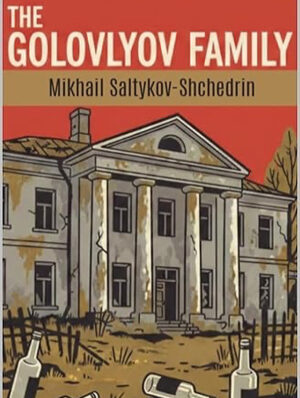
The Golovlyov Family by Mikhail Saltykov-Shchedrin
Page Count: 344Year: 1880READ FREEProducts search This is a mercilessly written chronicle of the disintegration and demise of a noble family. It stands as one of the most hopeless and bleak books, both within Saltykov-Shchedrin’s bibliography and in the history of Russian literature. It is a novel about degeneration, loneliness, and violence — primarily psychological. Later generations can read […]
€15.00 Login to Wishlist
First published in 1875, Russian Empire
“Otechestvennye Zapiski” magazine
This book is in the public domain
Reprint by Publishing House №10
Publication date July 24, 2025
Translation from Russian
358 Pages, Font 12 pt, Bookman Old Style
Electronic edition, File size 962 KB
Cover design, Translate by Yulia Basharova
Copyright© Yulia Basharova 2025. All rights reserved
Table of Contents
The Family Court
One day, the bailiff from a distant estate, Anton Vasiliev, having finished reporting to the mistress Arina Petrovna Golovlyova about his trip to Moscow to collect quit-rent from peasants living there by passport, and having already received her permission to go to the servants’ quarters, suddenly hesitated mysteriously, as if he had another matter to report, about which he was both deciding and not deciding to speak.
Arina Petrovna, who understood perfectly not only the slightest movements but also the secret thoughts of those close to her, immediately became uneasy.
“What else?” she asked, looking directly at the bailiff.
“Nothing, ma’am,” Anton Vasiliev tried to evade.
“Don’t lie! There’s more! I can see it in your eyes!”
Anton Vasiliev, however, did not dare to answer and continued to shift his weight from foot to foot.
“Tell me, what other matter do you have?” Arina Petrovna barked at him in a decisive voice. “Speak! Don’t wag your tail… you fickle bag!”
Arina Petrovna loved to give nicknames to the people who made up her administrative and household staff. She nicknamed Anton Vasiliev “fickle bag” not because he had ever actually been observed in betrayal, but because he was loose-tongued. The estate he managed centered around a significant trading village with many taverns. Anton Vasiliev enjoyed drinking tea in the tavern, boasting about his mistress’s omnipotence, and during this boasting, he would inadvertently let things slip. And since Arina Petrovna was constantly involved in various lawsuits, it often happened that the talkativeness of her trusted man exposed her mistress’s war stratagems before they could be put into action.
“There is, indeed…” Anton Vasiliev finally mumbled.
“What? What is it?” Arina Petrovna became agitated.
As a woman of authority, and moreover, strongly gifted with creativity, she instantly painted a picture of all possible contradictions and oppositions in her mind, and she so quickly assimilated this thought that she even turned pale and sprang from her armchair.
“Stepan Vladimorych sold the house in Moscow…” the bailiff reported, deliberately pausing.
“Well?”
“Sold, ma’am.”
“Why? How? Don’t equivocate! Tell me!”
“For debts… one must assume so! You know, they wouldn’t sell it for good reasons.”
“So, the police sold it? The court?”
“It seems so. They say the house went for eight thousand at auction.”
Arina Petrovna sank heavily into her armchair and stared out the window. For the first few moments, this news seemed to deprive her of consciousness. If she had been told that Stepan Vladimorych had killed someone, that the Golovlyov peasants had rebelled and refused to do corvée, or that serfdom had collapsed – even then she would not have been so utterly stunned. Her lips moved, her eyes stared into the distance, but saw nothing. She didn’t even notice that at that very moment, the girl Dunyashka had rushed past the window, covering something with her apron, and suddenly, seeing her mistress, spun around for a moment and quietly turned back (at another time, this act would have triggered a full investigation). Finally, however, she recovered and uttered:
“What a spectacle!”
After which, several more minutes of stormy silence followed.
“So you’re saying the police sold the house for eight thousand?” she re-asked.
“Precisely so.”
“That’s his parents’ blessing! Fine… scoundrel!”
Arina Petrovna felt that, given the news, she needed to make an immediate decision, but she couldn’t think of anything because her thoughts were tangled in completely opposite directions. On the one hand, she thought: “The police sold it! They didn’t sell it in an instant, did they! Surely there was an inventory, an appraisal, calls for bids? They sold it for eight thousand, whereas she, for that very house, two years ago, personally laid out twelve thousand, like a single kopeck! If only I had known, I could have acquired it myself for eight thousand at auction!” On the other hand, another thought came to mind: “The police sold it for eight thousand! That’s his parents’ blessing! Scoundrel! He squandered his parents’ blessing for eight thousand!”
“From whom did you hear this?” she finally asked, having definitively settled on the thought that the house was already sold and, consequently, the hope of acquiring it cheaply was lost to her forever.
“Ivan Mikhailov, the tavern keeper, told me.”
“And why didn’t he warn me in time?”
“He was cautious, it seems.”
“Cautious! I’ll show him ‘cautious’! Summon him from Moscow, and when he arrives – straight to the recruiting office and shave his forehead! ‘Cautious’!”
Although serfdom was on its way out, it still existed. Anton Vasiliev had often heard the most peculiar orders from his mistress, but her current decision was so unexpected that even he felt somewhat awkward. The nickname “fickle bag” involuntarily came to his mind. Ivan Mikhailov was a solid peasant, about whom it wouldn’t even occur to anyone that some misfortune could befall him. Moreover, he was his dear friend and kum – and suddenly, he was to be conscripted into the army, just because he, Anton Vasiliev, like a fickle bag, couldn’t keep his tongue in check!
“Forgive… Ivan Mikhailych!” he tried to intercede.
“Go… you enabler!” Arina Petrovna barked at him, but in such a voice that he didn’t even think of persisting in further defending Ivan Mikhailov.
But before continuing my narrative, I will ask the reader to become more closely acquainted with Arina Petrovna Golovlyova and her family situation.
Arina Petrovna is a woman of about sixty, but still vigorous and accustomed to living entirely as she pleases. She carries herself sternly; she unilaterally and unrestrainedly manages the extensive Golovlyov estate, lives secluded, calculatingly, almost sparingly, maintains no friendships with neighbors, is benevolent to local authorities, and demands such obedience from her children that with every action they ask themselves: what will mother say about this? In general, she has an independent, unyielding, and somewhat stubborn character, which, however, is significantly aided by the fact that in the entire Golovlyov family, there is no one from whom she could encounter opposition. Her husband is a frivolous and slightly drunken man (Arina Petrovna readily says of herself that she is “neither a widow nor a married woman”); her children partly serve in St. Petersburg, partly have taken after their father and, as “undesirables,” are not allowed to participate in any family affairs. Under these conditions, Arina Petrovna early on felt alone, so much so that, truthfully, she had even completely unlearned family life, although the word “family” never leaves her lips, and ostensibly, all her actions are exclusively guided by constant concerns for the arrangement of family matters.
The head of the family, Vladimir Mikhailych Golovlyov, had been known since his youth for his slovenly and mischievous character, and for Arina Petrovna, who had always been distinguished by her seriousness and practicality, he never presented anything appealing. He led an idle and lazy life, most often locking himself in his study, imitating the singing of starlings, roosters, and so on, and engaged in composing so-called “free verses.” In moments of frank outpouring, he boasted of being a friend of Barkov and that the latter had supposedly even blessed him on his deathbed. Arina Petrovna immediately disliked her husband’s poems, calling them filth and buffoonery, and since Vladimir Mikhailych had essentially married for the sole purpose of always having an audience for his poems at hand, it is understandable that disagreements were not long in coming. Gradually escalating and embittering, these disagreements ended, on the wife’s part, in complete and contemptuous indifference towards her jester-husband, and on the husband’s part, in sincere hatred for his wife — a hatred that, however, contained a significant measure of cowardice. The husband called his wife “witch” and “devil,” while the wife called her husband “windy mill” and “stringless balalaika.” In such a relationship, they lived together for over forty years, and it never occurred to either of them that such a life contained anything unnatural. With the passage of time, Vladimir Mikhailych’s mischief not only did not diminish but even acquired a more malicious character. Apart from his poetic exercises in the spirit of Barkov, he began to drink and eagerly ambushed maidservants in the corridor. At first, Arina Petrovna reacted to this new occupation of her husband with disgust and even agitation (in which, however, the habit of dominance played a greater role than direct jealousy), but then she waved her hand and only kept an eye on ensuring that the “pagan” girls did not bring the master Yerofeyich (a type of homemade liquor). From then on, having told herself once and for all that her husband was not her companion, she directed all her attention exclusively to one goal: expanding the Golovlyov estate, and indeed, during forty years of married life, she managed to tenfold her fortune. With astonishing patience and vigilance, she ambushed distant and nearby villages, secretly inquired about their owners’ relations with the guardianship council, and always appeared at auctions like a bolt from the blue. In the whirlwind of this fanatical pursuit of acquisition, Vladimir Mikhailych increasingly receded into the background and finally became completely feral. At the moment this story begins, he was already a decrepit old man who hardly left his bed, and if he occasionally left his bedroom, it was solely to stick his head through the half-open door of his wife’s room, shout “Devil!” and disappear again.
Arina Petrovna was only slightly happier with her children. She had too independent, so to speak, a solitary nature, to see anything in children other than an extra burden. She only breathed freely when she was alone with her accounts and household enterprises, when no one interfered with her business conversations with bailiffs, elders, housekeepers, etc. In her eyes, children were one of those fatalistic life circumstances against which she did not consider herself entitled to protest, but which nevertheless did not touch a single chord of her inner being, wholly devoted to the countless details of life management. There were four children: three sons and a daughter. She didn’t even like to talk about her eldest son and her daughter; she was more or less indifferent to her youngest son and only with the middle one, Porfisha, was it not so much that she loved him, but as if she feared him.
Stepan Vladimorych, the eldest son, who is primarily discussed in this narrative, was known in the family as Stepka the Blockhead and Stepka the Mischievous. He very early on became one of the “undesirables” and from childhood played the role in the house of either a pariah or a jester. Unfortunately, he was a gifted fellow, too eagerly and quickly absorbing the impressions that his environment produced. From his father, he inherited inexhaustible mischief, from his mother, the ability to quickly guess people’s weaknesses. Thanks to the first quality, he soon became his father’s favorite, which further intensified his mother’s dislike for him. Often, during Arina Petrovna’s absences on household matters, the father and adolescent son would retire to the study, adorned with Barkov’s portrait, read poems of a free content, and gossip, with the “witch,” i.e., Arina Petrovna, being particularly targeted. But the “witch” seemed to instinctively guess their activities; she would silently approach the porch, tiptoe to the study door, and eavesdrop on the cheerful conversations. This was followed by an immediate and severe beating of Stepka the Blockhead. But Stepka did not calm down; he was impervious to both beatings and admonitions and half an hour later would start carousing again. He would cut Anytka the maid’s headscarf into pieces, or let flies into sleepy Vasyutka’s mouth, or sneak into the kitchen and steal a pie there (Arina Petrovna, for economy, kept the children half-starved), which, however, he would immediately share with his brothers.
“I ought to kill you!” Arina Petrovna would constantly tell him. “I’ll kill you — and I won’t be held accountable! And the tsar won’t punish me for it!”
Such constant debasement, meeting a soft, easily forgetful soil, did not pass in vain. It resulted not in bitterness or protest, but in forming a slavish character, prone to buffoonery, lacking a sense of measure and devoid of any foresight. Such personalities readily succumb to any influence and can become anything: drunkards, beggars, jesters, and even criminals.
At twenty, Stepan Golovlyov completed his course at one of the Moscow gymnasiums and entered the university. But his student life was bitter. Firstly, his mother gave him just enough money to keep from starving; secondly, he showed not the slightest inclination for work, and instead harbored a cursed talent, expressed primarily in his ability to mimic; thirdly, he constantly suffered from a need for company and could not remain alone with himself for a minute. Therefore, he settled into the easy role of a hanger-on and pique-assiette (A French term meaning a sponger or moocher, someone who always manages to get invited to meals without contributing) and, thanks to his pliability to any trick, soon became a favorite of wealthy students. But the wealthy, while admitting him into their circle, still understood that he was not their equal, that he was merely a jester, and it was in this very sense that his reputation was established. Once having settled on this ground, he naturally gravitated lower and lower, so that by the end of his 4th year, he had completely played himself out. Nevertheless, thanks to his ability to quickly grasp and remember what he heard, he passed his exams successfully and received a candidate’s degree.
When he appeared before his mother with his diploma, Arina Petrovna merely shrugged her shoulders and muttered: “I’m amazed!” Then, after keeping him in the village for about a month, she sent him to St. Petersburg, assigning him one hundred rubles in assignats per month for living expenses. His wanderings through departments and chanceries began. He had no patronage, and no desire to make his way through personal labor. The idle mind of the young man had become so unaccustomed to focusing that even bureaucratic tasks, like memoranda and extracts from files, proved too much for him. Golovlyov struggled in St. Petersburg for four years and finally had to admit to himself that the hope of ever rising above a chancery clerk did not exist for him. In response to his laments, Arina Petrovna wrote a stern letter, beginning with the words: “I was confident of this beforehand,” and ending with an order to appear in Moscow. There, in a council of trusted peasants, it was decided to appoint Stepka the Blockhead to the court of appeals, entrusting him to the supervision of a clerk who had long handled Golovlyov’s affairs. What Stepan Vladimorych did and how he conducted himself in the court of appeals is unknown, but after three years, he was no longer there. Then Arina Petrovna decided on an extreme measure: she “threw her son a piece,” which, however, at the same time was also supposed to represent “parental blessing.” This “piece” consisted of a house in Moscow, for which Arina Petrovna had paid twelve thousand rubles.
For the first time in his life, Stepan Golovlyov breathed freely. The house promised to yield a thousand silver rubles in income, and compared to his previous situation, this sum seemed to him like something akin to genuine prosperity. He eagerly kissed his mother’s hand (“Just so, mind you, blockhead! Don’t expect anything more!” Arina Petrovna remarked) and promised to justify the kindness shown to him. But, alas! He was so unaccustomed to handling money, so absurdly he understood the scale of real life, that the fabled annual thousand rubles did not last long at all. In about four or five years, he was completely ruined and was quite happy to enlist, as a substitute, in the militia that was being formed at the time. The militia, however, only reached Kharkov before peace was concluded, and Golovlyov returned to Moscow. His house had already been sold by then. He was in a militia uniform, rather worn, though, with his boots untucked, and a hundred rubles in his pocket. With this capital, he tried his hand at speculation, meaning he began to play cards, and soon lost everything. Then he started visiting his mother’s well-off peasants who lived in Moscow, managing their own households; he would dine at one’s house, beg for a quarter-pound of tobacco from another, or borrow small sums from yet another. But finally, the moment came when he, so to speak, found himself face to face with a blank wall. He was almost forty, and he was forced to admit that further wandering existence was beyond his strength. Only one path remained – to Golovlyovo.
After Stepan Vladimorych, the eldest member of the Golovlyov family was his daughter, Anna Vladimirovna, about whom Arina Petrovna also did not like to speak.
The thing was, Arina Petrovna had plans for Annushka, but Annushka not only failed to live up to her hopes but instead caused a scandal throughout the entire district. When her daughter finished at the institute, Arina Petrovna settled her in the village, hoping to make her a free domestic secretary and accountant, but instead, Annushka, one fine night, fled from Golovlyovo with Cornet Ulanov and married him.
“Just like that, without parental blessing, like dogs, they got married!” Arina Petrovna lamented on this occasion. “And it’s a good thing he even led her around the lectern! Another would have taken advantage – and then disappeared! Try to find him afterwards!”
And Arina Petrovna dealt with her daughter just as decisively as she did with her undesirable son: she simply “threw her a piece.” She set aside a capital of five thousand for her and a small village of thirty souls with a dilapidated estate where all the windows were drafty and there wasn’t a single sturdy floorboard. After about two years, the young couple spent the capital, and the cornet disappeared to parts unknown, leaving Anna Vladimirovna with two twin daughters: Anninka and Lyubinka. Then Anna Vladimirovna herself passed away three months later, and Arina Petrovna, willy-nilly, had to take in the complete orphans. This she did, placing the little ones in the annex and assigning a crooked old woman, Palashka, to them.
“God’s mercies are many,” she would say, “the orphans won’t eat much bread, God knows, and for me in my old age – a comfort! God took one daughter – and gave me two!”
And at the same time, she wrote to her son Porfiry Vladimorych: “Just as your sister lived dissolutely, so she died, leaving her two puppies on my neck…”
Generally, however cynical this remark may seem, justice demands acknowledging that both these instances, regarding which the “throwing of pieces” occurred, not only did not cause financial damage to Arina Petrovna but even indirectly contributed to the rounding out of the Golovlyov estate by reducing the number of shareholders in it. For Arina Petrovna was a woman of strict rules, and once she had “thrown a piece,” she considered all her obligations regarding her undesirable children to be finished. Even at the thought of her orphan granddaughters, it never occurred to her that she would eventually have to give them anything. She only tried to squeeze as much as possible out of the small estate allotted to the late Anna Vladimirovna and deposit the extracted money with the guardianship council. She would say:
“Here, I’m accumulating money for the orphans, and as for what they cost in food and care – I don’t take anything from them! For my hospitality, God will surely repay me!”
Finally, the younger children, Porfiry and Pavel Vladimorych, were serving in Petersburg: the former in civil service, the latter in the military. Porfiry was married, Pavel was single.
Porfiry Vladimorych was known in the family by three names: Judushka (Judas), Bloodsucker, and Frank Boy, nicknames given to him in childhood by Stepka the Blockhead. From infancy, he loved to cuddle up to his dear friend Maman, secretly kiss her shoulder, and sometimes even subtly whisper tales. He would noiselessly open the door to Maman’s room, quietly creep into a corner, sit down, and, as if enchanted, never take his eyes off Maman while she wrote or busied herself with accounts. But even then, Arina Petrovna regarded these filial solicitations with a certain suspicion. Even then, that fixed gaze on her seemed enigmatic, and even then, she could not determine what exactly it exuded: poison or filial reverence.
“I myself can’t understand what kind of eyes he has,” she would sometimes ponder to herself. “He looks – well, it’s as if he’s throwing a noose. He just pours out poison, just lures you in!”
And she recalled significant details from the time when she was still “heavy” with Porfisha. There lived in their house then a certain pious and clairvoyant old man, whom they called Porfisha the Blessed, and to whom she always turned when she wished to foresee something in the future. And it was this very elder, when she asked him when her labor would follow and whom God would give her, a son or a daughter – he did not answer her directly, but crowed like a rooster three times and then mumbled:
“Little rooster, little rooster! Sharp little claw! The rooster crows, threatens the hen; the hen – cluck-cluck-cluck, but it will be too late!”
And that was all. But three days later (that’s it – he crowed three times!), she gave birth to a son (that’s it – little rooster, little rooster!), whom they named Porfiry, in honor of the clairvoyant elder…
The first half of the prophecy was fulfilled; but what could the mysterious words “the hen – cluck-cluck-cluck, but it will be too late” mean? – this is what Arina Petrovna pondered, looking at Porfisha from under her hand, while he sat in his corner and looked at her with his enigmatic gaze.
And Porfisha continued to sit meekly and silently and kept looking at her, looking so intently that his wide-open and motionless eyes welled up with tears. He seemed to foresee the doubts stirring in his mother’s soul and behaved with such calculation that even the most fastidious suspicion had to admit itself disarmed before his meekness. Even at the risk of annoying his mother, he constantly hovered in her sight, as if saying: “Look at me! I hide nothing! I am all obedience and devotion, and moreover, obedience not only out of fear but also out of conscience.” And no matter how strong her conviction that Porfishka the scoundrel was only fawning with his tail, and still throwing a noose with his eyes, yet in the face of such selfless devotion, even her heart could not withstand it. And involuntarily, her hand sought the best piece on the platter to give it to her affectionate son, despite the fact that the mere sight of this son aroused a vague unease in her heart, something mysterious, something ill-omened.
A complete opposite to Porfiry Vladimorych was his brother, Pavel Vladimorych. He was the perfect embodiment of a man devoid of any actions whatsoever. Even as a boy, he showed not the slightest inclination for learning, games, or sociability, but preferred to live aloof, alienated from people. He would often hide in a corner, pout, and start fantasizing. He would imagine that he had eaten too much oatmeal, that his legs had become thin because of it, and he wasn’t learning. Or – that he wasn’t Pavel, a nobleman’s son, but Davydka the shepherd, that a “bolona” (a large lump or swelling) had grown on his forehead, just like on Davydka, that he cracked a whip and wasn’t learning. Arina Petrovna would look at him and look at him, and her maternal heart would boil.
“Why are you pouting like a mouse over grain!” she couldn’t help but snap at him. “Or is the poison already working in you from now on! There’s no coming to mother: ‘Mama,’ he should say, ‘please caress me, my dear!'”
Pavlyusha would leave his corner and, with slow steps, as if pushed from behind, approach his mother.
“‘Mama,’ he would repeat in a bass voice unnatural for a child, ‘please caress me, my dear!'”
“Get out of my sight… you quiet one! You think if you hide in a corner, I won’t understand? I understand you completely, my dear! I see all your plans and schemes as clear as day!”
And Pavel, with the same slow steps, would go back and hide in his corner again.
Years passed, and Pavel Vladimorych gradually transformed into that apathetic and mysteriously gloomy person from whom, ultimately, emerges a person devoid of actions. Perhaps he was kind, but he did no one any good; perhaps he wasn’t foolish, but in his entire life, he never performed a single intelligent act. He was hospitable, but no one was attracted to his hospitality; he gladly spent money, but neither useful nor pleasant results ever came from these expenditures for anyone; he never offended anyone, but no one credited him for it; he was honest, but no one ever heard it said: how honestly Pavel Golovlyov acted in such and such a case! To top it all off, he often talked back to his mother and at the same time feared her like fire. I repeat: he was a gloomy man, but behind his gloom lay an absence of actions – and nothing more.
In adulthood, the difference in the characters of the two brothers was most sharply expressed in their relations with their mother. Judushka regularly sent his mama a lengthy letter every week, in which he extensively informed her of all the details of Petersburg life and assured her of his selfless filial devotion in the most refined expressions. Pavel wrote rarely and briefly, and sometimes even enigmatically, as if each word was being pulled from him with pliers. “Money, so much and for such a period, my invaluable friend Mama, I received from your trustee, the peasant Erofeev,” Porfiry Vladimorych would inform, for example, “and for sending it, for my upkeep, in accordance with your, dear Mama, kind permission, I express my deepest gratitude and with sincere filial devotion kiss your hands. I only grieve and am tormented by doubt about one thing: are you not overtaxing your precious health with continuous worries about satisfying not only our needs but also our whims?! I do not know about my brother, but I…” and so on. Pavel, on the same matter, expressed himself: “Money, so much for such a period, dearest parent, received, and, by my calculation, I am still due six and a half rubles, for which I respectfully ask your forgiveness.” When Arina Petrovna reprimanded her children for extravagance (this happened often, though there were no serious reasons), Porfisha always humbly submitted to these remarks and wrote: “I know, dear friend Mama, that you bear unbearable burdens for our sake, your unworthy children; I know that we very often do not justify your maternal care for us with our behavior, and, what is worst of all, due to human error, we even forget about this, for which I offer you my sincere filial apology, hoping in time to be rid of this vice and to be prudent in the use of the money you send, my invaluable friend Mama, for upkeep and other expenses.” And Pavel replied thus: “Dearest parent! Although you have not yet paid debts for me, I readily accept the reprimand of being called a spendthrift, for which I respectfully ask you to accept my assurances.” Even to Arina Petrovna’s letter, informing them of the death of their sister Anna Vladimirovna, both brothers responded differently. Porfiry Vladimorych wrote: “The news of the demise of my dear sister and good childhood friend Anna Vladimirovna struck my heart with sorrow, which sorrow was further intensified by the thought that a new cross is being sent to you, dear friend Mama, in the person of two orphan little ones. Is it not enough already that you, our common benefactress, deny yourself everything and, not sparing your health, direct all your strength to ensure your family not only what is necessary but also what is superfluous? Truly, though it is sinful, one sometimes cannot help but grumble. And the only refuge, in my opinion, for you, my dear, in this present case, is to recall as often as possible what Christ himself endured.” Pavel, however, wrote: “News of sister’s demise, who perished as a victim, received. However, I hope the Almighty will grant her peace in His chambers, though this is unknown.”
Arina Petrovna reread these letters from her sons, trying to guess which of them would be her villain. She would read Porfiry Vladimorych’s letter, and it seemed that he was the villain.
“Look how he writes! Look how he twists his tongue!” she would exclaim. “No wonder Stepka the Blockhead nicknamed him Judushka! Not a single true word! He lies about everything! Both ‘dear friend Mama,’ and about my burdens, and about my cross… he feels none of it!”
Then she would take Pavel Vladimorych’s letter, and again it seemed that he was her future villain.
“Foolish, foolish, but look how he secretly outsmarts his mother! ‘For which I respectfully ask you to accept my assurances…’ By all means! I’ll show you what it means to ‘respectfully accept assurances’! I’ll throw you a piece, like Stepka the Blockhead – then you’ll learn how I understand your ‘assurances’!”
And finally, a truly tragic cry burst from her maternal breast:
“And for whom am I hoarding all this immense wealth! For whom am I saving! I lose sleep at night, I eat less… for whom?!”
Such was the Golovlyovs’ family situation at the moment when the bailiff Anton Vasiliev reported to Arina Petrovna about Stepka the Blockhead squandering the “thrown piece” (an allocated inheritance/gift), which, given its cheap sale, now acquired a twofold significance as a “parental blessing.”
Arina Petrovna sat in her bedroom and couldn’t compose herself. Something was stirring within her that she couldn’t clearly account for. Was it pity, miraculously appeared, for her undesirable, but still son, or was it a naked feeling of insulted autocracy speaking – even the most experienced psychologist couldn’t determine this, so entangled and rapidly changing were all her feelings and sensations. Finally, from the general mass of accumulated impressions, the fear that the “undesirable” would again become a burden on her stood out more clearly than others.
“Anyutka (Anna’s diminutive) burdened me with her puppies, and now this blockhead…” she calculated mentally.
She sat for a long time in this manner, not uttering a word and staring fixedly out the window. Dinner was brought, which she barely touched; someone came to say: “Master requests vodka!” – she, without looking, tossed the storeroom key. After dinner, she went to the icon room, ordered all the lamps to be lit, and shut herself in, having first ordered the bathhouse to be heated. All these were signs that undoubtedly proved the mistress was “angry,” and so the house suddenly fell silent, as if dead. Maids walked on tiptoe; the housekeeper Akulina fussed like a madwoman: jam was scheduled to be cooked after dinner, and now it was time, the berries cleaned, ready, but there was no order or cancellation from the mistress; the gardener Matvei came with a question about whether it was time to pick the peaches, but he was hissed at so fiercely in the maids’ room that he immediately retreated.
After praying to God and washing in the bathhouse, Arina Petrovna felt somewhat pacified and again demanded an explanation from Anton Vasiliev.
“Well, and what is the blockhead doing?” she asked.
“Moscow is large – you can’t walk all of it in a year!”
“But surely he needs to eat and drink?”
“They feed off their peasants. They’ll have dinner at one’s house, beg a ten-kopeck piece for tobacco from another.”
“And who allowed them to give?”
“Have mercy, madam! Do the peasants really take offense! They give to poor strangers, but refuse their own masters!”
“I’ll show them… the givers! I’ll send the blockhead to your estate, and you’ll support him yourselves, the whole community, at your own expense!”
“All your power, madam.”
“What? What did you say?”
“All, I mean, your power, madam. If you order it, we’ll feed him!”
“That’s it… ‘we’ll feed him’! You talk, but don’t talk too much with me!”
Silence. But Anton Vasiliev didn’t get the nickname “fickle bag” (a person who is easily swayed or changes sides) from his mistress for nothing. He couldn’t resist and again began to shuffle his feet, burning with the desire to report something.
“And what a procurer!” he finally uttered. “They say when he returned from the campaign, he brought a hundred rubles with him. A hundred rubles isn’t a lot of money, but one could live on it for some time…”
“Well?”
“He thought he’d get rich, got into a scam…”
“Speak, don’t mince words!”
“He took it to a German club, they say. He thought he’d find a fool to cheat at cards, but instead, he himself ran into a smart one. He tried to run away, but they say they stopped him in the hallway. All the money he had – they took it all!”
“I suppose he got a beating too?”
“He got it all. The next day he comes to Ivan Mikhailych, and tells the story himself. And it’s even surprising: he laughs… cheerful! As if someone had patted him on the head!”
“Good for him! As long as he doesn’t show his face to me!”
“And one must assume that will be the case.”
“What are you saying! I won’t let him cross my threshold!”
“It can’t be otherwise!” Anton Vasiliev repeated. “And Ivan Mikhailych said he blurted out: ‘That’s it! I’ll go to the old woman’s place to eat dry bread!’ And for him, madam, to tell the truth, there’s nowhere else for him to go except here. He won’t stay long with his peasants in Moscow. Clothes are also needed, peace…”
This was precisely what Arina Petrovna feared; this was the essence of that vague notion that unconsciously disturbed her. “Yes, he will come, he has nowhere else to go – it’s inevitable! He will be here, eternally before her eyes, cursed, undesirable, forgotten! Why did she ‘throw him a piece’ (an allocated inheritance/gift) at that time? She thought that having received ‘what was due,’ he had vanished into eternity – but he is resurrected! He will come, he will demand, he will annoy everyone with his beggarly appearance. And his demands will have to be satisfied, because he is an impudent man, capable of any riot. You can’t lock ‘him’ up; ‘he’ is capable of appearing in rags even before strangers, capable of causing a ruckus, running to neighbors and telling them all the secrets of the Golovlyov affairs. Should she send him to Suzdal Monastery? – But who knows, is that Suzdal Monastery still around, and does it really exist to free distressed parents from the sight of stubborn children? They also say there’s a house of correction… but a house of correction – how would you take a forty-year-old stallion like him there?” In short, Arina Petrovna was completely lost at the mere thought of the misfortunes that threatened to disturb her peaceful existence with the arrival of Stepka the Blockhead.
“I’ll send him to your estate! Feed him at your own expense!” she threatened the bailiff. “Not at the estate’s expense, but at your own!”
“Why so, madam?”
“Because you caw. Caw! Caw! ‘It can’t be otherwise’… Get out of my sight… you crow!”
Anton Vasiliev turned around to the left, but Arina Petrovna stopped him again.
“Stop! Wait! Is it true then that he’s sharpening his skis (preparing to go) for Golovlyovo?” she asked.
“Would I lie, madam! He truly said: ‘I’ll go to the old woman to eat dry bread!'”
“I’ll show him what kind of bread the old woman has prepared for him!”
“But madam, he won’t live long with you!”
“What do you mean?”
“He coughs very badly… always clutching his left chest… He won’t last!”
“Such ones, my dear, live even longer! And he’ll outlive us all! He coughs and coughs – what’s wrong with him, the gangly stallion! Well, we’ll see about that. Go now: I need to make arrangements.”
All evening Arina Petrovna thought and finally decided: to convene a family council to decide the blockhead’s fate. Such constitutional inclinations were not in her character, but this time she decided to depart from the traditions of autocracy, so that by the decision of the whole family she could protect herself from the reproaches of good people. She had no doubt about the outcome of the upcoming meeting, however, and so she cheerfully set about writing letters, which ordered Porfiry and Pavel Vladimorych to immediately come to Golovlyovo.
While all this was happening, the culprit of the turmoil, Stepka the Blockhead, was already moving from Moscow towards Golovlyovo. He had boarded in Moscow, near Rogozyh, in one of the so-called “delezhan” (a type of common carriage or diligence), in which in former times, and still occasionally, small merchants and trading peasants traveled when returning to their homes for a visit. The “delezhan” was traveling towards Vladimir, and the same compassionate tavern keeper, Ivan Mikhailych, was transporting Stepan Vladimorych at his own expense, having bought a seat for him and paying for his food throughout the journey.
“So, Stepan Vladimorych, you do this: get off at the turn-off, and then walk, just as you are in your uniform – and present yourself to Mama!” Ivan Mikhailych agreed with him.
“Yes, yes, yes!” Stepan Vladimorych confirmed. “How far is it from the turn-off – fifteen versts (a Russian unit of distance, about 1.06 km) to walk! I’ll cover it in no time! In dust, in manure – that’s how I’ll appear!”
“Mama will see you in your uniform – maybe she’ll take pity!”
“Take pity, why wouldn’t she! Mother – she’s a kind old woman!”
Stepan Golovlyov is not yet forty years old, but outwardly he cannot be given less than fifty. Life had worn him down to such an extent that it left no trace of a nobleman’s son on him, not the slightest sign that he too had once been at university and that the educational word of science had also been addressed to him. He is an excessively tall, unkempt, almost unwashed fellow, thin from lack of nutrition, with a sunken chest, with long, grasping hands. His face is swollen, his hair and beard disheveled, with considerable graying, his voice loud but hoarse, suffering from a cold, his eyes bulging and inflamed, partly from excessive alcohol consumption, partly from constant exposure to the wind. He wears a dilapidated and completely worn-out gray militia uniform, from which the galloons (braids or stripes) have been torn off and sold for scrap; on his feet are worn-out, reddish-brown and patched boots worn over his trousers; from beneath his unbuttoned militia uniform, a shirt is visible, almost black, as if smeared with soot – a shirt that he, with true militia cynicism, himself calls a “flea-trap.” He looks from under his brows, grimly, but this gloom does not express inner discontent, but is the result of some vague anxiety that in another moment, he will die of hunger like a worm.
He talks incessantly, jumping disconnectedly from one subject to another; he talks even when Ivan Mikhailych listens to him, and even when the latter falls asleep to the music of his chatter. He is terribly uncomfortable sitting. Four people are crammed into the “delezhan” (a type of common carriage or diligence), so he has to sit with his legs bent, which after just three or four versts (a Russian unit of distance, about 1.06 km) causes unbearable pain in his knees. Nevertheless, despite the pain, he keeps talking. Clouds of dust burst into the side openings of the carriage; at times, oblique rays of sunlight creep in, suddenly, as if ablaze, scorching the entire interior of the “delezhan,” and he just keeps talking.
“Yes, brother, I’ve had my share of sorrow in my lifetime,” he recounts, “it’s time to call it a day! I won’t devour her, surely, but a piece of bread, I guess, can’t be found, eh? What do you think about that, Ivan Mikhailych?”
“Your mama has many pieces!”
“Only not for me – is that what you mean to say? Yes, my friend, she has a huge amount of money, but she grudges me a copper farthing! And that witch has always hated me! Why? Well, now, brother, you’re mistaken! I’m clean now, I’ll grab her by the throat! If she tries to kick me out – I won’t go! If she doesn’t give me food – I’ll take it myself! I, brother, have served the fatherland – now everyone is obliged to help me! I only fear one thing: she won’t give me tobacco – that’s vile!”
“Yes, you’ll probably have to say goodbye to tobacco!”
“Then I’ll grab the bailiff by the sides! Maybe the bald devil will give some to the master!”
“Give, why not give! But what if your mama forbids the bailiff too?”
“Well, then I’m utterly ruined; only one luxury remains from my former splendor – that’s tobacco! When I had money, brother, I used to smoke a quarter-pound of Zhukov a day!”
“You’ll have to say goodbye to vodka too!”
“That’s vile too. And vodka is even good for my health – it breaks up the phlegm. When we went on campaign to Sevastopol, brother – we hadn’t even reached Serpukhov yet, and it was already a bucket per man!”
“I suppose you sobered up?”
“I don’t remember. Something like that happened, I think. I, brother, went all the way to Kharkov, but strike me dead – I remember nothing. I only remember that we went through villages and cities, and also that in Tula, a tax-farmer gave us a speech. He shed tears, the scoundrel! Yes, our Mother Russia, the Orthodox, certainly had a hard time then! Tax-farmers, contractors, receivers – how did God save us!”
“But your mama made a profit even here. More than half of the militiamen from our estate didn’t return home, and for each of them, they say, a recruiting receipt (a document that could be sold to someone else who wished to avoid conscription) is now ordered to be issued. And that receipt costs over four hundred in the treasury.”
“Yes, brother, our mother is a clever woman! She should be a minister, not skimming cream from jam in Golovlyovo! You know what! She was unfair to me, she offended me – but I respect her! Smart as the devil, that’s what’s important! If it weren’t for her – what would we be now? We’d be left with just Golovlyovo – one hundred and one and a half souls! But she – look what a devilish fortune she has acquired!”
“Your brothers will be wealthy!”
“They will. I, however, will be left with nothing – that’s certain! Yes, brother, I’m ruined! But my brothers will be rich, especially the Bloodsucker (Porfiry’s nickname). He’ll worm his way into one’s soul without soap. But then again, he’ll eventually finish her off, the old witch; he’ll suck both the estate and the capital out of her – I’m a clairvoyant in these matters! But Pavel, my brother – he’s a soul of a man! He’ll secretly send me tobacco – you’ll see! As soon as I arrive in Golovlyovo – I’ll send him a note right away: ‘So and so, dear brother, – comfort me!’ Oh, dear me! If only I were rich!”
“What would you do then?”
“First, I’d make you rich right away…”
“Me? Why me! Think of yourself, I’m content as it is, thanks to your mama.”
“No, no – that, brother, is out of the question (meaning ‘that’s understood as a given’)! I’d make you commander-in-chief over all my estates! Yes, my friend, you fed and warmed a serviceman – thank you! If it weren’t for you, I’d be trudging on foot to my ancestors’ home right now! And I’d give you your freedom (a document granting freedom from serfdom) right into your teeth, and I’d open all my treasures before you – drink, eat, and be merry! And what did you think of me, my friend?”
“No, sir, please leave me out of it. What else would you do if you were rich?”
“Secondly, I’d immediately get myself a ‘shtuchka’ (a colloquial term for a woman, often implying a light-hearted or casual relationship). In Kursk, I went to the Lady Superior to attend a prayer service, and I saw one… ah, what a ‘shtuchka’! Believe me, there wasn’t a single moment when she stood still!”
“But perhaps she wouldn’t have become a ‘shtuchka’?”
“And what are money for! What is vile metal for? If a hundred thousand isn’t enough – take two hundred! I, brother, if I have money, I won’t spare anything, just to live to my heart’s content! To be honest, I even offered her three tselkovykh (old Russian coins, roughly a ruble) through a corporal at that time – she demanded five, the beast!”
“And five, it seems, didn’t happen?”
“I don’t know, brother, what to say. I tell you: it all seemed like a dream. Maybe she even came to me, but I forgot. The whole journey, two whole months – I remember nothing! And with you, it seems, this hasn’t happened?”
But Ivan Mikhailych is silent. Stepan Vladimorych peers closer and ascertains that his companion is nodding his head rhythmically and, at times, when his nose nearly touches his knees, he somehow awkwardly jolts and begins nodding in rhythm again.
“Oh, dear me!” he says, “You’re all rocked to sleep! You’re asking for bed! You’ve grown fat, brother, on tavern teas and meals! But I have no sleep! I have no sleep – and that’s that! What could I undertake now, though, what kind of trick! Perhaps from this fruit of the vine…”
Golovlyov glances around and ascertains that the other passengers are also asleep. The merchant sitting next to him is banging his head against the crossbar, but he’s still asleep. And his face has become glossy, as if covered in varnish, and flies have swarmed all around his mouth.
“What if I sent all these flies into his mouth – then, I bet, heaven would seem no bigger than a sheepskin!” a happy thought suddenly strikes Golovlyov, and he already begins to creep his hand towards the merchant to put his plan into action, but halfway through he remembers something and stops.
“No, enough mischief – enough! Sleep, friends, and rest! And I, for now… and where did he put that half-pint bottle? Aha! Here it is, my dear! Come on, come on in here! Save us, O Lord, your people!” he sings under his breath, taking a vessel from a canvas bag attached to the side of the kibitka (a type of covered wagon), and putting the neck to his mouth. “Well, now, that’s good! It’s warm now! Or more? No, that’s enough… it’s still twenty versts to the station, I’ll have time to get tipsy… or more? Oh, damn this vodka! You see a half-pint – and it just tempts you! It’s bad to drink, but you can’t not drink – because there’s no sleep! If only sleep, damn it, would overcome me!”
After gurgling a few more sips from the bottle, he puts the half-pint back in its place and begins to pack his pipe.
“Excellent!” he says. “First we drank, and now we’ll smoke our pipes! She won’t give me tobacco, the witch, she won’t – he was right about that. Will she even give me food? Leftovers, I suppose, she’ll send from the table! Oh, dear me! We had money once – and now it’s gone! There was a man – and now he’s gone! That’s how everything is in this world! Today you’re fed and drunk, living for your pleasure, smoking your pipe…”
And tomorrow – where are you, man?
However, I should eat something. You drink and drink, like a leaky barrel, but you don’t properly eat. And doctors say that drinking is beneficial only when there is also a “blagopotrebnaia” (appropriate or suitable) snack, as the Most Reverend Smaragd used to say when we passed through Oboyan. Through Oboyan? The devil knows, maybe through Kromy! That’s not the point, though, but how to get a snack now. I remember he put sausage and three French loaves in a small bag! He probably grudged buying caviar! Look how he sleeps, what songs he snores with his nose! He probably hogged all the provisions too!
He fumbles around himself and finds nothing.
“Ivan Mikhailych! Hey, Ivan Mikhailych!” he calls out.
Ivan Mikhailych wakes up and for a minute seems not to understand how he found himself “vis-à-vis” (face-to-face) with the master.
“I was just beginning to drift off to sleep!” he finally says.
“It’s nothing, friend, sleep! I just wanted to ask where our bag of provisions is hidden?”
“Hungry? But first, I suppose, you need a drink!”
“That’s true! Where’s your half-pint bottle?”
Having drunk, Stepan Vladimorych sets about the sausage, which turns out to be as hard as stone, as salty as salt itself, and encased in such a durable casing that one has to resort to the sharp end of a knife to pierce it.
“Some whitefish would be good now,” he says.
“Forgive me, sir, it completely slipped my mind. I remembered it all morning, even told my wife: be sure to remind me about the whitefish – and now, as if a sin occurred!”
“It’s nothing, we’ll eat sausage too. We marched on campaign – we ate worse. Father used to tell a story: an Englishman bet another Englishman that he would eat a dead cat – and he ate it!”
“Shh… ate it?”
“Ate it. Only it made him sick afterwards! He cured himself with rum. Drank two bottles in one gulp – and it was gone just like that. And then another Englishman bet that he would live for a whole year on sugar alone.”
“Did he win?”
“No, he didn’t live two days to complete the year – he died!” “But why don’t you yourself! Have a shot of vodka?”
“Never in my life.”
“You just fill yourself with tea? Not good, brother; that’s why your belly is growing. One must be careful with tea too: drink a cup, and then cover it with a shot glass. Tea accumulates dampness, and vodka breaks it up. Is that right?”
“I don’t know; you are learned people, you know better.”
“Exactly. When we went on campaign – we didn’t have time to bother with teas and coffees. But vodka – that’s a sacred thing: unscrew the canteen, pour, drink – and that’s it. They drove us so fast then, so fast that I hadn’t washed for ten days!”
“You, sir, have endured many hardships!”
“Many or not many, but try walking the main road! Well, but going forward was still something: they would offer sacrifices, feed us dinners, plenty of wine. But when going back – they stopped honoring us!”
Golovlyov chews the sausage with effort and finally swallows one piece.
“It’s salty, brother, this sausage!” he says. “However, I’m not picky! Mama won’t feast me on delicacies either: a plate of shchi (cabbage soup) and a cup of porridge – that’s all!”
“God is merciful! Perhaps she’ll even give you a pie on a holiday!”
“Neither tea, nor tobacco, nor vodka – you said that correctly. They say she’s grown fond of playing fools (a card game) now – maybe that? Well, she’ll invite me to play and treat me to tea. But as for the rest – forget it, brother!”
They stopped at the station for about four hours to feed the horses. Golovlyov had managed to finish the half-pint bottle, and he felt intensely hungry. The passengers went into the hut and settled down for dinner. After wandering around the yard, looking into the backyards and at the horses in the manger, startling pigeons, and even trying to fall asleep, Stepan Vladimorych finally convinces himself that the best thing for him is to follow the other passengers into the hut. There, on the table, shchi (cabbage soup) is steaming, and to the side, on a wooden tray, lies a large piece of beef, which Ivan Mikhailych is chopping into small pieces. Golovlyov sits a little apart, lights his pipe, and for a long time doesn’t know how to proceed with his hunger.
“Bread and salt, gentlemen!” he finally says. “The shchi, it seems, is fatty?”
“The shchi is fine!” Ivan Mikhailych responds. “You, sir, should ask for some yourself!”
“No, I just said it in passing, I’m full!”
“Full of what! You ate a piece of sausage, and that damned thing makes your stomach ache even more. Have some! I’ll tell them to set a small table for you on the side – eat to your health! Landlady! Set a table for the master on the side – like that!”
The passengers silently begin to eat and only exchange enigmatic glances. Golovlyov guesses that he has been “seen through,” although he, not without impudence, had played the part of a master the whole way and called Ivan Mikhailych his treasurer. His brows are furrowed, and tobacco smoke billows from his mouth. He is ready to refuse food, but the demands of hunger are so insistent that he somewhat ravenously attacks the cup of shchi placed before him and instantly empties it. Along with satiety, his self-confidence returns, and he, as if nothing had happened, says, turning to Ivan Mikhailych:
“Well, brother treasurer, you pay for me, and I’ll go to the hayloft to talk to Khrapovitsky!”
Waddling, he sets off to the hayloft, and this time, since his stomach is burdened, he falls into a heroic sleep. At five o’clock, he’s already on his feet again. Seeing the horses standing at empty mangers and scratching their muzzles against the edges, he begins to wake the coachman.
“He’s snoring, the scoundrel!” he shouts. “We’re in a hurry, and he’s having pleasant dreams!”
So it goes until the station from which the road turns towards Golovlyovo. Only here does Stepan Vladimorych become somewhat more subdued. He visibly loses heart and becomes silent. This time, Ivan Mikhailych encourages him and, above all, persuades him to throw away his pipe.
“When you approach the estate, sir, throw your pipe into the nettles! You’ll find it later!”
Finally, the horses that are to take Ivan Mikhailych further are ready. The moment of parting arrives.
“Farewell, brother!” Golovlyov says with a trembling voice, kissing Ivan Mikhailych. “She’ll devour me!”
“God is merciful! You also don’t be too scared!”
“She’ll devour me!” Stepan Vladimorych repeats in such a convinced tone that Ivan Mikhailych involuntarily lowers his eyes.
Having said this, Golovlyov sharply turns towards the country road and begins to walk, leaning on a gnarled stick that he had cut from a tree earlier.
Ivan Mikhailych watches him for a while and then rushes after him.
“Here’s something, master!” he says, catching up to him, “Earlier, when I was cleaning your militia uniform, I saw three tselkovykh (old Russian coins, roughly a ruble) in the side pocket – don’t accidentally drop them!”
Stepan Vladimorych visibly hesitates and doesn’t know how to act in this case. Finally, he extends his hand to Ivan Mikhailych and says through tears:
“I understand… for the serviceman’s tobacco… thank you! And as for that… she’ll devour me, dear friend! Mark my words – she will!”
Golovlyov finally turned towards the country road, and within five minutes, his gray militia cap was already a distant speck, now disappearing, now suddenly emerging from behind the dense forest growth. It was still early, just past six o’clock; a golden morning mist curled over the country road, barely allowing the rays of the just-appeared sun to pass through; the grass glistened; the air was saturated with the smells of fir, mushrooms, and berries; the road zigzagged across a lowland teeming with countless flocks of birds. But Stepan Vladimorych noticed nothing: all his light-heartedness had suddenly abandoned him, and he walked as if to the Last Judgment. One thought filled his entire being to the brim: three or four more hours – and there would be nowhere else to go. He recalled his old life in Golovlyovo, and it seemed to him that the doors of a damp cellar were opening before him, that as soon as he crossed the threshold of those doors, they would immediately slam shut – and then it would all be over. Other details came to mind, though not directly concerning him, but undoubtedly characterizing the Golovlyov ways. There was Uncle Mikhail Petrovich (colloquially “Mishka the Rowdy”), who also belonged to the “undesirables” (people who were disfavored or cast out) and whom Grandfather Pyotr Ivanych had confined to his daughter’s house in Golovlyovo, where he lived in the servants’ quarters and ate from the same bowl as the dog Trezorka. There was Aunt Vera Mikhailovna, who lived on charity at the Golovlyov estate with her brother Vladimir Mikhailych and who died “of moderation,” because Arina Petrovna reproached her for every piece of food eaten at dinner and every log of wood used to heat her room. Approximately the same awaited him. In his imagination, an endless series of bleak days, drowning in some gaping gray abyss, flickered – and he involuntarily closed his eyes. From now on, he would be alone with the wicked old woman, and not even wicked, but merely rigid in her apathetic dominance. This old woman would devour him, devour him not with torment, but with oblivion. No one to say a word to, nowhere to run – everywhere she was, powerful, paralyzing, despising. The thought of this inevitable future filled him with such anguish that he stopped near a tree and for some time beat his head against it. His entire life, full of antics, idleness, buffoonery, suddenly seemed to be illuminated before his mind’s eye. He was now going to Golovlyovo, he knew what awaited him there, and yet he was going, and could not but go. He had no other path. Even the lowest of men could do something for themselves, could earn their bread – he alone could do nothing. This thought seemed to awaken in him for the first time. He had thought about the future before and had imagined all sorts of prospects, but these had always been prospects of free abundance and never – prospects of labor. And now he faced the reckoning for the drunken haze in which his past had irrevocably drowned. A bitter reckoning, expressed in one terrible word: she’ll devour me!
It was about ten in the morning when the white Golovlyov bell tower appeared from behind the forest.
Stepan Vladimorych’s face turned pale, his hands trembled: he took off his cap and crossed himself. The biblical parable of the prodigal son returning home came to mind, but he immediately understood that, in his case, such memories were merely a delusion. Finally, he found the boundary post placed near the road with his eyes and found himself on Golovlyov land, on that undesirable (hated or unwelcome) land that had given birth to him as undesirable, nurtured him as undesirable, sent him out as undesirable in all four directions, and now, still undesirable, received him back into its bosom. The sun was already high and mercilessly scorching the endless Golovlyov fields. But he grew paler and paler and felt chills.
Finally, he reached the churchyard (cemetery), and there his vigor completely abandoned him. The manor house looked so peaceful from behind the trees, as if nothing unusual was happening within it; but its sight had the effect of a Medusa’s head on him. He fancied a coffin there. Coffin! Coffin! Coffin! – he unconsciously repeated to himself. And he dared not go straight to the manor, but went first to the priest and sent him to announce his arrival and to find out if his mama would receive him.
The priest’s wife, at the sight of him, became sorrowful and fussed about making scrambled eggs; the village boys crowded around him and looked at the master with astonished eyes; the peasants, passing by, silently took off their hats and glanced at him somewhat enigmatically; some old house serf even ran up and asked to kiss the master’s hand. Everyone understood that before them was an undesirable (outcast) who had come to an undesirable (unwelcome) place, had come forever, and there was no way out for him from here except feet first to the churchyard. And everyone felt both pity and dread at the same time.
Finally, the priest came and said that “mama was ready to receive” Stepan Vladimorych. Ten minutes later, he was there. Arina Petrovna met him with solemn strictness and measured him from head to toe with an icy gaze; but she allowed herself no useless reproaches. And she did not admit him into the rooms, but met and parted with him on the maids’ porch, ordering him to be led through another porch to his father. The old man was dozing in a bed covered with a white blanket, wearing a white cap, all white, like a corpse. Seeing him, he woke up and laughed idiotically.
“What, my dear fellow! Caught by the witch!” he shouted, while Stepan Vladimorych kissed his hand. Then he crowed like a rooster, laughed again, and repeated several times in a row: “She’ll devour him! She’ll devour him! She’ll devour him!”
“She’ll devour him!” – like an echo, it resonated in his soul.
His premonitions were justified. He was placed in a separate room of the annex where the office was also located. They brought him linen made of homemade canvas and his father’s old robe, which he immediately donned. The doors of the crypt (metaphorical, referring to his room) opened, let him in, and – slammed shut.
A series of sluggish, ugly days stretched out, one after another drowning in the gray, gaping abyss of time. Arina Petrovna did not receive him; he was also not allowed to see his father. Three days later, the bailiff Finogey Ipatych announced his “situation” from mama, which consisted of him receiving board and clothing and, in addition, a pound of Faleur (a brand of tobacco) per month. He listened to his mama’s will and only remarked:
“Look at that old woman! She sniffed out that Zhukov costs two rubles and Faleur costs one ruble ninety – and she still skimmed off ten kopecks in assignats (paper currency) per month! Surely, she intended to give to the poor at my expense!”
The signs of moral sobering that had appeared in the hours he was approaching Golovlyovo along the country road had again disappeared somewhere. Light-heartedness again took its rights, and with it followed reconciliation with “mama’s situation.” The future, hopeless and inescapable, which had once gleamed in his mind and filled him with trembling, became more and more shrouded in fog with each passing day and, finally, ceased to exist entirely. The immediate day, with its cynical nakedness, came to the fore, and it did so intrusively and insolently that it completely filled all thoughts, his entire being. And what role can the thought of the future play when the entire course of life, irrevocably and in the smallest details, has already been decided in Arina Petrovna’s mind?
For days on end, he paced back and forth in his allotted room, not letting the pipe out of his mouth and humming various snatches of songs, with church melodies unexpectedly giving way to rollicking ones, and vice versa. When the zemsky (local administrative official) was present in the office, he would go to him and calculate the income received by Arina Petrovna.
“And what does she do with such a huge amount of money!” he wondered, counting up to a figure of over eighty thousand in assignats (paper currency). “I know she doesn’t send much to my brothers, she lives stingily herself, feeds father salted strips of meat… To the pawnshop! Nowhere else but the pawnshop, she puts it there.”
Sometimes Finogey Ipatych himself would come to the office with the quitrents (rent paid by a tenant or vassal), and then the money, which made Stepan Vladimorych’s eyes light up, would be laid out in stacks on the office table.
“Look what a vast amount of money!” he would exclaim. “And it all goes into her maw! Not a single packet for her son! ‘Here, my son, who is in sorrow! Here’s some wine and tobacco for you!'”
And then began endless, cynical conversations with Yakov the zemstvo (local administrative official) about what means could be used to soften his mother’s heart so much that she would adore him.
“I had an acquaintance, a townsman, in Moscow,” Golovlyov recounted, “he knew ‘the word’ (a magical incantation or spell)… Whenever his mother wouldn’t give him money, he would say this ‘word’… And immediately it would start convulsing her whole body, arms, legs – everything!”
“So, he was casting some kind of spell or curse!” Yakov the zemstvo guessed.
“Well, interpret it as you wish, but it’s the absolute truth that such a ‘word’ exists. And then another man said: take a live frog and place it in an anthill at deep midnight; by morning, the ants will have eaten it all, and only one bone will remain; take this bone, and as long as you have it in your pocket – ask any woman for anything you want, and you will not be refused anything.”
“Well, that can be done right now!”
“That’s the point, brother, that first you have to put a curse upon yourself! If it weren’t for that… then that witch would dance around me like a petty demon.”
Hours were spent in such conversations, but no means were found. Everything either required putting a curse on oneself or selling one’s soul to the devil. As a result, nothing else remained but to live on “mama’s allowance,” supplementing it with some arbitrary levies on the rural chiefs, whom Stepan Vladimorych had universally taxed for his benefit in the form of tobacco, tea, and sugar. He was fed extremely poorly. Usually, he was brought the leftovers of mama’s dinner, and since Arina Petrovna was moderate to the point of stinginess, it was natural that little was left for him. This was especially tormenting for him, because ever since wine became forbidden fruit for him, his appetite had rapidly increased. From morning till evening he starved and thought only of how to get enough to eat. He would watch the hours when mama rested, run to the kitchen, even look into the servants’ quarters, and forage for something everywhere. At times he would sit by the open window and wait to see if anyone would pass by. If one of his peasants rode by, he would stop him and levy a tribute: an egg, a vatrushka (a type of sweet pastry), etc.
Even at their first meeting, Arina Petrovna had briefly explained to him the full program of his future life.
“For now – live!” she said. “Here’s a corner for you in the office, you’ll eat and drink from my table, and as for the rest – don’t be offended, my dear! I’ve never had delicacies from birth, and I certainly won’t start for you. Your brothers will arrive soon: whatever arrangement they advise among themselves for you – that’s how I will deal with you. I don’t want to take sin upon my soul myself; as my brothers decide – so be it!”
And so now he impatiently awaited his brothers’ arrival. But he didn’t think at all about what influence this arrival would have on his future fate (apparently, he decided there was no point in thinking about it), but only wondered if his brother Pavel would bring him tobacco and how much.
“And maybe he’ll even shell out some money!” he mentally added. “Porfishka the bloodsucker – he won’t give, but Pavel… I’ll tell him: ‘Give, brother, to a serviceman for wine… he’ll give! Why wouldn’t he!'”
Time passed, and he didn’t notice it. It was absolute idleness, which, however, he was hardly burdened by. Only in the evenings was it boring, because the zemstvo would leave for home around eight, and Arina Petrovna didn’t allow him candles, on the grounds that one could walk back and forth in the room even without candles. But he quickly got used to this too and even came to love the darkness, because in the darkness his imagination played out more vividly and carried him far away from the hateful Golovlyovo. Only one thing troubled him: his heart was uneasy and fluttered strangely in his chest, especially when he lay down to sleep. Sometimes he would jump out of bed, as if stunned, and run around the room, holding his hand to the left side of his chest.
“Oh, if only I could kick the bucket!” he thought to himself. “No, I won’t kick the bucket! But maybe…”
But when one morning the zemstvo mysteriously informed him that his brothers had arrived during the night – he involuntarily shuddered and his face changed. Something childish suddenly awakened in him; he wanted to run to the house quickly, to see how they were dressed, what beds were made for them, and if they had the same kind of travel necessaries as he had seen with a militia captain; he wanted to listen to how they would talk to mama, to peek at what they would be served for dinner. In short, he wanted to once again partake in that life that so stubbornly rejected him, to throw himself at his mother’s feet, beg her forgiveness, and then, in joy, perhaps even eat the fatted calf. It was still quiet in the house, but he had already run to the cook in the kitchen and learned what was ordered for dinner: for the hot course, fresh cabbage shchi (cabbage soup), a small pot, and yesterday’s soup to be reheated; for the cold course – salted полоток (a type of cured meat) and two pairs of small cutlets on the side; for the roast – mutton and four snipes on the side; for dessert – raspberry pie with cream.
“Yesterday’s soup, the полоток (cured meat), and the mutton – that, brother, is for the undesirable (outcast)!” he told the cook. “I suppose they won’t give me pie either!”
“That will be as mama pleases, sir.”
“Oh, dear me! And there was a time when I used to eat woodcocks! Yes, brother! Once I even bet Lieutenant Gremykin that I would eat fifteen woodcocks in a row – and I won! Only after that, I couldn’t look at them without disgust for a whole month!”
“And now you’d eat them again?”
“She won’t give them! And what is there to grudge, it seems! A woodcock is a free bird: you don’t feed it, you don’t look after it – it lives at its own expense! And the woodcock is not bought, and the ram is not bought – but just look at that! The witch knows that woodcock is tastier than mutton – so she won’t give it! She’ll let it rot, but she won’t give it! And what’s ordered for breakfast?”
“Liver is ordered, mushrooms in sour cream, suchni (a type of pastry or cake, possibly ‘sochen’ – a cheese pastry in this context)…”
“You could at least send me some sochek (diminutive of ‘sochen’)… try, brother!”
“I must try. But you, sir, do this. Later, when the brothers sit down for breakfast, send the zemstvo here: he will bring you a couple of sochek (pastries) under his shirt.”
Stepan Vladimorych waited all morning, but his brothers did not come. Finally, around eleven o’clock, the zemstvo brought the two promised suchni (pastries) and reported that the brothers had just finished breakfast and had locked themselves in the bedroom with mama.
Arina Petrovna met her sons solemnly, bowed down by grief. Two maids supported her by the arms; gray hairs had escaped in strands from under her white cap, her head was bowed and swayed from side to side, her feet barely dragged. In general, she liked to play the role of a respectable and sorrowful mother in the eyes of her children, and in such cases, she painstakingly dragged her feet and demanded to be supported by the maids. Stepka the Blockhead called such solemn receptions an “episcopal service,” his mother an “archbishopess,” and the maids Polka and Yulka the “archbishopess’s staff-bearers.” But since it was already two in the morning, the meeting took place without words. Silently she offered her hand to her children for kissing, silently kissed and crossed them, and when Porfiry Vladimorych expressed his readiness to chat with his dear friend mama for the rest of the night, she waved her hand, saying:
“Go! Rest from your journey! No time for talking now, we’ll talk tomorrow.”
The next day, in the morning, both sons went to kiss their father’s hand, but their father didn’t give his hand. He lay in bed with his eyes closed and, when his children entered, cried out:
“Have you come to judge the tax collector?… Get out, Pharisees… get out!”
Nevertheless, Porfiry Vladimorych emerged from his father’s study agitated and tearful, while Pavel Vladimorych, like a “truly unfeeling idol,” merely picked his nose.
“He’s not well, your father, dear friend Mama! Oh, he’s so unwell!” exclaimed Porfiry Vladimorych, throwing himself onto his mother’s chest.
“Is he very weak today?”
“So weak! So weak! He won’t last with you!”
“Well, he’ll creak on a bit longer!”
“No, my dear, no! And although your life has never been especially joyful, when one thinks of so many blows at once… truly, one even wonders how you have the strength to bear these trials!”
“What can I do, my friend, you bear it if it pleases the Lord God! You know what is said in the Scripture: bear one another’s burdens – so He chose me, my dear, to bear the burdens of my family!”
Arina Petrovna even squeezed her eyes shut: it seemed so good to her that everyone lived on everything ready-made, everyone had everything prepared, and she alone toiled all day and bore everyone’s burdens.
“Yes, my friend!” she said after a minute of silence. “It’s quite hard for me in my old age! I’ve saved for my children – it’s time to rest! No joke – four thousand souls! To manage such a behemoth at my age! Look after everyone! Keep track of everyone! And walk, and run! Even these bailiffs and managers of ours: don’t look at how he looks you in the eye! With one eye he’s on you, and with the other – he’s trying to get into the forest! This is the people… faithless! Well, what about you?” she suddenly interrupted, turning to Pavel. “Picking your nose?”
“What about me!” Pavel Vladimorych snapped back, disturbed in the middle of his activity.
“What do you mean ‘what’! He’s still your father – you could feel some pity!”
“What about it – father! Father as father… as always! He’s been like this for ten years! You always oppress me!”
“Why would I oppress you, my friend, I am your mother! Look at Porfisha: he was affectionate and felt pity – he did everything a good son should, but you don’t even want to look at your mother properly, always from under your brow and from the side, as if she’s not your mother, but your enemy! Don’t bite, please!”
“But what am I…”
“Wait! Be quiet for a minute! Let your mother speak! Do you remember what is said in the commandment: ‘Honor your father and your mother – and it will be well with you…’ so, you don’t want ‘well-being’ for yourself?”
Pavel Vladimorych was silent and looked at his mother with bewildered eyes.
“You see, you’re silent,” Arina Petrovna continued, “so you yourself feel that you have fleas. Well, God be with you! For a joyful reunion, let’s leave this conversation. God, my friend, sees everything, and I… oh, how long I have seen through you! Oh, children, children! Remember your mother when she lies in her grave, remember – but it will be too late then!”
“Mama!” Porfiry Vladimorych interjected. “Leave these dark thoughts! Leave them!”
“Everyone will have to die, my friend!” Arina Petrovna said sententiously. “These are not dark thoughts, but, one might say… divine! I am wasting away, children, oh, how I am wasting away! Nothing of my former self remains – only weakness and infirmity! Even the nasty maids have noticed it – and they don’t give a fig for me! I say one word – they say two! I say one word – they say ten! I have only one threat against them, that I’ll complain to the young masters, so to speak! Well, sometimes they quiet down!”
Tea was served, then breakfast, during which Arina Petrovna complained and felt sorry for herself. After breakfast, she invited her sons to her bedroom.
When the door was locked, Arina Petrovna immediately got down to business, the reason for which the family council had been convened.
“The blockhead showed up, after all!” she began.
“We heard, mama, we heard!” Porfiry Vladimorych responded, either with irony or with the benevolent air of a man who had just eaten well.
“He came, as if he had done something, as if it were only natural: no matter how much I carouse or cause trouble, my old mother will always have a piece of bread for me! How much hatred I’ve seen from him in my life! How much torment I’ve endured from his buffoonery and tricks alone! What efforts I made then to force him into service! – and it was all like water off a duck’s back! Finally, I struggled and struggled, thinking: Lord! If he himself doesn’t want to care for himself – am I really obliged to waste my life because of him, the gangly blockhead! Let me, I think, throw him a piece (an allocated inheritance/gift), perhaps he’ll get his own penny in hand – it’ll be more gradual! And I threw it. I even found a house for him myself, with my own hands, like a single kopeck, I laid out twelve thousand silver rubles! And what happened! Not even three years passed after that – and he’s hanging around my neck again! How long must I endure these indignities?”
Porfisha cast his eyes at the ceiling and shook his head sadly, as if to say: “Ah-ah-ah! Affairs! Affairs! And to bother dear friend mama so! If everyone would just sit quietly, peacefully and harmoniously – none of this would happen, and mama wouldn’t be angry… ah-ah-ah, affairs, affairs!” But Arina Petrovna, as a woman who could not tolerate the interruption of her thoughts by anything, disliked Porfisha’s movement.
“No, you wait with that head-shaking,” she said. “First, listen! How was I to learn that he had thrown the parental blessing, like a gnawed bone, into the garbage pit? How was I to feel that I, with your permission, didn’t get enough sleep at night, didn’t eat enough, and he – take that! It’s as if he took, bought a trinket at the market – didn’t need it, and threw it out the window! That’s the parental blessing!”
“Ah, mama! That’s such an act! Such an act!” Porfiry Vladimorych began, but Arina Petrovna stopped him again.
“Stop! Wait! When I order it, then you’ll give your opinion! And if only he, the scoundrel, had warned me! ‘Forgive me, mama,’ he should have said, ‘I couldn’t control myself!’ If I had known in time, I myself could have acquired the house for next to nothing! An unworthy son couldn’t benefit – let worthy children benefit! For he, playfully, the house – it would bring fifteen percent interest a year! Maybe I would have even thrown him another thousand rubles for his poverty! But no – there you have it! I sit here, neither sleeping nor doing anything, and he has already disposed of it! I laid out twelve thousand with my own hands for the house, and he sold it at auction for eight thousand!”
“And most importantly, mama, that he treated the parental blessing so low!” Porfiry Vladimorych hastened to add in a rapid murmur, as if fearing that mama might interrupt him again.
“And that, my friend, and that. My money, my dear, is not easy come, easy go; I didn’t acquire it through dances and clocks, but with my back and sweat. How did I attain wealth? When I married your father, he only had Golovlyovo, one hundred and one souls, and in distant places, where twenty, where thirty – about a hundred and fifty souls in total! And I, myself – had nothing at all! And yet, with such meager means, what a behemoth I built! Four thousand souls – you can’t hide them! And I would like to take them with me to the grave, but I can’t! Do you think those four thousand souls came easily to me? No, my dear friend, so difficult, so difficult, that sometimes you don’t sleep at night – you keep imagining how to cleverly manage a business so that no one can find out about it prematurely! And so that no one would outbid me, and so that I wouldn’t spend a single extra kopeck! And what haven’t I tried! Both slush, and impassable roads, and black ice – I’ve tasted it all! It’s only recently that I’ve started to indulge in luxury in my tarantasses (a type of four-wheeled carriage), but in the beginning, they would gather a peasant’s cart, tie some sort of kibitka (a small covered wagon) onto it, harness a pair of horses – and I’d trudge ‘truk-truk’ to Moscow! I’d trudge, and all the while I’d think: what if someone outbids me for the estate! And when you arrive in Moscow, you stop at the inn near Rogozhskaya, the stench and dirt – I endured it all, my friends! Sometimes I’d begrudge a ten-kopeck piece for a cabman – I’d walk on my own two feet from Rogozhskaya to Solyanka! Even the yardmen – they would marvel: ‘Madam,’ they’d say, ‘you are young and well-off, and yet you take on such labors!’ And I would just keep silent and endure. And the first time I had only thirty thousand in assignats – I sold my father’s distant small plots, about a hundred souls – and with that sum, I set out, no joke, to buy a thousand souls! I served a moleben (a prayer service) at the Iverskaya chapel, and then I went to Solyanka to try my luck. And what do you know! As if the Protectress saw my bitter tears – she indeed left the estate to me! And what a miracle: when I had given thirty thousand, besides the government debt, it was as if I had cut off the entire auction! Before, they had been shouting and getting excited, but then they stopped bidding, and suddenly it became completely quiet all around. The official present stood up, congratulated me, and I understood nothing! The lawyer, Ivan Nikolaich, was there, he approached me: ‘Congratulations on your purchase, madam,’ he said, and I stood there like a wooden pillar! And how great is God’s mercy! Just think: if, in my frenzy, someone had suddenly shouted mischievously: ‘I offer thirty-five thousand!’ – I might have, in my unconscious state, even offered forty! And where would I have gotten them?!”
Arina Petrovna had already told her children the epic of her first steps in the arena of acquiring wealth many times, but apparently, even to this day, it had not lost its novelty for them. Porfiry Vladimorych listened to mama, sometimes smiling, sometimes sighing, sometimes rolling his eyes, sometimes lowering them, depending on the nature of the vicissitudes she had gone through. And Pavel Vladimorych even opened his large eyes wide, like a child being told a familiar but never tiresome fairy tale.
“And you, I suppose, think mama’s fortune came for free!” Arina Petrovna continued. “No, my friends! Not even a pimple on your nose will pop up for free: after that first purchase, I lay in a fever for six weeks! So now you judge: how is it for me to see that after such, one might say, torments, my hard-earned money has been thrown into the garbage pit for no reason, no rhyme or reason!”
A minute of silence followed. Porfiry Vladimorych was ready to tear his robes, but feared that in the village, perhaps, there would be no one to mend them; Pavel Vladimorych, as soon as the “tale” of acquisition ended, immediately slumped, and his face resumed its former apathetic expression.
“So that’s why I called you,” Arina Petrovna began again. “Judge between me and him, the villain! As you say, so it shall be! If you judge him, he will be guilty; if you judge me, I will be guilty. But I will not let myself be wronged by the villain!” she added quite unexpectedly.
Porfiry Vladimorych felt that his day had come, and he launched into a nightingale-like speech. But, like a true bloodsucker, he did not get straight to the point, but started with circumlocutions.
“If you will allow me, dear friend Mama, to express my opinion,” he said, “then here it is in a nutshell: children are obliged to obey their parents, to blindly follow their instructions, to provide for them in their old age – that is all. What are children, dear Mama? Children are loving beings in whom everything, starting from themselves and ending with the last rag they possess – all belongs to their parents. Therefore, parents can judge children; children, never their parents. The duty of children is to honor, not to judge. You say: ‘Judge between me and him!’ That is magnanimous, dear Mama, mag-nif-i-cent! But can we even think about it without fear, we, who have been showered with your beneficence from the first day of our birth? Your will be done, but that would be sacrilege, not judgment! That would be such sacrilege, such sacrilege…”
“Stop! Wait! If you say you cannot judge me, then clear me, and condemn him!” Arina Petrovna interrupted him, who was listening intently and could not fathom what kind of trick Porfisha the bloodsucker had in his head.
“No, my dear Mama, I cannot do that either! Or, rather, I dare not and have no right. Neither to acquit nor to accuse – I cannot judge at all. You are the mother; only you know how to deal with us, your children. If we have deserved it – you reward us; if we have erred – you punish us. Our business is to obey, not to criticize. Even if you were to overstep, in a moment of parental anger, the measure of justice – even then we dare not grumble, because the paths of providence are hidden from us. Who knows? Perhaps it is meant to be this way! So it is here: brother Stepan acted basely, even, one might say, darkly, but only you can determine the degree of retribution he deserves for his action!”
“So, you refuse? ‘Get yourselves out of it, dear Mama, as you see fit!'”
“Ah, Mama, Mama! Is that not a sin for you! Oh-oh-oh! I say: whatever you wish to decide about brother Stepan’s fate, let it be – and you… oh, what dark thoughts you attribute to me!”
“Alright. Well, and you?” Arina Petrovna turned to Pavel Vladimorych.
“What about me!” Pavel Vladimorych spoke as if in a dream, but then unexpectedly plucked up courage and continued: “Of course, he’s guilty… tear him to pieces… pound him in a mortar… it’s well known… what about me!”
Muttering these incoherent words, he stopped and looked at his mother with an open mouth, as if he himself could not believe his ears.
“Well, my dear, with you – later!” Arina Petrovna coldly cut him off. “I see you want to follow in Stepka’s footsteps… oh, don’t make a mistake, my friend! You’ll repent later – but it will be too late!”
“What about me! I nothing!… I say: as you wish! What is there… disrespectful?” Pavel Vladimorych faltered.
“Later, my friend, later we’ll talk with you. You think that because you’re an officer, no one will find a way to deal with you! They will, my dear, oh, how they will! So, you both refuse to judge?”
“I, dear Mama…”
“And I too. What about me! For all I care, tear him to pieces…”
“For God’s sake, be silent… you are an unkind son!” (Arina Petrovna understood she had the right to say “scoundrel,” but, for the sake of a joyful reunion, refrained.) “Well, if you refuse, then I must judge him by my own judgment. And here is my decision: I will try to treat him kindly once more: I will give him father’s small Vologda village, order a small outbuilding to be built there – and let him live there, like a poor man, sustained by the peasants!”
Although Porfiry Vladimorych had refused to judge his brother, mama’s magnanimity so struck him that he could not bring himself to conceal from her the dangerous consequences that the recently declared measure entailed.
“Mama!” he exclaimed. “You are more than magnanimous! You see before you an act… well, the lowest, darkest act… and suddenly everything is forgotten, everything is forgiven! Mag-nif-i-cent. But forgive me… I fear for you, my dear! Judge me as you wish, but in your place… I would not have acted thus!”
“Why is that?”
“I don’t know… Perhaps I lack that magnanimity… that, so to speak, maternal feeling… But somehow it all seems: what if brother Stepan, due to his inherent depravity, deals with this second parental blessing of yours exactly as he did with the first?”
It turned out, however, that this consideration had already been in Arina Petrovna’s mind, but at the same time, there was another secret thought that now had to be expressed.
“The Vologda estate is father’s, inherited,” she drawled through clenched teeth. “Sooner or later, a part of father’s estate will still have to be allotted to him.”
“I understand that, dear friend Mama…”
“And if you understand that, then you also understand that by allotting him the Vologda village, one can demand from him an obligation that he is separated from father and content with everything?”
“I understand that too, dear Mama. You made a big mistake then, in your kindness! You should have taken an obligation from him then, when you bought the house – then you should have taken an obligation from him that he has no claim on father’s estate!”
“What can I do! I didn’t think of it!”
“Then, in his joy, he would have signed any paper! But you, in your kindness… oh, what a mistake that was! Such a mistake! Such a mistake!”
“‘Oh’ and ‘oh’ – you should have been ‘oh-ing’ then, when there was time. Now you’re ready to heap everything on your mother’s head, but as soon as it comes to action – you’re nowhere to be found! But anyway, it’s not about the paper: I can probably get the paper from him even now. Father won’t die right away, I suppose, and until then, the blockhead also needs to eat and drink. If he doesn’t give the paper – I can show him the door: ‘Wait for father’s death!’ No, I still want to know: you don’t like that I want to give him the small Vologda village?”
“He’ll squander it, my dear! He squandered the house – and he’ll squander the village!”
“And if he squanders it, then let him blame himself!”
“But then he’ll come to you!”
“Oh no, that’s nonsense! I won’t let him cross my threshold! Not only bread – I won’t even send water to him, the outcast! And people won’t condemn me for it, and God won’t punish me. There! He spent the house, he spent the estate – am I his serf, to provide for him alone my whole life? I have other children, too, you know!”
“And still he’ll come to you. He’s insolent, dear Mama!”
“I tell you: I won’t let him cross the threshold! Why are you squawking like a magpie: ‘he’ll come’ and ‘he’ll come’ – I won’t let him!”
Arina Petrovna fell silent and stared out the window. She herself vaguely understood that the small Vologda village would only temporarily free her from the “undesirable,” that in the end he would squander that too, and again come to her, and that, as a mother, she could not refuse him a corner, but the thought that her hater would remain with her forever, that he, even confined to the office, would, like a ghost, instantly haunt her imagination – this thought weighed so heavily on her that she involuntarily shuddered with her whole body.
“Never!” she finally cried out, banging her fist on the table and jumping up from her armchair.
And Porfiry Vladimorych looked at his dear friend Mama and sadly shook his head in rhythm.
“But you’re angry, Mama!” he finally said in such a caressing voice, as if he was about to tickle Mama’s tummy.
“And what, in your opinion, should I do? Start dancing?”
“Ah-ah-ah! And what does the Scripture say about patience? ‘In your patience possess ye your souls!’ – in patience – that’s it! Do you think God doesn’t see? No, He sees everything, dear friend Mama! We, perhaps, suspect nothing, we just sit here: and we’ll calculate this way, and we’ll try it that way – and He there has already decided: ‘Let me send her a trial!’ Ah-ah-ah! And I thought you, Mama, were a good girl!”
But Arina Petrovna understood very well that Porfisha the bloodsucker was only setting a trap, and so she finally got angry.
“Do you want to make a jester out of me!” she snapped at him. “Your mother is talking about business, and he’s clowning around! Don’t try to charm me! Tell me what you think! Do you want to leave him here in Golovlyovo, on his mother’s neck?”
“Exactly so, Mama, if it pleases you. To leave him in the same position as now, and also to demand from him a document regarding the inheritance.”
“So… so… I knew you would advise that. Well, alright. Let’s say it will be as you wish. No matter how unbearable it will be for me to always see my hater by my side – well, it seems there’s no one to pity me. When I was young, I bore the cross, and an old woman certainly shouldn’t refuse the cross. Let’s assume this, now let’s talk about something else. As long as father and I are alive – well, he will live in Golovlyovo, he won’t starve to death. But what then?”
“Mama! My dear friend! Why such dark thoughts?”
“Dark or light – one still has to think. We are not young. We both kick the bucket – what will happen to him then?”
“Mama! Do you really not rely on us, your children? Were we raised by you in such principles?”
And Porfiry Vladimorych looked at her with one of those enigmatic glances that always confused her.
“He’s setting a trap!” it echoed in her soul.
“I, Mama, will help the poor with even greater joy! What about the rich! Christ be with him! The rich have enough of their own! But the poor – do you know what Christ said about the poor!”
Porfiry Vladimorych stood up and kissed Mama’s hand.
“Mama! Allow me to give my brother two pounds of tobacco!” he asked.
Arina Petrovna did not answer. She looked at him and thought: Is he really such a bloodsucker that he would kick his own brother out onto the street?
“Well, do as you know! In Golovlyovo, so be it, let him live in Golovlyovo!” she finally said. “You’ve surrounded me! Entangled me! You started with: ‘as you please, mama!’ and in the end, you made me dance to your tune! Well, just listen to me! He is my hater, all his life he tormented and disgraced me, and finally he desecrated my parental blessing, but still, if you kick him out or force him to go among people – you will not have my blessing! No, no, and no! Now both of you go to him! I bet he has already strained his eyes looking for you!”
The brothers left; the Golovlyovo estate became desolate. With increased zeal, Arina Petrovna resumed her interrupted household chores; the clatter of cooks’ knives in the kitchen quieted down, but the activity in the office, in the barns, storerooms, cellars, etc., doubled. The summer for provisions was drawing to a close; jam making, pickling, and preparations for future use were underway; supplies for winter flowed in from everywhere, and from all estates, the peasant women’s natural duties were brought in by the cartload: dried mushrooms, berries, eggs, vegetables, and so on. All this was measured, received, and added to the provisions of previous years. It was not for nothing that the mistress of Golovlyovo had built a whole line of cellars, storerooms, and barns; all of them were completely full, and there was a lot of spoiled material in them that could not be approached because of the rotten smell. All this material was sorted by the end of summer, and the part of it that turned out to be unreliable was given to the household staff for consumption.
“The cucumbers are still good, only a little slimy on top, they smell a bit, but let the house serfs feast on them,” said Arina Petrovna, ordering this or that barrel to be set aside.
Stepan Vladimorych had wonderfully adapted to his new situation. At times, he passionately wanted to “get drunk,” “celebrate,” and generally “have a spree” (he even had money for this, as we shall see later), but he selflessly refrained, as if calculating that “the right time” had not yet come. Now he was busy every minute, for he took a lively and bustling part in the process of provision-making, selflessly rejoicing and grieving over the successes and failures of Golovlyovo’s frugality. With a kind of fervor, he made his way from the office to the cellars, in a single robe, without a cap, hiding from his mother behind trees and various small sheds that cluttered the red yard (Arina Petrovna, however, had noticed him in this state more than once, and her parental heart did indeed boil to properly put Stepan the blockhead in his place, but on reflection, she waved her hand at him), and there he watched with feverish impatience as carts were unloaded, jars, barrels, tubs were brought from the manor, how all this was sorted and, finally, disappeared into the gaping abyss of the cellars and storerooms. In most cases, he remained satisfied.
“Today they brought two carts of saffron milk caps from Dubrovin – now that’s what I call saffron milk caps!” he would exclaim to the zemstvo, delighted. “And we thought we’d be without saffron milk caps for the winter! Thank you, thank you, Dubrovin residents! Good job, Dubrovin residents! You saved us!”
Or:
“Today Mama ordered carp to be caught in the pond – oh, the old ones are good! More than half an arshin (about 14 inches) long! We must be eating carp all this week!”
Sometimes, however, he also grieved:
“The cucumbers, brother, didn’t turn out well this year! Gnarled and spotted – no real cucumber, and that’s that! Looks like we’ll be eating last year’s, and this year’s – to the household table, nowhere else!”
But in general, Arina Petrovna’s household system did not satisfy him.
“How much, brother, she’s let spoil – it’s a fright! They were hauling today, hauling: salted meat, fish, cucumbers – she ordered everything to be given to the household staff! Is that proper? Is that how you run a household with such calculation! A fresh supply goes to waste, and she won’t touch it until she’s eaten all the old rot!”
Arina Petrovna’s confidence that any paper could be easily extracted from Stepka the blockhead was fully justified. He not only signed all the papers sent to him by his mother without objection, but even boasted to the zemstvo that same evening:
“Today, brother, I signed all the papers. All renunciations – I’m clean now! No bowl, no spoon – I have nothing now, and nothing is foreseen in the future! I’ve appeased the old woman!”
He parted peacefully with his brothers and was delighted that he now had a whole supply of tobacco. Of course, he couldn’t help but call Porfisha a bloodsucker and a Judushka, but these expressions completely imperceptibly drowned in a whole stream of chatter, in which not a single coherent thought could be grasped. As a farewell, the brothers became generous and even gave him money, with Porfiry Vladimorych accompanying his gift with the following words:
“If you need oil for the lamp or want to light a candle to God – well, there’s the money! That’s how it is, brother! Live quietly and meekly, brother – and Mama will be pleased with you, and you will be at peace, and all of us will be cheerful and joyful. Mother – she’s kind, friend!”
“Kind she is, kind,” Stepan Vladimorych agreed, “only she feeds me rotten salted meat!”
“And whose fault is that? Who desecrated the parental blessing? – you yourself are to blame, you yourself squandered the little estate! And what an estate it was: round, highly profitable, a most wonderful little estate! If only you had behaved modestly and properly, you would have eaten beef and veal, or even ordered some sauce. And you would have had plenty of everything: potatoes, and cabbage, and peas… Am I right, brother?”
If Arina Petrovna had heard this dialogue, she would probably not have refrained from saying: “Well, the chatterbox is rattling!” But Stepka the blockhead was happy precisely because his hearing, so to speak, did not retain extraneous speeches. Judushka could talk as much as he wanted and be completely sure that not a single one of his words would reach its destination.
In short, Stepan Vladimorych saw his brothers off amicably and not without self-satisfaction showed Yakov the zemstvo two twenty-five ruble notes that had appeared in his hand after the farewell.
“Now, brother, this will last me for a long time!” he said. “We have tobacco, we are provided with tea and sugar, only wine was lacking – if we want it, there will be wine! However, I’ll hold off for now – there’s no time, I need to run to the cellar! If I don’t keep an eye out for a tiny bit – they’ll snatch it all in a flash! And she saw me, brother, that witch saw me, how I was once creeping along the wall near the household table. She stands by the window, probably watching me and thinking: ‘that’s why I’m short on cucumbers’ – well, that’s what it is!”
But finally, it was October: the rains poured, the street turned black and became impassable. Stepan Vladimorych had nowhere to go, because on his feet were his worn-out father’s slippers, and on his shoulders, his old father’s robe. He sat hopelessly by the window in his room and looked through the double frames at the peasant village, drowned in mud. There, amidst the gray autumn vapors, like black dots, people swiftly flitted about, whom the summer toil had not managed to break. The toil did not cease, but only acquired a new setting, in which the jubilant summer tones were replaced by incessant autumn twilight. Ovens smoked past midnight, the mournful beat of flails echoed throughout the vicinity. Threshing also took place in the master’s threshing floors, and in the office, it was rumored that they would hardly finish with the entire mass of the master’s grain before Shrovetide. Everything looked gloomy, sleepy, everything spoke of oppression. The office doors were no longer wide open, as in summer, and a bluish mist from the damp sheepskin coats’ evaporations floated in the room itself.
It is difficult to say what impression the picture of the laborious village autumn made on Stepan Vladimorych, and whether he even realized the toil continuing amidst the muddy mess, under the continuous downpour; but it is certain that the gray, perpetually weeping autumn sky weighed him down. It seemed to hang directly over his head and threaten to drown him in the opened abysses of the earth. He had nothing else to do but look out the window and watch the ponderous masses of clouds. From early morning, as soon as light dawned, the entire horizon was completely covered by them; the clouds stood as if frozen, enchanted; an hour passed, then another, then a third, and they still stood in the same place, and not the slightest change was noticeable either in their color or in their outlines. There is that cloud, lower and darker than the others: just now it had a torn shape (exactly like a priest in a cassock with arms outstretched), clearly outlined against the whitish background of the upper clouds – and now, at noon, it has retained the same shape. The right arm, it’s true, has become shorter, but the left has stretched out monstrously, and it pours from it, pours so much that an even darker, almost black stripe has appeared against the dark sky. And there is another cloud further away: just now it hung like a huge shaggy lump over the neighboring village of Naglovka and seemed to threaten to suffocate it – and now it hangs in the same place as the same shaggy lump, but its paws are stretched downward, as if it wants to jump down at any moment. Clouds, clouds, and clouds – so it went all day. Around five in the afternoon, a metamorphosis occurs: the surroundings gradually become shrouded and finally disappear completely. First, the clouds disappear and everything is covered by an indifferent black shroud; then the forest and Naglovka disappear somewhere; after it, the church, the chapel, the nearby peasant settlement, the orchard sink, and only an eye intently following the process of these mysterious disappearances can still distinguish the manor house standing a few fathoms away. It is already completely dark in the room; in the office, there is still twilight, no lights are lit; all that remains is to walk, walk, walk endlessly. A sickly languor shackles the mind; throughout the entire organism, despite the inactivity, an unprovoked, inexpressible fatigue is felt; only one thought flits, gnaws, and oppresses – and this thought is: coffin! coffin! coffin! Those dots that just now flickered against the dark background of the mud, near the village threshing floors – this thought does not oppress them, and they will not perish under the burden of despondency and languor: if they do not directly fight with the sky, at least they struggle, arrange something, protect, manage. Is it worth protecting and managing that over the arrangement of which they toil day and night – this did not occur to him, but he realized that even these nameless dots stood immeasurably higher than him, that he could not even struggle, that he had nothing to protect or manage.
He spent his evenings in the office, because Arina Petrovna, as before, did not provide him with candles. Several times he asked through the bailiff for boots and a half-coat to be sent to him, but received the answer that there were no boots provided for him, and when the frosts set in, he would be given felt boots. Obviously, Arina Petrovna intended to literally fulfill her program: to maintain the undesirable one (outcast) only to the extent that he would not die of hunger. At first, he cursed his mother, but then he seemed to forget about her; at first, he remembered something, then he stopped remembering altogether. Even the light of the candles lit in the office became repulsive to him, and he would shut himself in his room to be alone with the darkness. Ahead of him was only one recourse, which he still feared for now, but which pulled him towards it with an irresistible force. This recourse was to get drunk and forget. To forget deeply, irrevocably, to plunge into a wave of oblivion so completely that it would be impossible to crawl out of it. Everything drew him in this direction: the riotous habits of the past, the forced inactivity of the present, and his sickly body with its suffocating cough, with an unbearable, causeless shortness of breath, with constantly intensifying heart pains. Finally, he could not bear it.
“Today, brother, we need to get a shtof (a measure of spirits, about 1.23 liters) prepared for the night,” he said one day to the zemstvo in a voice that boded nothing good.
That day’s shtof led to a whole consistent series of new ones, and from then on, he got drunk every night. At nine o’clock, when the lights in the office were extinguished and people dispersed to their lairs, he would place the prepared shtof of vodka and a slice of black bread, thickly sprinkled with salt, on the table. He did not immediately proceed to the vodka, but rather, as if he was creeping up on it. All around, everything fell into a deathly sleep; only mice scratched behind the peeling wallpaper and the clock in the office ticked annoyingly. Having taken off his robe, in just his shirt, he scurried back and forth in the hotly heated room, stopping from time to time, approaching the table, fumbling for the shtof in the darkness, and resuming his pacing. He drank the first few shots with humorous sayings, voluptuously sucking in the burning liquid; but little by little, his heart rate quickened, his head caught fire – and his tongue began to mumble something incoherent. His dulled imagination struggled to create some images, his deadened memory tried to break through into the past, but the images came out torn, meaningless, and the past did not respond with a single memory, neither bitter nor bright, as if a dense wall had stood between it and the present moment once and for all. Before him was only the present in the form of a tightly locked prison, in which the idea of space and the idea of time had irrevocably drowned. The room, the stove, three windows in the outer wall, a creaking wooden bed with a thin, flattened mattress on it, a table with the shtof standing on it – his thoughts could not conceive of any other horizons. But, as the contents of the shtof dwindled, as his head became inflamed – even this meager sense of the present became unbearable. His mumbling, which at first had at least some form, finally disintegrated; the pupils of his eyes, striving to discern the outlines of the darkness, expanded immeasurably; the darkness itself, finally, disappeared, and in its place appeared a space filled with a phosphorescent glow. It was an infinite void, dead, devoid of a single living sound, ominously radiant. It followed him closely, with every turn of his steps. No walls, no windows, nothing existed; only an infinitely stretching, luminous void. He became frightened; he needed to deaden his sense of reality to such an extent that even this void would not exist. A few more efforts – and he was at his goal. Stumbling legs carried his numb body from side to side, his chest emitted not mumbling, but a wheeze, his very existence seemed to cease. That strange stupor set in, which, bearing all the signs of the absence of conscious life, at the same time undoubtedly indicated the presence of some special life, developing independently of any conditions whatsoever. Groans after groans escaped from his chest, not at all disturbing his sleep; the organic ailment continued its corroding work, seemingly causing no physical pain.
In the morning, he woke up with the light, and with it woke up: anguish, disgust, hatred. Hatred without protest, causeless, hatred for something undefined, formless. Inflamed eyes senselessly stop at one object, then another, and stare long and intently; his hands and feet tremble; his heart either freezes, as if it will tumble down, or begins to pound with such force that his hand involuntarily clutches his chest. Not a single thought, not a single desire. Before his eyes is the stove, and his mind is so filled with this image that it accepts no other impressions. Then the window replaced the stove, as window, window, window… Nothing is needed, nothing, nothing is needed. The pipe is filled and lit mechanically, and the half-smoked pipe falls out of his hands again; his tongue mutters something, but obviously only out of habit. The best thing: to sit and be silent, to be silent and stare at one point. It would be good to have a hangover cure at such a moment; it would be good to raise the body’s temperature enough to feel the presence of life, if only for a short time, but during the day, no amount of money could get him vodka. He had to wait for the night to again reach those blissful moments when the earth disappears from under his feet and instead of four hateful walls, an boundless glowing void opens before his eyes.
Arina Petrovna had not the slightest idea how the “blockhead” spent his time in the office. A fleeting glimmer of feeling, which had flickered in her conversation with Porfisha the bloodsucker, extinguished instantly, so that she didn’t even notice. On her part, there wasn’t even a systematic course of action, but simply oblivion. She had completely lost sight of the fact that beside her, in the office, lived a being connected to her by blood ties, a being who, perhaps, was languishing in longing for life. Just as she herself, once she had entered the rut of life, almost mechanically filled it with the same content, so, in her opinion, others should act. It did not occur to her that the very nature of life’s content changes according to a multitude of conditions, somehow or other formed, and that finally for some (and among them, for her) this content represents something beloved, voluntarily chosen, and for others – hateful and involuntary. Therefore, although the bailiff repeatedly reported to her that Stepan Vladimorych was “not well,” these reports slipped past her ears, leaving no impression on her mind. At most, she would respond with a stereotypical phrase:
“He’ll probably catch his breath, he’ll outlive you and me! What’s wrong with him, the gangly stallion! Coughing! Some cough for thirty years straight, and it’s still like water off a duck’s back!”
Nevertheless, when she was informed one morning that Stepan Vladimorych had disappeared from Golovlyovo during the night, she suddenly came to her senses. She immediately sent the entire household out to search and personally began an investigation, starting with an inspection of the room where the undesirable one had lived. The first thing that struck her was the shtof standing on the table, at the bottom of which a little liquid still sloshed, and which they had not thought to remove in their haste.
“What is this?” she asked, as if not understanding.
“That would be… occupied,” the bailiff replied, faltering.
“Who supplied it?” she began, but then caught herself and, suppressing her anger, continued her inspection.
The room was dirty, black, and so soaked with mud that even she, who knew and acknowledged no demands for comfort, felt uncomfortable. The ceiling was sooty, the wallpaper on the walls was cracked and hung in shreds in many places, the windowsills were black under a thick layer of tobacco ash, pillows lay scattered on the floor covered with sticky mud, and on the bed lay a crumpled sheet, all gray from the filth that had settled on it. In one window, the winter frame had been removed, or rather, torn out, and the window itself was left ajar: it was through this way, evidently, that the undesirable one had disappeared. Arina Petrovna instinctively glanced at the street and became even more frightened. It was already early November, but autumn this year had been especially prolonged, and the frosts had not yet set in. Both the road and the fields – everything was black, waterlogged, impassable. How did he pass? Where to? And then she remembered that he had nothing on but his robe and slippers, one of which was found under the window, and that all last night, as luck would have it, it had rained incessantly.
“It’s been quite a while since I’ve been here, my dears!” she murmured, inhaling some repulsive mixture of fusel oil, tobacco, and sour sheepskin instead of air.
All day, while people scoured the forest, she stood by the window, staring blankly into the bare distance. Such a commotion, all because of that blockhead! It seemed to her like some absurd dream. She had said then that he should be sent to the Vologda village – but no, that damned Judushka fawned: “Leave him in Golovlyovo, Mama!” – and now she had to deal with him! If he had lived there out of sight, as he wished – then Christ be with him! She had done her part: he had squandered one piece – she had thrown out another! And if he squandered another – well, don’t be offended, my dear! Even God cannot keep up with an insatiable maw! And everything would have been quiet and peaceful for us, but now – what a trick he pulled off! Look for him in the forest and whistle! It’s good if they bring him home alive – for from drunken eyes, it’s not long before one ends up in a noose! He took a rope, hooked it to a branch, wrapped it around his neck, and that was that! His mother had sleepless nights, ate insufficient food, and he, here he is, invented such a fashion – he decided to hang himself. And it would be fine if he was suffering, if he weren’t given food or drink, if he were exhausted by work – but instead, he wandered back and forth in the room all day, like a madman, eating and drinking, eating and drinking! Another person wouldn’t know how to thank his mother, but he decided to hang himself – that’s how my dear son obliged me!
But this time, Arina Petrovna’s assumptions about the blockhead’s violent death were not confirmed. Towards evening, a kibitka (a small covered wagon), pulled by a pair of peasant horses, appeared in sight of Golovlyovo and brought the fugitive to the office. He was in a semiconscious state, all beaten, cut, with a blue and swollen face. It turned out that during the night he had reached the Dubrovin estate, twenty versts (about 13 miles) from Golovlyovo.
He slept for a full twenty-four hours after that, and the next day he woke up. As usual, he began to walk back and forth in the room, but he did not touch his pipe, as if he had forgotten it, and he did not utter a single word to any questions. For her part, Arina Petrovna felt so much empathy that she almost ordered him to be moved from the office to the manor house, but then she calmed down and again left the blockhead in the office, ordering his room to be washed and cleaned, the bedding changed, curtains hung on the windows, and so on. The next evening, when she was informed that Stepan Vladimorych had woken up, she ordered him to be called to the house for tea and even found affectionate tones to explain to him.
“Where did you go from your mother?” she began. “Do you know how much you worried your mother? It’s a good thing father didn’t find out anything – how would he have felt in his condition?”
But Stepan Vladimorych, apparently, remained indifferent to his mother’s affection and stared with fixed, glassy eyes at the greasy candle, as if watching the soot that gradually formed on the wick.
“Oh, you silly boy, silly boy!” Arina Petrovna continued, more and more tenderly. “If only you had thought what kind of reputation would go around about your mother because of you! For she has plenty of envious people, thank God! And they’ll weave who knows what stories! They’ll say that she didn’t feed you, didn’t clothe you… oh, you silly boy, silly boy!”
The same silence, and the same fixed, senselessly directed gaze at one point.
“And why did you suddenly feel bad at your mother’s? You are clothed and fed – thank God! And you are warm, and you are well… what else, it seems, could you want! If you are bored, then don’t be offended, my friend – that’s what the countryside is for! We have no merriment or entertainment – and we all sit in corners and are bored! I would even be glad to dance and sing songs – but then you look out the window, and there’s no desire to go to God’s church in such muddy weather!”
Arina Petrovna paused, expecting the blockhead to at least mumble something; but the blockhead seemed to have turned to stone. Her heart gradually began to boil, but she still restrained herself.
“And if you were dissatisfied with something – perhaps there wasn’t enough food, or something from the linen – why couldn’t you frankly explain to your mother? ‘Mama, my dear, order some liver or perhaps some vatrushka to be prepared’ – would a mother really refuse you a piece? Or even wine – well, you wanted wine, well, Christ be with you! A glass, two glasses – would your mother really begrudge it? But instead – there you are: it’s not shameful to ask a servant, but it’s hard to speak a word to your mother!”
But all the flattering words were in vain: Stepan Vladimorych not only did not become sentimental (Arina Petrovna hoped he would kiss her hand) and did not show remorse, but even seemed to have heard nothing at all.
From then on, he fell completely silent. For whole days he walked around the room, his brow grimly furrowed, moving his lips and feeling no fatigue. At times he would stop, as if wishing to express something, but could find no words. Apparently, he had not lost the ability to think; but impressions were so weakly retained in his brain that he immediately forgot them. Therefore, his failure to find the right word did not even cause him impatience. Arina Petrovna, for her part, thought he would surely set fire to the estate.
“He’s silent all day!” she would say. “He must be thinking about something, the blockhead, while he’s silent! Just mark my words, if he doesn’t burn down the estate!”
But the blockhead simply didn’t think at all. It seemed he had completely submerged himself in a dawnless gloom, where there was no place not only for reality but also for fantasy. His brain produced something, but this something had no relation to the past, the present, or the future. It was as if a black cloud enveloped him from head to toe, and he peered into it, into it alone, followed its imaginary fluctuations, and at times shuddered and seemed to defend himself from it. In this enigmatic cloud, the entire physical and mental world was submerged for him…
In December of the same year, Porfiry Vladimorych received a letter from Arina Petrovna of the following content:
“Yesterday morning, a new trial sent from the Lord befell us: my son, and your brother, Stepan, passed away. The evening before he was completely healthy and even had supper, but in the morning he was found dead in bed – such is the fleetingness of this life! And what is most sorrowful for a mother’s heart: thus, without a final blessing, he left this vain world, to rush into the realm of the unknown.
Let this serve as a lesson to us all: whoever neglects family ties must always expect such an end for himself. Both failures in this life, and a futile death, and eternal torments in the next life – all stem from this source. For no matter how highly intelligent or even noble we may be, if we do not honor our parents, then those very things, our high intelligence and nobility, will turn to nothing. Such are the rules that every person living in this world must firmly grasp, and servants, moreover, are obligated to honor their masters.
However, despite this, all honors were fully rendered to the one who departed into eternity, as to a son. A pall was ordered from Moscow, and the burial was performed by the archimandrite you know, assisted by the cathedral clergy. Forty-day prayers and commemorations are still being held, as is proper, according to Christian custom. I grieve for my son, but I dare not grumble, and I advise you, my children, not to either. For who can know this? – We grumble here, while his soul rejoices in the heavens!”
In a Family Way
A hot July afternoon. The master’s estate in Dubrovin seemed utterly deserted. Not only the idle, but also the working folk had scattered to various corners and lay down in the shade. Dogs sprawled under the canopy of a huge willow tree in the middle of the red courtyard, and the sound of their teeth snapping in their half-sleep, catching flies, could be heard. Even the trees stood dejected and motionless, as if exhausted. All the windows, both in the master’s house and in the servants’ quarters, were wide open. The heat poured down in hot waves; the earth, covered with short, scorched grass, blazed; an unbearable light, like a golden haze, veiled the surroundings, making it difficult to distinguish landmarks. And the master’s house, once painted gray and now whitened, and the small front garden before the house, and the birch grove separated from the estate by the road, and the pond, and the peasant village, and the rye field beginning just beyond the village outskirts – everything was submerged in a luminous haze. All sorts of smells, from the fragrance of flowering lindens to the miasmas of the cattle yard, hung thick in the air. Not a sound. Only from the kitchen came the rhythmic chopping of cooks’ knives, foretelling the inevitable okroshka (a cold soup) and cutlets for dinner.
Inside the master’s house, a silent anxiety reigned. The old mistress and two young girls sat in the dining room, and without touching their knitting, which lay abandoned on the table, they seemed frozen in anticipation. In the maid’s room, two women were busy preparing mustard plasters and compresses, and the measured clinking of spoons, like the chirping of a cricket, cut through the general torpor. In the corridor, girls moved cautiously barefoot, scurrying up and down the stairs from the mezzanine to the maid’s room and back. From time to time, a cry would come from upstairs: “Where are the mustard plasters! Asleep? Huh?” – and then a girl would dart like an arrow from the maid’s room. Finally, the creak of heavy footsteps was heard on the stairs, and the regimental doctor entered the dining room. The doctor was a tall, broad-shouldered man with strong, rosy cheeks that exuded health. His voice was resonant, his gait firm, his eyes bright and cheerful, his lips full and succulent, his appearance open. He was a jouisseur (pleasure-seeker) in the full sense of the word, despite his fifty years, a jouisseur who had never before, and would not for a long time, shy away from any drinking bout or any overeating. He was dressed for summer, elegantly, in a pique frock coat of unusual whiteness, adorned with light crest buttons. He entered, smacking his lips and sucking his tongue.
“Here, my dear, bring us some vodka and something to eat!” he ordered, stopping in the doorway leading to the corridor.
“Well? How is he?” the old mistress anxiously asked.
“God’s mercies are endless, Arina Petrovna!” the doctor replied.
“How so? That means…”
“That’s right. He’ll last two or three more days, and then – that’s it!”
The doctor made a meaningful gesture with his hand and quietly hummed: “Topsy-turvy, topsy-turvy, he’ll tumble head over heels!”
“How can this be? The doctors treated him and treated him – and suddenly!”
“What doctors?”
“Our zemstvo doctor and the district police officer came.”
“Doctors!! If only he had had a proper drainage (a medical procedure) a month ago – he would be alive!”
“Is there really nothing that can be done?”
“I said: God’s mercies are many, and I can add nothing more.”
“But perhaps it will work?”
“What will work?”
“Well, what about now… these mustard plasters…”
“Perhaps so, ma’am.”
A woman in a black dress and a black headscarf brought a tray on which stood a decanter of vodka and two plates with sausage and caviar. At her appearance, the conversation ceased. The doctor poured a glass, examined it against the light, and clicked his tongue.
“To your health, Mama!” he said, addressing the old mistress and swallowing the vodka.
“To your health, Father!”
“It’s from this very thing that Pavel Vladimorych is perishing in the prime of his life – from this vodka!” said the doctor, pleasantly grimacing and poking a fork into a slice of sausage.
“Yes, many people are lost because of it.”
“Not everyone can contain this liquid – that’s why! And since we can contain it, we’ll have another! Your health, madam!”
“Eat, eat! It won’t harm you!”
“Won’t harm me! My lungs, and kidneys, and liver, and spleen – everything is in order! Oh, by the way! This!” – he turned to the woman in the black dress, who had paused at the door as if listening to the masters’ conversation – “What have you prepared for dinner today?”
“Okroshka, and cutlets, and roast chickens,” the woman replied, smiling somewhat sourly.
“Do you have salted fish?”
“How, sir, can there be no fish! There is sturgeon, stellate sturgeon… There will be enough fish – plenty!”
“Then order us botvinia (a cold soup) with sturgeon for dinner… a good slice, you know, and fattier! What’s your name: Ulitushka, is it?”
“Ulitka, sir, people call me.”
“Well, then, quickly, Ulitushka, quickly!”
Ulitushka left; a heavy silence settled for a moment. Arina Petrovna rose from her seat and peered through the door, making sure Ulitushka had indeed left.
“Did you speak to him about the orphans, Andrei Osipych?” she asked the doctor.
“I did, ma’am.”
“Well, and what then?”
“Always the same, ma’am. He says, ‘As soon as I recover, I will definitely write both the will and the promissory notes.'”
A silence, even heavier, settled in the room. The young ladies picked up their canvas work from the table, and their hands, with a noticeable tremor, stitched seam after seam; Arina Petrovna sighed somewhat hopelessly; the doctor walked around the room, whistling: “Topsy-turvy, topsy-turvy!”
“But you should have told him properly!”
“What better than this: ‘You’ll be a scoundrel, I said, if you don’t provide for the orphans.’ Yes, Mama, you’ve messed up! If you had called me a month ago, I would have set up his drainage and taken care of the will… But now everything will go to Judushka, the rightful heir… definitely!”
“Grandmother! What will become of us!” the elder of the girls complained, almost in tears. “What is Uncle doing to us!”
“I don’t know, my dear, I don’t know. I don’t even know about myself. Today – here, and tomorrow – I don’t know where… Perhaps God will lead me to spend the night somewhere in a shed, or perhaps with a peasant in a hut!”
“Lord! how foolish this uncle is!” exclaimed the younger of the girls.
“And you, young lady, should keep your tongue in check!” the doctor remarked, and turning to Arina Petrovna, added: “But why don’t you yourself, Mama! You should try to persuade him!”
“No, no, no! He doesn’t want to! He doesn’t even want to see me! The other day I tried to approach him: ‘Have you come to give me last rites?’ he said.”
“I think it’s mostly Ulitushka… she’s setting him against you.”
“She! Exactly her! And she tells everything to Porfisha the bloodsucker! They say his horses stand in their harnesses all day, just in case brother starts to pass away! And imagine, the other day she even itemized all the furniture, things, dishes – everything: ‘just in case nothing gets lost,’ she said! She wants to portray us, us as thieves!”
“And you should deal with her in a military fashion… Topsy-turvy, you know, topsy-turvy…”
But the doctor had no time to develop his thought when a breathless girl rushed into the room and cried out in a frightened voice:
“To the master! The master demands the doctor!”
In a Family Way (Continued)
The family that appears on stage in this present narrative is already familiar to us. The old mistress is none other than Arina Petrovna Golovlyova; the dying owner of the Dubrovin estate is her son, Pavel Vladimorych; finally, the two girls, Anninka and Lyubinka, are the daughters of the late Anna Vladimirovna Ulanova, the very one to whom Arina Petrovna once “threw a piece.” Not more than ten years have passed since we last saw them, yet the positions of the characters have changed so much that there is no trace left of those artificial ties thanks to which the Golovlyovo family seemed something like an impregnable fortress. The family stronghold, erected by Arina Petrovna’s tireless hands, had collapsed, but it collapsed so imperceptibly that she, not understanding how it happened herself, became an accomplice and even a clear driving force of this destruction, the true soul of which was, of course, Porfisha the bloodsucker.
From an uncontrolled and quarrelsome owner of the Golovlyovo estates, Arina Petrovna had become a modest hanger-on in her younger son’s house, an idle hanger-on with no voice in household matters. Her head was bowed, her back hunched, her eyes dulled, her gait became sluggish, the impetuosity of her movements gone. Out of idleness, she learned knitting in her old age, but even that doesn’t go well for her, because her thoughts are constantly hovering somewhere – where? – she herself couldn’t always tell, but, in any case, not near the knitting needles. She would sit, knit for a few minutes – and suddenly her hands would drop by themselves, her head would fall back against the armchair, and she would begin to reminisce… She reminisces, reminisces, until an elderly drowsiness overtakes her entire elderly being. Or she would get up and begin to wander through the rooms, always looking for something, peeking somewhere, like a woman who had held the keys all her life and doesn’t understand where or how she lost them.
The first blow to Arina Petrovna’s authority was dealt not so much by the abolition of serfdom as by the preparations that preceded this abolition. First simple rumors, then noble assemblies with their addresses, then provincial committees, then editorial commissions – all this exhausted her, sowing confusion. Arina Petrovna’s imagination, already rich in creativity, painted whole masses of trifles for her. Sometimes the question would suddenly arise: how will I call Agashka? I suppose Agafyeushkav… or perhaps I’ll have to address her as Agafya Fyodorovna! Then she would imagine: she walks through an empty house, and the servants have settled in the servants’ quarters and are gorging themselves! When they get tired of gorging – they throw it under the table! Then it would seem that she peeked into the cellar, and there Yulka and Feshka were stuffing their cheeks so eagerly, so eagerly! She wanted to reprimand them – and she choked. “How can you tell them anything! Now they are free, and there’s no judgment for them, I suppose!”
However insignificant such trifles may be, a whole fantastic reality is gradually created from them, which draws in the whole person and completely paralyzes their activity. Arina Petrovna suddenly let go of the reins of power and for two years did nothing but exclaim from morning till night:
“If only one thing – either win or lose! But no: first call-up! second call-up! Neither a candle to God, nor a poker to the devil!”
During this time, at the very height of the committees’ disintegration, Vladimir Mikhailych also died. He died subdued, pacified, having renounced Barkov and all his affairs. His last words were:
“I thank my God that He did not allow me, alongside the serfs, to appear before His face!”
These words deeply imprinted themselves on Arina Petrovna’s susceptible soul, and her husband’s death, along with the phantasmagorias of the future, cast a kind of hopeless pallor over the entire Golovlyovo household. It was as if both the old Golovlyovo house and everyone living in it had suddenly decided to die.
Porfiry Vladimorych, from the few complaints expressed in Arina Petrovna’s letters, guessed with astonishing sensitivity the turmoil that had seized her thoughts. Arina Petrovna no longer dictated or lectured in her letters, but mostly relied on God’s help, “which, in these credulous times, does not abandon even servants, much less those who, by their wealth, were the most reliable support for the church and its adornment.” Judushka instinctively understood that if Mama began to rely on God, it meant that there was some flaw in her existence. And he took advantage of this flaw with his characteristic cunning agility.
Just before the end of the emancipation reform, he unexpectedly visited Golovlyovo and found Arina Petrovna despondent, almost exhausted.
“What? How? What are they saying in Petersburg?” was her first question after their mutual greetings.
Porfisha cast down his eyes and sat silently.
“No, put yourself in my position!” Arina Petrovna continued, understanding from her son’s silence that there was nothing good to expect. “Now I have thirty worthless girls sitting in the maid’s room alone – how am I to deal with them? If they remain dependent on me – how will I feed them? Now I have enough cabbage, and potatoes, and bread – everything in plenty, and we eat a little at a time! No potatoes – you order cabbage to be cooked; no cabbage – you make do with cucumbers! But then I myself would have to run to the market for everything, and pay money for everything, and buy, and deliver – where will you find enough for such a horde!”
Porfisha looked into his dear friend Mama’s eyes and smiled bitterly in sympathy.
“And if they are released in all four directions: ‘Run, my dears,’ they’ll say, ‘with your eyes popping out!’ – well, I don’t know! I don’t know! I don’t know! I don’t know what will come of it!”
Porfisha smirked, as if he himself found it very amusing “what would come of it.”
“No, don’t laugh, my friend! This matter is so serious, so serious, that perhaps God will add some sense to them – well, then… I’ll say about myself, at least: I’m not a stump; no matter what, I also need to be settled. How to act here? After all, what kind of upbringing did we receive? To dance and sing and receive guests – what will I do without my worthless girls? I can’t serve, or receive, or cook for myself – I can’t do anything, my friend!”
“God is merciful, Mama!”
“He was merciful, my friend, but not now! Merciful, merciful, but also with calculation: if we were good – the heavenly king favored us; if we became bad – well, don’t be offended! This is what I’m thinking: shouldn’t I just abandon everything while I’m still in my right mind. Truly! I’ll build myself a little hut near father’s grave, and I’ll just live there!”
Porfiry Vladimorych pricked up his ears; saliva appeared on his lips.
“And who will manage the estates?” he ventured cautiously, as if casting a line.
“Don’t be angry, you’ll manage them yourselves! Thank God – I’ve saved up! I don’t have to bear all the burdens alone…”
Arina Petrovna suddenly stumbled, as it were, and raised her head. Judushka’s grinning, drooling face, as if covered in oil, permeated with some carnivorous inner radiance, struck her eyes.
“So, you’re already preparing to bury me!” she remarked dryly. “Isn’t it a bit early, my dear! Don’t make a mistake!”
Thus, for the first time, the matter ended in nothing. But some conversations, once begun, never cease. A few hours later, Arina Petrovna returned to the interrupted discussion.
“I’ll go to Sergiev Posad,” she dreamed, “I’ll divide the estate, buy a small house in the settlement – and live!”
But Porfiry Vladimorych, having learned from his previous experience, remained silent this time.
“Last year, when my late father was still alive,” Arina Petrovna continued to dream, “I was sitting alone in my bedroom and suddenly I heard someone whispering to me: ‘Go to the wonderworker! Go to the wonderworker! Go to the wonderworker!’… three times, no less! I turned around, you know – no one! But I thought: this is a vision for me! ‘Well,’ I said, ‘if my faith is pleasing to God – I am ready!’ And no sooner had I uttered these words than suddenly in the room… such a fragrance! Such a fragrance spread! Of course, I immediately ordered packing, and by evening I was already on the road!”
Tears even welled up in Arina Petrovna’s eyes. Judushka took advantage of this to kiss his mama’s hand, even allowing himself to put his arm around her waist.
“Now you’re a good girl!” he said. “Ah! It’s good, my dear, when one lives in harmony with God! And he goes to God with prayer, and God comes to him with help. That’s how it is, dear friend Mama!”
“Wait! I haven’t finished yet! I arrive in the settlement the next evening, and directly – to the holy man. And there was an all-night vigil; singing, candles burning, the fragrance from the censers – and I don’t know where I am, on earth or in heaven! I went from the vigil to Hieromonk Jonah and said: ‘What is it, Your Highly Reverend, your temple is so especially good today!’ And he told me: ‘What, madam! For today Father Avvakum had a vision during the all-night vigil! Just as he began to raise his hands in prayer – he looks, and there’s light in the very dome, and a dove is looking at him!’ It was from then on that I decided: no matter what the time, I would spend the end of my life at Sergiev Posad!”
“And who will take care of us! Who will bother about your children? Oh, Mama, Mama!”
“Well, you’re not little, think for yourselves! And I… I will retire with Annushka’s orphans to the wonderworker and live under his wing! Perhaps one of them will also feel a desire to serve God, and Khotkov is close by! I’ll buy myself a little house, dig a small garden; cabbage, potatoes – I’ll have plenty of everything!”
This idle conversation continued for several days in a row; several times Arina Petrovna made the boldest assumptions, retracted them, and made them again, but finally brought the matter to such a point that retreat was no longer possible. No later than six months after Judushka’s visit, the state of affairs was as follows: Arina Petrovna did not go to Sergiev Posad, nor to the small house by her husband’s grave, but divided the estate, keeping only the capital for herself. In doing so, Porfiry Vladimorych was allocated the best part, and Pavel Vladimorych – the worse part.
Arina Petrovna remained, as before, in Golovlyovo, and, of course, a family comedy ensued. Judushka shed tears and begged his dear friend Mama to manage his estate without accountability, to receive income from it and use it at her discretion, “and whatever you, my dear, allot me from the income, I will be content with everything, even a trifle.” On the contrary, Pavel thanked his mother coldly (“he seemed to want to bite her”), immediately resigned (“thus, without his mother’s blessing, like a madman, he rushed to freedom!”) and settled in Dubrovin.
From then on, a darkening of Arina Petrovna’s intellect occurred. That inner image of Porfisha the bloodsucker, which she had once guessed with such rare insight, suddenly seemed to be veiled by a fog. It seemed she understood nothing more than that, despite the division of the estate and the emancipation of the peasants, she still lived in Golovlyovo and still reported to no one. Right there, nearby, lived another son – but what a difference! While Porfisha entrusted himself and his family – everything – to Mama’s discretion, Pavel not only consulted her about nothing, but even spoke through gritted teeth when they met!
And the more her reason was clouded, the more her heart boiled with jealousy towards her affectionate son. Porfiry Vladimorych asked her for nothing – she herself went to meet his desires. Little by little, she began to find flaws in the layout of the Golovlyovo allotments. In such-and-such a place, someone else’s land cut into the allotment – it would be good to buy that land; in such-and-such a place, a separate farmstead could be arranged, but there was little hay, and here, by adjacency, there was also a hayfield for sale – oh, what a good hayfield! Arina Petrovna became engrossed both as a mother and as a mistress, wishing to display her abilities in full splendor before her affectionate son. But Porfiry Vladimorych seemed to have hidden himself in an impenetrable shell. In vain did Arina Petrovna tempt him with purchases – to all her offers to acquire such-and-such a small forest or such-and-such a hayfield, he invariably replied: “I, dear friend Mama, am content with what you, by your grace, have bestowed upon me.”
These answers only inflamed Arina Petrovna. Carried away, on the one hand, by household tasks, and on the other – by polemical considerations regarding “that scoundrel Pavlushka,” who lived nearby and wanted nothing to do with her, she completely lost sight of her actual relationship to Golovlyovo. The former fever of acquisition seized her entire being with new force, but acquisitions no longer at her own expense, but at the expense of her beloved son. The Golovlyovo estate expanded, rounded out, and flourished.
And then, at the very moment when Arina Petrovna’s capital had diminished to such an extent that independent existence on the interest from it became almost impossible, Judushka, with a most respectful letter, sent her a whole bundle of accounting forms, which were to serve as her guide for the future in compiling annual reports. Here, next to the main household items, were: raspberries, gooseberries, mushrooms, etc. For each item there was a special account approximately as follows:
As of 18** there were raspberry bushes…00
Newly planted received…00
From the existing number of bushes, berries collected … 00 puds 00 funt 00 zolotniks
Of this number:
Used by you, dear friend Mama … 00 puds 00 funt 00 zolotniks
Spent on jam for the house of His Excellency
Porfiry Vladimorych Golovlyov …. 00 puds 00 funt 00 zolotniks
Given to boy N as a reward for good behavior … 1 funt
Sold to common folk for treats …. 00 puds 00 funt 00 zolotniks
Spoiled, due to lack of buyers, as well as from other reasons …. 00 puds 00 funt 00 zolotniks
And so on and so forth.
Note. In case the harvest of the reporting year is less than that of the previous year, the reasons for this, such as drought, rains, hail, etc., must be explained here.
Arina Petrovna gasped. First, she was struck by Judushka’s stinginess: she had never heard that gooseberries could be an item of accounting in Golovlyovo, and he, apparently, insisted on this item most of all; secondly, she understood very well that all these forms were nothing but a constitution binding her hand and foot.
The matter ended with Arina Petrovna, offended and indignant, moving to Dubrovin after a prolonged polemical correspondence, and subsequently, Porfiry Vladimorych retired and settled in Golovlyovo.
From then on, a series of murky days dedicated to forced tranquility began for the old woman. Pavel Vladimorych, as a man devoid of initiative, was somehow particularly picky in his attitude towards his mother. He accepted her quite tolerably, that is, he undertook to feed and water her and her orphaned nieces, but under two conditions: first, not to go up to his mezzanine, and second – not to interfere in household arrangements. The latter condition especially bothered Arina Petrovna. Everything in Pavel Vladimorych’s house was managed by: firstly, the housekeeper Ulitushka, a venomous woman caught in secret correspondence with Porfisha the bloodsucker, and secondly, the former father’s valet Kiryushka, who understood nothing about farming and daily read Pavel Vladimorych fawning instructions. Both stole mercilessly. How many times did Arina Petrovna’s heart ache at the sight of the rampant embezzlement in the house! How many times did she yearn to warn, to open her son’s eyes about the tea, sugar, and butter! Masses of it disappeared, and repeatedly Ulitushka, not at all embarrassed by the presence of the old mistress, even in her sight, hid whole handfuls of sugar in her pocket. Arina Petrovna saw all this and had to remain a silent witness to the embezzlement. Because as soon as she opened her mouth to remark on anything, Pavel Vladimorych would immediately shut her down.
“Mama!” he would say, “someone needs to be in charge of the house! I’m not saying this, everyone acts this way. I know my decisions are foolish, well, let them be foolish. And your decisions are clever – well, let them be clever! You are clever, very clever, but Judushka still left you without a corner!”
To top it all off, Arina Petrovna made a terrible discovery: Pavel Vladimorych drank. This passion crept into him stealthily, thanks to rural loneliness, and finally reached that terrible development that was to lead to an inevitable end. At first, when his mother moved into the house, he seemed to be still ashamed; quite often he would come down from the mezzanine and talk to his mother. Noticing how his tongue would stumble, Arina Petrovna long thought this was due to stupidity. She didn’t like it when he came to “talk,” and considered these conversations a great annoyance. Indeed, he constantly and somewhat absurdly grumbled. Sometimes there would be no rain for weeks on end, then suddenly such a downpour would start, as if unleashed; sometimes a beetle would overwhelm them, gnawing all the trees in the garden; sometimes a mole would appear, digging up all the meadows. All this provided an inexhaustible source for grumbling. He would come down from the mezzanine, sit opposite his mother and begin:
“Clouds are moving all around – is Golovlyovo far? The bloodsucker had a downpour yesterday! – but we have none! The clouds wander, they wander around – and not a drop for our share!”
Or:
“Look how it’s pouring! The rye has just bloomed, and it just keeps pouring! Half the hay is already rotted, and it keeps sprinkling and sprinkling! Is Golovlyovo far? The bloodsucker has long since cleared his fields, but we just sit and sit! We’ll have to feed the cattle rotten hay in winter!”
Arina Petrovna would listen to the foolish speeches in silence for a long time, but sometimes she couldn’t bear it and would say:
“You should sit with your hands folded more often!”
No sooner had she uttered this than Pavel Vladimorych would flare up.
“And what do you want me to do? Bring the rain to Golovlyovo?”
“Not the rain, but in general…”
“No, tell me, what, in your opinion, should I do? Not ‘in general,’ but directly… Should I change the climate for you? In Golovlyovo: if rain was needed – there was rain; if rain wasn’t needed – there was none! Well, and everything grows there… But with us, it’s the opposite! Let’s see how you’ll talk when there’s nothing to eat!”
“So, it is God’s will…”
“Then say so, that it’s God’s will! And not ‘in general’ – what an explanation you’ve found!”
Sometimes it even came to the point where he was burdened by property itself.
“And why did I even get this Dubrovin?” he complained. “What’s in it?”
“Why isn’t Dubrovin an estate! Good land, plenty of everything… And what suddenly came over you!”
“What came over me is that, in these times, one shouldn’t have property at all! Money – that’s it! You take money, put it in your pocket, and run away with it! But this immovable property…”
“But what kind of special time is this that one can’t even have property?”
“It’s a time when you don’t read newspapers, but I do. Lawyers are everywhere now – so you understand. A lawyer will find out you have property – and he’ll start circling!”
“How will he circle you, if you have proper documents?”
“He’ll circle just like they circle. Or take Porfisha the bloodsucker: he’ll hire a lawyer, and he’ll send you subpoena after subpoena!”
“What are you saying! Is this not a land of justice, I hope?”
“He’ll send subpoenas precisely because it’s not without justice. If it were without justice, they’d take it without subpoenas, but now it’s with subpoenas. My comrade, Gorlopyatov, his uncle died, and he foolishly accepted the inheritance! The inheritance turned out to be a mere penny, but the debts – a hundred thousand: promissory notes, all fake. And they’ve been judging him for the third year in a row: first they took his uncle’s estate, and then they sold his own at auction! There’s your property for you!”
“Is there such a law?”
“If there were no law – they wouldn’t have sold it. So, there is every law. For those who have no conscience, all laws are open, but for those who have a conscience, the law is closed. Go and look for it in the book!”
Arina Petrovna always yielded in these arguments. More than once she felt like shouting: “Get out of my sight, scoundrel!” but she would think and think, and then remain silent. Only perhaps she would grumble to herself:
“Lord! What kind of monsters did I give birth to! One – a bloodsucker, the other – some kind of blessed fool! For whom did I save! Sleepless nights, barely eating a morsel… for whom?!”
And the more Pavel Vladimorych was overtaken by his drinking binges, the more fantastic and, so to speak, sudden his conversations became. Finally, Arina Petrovna began to notice that something was amiss. For example: in the morning, a full decanter of vodka would be placed in the cupboard in the dining room, but by dinner, not a drop would be left. Or: she would be sitting in the living room and hear some mysterious creaking coming from the dining room, near the treasured cupboard; she would call out: “Who’s there?” – and hear someone’s footsteps quickly, but cautiously, moving away towards the mezzanine.
“Good heavens! Is he drinking, then?” she asked Ulitushka one day.
“He’s occupied, ma’am,” she replied, smiling acidly.
Convinced that his mother had guessed his secret, Pavel Vladimorych finally stopped bothering to be discreet. One fine morning, the cupboard completely disappeared from the dining room, and when Arina Petrovna asked where it had gone, Ulitushka replied:
“They ordered it moved to the mezzanine; he’ll be freer to pursue his activities there.”
Indeed, on the mezzanine, decanters followed one after another with astonishing speed. Isolated with himself, Pavel Vladimorych grew to hate the company of living people and created a special, fantastic reality for himself. This was a whole foolishly heroic novel, with transformations, disappearances, sudden enrichments — a novel in which the main characters were himself and Porfisha the bloodsucker. He didn’t fully realize how deeply his hatred for Porfisha had taken root in him. He hated him with all his thoughts, with all his insides; he hated him incessantly, every minute. As if alive, this vile image flitted before him, and in his ears resounded Judushka’s tearfully hypocritical idle talk, idle talk in which there was a dry, almost abstract malice towards everything living that did not submit to the code created by the tradition of hypocrisy. Pavel Vladimorych drank and reminisced. He recalled all the insults and humiliations he had endured because of Judushka’s claim to dominance in the house. In particular, he recalled the division of the estate, calculating every kopeck, comparing every patch of land — and he hated. In his wine-inflamed imagination, whole dramas were created, in which all wrongs were avenged, and in which he was now the offender, not Judushka. Sometimes he would imagine he had won two hundred thousand and came to tell Porfisha about it (a whole scene with dialogue), whose face twisted with envy. Sometimes he imagined their grandfather had died (another scene with dialogue, although there was no grandfather), leaving him a million, and Porfisha the bloodsucker – nothing. Sometimes he imagined he had invented a way to become invisible, and through this gained the ability to play such nasty tricks on Porfisha that he would groan. He was inexhaustible in inventing these pranks, and for a long time, absurd laughter echoed through the mezzanine, to the delight of Ulitushka, who hastened to inform her brother Porfiry Vladimorych of what was happening.
He hated Judushka, and at the same time, he feared him. He knew that Judushka’s eyes emitted an enchanting poison, that his voice, like a snake, crawled into the soul and paralyzed a person’s will. Therefore, he resolutely refused to meet him. Sometimes the bloodsucker would come to Dubrovin to kiss the hand of his dear friend Mama (he had driven her out of the house, but his deference did not cease) – then Pavel Vladimorych would lock the mezzanine door and remain confined the entire time that Judushka chatted with Mama.
Thus, days passed until Pavel Vladimorych finally found himself face to face with a mortal illness.
The doctor stayed overnight “for form’s sake” and early the next morning left for town. As he departed Dubrovin, he stated directly that the patient had no more than two days to live and that it was now too late to think about any “dispositions,” because he couldn’t even properly sign his name.
“He’ll sign you ‘soak it’ – and then you probably won’t settle with the court,” he added. “After all, even though Judushka respects Mama very much, he’ll still start a case of forgery, and if Mama is sent to a remote place according to the law, he’ll only hold a prayer service for those setting off on a journey!”
Arina Petrovna walked around all morning as if in a daze. She tried to pray – would God inspire her? – but even prayer would not come to mind, her tongue somehow wouldn’t obey. She would begin: “Have mercy on me, O God, according to Your great mercy,” and suddenly, she didn’t know how, she would drift to “from the evil one.” “Cleanse! Cleanse!” her tongue would mechanically babble, while her thoughts flew: sometimes peering into the mezzanine, sometimes going into the cellar (“so much good was there in autumn – all stolen!”), sometimes starting to recall something – far, far away. All some kind of twilight, and in this twilight, people, many people, all bustling, striving, hoarding. “Blessed is the man… blessed is the man… like incense… teach me… teach me…” But then her tongue gradually softened, her eyes looked at the icons and saw nothing; her mouth was wide open, her hands folded at her waist, and she stood motionless, as if frozen.
Finally, she sat down and wept. Tears flowed from her dulled eyes down her withered old cheeks, lingering in the furrows of wrinkles and dripping onto the greasy collar of her old calico blouse. It was something bitter, full of hopelessness and at the same time helplessly rebellious. And old age, and infirmities, and the helplessness of her situation – everything, it seemed, called her to death, as the only reconciling outcome, but at the same time, the past with its authority, contentment, and spaciousness mingled in, and the memories of this past clung to her, pulling her to the earth. “To die!” flashed through her mind, and a moment later the same word was replaced by another: “To live!” She didn’t think of Judushka, nor of her dying son – both of them seemed to have ceased to exist for her. She thought of no one, felt indignant at no one, accused no one; she even forgot if she had capital and if it was sufficient to secure her old age. Anguish, mortal anguish seized her whole being. Nausea! Bitterness! – this was the only explanation she could give for her tears. These tears came from afar; drop by drop they had accumulated from the very moment she left Golovlyovo and settled in Dubrovin. She was already prepared for everything that was now impending; she expected and foresaw everything, but it had somehow never occurred to her with such clarity that this awaited and foreseen must come to an end. And now this end had come, an end full of anguish and hopeless loneliness. All her life she had arranged something, agonized over something, and it turned out she had agonized over a phantom. All her life the word “family” had not left her lips; in the name of family she punished some, rewarded others; in the name of family she subjected herself to privations, tortured herself, disfigured her entire life – and suddenly it turned out that she had no family at all!
“Lord! Is it really like this for everyone!” spun in her head.
She sat, her head resting on her hand, her tear-stained face turned towards the rising sun, as if saying to it: “See!!” She did not moan or curse, but only sobbed quietly, as if choking on her tears. And at the same time, her soul burned:
“There is no one! There is no one! No! No! No!”
But then the tears dried up. Washing her face, she aimlessly wandered into the dining room, but there the girls accosted her with new complaints, which this time seemed particularly intrusive.
“What will happen, Grandmother! Will we really be left with nothing?” Anninka grumbled.
“How foolish this uncle is!” Lyubinka echoed her.
Around noon, Arina Petrovna decided to go to her dying son. Cautiously, stepping lightly, she went up the stairs and groped in the darkness for the doors leading to the rooms. Twilight reigned on the mezzanine; the windows were covered with green curtains, through which only a faint light penetrated; the long-unventilated atmosphere of the rooms was permeated with a repulsive mixture of diverse odors, in which berries, plasters, lamp oil, and those particular miasmas, the presence of which directly indicates illness and death, participated. There were only two rooms; in the first sat Ulitushka, cleaning berries and furiously blowing away flies that buzzed in a noisy swarm over heaps of gooseberries and boldly landed on her nose and lips. Through the half-open door from the next room, a dry and short cough came incessantly, occasionally dissolving into painful expectoration. Arina Petrovna paused indecisively, peering into the twilight and as if waiting to see what Ulitushka would do in view of her arrival. But Ulitushka did not even stir, as if she was already too confident that any attempt to influence the patient would be fruitless. Only an angry movement flitted across her lips, and Arina Petrovna heard a whispered word: devil.
“You should go downstairs, my dear!” Arina Petrovna addressed Ulitushka.
“What new thing is this!” the latter snapped back.
“I need to speak with Pavel Vladimorych. Go!”
“Pardon me, madam! How can I leave them? And if something suddenly happens – nothing to hand, nothing to receive.”
“What’s there?” a muffled voice came from the bedroom.
“Order Ulita to leave, my dear. I need to speak with you.”
This time, Arina Petrovna acted with such persistence that she was victorious. She crossed herself and entered the room. Near the inner wall, further from the windows, stood the patient’s bed. He lay on his back, covered with a white blanket, almost unconsciously smoking a cigarette. Despite the tobacco smoke, flies aggressively swarmed around him, so he constantly brushed them away with one hand or the other near his face. These hands were so weak, so lacking in muscle, that the outline of the bone, almost uniformly narrow from wrist to shoulder, was clearly visible. His head was somehow hopelessly pressed against the pillow, his face and entire body burned with a dry fever. His large, round eyes were sunken and stared aimlessly, as if searching for something; his nose was elongated and sharpened, his mouth half-open. He didn’t cough, but he breathed with such force that all his vital energy seemed concentrated in his chest.
“Well? How do you feel today?” Arina Petrovna asked, settling into a chair at his feet.
“Nothing… tomorrow… that is, today… when was the doctor here?”
“The doctor was here today.”
“Well, then, tomorrow…”
The patient stirred, as if trying to recall a word.
“Will you be able to get up?” Arina Petrovna prompted. “God grant, my dear, God grant!”
Both fell silent for a minute. Arina Petrovna wanted to say something, but to say it, she needed to talk. This was precisely the conversation she could never find when she was face to face with Pavel Vladimorych.
“Judushka… is he alive?” the patient finally asked himself.
“What could happen to him! He’s living and thriving.”
“I suppose he thinks: ‘Brother Pavel will die – and by God’s grace, I’ll get another estate!'”
“And we’ll all die someday, and after everyone, estates will go… to legal heirs…”
“Just not to the bloodsucker. I’ll throw it to the dogs before him!”
An excellent opportunity arose; Pavel Vladimorych himself had brought it up. Arina Petrovna did not fail to take advantage of it.
“We should think about this, my dear!” she said as if in passing, not looking at her son and examining her hands against the light, as if they were at that moment the main object of her attention.
“About what ‘this’?”
“Well, for instance, if you don’t want your brother to inherit your estate…”
The patient was silent. Only his eyes unnaturally widened, and his face became redder and redder.
“One could, my friend, also take into consideration that you have orphaned nieces – what capital do they have? And your mother, too…” Arina Petrovna continued.
“Did you manage to give everything to Judushka?”
“No matter what… I know I am to blame myself… But it’s not such a great sin, God knows… I also thought he was my son… And you could also not remind your mother of this.”
Silence.
“Well! Say something!”
“How soon are you planning to bury me?”
“Not bury, but still… And other Christians… Not everyone dies immediately, but in general…”
“That’s it, ‘in general’! You’re always ‘in general’! Do you think I don’t see!”
“What do you see, my dear?”
“I see that you consider me a fool! Well, let’s suppose I am a fool, and let me be a fool! Why do you come to a fool? Don’t come! And don’t bother!”
“I’m not bothering; I’m just generally… that everyone has a limit to their life…”
“Well, then wait!”
Arina Petrovna bowed her head and pondered. She saw very well that her situation was bad, but the hopelessness of the future tormented her so much that even obvious facts could not convince her of the futility of further attempts.
“I don’t know why you hate me!” she finally uttered.
“Not at all… I don’t hate you… not at all! I even very much… Pardon me! You raised us so well… all equally…”
He said this abruptly, choking; in the sounds of his voice, there was a kind of strained and at the same time triumphant laughter; sparks appeared in his eyes; his shoulders and legs twitched restlessly.
“Perhaps I really am guilty of something, then forgive me, for Christ’s sake!”
Arina Petrovna stood up and bowed, touching the ground with her hand. Pavel Vladimorych closed his eyes and did not answer.
“Let’s say, regarding real estate… It’s true that in your current condition, there’s no point in thinking about making dispositions… Porfiry is the legal heir, so let him have the real estate… But what about movable property, and capital?” Arina Petrovna decided to explain herself directly.
Pavel Vladimorych flinched, but remained silent. It’s very possible that at the word “capital” he wasn’t thinking at all about Arina Petrovna’s insinuations, but simply thought: it’s September already, I need to receive interest… multiply sixty-seven thousand six hundred by five and then divide by two – how much will that be?
“Perhaps you think I wish for your death, then disabuse yourself, my friend! You just live, and for me, an old woman, there’s little grief! What do I care! I’m warm and well-fed with you, and even if I want something sweet – I have everything! I’m only saying that Christians have such a custom, that in anticipation of the future life…”
Arina Petrovna paused, as if searching for the right word.
“To provide for their loved ones,” she finished, looking out the window.
Pavel Vladimorych lay motionless and quietly cleared his throat, not showing with a single movement whether he was listening or not. Apparently, his mother’s lamentations had annoyed him.
“The capital could be transferred hand to hand during one’s lifetime,” Arina Petrovna said, as if casually throwing out a suggestion and again beginning to examine her hands against the light.
The patient barely stirred, but Arina Petrovna didn’t notice this and continued:
“Capital, my friend, is also legally permitted to be transferred. Because it is an acquired thing: yesterday it was there, today – it’s not. And no one can demand an account of it – I give it to whomever I want.”
Pavel Vladimorych suddenly laughed somehow maliciously.
“You must have remembered Palochkin’s story!” he hissed. “He also gave his capital hand to hand to his wife, and she ran away with her lover!”
“I, my friend, have no lovers!”
“Then you’ll run away without a lover… with the capital!”
“How you understand me, though!”
“I don’t understand you at all… You’ve made me out to be a fool to the whole world – well, I am a fool! And let me be a fool! Look what tricks and schemes you’ve come up with – hand over the capital to them hand to hand! And what about me? – Do you order me to go and save myself in a monastery and watch from there how you will dispose of my capital?”
He uttered all this in one breath, full of malice and agitation, and then completely collapsed. For at least a quarter of an hour afterward, he coughed with all his might, so much so that it was even surprising that this wretched human skeleton still contained so much strength. Finally, he caught his breath and closed his eyes.
Arina Petrovna looked around, lost. Until now, she somehow hadn’t truly believed it, but now she was utterly convinced that any new attempt to persuade the dying man could only hasten the day of Judushka’s triumph. Judushka kept flitting before her eyes. Here he is, following the coffin, giving his brother the last Judushka-kiss, and two vile tears flowed from his eyes. Here the coffin is lowered into the ground; “Farewell, brother!” Judushka exclaims, twitching his lips, rolling his eyes, and trying to imbue his voice with a note of sorrow, and immediately turns halfway to Ulitushka and says: “Don’t forget to take the kutia, the kutia into the house! And put it on a clean tablecloth… to remember brother again in the house!” Here the memorial dinner is over, during which Judushka tirelessly talks with the priest about the deceased’s virtues and receives the priest’s full confirmation of these praises. “Ah, brother! Brother! You didn’t want to live with us!” he exclaims, rising from the table and extending his hand palm up for the priest’s blessing. Here, finally, thank God, everyone has eaten their fill and even slept after dinner; Judushka walks around the house as the master, taking inventory of things, noting them down, and occasionally looking suspiciously at his mother if he encounters any doubt.
All these inevitable scenes of the future flitted before Arina Petrovna’s eyes. And Judushka’s oily, piercing voice, addressed to her, rang in her ears as if alive:
“And do you remember, Mama, brother had golden cufflinks… so pretty, he used to wear them on holidays… and where did those cufflinks disappear to – I can’t imagine!”
Arina Petrovna had barely gone downstairs when a carriage, drawn by a four-in-hand, appeared on the hill by the Dubrovin church. In the carriage, in the place of honor, sat Porfiry Golovlyov without his hat, crossing himself towards the church; opposite him sat his two sons: Petenka and Volodenka. Arina Petrovna’s heart chilled: “The fox Patrikeyevna smelled carrion!” she thought; the girls also got scared and clung helplessly to their grandmother. In the house, until now quiet, anxiety suddenly rose; doors slammed, people ran about, cries of “The master is coming! The master is coming!” rang out – and the entire population of the estate immediately poured onto the porch. Some crossed themselves, others simply stood in anticipation, but all clearly understood that what had been happening in Dubrovin until now was only temporary, that only now was the real thing, the genuine one, beginning, with a real master at the helm. Many of the old, deserving household servants received monthly allowances under the “previous” master; many kept cows on the master’s hay, had vegetable gardens, and generally lived “freely”; naturally, everyone was interested in whether the “new” master would keep the old ways or replace them with new, Golovlyovo ones.
Meanwhile, Judushka drove up, and from the reception he received, he already concluded that the matter in Dubrovin was nearing its end. He unhurriedly got out of the carriage, waved his hands at the servants who had rushed to kiss his hand, then folded both hands palms inward and began to slowly ascend the stairs, whispering a prayer. His face simultaneously expressed both sorrow and firm submission. As a man, he grieved; as a Christian – he dared not grumble. He prayed “for dispensation,” but most of all he relied on and submitted to the will of Providence. His sons, in tandem, followed behind him. Volodenka mimicked his father, that is, folded his hands, rolled his eyes, and moved his lips; Petenka enjoyed the performance his brother was giving. Behind them, in a silent crowd, followed the cortege of household servants.
Judushka kissed his Mama’s hand, then her lips, then her hand again; then he patted his dear friend’s waist and, shaking his head sadly, said:
“And you’re still despondent! That’s not good, my friend! Oh, how not good! You should ask yourself: ‘What, they say, will God say to this?’ – He will say: ‘Here I, in my wisdom, arrange everything for the best, and she grumbles!’ Oh, Mama! Mama!”
Then he kissed both nieces and with the same captivating kinship in his voice said:
“And you, dragonflies, also dissolving into tears! I won’t have it! Smile right now – and that’s the end of it!”
And he stamped his feet at them, or rather, pretended to stamp, but in essence, was only benignly joking.
“Look at me!” he continued. “As a brother – I grieve! Perhaps I’ve cried more than once… I feel sorry for brother, very, even to tears sorry… You’ll cry, and then you’ll come to your senses: what is God for! Does God really know worse than us how and what? You’ll reflect on it like that – and you’ll cheer up. That’s how everyone should act! And you, Mama, and you, nieces, and you… everyone!” he addressed the servants. “Look at me, how spirited I walk!”
And with the same captivating charm, he presented himself as “spirited,” that is, he straightened up, put one leg back, puffed out his chest, and threw his head back. Everyone smiled, but sourly somehow, as if each one said to himself: “Well, now the spider has gone to weave its web!”
Having finished his performance in the hall, Judushka moved to the living room and again kissed his Mama’s hand.
“So that’s how it is, dear friend Mama!” he said, settling onto the sofa, “Here’s brother Pavel…”
“Yes, Pavel too…” Arina Petrovna quietly responded.
“Yes, yes, yes… too early! too early! You see, Mama, although I cheer up, in my soul I also… grieve very, very much for my brother! My brother didn’t love me, he strongly didn’t love me – perhaps that’s why God is sending this to him!”
“At such a moment, one could forget about that! Old squabbles should be left behind…”
“I, Mama, forgot long ago! I’m just saying: my brother didn’t love me, and why – I don’t know! Did I, it seems… in every way, both directly and indirectly, both ‘my dear’ and ‘brother’ – he backed away from me, and that’s it! But God just took and invisibly confined him to his limit!”
“I tell you: there’s no need to mention it! The man is already breathing his last!”
“Yes, Mama, death is a great mystery! ‘You know neither the day nor the hour’ – that’s what kind of mystery it is! Here he was planning all his plans, thought he was so high, so high that you couldn’t reach him, but God, at once, in an instant, overturned all his dreams. Now he might be glad to cover up his sins – but they are already written in the book of life. And from that book, Mama, what is written there, you won’t easily scratch out!”
“Surely repentance is accepted!”
“I wish it! I sincerely wish it for brother! He didn’t love me, but I – I wish it! I wish good to everyone! Both to those who hate and those who offend – everyone! He was unfair to me – that’s why God sent him illness, not me, but God! And does he suffer much, Mama?”
“So-so… Nothing. The doctor was here, even gave some hope,” Arina Petrovna lied.
“Well, how good! Nothing, my friend! Don’t be upset! Perhaps he’ll breathe freely again! We here are grieving over him and grumbling at the Creator, but he, perhaps, is sitting quietly on his bed and thanking God for his healing!”
This thought pleased Judushka so much that he even chuckled softly.
“But I came to visit you, Mama,” he continued, as if giving his Mama a pleasant surprise, “one can’t, my dear… as a relative! Just in case – after all, as a brother… to comfort, to advise, and to arrange things… you’ll allow it, won’t you?”
“What permissions can I give! I’m a guest here myself!”
“Well then, my dear. Since today is Friday, if you would be so kind, you’ll order a lean meal for me for dinner. A little salted fish, perhaps, some mushrooms, some cabbage – I don’t need much! And meanwhile, as a relative… I’ll hobble up to brother’s mezzanine – maybe I’ll even make it. If not for the body, then I’ll do something useful for the soul. And in his condition, the soul is probably more important. The body, Mama, we can mend with medicines and poultices, but the soul needs more fundamental remedies.”
Arina Petrovna did not object. The thought of the inevitability of the “end” had so completely enveloped her being that she observed and listened to everything happening around her in a kind of stupor. She saw Judushka, grunting, get up from the sofa, how he hunched over, shuffled his feet (he sometimes liked to pretend to be infirm: he thought it made him more respectable); she understood that the bloodsucker’s sudden appearance on the mezzanine must deeply agitate the patient and perhaps even hasten the outcome; but after the day’s turmoil, such weariness had come over her that she felt as if in a dream.
While this was happening, Pavel Vladimorych was in indescribable anxiety. He lay completely alone on the mezzanine and at the same time heard some unusual movement in the house. Every slamming door, every step in the corridor echoed with something mysterious. For some time he called and shouted with all his might, but convinced that his cries were useless, he gathered all his strength, raised himself in bed, and began to listen. After the general commotion, after the loud talking of voices, a dead silence suddenly fell. Something unknown, terrible, surrounded him from all sides. Daylight filtered meagerly through the drawn curtains, and as a lampada glowed faintly in the corner, before the icon, the twilight filling the room seemed even darker and thicker. It was into this mysterious corner that he stared, as if for the first time something in that depth struck him. The icon in its gilded setting, directly illuminated by the lampada’s rays, emerged from the darkness with astonishing brightness, as if something alive; a glowing circle swayed on the ceiling, now flaring up, now fading, as the lampada’s flame intensified or weakened. Below, a half-light prevailed, against the general background of which shadows trembled. On the same wall, near the illuminated corner, hung a dressing gown, on which also swayed strips of light and shadow, making it seem as if it were moving. Pavel Vladimorych stared and stared, and it seemed to him that there, in that corner, everything suddenly began to move. Loneliness, helplessness, dead silence – and amidst it, shadows, a whole swarm of shadows. It seemed to him that these shadows were coming, coming, coming… In indescribable horror, with eyes and mouth wide open, he stared into the mysterious corner and did not scream, but moaned. He moaned dully, impulsively, like a dog barking. He heard neither the creak of the stairs nor the cautious shuffle of footsteps in the first room – when suddenly the hateful figure of Judushka rose by his bed. It seemed to him that he had come out of that very darkness, which now stirred so mysteriously before his eyes; that there were more, and more… shadows, shadows, shadows without end! Coming, coming…
“Why? From where? Who let you in?” he instinctively cried out, weakly sinking back onto the pillow.
Judushka stood by the bed, peering at the sick man and sadly shaking his head.
“Does it hurt?” he asked, imbuing his voice with the utmost unctuousness he could muster.
Pavel Vladimorych was silent and stared at him with meaningless eyes, as if trying to understand. Meanwhile, Judushka approached the icon, knelt, became contrite, made three prostrations, stood up, and was again by the bed.
“Well, brother, get up! God has sent grace!” he said, sitting in the armchair, in such a joyful tone, as if he truly had “grace” in his pocket.
Pavel Vladimorych finally understood that before him was not a shadow, but the bloodsucker himself in the flesh. He somehow suddenly cringed, as if a chill had seized him. Judushka’s eyes looked bright, like a relative’s, but the sick man saw very well that these eyes concealed a “noose” that would leap out any moment and strangle him.
“Ah, brother, brother! What a nasty fellow you’ve become!” Judushka continued to joke in a familiar way. “But you just take heart! Get up and run! A little trot-trot – let Mama admire what fine fellows we’ve become! Phew-tee! Hoo-tee!”
“Get out, bloodsucker!” the sick man cried desperately.
“Ah-ah-ah! Brother, brother! I come to you with affection and comfort, and you… what a word you said! Ah-ah-ah, what a sin! And how could your tongue, my dear, turn to say such a word to your own brother! Shameful, my dear, very shameful indeed! Wait, I’ll just fix your pillow!”
Judushka stood up and poked the pillow with his finger.
“There!” he continued. “Now that’s splendid! Just lie there comfortably – no need to fix it until tomorrow!”
“Go away… you!”
“Oh, how illness has spoiled you, though! Even your character – it’s become so stubborn! ‘Go away, go away’ – well, how can I go away! If you want a drink – I’ll give you water; the lampada isn’t working – I’ll fix the lampada, add some wooden oil. You’ll lie, I’ll sit; quietly and calmly – and we won’t even notice how time passes!”
“Go away, bloodsucker!”
“You curse me, and I’ll pray to God for you. I know you’re not speaking from yourself, but illness is speaking in you. I, brother, am used to forgiving – I forgive everyone. Even today – I’m driving to you, met a peasant on the road and he said something. Well, what of it! God be with him! He defiled his own tongue! And I… not only did I not get angry, but I even crossed him – truly!”
“Robbed… the peasant?…”
“Who? Me! No, my friend, I don’t rob; robbers rob on the high roads, but I act according to the law. I caught his horse in my meadow – well, go, my dear, to the justice of the peace! If the justice of the peace says it’s allowed to graze on other people’s meadows – then God be with him! But if he says it’s not allowed – nothing to be done! Pay the fine! According to the law, my dear, according to the law!”
“Judas! Traitor! You ruined Mother!”
“And again I’ll say: whether you’re angry or not, you’re not speaking rightly! And if I weren’t a Christian, I too… could lay claim against you for this!”
“You ruined, ruined, ruined… Mother!”
“Now, stop it, stop it! I’ll pray to God: perhaps you’ll be calmer…”
However much Judushka restrained himself, the dying man’s insults so pierced him that even his lips twisted and turned white. Nevertheless, hypocrisy was such a need of his nature that he could not possibly break off the comedy once it had begun. With the last words, he indeed knelt and for a quarter of an hour raised his hands and whispered. Having done this, he returned to the dying man’s bed with a calmed, almost clear face.
“But brother, I came to speak with you about business,” he said, settling into the armchair, “you’re cursing me, but I’m thinking about your soul. Tell me, please, when was the last time you received solace?”
“Lord! What is this… take him away! Ulita! Agashka! Is anyone here?” the sick man groaned.
“Now, now, now! Calm down, my dear! I know you don’t like to talk about this! Yes, brother, you’ve always been a bad Christian and you remain one now. But it wouldn’t be bad, oh, how it wouldn’t be bad at such a moment to think about your soul! After all, our soul… oh, how carefully one must treat it, my friend! What does the Church prescribe for us? Bring, it says, prayers, thanksgivings… And also: a Christian end to our life, painless, blameless, peaceful – that’s what, my friend! To send for the priest now, and sincerely, with repentance… No-no! I won’t! I won’t! But truly, it would be so…”
Pavel Vladimorych lay all crimson and almost suffocating. If he could have broken his head at that moment, he undoubtedly would have.
“And regarding the estate – perhaps you’ve already made arrangements?” Judushka continued. “A lovely, a very lovely little estate you have – no denying it. The land is even better than in Golovlyovo: sandy loam! Well, and your capital… I, brother, know nothing. I only know that you let the peasants buy their freedom, but what and how – I never interested myself in that. Even today; I’m driving to you and I say to myself: ‘Brother Pavel must have capital!’ and yet, I think, if he does have capital, then surely he’s made arrangements for it!”
The sick man turned away and sighed heavily.
“You haven’t? Well, all the better, my friend! By law – it’s even more just. After all, it will go to your own kin, not strangers. I am already so frail – one foot in the grave! Yet I still think: why should I make arrangements if the law can arrange it for me? And how good that is, my dear! No quarrels, no envy, no complaints… the law!”
It was terrible. It seemed to Pavel Vladimorych that he was buried alive in a coffin, that he lay as if bound, in a lethargic sleep, unable to move a single limb, listening as the bloodsucker cursed over his body.
“Go away… for Christ’s sake… go away!” he finally began to beg his tormentor.
“Now, now, now! Calm down! I’ll go! I know you don’t love me… shame on you, my friend, great shame not to love your own brother! But I love you so much! And I always tell the children: ‘Even if brother Pavel is at fault towards me, I still love him!’ So, you mean, you haven’t made any arrangements – and that’s wonderful, my friend! Sometimes, though, it happens that capital gets squandered even during one’s lifetime, especially if one is without relatives, alone… well, I’ll keep an eye on it… Eh? What? Am I bothering you? Well, well, so be it, I’ll go! Just let me pray to God!”
He stood up, clasped his palms together, and quickly whispered:
“Farewell, friend! Don’t worry! Rest well – maybe God will grant it! And Mama and I will talk and discuss – perhaps we’ll come up with something! I, brother, asked for a lean meal to be prepared for dinner… a little salted fish, some mushrooms, and cabbage – so forgive me! What? Am I bothering you again? Ah, brother, brother!… Now, now, I’ll go, I’ll go! The main thing, my friend, don’t worry, don’t agitate yourself – just sleep and rest! Khrr… khrr…” he playfully teased in conclusion, finally deciding to leave.
“Bloodsucker!” came a piercing cry after him, so sharp that even he felt as if he’d been scorched.
While Porfiry Vladimorych (Judushka) prattles on the mezzanine, downstairs, Grandma Arina Petrovna gathers the young people around her (not without the aim of extracting some information) and converses with them.
“Well, how are you?” she turns to her eldest grandson, Petenka.
“Alright, Grandma, next year I’ll become an officer.”
“Will you? How many years have you been promising! Are your exams difficult – God knows!”
“He, Grandma, flunked ‘Beginnings’ on his last exams. Father asks: ‘What is God?’ He says: ‘God is Spirit… and is Spirit… and to the Holy Spirit…'”
“Oh, you poor, poor boy! How did you manage that? Even these orphans, I bet, know!”
“Of course they do! God is Spirit, invisible…” Anninka quickly tries to show off her knowledge.
“Whom no one has seen anywhere,” Lyubinka interrupts.
“Omniscient, all-good, omnipotent, omnipresent,” Anninka continues.
“Whither shall I go from Thy Spirit? Or whither shall I flee from Thy presence? If I ascend into heaven, Thou art there; if I make my bed in hell, behold, Thou art there…”
“And you should have answered like that,” Arina Petrovna remarks to Petenka, “you’d have your epaulettes by now. And you, Volodya, what are you thinking of doing?”
Volodya blushes and remains silent.
“You too, it seems: ‘and to the Holy Spirit’!” Arina Petrovna sighs. “Oh, children, children! You look so quick, but you just can’t conquer your studies. And it’s a good thing your father wasn’t a spoiler… what, how is he with you now?”
“Same as always, Grandma.”
“Does he beat you? But I heard he stopped fighting?”
“Less, but still… And most importantly, he’s very annoying.”
“This I don’t quite understand. How can a father be annoying?”
“Very annoying, Grandma. Can’t leave without asking, can’t take anything… completely vile!”
“But you should ask! Your tongue, I bet, won’t fall off!”
“No, no. Just start talking to him, and he won’t let go. ‘Wait and see, slowly and gently’… he talks so boringly, Grandma!”
“He, Grandma, listens in on us at the doors. Petenka just caught him the other day…”
“Oh, you rascals! What did he do?”
“Nothing. I told him: ‘It’s not right, Papa, to eavesdrop at doors; you might just get your nose flattened!’ And he: ‘Now, now! Nothing, nothing! I, brother, am like a thief in the night!'”
“He, Grandma, picked up an apple in the garden the other day and put it in his cupboard, and I took it and ate it. Then he searched for it, searched, demanded to interrogate everyone…”
“What! Has he become very stingy?”
“No, not stingy, but just somehow… he occupies himself with trifles. Hiding papers, looking for windfalls…”
“Every morning he serves a prosphora in his study, and then gives us a piece of it… very, very stale! But once we played a trick on him: we found out where he kept his prosphora, cut the bottom out, removed the crumb, and put in some Finnish butter!”
“You, too, are… desperadoes!”
“No, just imagine his surprise the next day! A prosphora, and with butter!”
“I suppose you got quite a scolding for that!”
“Nothing… He just spat all day and kept saying to himself: ‘Scoundrels!’ Of course, we didn’t take it personally. But he, Grandma, is afraid of you!”
“Why should he be afraid of me… I’m not a scarecrow, I hope!”
“He’s afraid – that’s for sure; he thinks you’ll curse him. He’s terribly afraid of curses!”
Arina Petrovna falls into thought. At first, the idea comes to her: what if I really… curse him? I’ll just take and curse him… curse him! Then this thought is replaced by another, more pressing question: what is Judushka up to? What kind of tricks is he playing up there? He must be squirming! Finally, a happy thought occurs to her.
“Volodya!” she says, “you, my dear, are light! Go quietly and listen to what’s happening up there?”
– “With pleasure, Grandma.”
Volodya tiptoes towards the door and disappears through it.
“How did you decide to come to us today?” Arina Petrovna begins to question Petenka.
– “We, Grandma, had been planning for a long time, and today Ulitushka sent a messenger to say that the doctor had been here and that if not today, then tomorrow, Uncle must surely die.”
– “Well, and about the inheritance… did you talk about that?”
– “We, Grandma, have been talking about inheritances all day. He keeps telling us how it used to be, even before Grandpa… he even remembers Goryushkino, Grandma. ‘If Aunt Varvara Mikhailovna hadn’t had children,’ he says, ‘Goryushkino would belong to us! And the children, he says, God knows from whom – well, but it’s not for us to judge others! We see a speck in our neighbor’s eye, but don’t notice the log in our own… that’s how it is, brother!'”
– “Look at him! Auntie was married, I bet; whatever there was – her husband covered it all up!”
– “Truly, Grandma! And every time we drive past Goryushkino, every single time he brings up that story! And Grandma Natalya Vladimirovna, he says, was taken from Goryushkino – by all rights it should belong to him in the Golovlyov family; but Papa, the deceased, gave it away as a dowry for his sister! And the melons, he says, that grew in Goryushkino! Twenty pounds each – that’s how big the melons were!”
– “Twenty pounds! I haven’t heard of such things! Well, and what are his assumptions about Dubrovin?”
– “Something similar. Watermelons and melons… all trifles! Lately, though, he kept asking: ‘And what do you children think, how much capital does brother Pavel have?’ He, Grandma, has already calculated everything: how much the redemption loan was, and when the estate was mortgaged to the guardianship council, and how much debt was paid… We even saw the paper on which he made the calculations, only we, Grandma, took it away… We, Grandma, almost drove him mad with that paper! He’d put it in the desk, and we’d take it and move it to the cupboard; he’d lock it in the cupboard, and we’d find the key and put it in the prosphora… once he went to the bathhouse to wash – he looks, and the paper is on the shelf!”
– “You have fun there!”
Volodya returns; all eyes turn to him.
– “Can’t hear anything,” he whispers, “only hear Father saying: ‘painless, blameless, peaceful,’ and Uncle saying to him: ‘Get out, bloodsucker!'”
– “And about the ‘arrangements’… didn’t you hear?”
– “I think there was something, but I couldn’t make it out… Father slammed the door very tightly, Grandma. It just hums. And then Uncle suddenly yells: ‘G-get o-out!’ Well, I quickly, quickly, came here!”
– “If only for the orphans…” Arina Petrovna sighs thoughtfully.
– “If Father gets it, he, Grandma, won’t give anything to anyone,” Petenka assures, “I even think he’ll deprive us of the inheritance too.”
– “He won’t take it to the grave with him, will he?”
– “No, but he’ll invent some means. He was talking to the priest the other day for a reason: ‘What,’ he says, ‘Father, if one were to build the Tower of Babel – would that require a lot of money?'”
– “Well, that’s just him… maybe out of curiosity…”
– “No, Grandma, he has some project. If not for the Tower of Babel, he’ll donate to Athos, but he won’t give it to us!”
– “And will Father’s estate be large, Grandma, when Uncle dies?” Volodya asks curiously.
– “Well, that’s still known only to God, who will die before whom.”
– “No, Grandma, Father is definitely calculating. Just now, as soon as we reached the Dubrovin pit, he even took off his cap, crossed himself: ‘Thank God,’ he says, ‘we’ll ride on our own land again!'”
– “He, Grandma, has already distributed everything. He saw a small forest: ‘Ah,’ he says, ‘if it were for the owner – oh, what a good forest it would be!’ Then he looked at the hayfield: ‘Oh, what a hayfield! Look, look, how many haystacks are piled up! There used to be a horse breeding farm here.'”
– “Yes, yes… both the small forest and the hayfield – it will all be yours, my dears!” Arina Petrovna sighs, “Good heavens! But, isn’t that a creak on the stairs!”
– “Quiet, Grandma, quiet! It’s him… like a thief in the night… listening at the door.”
Silence falls; but the alarm turns out to be false. Arina Petrovna sighs and whispers to herself: “Oh, children, children!” The young people stare intently at the orphans, as if they want to devour them; the orphans are silent and envious.
– “And you, cousin, have you seen Mademoiselle Lothar?” Petenka begins.
Anninka and Lyubinka glance at each other, as if asking if this is from history or geography.
– “In ‘La Belle Hélène’… she plays Hélène in the theater.”
– “Oh yes… Hélène… is that Paris? ‘Being beautiful and young, he ignited the hearts of goddesses’… We know! We know!” Lyubinka rejoiced.
– “That’s it, that’s exactly it. And how she does cas-ca-ader, ca-as-ca-der… lovely!”
– “The doctor was singing ‘topsy-turvy’ to us the other day.”
– “‘Topsy-turvy’ – that was the late Lyadova… oh, cousin, what a delight she was! When she died, about two thousand people followed the coffin… they thought there would be a revolution!”
– “Are you talking about theaters, then?” Arina Petrovna intervenes, “My dear, they shouldn’t be going to theaters, but to a monastery…”
– “You, Grandma, always want to bury us in a monastery!” Anninka complains.
– “And you, cousin, instead of a monastery, will run off to Petersburg! We’ll show you everything there!”
– “They, my dear, should not have pleasures on their minds, but the divine,” Arina Petrovna continues instructively.
– “We, Grandma, will take them for a ride in a cab to Sergievaya Pustyn – that will be divine!”
The orphans’ eyes even lit up and the tips of their noses turned red at these words.
– “And how they say they sing at Sergiev!” Anninka exclaims.
– “Take seven, cousin. Singing the Trisagion – even Father wouldn’t sing like that. And then we would take you around all three Podiachesky streets.”
– “We, cousin, would teach you everything, everything! In Petersburg, there are many young ladies like you: they walk around tapping their heels.”
– “Is that all you’ll teach them!” Arina Petrovna interjects, “Just leave them alone, for Christ’s sake… teachers! They too are going to teach… sciences, probably! I, with them, when Pavel dies, will go to Khotkovo… and that’s how we’ll live there!”
– “And you’re all swearing!” a voice suddenly rang out from the doorway.
In the middle of the conversation, no one had heard Judushka creep up, like a thief in the night. He was all in tears, his head bowed, his face pale, his hands clasped on his chest, his lips whispering. For a moment he searched for the icon with his eyes, finally found it, and for a minute raised his spirit.
– “Bad! Oh, how bad!” he finally exclaimed, embracing his dear friend Mama.
– “Is it really that bad?”
– “Very, very bad, my dear… and do you remember what a fine fellow he used to be!”
– “Well, when was he a fine fellow… I don’t remember that!”
– “Oh no, Mama, don’t say that! He always… I remember as if it were now, when he came out of the corps: so slender, broad-shouldered, blood and milk… Yes, yes! That’s how it is, my dear Mama! We all walk under God! today we are healthy and strong, and we could live and enjoy ourselves, and eat sweets, and tomorrow…”
He waved his hand and became contrite.
“Did he at least speak?”
“Little, my dear; he only said: ‘Farewell, brother!’ But he, Mama, he feels it! He feels that he’s in a bad way!”
“You’ll feel it, Father, when your chest is heaving!”
“No, Mama, I’m not talking about that. I’m talking about foresight; foresight, they say, is given to man; the one who is dying – he always feels it beforehand. But sinners – they are denied that comfort.”
“Now, now! Did he say anything about ‘arrangements’?”
“No, Mama. He wanted to say something, but I stopped him. ‘No,’ I said, ‘no need to talk about arrangements! Whatever you, brother, in your kindness, leave me, I will be content with everything, and if you leave nothing – I will remember you in prayers for the dead for free!’ And how he, Mama, wants to live! So badly! So badly!”
“And everyone wants to live!”
“No, Mama, I’ll speak for myself. If it pleases the Lord God to call me to Himself – I’m ready right now!”
“Good, if it’s to God, but what if you end up with Satan?”
In such a spirit the conversation continued, before dinner, during dinner, and after dinner. Arina Petrovna couldn’t even sit still in her chair from impatience. As Judushka prattled on, the thought occurred to her more and more frequently: “What if… I curse him?” But Judushka didn’t even suspect the storm brewing in his mother’s soul; he looked so clear-eyed and quietly, gently continued to torment his dear friend Mama with his hopeless dawdling.
“I’ll curse him! I’ll curse him! I’ll curse him!” Arina Petrovna repeated to herself with increasing resolve.
The rooms smelled of incense, a prolonged singing echoed through the house, doors were wide open, and those wishing to pay their respects to the deceased came and went. In life, no one paid attention to Pavel Vladimorych; with his death – everyone felt sorry for him. They recalled that he “never offended anyone,” “never spoke a harsh word to anyone,” “never looked askance at anyone.” All these qualities, which had seemed negative before, now appeared as something positive, and from the vague fragments of customary funeral platitudes emerged the type of a “good master.” Many repented of something, confessing that at times they had taken advantage of the deceased’s simplicity to his detriment – but who knew that this simplicity would end so soon? Simplicity lived and lived, they thought it would never end, but it suddenly… And if simplicity were alive – they would still egg it on now: “Egg it on, boys! Why look into fools’ teeth!” One peasant brought Judushka three rubles and said:
“I owed the late Pavel Vladimorych. There were no notes between us – so here!”
Judushka took the money, praised the peasant, and said he would give these three rubles for oil for the “unquenchable lamp.”
“And you, my dear, will see, and everyone will see, and the soul of the deceased will rejoice. Perhaps he’ll even beg something there for you! You don’t expect it – and suddenly God sends you happiness!”
It’s quite possible that comparison implicitly played a part in the worldly assessment of the deceased’s qualities. Judushka was not liked. Not that he couldn’t be avoided, but he loved trifles too much, bothering and pestering people. Few even dared to rent land from him, because he’d rent out a plot, and for every extra plowed or mowed inch, for every missed minute in payment, he’d immediately drag the tenant to court. He dragged many to court that way and gained nothing himself (his habit of litigating was so well-known everywhere that his claims were almost always rejected, without much deliberation), and he ruined people with red tape and missed work. “Don’t buy a yard, but buy a neighbor,” the proverb says, and everyone knew what kind of neighbor the Golovlyov master was. No matter that the justice of the peace would clear you, he’d wear you down with his own, satanic, judgment. And since malice (not even malice, but rather a moral ossification), covered by hypocrisy, always instilled some superstitious fear, the new “neighbors” (Judushka very amiably called them “neighbor-dears”) fearfully bowed low as they passed the bloodsucker, who stood all in black by the coffin with clasped palms and upturned eyes.
While the deceased lay in the house, the household walked on tiptoes, peeked into the dining room (where the coffin was placed on the dining table), shook their heads, and whispered. Judushka pretended to be barely alive, shuffled along the corridor, visited the “deceased,” became contrite, adjusted the pall on the coffin, and whispered with the rural police chief, who was drawing up inventories and applying seals. Petenka and Volodya bustled around the coffin, setting and lighting candles, offering the censer, and so on. Anninka and Lyubinka cried and, through their tears, sang in thin voices along with the deacons at the memorial services. The peasant women, in black calico dresses, wiped their tear-reddened noses with their aprons.
Arina Petrovna, immediately upon Pavel Vladimorych’s death, went to her room and locked herself in. She was not in tears, because she realized that she had to decide on something at once. She didn’t even think of staying in Dubrovin… “never!” – consequently, only one thing remained: to go to Pogorelka, the orphans’ estate, the very one she had once thrown like a “morsel” to her disrespectful daughter Anna Vladimirovna. Having made this decision, she felt relieved, as if Judushka had suddenly and forever lost all power over her. She calmly counted her five-percent bonds (the capital turned out to be: fifteen thousand of her own plus the same amount of the orphans’, accumulated by her) and calmly calculated how much money would be needed to put the Pogorelka house in order. Then she immediately sent for the Pogorelka elder, gave the necessary orders regarding hiring carpenters and sending carts to Dubrovin for her and the orphans’ belongings, ordered the tarantass to be prepared (her own tarantass stood in Dubrovin, and she had proof that it was her own), and began to pack. She felt neither hatred nor affection for Judushka: she simply found it repulsive to deal with him. She even ate reluctantly and little, because from this day on, she would be eating not Pavel’s, but Judushka’s. Several times Porfiry Vladimorych peeked into her room to chat with his dear friend Mama (he understood her preparations for departure very well, but pretended not to notice anything), but Arina Petrovna did not let him in.
“Go, my dear, go!” she said, “I don’t have time.”
Three days later, Arina Petrovna had everything ready for departure. They had celebrated the liturgy, sung the funeral service, and buried Pavel Vladimorych. At the funeral, everything happened exactly as Arina Petrovna had imagined that morning when Judushka was to arrive in Dubrovin. It was exactly so that Judushka cried: “Farewell, brother!” – when the coffin was lowered into the grave, and exactly so did he then turn to Ulitushka and hastily say:
“The kutia! Don’t forget to take the kutia! And put it on a clean tablecloth in the dining room… I suppose we’ll have to remember brother in the house too!”
For dinner, which, as was customary, was served immediately after returning from the funeral, three priests (including the archpriest) and a deacon were invited. A separate meal was arranged for the deacons in the hallway. Arina Petrovna and the orphans came out in travel clothes, but Judushka here too pretended not to notice. Approaching the appetizers, Porfiry Vladimorych asked the archpriest to bless the food and drink, then poured himself and the clergymen a glass of vodka, became contrite, and pronounced:
“To the newly reposed! Eternal memory! Ah, brother, brother, you have left us! And who, it would seem, should have lived, if not you. You are bad, brother! Not good!”
He said, crossed himself, and drank. Then he crossed himself again and swallowed a piece of caviar, crossed himself again – and tasted a piece of smoked salmon.
“Eat, Father!” he urged the archpriest, “all these are the late brother’s provisions! The deceased loved to eat! He ate well himself, and even more loved to treat others! Ah, brother, brother! You have left us! You are not good, brother, not kind!”
In short, he got so carried away that he even forgot about Mama. He only remembered when he had already scooped up some saffron milk caps and was about to put the spoon in his mouth.
“Mama! My dear!” he exclaimed in alarm, “And I, simpleton, am eating away – oh, what a sin! Mama! Appetizers! The saffron milk caps, the saffron milk caps! The Dubrovin saffron milk caps are famous, you know!”
But Arina Petrovna only nodded silently in response and did not move. It seemed she was listening with curiosity to something. It was as if some light had dawned before her eyes, and this entire comedy, which she had been accustomed to repeating since childhood, in which she herself had always participated, suddenly appeared to her as completely new, unseen.
The dinner began with family bickering. Judushka insisted that Mama sit in the hostess’s place; Arina Petrovna refused.
“No, you are the master here – you sit where you like!” she said dryly.
“You are the mistress! You, Mama, are the mistress everywhere! Both in Golovlyovo and in Dubrovin – everywhere!” Judushka insisted.
“No, no! Sit down! Where God grants me to be the mistress, there I’ll sit where I please! But here you are the master – you sit down!”
“So this is what we’ll do!” Judushka said contritely, “we’ll leave the master’s place unoccupied! As if brother is invisibly dining with us… he’s the master, and we’ll be guests!”
And so they did. While the soup was being served, Judushka, choosing a suitable topic, began a conversation with the priests, primarily addressing the archpriest.
“Many nowadays don’t believe in the immortality of the soul… but I do!” he said.
“Only some desperate ones, perhaps!..” replied the archpriest.
“No, not even desperate ones, but there’s such a science. As if a person by himself… Lives, and then suddenly – dies!”
“There are too many of these sciences nowadays – they should be reduced! They believe in sciences, but don’t believe in God. Even peasants – they try to be scholars.”
“Yes, Father, you are right. They want, they want to become scholars. I have some Naglov peasants: they have nothing to eat, but the other day they wrote a decree, they want to open a school… scholars!”
“Against everything, sciences have gone nowadays. Against rain – science, against fine weather – science. It used to be simple: they’d come and perform a moleben – and God would grant it. If fine weather was needed – the Lord would send fine weather; if rain was needed – there was no need to borrow rain from God. God has enough of everything. But since they started living by science – it’s as if everything was cut off: everything went out of season. Need to sow – drought, need to mow – rain!”
“You are right, Father, your holy truth. Before, when they prayed to God more often, the land bore better fruit. The harvests were not like today’s, fourfold and fivefold – the earth gave a hundredfold. Mama, I bet, remembers? Do you remember, Mama?” Judushka turned to Arina Petrovna, intending to draw her into the conversation as well.
“I haven’t heard of such in our parts… You, perhaps, read about the land of Canaan – there, they say, it really happened,” Arina Petrovna replied dryly.
“Yes, yes, yes,” said Judushka, as if not hearing his mother’s remark, “they don’t believe in God, they don’t acknowledge the immortality of the soul… but they want to gorge themselves!”
“Precisely, just to gorge and drink!” echoed the archpriest, rolling up the sleeves of his cassock to put a piece of memorial pie on his plate.
Everyone began the soup; for a while, only the clinking of spoons against plates and the snorting of the priests blowing on the hot liquid could be heard.
“But the Catholics,” Judushka continued, stopping eating, “they, although they don’t deny the immortality of the soul, instead, they say that the soul doesn’t go directly to hell or heaven, but for some time… enters some middle place.”
“And that, again, is unfounded.”
“How can I tell you, Father…” Porfiry Vladimorych pondered, “if one starts talking from the point of view of…”
“There’s no need to talk about trifles. What does the Holy Church sing? It sings: ‘in a place of verdure, in a place of refreshment, where there is neither sorrow nor sighing’… What ‘middle’ place is there to talk about then!”
Judushka, however, did not fully agree and wanted to object somewhat. But Arina Petrovna, who was already beginning to be annoyed by these conversations, stopped him.
“Well, eat, eat… Theologian! And the soup, I bet, is cold by now!” she said, and to change the subject, she turned to the archpriest: “Have you finished with the rye, Father?”
“Finished, madam; the rye is good this year, but the spring crops – they don’t promise much! The oats haven’t properly filled out, and they’ve already started to mix. One can expect neither grain nor straw.”
“Everyone’s complaining about oats nowadays!” Arina Petrovna sighed, watching Judushka scoop out the last of the soup.
Another dish was served: ham with peas. Judushka used this opportunity to resume the interrupted conversation.
“The Jews don’t eat this dish,” he said.
“Jews are foul creatures,” replied the archpriest, “they’re teased with a pig’s ear for it.”
“Nevertheless, take the Tatars, for instance… There must be some reason for this…”
“And Tatars are also foul creatures – that’s the reason.”
“We don’t eat horse meat, but Tatars disdain pork. In Paris, they say, they ate rats during the siege.”
“Well, they’re French!”
Thus the whole dinner proceeded. Crucian carp in sour cream was served – Judushka explained:
“Eat, Father! These are special crucian carp: the late brother loved them very much!”
Asparagus was served – Judushka said:
“Now that’s asparagus! In Petersburg, you’d have to pay a silver ruble for such asparagus. The late brother himself cultivated it! Look, it’s so thick, God bless it!”
Arina Petrovna’s heart was boiling: an hour had passed, and dinner was only halfway through. Judushka seemed to be deliberately delaying: he would eat, then put down his knife and fork, chat, then eat again, and chat again. How many times, in days gone by, Arina Petrovna had shouted at him for this: “Eat, for heaven’s sake, you devil!” – but apparently, he had forgotten Mama’s lessons. Or perhaps he hadn’t forgotten, but was doing it on purpose, taking revenge. Or perhaps he wasn’t even consciously taking revenge, but his inherently spiteful nature was simply playing out. Finally, the roast was served; at the very moment everyone stood up and Father Deacon began to chant “for the blessed repose,” – a commotion arose in the corridor, cries were heard, which completely destroyed the effect of the funeral exclamation.
“What’s that noise!” Porfiry Vladimorych shouted, “Did they break into a tavern or something?”
“Don’t shout, if you please! It’s me… my trunks are being moved,” Arina Petrovna replied, and added with no small irony: “Are you going to inspect them, perhaps?”
Everyone suddenly fell silent, even Judushka was at a loss and turned pale. He, however, immediately realized that he had to somehow gloss over his mother’s unpleasant apostrophe, and, turning to the archpriest, began:
“Take the grouse, for example… In Russia there are many of them, but in other countries…”
“Just eat, for Christ’s sake: we have twenty-five versts to travel; we need to get there before dark,” Arina Petrovna interrupted him. “Petenka! Hurry them up there, my dear, so they bring the pastries!”
Silence lasted for a few minutes. Porfiry Vladimorych quickly finished his piece of grouse and sat pale, tapping his foot on the floor and his lips trembling.
“You are offending me, my good friend Mama! You are deeply offending me!” he finally uttered, not looking at his mother, however.
“Who would offend you! And how did I… deeply offend you?”
“Very, very hurtful… so hurtful! So hurtful! At such a moment… to leave! We lived and lived… and suddenly… And finally these trunks… the inspection… It’s hurtful!”
“Well, if you want to know everything, then I can give you an answer. I lived here as long as my son Pavel was alive; he died – so I’m leaving. And as for the trunks, Ulitka has been following me on your orders for a long time. And as for me, it’s better to tell a mother directly that she is under suspicion, rather than hiss at her like a snake from behind someone else’s back.”
“Mama! My friend! But you… but I…” Judushka groaned.
“Enough!” Arina Petrovna did not let him continue, “I have spoken.”
“But how, my friend, could I have…”
“I tell you: I have spoken – and leave it. Let me go in peace, for Christ’s sake. The tarantass, hark, is ready.”
Indeed, in the yard, the sound of bells and the clatter of an approaching carriage were heard. Arina Petrovna was the first to rise from the table; the others followed.
“Well, now let’s sit for a moment, and then on our way!” she said, heading towards the drawing-room.
They sat, silent for a moment, and meanwhile, Judushka had completely recovered.
“Or perhaps you would live, Mama, in Dubrovin… look how good it is here!” he said, looking into his mother’s eyes with the tenderness of a guilty dog.
“No, my dear, enough! I don’t want to say anything unpleasant to you, on parting… but I cannot stay here! There’s no reason! Father! Let us pray!”
Everyone stood up and prayed; then Arina Petrovna kissed everyone goodbye, blessed everyone… in a familial way, and, treading heavily, headed for the door. Porfiry Vladimorych, at the head of all the household, saw her off to the porch, but then at the sight of the tarantass, the demon of sophistry perturbed him. “But the tarantass belongs to my brother!” flashed in his mind.
“So we’ll see each other, my good friend Mama!” he said, helping his mother into the carriage and glancing askance at the tarantass.
“If God wills… why not see each other!”
“Ah, Mama, Mama! You are a mischievous one – truly! Order the tarantass to be put away, and with God to your old little nest… Truly!” Judushka wheedled.
Arina Petrovna did not answer; she was already seated and had even made the sign of the cross, but the orphans were somewhat delayed.
And Judushka meanwhile kept glancing and glancing at the tarantass.
“So the tarantass, Mama, how about it? Will you deliver it yourself or order it to be sent for?” he finally couldn’t hold back.
Arina Petrovna even trembled with indignation.
“The tarantass is mine!” she cried out with such a painful scream that everyone felt awkward and ashamed. “Mine! Mine! My tarantass! I have… I have proof… there are witnesses! And you… and you… well, I’ll wait… I’ll see what else comes from you! Children! How long will you be?”
“Mercy, Mama! I’m not complaining… Even if the tarantass were from Dubrovin…”
“My tarantass, mine! Not Dubrovin’s, but mine! Don’t you dare say… do you hear?”
“I hear, Mama… So, my dear, don’t forget us… simply, you know, without fuss! We’ll come to you, you to us… in a familial way!”
“Are you seated? Go!” Arina Petrovna cried, barely controlling herself.
The tarantass jolted and rolled off at a small trot along the road. Judushka stood on the porch, waving his handkerchief and, until the tarantass completely disappeared from sight, shouted after it:
“In a familial way! We’ll come to you, you to us… in a familial way!”
Family Outcomes
It had never occurred to Arina Petrovna that a moment might come when she would represent an “extra mouth to feed” – and now this moment had crept up, precisely at a time when, for the first time in her life, she was practically convinced that her moral and physical strengths were undermined. Such moments always arrive suddenly; although a person may have long been broken, they still persevere and stand, – and then suddenly from somewhere, the final blow is delivered. It is very difficult to anticipate this blow, to realize its approach; one simply has to silently submit to it, for it is that very blow that instantly and irrevocably transforms a recently vigorous person into a ruin.
Arina Petrovna’s situation was difficult when, having broken with Judushka, she settled in Dubrovin, but then she, at least, knew that Pavel Vladimorych, though he might look askance at her intrusion, was still a sufficient man for whom an extra morsel meant little. Now, the matter took a completely different turn: she was at the head of a household where every “morsel” counted. And she knew the value of these “morsels,” for, having spent her entire life in the countryside, in communion with peasant folk, she had fully absorbed the peasant’s understanding of the damage an “extra mouth” inflicts on an already meager household.
Nevertheless, for a while after moving to Pogorelka, she still kept up her spirits, busily settled into the new place, and displayed her former clarity of economic reasoning. But the household in Pogorelka was bustling, petty, requiring constant personal oversight, and although in her haste she thought that achieving accurate accounting where farthings make up kopecks and kopecks make up dimes was no great wisdom, she soon had to admit that this conviction was mistaken. There was indeed no wisdom, but neither was there her former eagerness nor her former strength. Moreover, it was autumn, at the height of the harvest, and yet the weather was inclement, imposing an involuntary limit on Arina Petrovna’s zeal. Old age infirmities appeared, preventing her from leaving the house; long, melancholy autumn evenings set in, condemning her to fatalistic idleness. The old woman worried and yearned, but could do nothing.
On the other hand, she could not help but notice that something was also wrong with the orphans. They suddenly grew bored and hung their heads. Some vague plans for the future agitated them – plans in which ideas of labor were mixed with ideas of pleasure, of course, of the most innocent kind. There were memories of the institute where they were educated, and thoughts gleaned in snippets about working people, and a timid hope, with the help of institute connections, to grasp onto some thread and with its aid enter the bright realm of human life. Over all this vagueness, nevertheless, one poignant and very definite thought prevailed: to leave the hateful Pogorelka at all costs. And so, one fine morning, Anninka and Lyubinka announced to Grandma that they could no longer and would no longer stay in Pogorelka. That it was unlike anything, that they saw no one in Pogorelka except the priest, who moreover constantly, upon meeting them, for some reason spoke of virgins who had extinguished their lamps, and that in general – “it couldn’t go on like this.” The girls spoke sharply, for they feared Grandma, and the more courage they put on, the more they expected an angry outburst and resistance from her. But, to their surprise, Arina Petrovna listened to their laments not only without anger, but without even showing an inclination for the fruitless admonitions that impotent old age is so generous with. Alas! This was no longer the imperious woman who, in times of dullness, would confidently say: “I’ll go to Khotkovo and take my grandchildren with me.” And it was not only old-age impotence that contributed to this change, but also an understanding of something better, more just. The last blows of fate not simply humbled her, but also illuminated certain corners in her mental horizon into which her thought had seemingly never peered before. She understood that certain aspirations lie hidden within the human being, which can slumber for a long time, but once awakened, already irresistibly draw a person to where a ray of life appears, that comforting ray whose appearance the eyes had so long watched for amidst the hopeless gloom of the present. And, once understanding the legitimacy of such an aspiration, she was powerless to counteract it. True, she dissuaded her granddaughters from their intention, but weakly, without conviction; she worried about their future, especially since she herself had no connections in so-called society, but at the same time, she felt that separation from the girls was a proper, inevitable matter. What would happen to them? – this question arose before her insistently and every minute; but neither this question, nor even more terrifying ones, can hold back one who yearns for freedom. And the girls only kept repeating that they wanted to break free from Pogorelka. And indeed, after a few hesitations and delays, made to please Grandma, they left.
With the orphans gone, the Pogorelka house plunged into a kind of hopeless silence. As concentrated as Arina Petrovna was by nature, the proximity of human breath still had a calming effect on her. Having seen her granddaughters off, she perhaps for the first time felt that something had torn away from her being and that she had suddenly gained an unlimited freedom, so unlimited that she saw nothing before her but empty space. To somehow hide this emptiness from her own eyes, she immediately ordered the main rooms and the mezzanine, where the orphans had lived, to be boarded up (“and fewer logs will be needed, by the way,” she thought at the same time). For herself, she set aside only two rooms: one for a large icon case with icons, and the other serving simultaneously as a bedroom, study, and dining room. To save money, she also dismissed the servants, keeping only the old housemaid Afimiyushka, who could barely drag her feet, and the one-eyed soldier’s wife Markovna, who cooked and did laundry. But all these precautions helped little: the feeling of emptiness soon penetrated even the two rooms in which she thought to wall herself off from it. Helpless loneliness and dreary idleness — these were the two enemies she found herself face to face with, and with whom she was now obliged to while away her old age. And immediately following them came the work of physical and moral destruction, a work all the more cruel the less resistance an idle life offered it.
Days succeeded days with that depressing monotony so characteristic of rural life when it lacks comfort, economic labor, or intellectual stimulation. Regardless of external reasons that made personal economic labor inaccessible, Arina Petrovna also inwardly grew averse to the penny-pinching fuss that caught her at the end of her life. Perhaps she would have overcome her aversion if there had been a goal in sight that would justify her efforts, but there was precisely no goal. She had grown weary of everything and everyone, and everything and everyone had grown weary of her. Her former feverish activity suddenly gave way to drowsy idleness, and idleness, little by little, corrupted her will and led to inclinations she couldn’t have dreamed of even a few months prior. From a strong and composed woman, whom no one even dared to call an old woman, she became a ruin, for whom neither past nor future existed, but only the present moment to live through.
During the day, she mostly dozed. She would sit in an armchair in front of the table, on which smelly cards were laid out, and doze. Then she would startle, wake up, glance out the window, and for a long time, without any conscious thought, would not tear her eyes from the endlessly stretching distance. Pogorelka was a sad estate. It stood, as they say, on a stump, without a garden, without shade, without any signs of comfort whatsoever. There wasn’t even a front garden. The house was single-story, as if pressed down, and all blackened by time and bad weather; behind it were a few outbuildings, also falling into disrepair; and all around stretched fields, endless fields; not even a forest was visible on the horizon. But since Arina Petrovna had lived in the countryside almost without leaving since childhood, this poor nature not only did not seem dreary to her, but even spoke to her heart and awakened the remnants of feelings that still glowed within her. The best part of her being lived in these naked and endless fields, and her gaze instinctively sought them at all times. She peered into the field’s distance, peered into these drenched villages that dotted here and there on the horizon like black dots; she peered into the white churches of rural churchyards, peered into the variegated spots that clouds wandering in the sun’s rays painted on the plain of fields, peered into that unknown peasant who walked between the field furrows, and it seemed to her that he had simply frozen in one spot. But at the same time, she thought of nothing, or, better to say, her thoughts were so fragmented that she could not dwell on anything for a more or less prolonged period. She only looked, looked until an old-age drowsiness began to hum in her ears again and shrouded in fog the fields, and the churches, and the villages, and the peasant trudging in the distance.
Sometimes she seemingly recalled; but memories of the past returned without connection, in the form of fragments. Her attention could not focus on anything and ceaselessly jumped from one distant memory to another. At times, however, something special struck her, not joy – on joy, her past was cruelly stingy – but some offense, bitter, unbearable. Then it was as if something ignited inside her, anguish crept into her heart, and tears welled up in her eyes. She began to cry, cried heavily, with pain, cried as pitiful old age cries, whose tears flow as if under the weight of a nightmare. But while the tears flowed, unconscious thought continued its work and, unnoticed by Arina Petrovna, distracted her from the source that had given rise to the sad mood, so that after a few minutes the old woman herself wondered with surprise what had happened to her.
In general, she lived as if not personally participating in life, but solely by virtue of the fact that in this ruin there were still some forgotten ends hidden, which needed to be gathered, accounted for, and summarized. As long as these ends were still present, life went on as usual, forcing the ruin to perform all the external functions necessary for this half-asleep existence not to crumble into dust.
But if the days passed in unconscious slumber, the nights were positively agonizing. At night, Arina Petrovna was afraid; afraid of thieves, ghosts, devils, in short, everything that was a product of her upbringing and life. And the defense against all this was poor, because, apart from the decrepit servants mentioned above, the entire night staff of Pogorelka was embodied in the person of the limping peasant Fedoseyushka, who, for two rubles a month, came from the village to guard the master’s estate at night and usually dozed in the entrance hall, going out at appointed hours to strike the cast-iron board a few times. Although several male and female workers lived in the cattle yard, the cattle shed was twenty sazhens from the house, and calling someone from there was far from easy.
There is something heavy, oppressive about a sleepless country night. From about nine or, at most, ten o’clock, life seems to cease and a terrifying silence descends. And there is nothing to do, and candles are a pity – one is involuntarily forced to go to bed. Afimiyushka, as soon as the samovar was cleared from the table, by habit acquired during serfdom, spread a felt mat across the door leading to the mistress’s bedroom; then she scratched herself, yawned, and as soon as she collapsed onto the floor, she froze. Markovna bustled in the maid’s room a little longer and kept muttering something, cursing someone; but now at last she too quieted down, and a minute later you could hear her alternately snoring and mumbling. The watchman clanged the board several times to announce his presence and then fell silent for a long time. Arina Petrovna sits before a burning tallow candle and tries to ward off sleep with a game of solitaire; but she barely begins to lay out the cards when drowsiness starts to overcome her. “Next thing you know, you’ll start a fire in your sleep!” she tells herself and decides to lie down in bed. But she had barely sunk into the featherbeds when another trouble arrived: sleep, which had been so inviting and debilitating all evening, suddenly completely disappeared. The room was already hot enough; heat poured from the open vent, and the featherbeds made the atmosphere simply unbearable. Arina Petrovna tossed and turned from side to side, and she wanted to call someone, and she knew that no one would come to her call. A mysterious silence reigned around – a silence in which a watchful ear could distinguish a whole mass of sounds. Suddenly something clapped somewhere, then a howl erupted, then it was as if someone walked down the corridor, then some draft flew through the room and even brushed her face. A lampada burned before the icon and its light imparted a deceptive character to objects, as if they were not objects, but only outlines of objects. Next to this doubtful light appeared another, coming from the open door of the neighboring room, where four or five lampadas were lit before the icon case. This light lay on the floor in a yellow rectangle, as if cutting into the darkness of the bedroom, not blending with it. Shadows everywhere, swaying, moving silently. Here a mouse scratched behind the wallpaper; “Shh, you filthy thing!” Arina Petrovna would shout at it, and everything would fall silent again. Again shadows, again whispers coming from nowhere. The greater part of the night passed in a sensitive, sickly drowsiness, and only towards morning did sleep truly assert its rights. And at six o’clock, Arina Petrovna was already on her feet, exhausted from a sleepless night.
To all these reasons, sufficiently outlining the pitiful existence Arina Petrovna led, two more were added: scanty food and uncomfortable living quarters. She ate little and poorly, probably thinking that by doing so she could make up for the damage caused to the household by insufficient supervision. As for the dwelling, the Pogorelka house was dilapidated and damp, and the room in which Arina Petrovna had locked herself was never aired out and remained untidy for weeks on end. And so, amidst this complete helplessness, amidst the absence of all comfort and care, senility approached.
But the more she aged, the stronger her desire for life became apparent in her. Or, rather, not so much a desire for life as a desire to “feast,” coupled with a complete absence of the idea of death. Before, she feared death; now – it was as if she had completely forgotten about it. And since her life ideals differed little from those of any peasant, the concept of a “good life” with which she deluded herself was of a rather base nature. Everything she denied herself throughout her life – a good meal, peace, conversation with living people – all this became the subject of her most persistent thoughts. All the inclinations of a habitual freeloader – idle talk, flattering subservience for a handout, gluttony – grew with astonishing speed. At home, she ate common people’s cabbage soup with stale salted meat – and at this time, she dreamed of the Golovlyovo provisions, of the crucian carp that swam in the Dubrovin ponds, of the mushrooms that filled the Golovlyovo forests, of the poultry that was fattened in Golovlyovo in the farmyard. “A bit of soup now with goose giblets, or saffron milk caps in sour cream,” flashed through her mind, so vividly that the corners of her lips even drooped. At night, she tossed and turned, freezing with fear at every rustle, and thought: “In Golovlyovo, the bolts are strong, and the watchmen are faithful; they tap their board tirelessly – you can sleep as if in Christ’s bosom!” During the day, for hours on end, she had to not utter a word to anyone, and during this involuntary silence, it naturally came to mind: in Golovlyovo – there are many people, there you can pour out your soul! In short, Golovlyovo was recalled every minute, and, as these recollections increased, it became something like a luminous point, in which the “good life” was concentrated.
And the more frequently her imagination was disturbed by the thought of Golovlyovo, the more corrupted her will became, and the deeper her recent blood feuds receded. The Russian woman, by the very nature of her upbringing and life, too easily reconciles herself to the fate of a hanger-on, and therefore Arina Petrovna did not escape this fate, although it seemed that all her past had warned and protected her from this yoke. Had she not made a mistake “at that time,” had she not separated her sons, had she not trusted Judushka, she would still be a grumpy and demanding old woman who would make everyone dance to her tune. But since the mistake had been made irrevocably, the transition from the grumbling of self-will to the obedience and flattery of a hanger-on was only a matter of time. As long as her strength retained the remnants of its former firmness, the transition did not manifest outwardly, but as soon as she realized herself irrevocably condemned to helplessness and loneliness, then immediately all the impulses of faint-heartedness began to creep into her soul and little by little finally corrupted her already shaken will. Judushka, who, at first, when coming to Pogorelka, met only the coldest reception there, suddenly ceased to be hateful. The old grievances were somehow forgotten by themselves, and Arina Petrovna was the first to take a step towards rapprochement.
It began with requests. Messengers from Pogorelka appeared at Judushka’s first rarely, then more and more often. Now there were no saffron milk caps in Pogorelka, now the cucumbers were spotted from the rains, now the turkeys, in these free times, had died off, “and you would order, my dear friend, to catch some crucian carp in Dubrovin, which even the late son Pavel never refused his old mother.” Judushka frowned, but did not dare to openly express his displeasure. He felt sorry for the crucian carp, but most of all he feared that his mother would curse him. He remembered how she once said: “I’ll come to Golovlyovo, order the church to be opened, call the priest, and shout: ‘I curse you!'” – and this memory stopped him from many of the nastinesses at which he was a great master. But, fulfilling the will of his “good friend Mama,” he still casually hinted to those around him that every person is destined to bear a cross from God and that this is not done without purpose, for, without a cross, a person forgets himself and falls into depravity. To his mother, he wrote: “Cucumbers, my good friend Mama, I send as much as possible; as for the turkeys, besides those kept for breeding, only roosters remain, which for you, due to their enormous size and the limited size of your table, will be useless. But would you care to come to Golovlyovo to share a humble meal with me: then we will order one of these freeloaders (for my cook Matvey expertly capons them) to be roasted and we will feast with you, dearest friend, to our heart’s content.”
From then on, Arina Petrovna frequently visited Golovlyovo. She tasted both turkeys and ducks with Judushka; she slept soundly both at night and after dinner, and poured out her soul in endless conversations about trifles, at which Judushka was naturally adept, and she became adept due to old age. She did not even stop her visits when she learned that Judushka, bored with his prolonged widowhood, had taken in a young woman of spiritual calling, named Eupraxia, as his housekeeper. On the contrary, upon learning of this, she immediately went to Golovlyovo and, before even getting out of the carriage, with a kind of childish impatience, shouted to Judushka: “Well, come on, you old sinner! Show me, show me your darling!” She spent that entire day in complete pleasure, because Eupraxiushka herself served her at dinner, herself made her bed after dinner, and in the evening she played durak with Judushka and his darling. Judushka was also pleased with such a relaxed atmosphere and, as a sign of filial gratitude, ordered a pound of caviar, among other things, to be put in Arina Petrovna’s tarantass when she departed for Pogorelka, which was the highest sign of respect, for caviar was not his own product, but bought. This act so touched the old woman that she could not resist and said:
“Well, thank you for that! And God will love you, my dear friend, for comforting and cherishing your mother in her old age. At least, when I arrive back in Pogorelka – it won’t be boring. I always loved caviar – and now, by your grace, I’ll feast on it!”
Some five years had passed since Arina Petrovna’s relocation to Pogorelka. Judushka, having settled in his ancestral Golovlyovo, did not budge from there. He had aged considerably, faded, and dulled, but he was more cunning, lied, and prattled idly more than ever, because now he almost constantly had his good friend Mama at hand, who, for the sake of a sweet old woman’s morsel, had become an obligatory listener to his idle talk.
One should not think that Judushka was a hypocrite in the sense of, for example, Tartuffe or any modern French bourgeois who gushes like a nightingale about social foundations. No, if he was a hypocrite, he was a hypocrite of a purely Russian mold, that is, simply a man devoid of any moral compass and knowing no other truth than that found in elementary copybook maxims. He was limitlessly ignorant, a litigious person, a liar, an idle talker, and, to top it all off, he feared the devil. All these are negative qualities that by no means can provide solid material for genuine hypocrisy.
In France, hypocrisy is developed through education, forming, so to speak, an attribute of “good manners,” and almost always has a strong political or social coloring. There are hypocrites of religion, hypocrites of social foundations, of property, family, statehood, and recently there have even emerged hypocrites of “order.” If this kind of hypocrisy cannot be called a conviction, it is, in any case, a banner around which people gather who find it expedient to be hypocritical in one particular way rather than another. They are consciously hypocritical, in the sense of their banner, meaning they themselves know they are hypocrites, and, moreover, they know that others are not unaware of this. In the concept of the French bourgeois, the universe is nothing other than a vast stage where an endless theatrical performance takes place, in which one hypocrite cues another. Hypocrisy is an invitation to decorum, to propriety, to a beautiful external facade, and most importantly, hypocrisy is a bridle. Not for those, of course, who are hypocritical, floating in the heights of social heavens, but for those who shamelessly swarm at the bottom of the social cauldron. Hypocrisy restrains society from the unbridledness of passions and makes the latter a privilege only of a very limited minority. As long as the unbridledness of passions does not extend beyond the confines of a small and tightly organized corporation, it is not only safe but even supports and nourishes traditions of elegance. Elegance would perish if there were not a certain number of cabinets particuliers, [3] in which it is cultivated in moments free from the cult of official hypocrisy. But unbridledness becomes positively dangerous as soon as it becomes publicly accessible and is combined with granting everyone the freedom to present their demands and prove their legitimacy and naturalness. Then new social strata arise, which strive, if not to completely displace the old ones, then at least to significantly limit them. The demand for cabinets particuliers increases to such an extent that finally the question arises: wouldn’t it be simpler, for the future, to do without them entirely? It is from these undesirable occurrences and questions that the directing classes of French society are protected by that systematic hypocrisy which, not content with the ground of custom, passes to the ground of legality and from a simple trait of manners becomes a law having a compulsory character.
On this law of respect for hypocrisy is based, with rare exceptions, the entire modern French theater. The heroes of the best French dramatic works — that is, those that enjoy the greatest success precisely for the extraordinary reality of the everyday nastiness depicted in them — always manage at the end to find a few free minutes to correct these nastinesses with loud phrases in which the sanctity and sweetness of virtue are declared. Adèle can, throughout four acts, desecrate the marital bed in every possible way, but in the fifth, she will certainly publicly declare that the family hearth is the only refuge in which a French woman can find happiness. Ask yourself: what would happen to Adèle if the authors decided to continue their play for five more such acts, and you can infallibly answer this question that throughout the next four acts, Adèle will again desecrate the marital bed, and in the fifth, she will again turn to the audience with the same declaration. And there is no need to make assumptions; one simply needs to go from the Théâtre Français to the Gymnase, from there to the Vaudeville or the Variétés, to be convinced that Adèle equally desecrates the marital bed everywhere and everywhere at the end declares that this very bed is the only altar in which an honest Frenchwoman can perform sacred rites. This has become so ingrained in manners that no one even notices the most idiotic contradiction hidden here, that the truth of life appears alongside the truth of hypocrisy, and both go hand in hand, so intertwined that it becomes difficult to say which of these two truths has more right to recognition.
We Russians do not have strongly colored systems of education. We are not drilled; we are not trained to be future champions and propagandists of one social foundation or another. We are simply left to grow, like nettles grow by a fence. Therefore, there are very few hypocrites among us and many liars, sanctimonious chatterboxes, and idle talkers. We have no need to be hypocritical for the sake of any social foundations, for we know of no such foundations, and none of them cover us. We exist quite freely, that is, we vegetate, lie, and talk idly by ourselves, without any foundations.
Whether one should rejoice or sympathize on this occasion is not my place to judge. I think, however, that if hypocrisy can inspire indignation and fear, then aimless lying is capable of arousing annoyance and disgust. Therefore, the best thing is, leaving aside the question of the advantages of conscious hypocrisy over unconscious or vice versa, to lock oneself away from both hypocrites and liars.
So, Judushka is not so much a hypocrite as he is a mischievous person, a liar, and an idle talker. Having locked himself away in the countryside, he immediately felt at liberty, for nowhere else, in no other sphere, could his inclinations find such scope as here. In Golovlyovo, he met nowhere not only direct resistance but even the slightest indirect limitation that would make him think: “Well, I would make mischief, but I’d be ashamed of people.” No one’s judgment bothered him, no one’s immodest gaze troubled him – consequently, there was no reason to control himself. Boundless slovenliness became the dominant feature of his relations with himself. This complete freedom from any moral restrictions had long attracted him, and if he had not moved to the countryside earlier, it was solely because he feared idleness. Having spent more than thirty years in the dull atmosphere of a government department, he acquired all the habits and desires of an inveterate official who would not allow even a single minute of his life to be free from pouring from one empty vessel into another. But, looking more closely at the matter, he easily came to the conviction that the world of business idleness is so mobile that there is not the slightest difficulty in transferring it anywhere, into any sphere. And indeed, as soon as he settled in Golovlyovo, he immediately created such a mass of trifles and trivialities that could be endlessly turned over, without any fear of ever exhausting it. In the morning, he would sit at his writing desk and begin his activities; first, he would count up the cattlewoman, the housemaid, the manager, first in one way, then in another; second, he kept very complex accounting, both monetary and material: he entered every kopeck, every item, in twenty books, tallied totals, sometimes losing half a kopeck, sometimes finding a whole extra kopeck. Finally, he would take up his pen and write complaints to the justice of the peace and the mediator. All this not only left no idle minute but even had all the external forms of diligent, overwhelming labor. Judushka did not complain about idleness, but about the fact that he did not have time to do everything, although he slaved away in his study all day, not leaving his dressing gown. Piles of carefully filed, but unaudited, reports constantly lay on his desk, including a whole year’s accounts from the cattlewoman Fekla, whose activities seemed suspicious to him from the start, and whom he nevertheless could never find a free moment to account for.
Any connection with the outside world was definitively severed. He received no books, no newspapers, not even letters. One of his sons, Volodya, committed suicide; with the other, Petya, he corresponded briefly and only when sending money. A thick atmosphere of ignorance, prejudice, and painstaking pouring from empty to void reigned around him, and he felt not the slightest urge to free himself from it. He even learned that Napoleon III was no longer reigning only a year after his death, from the district police officer, but even then he expressed no particular emotion, only crossed himself, whispered: “May he rest in peace!” – and said:
“And how proud he was! Fie! Fie! Both this and that were wrong! Kings came to bow before him, princes stood guard in his antechamber! But God took him, and in one minute all his dreams were overthrown!”
Strictly speaking, he didn’t even know what was happening in his household, although from morning till night all he did was count and account. In this respect, he possessed all the qualities of a hardened departmental official. Imagine a department head whom the director, in a good mood, might have told: “My dear friend! For my considerations, it is necessary to know how much potatoes Russia can produce annually – so please make a detailed calculation!” Would the department head be stumped by such a question? Would he, at least, ponder the methods to be used to carry out the assigned task? No, he would act much simpler: he would draw a map of Russia, divide it into perfectly equal squares, find out how many desyatinas each square represented, then go to a small shop, find out how much potatoes were sown per desyatina and how much was obtained on average, and in conclusion, with God’s help and the first four rules of arithmetic, he would come to the result that Russia, under favorable conditions, could produce so much potatoes, and under unfavorable conditions – so much. And this work would not only satisfy his superior but would surely be placed in the one hundred and second volume of some “Works.”
He even chose a housekeeper perfectly suited to the environment he had created. The maiden Eupraxia was the daughter of a sexton at St. Nicholas Church in Kapelki and represented, in all respects, the purest treasure. She possessed neither quick understanding, nor resourcefulness, nor even promptness, but in return she was hardworking, unquestioning, and made almost no demands. Even when he “brought her closer” to himself – even then she only asked: “May she, when she wishes, drink cold kvas without asking?” – so much so that Judushka himself was touched by her selflessness and immediately placed at her disposal, in addition to kvas, two tubs of soaked apples, exempting her from any accounting for these items. Her appearance also held no particular appeal for an amateur, but in the eyes of an unpretentious person who knew what he needed, she was perfectly satisfactory. Her face was broad, white, her forehead narrow, framed by yellowish sparse hair, her eyes large, dull, her nose perfectly straight, her mouth worn, covered with that mysterious, as if escaping, smile that can be found in portraits painted by self-taught artists. In general, nothing remarkable, except perhaps her back, which was so broad and powerful that even the most indifferent person’s hand involuntarily rose to, as they say, “give the girl a whack” between the shoulder blades. And she knew this and was not offended, so that when Judushka for the first time gently patted her fatty nape, she only shrugged her shoulder blades.
Amidst this dull setting, days passed one after another, without any changes, without any hope of a fresh stream invading. Only the arrival of Arina Petrovna somewhat enlivened this life, and it must be said that if Porfiry Vladimorych initially frowned at the sight of Mama’s carriage in the distance, over time he not only grew accustomed to her visits but also came to love them. They satisfied his passion for idle talk, for if he found it possible to talk idly one-on-one with himself about various accounts and reports, then to talk idly with his good friend Mama was even more enticing for him. Gathered together, they talked from morning till night and could not get enough of talking. They talked about everything: what harvests used to be like and what they were like now; how landowners used to live and how they lived now; that salt, perhaps, used to be better, but there were no longer the same old cucumbers.
These conversations had the advantage of flowing like water and being easily forgotten; consequently, they could be renewed endlessly with the same interest as if they had just begun. Eupraxiushka was also present during these conversations, whom Arina Petrovna had come to love so much that she did not let her out of her sight. Sometimes, bored with the conversation, all three would sit down to cards and stay up late into the night, playing durak. They tried to teach Eupraxiushka whist with a dummy, but she didn’t understand. The enormous Golovlyovo house seemed to come alive on such evenings. Lights shone in all the windows, shadows flickered, so that a traveler might think that some unprecedented revelry was taking place there. Samovars, coffee pots, and snacks remained on the table all day. And Arina Petrovna’s heart was joyful and playful, and she would stay, instead of one day, for three or four days. And even, when leaving for Pogorelka, she would already think of a reason in advance to somehow return as quickly as possible to the temptations of the “good life” in Golovlyovo.
It’s late November, and the land is covered for an immeasurable distance by a white shroud. Outside, it’s night and a snowstorm; a sharp, cold wind drills through the snow, instantly piling up drifts, engulfing everything in its path, and filling the entire vicinity with a howl. The village, the church, the nearby forest – everything disappeared in the swirling snow mist; the ancient Golovlyovo garden roared mightily. But inside the master’s house, it was bright, warm, and cozy. In the dining room stood a samovar, around which were gathered: Arina Petrovna, Porfiry Vladimorych, and Eupraxiushka. A card table was set aside, on which worn cards were scattered. From the dining room, open doors led, on one side, to the icon room, all bathed in the light of lit lampadas; on the other – to the master’s study, where a lampada also flickered before an icon. In the warmly heated rooms, it was stuffy, smelling of lamp oil and the fumes of samovar charcoal. Eupraxia, sitting opposite the samovar, washed cups and wiped them with a towel. The samovar gurgled and raged: now it would hum with full force, now it would seem to fall asleep and hiss piercingly. Clouds of steam burst from under the lid and enveloped the teapot, which had been on the hot plate for a quarter of an hour. The seated figures conversed.
“Well, how many times were you the fool today?” Arina Petrovna asked Eupraxiushka.
“I wouldn’t have been, if I hadn’t given in. I want to please you,” Eupraxiushka replied.
“Tell me. I saw what pleasure you felt when I was throwing down threes and fives at you just now. I’m not Porfiry Vladimorych: he spoils you, always playing with just one or two cards, but I, Mama, have nothing to gain.”
“And you’d cheat too!”
“That sin is not on me!”
“And whom did I catch just now? Who wanted to pass off the seven of clubs with the eight of hearts as a pair? I saw it myself, I caught you!”
Saying this, Eupraxiushka stood up to take the teapot from the samovar and turned her back to Arina Petrovna.
“Look at that back of yours… God bless it!” Arina Petrovna exclaimed involuntarily.
“Yes, her back…” Judushka echoed mechanically.
“My back, my back… shameless people! What has my back done to you!”
Eupraxiushka looked left and right and smiled. Her back was her strong suit. Just now, even old Savelich, the cook, had gazed at it and said: “Look at that back! Like a slab!” And she hadn’t complained about him to Porfiry Vladimorych.
The cups were filled with tea one by one, and the samovar began to quiet down. But the snowstorm raged more and more fiercely; now it would strike the windowpanes with a whole torrent of snow, now it would roll along the stove flue with an inexpressible lament.
“The snowstorm, it seems, has really set in,” Arina Petrovna remarked, “it’s howling and whining!”
“Well, let it whine. It whines, and we drink tea here – that’s how it is, my dear friend, Mama!” Porfiry Vladimorych replied.
“Oh, it’s not good out in the field now, if such divine grace catches someone!”
“It’s not good for some, but we have little sorrow. For some it’s dark and cold, but for us it’s bright and warm. We sit and drink tea. With sugar, and with cream, and with lemon. And if we want it with rum, we’ll drink it with rum.”
“Yes, if now…”
“Allow me, Mama. I’m saying: it’s very bad out in the field now. No roads, no paths – everything’s snowed over. And wolves, too. But here we are, bright and cozy, and we fear nothing. We sit here and relax, in peace and harmony. If we want to play cards – we’ll play cards; if we want to drink tea – we’ll drink tea. We won’t drink more than we need, but as much as we need, we’ll drink. And why is that? Because, my dear friend Mama, God’s grace does not abandon us. If it weren’t for Him, the Heavenly King, perhaps we would now be wandering in the field, and it would be dark for us, and cold… In some old peasant coat, a poor belt, bast shoes…”
“What do you mean, bast shoes! I suppose we were born into the nobility too? Whatever they are, we still wear boots!”
“And do you know, Mama, why we were born into the nobility? It’s all because God’s grace was upon us. If it weren’t for that, we would be sitting in a hut now, and instead of a candle, a splint would be burning for us, and as for tea and coffee – we wouldn’t even dare to think about them! We would sit; I would poke at bast shoes, you would gather some empty cabbage soup for dinner, Eupraxiushka would weave red cloth… Or perhaps, to our misfortune, the village elder would even drive us out with a transport cart…”
“Well, even the village elder wouldn’t order a transport cart at such a time!”
“How should I know, my dear friend Mama! What if regiments are marching! Perhaps war or rebellion – so that the regiments are in place on time! Look, the other day, the district police officer told me Napoleon III died – surely now the French will start acting up! Naturally, ours will immediately go forward – well, then, peasant, give us a transport! And in the cold, and in the snowstorm, and on impassable roads – they won’t look at anything: go, peasant, if the authorities order! But for now, they’ll still spare us, they won’t drive us out with a transport!”
“There’s no doubt about it! God’s grace is great for us!”
“And what am I saying? God, Mama, is everything. He gives us firewood for warmth, and provisions for food – everything is Him. We think that we acquire everything ourselves, with our own money, but when we look, and see, and understand – it’s all God. And if He doesn’t want it, we will have nothing. For example, now I would like some oranges, and I would eat them myself, and treat my dear friend Mama, and give an orange to everyone, and I have money to buy oranges, I would take it out – go ahead! But God says: ‘Whoa!’ So I sit here: a philosopher without cucumbers.”
Everyone laughs.
“Tell me more!” Eupraxiushka rejoined, “My uncle was a sexton at the Assumption Church in Pesochoye; he seemed so diligent in his devotion to God – God could have done something for him! – but when the blizzard caught him in the field, he froze to death anyway.”
“And I’m saying the same thing. If God wills – a person will freeze, if He doesn’t – he will stay alive. Again, about prayer: there is pleasing prayer and there is displeasing prayer. Pleasing prayer reaches, but displeasing prayer – it’s all the same whether it exists or not. Perhaps uncle’s prayer was displeasing – that’s why it didn’t reach.”
“I remember, in ’24, I traveled to Moscow – I was pregnant with Pavel then – so I traveled to Moscow in December…”
“Allow me, Mama. I’ll finish about prayer. A person prays for everything because he needs everything. He needs butter, and cabbage, and cucumbers – well, in short, everything. Sometimes even what he doesn’t need, but he still, out of human weakness, asks for. But God sees better from above. You ask Him for butter, and He gives you cabbage or onions; you fuss about good weather and warmth, and He sends you rain and hail. And you must understand this and not grumble. For example, last September we kept asking God for frosts so that our winter crops wouldn’t rot, but God didn’t give us frosts – well, and our winter crops rotted.”
“And how they rotted!” Arina Petrovna sympathized, “In Novinki, the peasants’ entire winter field is almost lost. They’ll have to re-plow and sow with spring crops.”
“That’s exactly it. We here philosophize and cunningly calculate, and we’ll try this way, and that way, but God will instantly, in one moment, turn all our plans and considerations to dust. Mama, you wanted to tell something about what happened to you in ’24?”
“What’s that! I’ve forgotten already! It must have been about the same thing, about God’s grace. I don’t remember, my friend, I don’t remember.”
“Well, God willing, you’ll remember another time. And while it’s raging and swirling outside, you, my dear friend, should eat some jam. These are cherries, from Golovlyovo! Eupraxiushka made them herself.”
“Yes, I’m eating them. Cherries, I must admit, are rare for me now. Before, I often indulged in them, but now… Your cherries in Golovlyovo are good, juicy, large; in Dubrovin, no matter how hard they tried to grow them – they always came out unsweet. And you, Eupraxiushka, did you put French vodka in the jam?”
“Of course! I did it as you taught me. But this is what I wanted to ask: when you pickle cucumbers, do you put cardamom in them?”
Arina Petrovna pondered for a while and even spread her hands.
“I don’t remember, my friend; it seems I used to put cardamom in. Now – I don’t: what kind of pickling do I do now! But before, I did… I even remember very well that I did! But when I get home, I’ll rummage through my recipes, see if I can find it. When I was able, I used to notice and write everything down. Wherever I liked something, I would immediately ask everything, write it down on a piece of paper, and try it at home. Once I got such a secret, such a secret, that they offered a thousand rubles – that person wouldn’t reveal it, and that was the end of it! But I slipped the housemaid a quarter – she told me everything down to the last drop!”
“Yes, Mama, in your time you really were… a minister!”
“Minister or not minister, but I can thank God: I didn’t squander, but accumulated. And now I eat from my righteous labors: after all, I’m the one who started the cherries in Golovlyovo!”
“And thank you for that, Mama, a big thank you! Eternal thanks, both for yourself and for your descendants – that’s it!”
Judushka stands up, approaches his mother, and kisses her hand.
“And thank you for comforting your mother! Yes, your provisions are good, very good!”
“What provisions do we have! You used to have provisions, those were something. How many cellars there were, and not a single empty spot anywhere!
“I did have provisions – I won’t lie, I was never homeless. And as for having many cellars, well, back then the ‘wheel’ was big too, there were ten times more mouths to feed than now. Just the household serfs alone – you had to provide for everyone and feed everyone. A little cucumber for one, some kvas for another – little by little – and then, you look, and a lot has been spent.”
“Yes, it was a good time. There was a lot of everything then. Both bread and fruit – everything in abundance!”
“More manure was collected – that’s why it grew so well.”
“No, Mama, it’s not even from that. It was God’s blessing – that’s why. I remember once Papa brought an Aport apple from the garden, and everyone was even surprised: it couldn’t fit on the plate.”
“I don’t remember that. In general, I know there were good apples, but such large ones, the size of a plate – I don’t remember that. But a twenty-pound carp was caught in the Dubrovin pond during that coronation – that certainly happened.”
“Both carp and fruits – everything was large then. I remember Ivan the gardener grew watermelons – so big!”
Judushka first spreads his hands wide, then rounds them, pretending that he can’t quite encompass it.
“There were watermelons too. Watermelons, I tell you, my friend, vary by year. Some years there are many and they are good, another year there are few and they are tasteless, and in a third year there are none at all. Well, and one more thing must be said: it depends on where they grow well. Over at Grigory Alexandrych’s, in Khlebnikovo, nothing grew – no berries, no fruits, nothing. Only melons. But what melons they were!”
“So, God’s grace was on him for melons!”
“Yes, of course. Without God’s grace, you can’t get by anywhere, you can’t escape it!”
Arina Petrovna had already drunk two cups and began to glance at the card table. Eupraxiushka was also burning with impatience to play durak. But these plans were disrupted by Arina Petrovna herself, because she suddenly remembered something.
“But I have news,” she announced, “I received a letter from the orphans yesterday.”
“They were silent for a long time, and now they’ve replied. Looks like they’re in a tight spot, asking for money?”
“No, they’re not asking. Just look.”
Arina Petrovna took a letter from her pocket and handed it to Judushka, who read:
“Grandma, don’t send us any more turkeys or chickens. Don’t send money either, but save it for interest. We are not in Moscow, but in Kharkiv, and have joined the stage at the theater, and in the summer we will travel to fairs. I, Anninka, debuted in ‘Perichole’, and Lyubinka in ‘Anya’s Eyes’. I was called out several times, especially after the scene where Perichole comes out tipsy and sings: I am re-ea-dy, ready, re-a-a-dy! Lyubinka was also very popular. The director gave me a salary of one hundred rubles a month and a benefit performance in Kharkiv, and Lyubinka seventy-five a month and a benefit in the summer, at the fair. Besides, there are gifts from officers and lawyers. Only lawyers sometimes give fake money, so you have to be careful. And you, dear Grandma, use everything in Pogorelka, and we will never come there and don’t even understand how one can live there. Yesterday the first snow fell, and we went riding in troikas with the local lawyers; one looks like Plevako – wonderfully handsome! He put a glass of champagne on his head and danced the Trepak – delightfully fun! Another – not very handsome, like Yazykov from Petersburg. Imagine, he upset his imagination by reading ‘Collection of the Best Russian Songs and Romances’ and became so weak that he even faints in court. And so we spend almost every day with officers or lawyers. We ride, dine, and sup in the best restaurants and pay nothing. And you, Grandma, don’t spare anything in Pogorelka, and eat whatever grows there: bread, chickens, mushrooms – eat everything. We would also be happy with the capital…
Goodbye, our cavaliers have arrived, calling us to ride in troikas again. Milka! Divine! Goodbye!
Anninka.
And me too – Lyubinka.”
“Phew!” Judushka spat, returning the letter.
Arina Petrovna sat in thought and did not answer for a while.
“Have you answered them yet, Mama?”
“Not yet, and I only received the letter yesterday; I came to you to show it, and almost forgot it with all this.”
“Don’t answer. It’s better.”
“How can I not answer? I owe them an account. Pogorelka is theirs.”
Judushka also falls into thought; some sinister plan flashes through his mind.
“And I keep thinking, how will they maintain themselves in that den?” Arina Petrovna continued meanwhile, “After all, this is a business where if you stumble once – then you won’t get a maiden’s honor back! You can look for it later, whistle for it!”
“They need it very much!” Judushka snapped.
“Be that as it may… For a girl, it is, one might say, the first treasure in life… Who will take such a one as his wife afterwards?”
“Nowadays, Mama, they live just the same without a husband as with one. Nowadays they laugh at religious precepts. They reach a bush, get married under the bush – and it’s done. They call it a civil marriage.”
Judushka suddenly remembers that he himself is living in a sinful cohabitation with a maiden of spiritual calling.
“Of course, sometimes out of necessity…” he corrected himself, “if a person is able and moreover widowed… a change occurs out of necessity and according to law!”
“No doubt! In need, even a snipe whistles like a nightingale. Even saints sinned in need, let alone us sinners!”
“So that’s how it is. In your place, you know what I would do?”
“Advise me, my friend, tell me.”
“I would demand a full power of attorney for Pogorelka from them.”
Arina Petrovna looked at him fearfully.
“But I already have a full power of attorney for management,” she said.
“Not just for management. But so that you can sell, and mortgage, and, in short, so that everything can be disposed of at your discretion…”
Arina Petrovna lowered her eyes to the ground and remained silent.
“Of course, it’s a matter that needs to be considered. Think about it, Mama!” Judushka insisted.
But Arina Petrovna continued to remain silent. Although her quick-wittedness had significantly dulled due to old age, she still felt somewhat uneasy about Judushka’s insinuations. And she was afraid of Judushka; she regretted the warmth, and space, and abundance that reigned in Golovlyovo, and at the same time, it seemed to her that it was not for nothing that he spoke of a power of attorney, that he was again throwing a new noose. The situation became so tense that she began to inwardly scold herself for having been tempted to show the letter. Fortunately, Eupraxiushka came to the rescue.
“Well then! Shall we play cards?” she asked.
“Let’s! Let’s!” Arina Petrovna quickly replied, jumping up eagerly from her tea. But on the way to the card table, a new thought struck her.
“Do you know what day it is today?” she asked Porfiry Vladimorych.
“November twenty-third, Mama,” Judushka replied, puzzled.
“Twenty-third, it is the twenty-third, but do you remember what happened on the twenty-third of November? You’ve probably forgotten about the memorial service?”
Porfiry Vladimorych paled and crossed himself.
“Oh, Lord! What a misfortune!” he exclaimed, “Is that so? Is it true? Let me check the calendar.”
A few minutes later, he brought the calendar and found an inserted sheet with the inscription:
“November 23rd. Commemoration of the passing of my dear son Vladimir.
Rest, dear dust, until the joyful morning!
and pray to God for your Papa, who on this day will unfailingly perform a memorial service for you and with the liturgy.”
“Well, there you have it!” Porfiry Vladimorych uttered, “Oh, Volodya, Volodya! You are not a good son! A bad one! You must not be praying to God for Papa, that He even took away his memory! What are we to do about this, Mama?”
“It’s not such a big deal – you can perform the memorial service tomorrow. Both the memorial service and the morning service – we’ll take care of everything. It’s all my fault, being old and forgetful. I came specifically to remind you, but I lost track of it all on the way.”
“Oh, what a sin! It’s a good thing the lampadas in the icon room are lit. It’s as if something illuminated me from above. It’s not a holiday for us today or anything – the lampadas have just been lit since Vvedeniye Day – but just now Eupraxiushka came to me and asked: ‘Should I extinguish the side lampadas?’ And I, as if something pushed me, thought for a minute and said: ‘Don’t touch them! Christ be with them, let them burn!’ And then it turns out to be this!”
“And that’s good, at least the lampadas burned! Even that is a relief for the soul! Where are you sitting? Are you going to play against me again, or are you going to be lenient with your darling?”
“Well, I don’t know, Mama, if I can…”
“Why not! Sit down! God will forgive! It’s not on purpose, not intentionally, but out of forgetfulness. That’s happened even to saints! Tomorrow, first thing in the morning, we’ll get up, attend the morning service, perform the memorial service – we’ll do everything properly. And his soul will rejoice that his parents and good people remembered him, and we will be at peace knowing we fulfilled our duty. That’s how it is, my friend. And there’s no need to grieve – I’ll always say this: first, grief won’t bring your son back, and second – it’s a sin before God!”
Judushka was persuaded by these words and kissed his mother’s hand, saying:
“Oh, Mama, Mama! You have a heart of gold – truly! If it weren’t for you – what would I do at this moment! Well, I’d simply be lost! Truly, I’d be confused, lost!”
Porfiry Vladimorych gave instructions for tomorrow’s ceremony, and everyone sat down to play cards. They dealt once, they dealt another time. Arina Petrovna became heated and indignant with Judushka for playing against Eupraxiushka always with a single card. Between hands, Judushka indulged in memories of his deceased son.
“And how affectionate he was!” he said, “He would never take anything without permission. ‘I need some papers – may I take some papers, Papa?’ – ‘Take them, my friend!’ Or, ‘Would you be so kind, Papa, as to order crucian carp in sour cream for breakfast today?’ – ‘By all means, my friend!’ Oh, Volodya! Volodya! You were everyone’s favorite, only not theirs because you left your papa!”
Several more rounds passed; again, memories.
“And what suddenly happened to him – I don’t understand it myself! He lived so well and quietly, he lived and thrived, he made me happy – what could be better, it seemed! Suddenly – bang! What a sin, imagine! Just think about it, Mama, what a person encroached upon! His own life, the gift of the Heavenly Father! Why? What for? What was he lacking? Money, perhaps? I never delay salary, it seems; even my enemies won’t say that about me. Well, and if it seemed too little – then don’t be angry, my friend! Papa also has money sitting right here! If there’s little money – learn to control yourself. Don’t always have sweets, not always with sugar, sometimes eat with kvas! That’s how it is, brother! Your Papa, for example, hoped to receive money just now, but the manager came: the Terpenkov peasants aren’t paying their quit-rent. – Well, nothing to be done, I wrote a petition to the justice of the peace! Oh, Volodya, Volodya! No, you’re not a favorite, you abandoned your papa! You left him an orphan!”
And the livelier the game, the more abundant and sentimental the memories became.
“And how clever he was! I remember such an incident. He was lying in the corridor – he was no more than seven years old – when the deceased Sasha came up to him, and he said to her: ‘Mama! Mama! Is it true that only angels have wings?’ Well, she said: ‘Yes, only angels.’ ‘Then why,’ he said, ‘did Papa have wings when he just came in here?'”
Finally, some Homeric game unfolded. Judushka was left the “fool” with a full eight cards in his hands, including the trump ace, king, and queen. Laughter and teasing erupted, and Judushka himself graciously echoed it all. But amidst the general peak of merriment, Arina Petrovna suddenly quieted and listened intently.
“Stop! Don’t make noise! Someone is coming!” she said.
Judushka and Eupraxiushka also listened, but with no result.
“I’m telling you: they’re coming! Listen… shhh! The wind suddenly blew this way… Shhh! They’re coming! And even close!”
They began to listen again and, indeed, heard some distant jingling, sometimes carried, sometimes borne away by the wind. Five minutes passed, and the bell was now clearly audible, followed by voices in the yard.
“Young master Pyotr Porfiryevich has arrived!” came from the antechamber.
Judushka stood up and froze in place, pale as a sheet.
Petya entered somewhat languidly, kissed his father’s hand, then observed the same ceremony with his grandmother, bowed to Eupraxiushka, and sat down. He was a young man of about twenty-five, of rather handsome appearance, in a traveling officer’s uniform. That’s all that could be said about him, and Judushka himself probably knew little more. The mutual relations between father and son were such that they could not even be called strained: it was as if nothing existed at all. Judushka knew that there was a person, recorded in documents as his son, to whom he was obliged to send an agreed-upon, that is, self-determined, allowance at fixed intervals, and from whom, in return, he had the right to demand respect and obedience. Petya, for his part, knew that he had a father who could oppress him at any time. He rather willingly traveled to Golovlyovo, especially since he became an officer, but not because he found pleasure in conversing with his father, but simply because any person who has not given himself any account of life’s goals is somehow instinctively drawn to their own place. But now, he had evidently come out of necessity, out of compulsion, as a result of which he did not even express any of those signs of joyful bewilderment with which any prodigal noble son usually marked his arrival at his native place.
Petya was uncommunicative. To all his father’s exclamations — “What a surprise! Well, brother, you’ve obliged me! And I’m sitting here wondering: whom, God forgive me, does the night bring? – and here he is!” and so on — he replied either with silence or a forced smile. And to the question: “And how did you suddenly decide to come?” – he even replied heartily: “Well, I decided, and I came.”
“Well, thank you! Thank you! You remembered your father! You made me happy! I suppose you remembered your old grandmother too?”
“I remembered Grandma too.”
“Wait! Did you perhaps remember that today is the anniversary of my brother Volodya’s death?”
“Yes, I remembered that too.”
The conversation continued in this tone for half an hour, so that it was impossible to tell whether Petya was genuinely answering or merely putting them off. Therefore, resilient as Judushka was to his children’s indifference, even he couldn’t bear it and remarked:
“Yes, brother, you’re unkind! One can’t say you’re an affectionate son!”
If Petya had remained silent this time, accepted his father’s remark with meekness, or even better, kissed his father’s hand and said: “Forgive me, good Papa! I’m just tired from the journey!” – everything would have turned out well. But Petya acted quite ungratefully.
“As I am!” he replied so rudely, as if to say: “Just leave me alone, for goodness’ sake!”
Then Porfiry Vladimorych felt such pain, such pain, that he too found it impossible to remain silent.
“It seems how much I cared for you!” he said bitterly, “Even sitting here, I still think: how to make it better and more harmonious, so that everyone is well and comfortable, without need or sorrow… And you all just move away from me!”
“Who… you?”
“Well, you… and, by the way, the deceased, may he rest in peace, was the same…”
“Well then! I am very grateful to you!”
“I see no gratitude from you! No gratitude, no affection – nothing!”
“An unkind character – that’s all. Why do you keep speaking in the plural? One is already dead…”
“Yes, he died, God punished him. God punishes disobedient children. And yet I remember him. He was disobedient, but I still remember him. Tomorrow we will attend the morning service and perform the memorial service. He offended me, but I still remember my duty. Lord, my God! What is happening nowadays! A son comes to his father and snorts from the very first word! Is that how we acted in our time! It used to be, you would go to Golovlyovo, and for thirty versts you would repeat: ‘Remember, O Lord, King David and all his meekness!’ And here Mama is a living person – she will tell you! But now… I don’t understand! I don’t understand!”
“I don’t understand either. I came quietly, greeted you, kissed your hand, now I’m sitting, not bothering you, drinking tea, and if you give me dinner – I’ll have dinner. Why did you start this whole story?”
Arina Petrovna sat in her armchair, listening intently. It seemed to her that she was hearing the same familiar story, which had begun long ago, she couldn’t remember when. This story had completely closed, but now and then, it would open again on the same page. Nevertheless, she understood that such a meeting between father and son promised nothing good, and therefore felt it her duty to intervene in the dispute and speak a conciliatory word.
“Now, now, you Indian roosters!” she said, trying to give her admonition a jocular tone, “You’ve just seen each other, and you’re already fighting! They’re just pouncing on each other, just pouncing! Look, feathers will fly any minute! Oh-oh-oh! What a sorrow! And you, young men, sit quietly and talk peacefully among yourselves, and I, the old woman, will listen and admire you! You, Petya, – give in! One must always give in to one’s father, my friend, because he is a father! If at times something bitter comes from your father, accept it readily, with submission, and with respect, because you are a son! Perhaps from the bitter, something sweet will suddenly come – and then you’ll be the winner! And you, Porfiry Vladimorych, – condescend! He is a son, a young, tender man. He has traveled seventy-five versts over bumps and snowdrifts: he’s tired, and cold, and wants to sleep! The tea is already finished, order dinner, and then to rest! That’s how it is, my friends! Let’s all go to our rooms, say our prayers, and our hearts will feel better. And all our bad thoughts – God will banish them with sleep! And tomorrow, we’ll get up early and pray for the deceased. We’ll attend the morning service, listen to the memorial service, and then, when we return home, we’ll talk. And everyone, having rested, will tell their story in order, as it should be. You, Petya, about Petersburg, and you, Porfiry, about your rural life. And now let’s have dinner – and with God’s blessing, to bed!”
This exhortation had its effect, not because it contained anything truly convincing, but because Judushka himself saw that he had gone too far, and that it was better to end the day somehow peacefully. Therefore, he rose from his place, kissed his mother’s hand, thanked her “for the lesson,” and ordered dinner to be served. Dinner passed sternly and silently.
The dining room emptied, everyone went to their rooms. The house gradually quieted down, and a dead silence crept from room to room and finally reached the last refuge, where the ceremonial life had persisted longer than any other nook, that is, the Golovlyovo master’s study. Judushka finally finished with the bows he had counted out for a long, long time before the icons, and also lay down in bed.
Porfiry Vladimorych lay in bed but could not close his eyes. He felt that his son’s arrival portended something not entirely ordinary, and already in his head, all sorts of idle admonitions began to form. These admonitions had the merit of being applicable to any occasion and did not even represent a coherent chain of thoughts. Neither grammatical nor syntactical form was required for them either: they accumulated in his head as fragmented aphorisms and appeared when they came to his tongue. Nevertheless, as soon as some unusual case occurred in life, such a commotion arose in his head from the influx of aphorisms that even sleep could not pacify it.
Judushka couldn’t sleep: masses of trifles surrounded his head and weighed him down. Strictly speaking, Petya’s mysterious arrival did not particularly disturb him, for whatever happened, Judushka was already prepared for everything in advance. He knew that nothing would catch him by surprise and nothing would force him to deviate from the web of empty and utterly rotten aphorisms in which he was wrapped from head to toe. For him, there was no grief, no joy, no hatred, no love. The whole world, in his eyes, was a coffin, capable of serving only as an excuse for endless idle talk. Even when Volodya committed suicide, which was a great grief, he remained steadfast. It was a very sad story that lasted a full two years. For two whole years, Volodya struggled; at first, he showed pride and determination not to need his father’s help; then he weakened, began to beg, to plead, to threaten… And he always met with a ready-made aphorism in response, which was a stone given to a hungry man. Did Judushka realize that it was a stone and not bread, or did he not – that is a debatable question; but, in any case, he had nothing else, and he offered his stone as the only thing he could give. When Volodya shot himself, he performed a memorial service for him, recorded the day of his death in the calendar, and promised to hold a memorial service “with liturgy” every year on November 23rd in the future. But when, at times, even in him, some dull voice rose and muttered that, after all, resolving a family dispute with suicide was at least suspicious, then he brought out a whole retinue of ready-made aphorisms, such as “God punishes disobedient children,” “God opposes the proud,” and so on – and calmed down.
And now it’s the same. There’s no doubt that something bad has happened to Petya, but no matter what it is, he, Porfiry Golovlyov, must be above these contingencies. “He got himself tangled up – let him untangle himself; he cooked the porridge – let him eat it; if you like to ride – like to pull the sled too.” That’s exactly it; that’s exactly what he will say tomorrow, no matter what his son tells him. But what if Petya, like Volodya, refuses to accept a stone instead of bread? What if he too… Judushka dismisses this thought and attributes it to the devil’s temptation. He tosses and turns, trying to fall asleep, but cannot. Just as sleep begins to take hold, suddenly: “He would gladly reach the sky, but his arms are too short!” or: “Stretch your legs according to your clothes…” “Here I am… here you are… you’re very quick, but do you know the proverb: ‘Haste is needed only for catching fleas’?” Trifles surround him, crawling, climbing, pressing down. And Judushka does not sleep under the burden of idle talk, with which he hopes to satisfy his soul tomorrow.
Petya also couldn’t sleep, although the journey had quite broken him. He had a matter that could only be resolved here, in Golovlyovo, but it was such a matter that he didn’t know how to approach it. To tell the truth, Petya understood perfectly well that his cause was hopeless, that the trip to Golovlyovo would bring only extra troubles, but the point was that there was some dark instinct of self-preservation in him that overpowered all consciousness and kept pushing him: “Try everything to the last!” So he came, but instead of steeling himself and being ready to endure everything, he almost immediately quarreled with his father. What would come of this trip? Would the miracle that was to turn stone into bread happen, or not?
Wouldn’t it have been more direct to take a revolver and put it to his temple: “Gentlemen! I am unworthy of wearing your uniform! I have embezzled government money! And therefore I pronounce a just and strict judgment upon myself!” Bang – and it’s all over! “Deceased Lieutenant Golovlyov removed from the lists!” Yes, that would have been decisive and… beautiful. Comrades would have said: “You were unhappy, you were carried away, but… you were a noble man!” But instead of acting in that way immediately, he let the matter become known to everyone – and so he was released for a definite period, with the understanding that the embezzlement must be fully reimbursed during that time. And then – out of the regiment. And it was for this very purpose, at the end of which lay the shameful outcome of a career just begun, that he went to Golovlyovo, went with full confidence of receiving a stone instead of bread!
But maybe something will happen?! After all, it does happen… What if the present Golovlyovo disappears, and in its place a new Golovlyovo appears, with a new atmosphere, in which he… Not that his father… will die – why? – but just… generally, there will be a new “atmosphere”… And maybe Grandma too – after all, she has money! She’ll find out that trouble is ahead – and suddenly give it! “Here,” she’ll say, “go quickly, before the deadline passes!” And so he goes, hurries the coachmen, barely makes it to the station – and appears at the regiment just two hours before the deadline! “Well done, Golovlyov!” – his comrades say – “Shake hands, noble young man! And let everything be forgotten from now on!” And he not only remains in the regiment as before, but is promoted first to staff captain, then to captain, becomes the regimental adjutant (he was already the treasurer), and finally, on the regimental anniversary…
Ah! If only this night would pass quickly! Tomorrow… well, tomorrow let it be what it will be! But what he will have to hear tomorrow… ah, what won’t he hear! Tomorrow… but why tomorrow? There’s still a whole day ahead… After all, he stipulated two days precisely to have time to persuade, to move… Not a chance! You won’t persuade anyone here, you won’t move anyone! No, no…
Here his thoughts became utterly confused and gradually, one after another, drowned in the hazy sleep. After a quarter of an hour, the Golovlyovo estate was completely immersed in a heavy slumber.
The next day, early in the morning, the whole house was already on its feet. Everyone went to church, except, however, for Petya, who stayed home under the pretext that he was tired from the journey. Finally, they had attended the morning service and the memorial service and returned home. Petya, as usual, offered his hand to his father, but Judushka presented his hand sideways, and everyone noticed that he did not even cross himself over his son. They drank tea, ate the memorial kutya; Judushka walked around gloomily, shuffled his feet, avoided conversations, sighed, constantly clasped his hands together in a sign of pious prayer, and did not look at his son at all. For his part, Petya also shivered and silently smoked cigarette after cigarette. Yesterday’s strained situation had not only not improved overnight but had taken on such sharp tones that Arina Petrovna became seriously worried and decided to inquire from Eupraxiushka if anything had happened.
“What has happened?” she asked, “Why are they looking at each other like enemies since morning?”
“How should I know? Do I get involved in their affairs!” Eupraxia retorted.
“Was it you, perhaps? Maybe the grandson is bothering you too?”
“Why would he bother me! He just ambushed me in the corridor, and Porfiry Vladimorych saw it!”
“Hmph, so that’s what it is!”
And indeed, despite the extremity of his situation, Petya had by no means abandoned his inherent frivolity. He too had gazed at Eupraxiushka’s powerful back and decided to tell her so. It was precisely for this purpose that he had not gone to church, hoping that Eupraxia, as the housekeeper, would also remain at home. And so, when everything in the house quieted down, he threw his greatcoat over his shoulders and hid in the corridor. A minute passed, then another, the door leading from the entrance hall to the maid’s room slammed shut, and at the end of the corridor, Eupraxia appeared, holding a tray with a warm, rich pretzel for tea. But Petya had not yet managed to give her a good whack between the shoulder blades, had not managed to exclaim: “Now that’s a back!” – when the dining room door opened, and his father appeared in it.
“If you came here to make mischief, you scoundrel, I’ll have you thrown down the stairs!” Judushka uttered in an infinitely malicious voice.
Naturally, Petya instantly cowered.
He could not, however, fail to understand that the morning incident was not one that would favorably impact his funds. Therefore, he decided to remain silent and postpone the explanation until tomorrow. But at the same time, he not only did nothing to appease his father’s irritation but, on the contrary, behaved in the most imprudent and foolish manner. He smoked cigarettes incessantly, paying no attention to his father vigorously waving away the clouds of smoke with which he filled the room. Then, every minute, he cast endearingly foolish glances at Eupraxiushka, who, under their influence, smiled somewhat crookedly, which Judushka also noticed.
The day dragged on sluggishly. Arina Petrovna tried to play durak with Eupraxiushka, but nothing came of it. No one felt like playing, no one felt like talking; even trifles somehow didn’t come to mind, although everyone had whole untouched corners of this good in reserve. Dinner finally arrived, but even at dinner, everyone remained silent. After dinner, Arina Petrovna was about to leave for Pogorelka, but this intention of her good friend Mama even frightened Judushka.
“Christ be with you, my dear!” he exclaimed, “What, do you want to leave me alone, face to face with this… bad son? No, no! Don’t even think about it! I won’t let you!”
“What is it? Did something happen between you two! Tell me!” she asked him.
“No, nothing has happened yet, but you’ll see… No, don’t leave me! Let it happen while you’re here… It’s not for nothing! He didn’t come for nothing… So if something happens – you be the witness!”
Arina Petrovna shook her head and decided to stay.
After dinner, Porfiry Vladimorych retired to sleep, having first sent Eupraxiushka to the village priest; Arina Petrovna, postponing her departure to Pogorelka, also went to her room and, settling into an armchair, dozed off. Petya considered this the most opportune time to try his luck with his grandmother and went to her.
“What do you want? Come to play durak with an old woman?” Arina Petrovna greeted him.
“No, Grandma, I’ve come to you on business.”
“Well, tell me, speak.”
Petya hesitated for a minute and then blurted out:
“Grandma, I gambled away government money.”
Arina Petrovna’s eyes even darkened with shock.
“And how much?” she asked in a frightened voice, looking at him with fixed eyes.
“Three thousand.”
A moment of silence followed; Arina Petrovna looked anxiously from side to side, as if expecting help to appear from somewhere.
“And do you know that for this, it wouldn’t take long to end up in Siberia?” she finally uttered.
“I know.”
“Oh, you poor, poor boy!”
“Grandma, I wanted to ask you for a loan… I’ll pay good interest.”
Arina Petrovna was utterly terrified.
“What are you saying, what are you saying!” she stammered, flustered, “But I only have money left for my coffin and memorial service! And I am fed only by the grace of my granddaughters, and what I feast on at my son’s house! No, no, no! Please leave me alone! Please, leave me! You know what, you should ask your papa!”
“No, no way! To expect something from an iron priest and a stone prosphora! I was hoping for you, Grandma!”
“What are you saying! What are you saying! I would gladly, but what money do I have! And I don’t have such money! But you should turn to your papa, with affection, and with respect! ‘Here, Papa,’ you say, ‘it’s like this and like that: I’m guilty, due to my youth, I made a mistake…’ With a laugh and a smile, and kiss his hand, and kneel, and cry – he loves that – and then Papa will untie his purse for his dear son.”
“And what do you think! Should I do it? Wait! Wait! And what if you told him: ‘If you don’t give me money – I’ll curse you!’ He’s been afraid of your curse for a long time.”
“Now, now, why curse! Ask him without that. Ask him, my dear! For if you bow to your father one more time, your head won’t fall off: he is your father! Well, and he, for his part, will see… do it! Truly!”
Petya paced back and forth with his hands on his hips, as if pondering; finally, he stopped and said:
“No, it’s no use. He won’t give it anyway. Whatever I do, even if I break my forehead bowing – he still won’t give it. But if you threatened with a curse… So what should I do, Grandma?”
“I don’t know, truly. Try – maybe you’ll soften him. How, however, did you allow yourself such freedom: is it an easy matter, gambling away government money? Did someone teach you?”
“Well, I just gambled it away. Well, if you don’t have your own money, then give me from the orphans’ money!”
“What are you saying? Come to your senses! How can I give away orphans’ money? No, please, leave me alone! Don’t talk to me about this, for Christ’s sake!”
“So you don’t want to? A pity. But I would give good interest. Do you want five percent a month? No? Well, capital on capital after a year?”
“And don’t tempt me!” Arina Petrovna waved her hands at him, “Get away from me, for Christ’s sake! Papa might overhear, and he’ll say I incited you! Oh, my Lord! I, an old woman, wanted to rest, I even fell completely asleep, and he came with such a matter!”
“Well, alright. I’ll leave. So, it’s impossible? Excellent. Family relations. Because of three thousand rubles, a grandson must go to Siberia! Don’t forget to perform the farewell prayer service!”
Petya slammed the door and left. One of his frivolous hopes had burst – what to do now? Only one thing remained: to reveal everything to his father. But perhaps… Perhaps something…
“I’ll go now and finish it at once!” he told himself, “Or no! No, why today… Maybe something… but really, what could it be? No, better tomorrow… Still, at least for today… Yes, better tomorrow. I’ll tell him – and leave.”
He concluded that tomorrow would be the end of everything…
After the explanation with his grandmother, the evening dragged on even more slowly. Even Arina Petrovna quieted down, having learned the real reason for Petya’s arrival. Judushka tried to flirt with his mother, but seeing that she was deep in thought, he fell silent. Petya also did nothing but smoke. At dinner, Porfiry Vladimorych turned to him with a question:
“Will you finally tell me why you have honored us with your presence?”
“I’ll tell you tomorrow,” Petya answered sullenly.
Petya rose early after an almost sleepless night. The same divided thought pursued him – a thought that began with hope: “Maybe he’ll give it!” and invariably ended with the question: “Why did I come here?” Perhaps he didn’t understand his father, but in any case, he knew of no feeling, no weak string in him that he could grasp and exploit to achieve something. He felt only one thing: that in his father’s presence, he was face to face with something inexplicable, elusive. Not knowing where to start, what to say, gave rise, if not to fear, then at least to anxiety. And it had been like this since childhood. Always, ever since he could remember, things were arranged so that it seemed better to completely abandon any idea rather than make it dependent on his father’s decision. So it was now. Where would he start? How would he start? What would he say?… Oh, why did he even come?
Melancholy overcame him. Nevertheless, he understood that only a few hours remained and that, consequently, something had to be done. Gathering a feigned determination, buttoning his frock coat and whispering something as he went, he walked with a rather firm step towards his father’s study.
Judushka was at prayer. He was pious and willingly devoted several hours to prayer every day. But he prayed not because he loved God and hoped to commune with Him through prayer, but because he feared the devil and hoped that God would deliver him from evil. He knew many prayers and had especially mastered the technique of standing for prayer. That is, he knew when to move his lips and roll his eyes, when to clasp his hands palms inward and when to hold them uplifted, when to feel tender and when to stand orderly, making moderate signs of the cross. Both his eyes and nose would redden and moisten at specific moments, which his prayer practice indicated. But prayer did not renew him, did not enlighten his feelings, did not bring any light into his dull existence. He could pray and perform all the necessary bodily movements – and at the same time look out the window and notice if anyone was going to the cellar without permission, and so on. This was a completely peculiar, private formula of life that could exist and satisfy itself quite independently of the general formula of life.
When Petya entered the study, Porfiry Vladimorych was on his knees with uplifted hands. He didn’t change his position but merely wiggled one hand in the air, signaling that it wasn’t yet time. Petya settled in the dining room, where the tea service was already laid out, and began to wait. Those thirty minutes seemed like an eternity to him, especially since he was convinced that his father was making him wait on purpose. The feigned resolve with which he had armed himself gradually began to give way to a feeling of annoyance. At first, he sat quietly, then started pacing back and forth in the room and, finally, began to whistle something, which caused the study door to crack open, and Judushka’s irritated voice to be heard from within:
“Anyone who wants to whistle can go to the stable for that!”
A little later, Porfiry Vladimorych emerged, dressed entirely in black, in clean linen, as if prepared for something solemn. His face was bright, tender, radiating humility and joy, as if he had just been “vouchsafed.” He approached his son, crossed himself over him, and kissed him.
“Greetings, friend!” he said.
“Greetings!”
“How did you rest? Was your bed made well? Did you feel any bedbugs or fleas?”
“Thank you. I slept.”
“Well, if you slept, then thank God. Only with parents can one sleep sweetly. I know this from experience: no matter how well you settle in Petersburg, you’ll never sleep as sweetly as in Golovlyovo. It’s as if a cradle is rocking you. So, what shall we do: shall we drink tea first, or do you want to say something now?”
“No, let’s talk now. I need to leave in six hours, so perhaps some time will be needed to consider things.”
“Well, alright. But I, brother, tell you straight: I never consider things. My answer is always ready. If you ask for something proper – by all means! I will never refuse anything proper. Even if it’s difficult sometimes, and beyond my strength, if it’s proper – I cannot refuse! It’s my nature. Well, and if you ask improperly – don’t be offended! Even if I pity you – I will refuse! I have no tricks, brother! I’m all here, in the palm of your hand. Well, let’s go, let’s go to the study! You talk, and I’ll listen! We’ll listen, we’ll listen, what it is!”
When both entered the study, Porfiry Vladimorych left the door slightly ajar and then neither sat down himself nor invited his son to sit, but began to walk back and forth across the room. It was as if he instinctively felt that the matter would be delicate and that explaining such things on the move was much freer. It was also easier to hide his facial expression, and to stop the explanation if it took too unpleasant a turn. And with the help of the half-open door, he could even refer to witnesses, because Mama and Eupraxiushka would surely soon appear for tea in the dining room.
“Papa, I lost government money gambling,” Petya blurted out at once, somewhat dully.
Judushka said nothing. Only his lips could be seen trembling. And immediately after that, he, as usual, began to whisper.
“I lost three thousand,” Petya explained, “and if I don’t deposit them by the day after tomorrow, there could be very unpleasant consequences for me.”
“Well, then deposit it!” Porfiry Vladimorych said kindly.
The father and son walked a few turns in silence. Petya wanted to explain further, but he felt a lump in his throat.
“Where will I get the money?” he finally uttered.
“My dear friend, I do not know your sources. From whatever sources you relied on when you gambled away government money – from those, pay.”
“You yourself know very well that in such cases people forget about sources!”
“I know nothing, my friend. I have never played cards – except perhaps with Mama at durak to amuse the old woman. And please, don’t involve me in these dirty affairs, let’s go have some tea instead. We’ll drink it and sit, maybe we’ll talk about something, but for God’s sake, not about this.”
And Judushka made to go towards the door, to slip into the dining room, but Petya stopped him.
“Allow me, however,” he said, “I must somehow get out of this situation!”
Judushka chuckled and looked Petya in the face.
“You must, my dear!” he agreed.
“Then help me!”
“Ah, that… that’s another matter. That you must somehow get out of this situation – that’s true, you spoke the truth. But how to get out – that’s not my business!”
“But why won’t you help?”
“Firstly, because I have no money to cover your rotten affairs, and secondly – because it doesn’t concern me at all. You got yourself into a mess – you get yourself out. If you like to ride, like to pull the sled too. That’s how it is, friend. I started by saying earlier that if you ask correctly…”
“I know, I know. You have many words on your tongue…”
“Wait, hold your insolence, let me finish. That these are not just words – I will prove it to you now… So, I told you earlier: if you ask for what is due, for something worthwhile – by all means, friend! I am always ready to satisfy you! But if you come with an unworthy request – forgive me, brother! I have no money for rotten affairs, none at all! And there won’t be – you know that! And don’t dare say these are just ‘words,’ but understand that these words border very closely on action.”
“Think, however, what will become of me!”
“And what God wills, that will be,” Judushka replied, slightly raising his hands and glancing askance at the icon.
Father and son again made several turns around the room. Judushka walked reluctantly, as if complaining that his son was holding him captive. Petya, with his hands on his hips, followed him, biting his mustache and smirking nervously.
“I am your last son,” he said, “don’t forget that!”
“Job, my friend, God took everything from him, but he did not grumble, but only said: ‘The Lord gave, and the Lord has taken away; blessed be the name of the Lord!’ That’s how it is, brother!”
“That was God taking, but you are taking it away from yourself. Volodya…”
“Well, you seem to be starting to say vulgarities!”
“No, these are not vulgarities, but the truth. Everyone knows that Volodya…”
“No, no, no! I don’t want to listen to your vulgarities! And in general – enough. What needed to be said, you have said. I have also given you an answer. And now let’s go and drink tea. We’ll sit and talk, then we’ll eat, drink to our farewell – and with God. See how gracious God is to you! Both the weather has calmed down, and the road has become smoother. Slowly and steadily, trot, trot – and you won’t even notice how you reach the station!”
“Listen! Finally, I ask you! If you have even a drop of feeling…”
“No, no, no! Let’s not talk about it! Let’s go to the dining room: Mama must have been bored without tea for a long time. It’s not right to make an old woman wait.”
Judushka made a sharp turn and almost ran towards the door.
“Whether you leave or not, I will not drop this conversation!” Petya shouted after him, “It will be worse when we start talking with witnesses!”
Judushka turned back and stood directly opposite his son.
“What do you want from me, you wretch… tell me!” he asked in an agitated voice.
“I need you to pay the money I lost.”
“Never!!”
“So that’s your last word?”
“Do you see?” Judushka exclaimed solemnly, pointing a finger at the icon hanging in the corner, “Do you see this? This is Papa’s blessing… So, before it, I tell you: never!!”
And he left the study with a determined stride.
“Murderer!” was whispered after him.
Arina Petrovna was already at the table, and Eupraxiushka was making all the preparations for tea. The old woman was thoughtful, silent, and even seemed somewhat ashamed of Petya. Judushka, as was customary, approached her hand, and, as was also customary, she mechanically crossed herself over him. Then, as was customary, questions followed about everyone’s health, whether they had rested well, to which the usual monosyllabic answers were given.
Even the previous evening, she had been dull. Ever since Petya asked her for money and awakened in her the memory of the “curse,” she suddenly fell into a mysterious anxiety, and the thought began to relentlessly pursue her: what if I curse him? Learning in the morning that the explanation had begun in the study, she turned to Eupraxiushka with a request:
“Go, my dear, secretly listen at the door to what they’re saying!”
But Eupraxiushka, although she listened, was so foolish that she understood nothing.
“They’re just talking among themselves! Not shouting much!” she explained upon returning.
Then Arina Petrovna could not bear it and went herself to the dining room, where the samovar, meanwhile, had already been brought. But the explanation was already coming to an end; she only heard Petya raising his voice, and Porfiry Vladimorych seemed to be buzzing in response.
“Buzzing! Precisely buzzing!” she repeated in her head, “He buzzed the same way then! And how did I not understand it at the time!”
Finally, both father and son appeared in the dining room. Petya was red and breathing heavily; his eyes were wide, his hair disheveled, his forehead dotted with tiny drops of sweat. In contrast, Judushka entered pale and angry; he tried to appear indifferent, but despite all his efforts, his lower lip trembled. He could barely utter the usual morning greeting to his dear friend Mama.
Everyone took their places around the table; Petya sat somewhat apart, leaning back in his chair, crossing his leg over his knee, and, lighting a cigarette, looked at his father ironically.
“Here, Mama, our weather has calmed down,” Judushka began, “What a turmoil there was yesterday, but God only had to wish it – and here we have peace and quiet and God’s grace! Is that so, my friend?”
“I don’t know; I haven’t left the house today.”
“And by the way, we are seeing off a dear guest,” Judushka continued, “I got up early, looked out the window – and it’s quiet and calm outside, as if God’s angel flew by and in one moment calmed all this turmoil with his wing!”
But no one even responded to Judushka’s affectionate words; Eupraxiushka noisily drank tea from her saucer, blowing and snorting; Arina Petrovna looked into her cup and remained silent; Petya, rocking in his chair, continued to look at his father with such an ironically defiant expression, as if it took him great effort not to burst out laughing.
“Now, even if Petya doesn’t drive too fast,” Porfiry Vladimorych began again, “he’ll still easily reach the railway station by evening. We have our own horses, not exhausted; they’ll be fed for about two hours in Muravyovo – and they’ll bring him there in a flash. And then – whoosh! The machine started rumbling! Oh, Petya! Petya! You’re not good! You should stay here with us, be our guest – truly! It would be more fun for us, and you too – look how much better you’d get in just one week!”
But Petya continued to rock in his chair and look at his father.
“Why do you keep looking at me?” Judushka finally fumed, “Do you see patterns, or what?”
“I’m looking, waiting to see what else will come from you!”
“You won’t find anything, brother! As it was said, so it shall be. I will not change my word!”
A moment of silence ensues, during which a distinct whisper is heard:
“Judushka!”
Porfiry Vladimorych undoubtedly heard this apostrophe (he even paled), but he pretends that the exclamation does not refer to him.
“Oh, children, children!” he said, “I pity you, and I would like to caress and embrace you, but, apparently, there’s nothing to be done – it’s not fate! You yourselves flee from your parents, you have your own friends who are dearer to you than father and mother. Well, there’s nothing to be done! You think and think – and you submit. You are young people, and it’s known that a young person finds it more pleasant to be with a young person than with an old grumbler! So you humble yourself, and you don’t grumble; you only ask the heavenly Father: ‘Lord, do Your will!'”
“Murderer!” Petya whispered again, but now so distinctly that Arina Petrovna looked at him with fear. Something suddenly flashed before her eyes, like the shadow of Stepka the Simpleton.
“Who are you talking about?” Judushka asked, trembling all over with agitation.
“Just an acquaintance.”
“Exactly! So that’s what you say! For God knows what’s on your mind: perhaps you’re honoring someone present here with that title!”
Everyone falls silent; the tea glasses remain untouched. Judushka also leans back in his chair and rocks nervously. Petya, seeing that all hope is lost, feels something like a deathly anguish and, under its influence, is ready to go to the extreme. Both father and son look into each other’s eyes with some inexpressible smile. No matter how much Porfiry Vladimorych had disciplined himself, the moment was approaching when even he would not be able to restrain himself.
“You’d better leave while you’re in your right mind!” he finally blurted out, “Yes!”
“I will leave.”
“What are you waiting for! I see you’re looking for a quarrel, and I don’t want to quarrel with anyone. We live here quietly and peacefully, without quarrels or squabbles – Grandma is sitting here, you should at least be ashamed before her! Well, why did you come to us?”
“I told you why.”
“And if only for that, then you toiled in vain. Leave, brother! Hey, who’s there? Order a kibitka to be hitched for the young master. And a roasted chicken, and caviar, and something else… eggs, perhaps… wrap them in paper. You can have a snack at the station, brother, while the horses are being fed. Go with God!”
“No! I’m not leaving yet. I’m going to church again, to ask for a memorial service for the murdered servant of God, Vladimir.”
“For the suicide, that is…”
“No, for the murdered.”
Father and son stare at each other wide-eyed. It seems as if both will jump up at any moment. But Judushka makes an inhuman effort to control himself and turns his chair to face the table.
“Amazing,” he says in a strained voice, “A-ma-zing!”
“Yes, for the murdered!” Petya insisted gruffly.
“Who killed him?” Judushka asked, apparently still hoping that his son would come to his senses.
But Petya, undeterred, blurted out like a cannon shot:
“You!!”
“Me?!”
Porfiry Vladimorych was stunned. He hastily rose from his chair, turned to face the icon, and began to pray.
“You! You! You!” Petya repeated.
“Well then! Well, thank God! Now it’s easier, after I prayed!” Judushka said, sitting back down at the table, “Now, wait! Hold on! Although, as a father, I could have avoided explaining myself to you – well, let it be so! So, according to you, I killed Volodya?”
“Yes, you!”
“But in my opinion, that’s not true. In my opinion, he shot himself. I was here, in Golovlyovo, at the time, and he was in Petersburg. How could I have been involved? How could I have killed him from seven hundred versts away?”
“Do you really not understand?”
“I don’t understand… God sees, I don’t understand!”
“And who left Volodya penniless? Who stopped his salary? Who?”
“Tut-tut-tut! So why did he marry against his father’s wishes?”
“But you allowed it, didn’t you?”
“Who? Me? God forbid! I never allowed it! Never!”
“Well, yes, that is, you acted in your usual manner here too. Every word you say has ten meanings; try to guess!”
“I never allowed it! He wrote to me at the time: ‘Papa, I want to marry Lida.’ You understand: ‘I want,’ not ‘I ask permission.’ Well, and I replied: ‘If you want to marry, then marry, I cannot hinder you!’ That’s all there was to it.”
“That’s all there was to it,” Petya mimicked, “And isn’t that permission?”
“Precisely, no. What did I say? I said: ‘I cannot hinder’ – that’s all. But whether I allow or do not allow – that’s another question. He didn’t ask me for permission; he wrote directly: ‘Papa, I want to marry Lida’ – well, and I remained silent regarding permission. You want to marry – well, God be with you! Marry, my friend, whether Lida or anyone else – I cannot hinder you!”
“But you can leave him without a crust of bread. You should have written: ‘I don’t like your intention, and therefore, though I don’t hinder you, I still warn you not to count on financial help from me anymore.’ At least then it would have been clear.”
“No, I would never allow myself to do that! That I would start using threats against an adult son – never!! It is my rule that I do not hinder anyone! If he wanted to marry – let him marry! But as for the consequences – don’t be offended! He should have foreseen them himself – for that, God gave you a mind. And I, brother, do not meddle in other people’s affairs. And not only do I not meddle myself, but I don’t ask others to meddle in my affairs. Yes, I don’t ask, I don’t ask, I don’t ask, and even… I forbid it! Do you hear, you bad, disrespectful son – I for-bid you!”
“Forbid, if you please! You won’t muzzle everyone’s mouths!”
“And if only he had repented! If only he had understood that he had offended his father! Well, he did something vulgar – well, then repent! Ask for forgiveness! ‘Forgive me, dear Papa, for grieving you!’ But no!”
“But he wrote to you; he explained that he had nothing to live on, that he could not bear it any longer…”
“One does not explain oneself to a father. One asks a father for forgiveness – that’s all.”
“And that happened. He was so exhausted that he even asked for forgiveness. Everything happened, everything!”
“And even if that were so – again, he’s wrong. If he asked for forgiveness once, and sees that Papa doesn’t forgive – then ask again!”
“Oh, you!”
Having said this, Petya suddenly stopped rocking in his chair, turned to the table, and leaned on it with both hands.
“And I too…” he whispered almost inaudibly.
His face gradually contorted.
“And I too…” he repeated, breaking into hysterical sobs.
“And who is the wine…”
But Judushka was unable to finish his admonition, for at that very moment something completely unexpected happened. During the exchange just described, Arina Petrovna seemed to have been forgotten. But she was by no means an indifferent spectator to this family scene. On the contrary, from the very first glance, one could suspect that something quite unusual was happening within her, and that perhaps the moment had come when the results of her own life appeared before her mind’s eye in all their fullness and nakedness. Her face livened up, her eyes widened and shone, her lips moved as if trying to utter a word – and could not. And suddenly, at the very moment when Petya filled the dining room with sobs, she ponderously rose from her armchair, stretched out her hand, and a wail burst from her chest:
“I curr-se youuu!”
Niecey
Judushka still didn’t give Petya any money, though, like a good father, at the moment of his departure, he ordered chicken, veal, and a pie to be placed in his carriage. Then, despite the cold and wind, he personally went out onto the porch to see his son off, asked if he was sitting comfortably, if he had wrapped his legs well, and, returning to the house, he long crossed the dining room window, sending a blessing to the carriage carrying Petya off. In short, he performed the entire ritual properly, in a family way.
“Oh, Petya, Petya!” he said, “You are a bad son! A naughty one! Look what you’ve messed up… oh-oh-oh! And it seems like you could just live quietly and gently, meekly and harmoniously, with Papa and old Grandma – but no! Phooey! You have your own king in your head! We’ll live by our own wits! So there’s your wit! Oh, what a sorrow has come out of this!”
But not a single muscle twitched on his wooden face, not a single note in his voice sounded anything like a call to a prodigal son. And besides, no one heard his words, because only Arina Petrovna was in the room, who, under the influence of the shock she had just experienced, suddenly lost all vital energy and sat by the samovar, mouth agape, hearing nothing and staring blankly ahead.
Then life flowed on as before, filled with idle fuss and endless empty talk…
Contrary to Petya’s expectations, Porfiry Vladimorych bore his mother’s curse quite calmly and did not deviate an inch from the decisions that, so to speak, were always ready in his head. True, he paled slightly and rushed to his mother with a cry:
“Mama! Dearest! Christ be with you! Calm down, my dear! God is merciful! Everything will work out!”
But these words were more an expression of anxiety for his mother than for himself. Arina Petrovna’s outburst was so sudden that Judushka didn’t even think to pretend to be frightened. Just the day before, Mama had been gracious to him, joking, playing durak with Eupraxiushka – so, it was clear that something had just appeared to her for a moment, and there was nothing premeditated, “real.” Indeed, he was very afraid of his Mama’s curse, but he imagined it quite differently. In his idle mind, a whole scene had formed for this occasion: icons, lit candles, Mama standing in the middle of the room, terrible, with a blackened face… and cursing! Then: thunder, the candles extinguished, the curtain torn, darkness covered the earth, and above, amidst the clouds, the angry face of Jehovah appeared, illuminated by lightning. But since nothing of the sort happened, it meant that Mama had simply indulged in a whim, something seemed to her – and nothing more. And there was no reason for her to curse “in a real way,” because lately they hadn’t even had pretexts for conflicts. Much water had flowed under the bridge since he expressed doubt about the ownership of the tarantass by his mother (Judushka inwardly agreed that then he was guilty and deserved a curse); Arina Petrovna had humbled herself, and Porfiry Vladimorych only thought about how to calm his good friend Mama.
“The old woman is bad, oh, how bad! Sometimes she even starts to forget herself!” he comforted himself. “She’ll sit down, my dear, to play durak – and next thing you know, she’s dozing off!”
Fairness demands saying that Arina Petrovna’s frailty even worried him. He hadn’t yet prepared for the loss, hadn’t thought anything through, hadn’t had time to make the proper calculations: how much capital his Mama had upon leaving Dubrovin, how much income that capital could yield per year, how much she could spend from that income, and how much she could accumulate. In short, he hadn’t yet gone through a whole mass of trifles, without which he always felt caught off guard.
“The old woman is strong!” he sometimes dreamed, “She won’t live everything – how could she! At the time she separated us, she had good capital! Did she perhaps not give anything to the orphans – but no, she wouldn’t give much to the orphans either! The old woman has money, she has money!”
But these dreams, for now, held nothing serious and vanished without lingering in his mind. The mass of everyday trifles was already too enormous to increase it with new ones, for which there was no pressing need yet. Porfiry Vladimorych kept postponing and postponing, and only after the sudden scene of the curse did he realize that it was time to begin.
The catastrophe, however, arrived sooner than he anticipated. The day after Petya’s departure, Arina Petrovna left for Pogorelka and did not return to Golovlyovo. For about a month, she spent in complete solitude, not leaving her room and rarely allowing herself to utter a word even to the servants. Rising in the morning, she habitually sat at her writing desk, and habitually began to lay out cards, but almost never finished and seemed to freeze in place, her eyes fixed on the window. What she was thinking, or even if she was thinking about anything, the most astute connoisseur of the deepest secrets of the human heart would not have deciphered. It seemed she wanted to remember something, for example, how she found herself here, within these walls, and – she couldn’t. Alarmed by her silence, Afimyushka peered into the room, adjusted the pillows with which she was propped up in the armchair, tried to talk about something, but received only monosyllabic and impatient answers. Twice during this time, Porfiry Vladimorych came to Pogorelka, invited Mama to Golovlyovo, tried to ignite her imagination by describing red mushrooms, crucian carp, and other Golovlyovo temptations, but she only smiled enigmatically at his proposals.
One morning, as usual, she tried to get out of bed and couldn’t. She felt no particular pain, complained of nothing, but simply couldn’t get up. She wasn’t even alarmed by this circumstance, as if it were a matter of course. Yesterday she was still sitting at the table, able to move around – today she was lying in bed, “feeling unwell.” She even felt more at peace. But Afimyushka became alarmed and, secretly from her mistress, sent a messenger to Porfiry Vladimorych.
Judushka arrived early the next morning; Arina Petrovna was already significantly worse. He meticulously questioned the servants about what Mama had eaten, if she had allowed herself anything extra, but received the answer that Arina Petrovna had eaten almost nothing for about a month, and had completely refused food since yesterday. Judushka sighed, waved his hands, and, like a good son, before entering his mother’s room, warmed himself by the stove in the maid’s room so as not to expose the patient to cold air. And, incidentally (he had some devilish nose for the deceased), he immediately began to give instructions. He inquired about the priest, whether he was at home, so that, if necessary, he could be sent for immediately, checked where his Mama’s box of papers was kept, whether it was locked, and, having satisfied himself about the essentials, called the cook and ordered dinner to be prepared for himself.
“I don’t need much!” he said, “Is there chicken? – well, make some chicken soup! Maybe there’s some salted meat – prepare a piece of salted meat! Some kind of roast… that’s all I need!”
Arina Petrovna lay stretched out on her back in bed, with her mouth open and breathing heavily. Her eyes were wide; one hand had slipped out from under the rabbit blanket and was frozen in the air. Evidently, she was listening to the rustle produced by her son’s arrival, and perhaps even Judushka’s commands reached her. Thanks to the drawn blinds, twilight reigned in the room. The lamps were burning low at the bottom of the oil lamps, and their crackling could be heard as they touched the water. The air was heavy and foul; the stuffiness from the hotly stoked stoves, from the fumes spread by the oil lamps, and from the miasmas was unbearable. Porfiry Vladimorych, in felt boots, slid like a snake to his mother’s bed; his long and gaunt figure swayed mysteriously, enveloped in the twilight. Arina Petrovna watched him with eyes that were either frightened or surprised, and huddled under the blanket.
“It’s me, Mama,” he said, “Why are you so upset today! Oh-oh-oh! I couldn’t sleep a wink tonight; all night it kept pushing me: ‘Let me go, I think, and see how my Pogorelka friends are doing!’ I got up this morning, hitched up the kibitka, a pair of horses – and here I am!”
Porfiry Vladimorych chuckled kindly, but Arina Petrovna did not reply and huddled more and more under the blanket.
“Well, God is merciful, Mama!” Judushka continued, “The main thing is, don’t let yourself be hurt! Spit on the illness, get out of bed and walk around the room like a brave fellow! Just like this!”
Porfiry Vladimorych got up from his chair and showed how brave fellows walk around the room.
“Now wait, let me lift the curtain and look at you! Eh! You’re a fine fellow, my dear! You just need to cheer up, pray to God, and dress up – straight to the ball! Here, I brought you some holy Epiphany water, have some!”
Porfiry Vladimorych took a small bottle from his pocket, found a wineglass on the table, poured, and offered it to the invalid. Arina Petrovna made a movement to lift her head but couldn’t.
“The orphans…” she moaned faintly.
“Well, now even the orphans are needed! Oh, Mama, Mama! How did you suddenly… there! You got a little sick – and you’ve already lost heart! Everything will be! We’ll send a messenger to the orphans, and we’ll write for Petya from Petersburg – we’ll do everything in its turn! There’s no hurry; we’ll still live a long time! And how we’ll live! When summer comes – we’ll go mushroom picking together in the forest: for raspberries, for berries, for black currants! Or else – we’ll go to Dubrovin to catch crucian carp! We’ll harness old Savraska to a long dray, slowly and gently, trot-trot, we’ll sit and go!”
“The orphans…” Arina Petrovna repeated forlornly.
“The orphans will come too. Give it time – we’ll call everyone, everyone will come. We’ll come and sit all around you. You’ll be the mother hen, and we’ll be the chicks… cheep-cheep-cheep! Everything will be, if you’re a good girl. But you’re not being a good girl by deciding to be sick. See what you’ve started, you naughty one… oh-oh-oh! Instead of setting an example for others, you’re doing this! It’s not good, my dear! Oh, it’s not good!”
But no matter how Porfiry Vladimorych tried to cheer up his dear friend Mama with jokes and pleasantries, her strength waned with each hour. A messenger was sent to the city for a doctor, and since the patient continued to languish and call for the orphans, Judushka personally wrote a letter to Anninka and Lyubinka, comparing their behavior to his own, calling himself a Christian, and them – ungrateful. The doctor arrived at night, but it was already too late. Arina Petrovna, as they say, was “boiled” in one day. At about four in the morning, the agony began, and at six in the morning, Porfiry Vladimorych knelt by his mother’s bed and wailed:
“Mama! My friend! Bless me!”
But Arina Petrovna didn’t hear. Her open eyes stared dully into space, as if she was trying to understand something but couldn’t.
Judushka didn’t understand either. He didn’t grasp that the grave opening before his eyes was taking away his last connection to the living world, the last living being with whom he could share the dust that filled him. From then on, this dust, finding no outlet, would accumulate within him until it finally suffocated him.
With his usual busyness, he immersed himself in the myriad details of the funeral rites. He performed memorial services, ordered forty-day prayers, conversed with the priest, shuffled his feet moving from room to room, peered into the dining room where the deceased lay, crossed himself, raised his eyes to heaven, got up at night, silently approached the door, listened to the psalmist’s monotonous reading, and so on. He was even pleasantly surprised that there were no special expenses for him on this occasion, as Arina Petrovna had set aside a sum for the funeral during her lifetime, detailing precisely how much and where it should be spent.
After burying his mother, Porfiry Vladimorych immediately set about settling her affairs. While sorting through the papers, he found up to ten different wills (in one of them, she called him “disrespectful”); however, all of them had been written when Arina Petrovna was still a powerful lady and remained unformalized, merely as drafts. Therefore, Judushka was quite pleased that he didn’t even have to compromise his integrity when declaring himself the sole legal heir to the property left by his mother. This property consisted of fifteen thousand rubles in capital and meager movable assets, including the famous tarantass, which had almost become a source of contention between mother and son. Arina Petrovna had meticulously separated her personal accounts from the guardianship accounts, making it immediately clear what belonged to her and what belonged to the orphans. Judushka promptly declared himself the heir where appropriate, sealed the guardianship papers, distributed his mother’s modest wardrobe to the servants, sent the tarantass and two cows (which Arina Petrovna’s inventory listed under “mine”) to Golovlyovo, and then, having performed the final memorial service, departed for home.
“Wait for the owners,” he told the people gathered in the hall to see him off, “If they come, you’re most welcome! If they don’t, that’s their choice! For my part, I’ve done everything; I’ve put the guardianship accounts in order, concealed nothing, hid nothing — I did everything openly for all to see. The capital left by Mama belongs to me by law; the tarantass and two cows I sent to Golovlyovo are also mine by law. Perhaps some of my own belongings were even left here — well, God be with it! God commanded us to give to orphans! I pity Mama! She was a good old woman! A homebody! She even looked out for you, the servants, leaving you her wardrobe! Oh, Mama, Mama! You didn’t do well, my dear, by leaving us as orphans! Well, but if it pleases God, then we too must submit to His holy will! Only may your soul be well, and as for us… why should we worry about us!”
The first grave was soon followed by another.
Porfiry Vladimorych’s reaction to his son’s fate was quite puzzling. He received no newspapers, maintained no correspondence, and therefore could not have obtained any information about the trial involving Petya. Indeed, it’s doubtful he even wished to know anything about the matter. Generally, he was a man who, above all, avoided any anxieties, who was knee-deep in the mire of the most contemptible self-preservation, and whose existence, consequently, left no trace anywhere or on anything. There are many such people in the world; they all live in isolation, unable and unwilling to settle anywhere, oblivious to what awaits them in the next moment, eventually bursting like raindrops. They have no friendly ties, as friendship requires shared interests; nor do they have business ties, because even in the lifeless world of bureaucracy, they display a truly unbearable inertness. For thirty years running, Porfiry Vladimorych lingered and flitted through the department; then one fine morning he vanished — and no one noticed. Therefore, he learned of the fate that befell his son last, when the news had already spread among the household servants. But even then, he pretended to know nothing, so when Eupraxiushka once dared to mention Petya, Judushka waved his hands at her and said:
“No, no, no! I don’t know, I haven’t heard, and I don’t want to hear! I don’t want to know about his dirty deeds!”
But eventually, he had to learn everything. A letter arrived from Petya, informing him of his impending departure to a distant province and asking if his father would send him an allowance in his new circumstances. All day after this, Porfiry Vladimorych was visibly bewildered, pacing from room to room, gazing at the icon, crossing himself, and sighing. By evening, however, he gathered his courage and wrote:
“Criminal son Peter!
As a faithful subject, bound to honor the laws, I should not even respond to your letter. But as a father, subject to human weaknesses, I cannot, out of compassion, refuse sound advice to a child who has, through his own fault, plunged himself into an abyss of evils. Therefore, here, in brief, is my opinion on this matter. The punishment to which you have been subjected is severe, but entirely deserved by you — this is the first and foremost thought that should henceforth always accompany you in your new life. All other whims and even memories of them you must abandon, for in your situation, all this can only irritate and incite murmuring. You have already tasted the bitter fruits of arrogance; now try to taste the fruits of humility, especially since nothing else awaits you in your future. Do not grumble at the punishment, for the authorities are not even punishing you, but merely providing means for correction. To give thanks for this and strive to atone for what has been done — that is what you must constantly think about, not about a luxurious pastime, which, by the way, I myself, never having been on trial, do not possess. Therefore, follow this wise counsel and be reborn for a new life, be reborn completely, contenting yourself with what the authorities, by their mercy, deem necessary to assign to you. And I, for my part, will tirelessly pray to the giver of all blessings for the bestowal of steadfastness and humility upon you, and even on this very day, as I write these lines, I was in church and offered fervent prayers for this. I then bless you on your new path and remain
your indignant, but still loving father,
Porfiry Golovlyov.”
It’s unknown whether this letter reached Petya; but no more than a month after it was sent, Porfiry Vladimorych received official notification that his son, without reaching his place of exile, had fallen ill in a passing town, was hospitalized, and died.
Judushka found himself alone, but in the heat of the moment, he still didn’t fully grasp that with this new loss, he was finally cast adrift, face-to-face with only his own empty words. This happened shortly after Arina Petrovna’s death, when he was entirely absorbed in accounts and calculations. He reread the deceased’s papers, accounted for every kopeck, sought the connection of each kopeck with the guardianship funds, wanting, as he said, neither to appropriate another’s nor to lose his own. Amidst this flurry, the question of why he was doing all this and who would benefit from the fruits of his fuss didn’t even occur to him. From morning till evening, he toiled at his desk, criticizing the deceased’s arrangements and even fantasizing, so much so that in his busyness, little by little, he even neglected the accounts of his own household.
And everything in the house fell silent. The servants, who had always preferred to huddle in the servants’ quarters, almost entirely abandoned the main house, and when they did appear in the master’s rooms, they walked on tiptoes and spoke in whispers. There was something desolate, almost eerie, about both the house and the man within it, something that inspired an involuntary and superstitious dread. The twilight that already enveloped Judushka was destined to deepen day by day.
Then, when the theatrical season ended, Anninka arrived in Golovlyovo and announced that Lyubinka couldn’t come with her because she had already contracted for the entire Lent period and, as a result, had gone to Romny, Izyum, Kremenchug, and other towns, where she was scheduled to give concerts and perform her entire repertoire of cascade songs.
During her short artistic career, Anninka had changed considerably. This was no longer the naive, anemic, and somewhat listless girl who, in Dubrovin and Pogorelka, awkwardly swayed and quietly hummed as she moved from room to room, as if not knowing where to find her place. No, this was a fully developed young woman with sharp, even bold manners, at first glance of whom one could accurately conclude that she would not mince words. Her appearance had also changed and quite pleasantly surprised Porfiry Vladimorych. Before him stood a tall and stately woman with a beautiful rosy face, a high, well-developed bust, prominent gray eyes, and an excellent ashen braid that fell heavily on the back of her head – a woman who, apparently, was imbued with the consciousness that she was indeed the very “Beautiful Helen” for whom gentlemen officers were destined to sigh. She arrived in Golovlyovo early in the morning and immediately secluded herself in a private room, from which she emerged into the dining room for tea in a magnificent silk dress, rustling her train and skillfully maneuvering it among the chairs. Although Judushka loved his God above all else, this did not prevent him from having a taste for beautiful, and especially large, women. Therefore, he first crossed Anninka, then somehow particularly distinctly kissed her on both cheeks, and as he did so, he strangely squinted at her bust, causing Anninka to smile almost imperceptibly.
They sat down for tea; Anninka raised both hands upwards and stretched.
“Oh, Uncle, how boring it is here at your place!” she began, stifling a slight yawn.
“Well now! No sooner have you turned around than it seems boring! But you live with us – then we’ll see: maybe it will seem fun!” replied Porfiry Vladimorych, whose eyes suddenly gleamed with an oily sheen.
“No, it’s uninteresting! What do you have here? Snow all around, no neighbors… A regiment, I think, is stationed here?”
“A regiment is stationed, and there are neighbors, but, I confess, that doesn’t interest me. But by the way, if…”
Porfiry Vladimorych looked at her, but did not finish, merely grunted. Perhaps he intentionally stopped, wanting to pique her female curiosity; in any case, the former, barely noticeable smile again flitted across her face. She leaned on the table and looked rather intently at Eupraxiushka, who, all flushed, was wiping glasses and also glancing at her from under her brows with her large, cloudy eyes.
“This is my new housekeeper… diligent!” Porfiry Vladimorych said.
Anninka nodded almost imperceptibly and quietly purred: “Ah! ah! que j’aime… que j’aime… les mili-mili-mili-taires!” [4] – and her lower back somehow spontaneously twitched. Silence reigned, during which Judushka, humbly lowering his eyes, slowly sipped tea from his glass.
“Boredom!” Anninka yawned again.
“Boredom, boredom! You keep repeating the same thing! Just wait, live a little… We’ll have the sleigh hitched up – ride as much as your heart desires.”
“Uncle! Why didn’t you join the hussars?”
“Because, my friend, every person has their own limit set by God. One is to serve in the hussars, another is to be an official, a third is to trade, a fourth…”
“Oh, yes! A fourth, a fifth, a sixth… I forgot! And God distributes all this… right?”
“Well, yes, God too! There’s nothing to laugh at about that, my friend! Do you know what the Scripture says: without God’s will…”
“Is that about the hair?” – I know that too! But here’s the problem: nowadays everyone wears chignons, and that, it seems, isn’t foreseen! By the way: look, Uncle, what a wonderful braid I have… Isn’t it beautiful?”
Porfiry Vladimorych approached (somehow on tiptoes) and held the braid in his hand. Eupraxiushka also leaned forward, without letting go of the saucer with tea, and through the sugar clenched in her teeth, filtered:
“A chignon, perhaps?”
“No, not a chignon, but my own hair. I’ll let it down for you someday, Uncle!”
“Yes, it’s a beautiful braid,” Judushka praised, and somehow vulgarly pursed his lips; but then he remembered that, properly speaking, one should spit to ward off such temptations, and added: “Oh, you fidget! You fidget! All you think about are braids and trains, but you wouldn’t think to ask about the real thing, the important thing?”
“Oh, about Grandma… Is she dead?”
“She passed away, my friend! And how she passed away! Peacefully, quietly, no one even heard! She was truly deemed worthy of an unashamed end to her life! She remembered everyone, blessed everyone, called the priest, received communion… And it became so suddenly peaceful for her! Even she herself, my dear, said it: ‘Oh,’ she said, ‘how good I suddenly feel!’ And imagine: no sooner had she said that, than she suddenly began to sigh! She sighed once, twice, three times – we look, and she’s gone!”
Judushka stood up, turned to face the icon, clasped his hands palms inward, and prayed. Tears even welled up in his eyes: so well had he lied! But Anninka, apparently, was not one of the sensitive ones. True, she thought for a minute, but for a completely different reason.
“And do you remember, Uncle,” she said, “how she fed me and my sister, when we were little, with sour milk? Not recently… recently she was excellent… but back then, when she was still rich?”
“Now, now, why bring up old things! She fed you sour milk, but look what she raised, God bless you! Will you go to the grave, then?”
“Let’s go, perhaps!”
“Only, you know what! You should cleanse yourself first!”
“How… cleanse myself?”
“Well, after all… an actress… do you think that was easy for Grandma? So before going to the grave, you should attend a morning service, cleanse yourself! I’ll have one served early tomorrow, and then, with God!”
No matter how absurd Judushka’s suggestion was, Anninka was nevertheless flustered for a moment. But immediately after that, she angrily knitted her brows and said sharply:
“No, I’ll go… I’ll go now!”
“I don’t know, as you wish! But my advice is this: you could attend tomorrow’s morning service, drink some tea, order a pair of horses to be hitched to the kibitka, and then we could go together. And you would be cleansed, and Grandma’s soul…”
“Oh, Uncle, how silly you are, after all! You’re talking God knows what nonsense, and even insisting on it!”
“What? Didn’t like it? Well, don’t blame me – I’m a straight shooter, brother! I don’t like falsehood, and I’ll speak the truth to others and listen to it myself! Even if the truth is sometimes unwelcome, even if it’s bitter – you’ll still listen to it! And you must listen, because it’s the truth. That’s how it is, my friend! You just live with us and our way – and you’ll see for yourself that it’s better than traveling from fair to fair with a guitar.”
“God knows what you’re saying, Uncle! With a guitar!”
“Well, not with a guitar, but something like that. With a torban, maybe. However, you were the first to offend me, called me foolish, and it’s even more permissible for me, an old man, to speak the truth to you.”
“All right, let’s have the truth; we won’t talk about that. Tell me, please, was there an inheritance left after Grandmother?”
“How could there not be! Only the legal heir was present!”
“Meaning, you… And that’s even better. Is she buried here, in Golovlyovo?”
“No, in her own parish, near Pogorelka, at St. Nicholas on the Wail. She wished it herself.”
“Then I’ll go. Can I hire horses from you, Uncle?”
“Why hire? We have our own horses! You’re not a stranger, I suppose! My Niecey… you’re my Niecey!” Porfiry Vladimorych fussed, grinning “in a family way,” “A kibitka… a pair of horses – thank God! I don’t live in an empty house! Should I not go with you too! We could visit the grave, and drop by Pogorelka! We could look there, and look here, and talk, and think about what and how… You have a pretty little estate, there are useful spots in it!”
“No, I’ll go alone… why should you? By the way: Petya also died, didn’t he?”
“Died, my friend, Petya also died. And I pity him, on the one hand, even to tears I pity him, but on the other hand – he’s to blame himself! He was always disrespectful to his father – so God punished him for that! And if God has arranged something in His wisdom, then it’s not for you and me to rearrange it!”
“Of course, we won’t rearrange it. But here’s what I’m thinking: how is it that you, Uncle, are not afraid to live?”
“And what should I fear? See how much grace I have all around me?” Judushka swept his hand, pointing to the icons, “There’s grace here, and grace in the study, and in the icon room, it’s a real paradise! Look how many intercessors I have!”
“Still… always alone… it’s scary!”
“And if it’s scary, I’ll kneel down, pray – and everything will vanish as if by magic! And what is there to fear? It’s light during the day, and at night I have oil lamps burning everywhere, in all rooms! From the street, when it gets dark, it looks like a ball! And what a ball I have! Intercessors and saints of God – that’s my whole ball!”
“But do you know: Petya wrote to us before he died.”
“Well! As a relative. And thank him for at least not losing his family feelings!”
“Yes, he wrote. After the trial, when the verdict came out. He wrote that he had lost three thousand and you didn’t give him any. You are rich, Uncle, aren’t you?”
“It’s easy to count money in someone else’s pocket, my friend. Sometimes it seems to us that a person has mountains of gold, but if you look closer, he doesn’t even have enough for oil and a candle – and even that isn’t his, but God’s!”
“Well, then, we are richer than you. We pooled our own money, and we made our gentlemen friends sign up too – we collected six hundred rubles and sent it to him.”
“What kind of ‘gentlemen’ are these?”
“Oh, Uncle! But we… we are actresses! You yourself just now suggested I ‘cleanse myself’!”
“I don’t like it when you talk like that!”
“What can be done! Whether you like it or not, what’s done cannot be undone. After all, according to you, God is in this too!”
“Do not blaspheme, at least. You can say anything else, but blaspheme… I do not allow it! Where did you send the money?”
“I don’t remember. To some town… He named it himself.”
“I don’t know. If there was money, I should have received it after his death! He didn’t spend it all at once! I don’t know, I received nothing. The wardens and guards, I suppose, took advantage!”
“But we aren’t demanding it – it was just said in passing. And still, Uncle, it’s scary: how can a man be lost over three thousand!”
“Precisely, not over three thousand. It just seems to us that it’s over three thousand – so we keep repeating: three thousand! three thousand! But God…”
Judushka was about to launch into a full explanation, wanting to detail how God… Providence… through unseen ways… and all that… But Anninka unceremoniously yawned and said:
“Oh, Uncle! How boring you are!”
This time, Porfiry Vladimorych was seriously offended and fell silent. They walked back and forth across the dining room for a long time. Anninka yawned, Porfiry Vladimorych crossed himself in every corner. Finally, they were informed that the horses were ready, and the usual comedy of family goodbyes began. Golovlyov put on his fur coat, went out onto the porch, kissed Anninka, shouted at the servants: “Your feet! Wrap your feet warmer! Or the sweet rice pudding! Did you take the sweet rice pudding? Oh, don’t forget!” – and crossed the air as he spoke.
Anninka went to her grandmother’s grave, asked the local priest to serve a memorial service, and when the deacons mournfully sang “Eternal Memory,” she wept. The scene amidst which the ceremony took place was mournful. The church where Arina Petrovna was buried was poor; the plaster had fallen off in places, exposing large patches of the brick skeleton; the bell rang weakly and dully; the priest’s vestment was worn out. Deep snow covered the cemetery, so that a path had to be shoveled to reach the grave; there was no monument yet, only a simple white cross, with no inscription on it. The churchyard stood secluded, away from any village; nearby the church huddled the blackened huts of the priest and the church singers, and all around stretched a desolate snowy plain, on the surface of which some brushwood protruded in places. A strong March wind swept over the cemetery, constantly whipping the priest’s vestment and carrying away the singing of the church singers.
“And who would have thought, madam, that under this humble cross, by our poor church, the once richest landowner of this district found her rest!” said the priest at the end of the litany.
At these words, Anninka wept again. She remembered: where there was a table of feasts – there stands a coffin, and tears just flowed. Then she went to the priest’s hut, drank tea, chatted with the priest’s wife, again remembered: and pale death gazes upon all – and again wept long and profusely.
Pogorelka had not been informed of the young lady’s arrival, and so the rooms in the house weren’t even heated. Anninka, without removing her fur coat, walked through all the rooms and stopped for a minute only in her grandmother’s bedroom and in the icon room. In her grandmother’s room stood her bed, on which lay an untidy pile of greased down quilts and several pillows without pillowcases. Scattered scraps of paper lay on the writing desk; the floor was unswept, and a thick layer of dust covered all objects. Anninka sat down in the armchair where her grandmother used to sit and fell into thought. First, memories of the past appeared, then impressions of the present replaced them. The former passed by in fragments, fleetingly and without lingering; the latter settled densely. How long ago had she longed for freedom, how long ago had Pogorelka seemed hateful to her – and now suddenly her heart was overwhelmed by a painful desire to live in this hateful place. It was quiet here; uncomfortable, uninviting, but quiet, so quiet, as if everything around had died. There was plenty of air and space: there it was, the field – she would just run. Aimlessly, without looking back, just to breathe harder, to feel her chest ache. And there, in that semi-nomadic environment from which she had just escaped and to which she must return – what awaited her? And what had she gained from it? – Memories of stench-soaked hotels, of the eternal din from the common dining room and the billiard room, of unkempt and unwashed floor attendants, of rehearsals amidst the twilight reigning on stage, amidst canvas, painted backdrops that were disgusting to touch, in drafty winds, in dampness… That’s all! And then: officers, lawyers, cynical speeches, empty bottles, tablecloths soaked with wine, clouds of smoke, and din, din, din! And what did they tell her! With what cynicism did they touch her!.. Especially that one, with a mustache, with a voice hoarse from drinking, with inflamed eyes, with the eternal smell of the stable… oh, what he said! Anninka even shuddered at this memory and squeezed her eyes shut. Then, however, she came to, sighed, and moved to the icon room. There were only a few icons left in the icon case, only those that undoubtedly belonged to her mother, while the rest, her grandmother’s, had been removed and taken by Judushka, as heir, to Golovlyovo. The resulting empty spaces looked like gouged-out eyes. And there were no oil lamps either – Judushka had taken everything; only a single stub of yellow wax huddled forlornly, forgotten in a tiny tin candlestick.
“They even wanted to take the icon case, they kept asking – was it really the mistress’s dowry?” Afimyushka reported.
“Well, let him take it. And what, Afimyushka, did Grandma suffer long before she died?”
“Not very long, just a little over a day she lay there. She just seemed to fade away. She wasn’t truly sick, nothing! She hardly said anything, only mentioned you and your sister once or twice.”
“So, Porfiry Vladimorych took the icons then?”
“He took them. His own, he says, his Mama’s icons. And he took the tarantass to his place, and two cows. He must have seen from the mistress’s papers that they weren’t yours, but Grandma’s. He also wanted to take one horse, but Fedulych wouldn’t give it up: ‘This horse is ours,’ he said, ‘an old Pogorelka horse’ – well, he left it, he was afraid.”
Anninka also walked around the yard, looked into the outbuildings, the threshing floor, the cattle yard. There, amidst the muddy manure, stood the “working capital”: about twenty scrawny cows and three horses. She ordered bread to be brought, saying, “I’ll pay!” – and gave each cow a piece. Then the milkmaid invited the young lady into the hut, where a pot of milk was placed on the table, and in the corner by the stove, behind a low wooden partition, huddled a newborn calf. Anninka ate some milk, ran to the calf, impulsively kissed its muzzle, but immediately wiped her lips in disgust, saying that the calf’s muzzle was repulsive, all covered in some kind of saliva. Finally, she took three yellow banknotes from her purse, distributed them to the old servants, and began to get ready.
“What will you do?” she asked, settling into the kibitka, the old man Fedulych, who as the elder followed the young lady with his arms crossed over his chest.
“What should we do! We will live!” Fedulych simply replied.
Anninka again felt sad: it seemed to her that Fedulych’s words sounded ironic. She stood for a moment, sighed, and said:
“Well, goodbye!”
“But we thought you would return to us! Live with us!” Fedulych said.
“No… what for! It’s all the same… live!”
And again, tears flowed from her eyes, and everyone else also cried. It was somehow strange: she seemed to have nothing to regret, nothing even to mention – and yet she cried. And they too: nothing was said that went beyond ordinary questions and answers, but everyone felt heavy-hearted, “pity.” They settled her in the kibitka, wrapped her up, and all sighed deeply at once.
“Good luck!” was heard behind her as the carriage set off.
Driving past the churchyard, she again ordered a stop and, alone, without the clergy, walked along the cleared path to the grave. It was already quite dark, and lights had appeared in the church officials’ houses. She stood, holding on to the tombstone cross with one hand, but she wasn’t crying, only swaying. She wasn’t thinking anything specific, couldn’t formulate any definite thought, but she felt bitter, bitterly so with her whole being. And not for her grandmother, but bitterly for herself. Unconsciously swaying and leaning, she stood there for about fifteen minutes, and suddenly Lyubinka came to her mind, who, perhaps at this very moment, was warbling like a nightingale in some Kremenchug, amidst a lively company…
Ah! ah! que j’aime, que j’aime!
Que j’aime les mili-mili-taires!
She almost fell. She ran back to the carriage, got in, and ordered to be driven to Golovlyovo as quickly as possible.
Anninka returned to her uncle gloomy and quiet. However, this didn’t stop her from feeling somewhat hungry (Uncle, in his haste, didn’t even send chicken with her), and she was very glad that the table for tea was already set. Of course, Porfiry Vladimorych did not delay entering into conversation.
“Well, did you visit?”
“I did.”
“And did you pray at the grave? Did you have a memorial service performed?”
“Yes, a memorial service too.”
“So the priest was at home, I suppose?”
“Of course, he was; who else would perform the memorial service!”
“Yes, yes… And both deacons were there? Did they sing ‘Eternal Memory’?”
“They sang.”
“Yes. Eternal memory! Eternal memory to the deceased! A homebody old woman, she was a relative!”
Judushka rose from his chair, turned to face the icons, and prayed.
“Well, and how did you find things in Pogorelka? All well?”
“Honestly, I don’t know. Everything seems to be in its place.”
“That’s just ‘seems’! It always ‘seems’ to us, but if you look closely – it’s crooked here, and rotten there… That’s how we form our notions about others’ fortunes: ‘seems’! It all ‘seems’! But anyway, you have a pretty little estate; your late Mama arranged it very conveniently for you, even spent quite a bit of her own money on the estate… Well, it’s no sin to help orphans!”
Listening to these praises, Anninka couldn’t help but tease her soft-hearted uncle.
“And why, Uncle, did you take two cows from Pogorelka?” she asked.
“Cows? What cows? Do you mean Chernavka and Privedinka? But my friend, they were Mama’s!”
“And you are her legal heir? Well, then! And own them! Do you want me to send you a calf too?”
“Now, now, now! You’re already getting heated! But speak to the point. Whose cows do you think they were?”
“How should I know! They were in Pogorelka!”
“But I know, I have proof that the cows were Mama’s. I found a register in her own hand, it specifically says: ‘mine’.”
“Well, let’s leave it. It’s not worth talking about.”
“There’s a horse in Pogorelka, a bald-faced one – well, about that one I cannot say for sure. It seems as if it might have been Mama’s horse, but anyway – I don’t know! And what I don’t know, I cannot talk about!”
“Let’s leave this, Uncle.”
“No, why leave it! I, brother, am a straight shooter, I like to conduct every matter honestly! And why not talk about it! Everyone feels sorry for their own: I feel sorry for mine, and you feel sorry for yours – so let’s talk! And if we’re going to talk, I’ll tell you straight: I don’t need what’s yours, but I won’t give up what’s mine either. Because even though you’re not strangers to me, still.”
“And you even took the icons!” Anninka couldn’t help but add again.
“And I took the icons, and I took everything that belongs to me as the legal heir.”
“Now the icon case looks all full of holes…”
“What can be done! Pray even before such! God doesn’t need the icon case, but your prayer! If you approach sincerely, then your prayer will reach Him even before poor icons! But if you just: blab-blab! and look around, and make a curtsey – then even good icons won’t save you!”
Nevertheless, Judushka stood up and thanked God that he had “good” icons.
“And if you don’t like the old icon case – order a new one. Or put other icons in place of the removed ones. The old ones – my late Mama acquired and arranged, but the new ones – you acquire them yourself!”
Porfiry Vladimorych even chuckled: so reasonable and simple did this reasoning seem to him.
“Please tell me, what am I supposed to do now?” Anninka asked.
“Well, just wait. First, rest, pamper yourself, and sleep. We’ll chat and discuss, and we’ll look at it this way, and we’ll figure it out that way – maybe together we’ll come up with something!”
“We’re of age, I believe?”
“Yes, ma’am, of age, ma’am. You can manage your own actions and your own property!”
“Thank God for that, at least!”
“Allow me to congratulate you, ma’am!”
Porfiry Vladimorych stood up and reached out to kiss her.
“Oh, Uncle, how strange you are! Always kissing!”
“Why not kiss! You’re not a stranger to me – my Niecey! I, my friend, am family-minded! I’m always ready for my relatives! Be it a third cousin, or a fourth cousin – I’m always…”
“You’d better tell me what to do? Do I need to go to the city, or something? Take care of things?”
“We’ll go to the city, and we’ll take care of things – we’ll do everything in its own time. But first – rest, live a little! Thank God! You’re not living in an inn, but with your own uncle! There’s plenty to eat, and tea to drink, and jam to enjoy – everything in abundance! And if you don’t like some dish – ask for another! Ask, demand! If you don’t want shchi – order some soup! Cutlets, duck, suckling pig… Get Eupraxiushka by the sides!.. Oh, by the way, Eupraxiushka! I boasted about the suckling pig, but I honestly don’t even know if we have one?”
Eupraxiushka, who was holding a saucer of hot tea to her mouth at the time, nodded her nose affirmatively.
“Well, there you go! And there’s a suckling pig! So, just ask for whatever your heart desires! That’s it!”
Judushka again reached out to Anninka and, in a family-like manner, patted her knee with his hand, lingering, of course, accidentally, so that the orphan instinctively recoiled.
“But I have to go,” she said.
“That’s what I’m talking about. We’ll talk it over, and then we’ll go. With a blessing and a prayer to God, not just any old way: jump and scurry! Haste makes waste! People rush to a fire, but thank God, we’re not on fire! Your Lyubinka – she needs to rush to the fair, but what about you! And I’ll ask you something else: will you live in Pogorelka, then?”
“No, I have no reason to be in Pogorelka.”
“And I also wanted to tell you that. Settle in with me. We’ll live and prosper – and how we’ll prosper!”
As he said this, Judushka looked at Anninka with such oily eyes that she became uncomfortable.
“No, Uncle, I won’t settle with you. It’s boring.”
“Oh, you silly, silly girl! What’s this boredom that’s taken hold of you! Boring, boring, and why it’s boring – you can’t even say yourself, I suppose! He who has work, my friend, and who knows how to manage himself – he never knows boredom. For example, I don’t even see how time flies! On weekdays – managing the household: you look here, you look there, you go there, you talk, you judge – and next thing you know, the day has passed! And on holidays – to church! So it is with you! Live with us – and you’ll find something to do, and if there’s no work – sit down with Eupraxiushka and play durak or order the sleigh to be hitched – ride and ride! And when summer comes – we’ll go mushroom picking in the forest! We’ll drink tea on the grass!”
“No, Uncle, you’re offering in vain!”
“Truly, you should stay.”
“No. But listen: I’m tired from the journey, so can I go to bed?”
“And you can go bye-bye. And I have a bed ready for you, and everything as it should be. If you want to go bye-bye – rest, Christ be with you! But still, think about this: how much better it would be if you stayed with us in Golovlyovo!”
Anninka spent a restless night. The nervous whim that had seized her in Pogorelka continued. There are moments when a person who until then had only existed suddenly begins to understand that they not only truly live but that their life even contains some sort of wound. Where it came from, how, and when exactly it formed – in most cases, they don’t fully explain to themselves and most often attribute the origin of the wound to entirely different causes than those that actually conditioned it. But for them, an evaluation of the fact isn’t even necessary: it’s enough that the wound exists. The effect of such a sudden revelation, while equally tormenting for all, varies in its subsequent practical results depending on individual temperaments. For some, awareness renews, inspires them with the resolve to begin a new life on new foundations; on others, it reflects only as transient pain, which will not produce any future positive change, but in the present expresses itself even more painfully than in cases where the troubled conscience, due to adopted decisions, still sees at least some glimmers of hope for the future.
Anninka was not among those individuals who find in the awareness of their wounds a reason for life’s renewal, yet, as an intelligent girl, she understood perfectly well that between the vague dreams of honest labor that served as her starting point for leaving Pogorelka forever and the situation of a provincial actress in which she found herself, there existed an entire abyss. Instead of a quiet life of toil, she found a turbulent existence filled with endless revelry, brazen cynicism, and a disorderly, unproductive fuss. Instead of hardships and harsh external conditions, with which she had once reconciled herself, she was met with relative comfort and luxury, which, however, she could not now recall without blushing. And all this upheaval somehow happened imperceptibly to her: she was going somewhere good, but instead of one door, she entered another. Her desires were, indeed, very modest. How many times, sitting on the mezzanine in Pogorelka, had she imagined herself in her dreams as a serious girl, toiling, eager to educate herself, enduring need and privation with fortitude, for the sake of an idea of good (though, truly, the word “good” hardly had any definite meaning); but no sooner had she stepped onto the broad path of self-reliance than a practice spontaneously unfolded that immediately shattered the entire dream to dust. Serious work does not come on its own but is given only to persistent seeking and preparation, if not complete, then at least helping the seeking to some extent. But Anninka’s temperament and upbringing did not meet these demands. Her temperament was not at all passionate, but only easily irritated; and the material that her upbringing provided, and with which she intended to enter working life, was so insufficient that it could not serve as a basis for any serious profession. This upbringing was, so to speak, institutional-operetta, in which operetta almost certainly took precedence. Here, in chaotic disorder, mixed the problem of the flying flock of geese, and the shawl dance, and Peter Picard’s sermon, and the antics of Helen of Troy, and the ode to Felitsa, and a sense of gratitude to the superiors and patrons of noble maidens. In this disorderly vinaigrette (outside of which she could, with full justification, call herself tabula rasa), it was difficult even to make sense of it, let alone find a starting point. Such preparation did not awaken a love for work, but a love for high society, a desire to be surrounded, to listen to gentlemen’s compliments, and generally to immerse herself in the noise, glitter, and whirl of so-called social life.
If she had watched herself more closely, even in Pogorelka, in those moments when dreams of a life of toil were just beginning to form within her, when she saw in them something akin to liberation from Egyptian bondage — even then she might have caught herself dreaming not so much of working, but of being surrounded by like-minded people, passing the time in intelligent conversations. Of course, the people in these dreams were intelligent, and their conversations were honest and serious, but still, the celebratory side of life took precedence on her mental stage. Poverty was neat, deprivation only indicated the absence of excesses. Therefore, when in reality her dreams of honest labor resolved into an offer to take on an operatic role on the stage of a provincial theater, despite the contrast, she hesitated only briefly. She quickly refreshed her institute knowledge of Helen’s relationship with Menelaus, supplemented it with some biographical details from the life of the magnificent Prince of Taurida, and decided that this was perfectly sufficient to portray “Beautiful Helen” and “Excerpts from the Duchess of Gerolstein” in provincial towns and at fairs. At the same time, to clear her conscience, she recalled that a student she had met in Moscow exclaimed “holy art!” at every turn — and so she all the more readily made these words the motto of her life, as they conveniently gave her freedom and lent at least some external decorum to her entry onto a path to which she instinctively yearned with her whole being.
The life of an actress stirred her. Solitary, without guiding preparation, without a conscious goal, with only a temperament thirsty for noise, glitter, and praise, she soon found herself swirling in a chaos populated by an endless multitude of faces, replacing each other without any apparent connection. These faces were of the most diverse characters and convictions, so the very motives for forming connections with one or another could by no means be the same. Nevertheless, this one, and that one, and the next had long formed her circle, from which it had to be concluded that, strictly speaking, there could be no question of motives here. It was clear, therefore, that her life had become something like an inn, whose gates anyone could knock on who considered themselves cheerful, young, and possessing certain material means. It was clear that the matter here was not at all about choosing company to one’s liking, but about fitting in with any company whatsoever, just to avoid languishing in solitude. In essence, “holy art” led her into a cesspool, but her head immediately spun so much that she could not discern this. Neither the unwashed faces of the bellboys, nor the soiled, slimy scenery, nor the noise, stench, and din of hotels and inns, nor the cynical antics of admirers — nothing sobered her. She did not even notice that she was constantly in the company of only men and that an insurmountable barrier had arisen between her and other women who had a stable position.
The arrival in Golovlyovo sobered her for a moment.
From the morning, almost from the moment of her arrival, something was already sickening her. As an impressionable girl, she very quickly absorbed new sensations and adapted no less quickly to all situations. Therefore, upon arriving in Golovlyovo, she suddenly felt like a “young lady” again. She remembered that she had something of her own: her own house, her own graves, and she longed to see the familiar surroundings again, to breathe the air from which she had so recently fled without a backward glance. But this impression was immediately shattered upon collision with the reality she encountered in Golovlyovo. In this respect, she could be compared to someone who enters a gathering of long-unseen people with a friendly expression and suddenly notices that everyone regards their friendliness in a rather enigmatic way. Judushka’s vulgarly cast glances at her bust immediately reminded her that she had, in a way, accumulated a certain “baggage” behind her, which would not be so easy to settle accounts with. And when, after the naive questions of the Pogorelka servants, after the edifying sighs of the priest of Voplin and his wife, and after Judushka’s new admonitions, she was left alone, when she leisurely reviewed the day’s impressions, it became utterly certain to her that the former “young lady” had died forever, that from now on she was merely an actress of a pathetic provincial theater, and and that the position of a Russian actress was not far removed from that of a public woman.
Until now, she had lived as if in a dream. She stripped herself bare in “Beautiful Helen,” appeared drunk in “Pericole,” sang all sorts of indecencies in “Excerpts from the Duchess of Gerolstein,” and even regretted that it was not customary to present “la chose” and “l’amour” on stage, imagining how alluringly she would twitch her hips and chicly swish her tail. But it had never occurred to her to reflect on what she was doing. She only tried to ensure that everything she did came out “charming,” “with flair,” and at the same time pleased the officers of the regiment quartered in the town. But what this meant and what kind of sensations her twitching produced in the officers — she did not ask herself. The officers represented the decisive audience in the town, and she knew that her success depended on them. They invaded backstage, unceremoniously knocked on her dressing room door when she was still half-dressed, called her by diminutive names — and she viewed all this as a mere formality, a kind of inevitable backdrop of her profession, and only asked herself whether she maintained her role “charmingly” or “uncharmingly” within this setting. But she had not yet consciously considered either her body or her soul to be public. And now, when for a moment she again felt like a “young lady,” she suddenly felt an unbearable disgust. It was as if all her coverings had been stripped away, down to the last, and she had been publicly exposed; as if all those vile breaths, infected with the smells of wine and stable, had simultaneously enveloped her; as if she felt on her entire body the touch of sweaty hands, slobbering lips, and the wandering of murky eyes filled with carnal animality, which senselessly glided along the curved line of her naked body, as if demanding an answer from it: what is “la chose”?
Where to go? Where to leave this baggage that pressed on her shoulders? This question desperately thrashed in her head, but it only thrashed, neither finding nor even seeking an answer. This too was a kind of dream: her former life was a dream, and her present awakening was also a dream. The girl was upset, became emotional — that was all. It would pass. There are good moments, and there are bitter ones — that’s just how things are. But both merely glide by, and by no means change the once-established course of life. To give the latter a different direction requires much effort, it demands not only moral but also physical courage. It is almost like suicide. Although a person curses their life before suicide, although they positively know that death is freedom for them, the instrument of death still trembles in their hands, the knife slips across the throat, the pistol, instead of hitting straight in the forehead, hits lower, disfiguring. So it is here, but even harder. Here too, one must kill one’s former life, but having killed it, remain alive oneself. That “nothingness” which, in a genuine suicide, is achieved by the instantaneous pulling of the trigger — here, in this special suicide called “renewal,” is achieved by a whole series of harsh, almost ascetic efforts. And still, “nothingness” is achieved, because one cannot call normal an existence whose content consists solely of self-exertion, deprivations, and abstinences. He whose will is weakened, who is already undermined by the habit of an easy existence — his head will spin at the mere prospect of such “renewal.” And instinctively, turning his head away and squeezing his eyes shut, ashamed and accusing himself of cowardice, he will still again follow the well-worn path.
Ah! What a great thing is a life of labor! But only strong people accustom themselves to it, and those whom some cursed innate sin has condemned to it. Only such people are not afraid of it. The former, because, conscious of the meaning and resources of labor, they know how to find pleasure in it; the latter, because for them, labor is first and foremost an innate obligation, and then a habit.
It never even occurred to Anninka to settle in Pogorelka or Golovlyovo, and in this respect, she was greatly helped by the practical foundation upon which circumstances had placed her and which she instinctively did not abandon. She had been given a leave of absence, and she had already planned all her time and set the day for her departure from Golovlyovo. For weak-willed people, the external boundaries that define life significantly lighten its burden. In difficult cases, weak people instinctively cling to these boundaries and find justification in them. This is precisely what Anninka did: she decided to leave Golovlyovo as soon as possible, and if her uncle insisted, to shield herself from his importunities by the necessity of appearing on time.
Waking up the next morning, she walked through all the rooms of the enormous Golovlyovo house. Everywhere was deserted, unwelcoming, smelling of alienation, of desolation. The thought of settling in this house indefinitely utterly terrified her. “Never!” she repeated in a kind of frantic agitation, “Never!”
Porfiry Vladimorych met her the next day with his usual benevolence, in which it was impossible to distinguish whether he wanted to caress a person or intended to suck their blood dry.
“Well, little hurried one, did you sleep well? Where will you rush off to now?” he joked.
“Indeed, Uncle, I am rushing; I’m on leave, I need to be back on time.”
“Is that to perform as a buffoon again? I won’t let you!”
“Let me or not – I’ll leave on my own!”
Judushka shook his head sadly.
“And what will your late grandmother say?” he asked in a tone of gentle reproach.
“Grandmother knew even when she was alive. But what kind of expressions are those, Uncle? Yesterday you sent me to fairs with a guitar, today you’re talking about buffoonery? Listen! I don’t want you to talk like that!”
“Aha! The truth bites, it seems! But I love the truth! For me, if the truth…”
“No, no! I don’t want it, I don’t want it! I don’t need your truth or your falsehood! Listen! I don’t want you to express yourself like that!”
“Now, now! Are you all heated up? Come on, little dragonfly, for good sense, let’s have some tea! The samovar, I suppose, has long been hr-hr… and zz-zz… on the table.”
Porfiry Vladimorych tried to erase the impression made by the word “buffoonery” with a joke and a laugh, and as a sign of reconciliation, he even reached out to his niece to embrace her by the waist, but all this seemed so silly, almost disgusting, to Anninka that she squeamishly avoided the expected caress.
“I am seriously telling you again, Uncle, that I need to hurry!” she said.
“Well, let’s go, first we’ll drink some tea, and then we’ll talk!”
“But why necessarily after tea? Why can’t we talk before tea?”
“Because that’s why. Because everything must be done in order. First one thing, then another, first we’ll drink tea and chat, and then we’ll discuss business. We’ll manage everything.”
Before such insurmountable empty talk, all that remained was to submit. They began to drink tea, with Judushka maliciously prolonging the time, slowly sipping from his glass, crossing himself, slapping his thigh, babbling about his late Mama, and so on.
“Well, now we can talk,” he finally said, “how long do you intend to stay with me?”
“I can’t stay more than a week. I still need to visit Moscow.”
“A week, my friend, is a big deal; much can be done in a week, and little can be done – it depends on how you approach it.”
“We’ll do more, Uncle.”
“That’s what I’m talking about. Much can be done, and little. Sometimes you want to do much, but little comes of it, and sometimes it seems little is being done, but then you look, with God’s help, all affairs are imperceptibly finished. You’re rushing, you say you need to visit Moscow, but why, if I ask you – you won’t even be able to give a proper answer. But in my opinion, instead of Moscow, it would be better to spend this time on business.”
“I absolutely must go to Moscow because I want to try to get on the stage there. And as for business, you yourself say that much can be done in a week.”
“It depends on how you approach it, my friend. If you approach it properly – everything will go smoothly and well; but if you approach it improperly – well, then the matter will get stuck, it will be put off indefinitely.”
“Then you guide me, Uncle!”
“That’s exactly it. When you need it, it’s ‘you guide me, Uncle!’, but when you don’t – then it’s boring at Uncle’s, and you want to leave him as quickly as possible! Isn’t that the truth?”
“Just tell me what I need to do?”
“Stop, wait! So that’s what I’m saying: when Uncle is needed – he’s a darling, and dear, and a sweetheart, but when he’s not needed – they’ll show him their tail right away! But never to ask Uncle: ‘How, Uncle-dear, do you think, can I go to Moscow?'”
“How strange you are, Uncle! I absolutely need to be in Moscow, and you’d suddenly say I can’t?”
“And I would say: you can’t – and sit! Not a stranger said it, Uncle said it – you can listen to Uncle. Oh, my friend, my friend! It’s still good that you have an Uncle – there’s still someone to pity you and stop you! But with others – there’s no one! No one to pity them, no one to stop them – they grow up alone! Well, and things happen to them… all sorts of accidents happen in life, my friend!”
Anninka wanted to object, but she understood that it would only be adding fuel to the fire, and she remained silent. She sat and hopelessly watched Porfiry Vladimorych getting increasingly agitated.
“I’ve wanted to tell you for a long time,” Judushka continued meanwhile, “I don’t like it, how I don’t like it, that you go to these… to these fairs! Even if you don’t like me talking about guitars, still…”
“But it’s not enough to say: I don’t like it! You need to point out some way out!”
“Live with me – there’s your way out!”
“Oh no… that… never!”
“Why not?”
“Because there’s nothing for me to do here. What is there to do at your place! Wake up in the morning – go drink tea, while drinking tea think: ‘Now breakfast will be served!’ At breakfast – ‘Now they’ll set the table for dinner!’ At dinner – ‘Is tea coming soon again?’ And then supper and sleep… I’d die at your place!”
“And everyone does that, my friend. First they drink tea, then, those who are used to having breakfast – have breakfast, but I’m not used to having breakfast – and I don’t; then they have dinner, then they drink evening tea, and finally, they go to bed. So what! It seems there’s nothing funny or reprehensible in that! Now, if I…”
“Nothing reprehensible, just not for me.”
“Now, if I had offended someone, or condemned someone, or spoken ill of someone – well, then, certainly! One could condemn oneself for that! But drinking tea, having breakfast, having dinner… Christ be with you! Even you, however spry you may be, won’t live without food!”
“Well, yes, all that is fine, but it’s just not for me!”
“And don’t measure everything by your own yardstick – think about your elders too! ‘For me’ and ‘not for me’ – how can you speak like that! Rather, say: ‘according to God’s will’ or ‘not according to God’s will’ – that will be sensible, that will be right! If, for instance, in Golovlyovo we are not living according to God’s will, if we act against God, sin, or grumble, or envy, or do other bad things – well, then we are indeed guilty and deserve to be condemned. But even then, one must prove that we are truly not acting according to God’s will. Otherwise, just listen! ‘Not for me’! And I’ll tell you now, just about myself – isn’t there much that’s ‘not for me’! It’s ‘not for me’ that you talk to me like this and slander my hospitality – yet I sit here, silent! ‘Let me,’ I think, ‘gently make her feel it – perhaps she will come to her senses on her own!’ Perhaps while I answer your antics with a joke and a smile, your guardian angel will guide you onto the true path! After all, I’m offended not for myself, but for you! Ah-ah-ah, my friend, how wrong this is! And even if I had said something bad to you, or acted badly towards you, or you had seen some offense from me – well, then God be with you! Even if God commands one to accept instruction from an elder – well, if I’ve offended you, God be with you! Be angry with me! But I sit quietly and calmly, I sit, saying nothing, only thinking how to make things better and more comfortable, for everyone’s joy and comfort – and you! Phooey, bah! – this is the answer you give to my affections! And don’t blurt everything out at once, my friend, but first think, and pray to God, and ask Him to enlighten you! And if, for instance…”
Porfiry Vladimorych expounded at length, without ceasing. The words dragged on endlessly, one after another, like thick saliva. Anninka looked at him with an unreasoning fear and thought: how does he not choke? However, Uncle still did not say what she was supposed to do concerning Arina Petrovna’s death. She tried to raise the question at dinner, and again at evening tea, but each time Judushka would start dragging out some irrelevant triviality, so that Anninka regretted having even started the conversation, and thought only of one thing: when would all this end?
After dinner, when Porfiry Vladimorych went to sleep, Anninka found herself alone with Eupraxiushka, and she suddenly felt an urge to talk to her uncle’s housekeeper. She wanted to know why Eupraxiushka wasn’t afraid in Golovlyovo and what gave her the strength to endure the torrents of empty words that poured from her uncle’s lips from morning till night.
“Are you bored, Eupraxiushka, in Golovlyovo?”
“Why should we be bored? We’re not masters!”
“Still… you’re always alone… no entertainment, no pleasures – nothing!”
“What pleasures do we need! If I’m bored – I’ll look out the window. I lived with my father, at St. Nicholas in Kapelki, and I didn’t see much fun there!”
“Still, I suppose you were better off at home. You had companions, you visited each other, played…”
“What’s there to say!”
“And with Uncle… He always talks about something boring and for a long time somehow. Is he always like that?”
“Always, he talks like that all day long.”
“And you’re not bored?”
“What about me! I don’t listen!”
“You can’t not listen at all. He might notice, get offended.”
“How would he know! I look at him. He talks, and meanwhile I think about my own things.”
“What do you think about?”
“I think about everything. Cucumbers need pickling – I think about cucumbers, something needs to be sent to town for – I think about that. Whatever is needed for the household – I think about everything.”
“So, even though you live together, in reality you’re still alone?”
“Pretty much alone. Sometimes, maybe in the evening, he feels like playing ‘durak’ – well, we play. But even then: in the middle of the game, they’ll stop, put down the cards, and start talking. And I watch. When the deceased, Arina Petrovna, was alive, it was more cheerful. With her, he was afraid to say too much; every now and then the old woman would stop him. But now it’s unlike anything, what freedom he has taken upon himself!”
“You see: this, Eupraxiushka, is frightening! It’s frightening when a person speaks and you don’t know why he’s speaking, what he’s saying, or if he’ll ever finish. It is frightening, isn’t it? Awkward, isn’t it?”
Eupraxiushka looked at her as if some amazing thought had dawned on her for the first time.
“You’re not the only one,” she said, “many here don’t like them for that.”
“Is that so!”
“Yes. Even the footmen – not one can stay long with us; we change almost every month. The managers too. All because of this.”
“Does he annoy them?”
“He tyrannizes them. Drunkards – they stay, because a drunkard doesn’t hear. You can blow a trumpet at him – his head is covered as if with a pot anyway. But then again, there’s trouble: they don’t like drunkards.”
“Oh, Eupraxiushka, Eupraxiushka! And he’s still trying to persuade me to live in Golovlyovo!”
“Well, young lady! You really should live with us! Maybe they’d be ashamed in front of you!”
“Oh no! Your humble servant! I wouldn’t have the patience to even look him in the eye!”
“What’s there to say! You are masters! You have your own will! However, I suppose, will or no will, you still have to dance to someone else’s tune sometimes!”
“Even how often!”
“That’s what I thought too! And there’s something else I wanted to ask you: is it good to serve as an actress?”
“My own bread – that’s good enough.”
“And is it true what Porfiry Vladimorych told me: that other men always hold actresses by the waist?”
Anninka flushed for a moment.
“Porfiry Vladimorych doesn’t understand,” she replied irritably, “that’s why he talks nonsense. He can’t even distinguish that what happens on stage is acting, not reality.”
“Well, I’ll be! That’s just like Porfiry Vladimorych… When he saw you, he even broadened his lips: ‘Niecey’ and ‘Niecey’! – as if he was a decent fellow! And his own shameless eyes were darting about!”
“Eupraxiushka! Why are you saying such foolish things!”
“Me? What about me! Live here – you’ll see for yourself! And what about me! If I’m dismissed, I’ll go back to the priest. And it is boring here; you spoke the truth about that.”
“That I could stay here, you assume that in vain. But that it’s boring in Golovlyovo – that’s true. And the longer you live here, the more boring it will be.”
Eupraxiushka pondered slightly, then yawned and said:
“When I lived with the priest, I was so thin, so very thin. And now – look at me! I’ve become a stove! So boredom, it seems, goes to good use!”
“You still won’t last long. Mark my words, you won’t last.”
The conversation ended there. Fortunately, Porfiry Vladimorych didn’t hear it – otherwise, he would have gained a new and grateful topic, which undoubtedly would have refreshed the endless triviality of his moralizing conversations.
For two whole days, Porfiry Vladimorych tormented Anninka. He kept saying: “Just bear with it, wait! Gently, gently! With a blessing and a prayer to God!” and so on. He completely exhausted her. Finally, on the fifth day, he did set off for the city, although even then he found a way to torment his niece. She was already standing in the hallway in her fur coat, and he, as if to spite her, delayed for a whole hour. He dressed, washed, slapped his thighs, crossed himself, walked, sat, gave orders like: “That’s how it is, brother!” or: “So you just… look out, brother, that nothing happens!” In general, he acted as if he was leaving Golovlyovo not for a few hours, but forever. Having worn out everyone, both people and horses, who had been standing at the entrance for an hour and a half, he finally realized that his own throat was dry from all the trifles, and decided to go.
In the town, the whole matter was concluded while the horses ate oats at the inn. Porfiry Vladimorych presented a report which showed that, as of the day of Arina Petrovna’s death, the orphans’ capital amounted to just under twenty thousand rubles in five-percent bonds. Then, a petition for the removal of guardianship, along with papers testifying to the orphans’ coming of age, was accepted, and an order immediately followed for the abolition of the guardianship administration and for the transfer of the estate and capital to the owners. That same evening, Anninka signed all the papers and inventories prepared by Porfiry Vladimorych, and finally breathed a sigh of relief.
The remaining days Anninka spent in the greatest agitation. She wanted to leave Golovlyovo immediately, right then and there, but her uncle answered all her impulses with jokes which, despite their good-natured tone, concealed such foolish stubbornness that no human force could break it.
“You yourself said you’d stay a week,” he said, “well, stay! What’s it to you! No rent to pay – and you’re welcome for free! And tea to drink, and food to eat – anything you wish, everything will be there!”
“But Uncle, I really must go!” Anninka pleaded.
“You can’t sit still, but I won’t give you horses!” Judushka joked, “I won’t give you horses, and you’ll stay here as my prisoner! When the week passes – I won’t say a word! We’ll attend the morning service, eat a bite before you leave, drink some tea, chat… We’ll look at each other our fill – and off you go with God! Oh, and what about this! Why don’t you visit the grave in Voplino again? You could say goodbye to Grandma – perhaps the deceased would even give you some good advice!”
“Perhaps!” Anninka agreed.
“So this is what we’ll do: early on Wednesday, we’ll listen to the morning service here and have lunch before you leave, and then my horses will take you to Pogorelka, and from there you’ll ride to Dvoriki on your own, on the Pogorelka horses. A landowner yourself! You have your own horses!”
She had to submit. Vulgarity has enormous power; it always catches a fresh person off guard, and while they are surprised and looking around, it quickly entangles them and takes them into its grip. Everyone has probably had occasion, passing by a cesspool, not only to hold their nose but also to try not to breathe; a person must do exactly the same violence to themselves when entering an area saturated with idle talk and vulgarity. They must dull their sight, hearing, smell, taste; they must overcome all susceptibility, become numb. Only then will the miasmas of vulgarity not suffocate them. Anninka understood this, though late; in any case, she decided to leave the matter of her liberation from Golovlyovo to the natural course of events. Judushka had so utterly defeated her with the irresistibility of his idle talk that she did not even dare to shy away when he embraced her and paternally patted her back, saying: “Now you’re a good girl!” She involuntarily shuddered each time she felt his bony and slightly trembling hand creeping up her back, but the thought of further expressions of disgust restrained her: “Lord! If only he would let me go in a week!” Fortunately for her, Judushka was not a squeamish fellow, and although he perhaps noticed her impatient movements, he remained silent. Evidently, he adhered to the theory of mutual relations between the sexes, which is expressed by the proverb: “Love or not, but look often!”
Finally, the impatiently awaited day of departure arrived. Anninka rose almost at six in the morning, but Judushka had still anticipated her. He had already completed his usual prayer vigil and, awaiting the first stroke of the church bell, paced the rooms in slippers and a dressing gown, peeking, eavesdropping, and so on. Evidently, he was agitated, and upon meeting Anninka, he looked at her somewhat askance. It was already quite light outside, but the weather was foul. The entire sky was covered with solid dark clouds, from which a spring drizzle — neither rain nor snow — was falling; puddles appeared on the blackened village road, portending flooded areas in the field; a strong wind blew from the south, promising a foul thaw; the trees were stripped of snow and swayed chaotically from side to side with their soaked bare tops; the master’s outbuildings had turned black and seemed slimy. Porfiry Vladimorych led Anninka to the window and pointed with his hand at the scene of spring revival.
“Should you really go, is it wise?” he asked, “Shouldn’t you stay?”
“Oh, no, no!” she cried out in fright, “This… this… it will pass!”
“Hardly. If you leave at one o’clock, you’ll hardly reach Pogorelka before seven. And at night, can one possibly travel in this current thaw – you’ll have to spend the night in Pogorelka anyway.”
“Oh, no! I’ll go even at night, I’ll go right now… I’m brave, Uncle! And why wait until one o’clock? Uncle! Darling! Please let me leave now!”
“And what will Grandma say? She’ll say: ‘What a granddaughter, she came, hopped around, and didn’t even want to receive a blessing from me!'”
Porfiry Vladimorych stopped and fell silent. For a while, he shuffled his feet in place and alternately glanced at Anninka and lowered his eyes. Evidently, he was trying to decide whether or not to say something.
“Wait a moment, I’ll show you something!” he finally decided and, taking a folded sheet of postal paper from his pocket, handed it to Anninka, “Here, read this!”
Anninka read:
“Today I prayed and asked God to let me keep my Anninka. And God told me: ‘Take Anninka by her plump waist and press her to your heart.'”
“So, is that it?” he asked, slightly pale.
“Ugh, Uncle! How disgusting!” she replied, looking at him in confusion.
Porfiry Vladimorych turned even paler and, muttering through clenched teeth, “It seems we need hussars!” he crossed himself and, shuffling in his slippers, left the room.
A quarter of an hour later, however, he returned as if nothing had happened and was already joking with Anninka.
“So, how about it?” he said, “Will you stop by Voplino from here? Do you want to say goodbye to the old woman, Grandma? Say goodbye! Say goodbye, my friend! You’ve started a good thing by remembering Grandma! One should never forget relatives, especially those who, one might say, laid down their souls for us!”
They attended the morning service with a memorial service, ate kutia at the church, then came home, ate kutia again, and sat down for tea. Porfiry Vladimorych, as if to spite her, sipped his tea from the glass more slowly than usual and agonizingly stretched out his words, rambling in between sips. By ten o’clock, however, the tea was finished, and Anninka pleaded:
“Uncle! Can I leave now?”
“And what about eating? Have lunch before you go? Did you really think Uncle would just let you go like that! No, no! Don’t even think about it! That’s never happened in Golovlyovo! My late Mama wouldn’t have let me near her eyes if she knew I sent my own niece on a journey without bread and salt! Don’t think that! Don’t even imagine it!”
She had to submit again. However, an hour and a half passed, and no one even thought of setting the table. Everyone had scattered; Eupraxiushka, jingling keys, flitted about the yard, between the pantry and the cellar; Porfiry Vladimorych was talking with the manager, exhausting him with absurd orders, slapping his thighs, and generally contriving to somehow prolong the time. Anninka walked back and forth alone in the dining room, glancing at the clock, counting her steps, and then the seconds: one, two, three… From time to time she looked out at the street and was convinced that the puddles were getting bigger and bigger.
Finally, spoons, knives, and plates clattered; the footman Stepan came into the dining room and threw the tablecloth onto the table. But, it seemed, a particle of the dust that filled Judushka had transferred to him too. He barely moved the plates, blew into the glasses, looked through them at the light. Exactly at one o’clock, they sat down at the table.
“So you’re leaving!” Porfiry Vladimorych began the conversation appropriate for a farewell.
A plate of soup stood before him, but he did not touch it and looked at Anninka with such tender affection that even the tip of his nose turned red. Anninka hurriedly swallowed spoon after spoon. He too took up his spoon and was just about to immerse it in the soup, but immediately placed it back on the table.
“Forgive me, an old man!” he droned, “You ate your soup quickly, but I eat slowly. I don’t like to treat God’s gift carelessly. Bread is given to us for our sustenance, and we scatter it for nothing – see how much you’ve crumbled? And in general, I like to do everything thoroughly and carefully – it comes out stronger. Perhaps it angers you that I don’t jump through hoops at the table – or whatever you call it – but what can be done! Be angry, if you wish! You’ll be angry, you’ll be angry, and then you’ll forgive! You won’t always be young, you won’t always be jumping through hoops, and someday you’ll gain experience – then you’ll say: ‘Uncle was probably right!’ That’s how it is, my friend. Now, perhaps you’re listening to me and thinking: ‘Ugh, Uncle! Old grumbling Uncle!’ But when you live as long as I have – you’ll sing a different tune, you’ll say: ‘Good Uncle! He taught me good things!'”
Porfiry Vladimorych crossed himself and swallowed two spoonfuls of soup. Having done this, he again put the spoon back in the plate and leaned back in his chair as a sign of the impending conversation.
“Blood-sucker!” was on Anninka’s tongue. But she restrained herself, quickly poured herself a glass of water, and drank it in one gulp. Judushka seemed to sense by intuition what was happening within her.
“What! You don’t like it!” he exclaimed, “Well, even if you don’t like it, you still listen to Uncle! I’ve wanted to talk to you about this haste of yours for a long time, but I never had the time. I don’t like this haste in you: it shows thoughtlessness, imprudence. You left grandmother for nothing then – and weren’t ashamed to upset the old woman! – but why?”
“Oh, Uncle! Why do you bring that up! It’s already done! It’s even unkind of you!”
“Wait! I’m not talking about whether it’s good or bad, but about the fact that even though it’s done, it can still be undone. Not only we sinners, but God himself changes His actions: today He sends rain, and tomorrow He gives sunshine! Ah! Come on! The theater is not some kind of treasure, is it! Come on! Make up your mind!”
“No, Uncle! Leave it! I beg you!”
“And I’ll tell you this too: your thoughtlessness in you is bad, but I like even less how easily you treat the remarks of your elders. Uncle wishes you well, and you say: ‘Leave it!’ Uncle comes to you with affection and greeting, and you snort at him! And yet, do you know who gave you your uncle? Come on, tell me, who gave you your uncle?”
Anninka looked at him in bewilderment.
“God gave you your uncle – that’s who! God! If it weren’t for God, you would be alone now, you wouldn’t know what to do with yourself, and what petition to submit, and where to submit it, and what to expect from that petition. You would be like in a forest; one would offend you, another would deceive you, and a third would simply laugh at you! But since you have an uncle, then we, with God’s help, in one day turned all your affairs around our little finger. We went to the city, and visited the guardianship, and submitted the petition, and received the resolution! So that’s what an uncle means, my friend!”
“But I am grateful to you, Uncle!”
“And if you’re grateful to Uncle, then don’t snort at him, but obey. Uncle wishes you well, even if sometimes it seems to you…”
Anninka could barely control herself. There was one last way to get rid of her uncle’s admonitions: to pretend that she, at least in principle, accepted his offer to stay in Golovlyovo.
“Very well, Uncle,” she said, “I’ll think about it. I myself understand that living alone, far from relatives, is not entirely convenient… But, in any case, I can’t decide on anything now. I need to think.”
“Well, you see, you’ve understood. But what is there to think about! We’ll have the horses unharnessed, your suitcases taken out of the kibitka – and that’s all the thinking!”
“No, Uncle, you forget that I have a sister!”
It is unknown whether this argument convinced Porfiry Vladimorych, or whether this whole scene was staged by him merely for appearances, and he himself didn’t quite know whether he truly needed Anninka to stay in Golovlyovo, or if it wasn’t necessary at all, but simply a whim that had momentarily entered his head. But, in any case, dinner proceeded more lively after that. Anninka agreed to everything, giving answers that left no room for quibbling or idle talk. Nevertheless, the clock showed half-past two when dinner ended. Anninka sprang from the table as if she had been sitting in a steam bath the whole time, and rushed to her uncle to say goodbye.
Ten minutes later, Judushka, in a fur coat and bear-skin boots, was already seeing her off on the porch and personally watched as the young lady was settled into the kibitka.
“Go easy on the descent – hear me! And in Senkino, on the hillside – mind you don’t fall out!” he instructed the coachman.
Finally, Anninka was wrapped up, settled, and the kibitka’s apron was fastened.
“You should have stayed!” Judushka called out to her one last time, wishing that everything would turn out properly, in a family-like manner, even in front of the gathered servants. “At least, will you come again, or what? Tell me!”
But Anninka felt herself free at last, and suddenly she wanted to be mischievous. She leaned out of the kibitka and, enunciating each word, replied:
“No, Uncle, I won’t come back! It’s scary with you!”
Judushka pretended not to hear, but his lips turned white.
The liberation from Golovlyovo’s captivity so delighted Anninka that she never once dwelled on the thought that behind her, in indefinite captivity, remained a man for whom, with her departure, every connection to the world of the living was severed. She thought only of herself: that she had escaped and that now she was well. The influence of this feeling of freedom was so strong that when she revisited the Voplino cemetery, there was no longer any trace of the nervous sensitivity she had displayed during her first visit to her grandmother’s grave. She calmly listened to the memorial service, bowed to the grave without tears, and quite readily accepted the priest’s offer to have a cup of tea in his hut.
The conditions in which the Voplino priest lived were very meager. In the only clean room of the house, which served as a reception area, a kind of dreary bareness reigned; a dozen painted chairs upholstered in horsehair fabric, considerably worn in places, were arranged along the walls, and a similar sofa with a protruding back, like the chest of a pre-reform general, stood there; in one of the spaces between windows, there was a simple table covered with a soiled cloth, on which lay the parish’s confessional books, and from behind them peered an inkwell with a pen stuck in it; in the eastern corner hung an icon case with a parental blessing and a lit oil lamp; beneath it stood two chests with the priest’s wife’s dowry, covered with gray, faded cloth. There was no wallpaper on the walls; in the middle of one wall hung several faded daguerreotype portraits of bishops. The room smelled strangely, as if it had long served as a graveyard for cockroaches and and flies. The priest himself, though still a young man, had considerably faded in these surroundings. Thin whitish hair hung in straight strands on his head, like branches on a weeping willow; his eyes, once blue, looked subdued; his voice trembled, his beard sharpened; his cassock, made of coarse cloth, was poorly fastened in front and hung as if on a hanger. The priest’s wife, also a young woman, seemed even more exhausted than her husband from annual childbirth.
Nevertheless, Anninka could not help but notice that even these forgotten, exhausted, and poor people treated her not as a true parishioner, but rather with pity, as a lost sheep.
“Have you visited your uncle?” the priest began, cautiously taking a cup of tea from the tray offered by his wife.
“Yes, I stayed almost a week.”
“Now Porfiry Vladimorych has become the chief landowner in all our district – there is no one more powerful than him. Only, success in life seems to elude them. First one son died, then another, and finally, their mother. It’s surprising how they didn’t persuade you to settle in Golovlyovo.”
“Uncle offered, but I didn’t stay myself.”
“Why so?”
“Well, it’s better when you live in freedom.”
“Freedom, madam, is certainly not a bad thing, but it is not without its dangers. And if one considers that you are Porfiry Vladimorych’s closest relative, and consequently, the direct heir to all his estates, then it seems to me, one might somewhat restrain oneself regarding freedom.”
“No, Father, my own bread is better. It’s somehow easier to live when you feel you owe nothing to anyone.”
The priest cast a dull glance at her, as if he wanted to ask: “But do you really know what ‘one’s own bread’ is?” – but he refrained and only timidly wrapped the skirts of his cassock around him.
“And how much salary do you get as an actress?” the priest’s wife interjected.
The priest was completely flustered and even blinked in his wife’s direction. He fully expected Anninka to be offended. But Anninka was not offended and replied without any pretense:
“Now I receive one hundred and fifty rubles a month, and my sister – one hundred. And we are given benefits. In a year, both of us will receive about six thousand.”
“Why do they give your sister less? Are they worse in dignity, or what?” the mother continued to inquire.
“No, but my sister has a different genre. I have a voice, I sing – the public likes that more, but my sister’s voice is weaker – she acts in vaudevilles.”
“So, even there it’s the same: some are priests, some are deacons, and some serve as choirboys?”
“However, we share equally; we had it agreed from the beginning that we would divide the money in half.”
“As relatives? What could be better than as relatives? And how much is that, priest? Six thousand rubles, if divided by months, how much would that be?”
“Five hundred rubles a month, and divided by two – two hundred and fifty each.”
“Oh, what money! We couldn’t even live on that for a year. And what else I wanted to ask you: is it true that actresses are treated as if they are not real women?”
The priest was completely alarmed and even let the skirts of his cassock fall open; but, seeing that Anninka was rather indifferent to the question, he thought: “Aha! It seems she really can’t be shaken!” – and calmed down.
“That is, how so, not real women?” Anninka asked.
“Well, they are, as it were, kissed, embraced, or something… Even, as it were, when they don’t want to, even then they must…”
“They don’t kiss, but they pretend to kiss. And as for wanting or not wanting – there can be no question of that in these cases, because everything is done according to the play: as it is written in the play, so they act.”
“Even if it’s according to the play, still… Someone with a drooling snout comes at you, it’s disgusting even to look at him, and you have to offer him your lips!”
Anninka involuntarily blushed; in her imagination, the drooling face of the brave Rotmistr Papkov suddenly flashed, which indeed “came at her,” and alas! it wasn’t even “according to the play”!
“You don’t understand at all how it happens on stage!” she said rather dryly.
“Of course, we haven’t been to theaters, but still, I suppose, there’s all sorts of things there. Quite often, the priest and I talk about you, young lady; we pity you, even very much.”
Anninka was silent; the priest sat and plucked his beard, as if he was deciding to speak his mind as well.
“However, madam, in every calling there are both pleasant and unpleasant things,” he finally spoke, “but a person, due to their weakness, delights in the former and tries to forget the latter. Why forget? Precisely for that reason, madam, so that even this last reminder of duty and a virtuous life may, if possible, not be before one’s eyes.”
And then, sighing, he added:
“And most importantly, madam, one must preserve one’s treasure!”
The priest looked instructively at Anninka; the mother sadly shook her head, as if to say: “As if!”
“And this very treasure, it seems to me, to preserve in the acting profession – is a rather dubious matter,” the priest continued.
Anninka didn’t know what to say to these words. Little by little, it began to seem to her that the conversation of these simple-minded people about “treasure” was of completely the same value as the conversations of the officers of “the regiment quartered in this town” about “la chose.” In general, she was convinced that here too, as at her uncle’s, they saw her as a very special phenomenon, to which one could relate condescendingly, but at a certain distance, so as “not to get stained.”
“Why is your church so poor, Father?” she asked, to change the subject.
“It has nothing to be rich from – that’s why it’s poor. The landowners have all dispersed to their posts, and the peasants have nothing to rise from. And there are barely two hundred souls in the parish in total!”
“Our bell is too bad!” sighed the mother.
“Both the bell and everything else. Our bell, madam, weighs only fifteen poods, and even that, unfortunately, cracked. It doesn’t ring, but makes some kind of noise – even reprehensible. The late Arina Petrovna promised to build a new one, and if she were alive, then we, of course, would certainly have a bell now.”
“You should tell your uncle that grandmother promised!”
“I did, madam, and he, to tell the truth, listened to my annoyance quite kindly. Only he couldn’t give me a satisfactory answer: he hadn’t heard anything from his mama, you see! The deceased, you see, never spoke to him about it! And if, he said, he had heard, he would have certainly fulfilled her will!”
“When, I suppose, he didn’t hear!” the priest’s wife said, “The whole district knows, and he didn’t hear!”
“So we live this way. Before, we at least had hope, but now we are left entirely without hope. Sometimes there’s nothing to serve with: no prosphora, no red wine. And we don’t even talk about ourselves.”
Anninka wanted to get up and say goodbye, but a new tray appeared on the table, on which stood two plates, one with saffron milk caps, the other with pieces of caviar, and a bottle of Madeira.
“Sit down! Don’t be offended! Have a taste!”
Anninka obeyed, hastily swallowed two saffron milk caps, but refused the Madeira.
“Here’s something else I wanted to ask you,” the priest’s wife said meanwhile, “there’s a girl in our parish, the daughter of a Lychevsky yard-servant; she was in service to an actress in St. Petersburg. She says it’s good to live as an actress, only you have to get a ticket every month… is that true?”
Anninka stared with wide eyes and didn’t understand.
“It’s for freedom,” the priest explained, “but, it seems to me, she’s not telling the truth. On the contrary, I’ve heard that many actresses even receive pensions from the treasury for their service.”
Anninka became convinced that the deeper into the forest, the more wood, and began to say her final goodbyes.
“But we thought you would leave acting now?” the priest’s wife persisted.
“Why should I?”
“Still. You’re a young lady. Now you’ve come of age, you have your own estate – what could be better!”
“Well, and after Uncle, you’re the direct heiress,” the priest added.
“No, I won’t live here.”
“Oh, how we hoped! We kept saying among ourselves: our young ladies will certainly live in Pogorelka! And in summer it’s even very nice here: you can go mushroom picking in the forest!” the mother tempted.
“We have plenty of mushrooms even in a dry summer – a terrible amount!” the priest echoed her.
Finally, Anninka departed. Upon arriving in Pogorelka, her first words were: “Horses! Please, horses, quickly!” But Fedulych merely shrugged his shoulders in response to her request.
“What ‘horses’!” he grumbled. “We haven’t even fed them yet!”
“But why, finally! Oh, my God! It’s as if everyone has conspired!”
“Conspired, we have. How could we not conspire, when it’s obvious to everyone that you can’t travel at night in this thaw. You’ll just get stuck in the mud in the field – so, in our opinion, it’s better to stay home!”
Grandma’s apartments were warmed up. In the bedroom, a fully made bed stood, and a samovar puffed on the writing desk; Afimyushka was scraping the bottom of Grandma’s antique casket for leftover tea that remained after Arina Petrovna. While the tea was brewing, Fedulych, with arms crossed, facing the young lady, stood by the door, and on either side stood the cowherd and Markovna in such poses as if, at the slightest gesture, they were ready to run as fast as they could.
“The tea is still Grandma’s,” Fedulych began the conversation, “what was left at the bottom by the deceased. Porfiry Vladimorych was going to take the casket too, but I wouldn’t agree. ‘Perhaps,’ I said, ‘the young ladies will arrive, and they’ll want some tea while they get their own supplies.’ Well, never mind! He even joked: ‘You, old rogue,’ he said, ‘you’ll drink it yourself! See,’ he said, ‘deliver the casket to Golovlyovo later!’ Look, he’ll send for it tomorrow!”
“You shouldn’t have given it to him then.”
“Why give it away – he has plenty of his own tea. And now, at least, we’ll drink it after you. Oh, and one more thing, young lady: will you entrust us to Porfiry Vladimorych, or what?”
“I hadn’t thought of it.”
“Yes, ma’am. And we were about to revolt just now. ‘If,’ we thought, ‘they hand us over to the Golovlyovo master, we’ll all ask for our dismissal.'”
“Why so? Is Uncle really that frightening?”
“Not very frightening, but he tyrannizes, he spares no words. He can rot a person with his words.”
Anninka smiled involuntarily. It was precisely some kind of pus that seeped through Judushka’s ramblings! It wasn’t simple idle talk, but a putrid ulcer that constantly exuded pus.
“Well, and what have you decided about yourself, young lady?” Fedulych continued to pry.
“That is, what am I supposed to ‘decide’ about myself?” Anninka became slightly confused, sensing that here too she would have to endure ramblings about “treasure.”
“So you won’t leave acting?”
“No… that is, I haven’t thought about it yet… But what’s wrong with me earning my own bread as best I can?”
“What’s good about it! Going to fairs with a begging bag! Comforting drunkards! You are a young lady, after all!”
Anninka said nothing, only frowned. The question beat painfully in her head: “Lord! When will I finally leave this place!”
“Of course, you know best how to act for yourself, but we thought you would return to us. Our house is warm, spacious – you could even play tag here! The deceased grandmother arranged it very well! If you get bored – we’ll harness the sleigh, and in summer – you can go mushroom picking in the forest!”
“We have all kinds of mushrooms here: saffron milk caps, woolly milk caps, brittlegills, and aspen boletes – a terrible lot!” Afimyushka shamelessly mumbled, tempting her.
Anninka rested both elbows on the table and tried not to listen.
“A girl here said,” Fedulych mercilessly insisted, “she lived in service in St. Petersburg, and she said that all actresses are ‘ticketed.’ Every month they have to present a ‘ticket’ to the authorities!”
Anninka felt as if she had been burned: all day she had been hearing these words!
“Fedulych!” she cried out, “What have I done to you? Do you really enjoy insulting me?”
She had had enough. She felt that she was suffocating, that one more word – and she wouldn’t be able to bear it.
Unsanctioned Family Joys
One day, not long before the catastrophe with little Petya, Arina Petrovna, while visiting Golovlyovo, noticed that Eupraxiushka seemed to have plumped up. Raised in the practice of serfdom, where the pregnancies of household maids were the subject of detailed and not uninteresting investigations and were almost considered a source of income, Arina Petrovna had a keen and infallible eye in this regard. It was enough for her to fix her gaze on Eupraxiushka’s torso for the latter, without a word and fully conscious of her guilt, to turn her flushed face away.
“Now, now, my dear! Look at me! Are you heavy?” the experienced old woman interrogated the guilty dove; but in her voice there was no reproach, but on the contrary, it sounded playful, almost cheerful, as if a breath of the good old times had wafted over her.
Eupraxiushka, whether shyly or complacently, remained silent, and her cheeks only flushed deeper and deeper under Arina Petrovna’s scrutinizing gaze.
“That’s it! Even yesterday I saw – you were hunching up! Walking, wagging your tail – as if you were proper! But you can’t deceive me with tails, brother! I see your girlish tricks five versts ahead! Was it the wind that did it? Since when? Confess! Tell me!”
A detailed interrogation followed, and an equally detailed explanation. When were the first signs noticed? Is there a midwife in mind? Does Porfiry Vladimorych know about the joy awaiting him? Is Eupraxiushka taking care of herself, not lifting anything heavy? And so on. It turned out that Eupraxiushka was already five months pregnant: that there was no midwife in mind yet; that Porfiry Vladimorych, although informed, had said nothing, but only clasped his hands palms inward, whispered with his lips, and looked at the icon, as a sign that everything was from God and that He, the heavenly king, would provide for everything Himself; that, finally, Eupraxiushka had once been careless, lifted a samovar, and at that very moment felt as if something had snapped inside her.
“However, you are unbaptized, I see!” Arina Petrovna lamented, having listened to these confessions, “It seems I’ll have to take care of this myself! Look, five months pregnant, and they don’t even have a midwife in mind! You should at least have shown yourself to Ulitka, you foolish girl!”
“I was going to, but the master doesn’t quite like Ulitushka…”
“Nonsense, madam, nonsense! Whether Ulitka is guilty or not before the master – that’s one thing! But here’s such a case – and he’s dismissive! What are we supposed to do, kiss her or something? No, it’s inevitable, I’ll have to get involved in this myself!”
Arina Petrovna wanted to feel sad, taking advantage of this occasion, that even now, in her old age, she had to bear burdens; but the subject of conversation was so attractive that she only smacked her lips and continued:
“Well, madam, now just loosen your belt! It was fun riding – now try to pull the sled! Try it! Try it! I raised three sons and a daughter, and buried five children young – I know! That’s where they are, our men, sitting!” she added, striking herself on the back of the head with her fist.
And suddenly, it was as if she was enlightened.
“Good heavens! But it’s almost Lent! Wait, wait! Let me count!”
They began counting on their fingers, counted once, twice, a third time – it came out exactly under Lent.
“Well, well! This is our holy man! Just wait, I’ll tease him! Our prayer-book! What a mess he’s gotten into! I’ll tease him! I won’t be myself if I don’t tease him!” the old woman joked.
Indeed, that same day, over evening tea, Arina Petrovna, in Eupraxiushka’s presence, teased Judushkahka.
“Our humble one! Look what a trick he pulled! Really, wasn’t your beauty filled by the wind? Well, brother, you surprised me!”
Judushkahka at first squirmed squeamishly at his mother’s jokes, but, convinced that Arina Petrovna was speaking “as a relative,” “with all her soul,” he himself gradually cheered up.
“You’re a prankster, Mama! Truly, a prankster!” he joked in turn; but, however, as was his custom, he reacted evasively to the subject of family conversation.
“What ‘prankster’! We need to talk about this seriously! After all, what a matter it is! There’s a ‘secret’ here – that’s what I’ll tell you! Even if not in the proper manner, but still… No, we need to think about this matter very, very carefully! What do you think: should she give birth here, or will you take her to the city?”
“I don’t know, Mama, I don’t know anything, darling!**” Porfiry Vladimorych evaded, “You’re a prankster! Truly, a prankster!”
“Well, then wait, madam! We’ll talk about this outside in the cool! And how, and what – we’ll define everything in detail! Otherwise, these men – they just want to fulfill their whim, and then our sister has to bear the brunt for them, as best she knows how!”
Having made her discovery, Arina Petrovna felt like a fish in water. She talked with Eupraxiushka all evening and couldn’t get enough. Even her cheeks flushed, and her eyes somehow shone with youthful vivacity.
“You know, my dear, what do you think?” she insisted, “This is… divine! Because even if not in the usual order, it’s still in a real way… Only you watch me! If it happens during Lent – God forbid! I’ll laugh at you! And I’ll drive you out of the world!”
They called Ulitushka for advice. First, they talked about the practical matters, what and how, whether a cleansing wash was needed, or to rub the stomach with a special ointment, then they returned to their favorite topic and began to count on their fingers – and it always came out exactly on a Lenten day! Eupraxiushka blushed like a poppy flower, but she did not deny it, instead referring to her involuntary position.
“What about me!” she said, “My business is as ‘they’ want! If the master orders – can our sister go against their orders!”
“Now, now, quiet one! Don’t fawn!” Arina Petrovna joked, “You yourself, I suppose…”
In short, the women indulged in this matter to their heart’s content. Arina Petrovna recalled a whole series of incidents from her past and, of course, did not fail to narrate them. First, she told about her personal pregnancies. How she suffered with Styopka the Blockhead, how, being pregnant with Pavel Vladimorych, she traveled by post-chaise to Moscow so as not to miss the Dubrovin auction, and then almost went to the next world because of it, and so on and so forth. All her births were remarkable in some way; only one was easy – that was Judushkahka’s birth.
“I simply didn’t feel any burden at all!” she said, “I’d sit, you know, and think: ‘Lord! Am I really heavy!’ And when the time came, I lay down on the bed for a moment, and I don’t even know how – suddenly I gave birth! He was the easiest son for me! The easiest, the very easiest!”
Then began stories about the household maids: how many she herself “caught,” how many she tracked with the help of trusted people, and primarily Ulitushka. Her old memory preserved these recollections with astonishing clarity. In her entire past, gray and entirely consumed by petty and large-scale hoarding, the tracking of lustful household maids was the only romantic element that touched a living chord.
It was a kind of fiction in a dull magazine, in which the reader expects to encounter research on dry fogs and the burial place of Ovid – and suddenly, instead, reads: Here rushes a dashing troika… The denouements of simple girlish romances were usually very strict and even inhuman (the guilty party was married off to a distant village, invariably to a peasant widower with a large family; the guilty man was demoted to a stable hand or given to the soldiers); but the memories of these denouements somehow faded (the memory of cultured people regarding their past behavior is generally lenient), and the very process of tracking “amorous intrigue” still flashed before her eyes as if alive. And no wonder! This process, in dull times, was conducted with the same captivating interest with which a feuilleton novel is read today, in which the author, instead of immediately crowning the mutual desire of the heroes, places a period at the most pathetic place and writes: to be continued.
“I suffered quite a bit with them!” Arina Petrovna narrated. “Some struggle until the last minute, fawn – always hoping to deceive! Well, my dear, you won’t outsmart me! I’ve cut my teeth on these matters myself!” she added almost sternly, as if threatening someone.
Finally, there followed stories from the realm of, so to speak, political pregnancies, concerning which Arina Petrovna appeared no longer as a punisher, but as a concealer and accomplice.
For example, her father Pyotr Ivanych, a decrepit seventy-year-old man, also had a “madam” who suddenly turned out to be pregnant, and it was necessary, for higher considerations, to conceal this pregnancy from the old man. And she, Arina Petrovna, as ill luck would have it, was at that time quarreling with her brother Pyotr Petrovich, who also, for some political considerations, was tracking this pregnancy and wanted to open the old man’s eyes about the “madam.”
“And what do you think! We carried out all this mechanism almost in front of Papa’s eyes! He sleeps, the darling, in his bedroom, and we work right next to him! And in whispers, and on tiptoes! I myself, with my own hands, covered her mouth so she wouldn’t cry, and I, with my own hands, tidied up her linen, and her son – a very handsome, healthy boy was born! – and then, I got into a cab and sent him to the orphanage! So that when my brother found out a week later, he only gasped: ‘Well, sister!'”
There was yet another political pregnancy: an incident happened with sister Varvara Mikhailovna. Her husband had left for a campaign against the Turks, and she, well, she wasn’t careful! She galloped back to Golovlyovo like mad – “Save me, sister!”
“Well, though we were at odds at the time, I didn’t let on: I received her honorably, comforted her, calmed her, and then, under the guise of hospitality, I handled the matter so smoothly that her husband went to his grave knowing nothing!”
So narrated Arina Petrovna, and, to tell the truth, few storytellers found such attentive listeners. Evpraxiushka tried not to miss a word, as if before her eyes unfolded the vicissitudes of some wondrous fairy tale; as for Ulitushka, she, as an accomplice in most of what was told, only smacked her lips in the corners.
Ulitushka also blossomed and rested. Her life had been a troubled one. From her youth, she burned with servile ambition, and in her dreams and waking hours, she raved about how she might serve her masters and command her own brother – and all to no avail. Just when she would, it seemed, step onto a higher rung, some invisible force would shove her off and thrust her back into the very abyss. She possessed all the qualities of a useful barin’s servant to perfection: she was venomous, sharp-tongued, and always ready for any betrayal, yet at the same time, she suffered from some uncontrollable obsequiousness that rendered all her venomousness to naught. In times past, Arina Petrovna readily used her services when a secret investigation into a maid’s desires was needed or any dubious matter had to be smoothed over, but she never valued her merits or allowed her to hold any substantial position. Consequently, Ulitka complained and spoke spitefully; but her complaints were ignored, because everyone knew that Ulitka was a wicked girl, who would immediately curse you to hell, and a minute later, just beckon her with a finger – and she would run back again, ready to serve on her hind legs. Thus she wandered, always striving for something and never succeeding, until the abolition of serfdom finally put an end to her servile ambition.
In her youth, there was even an incident that gave her very serious hopes. During one of his visits to Golovlyovo, Porfiry Vladimorych had an affair with her and even, as the Golovlyovo tradition had it, had a child by her, for which he was long under the wrath of his mother, Arina Petrovna. Whether this connection continued later, during Judushkahka’s subsequent visits to his ancestral home, is unknown; but, in any case, when Porfiry Vladimorych finally moved to Golovlyovo permanently, Ulitushka’s dreams had to crumble in the most offensive way. Immediately upon Judushkahka’s arrival, she rushed to him with a whole heap of gossip, in which Arina Petrovna was accused of almost fraud; but “the master” listened to the gossip favorably, yet still looked at Ulitka coldly and did not remember her former “service.” Deceived in her calculations and offended, Ulitushka moved to Dubrovino, where brother Pavel Vladimorych, out of hatred for brother Porfiry Vladimorych, gladly accepted her and even made her his housekeeper. Here her fortunes seemed to improve. Pavel Vladimorych sat on the mezzanine and drank glass after glass, while she bustled about the pantries and cellars from morning till night, rattling keys, chattering loudly, and even started some quarrels with Arina Petrovna, whom she almost drove to her grave.
But Ulitushka loved all sorts of betrayals too much to quietly enjoy the good life that had fallen to her lot. This was the very time when Pavel Vladimorych had drunk so much that one could look with certain hopes to the outcome of this incessant drunkenness. Porfiry Vladimorych understood that in such a state of affairs, Ulitushka represented an invaluable treasure – and again beckoned her with his finger. She was given an order from Golovlyovo – not to leave the chosen victim by a single step, not to contradict him in anything, even in his hatred for brother Porfiry Vladimorych, but only to eliminate Arina Petrovna’s interference by all means. This was one of those family atrocities that Judushkahka did not so much decide upon after mature reflection, but rather carried out by himself, as the most ordinary undertaking. It would be superfluous to say that Ulitushka carried out the assignment precisely. Pavel Vladimorych did not stop hating his brother, but the more he hated, the more he drank and the less he became capable of listening to any remarks from Arina Petrovna about “arrangements.” Every movement of the dying man, every word he uttered, immediately became known in Golovlyovo, so that Judushkahka could, with full knowledge of the matter, determine the moment when he should step out from behind the scenes and appear on stage as the true master of the situation he had created. And he took advantage of this, that is, he descended upon Dubrovino precisely when it, so to speak, gave itself into his hands.
For this service, Porfiry Vladimorych gave Ulitushka woolen fabric for a dress, but still did not allow her close to him. Again, Ulitushka plunged from the heights of grandeur into the abyss, and this time, it seemed, in such a way that no one in the world would ever beckon her again.
As a special favor for “attending to his brother in his last moments,” Judushkahka allotted her a corner in the hut where, after the abolition of serfdom, the remaining deserving household serfs generally lived. There, Ulitushka finally humbled herself, so much so that when Porfiry Vladimorych took a fancy to Eupraxiushka, she not only showed no recalcitrance but was even the first to come to “the master’s mistress” to pay her respects and kissed her on the shoulder.
And suddenly, at the moment when she already considered herself forgotten and abandoned, she was lucky again: Eupraxiushka became pregnant. They remembered that somewhere in the servants’ hut a “golden person” was huddled, and they beckoned him. True, “the master” himself did not beckon, but it was enough that he did not prevent it. Ulitushka marked her entry into the master’s house by taking the samovar from Eupraxiushka’s hands and, with flair and a slight swagger, carried it into the dining room where Porfiry Vladimorych was sitting at the time. And “the master” did not say a word. It seemed to her that he even smiled when, another time, with the same samovar in her hands, she met him in the corridor and shouted from afar:
“Master! Step aside – I’ll scald you!”
Summoned by Arina Petrovna to the family council, Ulitushka at first played coy and refused to sit down. But when Arina Petrovna kindly snapped at her:
“Sit down! Sit down! No need to pull stunts! The Tsar has made us all equal – sit down!” – she sat, at first quietly, and then she loosened her tongue.
This woman also reminisced. A lot of filth had accumulated in her memory from past serfdom practices. Apart from carrying out delicate assignments concerning the tracking of maidens’ desires, Ulitushka served in the Golovlyovo house as an apothecary and healer. How many mustard plasters, cupping horns, and especially enemas she had administered in her life! She administered enemas to old master Vladimir Mikhaylych, and old mistress Arina Petrovna, and all the young masters without exception – and she retained the most grateful memories of it. And now, for these memories, an almost boundless field presented itself…
The Golovlyovo house somehow mysteriously came alive. Arina Petrovna kept visiting “the good son” from Pogorelka, and under her supervision, preparations were actively underway, which as yet had no name. After evening tea, all three women would gather in Eupraxiushka’s room, feast on homemade jam, play “durak,” and until the late roosters, indulged in reminiscences that made “the madam” blush intensely at times. Every insignificant event served as a pretext for new and new stories. If Eupraxiushka offered some raspberry jam – Arina Petrovna would tell how, being pregnant with her daughter Sonya, she couldn’t even stand the smell of raspberries.
“The moment they bring it into the house – I already hear it’s been brought! So I cry out at the top of my lungs: ‘Out! Take it out, the cursed thing!’ And then, once I’ve given birth – it’s nothing again! And I love it again!”
If Evpraxiushka brought caviar for a snack, Arina Petrovna would recall an incident concerning caviar.
“And I had a case with caviar – it was truly peculiar! At that time, I had only been married for a month or two – and suddenly I craved this caviar so much, I had to have it! I would secretly go into the pantry and just eat and eat! I only asked my beloved: ‘Vladimir Mikhaylych, what does it mean that I keep eating caviar?’ And he smiled like that and said: ‘But my dear, you are heavy!’ And indeed, exactly nine months later I gave birth, I gave birth to Styopka the Blockhead!”
Meanwhile, Porfiry Vladimorych continued to treat Eupraxiushka’s pregnancy with the same mysteriousness as before, and he never once explicitly stated his involvement in the matter. It was quite natural that this constrained the women, hindering their effusions, and so Judushkahka was almost completely ignored and unceremoniously chased away when he came to visit Eupraxiushka’s room in the evening.
“Go on, go on, young man!” Arina Petrovna would say cheerfully, “You’ve done your part, now it’s our, the women’s, turn! It’s a holiday on our street!”
Judushkahka humbly withdrew, and although he didn’t miss the opportunity to reproach his good friend, his mother, for becoming unkind to him, deep down he was very pleased that he wasn’t bothered and that Arina Petrovna had taken a keen interest in his difficult circumstance. If it weren’t for her involvement – God knows what he would have had to undertake to smooth over this nasty business, the mere thought of which made him cringe and spit. But now, thanks to Arina Petrovna’s experience and Ulitushka’s cunning, he hoped that “the trouble” would pass unnoticed and that he himself might learn of its result when everything was completely over.
Porfiry Vladimorych’s calculations, however, did not come to fruition. First, the catastrophe with little Petya occurred, and soon after, Arina Petrovna’s death followed. He had to pay the price himself, and without any hope of a sordid combination. He couldn’t send Eupraxiushka away, as if she were worthless, to her relatives, because, thanks to Arina Petrovna’s intervention, the matter had gone too far and was known to everyone. There was also little hope in Ulitushka’s zeal, because although she was a cunning girl, if he trusted her, he might not even escape the judicial investigator afterward. For the first time in his life, Judushkahka seriously and sincerely grumbled about his loneliness; for the first time, he vaguely understood that the people around him were not just pawns, good only for deceiving.
“And what would it have cost her to wait just a little,” he secretly complained about his dear friend, his mother, “She would have arranged everything properly, cleverly and quietly – and Christ be with her! The time came to die – there’s nothing to be done! It’s a pity for the old woman, but if it is God’s will, then our tears, and our doctors, and our medicines, and all of us – all are powerless against God’s will! The old woman lived, she enjoyed herself! And she herself lived her life as a lady, and left her children as masters! She lived, and that’s enough!”
And, as usual, his restless thought, which disliked dwelling on any subject presenting practical difficulties, immediately shifted to the side, to an easier subject, about which one could idle endlessly and unhindered.
“And how she died, only the righteous are worthy of such a death!” he lied to himself, though he himself did not understand whether he was lying or telling the truth, “Without illness, without turmoil… just like that! She sighed – we look, and she’s already gone! Oh, Mama, Mama! And a smile on her face, and a blush… And her hand folded, as if she wants to bless, and her eyes closed… Adieu!”
And suddenly, in the midst of his pitying words, it seemed to sting him again. That nastiness again… Phooey! Phooey! Phooey! What would it have cost Mama to wait just a little longer! Only about a month, or maybe even less, was left – and now, just like that!
For some time, he tried to evade Ulitushka’s questions in the same way he had evaded his dear friend, his mother: “I don’t know! I don’t know anything!” But Ulitushka, being a brazen woman, and having, moreover, felt her power, was not so easily approached with such tactics.
“Do I know! Did I build the carriage!” she cut him off at the very beginning so sharply that he understood that from now on, his hopes for a happy combination of the role of an adulterer with the role of a detached observer of the results of his own adultery had definitively collapsed.
Trouble was approaching closer and closer, an inevitable, almost tangible trouble! It pursued him every minute and, what was worse, paralyzed his idle thinking. He made every possible effort to suppress the idea of it, to drown it in a flood of idle words, but he only partially succeeded. He tried to somehow hide behind the indisputability of the laws of higher will and, as usual, made a whole tangled mess out of this theme, which he endlessly unwound, entangling it with the parable of a hair not falling from a man’s head, and the legend of a building built on sand; but at the very moment when idle thoughts freely rolled one after another into some mysterious abyss, when the endless unwinding of the tangle already seemed fully secured – suddenly, as if from around a corner, a single word burst in and immediately broke the thread. Alas! This word was: “adultery,” and it denoted an act that Judushkahka did not even want to admit to himself.
And so, when, after futile attempts to forget and suppress, it finally became clear that he was caught – anguish would fall upon him. He would begin to walk around the room, thinking of nothing, but only feeling a gnawing and trembling inside him.
This was a completely new bridle that his idle mind had encountered for the first time in his life. Hitherto, no matter which way his empty fantasy went, everywhere it met boundless space, across which all sorts of combinations were formed. Even the deaths of Volodya and Petya, even the death of Arina Petrovna, did not hinder his idle thinking. These were ordinary, generally accepted facts, for the evaluation of which there existed a generally accepted, long-established setting. Memorial services, forty-day prayers, funeral meals, and so on – all this he, as was customary, performed properly and by all this, so to speak, justified himself both before people and before providence. But adultery… what was that? Why, this was an exposure of an entire life, an uncovering of its inner falsehood! Although before he was considered a quibbler, let’s even say – a “blood-sucker,” but in all that human murmur there was so little legal basis that he could quite reasonably retort: “Prove it!” And suddenly now… an adulterer! An exposed, undeniable adulterer (he had not even taken any precautions, thanks to Arina Petrovna (oh, Mama! Mama!), had not even managed to lie), and even “on a Lenten day”… Phooey!… Phooey! Phooey!
In these internal conversations with himself, however tangled their content, there was even something resembling an awakening of conscience. But the question arose: would Judushkahka go further along this path, or would idle thinking also serve him its usual purpose here and present a new loophole, thanks to which he, as always, would manage to escape unscathed?
While Judushkahka withered in this manner under the burden of his empty idleness, an entirely unexpected internal revolution was gradually taking place within Evpraxiushka. The anticipation of motherhood apparently resolved the mental bonds that had tied her. Until now, she had been indifferent to everything, and she looked upon Porfiry Vladimorych as “the master,” to whom she had a subordinate relationship. Now, for the first time, she understood something, something to the effect that she had her own business, in which she was “the most important” and where she could not be pushed around with impunity. Consequently, even her facial expression, usually dull and clumsy, somehow became meaningful and lit up.
The death of Arina Petrovna was the first fact in her semi-unconscious life that had a sobering effect on her. However peculiar the old mistress’s attitude towards Evpraxiushka’s impending motherhood, there was nevertheless an unmistakable concern shining through, and not just the vilely evasive disgust that she encountered from Judushkahka. Therefore, Evpraxiushka began to see Arina Petrovna as a kind of protector, as if suspecting that some attack was being prepared against her. The premonition of this attack pursued her all the more persistently because it was not illuminated by consciousness, but only filled her entire being with a constant, aching confusion. Thought was not strong enough to directly indicate whence the attack would come and what it would consist of; but her instincts were already so aroused that at the sight of Judushkahka, she felt an inexplicable fear. Yes, it will come from there! – echoed in all the secret chambers of her heart – from there, from this dust-filled grave, to which she had hitherto been assigned as a simple hireling, and which by some miracle had become the father and master of her child! The feeling that awakened in her with this last thought was akin to hatred and would even inevitably have turned into hatred if it had not found distraction in Arina Petrovna’s participation, whose good-natured chatter gave her no time to ponder.
But then Arina Petrovna first retired to Pogorelka, and finally passed away altogether. Evpraxiushka became utterly terrified. The silence that enveloped the Golovlyovo house was broken only by a rustle, announcing that Judushkahka, stealthily and with his dressing gown pulled up, was roaming the corridor and eavesdropping at doors. Occasionally, one of the servants would rush in from the yard, slam the door in the maid’s room, and again silence would creep from all corners. A dead silence, filling one’s being with a superstitious, gnawing anguish. And since Evpraxiushka was at this time already in labor, there wasn’t even the resource of household chores for her, which in former times had physically exhausted her so much that by evening she would walk around as if half-asleep. She tried to endear herself to Porfiry Vladimorych, but these attempts each time provoked brief but malicious scenes that were tormenting even for her undeveloped nature. Therefore, she had to sit idly and think, that is, worry. And the reasons for worry grew more and more with each passing day, because Arina Petrovna’s death had untied Ulitushka’s hands and introduced a new element of gossip into the Golovlyovo house, which now became the only living matter on which Judushkahka’s soul rested.
Ulitushka understood that Porfiry Vladimorych was a coward and that in this empty and deceitful nature, cowardice bordered very closely on hatred. Moreover, she knew perfectly well that Porfiry Vladimorych was incapable not only of affection but even of simple pity; that he kept Evpraxiushka only because, thanks to her, the household routine ran smoothly without deviating from its established course. Armed with these simple facts, Ulitushka had every opportunity to constantly feed and nurture the feeling of hatred that surged in Judushkahka’s soul every time something reminded him of the impending “trouble.”
Soon, a whole web of gossip entangled Evpraxiushka from all sides. Ulitushka constantly “reported” to the master. Sometimes she would come and complain about the reckless management of household provisions.
“Goodness, master, how much good you’re getting out of it! Just now I went to the cellar for salted meat; I thought, how long ago did they start another barrel – I look, and there are only two or three pieces left at the bottom!”
“Really?” Judushkahka stared at her.
“If I hadn’t seen it with my own eyes – I wouldn’t have believed it! It’s even surprising where such a chasm goes! Butter, groats, cucumbers – everything! Other masters give people porridge with goose fat – such generosity! – and we have everything with butter, and with Finnish butter!”
“Really?” Porfiry Vladimorych was almost frightened.
Sometimes she would come and inadvertently report on the master’s linen:
“You should, little master, stop Evpraxiushka. Of course, it’s her girl’s business, unusual, but even about the linen… She’s used up whole piles of this linen for sheets and diapers, and the linen is all fine.”
Porfiry Vladimorych would only flash his eyes in response, but his entire empty being would turn at these words.
“Of course, she pities her baby!” Ulitushka continued in a honeyed voice, “She thinks something incredible has happened… a prince will be born! And by the way, the baby could have slept on coarse linen sheets… in their rank!”
Sometimes she even simply teased Judushkahka.
“And what I wanted to ask you, little master,” she would begin, “how are you going to deal with the baby? Will you make him your son, or, following the example of others, send him to an orphanage…”
But Porfiry Vladimorych would interrupt the question at the very beginning with such a grim look that Ulitushka would fall silent.
And so, amidst the hatred boiling on all sides, the moment drew nearer and nearer when the appearance of a tiny, crying “servant of God” was to resolve the moral confusion reigning in the Golovlyovo house and at the same time increase the number of other crying “servants of God” inhabiting the universe.
It was seven in the evening. Porfiry Vladimorych had already finished his nap after dinner and was sitting in his study, covering sheets of paper with calculations. This time, he was preoccupied with the question: how much money would he have now if his mother, Arina Petrovna, hadn’t appropriated the hundred ruble assignats given to him by his grandfather, Pyotr Ivanych, for his first tooth, but had deposited them in a pawnshop in the name of the underage Porfiry? The amount, however, was small: only eight hundred rubles in assignats.
“Let’s say the capital is small,” Judushkahka mused idly, “but it’s still good to know that there’s something for a rainy day. If you need it – you take it. Didn’t ask anyone, didn’t bow to anyone – took it yourself, your own, blood, given by grandfather! Oh, Mama! Mama! And how did you, my friend, act so recklessly!”
Alas! Porfiry Vladimorych had already calmed down from the anxieties that had so recently paralyzed his idle thinking. The peculiar glimmers of conscience, awakened by the difficulties into which Evpraxiushka’s pregnancy and Arina Petrovna’s unexpected death had placed him, gradually subsided. Idle thinking served its usual purpose here too, and Judushkahka ultimately managed, with incredible effort, to drown the idea of “trouble” in an abyss of idle words. It cannot be said that he consciously decided on anything, but somehow, the old, favorite formula suddenly came to mind: “I know nothing! I allow nothing and forbid nothing!” – to which he always resorted in difficult circumstances, and it very quickly put an end to the internal turmoil that had temporarily agitated him. Now he already looked upon the impending birth as a matter not concerning him, and therefore he even tried to give his own face an impassive and impenetrable expression. He almost ignored Evpraxiushka and did not even call her by name, and if he happened to ask about her, he expressed himself thus: “And is she… still sick?” In short, he proved so strong that even Ulitushka, who in the school of serfdom had quite a bit of experience in the science of reading hearts, understood that it was absolutely impossible to fight with such a person who was ready for anything and agreed to everything.
The Golovlyovo house was plunged into darkness; only in the master’s study, and in Evpraxiushka’s distant side room, did light flicker. Silence reigned in Judushkahka’s half of the house, broken only by the clicking of an abacus and the rustling of the pencil with which Porfiry Vladimorych made his calculations on paper. And suddenly, amidst the general silence, a distant but rending moan burst into the study. Judushkahka flinched; his lips instantly trembled; the pencil made an unwarranted stroke.
“One hundred and twenty-one rubles and twelve rubles ten kopecks…” Porfiry Vladimorych whispered, trying to drown out the unpleasant impression made by the moan.
But the moans recurred more and more frequently, finally becoming disturbing. The work became so inconvenient that Judushkahka left his desk. At first, he walked around the room, trying not to hear; but curiosity gradually overcame his idle thoughts. Quietly, he opened the study door, poked his head into the darkness of the adjacent room, and listened in an expectant pose.
“Good heavens! Did they forget to light the lamp before the icon ‘Soothe My Sorrows’!” flashed through his mind.
But then hurried, anxious footsteps were heard in the corridor. Porfiry Vladimorych quickly darted his head back into the study, carefully closed the door, and tiptoed to the icon. A second later, he was “in full form,” so that when the door burst open and Ulitushka rushed into the room, she found him standing in prayer with clasped hands.
“What if Evpraxiushka gives up her soul to God!” Ulitushka said, not fearing to disturb Judushkahka’s prayerful stance.
But Porfiry Vladimorych did not even turn to her, but only moved his lips faster than usual and, instead of an answer, waved one hand in the air, as if waving away an annoying fly.
“Why are you waving your hand! Evpraxiushka is bad, I tell you, she might die any moment!” Ulitushka insisted rudely.
This time, Judushkahka turned around, but his face was so calm, so unctuous, as if he had just, in contemplation of the divine, put aside all worldly cares and didn’t even understand why he might be disturbed.
“Though it is a sin to scold during prayer, yet as a man I cannot but reproach you: how many times have I asked not to disturb me when I am standing in prayer!” he said in a voice appropriate to a prayerful mood, allowing himself, however, to shake his head as a sign of Christian reproach, “Well, what else is going on there?”
“What else could it be: Evpraxiushka is suffering, she can’t give birth! As if you’re hearing this for the first time… Oh, you! At least take a look!”
“Why look! Am I a doctor, or what? Can I give advice, or what? And I don’t know, I don’t know any of your affairs! I know there’s a sick person in the house, but what she’s sick with and why she’s sick – I confess, I wasn’t even curious to find out! But to send for the priest, if the sick person is difficult – that I can advise! Send for the priest, pray together, light the lamps before the icons… and then the priest and I will have some tea!”
Porfiry Vladimorych was very pleased that he had expressed himself so categorically at this decisive moment. He looked at Ulitushka brightly and confidently, as if saying: “Well, now, refute me!” Even Ulitushka was at a loss in the face of this good-naturedness.
“You should come! You should look!” she repeated another time.
“I won’t come, because there’s no need to go. If it were for a business matter, I would go without your call. If I need to go five versts for business – I’ll go five versts; if I need to go ten versts – I’ll go ten versts! And there’s a frost outside, and a blizzard, and I just keep going and going! Because I know: there’s business, I can’t not go!”
Ulitushka thought she was dreaming and that in her dream vision, Satan himself stood before her and was discoursing.
“Well, to send for the priest, that’s right. That will be sensible. Prayer – do you know what is said about prayer in the Scripture? Prayer is the healing of the sick – that’s what is said! So you arrange it that way! Send for the priest, pray together… and I will pray at the same time! You there, in the icon room, pray, and I here, in my study, will ask God for mercy… With common efforts: you there, I here – and you see, the prayer reached!”
They sent for the priest, but before he could arrive, Evpraxiushka, in torment and agony, had already given birth. Porfiry Vladimorych could guess from the commotion and slamming doors that suddenly erupted from the direction of the maid’s room that something decisive had happened. Indeed, a few minutes later, hurried footsteps were again heard in the corridor, and immediately thereafter, Ulitushka burst into the study full sail, holding a tiny creature wrapped in linen.
“Here, take it! Look at it!” she exclaimed in a triumphant voice, bringing the child close to Porfiry Vladimorych’s face.
For a moment, Judushkahka seemed to waver; even his body swayed forward, and a spark gleamed in his eyes. But this was only for a single moment, for immediately thereafter, he fastidiously turned his face away from the infant and waved both hands in its direction.
“No, no! I’m afraid of them… I don’t like them! Go away… go away!” he stammered, his entire face expressing infinite disgust.
“But at least ask: is it a boy or a girl?” Ulitushka exhorted him.
“No, no… and there’s no need… and it’s not my business! These are your affairs, and I don’t know… I know nothing, and I don’t need to know… Leave me, for Christ’s sake! Go away!”
Again a sleepy vision, and again Satan… Ulitushka even exploded.
“Well, I’ll just take him and throw him on the sofa… you can nurse him!” she threatened.
But Judushkahka was not a man to be moved. At the very moment Ulitushka uttered her threat, he had already turned his face to the icons and modestly raised his hands. Evidently, he was asking God to forgive everyone: “those who know and those who do not know,” and “those who act by word, and by deed, and by thought,” and for himself he thanked God that he was not a thief, nor a bribetaker, nor an adulterer, and that God, in His mercy, had strengthened him on the path of the righteous. Even his nose trembled with tenderness, so that Ulitushka, observing him, spat and left.
“God took one Volodya – and gave another Volodya!” something quite inappropriate slipped from his thoughts; but he immediately noticed this unexpected play of mind and mentally muttered: “Phooey! Phooey! Phooey!”
The priest also arrived, sang, and censed. Judushkahka heard the deacon drawl: “Diligent Protectress!” – and himself became eager – he joined the deacon. Again Ulitushka ran in, shouted through the door:
“They named him Vladimir!”
The strange coincidence of this circumstance with his recent mental aberration, which also reminded him of the deceased Volodya, touched Judushkahka. He saw in this a divine providence and, this time without spitting, said to himself:
“Well, thank God! God took one Volodya, and gave another! That’s it, God! In one place you lose, you think you won’t find it – but God will take it and reward you a hundredfold in another place!”
Finally, it was announced that the samovar was served and the priest was waiting in the dining room. Porfiry Vladimorych completely calmed down and became tender. Father Alexander, indeed, was already sitting in the dining room, awaiting Porfiry Vladimorych. The Golovlyovo priest was a political man who tried to maintain a secular tone in his interactions with Judushkahka; but he understood very well that weekly and on great holidays, all-night vigils were held at the master’s estate, and furthermore, every first of the month, a moleben was served, and that all this brought the clergy no less than a hundred rubles a year in income. In addition, it was not unknown to him that the church land had not yet been properly surveyed, and that Judushkahka more than once, passing by the priest’s meadow, would say: “Oh, what a good meadow!” Therefore, a considerable share of “Jewish fear” was mixed into the priest’s secular demeanor, which expressed itself in the fact that the priest, during meetings with Porfiry Vladimorych, tried to put himself in a bright and joyful mood, even if he had no reason to feel such, and when the latter in conversation allowed himself to develop certain heresies regarding the ways of providence, the afterlife, and other things, then, without directly approving them, he nevertheless saw in them not blasphemy or sacrilege, but only a daring of mind peculiar to the noble class.
When Judushkahka entered, the priest hastily blessed him and even more hastily withdrew his hand, as if afraid that the bloodsucker would bite it. He had wanted to congratulate his spiritual son on the newborn Vladimir, but he considered how Judushkahka himself might react to this circumstance, and he held back.
“It’s drizzling outside today,” the priest began, “according to folk signs, in which, however, there is also some superstition, such a thaw portends bad weather.”
“Or perhaps it’s frost; we guess at a thaw – and God will decide to send frost!” Judushkahka countered, fussily and even almost cheerfully settling down at the tea table, where on this occasion the footman Prokhor was serving.
“It is true that man often, in his dreams, strives to reach the unreachable and find access to the inaccessible. And as a consequence, he finds either cause for repentance, or even sorrow itself.”
“And that’s why we must keep ourselves far from divinations and prying, and be content with what God sends. If God sends warmth – we will be glad for the warmth; if God sends frost – then welcome to the frost! We’ll tell them to heat the stoves hotter, and those who are traveling will wrap themselves tighter in their fur coats – and it will be warm for us!”
“Quite right!”
“Many people nowadays like to beat around the bush: this isn’t right, and that isn’t to their liking, and this third thing should be done like so, but I don’t like that. I don’t guess myself, and I don’t praise it in others. It’s arrogance – that’s my view on such attempts!”
“And that is also right.”
“We are all strangers here; that’s how I see myself! To drink tea, to have something light to eat… that’s permitted to us! Because God gave us a body and other parts… The government doesn’t forbid us that either: eat, but keep your tongue behind your teeth!”
“And again, perfectly correct!” the priest grunted and, from inner exultation, tapped the bottom of his emptied glass against the saucer.
“I reason that intellect is given to man not for exploring the unknown, but for abstaining from sins. For instance, if I feel carnal weakness or confusion and call upon my intellect for help: ‘Show me the ways,’ I say, ‘how to overcome that weakness’ – then I am acting correctly! Because in these cases, intellect can indeed be of use.”
“But faith is still more important,” the priest gently corrected.
“Faith is one thing, and intellect is another. Faith points to the goal, while intellect seeks out the paths. It will push here, knock there… it wanders, but in the meantime it will find something useful. All sorts of medicines, healing herbs, plasters, decoctions – all this intellect invents and discovers. But it must all be in accordance with faith – for good, not for harm.”
“And against that, I can say nothing!”
“Father, I read a book, and it says exactly this: the services of intellect, if it is guided by faith, should by no means be neglected, for a man without intellect soon becomes a plaything of passions. And I even think that the first fall of man occurred because the devil, in the form of a serpent, obscured human reason.”
The priest did not object to this, but he also refrained from praise, because he still could not clarify what Judushkahka’s speech was leading to.
“Often we see that people not only fall into mental sin, but also commit crimes – and all through lack of intellect. The flesh tempts, and there’s no intellect – and so man plunges into the abyss. And one wants something sweet, and something merry, and something pleasant, and especially if it’s the female sex… how can one guard oneself without intellect! But if I have intellect, I take camphor or oil; I rub it there, sprinkle it in another place – and lo and behold, the temptation is gone as if by magic!”
Judushkahka fell silent, as if waiting for the priest’s reply, but the priest was still puzzled as to what Judushkahka’s speech was leading to, and so he merely grunted and said without any reason:
“I have chickens in my yard… They’re bustling, because of the solstice; they run around, flutter, can’t find a place anywhere…”
“And it’s all because neither birds, nor beasts, nor reptiles have intellect. What is a bird? It has no grief, no worries – it just flies! Just now I looked out the window: sparrows are digging their beaks in manure – and that’s enough for them! But for a man – that’s not enough!”
“However, in some cases, Scripture also points to the birds of the air!”
“In some cases – that’s true. In those cases when faith saves even without intellect – then one must imitate birds. To pray to God, to compose verses…”
Porfiry Vladimorych fell silent. He was talkative by nature, and, in essence, the day’s event was on the tip of his tongue. But, apparently, the form in which ramblings on this subject could be properly expressed had not yet matured.
“Birds don’t need intellect,” he finally said, “because they have no temptations. Or, rather, there are temptations, but no one holds them accountable for it. Everything is natural for them: there’s no property to look after, no legal marriages, and consequently, no widowhood. They are not answerable to God or to authority: their only master is the rooster!”
“The rooster! The rooster! That’s exactly right! He’s like a Turkish sultan to them!”
“But man has arranged everything for himself in such a way that he has nothing natural, and therefore he needs a lot of intellect. Both so as not to fall into sin himself, and not to lead others into temptation. Isn’t that right, Father?”
“That is the absolute truth. And Scripture advises to pluck out the offending eye.”
“That’s if you take it literally, but one can, without plucking out the eye, arrange things so that it is not tempted. To turn to prayer more often, to subdue bodily vexation. Here I am, for example: at my prime, and I can’t say I’m frail… Well, and I have female servants… and I have little trouble! I know that one cannot do without servants – so I keep them! I keep male servants, and female servants – all sorts! Female servants are also needed in the household. To go to the cellar, to pour tea, to arrange for a snack… well, and Christ be with her! She does her work, I – mine… so we live!”
Saying this, Judushkahka tried to look the priest in the eyes; the priest, for his part, also tried to look Judushkahka in the eyes. But, fortunately, there was a candle between them, so they could look at each other to their heart’s content and see only the candle flame.
“And besides, I also reason this way: if one enters into close relations with servants – they will certainly start to command in the house. Then quarrels and disorder, disputes and rudeness will begin: you say one word, and she – two… And I refrain from that.”
The priest’s eyes even blurred: so intently did he stare at Judushkahka. Therefore, and feeling that social propriety demanded that the interlocutor at least from time to time interject a word into the general conversation, he shook his head and uttered:
“Shh…”
“And if one also acts as others do… like my neighbor, Mr. Anpetov, for example, or another neighbor, Mr. Otrobin… then one is not far from sin. Look at Mr. Otrobin: he has, it seems, about six people of that nastiness digging in his yard… And I don’t want that. I say this: if God took my guardian angel from me – then it is His holy will that I be a widower. And if, by God’s grace, I am a widower, then, consequently, I must remain a widower honestly and keep my bed undefiled. Is that right, Father?”
“It’s hard, sir!”
“I know it’s hard, and yet I do it. Some say: ‘It’s hard!’ But I say: ‘The harder, the better, if only God strengthens me!’ Not everyone gets sweetness and ease – some must labor for God! Deny yourself here – and you will receive there! Here it’s called ‘toil,’ and there it’s called ‘merit’! Am I speaking truly?”
“What could be truer!”
“One must also speak of merits. They are not always equal. One merit is great, and another merit is small! What do you think?”
“How is that possible! Whether a merit is great or small!”
“So that’s how it comes down to me. If a person conducts himself properly: doesn’t use foul language, doesn’t chatter idly, doesn’t judge others, and if he, moreover, hasn’t grieved anyone, hasn’t taken anything from anyone… well, and behaved cautiously regarding these temptations – then that person’s conscience will always be at peace. And nothing will stick to him, no dirt! And if someone judges him from around a corner, then, in my opinion, such judgments should not even be taken into account. Spit on them – and that’s that!”
“In such cases, Christian rules recommend forgiveness above all!”
“Well, or forgive! I always do that: if someone judges me, I forgive him and even pray to God for him! It’s good for him that a prayer reached God for him, and it’s good for me: I prayed, and then I forgot!”
“That’s right: nothing eases the soul like prayer! Both sorrows, and anger, and even illness – all flee from it, like the darkness of night from the sun!”
“Well, thank God! And one should always conduct oneself so that our life, like a candle in a lantern, is visible from all sides… And they will judge less – because there’s nothing to judge! Like us, for example: we sat, we talked, we chatted – who can judge us for that? And now let’s go and pray to God, and then go to bed. And tomorrow we’ll get up again… Isn’t that right, Father?”
Judushkahka stood up and loudly pushed back his chair, signaling the end of the conversation. The priest, for his part, also rose and raised his hand to bless; but Porfiry Vladimorych, in a show of particular favor this time, caught his hand and squeezed it in both of his.
“So they named him Vladimir, Father?” he said, shaking his head sadly towards Evpraxiushka’s room.
“In honor of the holy and Equal-to-the-Apostles Prince Vladimir, sir.”
“Well, thank God! She’s a diligent servant, faithful, but as for her intellect – don’t ask! That’s why they fall… into a-dul-tery!”
All the next day, Porfiry Vladimorych did not leave his study and prayed, asking God for guidance. On the third day, he came out for morning tea not in his dressing gown, as was his custom, but dressed formally in a frock coat, as he always did when intending to undertake something decisive. His face was pale, but it breathed spiritual enlightenment; a blissful smile played on his lips: his eyes looked kindly, as if all-forgiving; the tip of his nose, due to his prayerful diligence, was slightly reddened. He silently drank his three glasses of tea and, in the intervals between sips, moved his lips, clasped his hands, and looked at the icon, as if still, despite yesterday’s prayerful labor, expecting immediate help and intercession from it. Finally, having taken the last sip, he summoned Ulitushka and stood before the icon, so as to once again fortify himself with divine conversation, and at the same time to visually demonstrate to Ulitushka that what was to follow was not his doing, but God’s. Ulitushka, however, at first glance at Judushkahka’s face, understood that betrayal had been decided in the depths of his soul.
“I have prayed to God!” Porfiry Vladimorych began, and as a sign of submission to His holy will, he bowed his head and spread his hands.
“And a most beautiful thing it is!” Ulitushka replied, but there was such undeniable shrewdness in her voice that Judushkahka involuntarily raised his eyes to her.
She stood before him in her usual pose, one hand across her chest, the other propped against her chin; but sparks of laughter shone on her face. Porfiry Vladimorych slightly shook his head, as a sign of Christian reproach.
“I suppose God sent mercies?” Ulitushka continued, unperturbed by her interlocutor’s warning gesture.
“You’re always blaspheming!” Judushkahka couldn’t help but exclaim, “How many times have I tried to warn you against this with kindness and jokes, and you’re still at it! Your tongue is wicked… venomous!”
“I don’t think I’m… Usually, if one has prayed to God, it means God has sent mercies!”
“That’s just it – ‘you think’! And don’t babble whatever ‘you think’; sometimes you should know how to be silent! I’m talking business, and she’s saying ‘you think’!”
Ulitushka merely shifted her weight from one foot to the other, in lieu of an answer, as if expressing by this movement that everything Porfiry Vladimorych had to tell her was old news, known to her long ago.
“Well, then listen to me,” Judushkahka began, “I prayed to God, and I prayed yesterday, and today, and it all comes down to this: we absolutely must settle Volodya!”
“Of course, we must settle him! He’s not a puppy – you can’t just throw him in a swamp!”
“Stop, wait! Let me speak… You’re a plague, a plague! Well! So I’m saying: one way or another, we must settle Volodya. First of all, we must pity Evpraxiushka, and secondly, we must make a man of him too.”
Porfiry Vladimorych glanced at Ulitushka, probably expecting her to chatter away with him with pleasure, but she approached the matter quite simply and even cynically.
“Am I supposed to take him to the orphanage?” she asked, looking him squarely in the eye.
“Ah-ah!” Judushkahka interjected, “You’ve already decided… Madam Rattletrap! Oh, Ulitka, Ulitka! You’re always jumping and scampering! All you want to do is chatter and fidget! But how do you know? Maybe I’m not thinking about the orphanage? Maybe I’ve… thought of something else for Volodya?”
“Well, if it’s something else – there’s nothing wrong with that either!”
“That’s what I’m saying: although, on the one hand, I pity Volodya, on the other hand, if you reason and ponder – it turns out that we shouldn’t keep him at home!”
“Naturally! What will people say? They’ll say: ‘Where did this strange boy come from in the Golovlyovo house?'”
“That, and also this: there will be no benefit for him at home. His mother is young – she’ll spoil him; I’m old, although a bit of an extra, but for his mother’s faithful service… I might even give in! No, no – I might lower myself. Where one should whip the boy for a misdeed, here, for this and that… and you’ll be swamped with women’s tears and shouting – well, and you’ll throw up your hands! Isn’t that right?”
“That’s fair. It gets tiresome.”
“And I want everything to be just right for us. So that Volodya, in time, becomes a real man. A servant of God, and a subject of the Tsar. If God blesses him with peasant status, then he should know how to work the land… To mow there, to plough, to chop wood – a little bit of everything. And if fate destines him for another calling, then he should know a trade, a science… From there, you know, some even become teachers!”
“From the orphanage? They make them generals straight away!”
“Generals… Or not generals, but still… Perhaps a famous person will come out of Volodya! And they raise them there – excellently! I know that myself! The little beds are clean, the wet nurses are healthy, the babies’ shirts are white, the little bottles, pacifiers, diapers… in short, everything!”
“What could be better… for illegitimates!”
“And if he ends up as a foster child in a village – well, Christ be with him! He’ll get used to labor from a young age, and labor is the same as prayer! We – we pray in the real way! We stand before the icon, make the sign of the cross, and if our prayer is pleasing to God, He grants us for it! And the peasant – he labors! Some would be glad to pray in the real way, but they hardly even make it to church on holidays. But God still sees their labors – He grants them for their labors, as He does us for prayer. Not everyone gets to live in palaces and dance at balls – someone has to live in a smoky hut, walk the mother-earth and tend to her! And happiness – well, my grandmother used to say – where is it? One lives in palaces and luxury, yet sheds tears through gold, while another burrows into straw, eats a piece of bread with kvass, and his soul is in paradise! Am I speaking rightly?”
“What could be better than paradise in the soul!”
“So this is what we’ll do, my dear. You take the prankster Volodya, wrap him warmly and snugly, and take him straight to Moscow. I’ll arrange for a covered kibitka for you, I’ll order a pair of horses to be harnessed, and our road is smooth and even now: no bumps, no potholes – just roll along! Only you watch me: everything must be done honorably. In my way, in the Golovlyovo way… as I like it! The pacifier must be clean, the little bottle… shirts, sheets, swaddling clothes, diapers, blankets – everything in abundance! Take it! Command! And if they don’t give it, then take me, old man, by the sides – complain to me! And when you arrive in Moscow – stop at an inn. Food there, samovar, tea – demand it! Oh, Volodya, Volodya! What a sin has occurred! And it’s a pity to part with you, but there’s nothing to be done, brother! You’ll see the benefit later, you’ll be grateful yourself!”
Judushkahka slightly raised his hands and trembled his lips, as if in silent prayer. But this did not prevent him from glancing slyly at Ulitushka and noticing the sarcastic flickers that twitched across her face.
“What’s wrong? Do you want to say something?” he asked her.
“Nothing. It’s well known, they say: he will be grateful if he finds his benefactors.”
“Oh, you foolish, foolish woman! Are we going to give him away without a ticket! You take a ticket! With a ticket, we’ll easily find him ourselves! They’ll nurse him, feed him, teach him wisdom, and we’ll be right there with the ticket: ‘Please, our fine young man, Volodya the prankster, back!’ With a ticket, we’ll fish him out from the bottom of the sea… Am I speaking rightly?”
But Ulitushka did not answer the question; only the sarcastic flickers on her face became even sharper than before. Porfiry Vladimorych couldn’t bear it.
“You’re a plague, a plague!” he said, “The devil sits in you, the fiend… Phooey! Phooey! Phooey! Well, that’s enough. Tomorrow, at first light, you’ll take Volodya, and quickly, so Evpraxiushka doesn’t hear, and go with God to Moscow. You know the orphanage?”
“I’ve taken children there,” Ulitushka answered monosyllabically, as if hinting at something in the past.
“And if you’ve taken children there – then the books are in your hands. So, the ins and outs – everything should be known to you. Look, place him there, and humbly ask the superiors – just like this!”
Porfiry Vladimorych stood up and bowed, touching the ground with his hand.
“So that he’s well there! Not just anyhow, but in a proper manner! And the ticket, get the ticket. Don’t forget! With the ticket, we’ll find him anywhere later! And for expenses, I’ll give you two twenty-five-ruble notes. I know, I know everything! You’ll have to slip some here, and give a sheep in paper in another place… Alas, our sins, our sins! We are all people, all humans, we all want something sweet and good! And our Volodya! He seems so small, just a fingernail, but just look how much money he’s already costing!”
Having said this, Judushkahka crossed himself and bowed low to Ulitushka, silently recommending that she not neglect the prankster Volodya with her care. The future of the illegitimate family was arranged in the simplest way.
The next morning after this conversation, while the young mother thrashed in fever and delirium, Porfiry Vladimorych stood by the dining room window, moving his lips and crossing himself towards the glass. A bast-mat kibitka was driving out from the red yard, taking Volodya away. It went up the hill, drew level with the church, turned left, and disappeared into the village. Judushkahka made the final sign of the cross and sighed.
“The other day, Father spoke of a thaw,” he said to himself, “but God sent frost instead of a thaw! Frost, and what a frost! That’s how it always happens with us! We dream, we build castles in the air, we intellectualize, we think and try to outsmart God himself – but God will take it and in one minute turn all our arrogance into nothing!”
The Abandoned
Judushkahka’s agony began as the wellspring of his idle chatter, which he’d so eagerly abused until now, visibly dwindled. Everything around him lay empty: some had died, others had simply left. Even Anninka, despite the bleak future of a nomadic actress, hadn’t been swayed by the comforts of Golovlyovo. Only Evpraxiushka remained, but beyond being a very limited resource, some corruption had taken root in her, one that soon surfaced and convinced Judushkahka once and for all that his good days were irretrievably over.
Until this point, Evpraxiushka had been so defenseless that Porfiry Vladimorych could oppress her without the slightest worry. Thanks to her extreme mental underdevelopment and an innate weakness of character, she didn’t even feel this oppression. While Judushkahka spewed obscenities, she would gaze blankly into his eyes, lost in other thoughts. But now, she suddenly grasped something, and the immediate result of this awakened understanding was a sudden, not yet conscious, but vicious and unconquerable aversion.
Clearly, the young lady from Pogorelka’s stay in Golovlyovo hadn’t been without its effect on Evpraxiushka. Although Evpraxiushka couldn’t quite articulate the pain that her casual conversations with Anninka had stirred within her, she felt utterly disturbed internally. Previously, it had never occurred to her to ask why Porfiry Vladimorych, upon meeting a living soul, would immediately entangle them in a web of verbal fragments, impossible to grasp, yet unbearably burdensome. Now it was clear to her that Judushkahka, in the strict sense, didn’t converse, but “tyrannized,” and that, consequently, it wouldn’t hurt to “put him in his place,” to make him feel that it was his turn to “know honor.” So, she began to listen intently to his endless outpourings of words and truly understood only one thing: that Judushkahka was clinging, annoying, and irritating.
“That young lady said he doesn’t even know why he talks,” she mused to herself, “No, it’s malice at work in him! He knows who has no defense against him, and he twists them as he pleases!”
However, this was still a secondary matter. Primarily, Anninka’s visit to Golovlyovo had the effect of stirring Evpraxiushka’s youthful instincts. Until now, these instincts had smoldered dully within her; now, they flared up passionately and insistently. She understood much that she had previously regarded with complete indifference. Take, for instance: why on earth didn’t Anninka agree to stay in Golovlyovo? She just flat-out said: “It’s scary!” Why was that? Simply because she was young, because she “wanted to live.” And she, Evpraxiushka, was also young… Yes, young! It only seemed as if her youth had been submerged in fat – no, time was making its presence felt quite sharply in her too! It called and beckoned; sometimes it would subside, then flare up again. She had thought that things with Judushkahka would somehow work out, but now… “Oh, you old rotten stump! Look how he tricked me!” How good it would be to live with a companion now, a real one, a young one! They would embrace, lie down, her dear friend would kiss and caress, whisper tender words in her ear: “Look, you’re so white and plump!” “Oh, you cursed harpy! What did he find to entice me with – his old bones! Look, I bet the young lady from Pogorelka has a young man too! She certainly does! That’s why she gathered her skirts and ran off. And here I sit within four walls, waiting for him, the old man, to get it into his head!..”
Of course, Evpraxiushka didn’t immediately declare her rebellion, but once she embarked on this path, she never stopped. She sought out grievances, recalled the past, and while Judushkahka didn’t even suspect that some dark work was brewing within her, she silently, but constantly, stoked herself to hatred. First came general complaints, like “another’s life has consumed mine”; then it was time for comparisons. “Look, in Mazulino, Palageyushka lives as a housekeeper for the master: she sits idly by, and walks around in silk dresses. She doesn’t go to the cattle shed, nor to the cellar – she sits in her room and embroiders with beads!” And all these offenses and protests ended with one general wail:
“Oh, how my heart has now burned against you, you repulsive one! It has burned so! So burned!”
To this main cause, another was added, one that was especially valuable because it could serve as an excellent pretext for entering the struggle. Namely: the memory of childbirth and the disappearance of her son, Volodya.
At the time of this disappearance, Evpraxiushka reacted to the fact somewhat dully. Porfiry Vladimorych limited himself to informing her about the newborn being given to good hands, and to console her, he gave her a new shawl. Then everything again became hazy and went on as before. Evpraxiushka even more zealously than before plunged into the mire of household trifles, as if she wanted to vent her failed motherhood on them. But whether the maternal feeling continued to smolder quietly in Evpraxiushka, or simply a whim entered her head, in any case, the memory of Volodya suddenly revived. And it revived at the very moment when something new, free, unrestrained breathed upon Evpraxiushka, when she felt that there was another life, shaped quite differently than within the walls of the Golovlyovo house. It is understandable that the pretext was too good not to use it.
“Look what he did!” she inflamed herself, “He took away the child! As if he drowned a puppy in a whirlpool!”
Little by little, this thought completely seized her. She herself believed in some passionate desire to reunite with her child, and the more insistently this desire flared up, the more strength her resentment against Porfiry Vladimorych gained.
“At least now I’d have some amusement! Volodya! My born one! Where are you? Probably shoved off to some hussy in the village! Oh, may you all perish, you cursed masters! You make children, and then abandon them like puppies in a pit: ‘No one will ask us!’ they say! I should have slit my own throat then, rather than let that scoundrel defile me!”
Hatred appeared, a desire to vex, to ruin life, to destroy; the most unbearable of all wars began – a war of nagging, teasing, petty jabs. But it was precisely such a war that could break Porfiry Vladimorych.
One morning, during tea, Porfiry Vladimorych was very unpleasantly surprised. Usually at this time, he would spew forth masses of verbal filth, and Evpraxiushka, with a saucer of tea in her hand, would listen in silence, holding a lump of sugar between her teeth and occasionally snorting. And suddenly, just as he began to elaborate on the idea (warm, freshly baked bread was served for tea that day) that bread comes in different forms: visible, which we eat to sustain our bodies, and invisible, spiritual, which we partake of to gain our souls, Evpraxiushka most unceremoniously interrupted his discourse.
“They say Palageyushka lives well in Mazulino!” she began, turning her whole body towards the window and nonchalantly swinging her legs, crossed one over the other.
Judushkahka flinched slightly from the unexpectedness, but for the first time, he didn’t attach any particular significance to the incident.
“And if we don’t eat visible bread for a long time,” he continued, “we feel bodily hunger; but if for a prolonged period we do not partake of spiritual bread…”
“They say Palageyushka lives well in Mazulino!” Evpraxiushka interrupted him again, and this time, it was clearly not for nothing.
Porfiry Vladimorych raised his astonished eyes to her, but still refrained from reproaching her, as if sensing something amiss.
“If Palageyushka lives well – then Christ be with her!” he meekly replied.
“Her master,” Evpraxiushka continued to ramble, “doesn’t cause her any unpleasantness, doesn’t force her to work, and, by the way, always dresses her in silk dresses!”
Porfiry Vladimorych’s astonishment grew. Evpraxiushka’s speeches were so utterly incongruous that he didn’t even know what to do in the circumstances.
“And she has different dresses for every day,” Evpraxiushka babbled as if in a dream, “one for today, another for tomorrow, and a special one for holidays. And they go to church in a carriage with four horses: first her, then the master. And the priest, when he sees the carriage, starts ringing the bells. And then she sits in her room. If the master wants to spend time with her, she receives the master in her room, otherwise, she talks with her maid, or embroiders with beads!”
“Well, what of it?” Porfiry Vladimorych finally roused himself.
“That’s what I’m saying, Palageyushka’s life is very good!”
“And yours, I suppose, is bad? Oh, oh, oh, how… insatiable you are!”
Had Evpraxiushka remained silent this time, Porfiry Vladimorych would, of course, have erupted into a torrent of idle words, in which all the foolish hints that disturbed the proper flow of his idle chatter would have drowned without a trace. But Evpraxiushka apparently had no intention of being silent.
“What’s there to say!” she snapped, “My life isn’t bad either! I don’t walk around in rag dresses, and that’s already something to thank God for! Last year, they spent five rubles on two chintz dresses… broke the bank!”
“And the wool dress you forgot? And that shawl, who was that bought for recently? Oh-oh-oh!”
Instead of answering, Evpraxiushka leaned on the table with the hand holding the saucer and cast a sideways glance at Judushkahka, filled with such deep contempt that he felt unnerved by its unfamiliarity.
“And do you know how God punishes for ingratitude?” he stammered somewhat hesitantly, hoping that at least a reminder of God would somehow bring sense to the woman who had stirred up for no apparent reason. But Evpraxiushka not only remained untouched by this reminder but cut him off at his very first words.
“Enough! Stop trying to smooth-talk me! Don’t point to God!” she said, “I’m not a child! Enough! You’ve ruled enough! You’ve tyrannized enough!”
Porfiry Vladimorych fell silent. The full glass of tea stood before him, almost cold, but he didn’t even touch it. His face paled, his lips trembled slightly, as if trying to form a sneer, but without success.
“But this is Anyutka’s doing! It’s she, that viper, who incited you!” he finally uttered, though he himself wasn’t entirely clear about what he was saying.
“What ‘doing’?”
“Why, that you started talking to me… She! She taught you! No one else but her!” Porfiry Vladimorych agitatedly exclaimed. “Look here, out of the blue, you suddenly want silk dresses! Do you even know, shameless woman, who from your station walks in silk dresses?”
“Tell me, then I’ll know!”
“Well, simply the most… well, the most licentious ones are the only ones who walk around in them!”
But Evpraxiushka wasn’t even shamed by this; on the contrary, she replied with a kind of brazen reasonableness:
“I don’t know why they’re licentious… It’s known that masters demand… The master who inclines our kind to love with him… well, she lives with him, then! And you and I aren’t serving molebens, are we? We’re doing the same thing as the Mazulino master.”
“Oh, you… Phooey! Phooey! Phooey!”
Porfiry Vladimorych turned pale with surprise. He stared wide-eyed at his rebellious confidante, and a whole mass of idle words boiled in his chest. But for the first time in his life, he vaguely suspected that there were times when even an idle word couldn’t kill a person.
“Well, my dear! I see I can’t reason with you today!” he said, standing up from the table.
“You won’t reason with me today, and you won’t reason with me tomorrow… never! Enough! You’ve ruled enough! I’ve listened enough; now you listen to what my words will be!”
Porfiry Vladimorych lunged at her with clenched fists, but she thrust her chest forward so resolutely that he suddenly flinched. He turned his face to the icon, raised his hands, trembled his lips, and quietly shuffled into the study.
All that day, he felt uneasy. He didn’t yet have definite fears for the future, but it alone bothered him that such a fact had occurred, one that completely deviated from the usual routine of his day, and that this fact had gone unpunished. He didn’t even come out for dinner, but pretended to be ill and, in a meek, feignedly weak voice, asked for food to be brought to his study.
In the evening, after tea, which, for the first time in his life, passed in complete silence, he rose, as usual, for prayer; but in vain did his lips whisper the usual sequence for the coming sleep: his agitated mind even outwardly refused to follow the prayer. Some petty, yet persistent, anxiety seized his entire being, and his ear involuntarily listened to the fading echoes of the day, still resounding here and there, in different corners of the Golovlyovo house. Finally, when the last desperate yawn echoed somewhere beyond the wall and then everything suddenly fell silent, as if plunged deep to the bottom, he couldn’t bear it. Stealthily creeping, he shuffled along the corridor and, reaching Evpraxiushka’s room, put his ear to the door to eavesdrop. Evpraxiushka was alone, and only her yawning could be heard as she murmured: “Lord! Merciful Savior! Mother of the Dormition!” – and at the same time, she scratched her lower back with her fist. Porfiry Vladimorych tried the doorknob, but the door was locked.
“Evpraxiushka! Are you here?” he called out.
“I’m here, but not for you!” she snapped back so rudely that Judushkahka was left to retreat silently into his study.
The next day, another conversation followed. Evpraxiushka, as if on purpose, chose the morning tea time to sting Porfiry Vladimorych. It was as if she intuitively knew that all his idleness was distributed with such precision that a disturbed morning caused discomfort and pain for the entire day.
“I’d like to see, just glimpse, how some people live!” she began somewhat cryptically.
Porfiry Vladimorych winced all over. “Here it starts!” he thought, but remained silent and waited for what would happen next.
“Indeed! With a dear, young friend! They walk through the rooms in pairs and admire each other! Neither he reproaches her with harsh words, nor she against him. ‘My soul’ and ‘my friend,’ that’s all their conversation! Lovely! Noble!”
This topic was especially hateful to Porfiry Vladimorych. Although he allowed for adultery as a matter of strict necessity, he still considered amorous pastimes a demonic temptation. However, he once again showed faintheartedness, especially since he wanted tea, which had been steeping on the hot plate for several minutes, and Evpraxiushka showed no sign of pouring it.
“Of course, many of our kind are foolish,” she continued, impudently swaying on her chair and drumming her hand on the table, “some are so infatuated that they’re ready for anything for a chintz dress, while others simply lose themselves for nothing at all!… ‘Kvass,’ she says, ‘cucumbers, drink and eat as much as you want!’ What a way to entice!”
“So, is it truly out of mere self-interest…” Porfiry Vladimorych risked timidly observing, his eyes fixed on the teapot from which steam was now beginning to rise.
“Who says it’s out of mere self-interest? Have I become a profiteer myself!” Evpraxiushka suddenly veered off, “Perhaps you begrudge me a piece! Are you going to reproach me for a piece?”
“I’m not reproaching, I’m just saying: it’s not out of mere self-interest that people…”
“That’s just it, ‘I’m saying’! You say, but don’t talk yourself into trouble! Look at that! I serve out of interest! And allow me to ask, what interest have I found in you? Apart from kvass and cucumbers…”
“Well, not just kvass and cucumbers…” Porfiry Vladimorych couldn’t help but get carried away in turn.
“Well, tell me! Tell me, what else?”
“And who sends four sacks of flour to St. Nicholas every month?”
“Well, four sacks! Is there nothing else?”
“Groats, lean oil… in short, everything…”
“Well, groats, lean oil… you begrudge it even for your parents! Oh, you!”
“I’m not saying I begrudge it, but you…”
“I’m the one who became guilty! They won’t let me eat a piece without reproaches, and I’m still the one to blame!”
Evpraxiushka couldn’t hold back and burst into tears. And meanwhile, the tea continued to steep on the hot plate, so that Porfiry Vladimorych became genuinely alarmed. Therefore, he overcame himself, quietly moved closer to Evpraxiushka, and patted her on the back.
“Now, now, pour the tea… why are you crying!”
But Evpraxiushka sniffled two or three more times, puffed out her lips, and stared blankly into space with cloudy eyes.
“You were just talking about young men,” he continued, trying to give his voice a caressing intonation, “Well, we’re not… old fogeys either, are we?”
“What did you find! Leave me alone!”
“Truly! Why, I… do you know… when I served in the department, the director wanted to give his daughter to me in marriage!”
“She was probably rotten… some crooked one!”
“No, a proper maiden… and how she sang ‘Don’t sew for me, Mother!’ She sang so! So wonderfully!”
“She sang, but the accompanist was bad!”
“No, I, it seems…”
Porfiry Vladimorych was at a loss. He was even willing to grovel, to show that he too could walk around in a pair. With this in mind, he began to sway his entire body awkwardly and even attempted to embrace Evpraxiushka around the waist, but she roughly recoiled from his outstretched hands and angrily cried out:
“I tell you honestly: go away, house spirit! Or I’ll scald you with boiling water! And I don’t need your tea! I don’t need anything! Look what you thought of – you started reproaching me for a piece! I’m leaving here! So help me Christ, I’m leaving!”
And indeed, she left, slamming the door and leaving Porfiry Vladimorych alone in the dining room.
Judushkahka was completely bewildered. He began to pour himself tea, but his hands trembled so much that he needed the footman’s help.
“No, this won’t do! I must somehow arrange this… figure it out!” he whispered, pacing nervously back and forth in the dining room.
But he was incapable of either “arranging” or “figuring out” anything. His mind was so accustomed to leaping from one fantastic notion to another, encountering no difficulties, that the simplest fact of everyday reality caught him off guard. As soon as he began to “figure things out,” a whole mass of trivialities surrounded him from all sides, blocking any insight into real life. A kind of laziness, a general mental and moral anemia, had overcome him. He was drawn away from real life, to the soft couch of illusions that he could rearrange, dismiss some, promote others, in short, manage as he pleased.
And again, he spent the entire day in complete solitude, because Evpraxiushka this time did not appear for either dinner or evening tea. She had gone for the whole day to the village, visiting the priest, and returned only late in the evening. He couldn’t even occupy himself with anything, because even the trivialities seemed to have temporarily abandoned him. One inescapable thought tyrannized him: “I must arrange this somehow, I must!” He could neither make idle calculations nor stand in prayer. He felt that some ailment was approaching him, which he couldn’t yet define. More than once he stopped by the window, thinking to anchor his wavering thought to something, to distract himself with something, but all in vain. Spring was beginning outside, but the trees stood bare, not even fresh grass was yet visible. In the distance, black fields could be seen, here and there mottled with white patches of snow, still lingering in low places and hollows. The road was entirely black with mud and gleamed with puddles. But all this appeared to him as if through a net. Around the wet outbuildings reigned complete desolation, though all the doors everywhere were wide open; in the house too, no one could be called out, though some sounds, like distant slamming doors, constantly reached his ears. How good it would be to turn invisible now and eavesdrop on what that rabble was saying about him! Do the scoundrels appreciate his favors, or perhaps they’re slandering him for his own good deeds? You could shove food into their mouths from morning till night, it’s never enough, it’s all water off a duck’s back! It seemed like only recently they started a new barrel of pickles, and already… But just as he began to lose himself in this thought, just as he began to figure out how many pickles there could be in the barrel and how many should, by the most generous estimate, be allocated per person, a ray of reality flashed in his mind again and instantly overturned all his calculations.
“Just look at her! She left without even asking!” he thought, as his eyes wandered into space, trying to discern the priest’s house, where, in all probability, Evpraxiushka was at that very moment trilling like a nightingale.
But then dinner was served; Porfiry Vladimorych sat alone at the table and somewhat languidly slurped empty soup (he couldn’t stand soup without anything in it, but she had deliberately ordered such a one today).
“I bet the priest too is fed up to death that she invited herself over!” he thought, “Still, he’ll have to give an extra helping! Of cabbage soup, and porridge… and for a guest, perhaps some roasted meat…”
Again, his imagination ran wild, again he began to lose himself, as if sleep was drawing him in. How many extra spoons of cabbage soup would be used? How much porridge? And what are the priest and his wife saying about Evpraxiushka’s arrival? How they’re cursing her amongst themselves… All this, both the food and the talk, fluttered before his eyes as if alive.
“They probably all slurp from the same bowl! She left, managed to find herself a treat! It’s slushy and muddy outside – how long until trouble! She’ll come back, bring back her tattered skirts… oh, you viper! A viper indeed! Yes, I must, I must somehow…”
At this phrase, his thought invariably broke off. After dinner, he lay down, as usual, to sleep, but only tormented himself, tossing and turning. Evpraxiushka came home only after dark, and crept into her corner so quietly that he didn’t even notice. He had ordered the servants to be sure to inform him when she returned, but they, as if in collusion, kept silent. He tried again to push into her room, but this time too he found the door locked.
On the third day, in the morning, Evpraxiushka, though she did appear for tea, spoke even more threateningly and sharply.
“Where is my Volodyushka now, I wonder?” she began, feigning a tearful tone in her voice.
Porfiry Vladimorych turned completely pale at this question.
“If only I could glimpse him, how he, my dear, suffers there! Or perhaps he’s already dead… truly!”
Judushkahka trembled his lips, whispering a prayer.
“With us, nothing is like it is with normal people! Look, the Mazulino master’s Palageyushka gave birth to a daughter – she was immediately dressed in batiste-dicos, a pink bed was arranged for her… How many sarafans and kokoshniks were gifted to just one wet-nurse! And with us… oh, you!”
Evpraxiushka sharply turned her head to the window and sighed loudly.
“They speak the truth when they say all masters are cursed! They bear children – and then abandon them in a swamp, like puppies! And they care little! And they give no account to anyone, as if there is no God over them! Even a wolf wouldn’t do that!”
Porfiry Vladimorych’s insides churned. He endured for a long time, but finally couldn’t bear it and hissed through clenched teeth:
“However… you’ve acquired new fashions! This is the third day in a row I’ve been listening to your conversations!”
“Well, fashions! Fashions, then fashions! It’s not just for you to talk – others can, I suppose, also utter a word! Truly! You bore a child – and what did you do with him! You probably left him to rot in some peasant woman’s hut in the village! No care for him, no food, no clothes… he lies, probably, in the dirt and sucks on a sour pacifier!”
She teared up and wiped her eyes with the corner of her neckerchief.
“The young lady from Pogorelka spoke the truth, that it’s scary with you. It is scary. No pleasure, no joy, only intrigues… Prisoners in jail live better. At least, if I had a child now – I would at least find some amusement. But look at this! I had a child – and even that was taken away!”
Porfiry Vladimorych sat in his place and somehow agonizingly shook his head, as if he had indeed been pressed against a wall. From time to time, groans even escaped his chest.
“Ah, it’s hard!” he finally uttered.
“No ‘hard’! A slave beats herself if she reaps poorly! Truly, I’ll go to Moscow, just to glimpse Volodya! Volodya! Volodenka! My de-ear! Master! Shall I go to Moscow, then?”
“No need!” Porfiry Vladimorych replied dully.
“Oh yes, I will! And I won’t ask anyone, and no one can forbid me! Because I am a mother!”
“What kind of mother are you! You’re a loose woman – that’s what you are!” Porfiry Vladimorych finally burst out, “Tell me, what do you want from me?”
To this question, Evpraxiushka seemed unprepared. She stared at Judushkahka with wide eyes and remained silent, as if pondering what she truly wanted.
“Well, I’m being called a loose woman now!” she cried out, bursting into tears.
“Yes! A loose woman! A loose woman, a loose woman! Phooey! Phooey! Phooey!”
Porfiry Vladimorych completely lost his temper, jumped up, and almost ran out of the dining room.
This was the last surge of energy he allowed himself. After that, he quickly became haggard, dull, and timid, while Evpraxiushka’s persistent nagging seemed endless. She possessed an immense power: the tenacity of obtuseness, and since this power constantly struck at one point — to vex, to ruin life — at times it appeared truly terrifying. Little by little, the dining room arena became insufficient for her; she would burst into the study and corner Judushkahka there (previously, she wouldn’t even have dared to enter when the master was “busy”). She would come in, sit by the window, fix her dull eyes on nothing, scratch her shoulder blades against the doorframe, and begin to ramble. One topic, in particular, became dear to her heart — a topic whose foundation was the threat to leave Golovlyovo. In truth, she never seriously considered it and would even have been very surprised if she were suddenly offered to return to her parental home; but she guessed that Porfiry Vladimorych feared nothing more than her departure. She always approached this subject gradually, in roundabout ways. She would be silent, scratch her ear, and then suddenly, as if remembering something, she’d say:
“Today at St. Nicholas’, they’re probably baking pancakes!”
At this opening, Porfiry Vladimorych turned green with anger. Just before this, he had begun a very complex calculation: how much milk he could sell in a year if all the cows in the district died off, and his alone, with God’s help, not only remained unharmed but even gave double the usual amount of milk. However, in view of Evpraxiushka’s arrival and her question about pancakes, he abandoned his work and even forced a smile.
“Why are they baking pancakes there?” he asked, grinning with his whole face, “Oh, good heavens, it’s indeed Parents’ Day today! And I, a scatterbrain, quite forgot! Oh, what a sin! There will be nothing to commemorate my deceased mother with!”
“I’d like to eat some pancakes… parental ones!”
“And who’s stopping you! Give the order! Grab Maryushka the cook by the sides! Or Ulitushka! Ah, Ulitka bakes pancakes so well!”
“Perhaps she pleased you with something else?” Evpraxiushka barbed.
“No, I can’t deny it, Ulitka bakes pancakes well, very well! Light, soft — oh, eat them!”
Porfiry Vladimorych tried to amuse Evpraxiushka with a joke and a laugh.
“I’d eat pancakes, but not Golovlyovo ones, but parental ones!” she pouted.
“And that won’t be a problem for us! Grab Arkhipushka the coachman by the sides! Order a pair of horses to be hitched, and just roll along!”
“No, no! What’s the point! The bird’s caught in the trap… I was foolish myself! Who needs me, like this? You yourselves recently called me a loose woman… what’s the point!”
“Oh-oh-oh! Aren’t you ashamed to slander me! And do you know how God punishes for slander?”
“You called me, straight up, a loose woman! Here’s the icon, right here, with the priest present! Oh, I despise this Golovlyovo! I’ll run away from here! Truly, I’ll run away!”
Saying this, Evpraxiushka behaved with complete nonchalance: she swayed on her chair, picked her nose, scratched herself. Clearly, she was playing a comedy, teasing him.
“I, Porfiry Vladimorych, wanted to tell you something,” she continued to ramble, “I need to go home!”
“Are you going to visit your father and mother?”
“No, I’m leaving for good. I’ll stay, I mean, at St. Nicholas’.”
“Why so? Did something offend you?”
“No, not offended, but… it’s just that… one must, sometime… And it’s boring here… even scary! The house feels as if everything has died out! The servants are wild, all hiding in kitchens and servants’ quarters, so I sit alone in the whole house; someone might cut my throat, watch out! At night, when you lie down to sleep, whispers crawl from all corners!”
However, days passed, and Evpraxiushka showed no sign of carrying out her threat. Nevertheless, the effect of this threat on Porfiry Vladimorych was very decisive. He suddenly somehow understood that despite agonizing from morning till evening in his so-called labors, he, in fact, did absolutely nothing and could have gone without dinner, had no clean linen, no proper clothes, if there hadn’t been someone’s eye watching over his household so that it wouldn’t be disrupted. Until now, he seemed not to feel life, not to understand that it had some setting that wasn’t self-creating. His whole day followed a once-established routine; everything in the house revolved personally around him and for his sake; everything was done in its own time; every item was in its place – in short, such immutable precision reigned everywhere that he didn’t even attach any significance to it. Thanks to this order of things, he could indulge his idle talk and idle thoughts to his heart’s content, without fearing that the stings of real life would ever expose him. It was true that this entire artificial contrivance hung by a thread; but it couldn’t occur to a person constantly absorbed in himself that this thread was something very thin, easily broken. It seemed to him that life was firmly established, forever… And suddenly all this was to collapse, to collapse in an instant, at one foolish word: “No, no! I’m leaving!” Judushkahka was completely bewildered. What if she really left? he thought. And he mentally began to construct all sorts of absurd combinations, with the aim of somehow retaining her, and even decided on concessions to Evpraxiushka’s rebellious youth that would never have occurred to him before.
“Phooey! Phooey! Phooey!” he spat, when the possibility of a confrontation with Arkhipushka the coachman or Ignat the clerk presented itself to him in all its offensive nakedness.
Soon, however, he became convinced that his fear regarding Evpraxiushka’s departure was, to say the least, unfounded, and immediately thereafter his existence abruptly entered a new and completely unexpected phase for him. Evpraxiushka not only did not leave but even visibly quieted down with her nagging. Instead, she completely abandoned Porfiry Vladimorych. May arrived, the bright days came, and she hardly appeared in the house at all. Only by the constant slamming of doors did Judushkahka guess that she had run to her room for something, only to disappear again immediately afterward. Waking in the morning, he did not find his clothes in their usual place and had to conduct lengthy negotiations to get clean linen; tea and dinner were served either too early or too late, with the half-drunk footman Prokhor serving at the table in a stained frock coat, always reeking of some unpleasant mixture of fish and vodka.
Nevertheless, Porfiry Vladimorych was already glad that Evpraxiushka left him in peace. He even reconciled himself to the disorder, just to know that someone in the house still held this disorder in their hands. He was frightened not so much by the disarray as by the thought of the need for personal intervention in the circumstances of life. With horror, he imagined that a moment might come when he himself would have to manage, command, oversee. In anticipation of this moment, he tried to suppress any protest within himself, closed his eyes to the growing anarchy in the house, faded into the background, remained silent. And in the master’s courtyard, meanwhile, a daily, open revelry was taking place. With the onset of warmth, the Golovlyovo estate, until then sedate and even gloomy, became lively. In the evening, the entire population of house serfs, both retired and on active duty, old and young — everyone poured out into the street. They sang songs, played the accordion, laughed, shrieked, played tag. Ignat the clerk appeared in a bright red shirt and some unprecedentedly narrow jacket, whose lapels did not at all cover his dashingly protruding chest. Arkhip the coachman had arbitrarily taken possession of a silk driving shirt and a plush waistcoat and was evidently competing with Ignat for Evpraxiushka’s heart. Evpraxiushka ran between them and, as if wild, rushed first to one, then to the other. Porfiry Vladimorych was afraid to look out the window so as not to witness a love scene; but he couldn’t help but hear. At times, the sound of a heavy blow echoed in his ears: it was Arkhipushka the coachman giving Evpraxiushka a full-palmed slap while chasing her in tag (and she didn’t get angry, but only crouched slightly); at times, a conversation reached him:
“Evpraxeya Nikitishna! Oh, Evpraxeya Nikitishna!” the tipsy Prokhor called from the master’s porch.
“What do you want?”
“The tea key, please, the master wants tea!”
“He can wait… the kikimora!”
In a short time, Porfiry Vladimorych became completely savage. The entire usual course of his life was disturbed and distorted, but he somehow stopped paying attention to it. He demanded nothing from life except not to be disturbed in his last refuge – his study. As much as he had been fastidious and annoying in his relations with those around him before, he now became timid and sullenly submissive. It seemed as if all contact with real life had ceased for him. To hear nothing, to see no one – that was what he desired. Evpraxiushka could not show up in the house for days on end, the servants could do as they pleased, indulging in idleness in the courtyard – he reacted to everything with indifference, as if nothing was happening. Previously, if the clerk had allowed himself even the slightest inaccuracy in delivering reports on the state of various branches of household management, he would surely have tyrannized him with admonitions; now – he had to sit for whole weeks without reports, and he only occasionally felt burdened by this, namely, when he needed a figure to support some fantastic calculations. But in his study, alone with himself, he felt like a complete master, able to indulge in idle contemplation as much as his soul desired. Just as both his brothers had died, consumed by a binge, so too he suffered from the same illness. Only this was a binge of a different kind – a binge of idle thought. Locked in his study and seated at his desk, he toiled from morning till evening over fantastic work: constructing all sorts of impossible suppositions, calculating himself, conversing with imaginary interlocutors, and creating entire scenes in which the first chance person that came to mind acted as a character.
In this whirlpool of fantastic actions and images, a certain morbid thirst for acquisition played the main role. Although Porfiry Vladimorych had always generally been petty and prone to petty litigiousness, no direct personal benefits came from these inclinations due to his practical absurdity. He annoyed, tormented, tyrannized (primarily the most defenseless people, who, so to speak, invited offense themselves), but he himself most often lost out from his capriciousness. Now these traits had entirely transferred to an abstract, fantastic realm, where there was no longer room for resistance or justifications, where there were neither strong nor weak, where neither police nor magistrates existed (or, rather, they did exist, but solely for the purpose of protecting his, Judushkahka’s, interests), and where, consequently, he could freely ensnare a whole world in a net of lawsuits, oppressions, and grievances.
He loved to mentally torment, ruin, disinherit, and suck blood. He went through, one by one, all branches of his estate: the forest, the cattle yard, the grain, the meadows, etc., and on each, he created an elaborate edifice of fantastic oppressions, accompanied by the most complex calculations, which included fines, usury, general calamities, and the acquisition of securities – in short, a whole convoluted world of idle landowner ideals. And since everything here depended on arbitrarily assumed overpayments or underpayments, every overpaid or underpaid kopeck served as a pretext for reworking the entire edifice, which thus changed endlessly. Then, when his tired mind was no longer able to follow with due attention all the details of his tangled calculations regarding acquisition operations, he transferred the arena of his imagination to more expansive fictions. He recalled all the clashes and arguments he had had with people not only recently but also in his most distant youth, and he elaborated them with such calculation that he always emerged victorious from every encounter. He mentally exacted revenge on his former departmental colleagues who had surpassed him in service and had so wounded his pride that they forced him to abandon his official career; he exacted revenge on his schoolmates who had once used their physical strength to tease and oppress him; he exacted revenge on his neighbors whose estates resisted his claims and defended their rights; he exacted revenge on servants who had ever spoken a rude word to him or simply failed to show sufficient respect; he exacted revenge on his mother, Arina Petrovna, for squandering a lot of money on the establishment of Pogorelka, money which, “by all rights,” was due to him; he exacted revenge on his brother, Stepka the blockhead, for calling him Judushkahka; he exacted revenge on his aunt, Varvara Mikhailovna, for suddenly having children “out of the blue,” when no one expected it, as a result of which the village of Goryushkino forever slipped away from the Golovlyovo lineage. He exacted revenge on the living, he exacted revenge on the dead.
Fantasizing in this way, he imperceptibly reached a state of intoxication; the ground seemed to disappear from under his feet, and wings seemed to grow behind his back. His eyes gleamed, his lips trembled and foamed, his face paled and took on a menacing expression. And as his fantasy grew, the entire air around him became populated with phantoms with whom he engaged in an imaginary struggle.
His existence gained such fullness and independence that he had nothing left to desire. The whole world was at his feet, of course, that simple world that was accessible to his meager worldview. Every simplest motif he could vary infinitely, he could return to each one several times, elaborating it in a new way each time. It was a kind of ecstasy, clairvoyance, something similar to what happens at spiritualistic séances. Unrestricted imagination creates an illusory reality which, due to the constant excitation of mental powers, transforms into something concrete, almost tangible. This is not faith, not conviction, but precisely mental debauchery, ecstasy. People become dehumanized; their faces are distorted, their eyes burn, their tongues utter involuntary speeches, their bodies make involuntary movements.
Porfiry Vladimorych was happy. He tightly locked the windows and doors so he wouldn’t hear, and lowered the blinds so he wouldn’t see. All ordinary life functions that didn’t directly touch his world of fantasy he performed hastily, almost with revulsion. When the tipsy Prokhor knocked on his study door, announcing that dinner was served, he impatiently ran into the dining room, contrary to all his former habits, quickly ate his three courses, and then disappeared back into his study. Even his manners, when interacting with living people, developed something partly timid, partly stupidly mocking, as if he simultaneously feared and provoked. In the morning, he hurried to get up as early as possible to immediately start his “work.” He shortened his prayer time; he uttered the words of prayer indifferently, not delving into their meaning; he made the sign of the cross and raised his hands mechanically, indistinctly. Even the notion of hell and its agonizing retributions (a special retribution for each sin) seemed to have left him.
Meanwhile, Evpraxiushka languished in the haze of carnal lust. Prancing indecisively between Ignat the clerk and Arkhipushka the coachman, and at the same time casting sidelong glances at the red-faced carpenter Ilyusha, who, with a whole crew, had taken on the job of airing out the master’s cellar, she noticed nothing of what was happening in the master’s house. She thought the master was putting on some “new comedy,” and many a merry word was exchanged on this account among the friendly company of liberated servants. But one day, quite by chance, she walked into the dining room just as Judushkahka was hastily finishing a piece of roasted goose, and suddenly she felt a shiver of dread.
Porfiry Vladimorych sat in a greasy dressing gown, from which cotton stuffing protruded in places; he was pale, unkempt, and unshaven with a stubble instead of a beard.
“Master! What is it? What happened?” she rushed to him in alarm.
But Porfiry Vladimorych only smiled back with a foolish, caustic grin, as if to say: Go on, try to sting me now!
“Master! What is it? Speak! What happened?” she repeated.
He stood up, fixed a hatred-filled gaze upon her, and slowly pronounced:
“If you, you loose woman, ever again… come into my study… I’ll kill you!”
Thanks to this chance encounter, Porfiry Vladimorych’s external existence improved. Feeling no material hindrances, he freely surrendered himself to his solitude, so much so that he didn’t even notice summer passing. August had already passed its halfway point; the days shortened; a fine rain continuously drizzled outside; the ground was soaked; the trees stood dejectedly, shedding their yellowed leaves. In the courtyard and around the servants’ quarters, an imperturbable silence reigned; the house serfs huddled in their corners, partly due to the gloomy weather, partly because they had guessed that something was amiss with the master. Evpraxiushka had finally come to her senses; she had forgotten about silk dresses, and dear friends, and for hours on end she sat in the maid’s room on a chest, not knowing what to do or what to undertake. The tipsy Prokhor teased her, saying she had worn out the master, poisoned him, and that she couldn’t avoid a walk down the Vladimirka for it.
Meanwhile, Judushkahka sits locked in his study and dreams. He even feels better that it has become fresher outside; the rain, ceaselessly rattling against his study windows, induces a semi-doze, in which his fantasy unfolds even more freely and widely. He imagines himself invisible and, in this form, mentally inspects his possessions, accompanied by old Ilya, who had served as a steward under his late father, Vladimir Mikhailovich, and who had long ago been buried in the graveyard.
“Ilya is a clever peasant! An old servant! Nowadays, such people are dying out. What do we have now: flattery and chatter, but as soon as it comes to business – no one’s there!” Porfiry Vladimorych reasoned with himself, very pleased that Ilya had risen from the dead.
Unhurriedly and with God’s blessing, unseen by anyone, they make their way through fields and ravines, through valleys and meadows, to the Ukhovshchina wasteland and for a long time they can’t believe their eyes. A dense forest stands before them like a wall, standing tall, only its treetops roaring in the heights. The trees are all alike, red – pine; some two, some even three arm-spans around; their trunks are straight, bare, and their crowns mighty, bushy: meaning this forest can stand for a long time yet!
“Now, brother, that’s a forest!” Judushkahka exclaims in delight.
“A reserved plot!” old Ilya explains, “Even under your late grandfather, Mikhail Vasilievich, they walked around it with icons – look how it has grown!”
“And how many dessiatinas do you think there are here?”
“Well, at that time they measured exactly seventy dessiatinas, and now… back then, a dessiatina was an economic one, one and a half times larger than today’s.”
“Well, and what do you think, approximately how many trees are on each dessiatina?”
“Who knows! God has counted them!”
“And I think there must be six hundred – seven hundred per dessiatina. And not per the old dessiatina, but the current one, the thirty-desiatina one. Wait! Hold on! If six hundred… well, let’s say six hundred and fifty, how many trees will there be on one hundred and five dessiatinas?”
Porfiry Vladimorych takes a sheet of paper and multiplies 105 by 650: it turns out to be 68,250 trees.
“Now, if we sell all this timber… varying in kind… what do you think, can we get ten rubles per tree?”
Old Ilya shakes his head.
“Too little!” he says, “After all, what a forest this is! From each tree, two mill shafts will come out, plus a building log, for any construction you like, and a seven-vershok log, and commercial timber, and branches… In your opinion, how much is a mill shaft worth?”
Porfiry Vladimorych pretends not to know, though he had long ago determined and set everything down to the last kopeck.
“In these parts, one shaft is worth ten rubles, but if it were in Moscow, it seems there would be no price for it! What a shaft it is! It can barely be carried by a troika! And then another shaft, thinner, and a log, and a seven-vershok log, and firewood, and branches… and the tree itself, at its very least, will fetch twenty rubles.”
Porfiry Vladimorych listens to Ilya’s words and can’t get enough of them! A clever, loyal peasant, this Ilya! And God has somehow extraordinarily blessed him with the management of everything! Among Ilya’s assistants is old Vavilo (who has also been in the graveyard for a long time) – what a hardy man! The clerks include Arina Petrovna’s zemstvo clerk, Philipp the resettler (he was resettled from the Vologda villages about sixty years ago); the foresters are all experienced, tireless; the dogs at the barns – fierce! Both people and dogs – all are ready to rip the devil’s throat out for the master’s good!
“Well then, brother, let’s estimate: how much will it be if we sell the entire wasteland, considering the variety?”
Porfiry Vladimorych again calculates mentally how much a large shaft is worth, how much a smaller shaft, how much a building log, a seven-vershok log, firewood, branches. Then he adds, multiplies, cuts off fractions in one place, adds in another. The sheet of paper fills with columns of numbers.
“Here, brother, look what came out!” Judushkahka shows the imaginary Ilya some completely unheard-of figure, so much so that even Ilya, who, for his part, was not averse to increasing the master’s wealth, seemed to shrink.
“It seems a bit too much!” he says, thoughtfully moving his shoulder blades.
But Porfiry Vladimorych has already cast aside all doubts and only giggles merrily.
“You’re a strange one, brother! This is not me, but the number speaking… There’s a science, brother, called arithmetic… it won’t lie, brother! Well, good, we’re done with Ukhovshchina now; let’s go, brother, to Fox Pits, I haven’t been there in a long time! It seems to me that the peasants there are up to mischief, oh, they’re up to mischief! And Garanka the watchman… I know! I know! Garanka is good, a diligent watchman, loyal – that goes without saying! But still… He seems to have started swindling a little!”
They walk noiselessly, invisibly, barely pushing through the thick birch grove, and suddenly stop, holding their breath. A peasant’s cart lies on its side right on the road, and the peasant stands and grieves, looking at the broken axle. He grieved and grieved, cursed the axle, and cursed himself in passing, lashed the horse’s back with a whip (“Look, you crow!”), but he had to do something – he couldn’t just stand there until tomorrow! The thieving peasant looks around, listens: is anyone coming? Then he chooses a suitable birch tree, takes out an axe… And Judushkahka stands still, not moving… The birch tree trembled, swayed, and suddenly, like a sheaf, fell to the ground. The peasant wants to chop off as much as he needs for the axle from the butt, but Judushkahka has already decided that the right moment has come. Stealthily, he creeps up to the peasant and instantly snatches the axe from his hands.
“Ah!” the surprised thief barely manages to cry out.
“Ah!” Porfiry Vladimorych mimics him, “And is it allowed to steal other people’s timber? ‘Ah!’ – and whose birch tree did you chop down, yours?”
“Forgive me, father!”
“I, brother, have long forgiven everyone! I myself am a sinner before God and dare not condemn others! It is not I, but the law that condemns. The axle you chopped down, bring it to the estate, and while you’re at it, bring a ruble in fine; and for now, let the axe stay with me! I’m sure, brother, it will be safe!”
Pleased that he had actually managed to prove to Ilya the justice of his opinion regarding Garanka, Porfiry Vladimorych mentally enters the forester’s hut from the scene of the crime and delivers a proper admonition. Then he sets off home and on the way catches three peasant hens in the master’s oats. Returning to his study, he again sets to work, and an entirely new economic system suddenly germinates in his mind. Everything growing and vegetating on his land, sown and unsown, is converted into money according to its kind, and with a fine besides. All people suddenly became loggers and grazers, and Judushkahka not only does not grieve about this but, on the contrary, even rubs his hands together with pleasure.
“Graze, fathers, chop! It’s better for me,” he repeats, perfectly content.
And immediately he takes a new sheet of paper and begins calculations and computations.
How much oats grow on a dessiatina and how much money can these oats bring if peasant hens trample them and pay a fine for all that is trampled?
“And the oats, though trampled, will recover after a little rain!” Judushkahka mentally adds.
How many birch trees grow in Fox Pits and how much money can be gotten for them if peasants chop them down in a thieving manner and pay a fine for all that is chopped?
“And the birch tree, though it’s chopped down, will go to my house for heating, so I don’t have to cut firewood myself!” Judushkahka again mentally adds.
Enormous columns of figures cover the paper; first rubles, then tens, hundreds, thousands… Judushkahka gets so tired from the work and, most importantly, is so agitated by it, that he rises from the table, covered in sweat, and lies down to rest on the sofa. But his rebellious imagination does not curb its activity even there, only choosing another, easier topic.
“Mother, Arina Petrovna, was a clever woman,” Porfiry Vladimorych fantasizes, “She knew how to demand, and she also knew how to caress – that’s why everyone served her with pleasure! However, she also had her sins! Oh, the deceased had many fleas!”
No sooner had Judushkahka mentioned Arina Petrovna, than she was right there; as if her heart knew she had to answer: she appeared to her dear son from the grave herself.
“I don’t know, my friend, I don’t know how I’ve wronged you!” she says somewhat sadly, “It seems I…”
“Tut-tut-tut, my dear! Better not sin!” Judushkahka exposes her unceremoniously, “If it comes to that, I’ll lay everything out before you right now! Why, for example, didn’t you stop Aunt Varvara Mikhailovna at that time?”
“How could I stop her! She was of full age herself, she had the right to dispose of herself!”
“Well, no, allow me! What kind of husband did she have? Old and tipsy – well, the most, the most… sterile! And yet she had four children… where, I ask you, did these children come from?”
“What is this, my friend, how strangely you speak! As if I am the cause of this!”
“Cause or not cause, you could still have influenced her! With a laugh and a joke, ‘my dear’ and ‘my soul’ – you see, she might have been shamed! But you did the opposite! You bristled and jumped to conclusions! ‘Varka’ and ‘Varka,’ and ‘vile’ and ‘shameless’! You almost married her off to the whole district! That’s why she… and she too bristled! A pity! Goryushkino would be ours now!”
“You’re obsessed with this Goryushkino!” says Arina Petrovna, evidently at a loss before her son’s accusation.
“What’s Goryushkino to me! Perhaps I need nothing! As long as there’s enough for a candle and some oil – that’s enough for me! But generally, in justice… Yes, Mother, I’d gladly keep silent, but I cannot help but speak: a great sin lies on your soul, a very, very great one!”
Arina Petrovna no longer answers, but only throws up her hands, either overwhelmed or bewildered.
“Or take, for example, another matter,” Judushkahka continues, admiring his mother’s confusion, “why did you buy a house in Moscow for brother Stepan at that time?”
“It was necessary, my friend; he also had to be given some piece of something,” Arina Petrovna justifies herself.
“And he took it and squandered it! And it would be good if you didn’t know him: he was a brawler, and a foul-mouthed one, and disrespectful – no, not at all. And you even wanted to give him father’s Vologda village! And what a village it was! All within one boundary, no neighbors, no intermingling of fields, a nice little forest, a small lake… it stands like a peeled egg, Christ be with it! It’s good that I happened to be there at the time and prevented it… Oh, Mother, Mother, isn’t this a sin for you!”
“But he’s your son… understand, he’s still your son!”
“I know, and I understand very well! And still, it shouldn’t have been done, it wasn’t right! The house cost twelve thousand silver – and where is it? Twelve thousand cried here, and Aunt Varvara Mikhailovna’s Goryushkino, at the very least, should be valued at fifteen thousand… So, a lot of money would come out!”
“Now, now, enough! Stop it! Don’t be angry, for Christ’s sake!”
“I, Mother, am not angry, I’m only judging justly… what is true is true – I cannot bear lies! I was born with truth, I lived with truth, and I will die with truth! God loves truth, and commands us to love it. Take, for example, Pogorelka; I will always say, much, oh, how much money you spent on its establishment.”
“But I myself lived there…”
Judushkahka reads the words on his mother’s face very well: You insufferable bloodsucker! – but pretends not to notice them.
“No matter that you lived there, but still… The icon case is still in Pogorelka, and whose is it? The small horse – also; the tea caddy… I myself saw it with my own eyes when father was still in Golovlyovo! And it’s a nice little thing!”
“Oh, what’s the use!”
“No, Mother, don’t say that! Of course, it’s not immediately apparent, but then a ruble here, half a ruble there, and a quarter in the third place… When you look and see… But anyway, allow me, I’d better calculate everything in numbers right now! A figure is a sacred thing; it won’t lie!
Porfiry Vladimorych again rushes to the table to finally clarify what losses his dear friend Mother had inflicted upon him. He taps on the abacus, draws columns of figures on paper – in short, he prepares everything to expose Arina Petrovna. But, fortunately for the latter, his wavering thought cannot long dwell on the same subject. Imperceptibly to himself, a new object of acquisition creeps up on him and, as if by some magic, gives his thought an entirely different direction. The figure of Arina Petrovna, so vividly flickering before his eyes just a minute ago, suddenly plunged into the abyss of oblivion. The figures blurred…
Porfiry Vladimorych had long intended to calculate what farming could bring him, and now the most opportune moment had arrived. He knows that the peasant is always in need, always looking to borrow, and always repays without deceit, with interest. The peasant is especially generous with his labor, which “costs nothing” and is therefore always, in calculations, considered as naught, as a sign of love. There are indeed many needy people in Russia, oh, so many! Many people who cannot determine today what awaits them tomorrow, many who, wherever they turn their longing gaze, see only hopeless emptiness, everywhere hear only one word: Give! Give! And so, around these hopeless people, around this shifting rabble, Judushkahka spreads his endless web, at times entering into a kind of frantic fantastic orgy.
It’s April, and the peasant, as usual, has nothing to eat. “They’ve eaten through everything, my dears! They feasted all winter, and by spring their bellies are empty!” Porfiry Vladimorych muses to himself, and as if on cue, he has just finished clarifying all the accounts from last year’s farming. In February, the last ricks of grain were threshed; in March, the grain lay piled in the bins; and just the other day, all the cash had been entered into the corresponding columns in the ledgers. Judushkahka stands by the window and waits. In the distance, on the bridge, a peasant named Foka appears in his small cart. At the turnoff to Golovlyovo, he frantically jerked the reins and, lacking a whip, shooed his horse with his hand, the animal barely moving its legs.
“Here!” Judushkahka whispers, “Look at his horse! How is it even alive! But feed it for a month or two – it’ll be fine! You’d give twenty-five rubles for it, or even thirty.”
Meanwhile, Foka drove up to the servants’ quarters, tied his horse to the fence, tossed it a handful of hay dust, and a minute later was shifting from foot to foot in the maid’s room, where Porfiry Vladimorych usually received such petitioners.
“Well, friend! What good news do you bring?” Porfiry Vladimorych begins.
“Well, sir, some rye…”
“What’s wrong! Already eaten yours, it seems? Oh, oh, what a sin! If you drank less vodka, worked more, and prayed to God, the very earth would feel it! Where there’s grain now – you’d see, at that time there would be two or three times as much! You wouldn’t even need to borrow!”
Foka smiles somewhat hesitantly in response.
“Do you think God is far away, so He doesn’t see?” Porfiry Vladimorych continues to moralize, “But God – He is right here. And there, and here, and right with us, while you and I are talking – He is everywhere! And He sees everything, hears everything, only pretends not to notice. ‘Let people live by their own wits,’ He says; ‘let’s see if they will remember Me!’ And we take advantage of this, and instead of giving to God for a candle from our plenty, we go to the tavern, and to the tavern! That is precisely why God does not give us rye – isn’t that right, friend?”
“That’s undeniable! That’s exactly right!”
“Well, you see, you understand now. And why do you understand? Because God has turned His grace away from you. If you had had a good rye harvest, you would have become arrogant again, but now that God…”
“This is just, and if we…”
“Wait! Let me speak! And it always happens so, friend, that God reminds those who forget Him. And we should not grumble about this, but should understand that it is done for our own good. If we remembered God, He would not forget us. He would give us everything: rye, and oats, and potatoes – here, eat! And He would look after your cattle too – look at your horse! It’s barely holding on! And if you have poultry, He would give them the right direction too!”
“And that is all your truth, Porfiry Vladimorych.”
“To honor God, that is first, and then – your elders, who have received distinction from the tsars themselves, landowners, for example.”
“But we, Porfiry Vladimorych, even then, it seems…”
“You ‘seem to,’ but think it over and judge – and perhaps it won’t turn out so in practice. Now, as you’ve come to me for rye, it’s a sin to say! You’re very respectful and kind to me; but two years ago, do you remember, when I needed reapers, and I came to you, the peasants, to bow? ‘Help me, brothers,’ I said, ‘deliver me!’ What did you answer to my request? ‘We have to reap ourselves!’ you said! ‘Today,’ you said, ‘is not the old times, to work for masters, today – it’s freedom!’ Freedom, but no rye!”
Porfiry Vladimorych looks at Foka with an instructive gaze; but the latter doesn’t stir, as if petrified.
“You are very proud, and that is precisely why you have no happiness. Take me, for example: it seems God has blessed me, and the Tsar has favored me, but I – I am not proud! How can I be proud! What am I! A worm! A bug! Phooey! But God took and blessed me for my humility! And He Himself sought me with His mercy, and He inspired the Tsar to favor me.”
“I reckon, Porfiry Vladimorych, that before, under the landowners, things were incomparably better,” Foka flatters.
“Yes, brother, you had your time too! You feasted, you lived! You had everything, rye, and hay, and potatoes! Well, but why recall the old times! I am not vindictive; I, brother, have long forgotten about the reapers, it just came to mind! So, what were you saying, you need rye?”
“Yes, some rye…”
“Are you planning to buy it, then?”
“Buy it where! On loan, I mean, until the new harvest!”
“Oh dear, oh dear! Rye, my friend, bites nowadays! I don’t know what to do with you…”
Porfiry Vladimorych falls into a momentary reverie, as if he truly doesn’t know how to proceed: “I want to help the man, but the rye bites…”
“It’s possible, my friend, it’s possible to give rye on loan,” he finally says, “but, to be honest, I don’t have any rye for sale: I can’t stand trading with God’s gift! But on loan – that’s different, I do that with pleasure. I, brother, remember: today I lend to you, and tomorrow – you will lend to me! Today I have plenty – take it, borrow! You want to take a quarter – take a quarter! Need an eighth – measure out an eighth! And tomorrow, perhaps, things will turn out so that I will have to knock at your window: ‘Lend me, Fokushka, an eighth of rye – I have nothing to eat!'”
“Oh no! Would you, sir, really…”
“I won’t, but for example… And there are such turns in the world, friend! They write in the newspapers: what a pillar Napoleon was, and even he failed, he didn’t succeed. That’s how it is, brother. How much rye do you need?”
“A quarter, if it pleases you.”
“A quarter is possible. Only I tell you beforehand: rye bites now, friend, how it bites! So this is what we’ll do: I’ll order six chetveriks to be measured out for you, and you, in eight months, will give me back two full chetveriks – that will be exactly a quarter! I don’t take percentages, but from the abundance of rye…”
Foka was even breathless from Judushkahka’s offer; for some time he said nothing, only shifted his shoulder blades.
“Won’t that be too much, sir?” he finally uttered, obviously timidly.
“If it’s too much – then turn to others! I, friend, am not forcing you, but offering from the heart. I didn’t send for you, you found me yourself. You have a request, I have an answer. That’s how it is, friend!”
“That’s how it is, but it seems like a full two chetveriks is a bit much?”
“Oh, oh, oh! And I even thought you were a fair peasant, respectable! Well, tell me, how am I to live? Where am I supposed to cover my expenses? Do you even know how many expenses I have? There’s no end, my dear, to my expenses. I have to give to this one, satisfy that one, and lay it out for the third one! Everyone needs something, everyone bothers Porfiry Vladimorych, and Porfiry Vladimorych has to bear the brunt for everyone! And then there’s this: if I sold rye to a merchant – I would get the money on the table right away. Money, brother, is a sacred thing. With money, I’ll buy myself tickets, put them in a safe place, and start collecting interest! No worries for me, no grief, just clip a coupon – and here’s the money! But with rye, I still have to walk around, and fuss over it, and try! How much will dry up, how much will spill, how much will a mouse eat! No, brother, money – as much as possible! And it’s high time I got some sense! High time to convert everything into money and leave you all!”
“Why don’t you live with us, Porfiry Vladimorych?”
“I’d be glad to, my dear, but I no longer have the strength. If I had my former strength, of course, I’d live on, I’d fight on. No! It’s time, time for rest! I’ll leave this place for Trinity-Sergius, I’ll hide under the wing of the saint – no one will even hear me. And how good it will be for me: peaceful, honest, quiet, no clamor, no quarrels, no noise – just like in heaven!”
In short, no matter how much Foka wriggles, the deal is settled just as Porfiry Vladimorych desires. But that’s not all: just as Foka has agreed to the loan terms, a certain Shelepikha appears on the scene. Just a worthless peasant woman from the wasteland, with perhaps a dessiatina of hayfield, and even that’s doubtful… So, what if…
“I’m doing you a favor – and you do me one,” says Porfiry Vladimorych, “This isn’t for interest, but as a favor! God is for everyone, and we are for each other! You’ll mow that dessiatina in jest, and I’ll remember you in the future! I, brother, am simple! You serve me for a ruble, and I…”
Porfiry Vladimorych stands up and, as a sign of concluding the matter, prays towards the church. Foka, following his example, also crosses himself.
Foka disappears; Porfiry Vladimorych takes a sheet of paper, arms himself with an abacus, and the beads jump under his nimble hands… Little by little, a whole orgy of numbers begins. The entire world is veiled in Judushkahka’s eyes as if by a haze; with feverish haste, he moves from the abacus to the paper, from the paper to the abacus. The numbers grow, they grow…
Calculation
It’s mid-December; the surroundings, gripped by an immeasurable snowy shroud, quietly stiffen; overnight, so many snowdrifts have piled up on the road that peasant horses struggle heavily through the snow, pulling empty sleighs. And there’s almost no trace of a path to the Golovlyovo estate. Porfiry Vladimorych has become so unaccustomed to visitors that, with the onset of autumn, he completely boarded up both the main gates leading to the house and the front porch, leaving the household to communicate with the outside world through the maid’s entrance and side gates.
It’s morning; eleven o’clock strikes. Judushkahka, dressed in a dressing gown, stands at the window and gazes aimlessly forward. Earlier, he had wandered back and forth in his study, constantly thinking and calculating imaginary incomes, until he finally got lost in the numbers and grew tired. Both the fruitful orchard, spread out against the main facade of the master’s house, and the village, nestled behind the garden, – all were swallowed up in snowy drifts. After yesterday’s blizzard, the day turned out frosty, and the snowy blanket glistens completely in the sun with millions of sparks, so that Porfiry Vladimorych involuntarily squints his eyes. Outside, it’s deserted and quiet; not the slightest movement at the servants’ quarters or around the cattle yard; even the peasant village has quieted down, as if dead. Only a bluish smoke curls above the priest’s house, drawing Judushkahka’s attention.
“It’s eleven o’clock, and the priest’s wife hasn’t finished cooking yet,” he thinks, “these priests are always stuffing themselves!”
Starting from this point, he begins to consider: is it a weekday or a holiday today, a fast day or a meat day, and what should the priest’s wife be cooking – when suddenly his attention is diverted. On a hill, at the very exit from the village of Naglovka, a black dot appears, gradually moving closer and growing larger. Porfiry Vladimorych peers intently and, of course, first of all poses a whole host of idle questions. Who is riding? A peasant or someone else? No one else, however, so it must be a peasant… yes, it is a peasant! Why are they coming? If for firewood, the Naglovka forest is on the other side of the village… surely, the scoundrel intends to steal from the master’s forest! If to the mill, then again, after leaving Naglovka, one must turn right… Perhaps for the priest? Is someone dying or already dead?… Or perhaps someone was born? Which woman gave birth? Nenila was with child in the autumn, but it seems too early for her… If a boy was born, he will eventually be included in the census – how many souls, after all, were there in Naglovka according to the last census? And if it’s a girl, they are not recorded in the census, and generally… And yet, one cannot do without the female sex either… Phooey!
Judushkahka spits and looks at the icon, as if seeking protection from the evil one.
It’s very likely that he would have wandered in thought for a long time if the black dot that appeared near Naglovka had merely flickered and disappeared in the usual manner; but it continued to grow and grow and finally turned onto the causeway leading to the church. Then Judushkahka clearly saw that a small matting-covered kibitka, drawn by a pair of horses in tandem, was approaching. It climbed the rise and drew level with the church (“Is it the dean?” flashed through his mind, “No wonder the priest’s wife hasn’t finished cooking yet!”), then turned right and headed straight for the estate: “Just as I thought, it’s coming here!” Porfiry Vladimorych instinctively wrapped his dressing gown tighter and recoiled from the window, as if afraid the traveler might notice him.
He guessed correctly: the carriage drove up to the estate and stopped at the side gate. A young woman hastily jumped out of it. She was dressed quite out of season, in a city quilted coat, more for show than for warmth, trimmed with karakul, and apparently numb with cold. This person, met by no one, ran with short hops to the maid’s porch, and a few seconds later, the slamming of a door in the maid’s room could be heard, followed by another door slamming, and then walking, slamming, and commotion began in all the rooms closest to the exit.
Porfiry Vladimorych stood at his study door and listened. He had not seen anyone from outside for so long, and had generally become so unaccustomed to human society, that he was taken aback. A quarter of an hour passed; the walking and door slamming continued unabated, but he still hadn’t been announced. This agitated him even more. It was clear that the visitor belonged to the category of people who, as “intimates,” gave no cause to doubt their right to hospitality. Who were his “intimates”? He began to recall, but his memory served him sluggishly. He had a son Volodya and a son Petya, and his mother Arina Petrovna… it was long ago, oh, long ago! Now, in Goryushkino, since last autumn, Nadya Galkina, the daughter of his late aunt Varvara Mikhailovna, had settled – could it be her? No, she had already tried to break into the Golovlyovo shrine once, and got nothing! “She dares not! She won’t dare!” Judushkahka repeated, growing indignant at the mere thought of Galkina’s possible arrival. But who else could it be?
While he was thus trying to remember, Evpraxiushka cautiously approached the door and announced:
“The young lady from Pogorelka, Anna Semyonovna, has arrived.”
Indeed, it was Anninka. But she had changed so much that it was almost impossible to recognize her. The person who appeared in Golovlyovo this time was no longer the beautiful, lively, and youthfully vibrant girl with a rosy face, bulging gray eyes, a high chest, and a heavy ash-blonde braid on her head, who had come here shortly after Arina Petrovna’s death. Instead, it was a weak, emaciated creature with a sunken chest, hollowed cheeks, an unhealthy blush, sluggish movements, a stooping, almost hunched figure. Even her magnificent braid looked somehow meager, and only her eyes, due to the general thinness of her face, seemed even larger than before and burned with a feverish gleam. Evpraxiushka stared at her for a long time, as if at a stranger, but finally recognized her.
“Young lady! Is that you?” she cried out, clapping her hands.
“It is. Why?”
Having said this, Anninka quietly laughed, as if wanting to add: Yes, that’s how it is! They’ve really finished me off!
“Is uncle well?” she asked.
“What about uncle! He’s all right… Only they’re supposedly alive, but we hardly ever see them anymore!”
“What’s wrong with him, then?”
“Well… it seems they’ve just become like that from boredom…”
“Has he even stopped his bean-counting?”
“Now, young lady, they’re silent. They used to talk all the time and then suddenly fell silent. Sometimes we hear them talking amongst themselves in the study, and even laughing, it seems, but when they come into the rooms – they fall silent again. They say the same thing happened to their deceased brother, Stepan Vladimorych… Everyone was cheerful – and then suddenly fell silent. Are you, young lady, quite well?”
Anninka just waved her hand in response.
“Is your sister quite well?”
“She’s been lying in a grave by the main road in Krechetovo for a whole month now.”
“Oh, God save us! Already by the road?”
“You know how suicides are buried.”
“My God! They were all young ladies – and suddenly they laid hands on themselves… How could that be?”
“Yes, first they ‘were young ladies,’ and then they poisoned themselves – that’s all. But I was afraid, I wanted to live! So I came to you! Not for long, don’t be scared… I’ll die!”
Evpraxiushka stared at her with wide eyes, as if she didn’t understand.
“Why are you looking at me? Am I pretty? Well, as I am… But anyway, about that later… later… Now, tell the coachman to calculate his fare and warn uncle.”
Saying this, she took an old purse from her pocket and pulled out two yellow banknotes.
“And here’s my property!” she added, pointing to a flimsy suitcase, “Everything is here: both inherited and acquired! I’m frozen, Evpraxiushka, very frozen! I’m sick all over, not a single bone in my body is well, and here, as if on purpose, it’s freezing cold… I kept thinking one thing on the way: when I get to Golovlyovo, at least I’ll die in the warmth! Could I have some vodka… do you have any?”
“But young lady, wouldn’t you prefer tea; the samovar will be ready soon.”
“No, tea later, but now some vodka… You, however, don’t tell uncle about the vodka yet… Everything will become clear by itself later.”
While tea was being set in the dining room, Porfiry Vladimorych appeared. In turn, Anninka also met him with astonishment: he had become so thin, faded, and wild. He treated Anninka somewhat strangely: not exactly cold, but as if he had no concern for her at all. He spoke little, reluctantly, like an actor struggling to recall lines from old roles. He was generally distracted, as if a completely different and very important task was occupying his mind at the time, from which he had been annoyingly torn away for trifles.
“Well, here you are!” he said, “What do you want? Tea? Coffee? Order it!”
In former times, during family visits, Judushkahka usually played the role of the sensitive one, but this time Anninka became emotional, and genuinely so. She must have been in great pain internally, because she rushed to Porfiry Vladimorych’s chest and embraced him tightly.
“Uncle! I’ve come to you!” she cried and suddenly burst into tears.
“Well, then! Welcome! I have plenty of rooms – live here!”
“I’m sick, uncle! Very, very sick!”
“And if you’re sick, you must pray to God! When I’m sick, I, too, cure myself with prayer!”
“I’ve come to you to die, uncle!”
Porfiry Vladimorych looked at her with an examining eye, and a barely perceptible smirk flickered across his lips.
“You’ve played your last hand?” he uttered almost inaudibly, almost to himself.
“Yes, I’ve played my last hand. Lyubinka – she ‘played her last hand’ and died, but I… I live!”
At the news of Lyubinka’s death, Judushkahka devoutly crossed himself and whispered a prayer. Anninka, meanwhile, sat down at the table, leaned on her elbows, and, looking towards the church, continued to weep bitterly.
“Now, to weep and despair – that’s a sin!” Porfiry Vladimorych remarked instructively, “Do you know how it should be done, Christian-like? Not to weep, but to submit and hope – that’s how a Christian should behave!”
But Anninka leaned back in her chair and, with her hands sadly drooping, repeated:
“Oh, I don’t know! I don’t know, I don’t know, I don’t know!”
“If you grieve so much for your sister – that’s also a sin!” Judushkahka continued to preach, “Because although it’s commendable to love sisters and brothers, yet, if it pleases God to call one of them, or even several, to Himself…”
“Oh, no, no! Uncle, are you kind? Are you kind? Tell me!”
Anninka again rushed to him and embraced him.
“Well, kind, kind! Now, speak! Do you want something? A snack? Tea, coffee? Ask for it! Make yourself at home!”
Anninka suddenly remembered how, on her first visit to Golovlyovo, her uncle had asked: “Do you want veal? A suckling pig? Potatoes?” – and she understood that she would find no other comfort here.
“Thank you, uncle,” she said, sitting down at the table again, “I don’t need anything special. I am confident beforehand that I will be content with everything.”
“And if you are content, then praise God! Will you go to Pogorelka, then?”
“No, uncle, I’ll stay with you for now. You don’t object to that, do you?”
“Christ be with you! Live here! If I asked about Pogorelka, it’s because arrangements need to be made for a journey: a kibitka, horses…”
“No! Later! Later!”
“Excellent. You’ll go sometime later, but for now, live with us. You’ll help with the household – I’m alone, after all! This beauty,” Judushkahka pointed almost with hatred at Evpraxiushka, who was pouring tea, “is always roaming around the servants’ quarters, so sometimes you can’t call anyone, the whole house is empty! Well, for now, goodbye. I’ll go to my room. I’ll pray, and I’ll work, and I’ll pray again… that’s how it is, friend! How long ago did Lyubinka pass away?”
“About a month ago, uncle.”
“Then tomorrow, very early, we’ll go to the morning service, and incidentally, we’ll serve a memorial service for the newly departed servant of God, Lyubov… So, goodbye for now! Drink your tea, and if you want a snack from your journey, order a snack. And we’ll see each other again at dinner. We’ll talk, we’ll converse; if something is needed – we’ll arrange it, and if not – we’ll just sit!”
Thus occurred this first family meeting. With its conclusion, Anninka entered a new life in that very detested Golovlyovo, from which she, twice already during her short life, had not known how to escape.
Anninka went downhill very quickly. The realization, triggered by the trip to Golovlyovo (after the death of her grandmother, Arina Petrovna), that she was a “young lady,” that she had her own nest and her own graves, that not everything in her life was exhausted by the stench and clamor of hotels and inns, that there was, finally, a refuge where she would not be overtaken by vile breaths infected with the smell of wine and stables, where that “mustachioed man,” with a voice hoarse from drinking and inflamed eyes (oh, what he said to her! what gestures he made in her presence!), would not burst in – this realization vanished almost immediately after Golovlyovo disappeared from sight.
Anninka then went straight from Golovlyovo to Moscow and began to lobby for herself and her sister to be accepted into the state theater. To this end, she approached both her “maman,” the directress of the institute where she had been educated, and some of her institute classmates. But everywhere, she was received somewhat strangely. Her “maman,” who had been rather cordial to her at first, as soon as she learned that Anninka performed in a provincial theater, suddenly changed her benevolent expression to a grave and severe one, and her classmates, mostly married women, looked at her with such brazen astonishment that she simply became timid. Only one, more good-natured than the others, wishing to show sympathy, asked:
“Tell me, dear, is it true that when you, actresses, dress in your changing rooms, officers lace up your corsets?”
In short, her attempts to establish herself in Moscow remained just attempts. It must be said, however, that she had no real aptitude for success on the capital stage. Both she and Lyubinka belonged to the type of lively but not particularly gifted actresses who play the same role their entire lives. Anninka excelled at “Perichole,” Lyubinka at “Annetta’s Eyes” and “The Old-Time Colonel.” And after that, no matter what they undertook, “Pericholes” and “Annetta’s Eyes” always emerged, and in most cases, perhaps nothing at all emerged. Anninka also had to play “Beautiful Helen” (often, even, due to her duties); she would put on a fiery wig over her ash-blonde hair, make a slit in her tunic right up to her waist, but even then, the result was mediocre, sluggish, not even cynical. From “Helen,” she moved on to “Excerpts from the Duchess of Gerolstein,” and since a completely meaningless production was added to the colorless acting here, the result was something utterly foolish. Finally, she undertook to play Clerette in “The Daughter of the Market,” but here, trying to electrify the audience, she overacted to such an extent that even the undemanding provincial spectators felt that it was not even an actress trying to “please” who was flailing on stage, but simply some indecent hussy. In general, Anninka acquired a reputation as a nimble actress with a decent voice, and since she also had a beautiful appearance, she could perhaps draw crowds in the provinces. But that was all. She could not make people talk about her and had no distinct personality. Even among the provincial audience, her fan base consisted exclusively of military men of all branches of service, whose main claim was to have free access backstage. In the capital, however, she was only conceivable if imposed by very strong patronage, and even then, from the public, she would probably only earn the unenviable nickname of “harpist.”
She had to return to the provinces. In Moscow, Anninka received a letter from Lyubinka, from which she learned that their troupe had migrated from Krechetovo to the provincial town of Samovarov, which Lyubinka was very happy about because she had befriended a Samovarov zemstvo activist who was so taken with her that he “seemed ready to steal zemstvo money” just to fulfill her every wish. And indeed, upon arriving in Samovarov, Anninka found her sister in comparatively luxurious surroundings and frivolously decided to abandon the stage. At the moment of Anninka’s arrival, Lyubinka’s “friend,” the zemstvo activist Gavrilo Stepanych Lyulkin, was also present. He was a retired hussar staff-captain, recently a belhomme, but now slightly heavier. His face was noble, his manners noble, his way of thinking noble, but at the same time, everything combined inspired confidence that this man would by no means shy away from the zemstvo coffers. Lyubinka received her sister with open arms and announced that a room had been prepared for her in her apartment.
But, under the influence of her recent trip to “her place,” Anninka became angry. A heated conversation ensued between the sisters, and then a quarrel. Anninka involuntarily recalled how the Woplinsky priest had said that it was difficult to maintain “treasure” in the acting profession.
Anninka settled in a hotel and ceased all communication with her sister. Holy Week passed; performances began on Thomas Sunday, and Anninka learned that a Miss Nalimova had been sent for from Kazan to replace her sister, an indifferent actress, but completely uninhibited in terms of body movements. As usual, Anninka appeared before the public in “Perichole” and delighted the Samovarov residents. Returning to her hotel, she found a package in her room containing a hundred-ruble note and a short note that read: “And in case of anything, the same amount again. Merchant of fashionable goods, Kukishev.” Anninka was annoyed and went to complain to the hotel owner, but the owner declared that it was Kukishev’s “habit” to congratulate all actresses upon their arrival, and besides, he was a quiet man and there was no need to be offended by him. Following this advice, Anninka sealed the letter and money in an envelope and, returning everything to its rightful owner the next day, felt at ease.
But Kukishev proved to be more persistent than the hotel owner had described him. He considered himself among Lyulkin’s friends and was on friendly terms with Lyubinka. He was a wealthy man and, moreover, like Lyulkin, as a member of the city council, he was in the most favorable conditions regarding the city’s treasury. And with this, like Lyulkin himself, he possessed fearlessness. From a merchant’s perspective, he had a captivating appearance. Namely, he resembled the beetle that, according to the song, Masha found in the field instead of berries:
A black beetle with a mustache,
And a curly head,
With dark brown eyebrows —
Truly my darling one!
Armed with such an appearance, he felt all the more entitled to dare, as Lyubinka had directly promised him her cooperation.
In general, Lyubinka seemed to have completely burned her bridges, and rumors circulated about her that were most unpleasant for her sister’s pride. It was said that every evening a boisterous gang gathered at her place, dining from midnight until morning. Lyubinka would preside over this company, portraying a “gypsy,” half-dressed (at which point Lyulkin, turning to his drunken friends, would exclaim: “Look! Now that’s a bosom!”), with unbound hair and a guitar in hand, singing:
“Oh, how pleasant it was for me,
With that dear mustachioed man!”
Anninka listened to these stories with agitation. And what astonished her most was that Lyubinka sang the romance about the mustachioed man in a Gypsy manner, exactly like Matresha from Moscow! Anninka always gave Lyubinka full credit, and if she’d been told, for example, that Lyubinka sang couplets from “The Old-Time Colonel” “inimitable” — she would, of course, have found it perfectly natural and readily believed it. Indeed, it was impossible not to believe it, because the Kursk, Tambov, and Penza audiences still remembered with what inimitable naivety Lyubinka, with her small voice, declared her desire to be a lieutenant colonel… But for Lyubinka to sing like a Gypsy, in Matresha’s style — that, excuse me, was a lie! Anninka, on the other hand, could sing like that — that was beyond doubt. It was her genre, her forte, and all of Kursk, who had seen her in the play “Russian Romances in Characters,” would readily testify that she “could.”
And Anninka would pick up her guitar, throw a striped sash over her shoulder, sit on a chair, cross her legs, and begin: i-eh! i-akh! And indeed, it came out exactly, point for point, just like the Gypsy Matresha.
Be that as it may, Lyubinka was living lavishly, and Lyulkin, so as not to spoil the picture of drunken bliss with any refusals, had apparently already begun borrowing from the zemstvo fund. Not to mention the mass of champagne that was drunk and poured onto the floor every night in Lyubinka’s apartment, she herself became more capricious and demanding with each passing day. First, dresses ordered from Madame Minangua in Moscow appeared on the scene, and then diamonds from Fould. Lyubinka was shrewd and did not neglect valuables. A drunken life was one thing, but gold and jewels, and especially winning lottery tickets, were another entirely. In any case, life was not so much cheerful as riotous, shameless, from one stupor to another. One thing was unpleasant: it became necessary to earn the favorable attention of the police chief, who, although he belonged to Lyulkin’s circle of friends, sometimes liked to make it felt that he was, in a way, in power. Lyubinka always guessed when the police chief was dissatisfied with her hospitality, because in such cases, a precinct officer would appear at her place the next morning and demand her passport. And she submitted: in the morning she would offer the precinct officer a snack and vodka, and in the evening she would personally make some kind of “Swedish” punch for the police chief, for which he had a great fondness.
Kukishev saw this overflowing sea and burned with envy. He desperately wanted to have exactly the same kind of inn and exactly the same kind of “beauty.” Then he could spend his time more diversely: tonight with Lyulkin’s “beauty,” tomorrow night with his, Kukishev’s, “beauty.” This was his cherished dream, the dream of a foolish man, who, the more foolish he was, the more persistent he became in achieving his goals. And Anninka seemed the most suitable person for fulfilling this dream.
However, Anninka did not give in. Until now, blood had not yet spoken in her, although she had many admirers and was not reserved in her dealings with them. There was one moment when it seemed to her that she was ready to fall in love with the local tragic actor, Miloslavsky the 10th, who, in turn, apparently burned with passion for her. But Miloslavsky the 10th was so foolish and moreover so persistently intoxicated that he never expressed anything to her, but only stared wide-eyed and somehow ridiculously hiccuped when she passed by. Thus, this love withered in its very bud. All other admirers, Anninka simply viewed as an unavoidable part of the environment to which a provincial actress was condemned by the very conditions of her profession. She submitted to these conditions, availed herself of the small privileges (applause, bouquets, troika rides, picnics, etc.) that they afforded her, but she did not go beyond this, so to speak, external debauchery.
She acted the same way now. Throughout the entire summer, she steadfastly remained on the path of virtue, jealously guarding her “treasure” and as if wanting to prove, from afar, to the Voplin priest that even among actresses there are individuals to whom heroism is not alien. One day, she even decided to complain about Kukishev to the regional governor, who graciously listened to her and praised her for her heroism, recommending that she remain in that state in the future. But along with this, seeing in her complaint only a pretext for an indirect attack on his own person, the regional governor was pleased to add that, having expended his strength in the struggle with internal enemies, he had no firm reason to believe that he could be useful in the required sense. Hearing this, Anninka blushed and left.
Meanwhile, Kukishev acted so cleverly that he managed to interest the public in his solicitations. The public somehow suddenly realized that Kukishev was right and that Miss Pogorelskaia the 1st (as she was advertised on posters) was not some great “snob” to play the role of an untouchable. A whole party was formed, which set itself the task of curbing the intractable upstart. It began with the backstage regulars starting to avoid her dressing room and making a nest for themselves nearby, in the dressing room of Miss Nalimova. Then – without, however, showing overtly hostile actions – they began to receive Miss Pogorelskaia, upon her entrances, with such deadly restraint, as if not the lead actress had appeared on stage, but some publicly known extra. Finally, they insisted that the impresario take away some of Anninka’s roles and give them to Nalimova. And what is even more curious, Lyubinka took the most active part in this entire underground intrigue, with Nalimova serving as her confidante.
By autumn, Anninka saw with astonishment that she was being forced to play Orestes in “Beautiful Helen” and that of her former lead roles, only Perichole remained to her, and even then, only because Miss Nalimova herself did not dare to compete with her in that play. Furthermore, the impresario informed her that, in view of the public’s cooling towards her, her salary was being reduced to 75 rubles a month with one half-benefit performance during the year.
Anninka became scared because with such a salary, she would have to move from the hotel to an inn. She wrote letters to two or three impresarios, offering her services, but from everywhere she received the answer that there was already no shortage of Pericholes, and since, moreover, it had become known from reliable sources about her intractability, there was even less hope for success.
Anninka was spending her last reserve money. Another week – and she would inevitably end up in an inn, on a par with Miss Khoroshavina, who played Parthenisa and enjoyed the patronage of the district supervisor. Something akin to despair began to creep over her, especially since a mysterious hand slipped a note of the same content into her room every day: “Perichole! Submit! Your Kukishev.” And then, in this difficult moment, Lyubinka burst into her room quite unexpectedly.
“Tell me, for heaven’s sake, for what prince are you guarding your treasure?” she asked curtly.
Anninka was dumbfounded. First of all, she was struck by the fact that both the Voplin priest and Lyubinka used the word “treasure” in the same sense. Only the priest saw “the foundation” in the treasure, while Lyubinka viewed it as an empty matter, from which, however, “scoundrel men” were capable of becoming stupefied.
Then she involuntarily asked herself: what, indeed, is this treasure? Is it really a treasure, and is it worth guarding? – and alas! she found no satisfactory answer to this question. On the one hand, it seemed shameful to be without a treasure, and on the other… oh, blast it! Is the whole meaning, the whole merit of life, really only to be expressed in constantly fighting for this treasure?
“In half a year I managed to save up thirty winning tickets,” Lyubinka continued, “and so many things… Look at the dress I’m wearing!”
Lyubinka turned around, smoothed her dress first from the front, then from the back, and let herself be inspected from all sides. The dress was indeed expensive and amazingly tailored: directly from Minangua in Moscow.
“Kukishev is kind,” Lyubinka began again, “he’ll dress you up like a doll and give you money too. You could even put the theater aside… it’s enough!”
“Never!” Anninka cried out heatedly, who had not yet forgotten the words: sacred art!
“You can stay if you want. You’ll get the senior salary again, you’ll go ahead of Nalimova.”
Anninka remained silent.
“Well, goodbye. They’re waiting for me downstairs. Kukishev is there too. Shall we go?”
But Anninka continued to be silent.
“Well, think about it, if there’s anything to think about… And when you decide – come! Goodbye!”
On September 17th, Lyubinka’s nameday, the poster of the Samovarov theater announced an extraordinary performance. Anninka reappeared in the role of “Beautiful Helen,” and that same evening, “for this time only,” the role of Orestes was performed by Miss Pogorelskaya the 2nd, that is, Lyubinka. To top off the celebration, and also “for this time only,” Miss Nalimova was dressed in tights and a short jacket, her face lightly smudged with soot, armed with a sheet of iron, and sent onto the stage in the role of the blacksmith Cleon. In view of all this, the audience was also somehow enthusiastically inclined. As soon as Anninka appeared from behind the curtains, she was met with such a clamor that she, completely unaccustomed to ovations, felt tears welling up in her throat. And when, in the third act, in the scene of nocturnal awakening, she rose from the couch almost naked, a groan, in the full sense of the word, rose from the hall. So much so that one overly electrified spectator shouted to Menelaus, who appeared in the doorway: “Go away, you hateful man, get out!” Anninka understood that the audience had forgiven her. For his part, Kukishev, in a tailcoat, white tie, and white gloves, proudly declared his triumph and, during intermissions, treated acquaintances and strangers to champagne at the buffet. Finally, the impresario of the theater, filled with jubilation, appeared in Anninka’s dressing room and, kneeling, said:
“Well, young lady, now – you are a good girl! And therefore, from this very evening, as before, you are transferred to the highest salary with a corresponding number of benefits, sir!”
In a word, everyone praised her, everyone congratulated her and expressed sympathy, so that she herself, at first timid and as if not finding her place from oppressive melancholy, unexpectedly became convinced that she… had fulfilled her mission!
After the performance, everyone went to the birthday girl’s place, and there the congratulations intensified. Such a crowd gathered in Lyubinka’s apartment, and it immediately became so smoky with tobacco that it was difficult to breathe. They immediately sat down for supper, and the champagne flowed. Kukishev did not leave Anninka’s side for a moment; she was apparently slightly embarrassed but at the same time no longer burdened by his courtship. She found it a little funny, but also flattering, that she had so easily acquired this tall and strong merchant, who could playfully bend and unbend a horseshoe and to whom she could order anything and do whatever she wanted with him. At supper, general merriment began, that drunken, disorderly merriment in which neither mind nor heart participates and from which one wakes up the next day with a headache and urges to vomit. Only one of those present, the tragic actor Miloslavsky the 10th, looked gloomy and, avoiding champagne, downed plain vodka shot after shot. As for Anninka, she abstained from “intoxication” for some time; but Kukishev was so insistent and so pitifully pleaded on his knees: “Anna Semyonovna! You have a debet, sir! Allow me to ask, sir! For our bliss, sir! Advice and love, sir! Do us this favor, sir!” – that although she was annoyed to see his foolish figure and listen to his foolish speeches, she still could not refuse and did not have time to come to her senses before her head began to spin. Lyubinka, for her part, was so magnanimous that she herself offered Anninka to sing “Oh, how pleasant it was for me with that dear mustachioed man,” which the latter performed with such perfection that everyone exclaimed: “Now that’s exactly… Matresha-style!” In return, Lyubinka masterfully sang couplets about how pleasant it was to be a lieutenant colonel, and immediately convinced everyone that this was her true genre, in which she had no rivals, just as Anninka had none in songs of the Gypsy style. In conclusion, Miloslavsky the 10th and Miss Nalimova presented a “masquerade scene,” in which the tragic actor recited excerpts from “Ugolino” (“Ugolino,” a tragedy in 5 acts, by N. Polevoy), and Nalimova gave him lines from Barkov’s unpublished tragedy. Something so unexpected came out that Miss Nalimova almost eclipsed the Pogorelsky sisters and almost became the heroine of the evening.
It was almost light when Kukishev, leaving the dear birthday girl, seated Anninka in a carriage. Pious townsfolk were returning from matins and, looking at the dressed-up and slightly swaying Miss Pogorelskaya the 1st, grumbled sullenly:
“People are coming from church, and they’re guzzling wine… there’s no perdition for you!”
From her sister’s, Anninka went not to the hotel, but to her own apartment, a small but cozy and very nicely furnished one. Kukishev followed her in.
The entire winter passed in some unprecedented haze; Anninka was completely disoriented, and if she occasionally remembered the “treasure,” it was only to mentally add immediately: “What a fool I was!” Kukishev, under the influence of the proud realization that his idea of a “beauty” equal in dignity to Lyubinka had come true, not only did not spare money but, spurred by rivalry, invariably ordered two outfits when Lyulkin ordered only one, and set two dozen bottles of champagne when Lyulkin set one. Even Lyubinka began to envy her sister, because the latter managed to accumulate forty winning lottery tickets during the winter, in addition to a decent amount of gold trinkets with and without stones. They, however, became friends again and decided to store all their accumulated wealth jointly. At the same time, Anninka still dreamed of something and, in intimate conversation with her sister, said:
“When all this is over, we will go to Pogorelka. We will have money, and we will start managing the household.”
To which Lyubinka very cynically retorted:
“And you think this will ever end… fool!”
To Anninka’s misfortune, Kukishev had a new “idea,” which he began to pursue with his usual persistence. As an undeveloped and undoubtedly unintelligent man, it seemed to him that he would reach the pinnacle of bliss if his “beauty” would “accompany him,” that is, start drinking vodka with him.
“Let’s clink glasses, sir! Together, sir! One shot, sir!” he constantly bothered her (he always addressed Anninka with “you,” firstly, valuing her noble status and, secondly, wanting to show that he, too, had not lived for nothing as a “boy” in the Moscow Gostiny Dvor).
Anninka refused for some time, citing that Lyulkin never forced Lyubinka to drink vodka.
“However, they still partake out of love for Mr. Lyulkin, sir!” Kukishev countered, “And allow me to inform you, my dear, are Messrs. Lyulkin our example, sir? They are Lyulkin, sir, and you and I are Kukishev, sir! That’s why we’ll clink glasses, in our own way, sir, in the Kukishev way, sir!”
In a word, Kukishev insisted. One day Anninka accepted a glass filled with green liquid from her beloved’s hand and poured it down her throat at once. Naturally, she saw no light, choked, coughed, became dizzy, and this brought Kukishev into frantic delight.
“Allow me to tell you, my dear! You’re not drinking it right, sir! You’re too fast, sir!” he taught her when she had calmed down a little, “The pakalchik (as he called the shot glass) should be held in your hands like this, sir! Then brought to the lips slowly: one, two, three… God bless it!”
And he calmly and seriously tilted the glass down his throat, as if pouring its contents into a trough. He didn’t even wince, but merely took a miniature piece of black bread from a plate, dipped it in the salt shaker, and chewed.
Thus, Kukishev achieved the realization of his second “idea” and began to ponder what new “idea” he could invent to really make the Lyulkin gentlemen take notice. And, of course, he came up with one.
“Do you know what, sir?” he suddenly announced, “When summer comes, let’s go with the Lyulkin gentlemen to my mill, sir; we’ll take a satchel, sir (that’s what he called a box with wine and snacks), and we’ll bathe in the river, sir, with mutual agreement between us, sir!”
“Well, that will never happen!” Anninka retorted indignantly.
“Why not, sir! First we’ll bathe, then we’ll have a little nip, sir, and then a little stroll and bathe again, sir! It will be a marvelous affair, sir!”
It is unknown whether this new “idea” of Kukishev’s was realized, but it is known that this drunken haze lasted a whole year, and during that time, neither the city council nor the zemstvo council showed the slightest concern regarding Messrs. Kukishev and Lyulkin. Lyulkin, however, went to Moscow for appearance’s sake and, upon returning, said that he had sold timber for felling, and when he was reminded that he had already sold timber four years ago when he lived with the Gypsy Domashka, he retorted that then he had sold the Drygalovsky tract, and now – the Dashkin Styodobushka wasteland. To give his story more credence, he added that the sold wasteland was so named because, under serfdom, a girl named Dashka was “caught” in that forest and immediately punished there with rods for it. As for Kukishev, to divert attention, he secretly spread a rumor that he had brought a consignment of lace from abroad duty-free in pencils and had made a good profit from this operation.
Nevertheless, in September of the following year, the police chief asked Kukishev for a loan of a thousand rubles, and Kukishev had the imprudence to refuse. Then the police chief began to whisper about something with the prosecutor’s assistant (“They both guzzled champagne at my place every evening!” Kukishev later testified in court). And so, on September 17th, on the anniversary of Kukishev’s “loves,” when he, along with others, was again celebrating Lyubinka’s nameday, a councilor from the city administration ran up and announced to Kukishev that a meeting had gathered at the administration and a protocol was being drawn up.
“So, they found the ‘debet’?” Kukishev exclaimed rather flippantly and, without further ado, followed the messenger to the administration, and from there to prison.
The next day, the zemstvo administration also became alarmed. The members gathered, sent to the treasury for the money box, counted, recounted, but no matter how they clapped on the abacus, in the end it turned out that there was a “debet” here too. Lyulkin was present during the audit, pale, gloomy, but… noble! When the “debet” was fully tangible and the members, each to himself, discussed what Drygalovsky tract each of them would have to sell to cover the embezzlement, Lyulkin went to the window, took a revolver from his pocket, and immediately put a bullet in his temple.
This incident caused a lot of talk in the city. They judged and compared. Lyulkin was pitied; they said: at least he ended it nobly! About Kukishev they said: he was born a merchant, and a merchant he will die! And about Anninka and Lyubinka they spoke directly, saying that it was “they,” that it was “because of them,” and that it wouldn’t be amiss to throw them into prison too, so that such swindlers would not be tempted in the future.
The investigator, however, did not throw them into prison, but he frightened them so much that they were completely bewildered. Of course, there were people who friendly advised them to hide what was more valuable, but they listened and understood nothing. Thanks to this, the plaintiffs’ lawyer (both administrations hired the same lawyer), a daring fellow, in order to secure the claims, appeared with a bailiff at the sisters’ place and described and sealed everything he found, leaving at their disposal only dresses and those gold and silver items which, according to the engraved inscriptions, turned out to be gifts from an admiring public. Lyubinka managed, however, to grab a packet of papers given to her the day before and hide them behind her corset. In this packet there were a thousand rubles – all that the sisters had to live on for an indefinite time.
While awaiting trial, they were held in Samovarny for about four months. Then the trial began, during which they, and especially Anninka, endured a complete torture. Kukishev was disgustingly cynical; there was no need for the details he revealed, but he evidently wanted to show off to the Samovarov ladies and recounted absolutely everything. The prosecutor and the private accuser, young men who also wanted to please the Samovarov ladies, took advantage of this to give the process a playful character, in which, of course, they succeeded. Anninka fainted several times, but the private accuser, concerned with securing the claim, resolutely paid no attention to this and asked question after question. Finally, the investigation ended, and the interested parties were given the floor. It was late at night when the jury delivered a guilty verdict for Kukishev, with mitigating circumstances, however, as a result of which he was immediately sentenced to exile to live in Western Siberia, to not so distant places.
With the conclusion of the case, the sisters were able to leave Samovarov. And it was time, because the hidden thousand rubles were running out. And moreover, the impresario of the Krechetovo theater, with whom they had previously agreed, demanded that they appear in Krechetovo immediately, threatening, otherwise, to break off negotiations. Of the money, belongings, and papers sealed at the request of the private accuser, there was no news…
Such were the consequences of careless handling of “treasure.” Exhausted, tormented, crushed by general contempt, the sisters lost all faith in their strength, all hope for a brighter future. They grew thin, became dispirited, and timid. And, to top it all off, Anninka, after her schooling with Kukishev, learned to drink.
Things got even worse. In Krechetovo, no sooner had the sisters left the train car than they were immediately taken in hand. Lyubinka was taken in by Captain Papkov, Anninka by the merchant Zabvenny. But the former liberties were gone. Both Papkov and Zabvenny were coarse, brawling men, but they spent moderately (Zabvenny expressed it as: “depending on the goods”), and after three or four months, they cooled considerably. To top it off, alongside moderate romantic successes came excessively moderate stage successes. The impresario, who had hired the sisters expecting a scandal to be produced by them in Samovarov, unexpectedly miscalculated. At the very first performance, when both Pogorelsky girls were on stage, someone from the gallery shouted: “Hey you, defendants!” – and this nickname stuck to the sisters, immediately deciding their stage fate.
A sluggish, dull life, devoid of any intellectual interest, dragged on. The audience was cold, the impresario sulked, the patrons – did not intercede. Zabvenny, who, like Kukishev, dreamed of how he would “compel” his beauty to go for a little stroll with him, how she would at first feign shyness, and then little by little yield, was very offended when he saw that the schooling was already fully completed and that he had only one consolation left: to gather friends and watch Anyutka “guzzle vodka.” For his part, Papkov was also displeased and found that Lyubinka had lost weight, or, as he put it, had “turned into a bitch.”
“You used to have some flesh on you,” he interrogated her, “tell me, where did you put it?”
And as a result, he not only didn’t stand on ceremony with her but even, when drunk, beat her more than once.
By the end of winter, the sisters had neither “real” patrons nor “permanent positions.” They still clung to the theater somehow, but there was no longer any talk of “Pericholes” and “Old-Time Colonels.” Lyubinka, however, looked somewhat livelier, while Anninka, being more nervous, had completely faded and seemed to have forgotten the past and was unaware of the present. Moreover, she began to cough suspiciously: some mysterious ailment was clearly coming to meet her…
The following summer was terrible. Little by little, the sisters began to be taken to hotels for visiting gentlemen, and a moderate tariff was established for them. Scandals followed scandals, beatings followed beatings, but the sisters were tenacious as cats, and still clung on, still wanted to live. They resembled those pathetic little dogs that, despite being scalded, wounded, with broken legs, still crawl into their favored spot, whining and crawling. Keeping such individuals at the theater proved inconvenient.
In this grim year, only once did a ray of light break into Anninka’s existence. Namely, the tragic actor Miloslavsky the 10th sent a letter from Samovarov, in which he persistently offered her his hand and heart. Anninka read the letter and wept. She tossed and turned all night, was, as they say, beside herself, but in the morning sent a short reply: “Why? So we can drink vodka together?” Then the darkness deepened more than before, and the endless, vile stupor began again.
Lyubinka was the first to regain consciousness, or rather, not to regain consciousness, but instinctively felt that it was enough to live. No work was foreseen ahead: both youth, and beauty, and the rudiments of talent – everything somehow suddenly disappeared. The fact that they had a refuge in Pogorelka never even occurred to her. It was something distant, vague, completely forgotten. If Pogorelka had not enticed them before, it certainly did not now. Yes, precisely now, when they were almost starving to death, now least of all did it entice them there. With what face would she appear? With a face on which all sorts of drunken breaths had branded a mark: vile! Everywhere they lay, these cursed breaths, everywhere they are felt, in every place. And what is most horrible, both she and Anninka had become so accustomed to these breaths that they imperceptibly made them an inseparable part of their existence. Neither the stench of taverns, nor the clamor of inns, nor the cynicism of drunken speeches were repulsive to them, so that if they were to go to Pogorelka, they would probably miss all of it. But, in addition, they would still need something to live on in Pogorelka. How many years they had wandered the world, and there was no news about the income from Pogorelka. Was it not a myth? Had everyone there died out? All those witnesses of a distant and eternally memorable childhood, when their grandmother Arina Petrovna raised them, orphans, on sour milk and spoiled salted meat… Oh, what a childhood that was! What a life that was… all of it! All of life… all, all, all of life!
It was clear that they had to die. Once this thought illuminated the conscience, it became tenacious. Both sisters often awakened from their stupor, but Anninka’s awakenings were accompanied by hysterics, sobbing, tears, and passed more quickly. Lyubinka was colder by nature, and therefore did not cry, did not curse, but only persistently remembered that she was “vile.” Moreover, Lyubinka was reasonable and somehow quite clearly figured out that there was no point in living. Nothing at all was visible ahead but shame, destitution, and the streets. Shame was a matter of habit, it could be endured, but destitution – never! It was better to end everything at once.
“We must die,” she said to Anninka one day in the same coldly reasoned tone with which she had asked her two years ago for whom she was guarding her treasure.
“Why?” Anninka somehow fearfully retorted.
“I’m telling you seriously: we must die!” Lyubinka repeated. “Understand! Wake up! Try!”
“Well… we’ll die!” Anninka agreed, though hardly, however, realizing the severe meaning contained in that decision.
That same day, Lyubinka broke off the heads of phosphorus matches and prepared two glasses of infusion. One of them she drank herself, the other she offered to her sister. But Anninka instantly became timid and refused to drink.
“Drink… you wretch!” Lyubinka cried at her, “Sister! My dear! Darling! Drink!”
Anninka, almost mad with fear, cried and thrashed around the room. And at the same time instinctively clutched her throat with her hands, as if trying to strangle herself.
“Drink! Drink… you wretch!”
The artistic career of the Pogorelsky sisters ended. That same evening, Lyubinka’s corpse was taken to the field and buried. Anninka remained alive.
Upon her arrival in Golovlyovo, Anninka very quickly brought an atmosphere of the most shameless vagrancy into Judushkahka’s old nest. She woke up late; then, undressed, unkempt, with a heavy head, she wandered aimlessly from corner to corner until dinner, coughing so excruciatingly that Porfiry Vladimorych, sitting in his study, would startle and flinch every time. Her room always remained untidy; the bed was in disarray; linens and toiletries lay scattered on chairs and on the floor. At first, she only saw her uncle during dinner and for evening tea. The Golovlyovo master would emerge from his study dressed entirely in black, spoke little, and as before, ate for an exhausting length of time. Apparently, he was observing her, and Anninka, from his eyes, which were cast sidelong at her, guessed that he was observing her precisely.
After dinner, the early December twilight would set in, and the melancholy walking through the long enfilade of formal rooms would begin. Anninka loved to watch how the flicker of the gray winter day gradually died out, how the surroundings dimmed and the rooms filled with shadows, and how then suddenly the entire house would plunge into impenetrable gloom. She felt lighter amidst this darkness and therefore almost never lit candles. Only at the end of the long hall did a cheap palm candle sputter and melt, forming a small glowing circle with its flame. For some time, the usual post-dinner movement occurred in the house: the clatter of dishes being washed could be heard, the sound of drawers being pulled out and pushed in resonated, but soon the thud of retreating footsteps followed, and then a dead silence fell. Porfiry Vladimorych would lie down for his after-dinner rest, Evpraxiushka would bury herself in her featherbed in her room, Prokhor would go to the servants’ quarters, and Anninka would be left completely alone. She walked back and forth, humming softly and trying to tire herself out and, most importantly, to think of nothing. Walking towards the hall, she peered into the glowing circle formed by the candle flame; returning, she tried to distinguish some point in the thickening gloom. But, despite her efforts, memories simply floated towards her. Here was the dressing room, papered with cheap wallpaper over a wooden partition, with the inevitable cheval glass and the no less inevitable bouquet from Lieutenant Papkov the 2nd; here was the stage with its smoky, grimy, and slippery from dampness scenery; here she herself was twirling on stage, merely twirling, imagining she was acting; here was the theater hall, appearing so elegant, almost brilliant from the stage, but in reality shabby, dark, with makeshift furniture and boxes upholstered in worn crimson plush. And finally, staff officers, staff officers, staff officers endlessly. Then the hotel with its smelly corridor, dimly lit by a smoking kerosene lamp; the room into which she, after the performance, would hastily run to change for further festivities, a room with an unmade bed from the morning, with a washbasin filled with dirty water, with a sheet lying on the floor and forgotten long johns on the back of a chair; then the common room, full of kitchen fumes, with a table set in the middle; supper, cutlets with peas, tobacco smoke, clamor, jostling, drunkenness, revelry… And again, staff officers, staff officers, staff officers endlessly…
Such were the memories related to the time she once called the time of her successes, her victories, her well-being…
After these memories, a series of others began. In them, the inn played a prominent role, already quite foul-smelling, with walls freezing in winter, with trembling floors, with a wooden partition from whose cracks the glossy bellies of bedbugs peeked out. Drunken and brawling nights; traveling landowners hastily pulling small bills from their thin wallets; swaggering merchants encouraging “actresses” almost with whips in their hands. And in the morning, a headache, nausea, and endless anguish. In conclusion – Golovlyovo…
Golovlyovo – that is death itself, malicious, empty-wombed; it is death, eternally lurking for a new victim. Two uncles died there; two cousins received “especially severe” wounds there, the consequence of which was death; finally, Lyubinka… Although it seems that she died somewhere in Krechetovo “on her own business,” the beginning of “especially severe” wounds was undoubtedly laid here, in Golovlyovo. All deaths, all poisons, all plagues – everything comes from here. Here they were fed rotten salted meat; here for the first time the words reached the orphans’ ears: hateful, beggars, parasites, insatiable stomachs, etc.; here nothing went unpunished for them, nothing was hidden from the penetrating gaze of the callous and eccentric old woman: neither an extra piece, nor a broken penny doll, nor a torn rag, nor a worn-out shoe. Every transgression was immediately rectified either by reproach or by a slap. And so, when they got the opportunity to dispose of themselves and realized that they could flee from this vileness, they fled… there! And no one held them back from fleeing, nor could they be held back, because nothing worse, nothing more hateful than Golovlyovo was foreseen.
Ah, if only she could forget all this! If only she could create something else, even in a dream, some magical world that would obscure both the past and the present. But alas! The reality she had lived through was endowed with such an iron vitality that under its yoke all glimpses of imagination spontaneously extinguished. In vain did dreams try to create little angels with silver wings – from behind these little angels, Kukishevs, Lyulkins, Zabvennys, Papkovs relentlessly peered out… My God! Has everything really been lost? Has even the ability to lie, to deceive oneself – even that drowned in nightly revelries, in wine and debauchery? One must, however, somehow kill this past, so that it does not poison the blood, does not tear the heart to pieces! Something heavy must fall upon it, something that would crush it, completely destroy it, to ashes!
And how strangely and cruelly it all turned out! One cannot even imagine that some future is possible, that there is a door through which one can go somewhere, that anything at all can happen. Nothing can happen. And what is most unbearable: in essence, she has already died, and yet the external signs of life are present. She should have ended it then, along with Lyubinka, but for some reason, she remained. How did that mass of shame, which at that time descended upon her from all sides, not crush her? And what an insignificant worm one must be to crawl out from under such a heap of suddenly fallen stones?
These questions made her groan. She ran and spun around the hall, trying to calm her agitated memories. And towards her floated: and the Duchess of Gerolstein, brandishing a hussar’s dolman, and Clerette Angot, in a wedding dress, with a slit in front down to her waist, and Beautiful Helen, with slits in front, behind, and on all sides… Nothing but shamelessness and nudity… that’s what her whole life had been! Could all this really have happened?
Around seven o’clock, the house began to awaken again. Preparations for the upcoming tea could be heard, and finally, Porfiry Vladimorych’s voice resonated. Uncle and niece sat down at the tea table, exchanging remarks about the passing day, but since the content of that day was meager, the conversation turned out to be meager as well. After drinking tea and performing the ritual of familial kissing for a good night’s sleep, Judushkahka finally crept into his burrow, and Anninka went to Evpraxiushka’s room and played “millers” with her.
From 11 o’clock, the revelry began. After first making sure that Porfiry Vladimorych had settled down, Evpraxiushka placed various village pickles and a decanter of vodka on the table. Senseless and shameless songs were recalled, the sounds of a guitar resounded, and in between the songs and vulgar conversation, Anninka drank. She drank at first “in the Kukishev way,” calmly, “God bless it!”, but then gradually transitioned into a gloomy tone, began to groan, to curse…
Evpraxiushka looked at her and “pitied” her.
“I look at you, young lady,” she said, “and I feel so sorry for you! So sorry!”
“Well, you drink with me – then you won’t feel sorry!” Anninka retorted.
“No, how can I! I was almost expelled from the clergy because of your uncle, and if, in addition…”
“Well, then there’s nothing to talk about. Let me sing ‘The Mustachioed Man’ for you instead.”
Again, the guitar strummed, again a whoop rose: i-akh! i-okh! Far past midnight, sleep, like a stone, fell upon Anninka. This desired stone killed her past for several hours and even calmed her ailment. And the next day, broken, half-crazed, she crawled out from under it again and began to live again.
And so, on one of those vile nights, when Anninka was spiritedly singing her repertoire of vile songs to Evpraxiushka, the exhausted, deathly pale figure of Judushkahka suddenly appeared in the doorway of the room. His lips trembled; his eyes were sunken and, in the dim flicker of the palm candle, seemed like sightless hollows; his hands were folded palms inward. He stood for a few seconds before the stunned women and then, slowly turning, left.
There are families over whom some kind of obligatory predestination seems to weigh. This is particularly noticeable among that small gentry stratum which, without business, without connection to general life, and without ruling significance, at first huddled under the protection of serfdom, scattered across the face of the Russian land, and now, without any protection, lives out its days in crumbling estates. In the lives of these pathetic families, both success and failure — everything happens somehow blindly, unforeseen, unconsidered.
Sometimes, over such a family, a stream of happiness seems to pour forth. From a dilapidated cornet and his wife, meekly wasting away in a rural backwater, a whole brood of young people suddenly appears, sturdy, neat, nimble, and exceedingly quick to grasp the essence of life. In a word, “clever ones.” All of them are clever – both young men and young women. The young men – they finish their courses in “establishments” with excellent marks and already, on school benches, arrange connections and patronage for themselves. They know how to present themselves modestly at the right time (j’aime cette modestie! [5] – their superiors say of them) and independently at the right time (j’aime cette indépendance! [6]); they keenly anticipate all kinds of trends, and they never break with any of them without leaving a reliable loophole behind. Thanks to this, they ensure for themselves for life the possibility of shedding their old skin without scandal and at any time and donning a new one, and if necessary, putting on the old skin again. In a word, these are true doers of this age, who always begin by seeking and almost always end by betraying. As for the young women, they, to the extent of their specialization, also contribute to the revival of the family, that is, they marry successfully, and then display so much tact in managing their assets that they easily win prominent places in so-called society.
Thanks to these coincidentally formed conditions, good fortune simply flows towards the impoverished family. The first successful ones, having bravely endured the struggle, in turn raise a new, clean generation, for whom life is already easier because the main paths are not only marked out but also trodden. After this generation, even more generations will grow, until finally the family naturally enters the ranks of those who, without any preliminary struggle, simply consider themselves to have an inherent right to lifelong jubilation.
Recently, due to the emergence of a demand for so-called “fresh people,” a demand caused by the gradual degeneration of “not fresh” people, examples of such successful families have begun to appear quite frequently. It used to happen that from time to time a star with a “tail” would appear on the horizon, but this was rare, firstly, because the wall surrounding that carefree area, on the gates of which was written: “Here, pies with filling are eaten at all times,” presented almost no cracks, and secondly, because in order to penetrate this area accompanied by a “tail,” one truly had to have something substantial in one’s soul. Well, nowadays, a good many more cracks have appeared, and the very act of penetration has become simpler, as solid qualities are not asked of the newcomer, but only “freshness,” and nothing more.
But alongside successful families, there are a great many whose domestic hearth, from the very cradle, apparently gives them nothing but desperate misfortune. Suddenly, like a louse, either adversity or vice attacks the family and begins to consume it from all sides. It spreads throughout the entire organism, creeping into the very core and gnawing away generation after generation. Collections of weaklings, drunkards, petty debauchees, meaningless idlers, and generally failures appear. And the further it goes, the more stunted the people produced become, until finally sickly simpletons, like the Golovlyovs I once depicted [7], appear on the scene – simpletons who at the first onslaught of life cannot withstand it and perish.
Precisely this kind of unfortunate fate weighed upon the Golovlyovo family. For several generations, three characteristic features permeated the history of this family: idleness, unsuitability for any kind of work, and binge drinking. The first two led to empty talk, empty thoughts, and empty stomachs; the last seemed to be an obligatory conclusion to the general disorder of life. Before Porfiry Vladimorych’s eyes, several victims of this fate perished, and moreover, tradition spoke of grandfathers and great-grandfathers. These were all mischievous, empty-headed, and useless drunkards, so the Golovlyovo family would probably have completely fallen into decay if, amidst this drunken disorder, Arina Petrovna had not shone like a random meteor. This woman, thanks to her personal energy, raised the family’s well-being to its highest point, but despite all that, her labor was in vain, because she not only did not pass on her qualities to any of her children but, on the contrary, herself died, entangled on all sides by idleness, empty talk, and empty stomachs.
Until now, however, Porfiry Vladimorych had held firm. Perhaps he consciously guarded himself against drunkenness, in view of previous examples, but perhaps the binge of empty thinking still satisfied him for the time being. Nevertheless, local rumor did not in vain doom Judushkahka to a true, “drunken” binge. Indeed, he himself at times seemed to feel that there was some gap in his existence; that empty thinking gave much, but not everything. Namely, something deafening, sharp was missing, something that would finally abolish the idea of life and once and for all throw him into emptiness.
And so the desired moment presented itself. For a long time, ever since Anninka’s arrival, Porfiry Vladimorych, locked in his study, had listened to the vague noise reaching him from the other end of the house; for a long time he had guessed and been puzzled… And finally, he scented it.
The next day, Anninka expected a lecture, but none followed. As was his custom, Porfiry Vladimorych spent the entire morning locked in his study, but when he came out for dinner, instead of one glass of vodka (for himself), he poured two and, silently, with a foolish smile, pointed to one of them for Anninka. It was, so to speak, a silent invitation, which Anninka accepted.
“So you say Lyubinka died?” Judushkahka remembered midway through dinner.
“She died, uncle.”
“Well, may she rest in peace! To grumble is a sin, but to commemorate is right. Shall we commemorate her, then?”
“Let’s commemorate her, uncle.”
They each had another drink, and then Judushkahka fell silent: evidently, he hadn’t fully recovered from his prolonged wildness. Only after dinner, when Anninka, performing the family ritual, approached to thank her uncle with a kiss on the cheek, he in turn patted her cheek and uttered:
“That’s how you are!”
In the evening, that same day, during tea, which this time lasted longer than usual, Porfiry Vladimorych for some time looked at Anninka with the same enigmatic smile, but finally suggested:
“Should I order some snacks?”
“Well… order them!”
“That’s right, better at uncle’s, than in back alleys… At least uncle…”
Judushkahka did not finish. He probably wanted to say that uncle, at least, would “restrain,” but the word somehow didn’t come out.
From then on, every evening, snacks appeared in the dining room. The external window shutters were closed, the servants retired to bed, and niece and uncle remained face to face. At first, Judushkahka seemed unable to keep up, but a short practice was enough for him to completely catch up with Anninka. Both sat, slowly drinking, and between glasses, they recalled and conversed. The conversation, initially indifferent and sluggish, became livelier and livelier as their heads grew warm and, finally, invariably turned into a disorderly quarrel, the basis of which was memories of Golovlyovo’s deaths and injuries.
The instigator of these quarrels was always Anninka. With merciless importunity, she would dig through the Golovlyovo archives and especially loved to tease Judushkahka, proving that the main role in all the injuries, alongside the deceased grandmother, belonged to him. At the same time, every word of hers breathed such cynical hatred that it was difficult to imagine how so much vital fire could still be preserved in this tormented, half-extinguished organism. These taunts infinitely wounded Judushkahka; but he retorted weakly and mostly grew angry, and when Anninka, in her mischievous incitement, went too far, he would cry out and curse.
Such scenes were repeated day after day, without change. Although all the details of the sorrowful family synodicon were exhausted very quickly, this synodicon stood so persistently before these oppressed beings that all their mental faculties seemed to be chained to it. Every episode, every memory of the past inflamed some wound, and every wound recalled a new retinue of Golovlyovo injuries. Some bitter, vengeful pleasure was felt in exposing these poisons, in evaluating them, and even in exaggerations. Neither in the past nor in the present was there a single moral foundation to hold onto. Nothing but pitiful miserliness, on the one hand, and meaningless empty stomachs – on the other. Instead of bread – a stone, instead of teaching – a cudgel. And, as a variation, a vile reminder of freeloading, gluttony, charity, hidden pieces… This was the answer that a young heart, yearning for greeting, warmth, love, received. And what! by some bitter irony of fate, the result of this cruel schooling was not a harsh attitude towards life, but a passionate desire to enjoy its poisons. Youth wrought the miracle of oblivion; it did not allow the heart to turn to stone, did not allow the beginnings of hatred to develop in it at once, but, on the contrary, intoxicated it with the thirst for life. Hence the reckless, backstage revelry, which for several years did not allow her to come to her senses and pushed all things Golovlyovo deep within. Only now, when the end was already felt, did a gnawing pain flare up in her heart, only now did Anninka truly understand her past and truly begin to hate.
The drunken conversations stretched late into the night. If not for the disordered thoughts and words brought on by the wine, these talks could have quickly escalated into something terrible. Fortunately, while wine uncovered endless springs of pain in these tormented hearts, it also pacified them. The deeper the night advanced, the more disjointed their speech became, and the more powerless their surging hatred. In the end, not only was there no pain, but all their immediate surroundings vanished, replaced by a glowing emptiness. Tongues grew tangled, eyes closed, movements stiffened. Uncle and niece slowly rose from their seats and, swaying, retreated to their respective lairs.
It goes without saying that these nightly escapades couldn’t remain a secret in the house. On the contrary, their nature became so clear that no one was surprised when a household member, referring to these incidents, uttered the word “criminality.” The Golovlyovo mansion became utterly numb; even in the mornings, there was no movement. The masters awoke late, and then, until dinner, Anninka’s soul-rending cough echoed through the house, accompanied by continuous curses. Judushkahka listened with fear to these agonizing sounds, sensing that misfortune was also coming for him, something that would finally crush him.
From everywhere, from every corner of this hateful house, “deaths” seemed to crawl out. Wherever you went, whichever way you turned, gray specters stirred. Here was Papa Vladimir Mikhailovich, in a white cap, sticking out his tongue and quoting Barkov; here was Brother Styopka-the-Dunce, and next to him Brother Pashka-the-Quiet; here was Lyubinka, and here were the last sprouts of the Golovlyovo lineage: Volodka and Petka… All of them drunken, debauched, tormented, bleeding… And above all these ghosts hovered a living phantom, and this living phantom was none other than Porfiry Vladimorych Golovlyov himself, the last representative of a defunct line…
* * *
Ultimately, the constant recollections of past deaths had to take their toll. The past became so vivid that the slightest touch caused pain. The natural consequence was either fear or an awakening of conscience, more likely the latter. Surprisingly, it turned out that conscience wasn’t entirely absent; it had merely been suppressed and, as it were, forgotten. As a result, it lost the active sensitivity that invariably reminds a person of its existence.
Such awakenings of a wild conscience are incredibly agonizing. Devoid of nurturing care, seeing no light ahead, conscience offers no reconciliation, points to no possibility of a new life, but only endlessly and fruitlessly torments. A person sees himself trapped in a stone sack, ruthlessly sacrificed to the agony of repentance — precisely agony alone, without hope of returning to life. There’s no other way to soothe this fruitless, corroding pain except to seize a moment of grim resolve and smash one’s head against the stones of the sack…
Throughout his long, empty life, Judushkahka had never even contemplated that the process of death was occurring right alongside his own existence. He lived quietly and steadily, without rushing and with prayers to God, and by no means assumed that precisely from this came a more or less severe injury. Consequently, he was even less able to admit that he himself was the cause of these injuries.
And suddenly, a terrible truth illuminated his conscience, but it illuminated it late, uselessly, only when an irreversible and irreparable fact stood before his eyes. Here he was, grown old, wild, one foot in the grave, and there was no being in the world who would approach him, who would “pity” him. Why was he alone? Why did he see not only indifference but also hatred all around him? Why had everything he touched perished? Here, in this very Golovlyovo, there was once an entire human nest — how did it happen that not a feather remained of it? Of all the fledglings nurtured there, only his niece survived, but even she appeared to mock him and finish him off. Even Evpraxiushka — as simple-minded as she was — even she hated him. She lived in Golovlyovo because her father, the sexton, received monthly household provisions from here, but she undoubtedly lived in hatred. And to her, he, Judas, had inflicted the most grievous injury; from her, he had managed to steal the light of life by taking her son and casting him into some nameless pit. What had his entire life led to? Why had he lied, engaged in idle talk, oppressed, hoarded? Even from a material point of view, from the point of view of “inheritance” — who would benefit from the results of this life? Who?
I repeat: conscience awoke, but fruitlessly. Judushka groaned, raged, thrashed about, and with feverish malice awaited the evening, not just to drunkenly revel, but to drown his conscience in wine. He hated the “dissolute girl” who so coldly and brazenly irritated his wounds, and at the same time was irresistibly drawn to her, as if not everything had yet been said between them, as if there were still more wounds that needed to be inflamed. Every evening he made Anninka repeat the story of Lyubinka’s death, and every evening in his mind, the idea of self-destruction ripened more and more. At first, this thought flashed by chance, but as the process of deaths became clearer, it crept deeper and deeper and, finally, became the only shining point in the gloom of the future.
* * *
Moreover, his physical health had sharply deteriorated. He was already coughing seriously and at times felt unbearable attacks of suffocation which, regardless of his moral torment, were in themselves capable of filling life with continuous agony. All the external signs of the specific Golovlyovo poisoning were present, and in his ears already echoed the groans of his brother, Pavlushka-the-Quiet, who had suffocated in the attic of the Dubrovin house. However, this sunken, thin chest, which seemed ready to crack at any moment, proved to be astonishingly tenacious. Each day it contained an ever-increasing mass of physical suffering, yet it held on, did not yield. It was as if his organism, with its unexpected resilience, was avenging the old deaths. “Is this really not the end?” Judushka would say each time with hope, feeling an attack approaching; but the end never came. Evidently, violence was needed to hasten it.
In short, no matter how you look at it, all accounts with life were settled. To live was both agonizing and unnecessary; it would be most necessary to die; but the trouble was that death would not come. There was something treacherously vile in this mischievous delay of dying, when death was called upon by all the forces of the soul, yet it only seduces and taunts…
* * *
It was late March, and Holy Week was drawing to a close. However much Porfiry Vladimorych had declined in recent years, his childhood-established reverence for the sanctity of these days still affected him. His thoughts naturally turned to serious matters; no other desire was felt in his heart except for an absolute thirst for profound quiet. In accordance with this mood, the evenings also lost their ugly, drunken character and were passed in silence, in mournful abstinence.
Judushka and Anninka sat together in the dining room. Barely an hour ago, the all-night vigil, accompanied by the reading of the twelve gospels, had ended, and the strong scent of frankincense still lingered in the room. The clock struck ten, the household members dispersed to their corners, and a deep, concentrated silence settled over the house. Anninka, holding her head in both hands, leaned on the table and fell into thought; Porfiry Vladimorych sat opposite her, silent and sad.
This service always had a profoundly shattering effect on Anninka. Even as a child, she’d weep bitterly when the priest pronounced, “And having braided a crown of thorns, they placed it on His head, and a reed in His right hand,” and with a sobbing, reedy voice, she’d sing along with the deacon, “Glory to Your long-suffering, O Lord! Glory to You!” After the all-night vigil, deeply agitated, she’d rush to the maidservants’ room and there, amidst the gathering dusk (Arina Petrovna didn’t allow candles in the maidservants’ room when there was no work), she’d recount “the Lord’s passions” to the servant women. Quiet, subservient tears would flow, deep, subservient sighs would be heard. The servants felt with their hearts their Lord and Redeemer, believing He would rise, truly rise. And Anninka also felt and believed. Beyond the deep night of torture, vile mockery, and abandonment, for all these poor in spirit, a kingdom of light and freedom was visible. Even the old mistress herself, Arina Petrovna, usually stern, grew quiet on these days, neither grumbling nor reproaching Anninka for her orphanhood, but stroking her head and urging her not to fret. But Anninka couldn’t calm down for a long time even in bed; she’d startle, toss and turn, jumping up several times during the night and talking to herself.
Then came the years of schooling, followed by the years of wandering. The former were empty, the latter — agonizingly vulgar. Yet even there, amidst the squalor of the actors’ vagrant life, Anninka jealously set aside “holy days” and searched in her soul for echoes of the past that helped her to feel childlike tenderness and sigh. But now, when life had revealed itself entirely, down to the last detail, when the past had cursed itself, and in the future, neither repentance nor forgiveness was foreseen, when the wellspring of tender emotion had dried up, and with it, tears had also ceased — the impression made by the recently heard tale of the sorrowful path was truly crushing. Even then, in childhood, a deep night had weighed upon her, but beyond the darkness, rays were still faintly anticipated. Now — nothing was anticipated, nothing was foreseen: night, eternal, unending night — and nothing more. Anninka didn’t sigh, didn’t fret, and seemed to think of nothing at all, only falling into a deep stupor.
For his part, Porfiry Vladimorych, with no less meticulousness, had revered “holy days” since his youth, but he revered them solely from the ritualistic side, like a true idolater. Annually, on the eve of Good Friday, he’d invite the priest, listen to the Gospel narrative, sigh, raise his hands, bow his forehead to the ground, mark on a candle with wax pellets the number of Gospels read, and yet understood absolutely nothing. And only now, when Anninka awakened in him the consciousness of “deaths,” did he understand for the first time that this narrative spoke of some unheard-of injustice that had enacted a bloody judgment over Truth…
Of course, it would be an exaggeration to say that any profound life comparisons arose in his soul regarding this discovery, but it’s undeniable that some turmoil, almost bordering on despair, occurred within him. This turmoil was all the more tormenting because the past that served as its source had been lived so unconsciously. There was something terrible in this past, but what exactly — it was impossible to recall in its entirety. Yet it couldn’t be forgotten either. Something immense, which until now had stood motionless, covered by an impenetrable veil, only now began to move towards him, threatening to crush him at every moment. If it truly crushed him, that would be for the best; but he was tenacious — he might even crawl out. No, waiting for the denouement from the natural course of events was too uncertain; he had to create the denouement himself, to put an end to the unbearable turmoil. There was such a denouement, yes. He’d been contemplating it for about a month, and now, it seemed, he wouldn’t miss it. “We’ll receive communion on Saturday — I need to go to my deceased mother’s grave to say goodbye!” the thought suddenly flashed in his mind.
“Shall we go, then?” he asked Anninka, voicing his assumption aloud.
“Perhaps… let’s go…”
“No, not let’s go, but…” Porfiry Vladimorych began and then suddenly broke off, as if realizing Anninka might interfere.
“But before my deceased mother… I tormented her… I did!” meanwhile, these thoughts churned in his mind, and the yearning to “say goodbye” burned stronger and stronger in his heart with each passing minute. But to “say goodbye” not in the usual way, but to fall on the grave and be frozen in the cries of mortal agony.
“So you’re saying Lyubinka died of her own accord?” he suddenly asked, apparently trying to embolden himself.
At first, Anninka seemed not to hear her uncle’s question, but it evidently reached her, because after two or three minutes she herself felt an irresistible urge to return to that death, to torment herself with it.
“So she said: ‘Drink… you wretch?!'” he repeated, when she had recounted her story in detail.
“Yes… she said.”
“And you stayed? You didn’t drink?”
“Yes… here I am living…”
He stood up and paced back and forth in the room several times in visible agitation. Finally, he approached Anninka and stroked her head.
“Poor you! My poor, poor dear!” he whispered softly.
At his touch, something unexpected happened within her. At first, she was astonished, but gradually her face began to contort, to twist, and suddenly a torrent of hysterical, dreadful sobs burst from her chest.
“Uncle! Are you kind? Tell me, are you kind?” she almost screamed.
In a broken voice, amidst tears and sobs, she repeated her question, the very one she had asked on that day when, after her “wandering,” she had finally returned to settle in Golovlyovo, and to which he had then given such an absurd answer.
“Are you kind? Tell me! Answer! Are you kind?”
“Did you hear what they read at the all-night vigil today?” he asked when she finally quieted down, “Oh, what sufferings those were! Only through such sufferings can one… And He forgave! Forgave everyone forever!”
He again began to stride about the room with large steps, agonizing, suffering, and not feeling the drops of sweat covering his face.
“He forgave everyone!” he said aloud to himself, “Not only those who then gave Him vinegar with gall, but also those who later, now, and forevermore, will bring vinegar mixed with gall to His lips… Horrible! Oh, it’s horrible!”
And suddenly, stopping before her, he asked:
“And you… have you forgiven?”
Instead of answering, she threw herself at him and hugged him tightly.
“You must forgive me!” he continued, “For everyone… And for myself… and for those who are no longer here… What is it! What has happened?!” he exclaimed almost distractedly, looking around, “Where… is everyone?…”
* * *
Exhausted and deeply shaken, they retired to their rooms. But Porfiry Vladimorych couldn’t sleep. He tossed and turned in his bed, trying to remember what other obligation weighed upon him. Suddenly, with perfect clarity, the words that had casually flashed through his mind about two hours earlier resurfaced: “I need to go to my deceased mother’s grave to say goodbye…” At this thought, a terrible, tormenting anxiety seized his entire being.
Finally, he couldn’t bear it, got out of bed, and put on his dressing gown. Outside, it was still dark, and not the slightest rustle could be heard from anywhere. Porfiry Vladimorych walked around the room for a while, stopping before the icon of the Redeemer in a crown of thorns, illuminated by a lamp, and gazed at it intently. At last, he made up his mind. It’s hard to say how much he himself was conscious of his decision, but a few minutes later, he stealthily made his way to the front hall and unlatched the hook securing the entrance door.
Outside, the wind howled, and a wet March blizzard swirled, sending entire torrents of melting snow into his eyes. But Porfiry Vladimorych walked along the road, stepping through puddles, feeling neither snow nor wind, only instinctively wrapping the flaps of his dressing gown around himself.
Early the next morning, a rider galloped from the village nearest to the cemetery where Arina Petrovna was buried, bringing news that the frozen corpse of the Golovlyovo master had been found a few steps from the road. They rushed to Anninka, but she lay in bed unconscious, with all the signs of a fever. Then they equipped another rider and sent him to Goryushkino to “sister” Nadezhda Ivanovna Galkina (daughter of Aunt Varvara Mikhailovna), who had been closely observing everything that happened in Golovlyovo since the previous autumn.
1875–1880