
The Blind Musician, Vladimir Korolenko: Read FREE Full Text Online (English Translation)
You can now read the full text for free of one of the most moving and uplifting novellas in Russian literature — The Blind Musician by the distinguished author Vladimir Korolenko. This essential piece of humanist reflective fiction is available for online reading here in a high-quality English translation.
Dive into the captivating story of Petrus Popelsky, who, deprived of his sight, finds salvation, spiritual enlightenment, and his calling in music and compassion for his fellow man. Start reading instantly without any download required. This exclusive free access is your gateway to the world of great Russian authors and their works.
You can also buy this book from us in the definitive paperback edition via the link.
-
Buy eBook
 Editor's Pick
Fayina’s Dream by Yulia Basharova
Page Count: 466Year: 2025Products search A mystical, satirical allegory about the war in Grabland, featuring President Liliputin. There is touching love, demons, and angels. Be careful! This book changes your thinking! After reading it, you’ll find it difficult to sin. It is a combination of a mystical parable, an anarchy manifesto, and a psychological drama, all presented in […]
€10.00 Login to Wishlist -
Buy Book
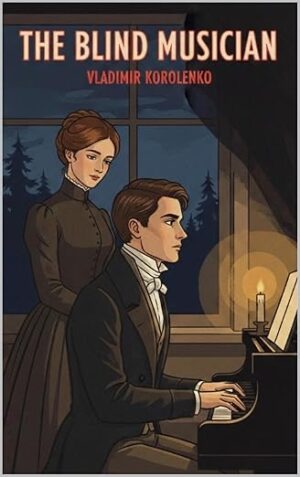
The Blind Musician by Vladimir Korolenko
Page Count: 219Year: 1886READ FREEProducts search This is the story of a boy, born into a wealthy noble family, whose life is shadowed by blindness from the very beginning. How can one find their place in a world where its most obvious manifestations are inaccessible? Petr’s life changes with every new experience. His musical talent blossoms under the guidance […]
€17.00 Login to Wishlist
First published in 1886 by newspaper
“Russkiye Vedomosti” and journal “Russkaya Mysl”
This book is in the public domain
Reprint by Publishing House №10
Publication date July 23, 2025
Translation from Russian
221 Pages, Font 12 pt, Bookman Old Style
Electronic edition, File size 962 KB
Cover design, Translate by Yulia Basharova
Copyright© Yulia Basharova 2025. All rights reserved
Table of Contents
Chapter One
I
The child was born into a wealthy family in the Southwest region, in the dead of night. The young mother lay in a deep stupor, but when the newborn’s first cry, soft and plaintive, echoed in the room, she thrashed about in her bed with closed eyes. Her lips whispered something, and on her pale face, with its soft, almost childlike features, appeared a grimace of impatient suffering, like a spoiled child experiencing an unfamiliar sorrow.
The grandmother leaned her ear to the mother’s quietly whispering lips.
“Why… why is he doing that?” the sick woman asked barely audibly.
The grandmother didn’t understand the question. The child cried out again. A reflection of acute suffering crossed the sick woman’s face, and a large tear slipped from her closed eyes.
“Why, why?” her lips continued to whisper softly.
This time, the grandmother understood the question and calmly replied:
“You’re asking why the child is crying? It’s always like this, calm down.”
But the mother couldn’t calm down. She flinched each time the child cried anew and kept repeating with angry impatience:
“Why… so… so horrible?”
The grandmother heard nothing unusual in the child’s cry and, seeing that the mother was speaking as if in a hazy stupor and likely just delirious, left her and attended to the child.
The young mother fell silent, and only at times did some heavy suffering, unable to break out in movement or words, squeeze large tears from her eyes. They seeped through her thick eyelashes and quietly rolled down her pale, marble-like cheeks.
Perhaps the mother’s heart sensed that along with the newborn child, a dark, inescapable sorrow had come into the world, hovering over the cradle to accompany the new life until the grave.
Or perhaps, it was indeed delirium. Be that as it may, the child was born blind.
II
At first, no one noticed. The boy looked with the same dull, unfocused gaze that all newborns have up to a certain age. Days passed, and the new life was now counted in weeks. His eyes cleared, the hazy film lifted, and his pupils became defined. But the child didn’t turn his head towards the bright ray of light that entered the room with the cheerful chirping of birds and the rustling of the green beech trees swaying by the windows in the dense village garden. The mother, having recovered, was the first to anxiously notice the strange expression on the child’s face, which remained still and somehow unnaturally serious.
The young woman looked at people like a frightened dove, asking:
“Tell me, why is he like this?”
“Like what?” strangers asked indifferently. “He’s no different from other children his age.”
“Look how strangely he’s searching for something with his hands…”
“A child can’t yet coordinate hand movements with visual impressions,” the doctor replied.
“Why does he always look in the same direction?… Is he… is he blind?” A terrible realization suddenly burst from the mother’s chest, and no one could console her.
The doctor took the child in his arms, quickly turned him towards the light, and looked into his eyes. He seemed slightly flustered and, after uttering a few meaningless phrases, left, promising to return in a couple of days.
The mother wept and thrashed like a wounded bird, pressing the child to her chest, while the boy’s eyes continued to gaze with the same unmoving, stern look.
The doctor did indeed return in a couple of days, bringing an ophthalmoscope with him. He lit a candle, moved it closer to and further away from the child’s eye, peered into it, and finally said with a troubled expression:
“Unfortunately, madam, you were not mistaken… The boy is indeed blind, and hopelessly so…”
The mother listened to this news with quiet sorrow.
“I knew it long ago,” she said softly.
III
The family in which the blind boy was born was small. Besides the previously mentioned individuals, it also consisted of the father and “Uncle Maxim,” as he was called by all household members without exception, and even by outsiders. The father resembled a thousand other rural landowners in the Southwest region: he was good-natured, perhaps even kind, looked after his workers well, and dearly loved building and rebuilding mills. This occupation consumed almost all of his time, and thus his voice was heard in the house only at certain, specific hours of the day, coinciding with dinner, breakfast, and other similar events. On these occasions, he would always utter the unchanging phrase: “Are you well, my little dove?” — after which he would sit down at the table and say almost nothing else, perhaps occasionally mentioning something about oak shafts and gears. Understandably, his peaceful and unassuming existence had little impact on his son’s character. Uncle Maxim, however, was of an entirely different sort. Ten years before the events described, Uncle Maxim was known as the most dangerous brawler not only in the vicinity of his estate but even in Kyiv “at the Contracts.” Everyone wondered how such a terrible brother could have emerged in such a respectable family in every sense, as was the family of Pani Popelska, née Yatsenko. No one knew how to properly interact with him or how to please him. He responded to the politeness of the gentry with insolence, and he indulged the peasants’ willfulness and rudeness, to which even the meekest of “szlachta” would certainly have responded with slaps. Finally, to the great joy of all right-thinking people, Uncle Maxim became very angry with the Austrians for some reason and went to Italy: there he joined another brawler and heretic – Garibaldi, who, as the landowners recounted with horror, had become sworn brothers with the devil and held the Pope himself in no regard. Of course, in this way Maxim eternally damned his restless schismatic soul, but “the Contracts” proceeded with fewer scandals, and many noble mothers stopped worrying about the fate of their sons.
The Austrians must also have been deeply angered by Uncle Maxim. From time to time, his name was mentioned in dispatches in “Kurierka”, the landowners’ long-favored newspaper, among the desperate Garibaldian comrades, until one day, from the same “Kurierka”, the gentry learned that Maxim had fallen with his horse on the battlefield. The enraged Austrians, who had evidently long been sharpening their teeth on the inveterate Volynian (who, almost alone, in the opinion of his compatriots, was still upholding Garibaldi), hacked him to pieces like cabbage.
“Maxim ended badly,” the gentry told themselves, attributing this to the special intercession of St. Peter for his vicar. Maxim was considered dead.
It turned out, however, that Austrian sabers had not managed to drive Maxim’s stubborn soul out of him, and it remained, albeit in a severely damaged body. The Garibaldian brawlers carried their worthy comrade out of the fray, took him somewhere to a hospital, and then, a few years later, Maxim unexpectedly appeared at his sister’s house, where he remained.
Now he was no longer interested in duels. His right leg had been completely amputated, so he walked with a crutch, and his left arm was injured and only good for leaning on a stick somehow. And generally, he had become more serious, settled down, and only occasionally did his sharp tongue act as accurately as his saber once did. He stopped going to “the Contracts,” rarely appeared in society, and spent most of his time in his library reading some books about which no one knew anything, except for the assumption that the books were utterly godless. He also wrote something, but since his works never appeared in “Kurierka”, no one attached serious importance to them.
At the time when the new being appeared and began to grow in the village house, silvery streaks of gray were already breaking through Uncle Maxim’s closely cropped hair. His shoulders were raised from constantly leaning on crutches, and his torso had taken on a square shape. His strange appearance, grimly furrowed brows, the sound of his crutches, and the clouds of tobacco smoke with which he constantly surrounded himself, never letting the pipe out of his mouth — all this frightened outsiders, and only those close to the invalid knew that in the mutilated body beat a warm and kind heart, and in the large, square head, covered with bristly, thick hair, an restless thought worked.
But even close people did not know what question this thought was working on at that time. They only saw that Uncle Maxim, surrounded by blue smoke, sometimes sat motionless for hours, with a misty gaze and grimly furrowed thick brows. Meanwhile, the crippled fighter thought that life is a struggle and that there is no place for invalids in it. It occurred to him that he had forever dropped out of the ranks and was now needlessly burdening the baggage train; it seemed to him that he was a knight, unhorsed by life and cast down into the dust. Was it not cowardly to writhe in the dust like a crushed worm; was it not cowardly to cling to the victor’s stirrup, begging for the pitiful remnants of one’s own existence?
While Uncle Maxim coolly and courageously discussed this burning thought, weighing and comparing arguments for and against, a new being, whom fate had destined to come into the world already an invalid, began to flash before his eyes. At first, he paid no attention to the blind child, but then the strange similarity of the boy’s fate to his own interested Uncle Maxim.
“Hmm… yes,” he said thoughtfully one day, glancing sideways at the boy, “this lad is also an invalid. If you put the two of us together, you’d probably get one miserable little human.”
From then on, his gaze rested on the child more and more often.
IV
The child was born blind. Who was to blame for his misfortune? No one! Not only was there no hint of anyone’s “ill will,” but even the very cause of the misfortune was hidden somewhere deep within the mysterious and complex processes of life. Yet, with every glance at the blind boy, the mother’s heart was squeezed with sharp pain. Of course, she suffered in this case as a mother, reflecting her son’s ailment and with a grim premonition of the difficult future that awaited her child; but, besides these feelings, deep in the young woman’s heart also gnawed the awareness that the cause of the misfortune lay as a formidable possibility in those who had given him life… This was enough for the little being with beautiful, but sightless eyes, to become the center of the family, an unconscious despot, with whose slightest whim everything in the house conformed.
It’s unknown what would have become of the boy over time, predisposed to baseless bitterness by his misfortune and in whom everything around him sought to develop egoism, if strange fate and Austrian sabers hadn’t forced Uncle Maxim to settle in the village, in his sister’s family.
The presence of the blind boy in the house gradually and imperceptibly gave the active mind of the mutilated fighter a different direction. He still spent hours smoking his pipe, but in his eyes, instead of deep and dull pain, there was now the thoughtful expression of an interested observer. And the more Uncle Maxim observed, the more often his thick brows furrowed, and the more intensely he puffed on his pipe. Finally, one day he decided to intervene.
“This lad,” he said, blowing ring after ring, “will be much unhappier than I am. It would have been better if he hadn’t been born.”
The young woman lowered her head, and a tear fell onto her work.
“It’s cruel to remind me of this, Max,” she said softly, “to remind me without purpose…”
“I’m only telling the truth,” Maxim replied. “I don’t have a leg or an arm, but I have eyes. The lad has no eyes, and in time he’ll have neither hands, nor legs, nor will…”
“Why then?”
“Understand me, Anna,” Maxim said more gently. “I wouldn’t needlessly tell you cruel things. The boy has a delicate nervous system. He still has every chance to develop his other abilities to such an extent that it could at least partially compensate for his blindness. But for that, he needs exercise, and exercise is only brought about by necessity. Foolish over-protectiveness, eliminating the need for effort from him, kills all his chances for a fuller life.”
The mother was intelligent and therefore managed to overcome the immediate impulse that made her rush headlong at every plaintive cry of the child. A few months after this conversation, the boy crawled freely and quickly through the rooms, sharpening his hearing to every sound and, with an unusual liveliness not seen in other children, felt every object that fell into his hands.
V
He soon learned to recognize his mother by her gait, the rustle of her dress, and other elusive signs, accessible only to him. No matter how many people were in the room or how they moved, he always unerringly went in the direction where she sat. When she unexpectedly picked him up, he immediately knew he was with his mother. But when others picked him up, he quickly began to feel the person’s face with his little hands and soon recognized the nanny, Uncle Maxim, and his father. However, if he encountered a stranger, the movements of his small hands became slower: the boy cautiously and intently ran them over the unfamiliar face, and his features expressed strained attention; it was as if he was “looking closely” with his fingertips.
By nature, he was a very lively and active child, but as months passed, his blindness increasingly left its mark on his developing temperament. His lively movements gradually faded; he started to retreat into secluded corners and would sit there quietly for hours, his features frozen, as if listening intently to something. When the room was quiet and the variety of sounds didn’t distract him, the child seemed to be thinking about something with a puzzled and surprised expression on his beautiful, unnaturally serious face.
Uncle Maxim guessed correctly: the boy’s delicate and rich nervous system was asserting itself, and through heightened sensitivity to touch and hearing, it seemed to strive to restore the fullness of his perceptions to a certain extent. Everyone was amazed by the striking subtlety of his touch. At times, it even seemed he was not oblivious to the sensation of colors; when brightly colored scraps of fabric fell into his hands, he would linger on them longer with his sensitive fingers, and an expression of astonishing attention would cross his face. However, as time went on, it became increasingly clear that the development of his perceptiveness was mainly leaning towards hearing.
Soon, he had perfectly learned the rooms by their sounds: he distinguished the footsteps of household members, the creak of the chair under his invalid uncle, the dry, measured rustle of thread in his mother’s hands, and the steady ticking of the wall clock. Sometimes, crawling along the wall, he would keenly listen to a faint rustle, inaudible to others, and, raising his hand, would reach for a fly scurrying on the wallpaper. When the startled insect took off and flew away, an expression of painful bewilderment appeared on the blind boy’s face. He couldn’t account for the mysterious disappearance of the fly. But later, even in such cases, his face retained an expression of thoughtful attention; he would turn his head in the direction where the fly had flown – his keen hearing caught the faint hum of its wings in the air.
The world, sparkling, moving, and sounding around him, penetrated the blind boy’s small head primarily in the form of sounds, and his perceptions took shape in these forms. A peculiar attentiveness to sounds would settle on his face: his lower jaw would subtly drop forward on his thin, elongated neck. His eyebrows became unusually mobile, and his beautiful, yet unmoving eyes gave the blind boy’s face a stern yet touching imprint.
VI
The third winter of his life was nearing its end. Outside, the snow was already melting, spring streams chimed, and with that, the boy’s health, which had been faltering all winter and thus kept him indoors, began to improve.
The second window frames were removed, and spring burst into the room with double force. The laughing spring sun looked into the light-filled windows, the still-bare branches of the beech trees swayed, and in the distance, dark fields stretched out, where patches of melting snow lay in some places, and in others, young grass was just breaking through with a barely noticeable green. Everyone breathed more freely and better; spring was reflected in everyone as a surge of renewed and vigorous life force.
For the blind boy, it burst into the room only with its hurried sounds. He heard how the spring waters rushed, as if chasing each other, leaping over stones, cutting deep into the softened earth; the beech branches whispered outside the windows, clashing and rattling with light taps against the glass. And the hurried spring drip from the icicles hanging on the roof, caught by the morning frost and now warmed by the sun, tapped with a thousand ringing beats. These sounds fell into the room like bright and resonant pebbles, quickly tapping out a shimmering cascade. From time to time, through this ringing and noise, the calls of cranes smoothly drifted from a distant height and gradually died away, as if gently melting into the air.
On the boy’s face, this awakening of nature manifested as a painful bewilderment. He strained his eyebrows, stretched his neck, listened intently, and then, as if alarmed by the incomprehensible commotion of sounds, suddenly reached out, searching for his mother, and rushed to her, pressing himself tightly against her chest.
“What’s wrong with him?” the mother asked herself and others.
Uncle Maxim looked intently at the boy’s face but couldn’t explain his inexplicable anxiety.
“He… can’t understand,” the mother guessed, catching an expression of painful bewilderment and questioning on her son’s face.
Indeed, the child was alarmed and restless: he would either catch new sounds or be surprised that the old ones, to which he had begun to grow accustomed, suddenly fell silent and disappeared somewhere.
VII
The chaos of spring’s disarray subsided. Under the sun’s warm rays, nature’s work increasingly settled into its routine; life seemed to intensify, its forward momentum quickening, like the accelerating speed of a train. Young grass greened the meadows, and the scent of birch buds filled the air.
They decided to take the boy out to the field, to the bank of the nearby river.
His mother led him by the hand. Beside them, Uncle Maxim walked on his crutches, and they all headed towards a riverside hillock, which the sun and wind had sufficiently dried. It was green with thick turf and offered a view of the distant expanse.
The bright day struck the eyes of the mother and Maxim. Sunlight warmed their faces, and the spring wind, as if flapping invisible wings, dispelled this warmth, replacing it with a fresh coolness. Something intoxicatingly delightful, even languid, drifted in the air.
The mother felt the child’s small hand clench tightly in hers, but the intoxicating breath of spring made her less sensitive to this manifestation of childish anxiety. She breathed deeply and walked forward without turning; if she had, she would have seen a strange expression on the boy’s face. He turned his open eyes towards the sun with silent wonder. His lips parted; he inhaled the air in quick gulps, like a fish taken out of water; an expression of painful rapture occasionally broke through his helplessly bewildered little face, running across it in nervous spasms, illuminating it for a moment, only to be immediately replaced by an expression of wonder bordering on fright and bewildered questioning. Only his eyes retained that same calm and fixed, sightless gaze.
Reaching the hillock, all three sat down. When the mother lifted the boy from the ground to seat him more comfortably, he again clutched convulsively at her dress; it seemed he feared he would fall somewhere, as if not feeling the ground beneath him. But the mother, this time too, did not notice the anxious movement, because her eyes and attention were captivated by the marvelous spring scene.
It was noon. The sun rolled quietly across the blue sky. From the hill where they sat, the widely flooded river was visible. It had already carried away its ice floes, and only occasionally did the last of them float and melt here and there on its surface, standing out as white specks. On the floodplains, water stood in wide lagoons; white clouds, reflecting in them along with the overturned azure vault, floated quietly in the depths and disappeared, as if they too were melting, like the ice floes. At times, a light ripple ran from the wind, sparkling in the sun. Further beyond the river, the dark, steamed fields stretched, shimmering with a swirling, wavering haze that obscured distant straw-roofed huts and the vaguely outlined blue strip of forest. The earth seemed to sigh, and something rose from it to the sky, like clouds of sacrificial incense.
Nature stretched all around, like a grand temple prepared for a celebration. But for the blind boy, it was only an immense darkness, unusually agitated around him, stirring, rumbling, and ringing, reaching out to him, touching his soul from all sides with yet unknown, unusual impressions, from whose influx the child’s heart painfully throbbed.
From his very first steps, when the rays of the warm day struck his face, warming his tender skin, he instinctively turned his sightless eyes towards the sun, as if feeling towards what center everything around him gravitated. For him, there was neither this transparent distance, nor the azure vault, nor the widely spread horizon. He only felt something material, caressing and warm, touching his face with a gentle, warming touch. Then something cool and light, though less light than the warmth of the sun’s rays, lifted this languor from his face and swept over him with a sensation of fresh coolness. In the rooms, the boy was used to moving freely, feeling emptiness around him. Here, however, he was enveloped by strangely alternating waves, sometimes gently caressing, sometimes tickling and intoxicating. The warm touches of the sun were quickly fanned away by something, and a current of wind, ringing in his ears, encompassing his face, temples, head all the way to the back of his neck, stretched around him, as if trying to pick up the boy, to carry him somewhere into a space he could not see, carrying away his consciousness, inducing a forgetful languor. It was then that the boy’s hand clutched his mother’s hand more tightly, and his heart sank, seeming about to stop beating altogether.
When he was seated, he seemed to calm down somewhat. Now, despite the strange sensation that overwhelmed his entire being, he still began to distinguish individual sounds. Dark, caressing waves continued to rush irresistibly, and it seemed to him that they penetrated inside his body, as the beats of his stirred blood rose and fell with the beats of these waves. But now they brought with them either the bright trill of a lark, or the quiet rustle of a blooming birch, or the barely audible splashes of the river. A swallow whistled with a light wing, drawing whimsical circles nearby, midges buzzed, and above it all, a long and mournful cry of a ploughman in the plain, urging his oxen over the freshly ploughed strip, occasionally drifted.
But the boy could not grasp these sounds in their entirety, could not connect them, arrange them into perspective. They seemed to fall, penetrating his dark little head, one after another, sometimes quiet, indistinct, sometimes loud, bright, deafening. At times, they crowded together simultaneously, unpleasantly mixing into an incomprehensible disharmony. And the wind from the field continued to whistle in his ears, and it seemed to the boy that the waves were running faster and their rumble obscured all other sounds, which now came from somewhere else, like a memory of yesterday. And as the sounds dimmed, a sensation of tickling languor poured into the boy’s chest. His face twitched with rhythmic undulations; his eyes closed then opened again, his eyebrows moved anxiously, and in all his features, a question emerged, a heavy effort of thought and imagination. His consciousness, not yet strengthened and overwhelmed with new sensations, began to falter: it still struggled with the impressions flooding in from all sides, striving to hold its ground amidst them, to merge them into a whole and thus master them, conquer them. But the task was beyond the dark brain of the child, who lacked visual representations for this work.
And the sounds flew and fell one after another, still too variegated, too resonant… The waves engulfing the boy rose more and more intensely, rushing from the surrounding ringing and rumbling darkness and returning into that same darkness, replaced by new waves, new sounds… faster, higher, more painfully they lifted him, rocking him, lulling him… Once more, a long and mournful note of a human cry flew over this dimming chaos, and then everything immediately fell silent.
The boy groaned softly and fell back onto the grass. His mother quickly turned to him and also cried out: he lay on the grass, pale, in a deep faint.
VIII
Uncle Maxim was greatly disturbed by this incident. For some time now, he had been subscribing to books on physiology, psychology, and pedagogy, and with his usual energy, he immersed himself in studying all that science offered regarding the mysterious growth and development of a child’s soul.
This work captivated him more and more, and consequently, the gloomy thoughts about his unsuitability for life’s struggle, about “the worm crawling in the dust,” and about the “baggage train” had long since imperceptibly vanished from the veteran’s square head. In their place, thoughtful attention reigned in his mind; at times, even rosy dreams warmed his aging heart. Uncle Maxim became more and more convinced that nature, while denying the boy sight, had not wronged him in other respects; this was a being who responded to accessible external impressions with remarkable fullness and strength. And it seemed to Uncle Maxim that he was called to develop the boy’s inherent talents, to counterbalance the injustice of blind fate through the effort of his thought and influence, to put a new recruit into the ranks of fighters for life’s cause in his stead, a recruit whom no one could count on without his influence.
“Who knows,” the old Garibaldian thought, “one can fight not only with a spear and saber. Perhaps one day, unjustly wronged by fate, he will take up the weapon available to him in defense of others, those deprived by life, and then I, a mutilated old soldier, will not have lived in vain…”
Even the free thinkers of the 1840s and 1850s were not strangers to the superstitious notion of nature’s “mysterious designs.” It’s not surprising, therefore, that as the child developed, displaying extraordinary abilities, Uncle Maxim became firmly convinced that the blindness itself was merely one of the manifestations of these “mysterious designs.” “Deprived for the sake of the deprived” – this was the motto he had already inscribed on the battle banner of his protégé.
IX
After his first spring walk, the boy lay in a delirium for several days. He would either lie motionless and silent in his bed, or mumble something and listen intently. And throughout this time, the characteristic expression of bewilderment never left his face.
“Truly, he looks as if he’s trying to understand something and can’t,” the young mother said.
Maxim pondered and nodded his head. He understood that the boy’s strange anxiety and sudden faint were explained by the abundance of impressions that his consciousness couldn’t cope with, and he decided to gradually introduce these impressions to the recovering boy, so to speak, dismembered into their constituent parts. In the room where the patient lay, the windows were tightly closed. Then, as he recovered, they would open them for a while, then he would be led through the rooms, taken out onto the porch, into the yard, into the garden. And each time an anxious expression appeared on the blind boy’s face, his mother would explain the sounds that were striking him.
“The shepherd’s horn is heard beyond the forest,” she would say. “And that’s the voice of a robin, heard through the chirping of a flock of sparrows. The stork clatters on its wheel. It arrived recently from distant lands and is building a nest in its old place.”
And the boy would turn his face to her, shining with gratitude, take her hand, and nod his head, continuing to listen with thoughtful and meaningful attention.
X
He began to ask about everything that caught his attention, and his mother, or more often Uncle Maxim, would tell him about various objects and creatures that made those sounds. The mother’s stories, being more lively and vivid, made a greater impression on the boy, but at times the impression was too painful. The young woman, suffering herself, with a moved face and eyes full of helpless pity and pain, tried to give her child a concept of shapes and colors. The boy strained his attention, furrowed his brows, and even slight wrinkles appeared on his forehead. Clearly, the child’s mind was struggling with an impossible task; his dark imagination battled, trying to create a new perception from indirect data, but nothing came of it. Uncle Maxim always frowned displeasedly in such cases, and when tears appeared in the mother’s eyes and the child’s face paled from concentrated effort, Maxim would intervene, gently push his sister aside, and begin his own stories, in which he, as much as possible, resorted only to spatial and auditory descriptions. The blind boy’s face would become calmer.
“Well, what does it look like? Is it big?” he asked about the stork, which was beating a lazy drum roll on its pole.
And with that, the boy spread his arms. He usually did this with similar questions, and Uncle Maxim would tell him when to stop. Now he spread his small hands completely, but Uncle Maxim said:
“No, it’s much bigger. If we brought it into the room and put it on the floor, its head would be taller than the back of a chair.”
“Big…” the boy said thoughtfully. “And the robin is like this!” — and he barely parted his cupped palms.
“Yes, the robin is like that… But big birds never sing as well as small ones. The robin tries to make everyone happy to listen to it. But the stork is a serious bird; it stands on one leg in its nest, looking around like an angry owner at his workers, and grumbles loudly, not caring that its voice is hoarse and that outsiders might hear it.”
The boy laughed, listening to these descriptions, and for a while forgot his difficult attempts to understand his mother’s stories. Still, these stories attracted him more strongly, and he preferred to direct his questions to her rather than to Uncle Maxim.
Chapter Two
I
The child’s mind was enriched with new perceptions; through his highly refined hearing, he penetrated further and further into the nature surrounding him. Above and around him still lay a deep, impenetrable darkness; this darkness hung over his brain like a heavy cloud, and although it had settled there since birth, and although the boy seemingly should have grown accustomed to his misfortune, his childlike nature, by some instinct, ceaselessly struggled to free itself from the dark veil. These unconscious impulses toward the unknown light, which never left the child for a moment, were imprinted ever more deeply on his face with an expression of vague, suffering effort.
Nevertheless, there were moments of clear contentment, of bright childish delight, and this happened when accessible external impressions gave him a new, strong sensation, introducing him to new phenomena of the invisible world. The great, mighty nature did not remain entirely closed to the blind boy. For instance, once, when he was brought down to a high cliff overlooking the river, he listened with a special expression to the quiet splashes of the river far below his feet and, with a pounding heart, clutched his mother’s dress, listening to the stones that broke off under his feet roll down. From then on, he imagined depth as the quiet murmur of water at the foot of the cliff or as the startled rustle of falling pebbles.
Distance sounded in his ears as a vaguely fading song; when spring thunder rumbled across the sky, filling the space and losing itself with an angry roar behind the clouds, the blind boy listened to this roar with reverent awe, and his heart expanded, and a majestic idea of the expanse of the heavens arose in his mind.
Thus, sounds were for him the main direct expression of the external world; other impressions served only as an addition to auditory impressions, into which his perceptions poured as into forms.
At times, on a hot afternoon, when everything around fell silent, when human movement quieted down and a peculiar stillness settled in nature, under which one could only sense the continuous, soundless flow of life force, a characteristic expression appeared on the blind boy’s face. It seemed that under the influence of the external silence, some sounds accessible only to him arose from the depths of his soul, which he seemed to listen to with strained attention. One could think, looking at him at such moments, that a nascent, vague thought began to sound in his heart, like a faint melody of a song.
II
He was already in his fifth year. He was thin and weak, but he walked and even ran freely throughout the house. Anyone watching him confidently move through the rooms, turning exactly where needed and easily finding the objects he wanted, might have thought, if they were a stranger, that they were seeing not a blind child, but merely a strangely focused one with thoughtful eyes gazing into an indefinite distance. However, he walked with greater difficulty in the yard, tapping a stick in front of him. If he didn’t have a stick, he preferred to crawl on the ground, quickly examining objects in his path with his hands.
III
It was a quiet summer evening. Uncle Maxim sat in the garden. The father, as usual, was busy somewhere in the distant field. The yard and surroundings were quiet; the village was falling asleep, and in the servants’ quarters, the chatter of workers and servants had also ceased. The boy had been put to bed about half an hour ago.
He lay in a semi-slumber. For some time now, a strange memory had become associated with this quiet hour for him. He, of course, did not see how the blue sky darkened, how the black tops of the trees swayed, silhouetted against the starry azure, how the shaggy “thatches” of the buildings surrounding the courtyard frowned, how the blue haze spread over the earth along with the thin gold of moonlight and starlight. But for several days now, he had been falling asleep under some special, enchanting impression, which he couldn’t account for the next day.
When drowsiness covered his consciousness more and more thickly, when the vague rustle of the beeches completely subsided, and he ceased to distinguish the distant barking of village dogs, the nightingale’s chirping across the river, or the melancholic tinkling of bells tied to a foal grazing in the meadow — when all individual sounds faded and disappeared, it began to seem to him that they all, merging into one harmonious melody, quietly flew into the window and long circled above his bed, inducing vague but wonderfully pleasant dreams. In the morning, he would wake up softened and turn to his mother with a lively question:
“What was that… yesterday? What was it?”
The mother didn’t know what was happening and thought the child was troubled by dreams. She herself put him to bed, carefully made the sign of the cross over him, and left when he began to doze off, noticing nothing unusual. But the next day, the boy again spoke to her about something that had pleasantly disturbed him since the evening.
“So nice, Mama, so nice! What is it?”
That evening, she decided to stay by the child’s bed longer to unravel the strange mystery for herself. She sat on a chair, next to his crib, mechanically knitting stitches and listening to her Petrusya’s even breathing. He seemed to have fallen completely asleep when suddenly, in the darkness, his quiet voice was heard:
“Mama, are you here?”
“Yes, yes, my boy…”
“Please, go away, it is afraid of you and it hasn’t come yet. I was just about to fall asleep, and it’s still not here…”
The surprised mother listened with a strange feeling to this half-asleep, plaintive whisper… The child spoke of his sleepy dreams with such certainty, as if it were something real. Nevertheless, the mother got up, leaned over to kiss the boy, and quietly left, deciding to imperceptibly approach the open window from the garden side.
She hadn’t even finished her circuit when the mystery was explained. She suddenly heard the quiet, shimmering tones of a panpipe coming from the stable, blending with the rustle of the southern evening. She immediately understood that it was these simple, unpretentious melodic flourishes, coinciding with the fantastic hour of drowsiness, that so pleasantly shaped the boy’s memories.
She herself stopped, stood for a moment, listening to the heartfelt tunes of the Ukrainian folk song, and, completely reassured, went into the dark garden alley to Uncle Maxim.
“Ioachim plays well,” she thought. “Strange, how much delicate feeling there is in this seemingly rough ‘lad’.”
IV
And Ioachim truly played well. Even a tricky violin was nothing to him, and there was a time when at the inn on Sundays, no one could play a “kozak” or a lively Polish “krakowiak” better than he. When he would sit on a bench in the corner, pressing the violin firmly against his shaven chin, his tall sheepskin hat jauntily pushed back on his head, and strike the taut strings with his crooked bow, it was rare for anyone at the inn to remain seated. Even the old one-eyed Jew who accompanied Ioachim on the double bass would become animated to the highest degree. His clumsy “instrument” seemed to be straining with effort to keep its heavy bass notes in time with the light, melodious, and leaping tones of Ioachim’s violin, while old Yankel himself, shrugging his shoulders high, twisted his bald head in his yarmulke and bounced in time with the playful and brisk melody. What then to say of the baptized folk, whose legs have been arranged since ancient times in such a way that at the first sounds of a cheerful dance tune, they spontaneously begin to bend and tap their feet.
But ever since Ioachim fell in love with Marya, a maid from a neighboring landowner’s house, he somehow lost his fondness for the cheerful violin. It’s true that the violin didn’t help him win the sharp-tongued girl’s heart, and Marya preferred the beardless German face of the master’s valet to the mustachioed “mug” of the Ukrainian musician. Since then, his violin was no longer heard at the inn or at evening gatherings. He hung it on a peg in the stable and paid no attention to the fact that, due to dampness and his neglect, one string after another kept snapping on his once-beloved instrument. And they snapped with such a loud and plaintive death-rattle that even the horses neighed sympathetically and turned their heads in surprise towards their embittered master.
In place of the violin, Ioachim bought a wooden pipe from a passing Carpathian Highlander. He apparently found that its quiet, soulful flourishes better suited his bitter fate, better expressed the sorrow of his rejected heart. However, the Highlander’s pipe disappointed his expectations. He went through dozens of them, tried them in every way, cut them, soaked them in water and dried them in the sun, hung them on a thin string under the roof to let the wind blow through them, but nothing helped: the Highlander’s pipe would not obey his Ukrainian heart. It whistled where it should have sung, shrieked when he expected a languid tremor from it, and generally did not yield to his mood at all. Finally, he became angry with all wandering Highlanders, utterly convinced that none of them could make a good pipe, and then resolved to make one with his own hands. For several days he roamed with furrowed brows through fields and swamps, approached every willow bush, sorted through its branches, cut some of them, but apparently still could not find what he needed. His brows remained grimly furrowed, and he walked on, continuing his search. Finally, he came upon a spot by a lazily flowing river. The water barely stirred the white heads of water lilies in this backwater; the wind did not reach here due to the thickly overgrown willows that quietly and thoughtfully leaned towards the dark, calm depths. Ioachim, pushing aside the bushes, approached the river, stood for a moment, and somehow suddenly became convinced that it was here that he would find what he needed. The wrinkles on his forehead smoothed out. He took out a folding knife tied to a strap from behind his boot, and, casting an attentive glance at the thoughtfully whispering willow bushes, decisively approached a thin, straight trunk swaying over the eroded bank. He flicked it with his finger for some reason, watched with satisfaction how it resiliently swayed in the air, listened to the whisper of its leaves, and shook his head.
“That’s exactly it,” Ioachim muttered with satisfaction and threw all the previously cut twigs into the river.
The pipe turned out splendidly. After drying the willow, he burned out its core with a red-hot wire, burned six round holes, cut a seventh diagonally, and tightly plugged one end with a wooden stopper, leaving a narrow, slanted slit in it. Then it hung on a string for a whole week, warmed by the sun and fanned by the ringing wind. After that, he carefully planed it with a knife, polished it with glass, and rubbed it firmly with a piece of coarse cloth. Its top was round, and from the middle, perfectly polished facets extended, on which he had burned various intricate patterns with the help of curved pieces of iron. After trying it out with a few quick arpeggios, he shook his head excitedly, grunted, and hastily hid it in a secluded spot near his bed. He didn’t want to make his first musical experiment amidst the daytime hustle. But that same evening, tender, thoughtful, shimmering, and trembling trills poured from the stable. Ioachim was completely satisfied with his pipe. It seemed to be a part of him; the sounds it produced flowed as if from his own warmed and softened chest, and every curve of his feeling, every shade of his sorrow, immediately trembled in the wondrous pipe, quietly detached from it and resounded after others, amidst the keenly listening evening.
V
Now Ioachim was in love with his pipe and was celebrating his honeymoon with it. During the day, he diligently performed his duties as a stableman: leading horses to water, harnessing them, driving out with the “Pani” or Maxim. At times, when he glanced towards the neighboring village where the cruel Marya lived, longing would gnaw at his heart. But with the onset of evening, he forgot about the whole world, and even the image of the dark-browed girl seemed to be veiled in mist. This image lost its burning clarity, appearing before him in some vague background, just enough to lend a pensive, melancholic character to the wonderful pipe’s melodies.
In such musical ecstasy, completely pouring himself into the trembling melodies, Ioachim lay in the stable that evening. The musician had completely forgotten not only the cruel beauty but had even lost sight of his own existence, when suddenly he flinched and sat up in his bed. At the most pathetic part, he felt a small hand quickly run light fingers over his face, slide over his arms, and then somewhat hastily begin to feel the pipe. At the same time, he heard a quick, excited, short breath nearby.
“Curses on you, hell to you,” he uttered the usual incantation and immediately added a question: “Devil or God?” — wanting to know if he was dealing with an unclean spirit.
But immediately, a moonbeam that had slipped through the open stable doors showed him he was mistaken. Standing by his cot was the blind young master, eagerly reaching out to him with his little hands.
An hour later, the mother, wishing to check on sleeping Petrus, did not find him in his bed. She was initially frightened, but soon a mother’s intuition told her where to look for the missing boy. Ioachim was very embarrassed when, stopping to take a breath, he unexpectedly saw “the gracious Pani” in the stable doorway. She had apparently been standing there for several minutes, listening to his playing and watching her boy, who sat on the cot, wrapped in Ioachim’s sheepskin coat, still eagerly listening to the interrupted song.
VI
From then on, the boy appeared in Ioachim’s stable every evening. It never even occurred to him to ask Ioachim to play anything during the day. It seemed that the daytime hustle and bustle, in his mind, precluded the possibility of those quiet melodies. But as soon as evening fell, Petrus felt a feverish impatience. Evening tea and dinner merely served as an indication that the desired moment was near, and his mother, who instinctively disliked these musical sessions, nonetheless couldn’t forbid her darling from running to the pipeman and sitting with him in the stable for two hours before bed. These hours now became the happiest time for the boy, and his mother saw with burning jealousy that the evening impressions possessed the child even throughout the next day, that he no longer responded to her caresses with his former undivided attention, that even while sitting in her arms and embracing her, he would thoughtfully recall Ioachim’s song from the previous night.
Then she remembered that several years ago, while studying at Pani Radetska’s boarding school in Kyiv, she, among other “pleasant arts,” had also studied music. True, this memory itself wasn’t particularly sweet, as it was associated with the image of her teacher, an old German spinster named Klaps, who was very thin, very prosaic, and, most importantly, very angry. This extremely bilious maiden, who very skillfully “broke” her students’ fingers to give them the necessary flexibility, at the same time remarkably succeeded in killing any signs of musical poetic feeling in her pupils. This timid feeling could not endure the mere presence of Miss Klaps, let alone her teaching methods. Therefore, after leaving the boarding school and even after getting married, Anna Mikhailovna didn’t even consider resuming her musical exercises. But now, listening to the Ukrainian pipeman, she felt that along with her jealousy towards him, the sensation of live melody was gradually awakening in her soul, and the image of the German maiden was fading. The result of this process was Pani Popelska’s request to her husband to order a piano from the city.
“As you wish, my little dove,” replied her exemplary husband. “You didn’t seem to care much for music.”
A letter was sent to the city that same day, but it would take at least two or three weeks for the instrument to be purchased and brought from the city to the village.
Meanwhile, melodic calls rang out from the stable every evening, and the boy rushed there, no longer even asking his mother’s permission.
The specific scent of the stable mingled with the aroma of dry grass and the sharp smell of rawhide straps. Horses quietly chewed, rustling the wisps of hay they pulled from behind the grate; when the pipeman paused for a breath, the whisper of the green beech trees from the garden clearly carried into the stable. Petrik sat, as if enchanted, and listened.
He never interrupted the musician, and only when the musician himself stopped and two or three minutes passed in silence, was the silent enchantment replaced in the boy by a strange eagerness. He reached for the pipe, took it with trembling hands, and put it to his lips. Since this caused the boy’s breath to catch in his chest, the first sounds he produced were somewhat trembling and quiet. But then, little by little, he began to master the simple instrument. Ioachim placed his fingers over the holes, and although his tiny hand could barely cover these openings, he soon got used to the sounds of the scale. Each note, for him, seemed to have its own special “face,” its individual character; he already knew in which hole each of these tones lived, from where it needed to be released, and sometimes, when Ioachim quietly played some simple tune with his fingers, the boy’s fingers would also begin to move. He clearly imagined the successive tones arranged in their usual places.
VII
Finally, exactly three weeks later, the piano was brought from the city. Petya stood in the yard, listening attentively as the bustling workers prepared to carry the imported “music” into the room. It was evidently very heavy, as the cart creaked, and the men grunted and breathed heavily when they began to lift it. Then they moved with measured, heavy steps, and with each step, something above their heads strangely hummed, grumbled, and jingled. When the strange music was placed on the living room floor, it again responded with a dull rumble, as if threatening someone in great anger.
All of this instilled in the boy a feeling akin to fright and did not predispose him favorably towards the new inanimate, yet angry, guest. He went into the garden and did not hear how the instrument was set on its legs, how the tuner from the city wound it with a key, tested the keys, and tuned the wire strings. Only when everything was finished did his mother send for Petya to come into the room.
Now, armed with a Viennese instrument by a master craftsman, Anna Mikhailovna already anticipated victory over the simple village pipe. She was confident that her Petya would now forget the stable and the pipeman, and that all his joys would come from her. She looked with laughing eyes at the boy, who entered timidly with Maxim, and at Ioachim, who had asked permission to listen to the foreign music and now stood by the door, shyly lowering his eyes and letting his forelock hang down. When Uncle Maxim and Petya sat on the couch, she suddenly struck the piano keys.
She played a piece that she had mastered at Pani Radetska’s boarding school under the tutelage of Miss Klaps. It was something particularly noisy but quite intricate, requiring considerable finger flexibility; at her public examination, Anna Mikhailovna had earned abundant praise for this piece, both for herself and especially for her teacher. No one could say for certain, but many guessed that the taciturn Pan Popelsky had been captivated by Panna Yatsenko precisely during that brief fifteen minutes when she performed the difficult piece. Now, the young woman played it with a conscious aim for another victory: she wished to draw her son’s small heart, enchanted by the Ukrainian pipe, more strongly to herself.
However, this time her expectations were dashed: the Viennese instrument proved unable to compete with a piece of Ukrainian willow. True, the Viennese piano had mighty advantages: expensive wood, excellent strings, superb craftsmanship from the Viennese master, and the richness of a wide register. But the Ukrainian pipe also found allies, as it was at home, amidst its kindred Ukrainian nature.
Before Ioachim cut it with his knife and burned out its heart with hot iron, it had swayed here, above the familiar native river known to the boy, caressed by the Ukrainian sun that warmed him too, and the same Ukrainian wind fanned it, until the keen eye of the Ukrainian pipeman noticed it above the eroded bank. And now it was difficult for the foreign newcomer to compete with the simple local pipe, because it had appeared to the blind boy in the quiet hour of slumber, amidst the mysterious evening rustle, under the whisper of the sleeping beech trees, accompanied by all its kindred Ukrainian nature.
And Pani Popelska was far from Ioachim’s level. True, her slender fingers were faster and more flexible; the melody she played was more complex and richer, and Miss Klaps had put in much effort to teach her student to master the difficult instrument. But Ioachim possessed an immediate musical feeling; he loved and grieved, and with his love and longing, he turned to his native nature. This nature taught him its simple tunes, the sound of its forests, the quiet whisper of the steppe grass, the thoughtful, native, ancient song he had heard even over his own childhood cradle.
Yes, it turned out to be difficult for the Viennese instrument to defeat the Ukrainian pipe. Not even a minute passed before Uncle Maxim suddenly sharply struck the floor with his crutch. When Anna Mikhailovna turned in that direction, she saw on Petrik’s pale face the very same expression with which the boy had lain on the grass on the memorable day of his first spring walk.
Ioachim looked at the boy sympathetically, then cast a disdainful glance at the German music and left, clomping his clumsy “choboty” (boots) across the living room floor.
VIII
This failure cost the poor mother many tears — tears and shame. For her, the “gracious Pani” Popelska, who had heard the thunder of applause from “select audiences,” to find herself so cruelly defeated, and by whom? A simple stableman, Ioachim, with his foolish little whistle! When she recalled the disdainful look of the Ukrainian man after her unsuccessful concert, anger flushed her face, and she sincerely hated the “nasty peasant.”
And yet, every evening, when her boy ran off to the stable, she would open the window, lean on it, and listen intently. At first, she listened with a feeling of angry disdain, trying only to catch the ridiculous aspects of this “silly chirping,” but little by little — she herself couldn’t explain how it happened — the “silly chirping” began to captivate her attention, and she eagerly absorbed the pensive, melancholic tunes. Coming to her senses, she asked herself what their appeal was, their enchanting secret, and gradually these blue evenings, the indistinct evening shadows, and the wondrous harmony of the song with nature answered her question.
“Yes,” she thought to herself, defeated and conquered in her turn, “there is some very special, true feeling here… an enchanting poetry that cannot be learned from notes.”
And this was true. The secret of this poetry lay in the amazing connection between the long-dead past and eternally living nature, which eternally speaks to the human heart, witnessing this past. And he, the rough peasant in greased boots with calloused hands, carried this harmony, this living feeling of nature, within him.
And she realized that the proud “Pani” in her was humbling herself before the stableman-peasant. She forgot his coarse clothing and the smell of tar, and through the quiet, flowing melodies of the song, she recalled his good-natured face, with its soft expression in his gray eyes and a shyly humorous smile beneath his long mustache. At times, anger would again flood the young woman’s face and temples: she felt that in the struggle for her child’s attention, she had stepped into the same arena as this peasant, on equal footing, and he, the “peasant,” had won.
And the trees in the garden whispered above her head, the night flared with lights in the blue sky and spread blue darkness over the earth, and at the same time, a burning sadness poured into the young woman’s soul from Ioachim’s songs. She became increasingly humble and learned more and more to grasp the simple secret of immediate and pure, unadorned poetry.
IX
Yes, the peasant Ioachim had a true, living feeling! But her? Did she not possess a drop of that feeling? Why then did her chest feel so warm, and her heart beat so anxiously, and tears involuntarily well up in her eyes?
Was this not feeling, not the burning feeling of love for her deprived, blind child, who ran from her to Ioachim and to whom she could not give the same vibrant joy?
She remembered the expression of pain caused by her playing on the boy’s face, and burning tears streamed from her eyes, and at times she struggled to suppress the sobs that rose in her throat, ready to burst forth.
Poor mother! Her child’s blindness became her own eternal, incurable ailment. It manifested in an exaggerated tenderness, and in this all-consuming feeling that bound her aching heart with a thousand invisible strings to every manifestation of her child’s suffering. For this reason, what in another would have caused only annoyance — this strange rivalry with the Ukrainian pipeman — became for her a source of intense, exaggeratedly painful suffering.
So time passed, bringing her no relief, but not without benefit: she began to recognize within herself surges of that same living sensation of melody and poetry that so enchanted her in the Ukrainian’s playing. Then hope revived within her. Under the influence of sudden bursts of self-confidence, she approached her instrument several times and opened the lid with the intention of drowning out the quiet pipe with the melodious strikes of the keys. But each time, a feeling of indecision and timid fear held her back from these attempts. She remembered the face of her suffering boy and the disdainful look of the Ukrainian man, and her cheeks burned in the darkness with shame, and her hand only hovered in the air above the keyboard with a fearful eagerness…
Nevertheless, day by day, some inner awareness of her strength grew within her, and, choosing times when the boy was playing in the far alley before evening or went for a walk, she would sit at the piano. She was not particularly satisfied with her first attempts; her hands did not obey her inner understanding, the sounds of the instrument initially seemed alien to the mood that had taken hold of her. But gradually, this mood poured into them with greater fullness and ease; the Ukrainian’s lessons had not been in vain, and the mother’s fervent love and keen understanding of what so strongly captivated the child’s heart enabled her to learn these lessons so quickly. Now, not crackling, intricate “pieces” flowed from her hands, but a quiet song, a sad Ukrainian dumka, resonated and wept in the dark rooms, softening the mother’s heart.
Finally, she gained enough courage to enter into open struggle, and so, in the evenings, a strange competition began between the manor house and Ioachim’s stable. From the shaded shed with its overhanging straw roof, the shimmering trills of the pipe quietly flew out, and to meet them, from the open windows of the manor, sparkling through the beech leaves with reflected moonlight, came the melodious, full chords of the piano.
At first, neither the boy nor Ioachim wanted to pay attention to the “clever” music from the manor, against which they held a prejudice. The boy even frowned and impatiently urged Ioachim on when he stopped.
“Eh! Play, play!”
But barely three days passed before these pauses became more and more frequent. Ioachim would constantly put down his pipe and begin to listen with increasing interest, and during these pauses, the boy also listened intently and forgot to urge his friend on. Finally, Ioachim said with a thoughtful expression:
“Well, how beautiful… Look what a thing it is…”
And then, with the same thoughtful, absentminded look of someone listening, he picked up the boy and walked with him through the garden to the open window of the living room.
He thought that “the gracious Pani” was playing for her own pleasure and wasn’t paying attention to them. But Anna Mikhailovna heard in the intervals how her rival pipe fell silent, saw her victory, and her heart beat with joy.
At the same time, her angry feeling towards Ioachim completely subsided. She was happy and realized that she owed this happiness to him: he had taught her how to win her child back, and if now her boy would receive whole treasures of new impressions from her, then both of them should be grateful to him, the peasant pipeman, their common teacher.
X
The ice was broken. The next day, the boy, with timid curiosity, entered the living room, a place he hadn’t visited since the strange city guest, who had seemed so angrily loud, had taken up residence there. Now, the previous day’s songs from this guest had captivated the boy’s ear and changed his attitude towards the instrument. With the last traces of his former shyness, he approached where the piano stood, stopped at a distance, and listened intently. The living room was empty. His mother sat working on the sofa in another room, holding her breath, watching him, admiring his every movement, every change of expression on the child’s sensitive face.
Reaching out from afar, he touched the polished surface of the instrument and immediately, timidly, withdrew. Repeating this two or three times, he moved closer and began to carefully explore the instrument, bending down to the floor to feel its legs, circling around its free sides. Finally, his hand found the smooth keys.
A quiet string sound vibrated uncertainly in the air. The boy listened for a long time to the vibrations that had already vanished from his mother’s hearing, and then, with an expression of complete attention, he touched another key. After running his hand across the entire keyboard, he hit a high-register note. He gave each tone enough time, and they, one by one, swayed, trembled, and faded in the air. The blind boy’s face, along with intense attention, expressed pleasure; he evidently admired each individual tone, and even in this sensitive attentiveness to elementary sounds, the constituent parts of a future melody, the makings of an artist were evident.
However, it seemed that the blind boy also ascribed some special properties to each sound: when a cheerful and bright high-register note flew from under his hand, he would lift his animated face, as if accompanying this resonant, fleeting note upwards. Conversely, with the thick, barely audible, and dull tremor of a bass note, he would tilt his ear; it seemed to him that this heavy tone must necessarily roll low over the ground, scattering across the floor and losing itself in the distant corners.
XI
Uncle Maxim tolerated all these musical experiments. Strange as it may seem, the boy’s clearly emerging inclinations stirred a dual feeling in the invalid. On one hand, the passionate attraction to music indicated the boy’s undeniable musical abilities and thus partly defined his possible future. On the other hand, an undefined feeling of disappointment mingled with this awareness in the old soldier’s heart.
“Of course,” Maxim reasoned, “music is also a great power, allowing one to sway the hearts of the crowd. He, blind, will gather hundreds of elegantly dressed dandies and ladies, will play various… waltzes and nocturnes for them (truth be told, Maxim’s musical knowledge didn’t extend beyond these ‘waltzes’ and ‘nocturnes’), and they will wipe their tears with handkerchiefs. Oh, damn it, that’s not what I’d want, but what can you do! The lad is blind, so let him become in life what he can. But still, wouldn’t a song be better, perhaps? A song speaks not just to an indefinitely languishing ear. It provides images, awakens thought in the mind and courage in the heart.”
“Hey, Ioachim,” he said one evening, entering Ioachim’s stable after the boy. “Just for once, ditch your whistle! That’s fine for boys in the street or a shepherd’s boy in the field, but you’re a grown man, even if that foolish Marya did make a proper calf out of you. Bah, I’m even ashamed of you, honestly! The girl turned away, and you just melted. You whistle like a quail in a cage!”
Ioachim, listening to this long harangue from the annoyed pan, smirked in the darkness at his causeless anger. Only the mention of boys and the shepherd’s boy somewhat stirred in him a feeling of slight offense.
“Don’t say that, master,” he began. “You won’t find a pipe like this from any shepherd in Ukraine, let alone a shepherd’s boy… Those are just whistles, but this one… just listen.”
He covered all the holes with his fingers and played two notes an octave apart on the pipe, admiring the full sound. Maxim spat.
“Bah, God forgive me! The fellow’s gone completely stupid! What’s your pipe to me? They’re all the same – pipes and women, including your Marya. Why don’t you sing us a song, if you can – a good old song.”
Maxim Yatsenko, a Little Russian himself, was a simple man with the peasants and servants. He often shouted and swore, but in a way that wasn’t offensive, and so people treated him respectfully, but freely.
“Well, why not?” Ioachim replied to the pan’s suggestion. “I once sang no worse than others. But perhaps our peasant song won’t be to your taste either, master?” he stung his interlocutor slightly.
“Don’t blather needlessly,” Maxim said. “A good song is no match for a pipe, if only a person knows how to sing properly. Now let’s listen, Petrus, to Ioachim’s song. Will you understand it, lad?”
“Will it be a ‘peasant’ song?” the boy asked. “I understand ‘peasant-like’.”
Maxim sighed. He was a romantic and once dreamed of a new Cossack Sich.
“Ah, lad! These are not peasant songs… These are songs of a strong, suffering people. Your grandfathers on your mother’s side sang them in the steppes by the Dnieper, and by the Danube, and on the Black Sea… Well, you’ll understand it someday, but now,” he added thoughtfully, “I fear something else…”
Indeed, Maxim feared another misunderstanding. He thought that the vivid images of epic songs necessarily required visual representations to speak to the heart. He feared that the child’s dark mind would be unable to grasp the pictorial language of folk poetry. He forgot that ancient bards, that Ukrainian kobzars and bandurists, were mostly blind. True, a difficult lot, a disability, often forced them to take up a lyre or bandura to beg for alms. But not all of them were merely beggars and artisans with nasal voices, and not all of them lost their sight only in old age. Blindness shrouds the visible world with a dark veil, which, of course, burdens the brain, hindering and oppressing its work, yet from inherited perceptions and impressions received through other means, the brain creates its own world in the darkness, a sad, melancholy, and gloomy one, but not devoid of a peculiar, vague poetry.
XII
Maxim and the boy settled on the hay, while Ioachim reclined on his bench (this pose best suited his artistic mood) and, after a minute’s thought, began to sing. Whether by chance or by keen instinct, his choice was very successful. He chose a historical scene:
Oh, there on the hill, reapers are reaping.
Anyone who has heard this beautiful folk song performed properly has surely had its ancient melody etched into their memory — high, drawn-out, as if tinged with the sadness of historical remembrance. It contains no events, bloody battles, or heroic deeds. This is not a Cossack’s farewell to his beloved, not a daring raid or a boat trip across the blue sea and the Danube. It is merely a fleeting image, instantly surfacing in the Ukrainian’s memory like a vague dream, like a fragment from a dream about the historical past. Amidst the mundane and gray present day, this scene suddenly rose in his imagination, vague, misty, tinged with that peculiar sorrow that emanates from a vanished, yet not completely traceless, native antiquity. Of it still speak the tall burial mounds where Cossack bones lie, where at midnight fires ignite, from where heavy moans are heard at night. Of it also speaks folk legend, and the ever-fading folk song:
Oh, there on the hill, reapers are reaping,
And beneath the hill, beneath the green one,
Cossacks are marching!
Cossacks are marching!
On the green hill, reapers are harvesting grain. And beneath the hill, down below, a Cossack army marches.
Maxim Yatsenko listened intently to the mournful tune. In his imagination, evoked by the marvelous motif that blended astonishingly with the song’s content, this scene surfaced, as if illuminated by the melancholic gleam of sunset. In the peaceful fields, on the hill, silently bending over the cultivated lands, the figures of reapers are visible. And below, detachments pass silently one after another, merging with the evening shadows of the valley.
At the front, Doroshenko
Leads his army, the Zaporozhian army,
So handsomely.
And the drawn-out note of the song about the past sways, rings, and fades in the air, only to ring out again and evoke new and newer figures from the gloom.
XIII
The boy listened with a somber and sad face. When the singer sang of the hill where the reapers harvested, his imagination immediately transported Petrus to the height of the cliff familiar to him. He recognized it because below, the river splashed with barely audible waves hitting the stone. He also knew what reapers were; he heard the clinking of sickles and the rustle of falling ears of grain.
When the song transitioned to what was happening beneath the hill, the blind listener’s imagination immediately drew him away from the heights into the valley…
The clinking of sickles fell silent, but the boy knew that the reapers were still there, on the hill; they remained, but they weren’t audible because they were high up, as high as the pines whose rustling he had heard standing beneath the cliff. And below, by the river, came the frequent, even thud of horses’ hooves… There were many of them, creating a vague hum there, in the darkness, beneath the hill. These were the “Cossacks marching.”
He also knew what a Cossack meant. Old “Khvedko,” who occasionally visited the estate, was always called “the old Cossack.” He had often taken Petrus onto his lap, stroking his hair with his trembling hand. When the boy, as was his custom, felt his face, his sensitive fingers touched deep wrinkles, large drooping mustaches, sunken cheeks, and old man’s tears on his cheeks. The boy imagined similar Cossacks, under the drawn-out sounds of the song, there below, beneath the hill. They sat on horses, just like “Khvedko,” moustached, just as hunched, just as old. They moved quietly as formless shadows in the darkness, and just like “Khvedko,” they cried about something, perhaps because over both the hill and the valley hung these mournful, drawn-out moans of Ioachim’s song — a song about the “unheedful Cossack” who traded his young wife for a marching pipe and the hardships of battle.
One glance was enough for Maxim to understand that the boy’s sensitive nature was capable of responding, despite his blindness, to the poetic images of the song.
Chapter Three
I
Thanks to the regimen established by Maxim’s plan, the blind boy was, wherever possible, left to his own efforts, and this yielded the best results. In the house, he didn’t seem helpless at all; he moved everywhere with great confidence, cleaned his own room, and kept his toys and belongings in a certain order. Furthermore, to the extent it was accessible to him, Maxim paid attention to physical exercise: the boy had his own gymnastics, and in his sixth year, Maxim gifted his nephew a small, gentle horse. The mother initially couldn’t imagine that her blind child could ride, and she called her brother’s idea pure madness. But the invalid brought all his influence to bear, and within two or three months, the boy was happily riding in the saddle next to Ioachim, who only gave commands at turns.
Thus, blindness did not impede his proper physical development, and its influence on the child’s moral character was minimized as much as possible. For his age, he was tall and slender; his face was somewhat pale, his features delicate and expressive. His dark hair further emphasized the paleness of his face, and his large, dark, rather immobile eyes gave him a unique expression that immediately captivated attention. A slight furrow above his brows, a habit of leaning his head forward slightly, and an expression of sadness that sometimes flitted across his handsome face like clouds — these were all that blindness manifested in his appearance. His movements in familiar surroundings were confident, yet it was still noticeable that his natural vivacity was suppressed and manifested at times in rather abrupt, nervous impulses.
II
From then on, auditory impressions became definitively paramount in the blind boy’s life; sound forms became the primary forms of his thought, the core of his intellectual work. He memorized songs, listening intently to their enchanting melodies, familiarizing himself with their content, coloring it with the sadness, joy, or pensiveness of the tune. He listened even more carefully to the voices of surrounding nature and, merging vague sensations with familiar, native motifs, he was sometimes able to generalize them into free improvisation, in which it was difficult to distinguish where the traditional, ear-familiar motif ended and personal creativity began. He himself could not separate these two elements in his songs; they merged so completely within him. He quickly learned everything his mother, who taught him to play the piano, imparted to him, but he also loved Ioachim’s pipe. The piano was richer, more resonant, and fuller, but it remained indoors, whereas the pipe could be taken to the field, and its flourishes merged so inseparably with the quiet sighs of the steppe that at times Petrus himself could not tell whether the wind carried distant, vague thoughts, or if he himself drew them from his pipe.
This fascination with music became the center of his intellectual growth; it filled and diversified his existence. Maxim used it to introduce the boy to the history of his country, and all of it unfolded before the blind boy’s imagination, woven from sounds. Interested by the songs, he became acquainted with their heroes, their fates, and the fate of his homeland. From this began an interest in literature, and in his ninth year, Maxim commenced his first lessons. Maxim’s skillful lessons (for which he had to study special methods for teaching the blind) greatly pleased the boy. They introduced a new element into his moods — definiteness and clarity, balancing the vague sensations of music.
Thus, the boy’s day was filled; one could not complain about the scarcity of impressions he received. He seemed to live a full life, as much as was possible for a child. It also seemed that he was not even aware of his blindness.
And yet, some kind of laborious, unchildlike sadness still permeated his character. Maxim attributed this to a lack of children’s company and tried to compensate for this deficiency.
The village boys invited to the estate were shy and could not relax freely. Besides the unfamiliar surroundings, the “young master’s” blindness also greatly embarrassed them. They looked at him timidly and, huddled together, remained silent or whispered timidly to each other. When the children were left alone in the garden or in the field, they became more relaxed and started playing games, but it turned out that the blind boy somehow remained on the sidelines and sadly listened to the cheerful frolic of his comrades.
At times, Ioachim would gather the children around him and begin to tell them cheerful sayings and fairy tales. The village children, well acquainted with both the foolish Ukrainian devil and cunning witches, supplemented these stories from their own repertoire, and generally, these conversations were very lively. The blind boy listened to them with great attention and interest, but he himself rarely laughed. Apparently, the humor of spoken language remained largely inaccessible to him, and it’s no wonder: he could not see the sly twinkle in the storyteller’s eyes, nor the laughing wrinkles, nor the twitching of long mustaches.
III
Shortly before the time described, the “possessor” (owner/tenant) of a small neighboring estate changed. In place of the previous restless neighbor, with whom even the taciturn Pan Popelsky had a lawsuit over some damage, an old man named Jaskulsky and his wife now settled in the nearby manor. Despite the fact that both spouses were collectively at least a hundred years old, they had married relatively recently, as Pan Jakub had long been unable to save up the necessary sum for the lease and thus wandered as an “economist” (steward) for strangers, while Pani Agnieszka, awaiting the happy moment, lived as an honored “pokoyuvka” (chambermaid) for Countess Potocka. When, at last, the happy moment arrived and the bride and groom stood hand in hand in the church, half the hair in the dashing groom’s mustache and forelock was completely gray, and the bride’s face, covered with a shy blush, was also framed by silvery curls.
This circumstance did not, however, hinder their marital happiness, and the fruit of this late love was their only daughter, who was almost the same age as the blind boy. Having set up their own corner in their old age, where they could, albeit conditionally, consider themselves complete masters, the old couple lived there quietly and modestly, as if compensating themselves with this tranquility and solitude for the restless years of a hard life “among strangers.” Their first lease proved not entirely successful, and now they had somewhat downsized their enterprise. But even in their new place, they immediately settled in their own way. In a corner adorned with ivy-twined icons, Jaskulska kept, along with a willow branch and a “gromnitsa” (blessed candle), some small bags of herbs and roots, which she used to treat her husband and the village women and men who came to her. These herbs filled the entire hut with a peculiar, specific fragrance that was inextricably linked in the memory of every visitor with the recollection of this clean little house, its quietness and order, and the two old people living in it a remarkably tranquil life for those times.
In the company of these old people grew their only daughter, a small girl with a long blonde braid and blue eyes, who struck everyone upon first acquaintance with a strange solidity diffused throughout her entire figure. It seemed that the calm of her parents’ late love was reflected in her daughter’s character through this unchildlike thoughtfulness, the flowing calmness of her movements, and the pensiveness and depth of her blue eyes. She never shied away from strangers, did not avoid acquaintance with other children, and participated in their games. But all of this was done with such sincere condescension, as if for her personally, it wasn’t at all necessary. Indeed, she was perfectly content with her own company, walking, gathering flowers, talking to her doll, and all with an air of such solidity that at times it seemed as if before you was not a child, but a tiny grown woman.
IV
One day, Petrik was alone on the hillock by the river. The sun was setting, and silence hung in the air; only the distant lowing of the herd returning from the village reached him, softened by the distance. The boy had just stopped playing and leaned back on the grass, giving himself over to the drowsy languor of the summer evening. He lost himself for a moment when suddenly light footsteps roused him from his slumber. He raised himself on an elbow with displeasure and listened. The footsteps stopped at the foot of the hillock. The gait was unfamiliar to him.
“Boy!” he suddenly heard a child’s voice exclaim. “Do you know who was just playing here?”
The blind boy disliked having his solitude disturbed. So, he answered the question in a not-so-friendly tone:
“That was me…”
A light, surprised gasp was the response to this statement, and immediately the girl’s voice added in a tone of naive approval:
“How beautiful!”
The blind boy remained silent.
“Why don’t you leave?” he then asked, hearing that the uninvited conversationalist was still standing there.
“Why are you chasing me away?” the girl asked in her clear and naively surprised voice.
The sounds of this calm child’s voice had a pleasant effect on the blind boy’s hearing; nevertheless, he replied in his previous tone:
“I don’t like it when people come to me…”
The girl laughed.
“Oh, really! Look at that! Is the whole earth yours that you can forbid anyone from walking on it?”
“Mama told everyone not to come here to me.”
“Mama?” the girl repeated thoughtfully. “But my mama allowed me to walk by the river…”
The boy, somewhat spoiled by everyone’s compliance, was unaccustomed to such persistent objections. A flush of anger passed over his face like a nervous wave; he sat up and spoke quickly and agitatedly:
“Go away, go away, go away!”
It’s unknown how this scene would have ended, but at that moment, Ioachim’s voice was heard from the estate, calling the boy for tea. He quickly ran down the hillock.
“Oh, what a nasty boy!” he heard an genuinely indignant remark behind him.
V
The next day, sitting in the same spot, the boy recalled yesterday’s encounter. There was no annoyance in this memory now. On the contrary, he even wished that this girl with such a pleasant, calm voice, which he had never heard before, would come again. The children he knew shouted loudly, laughed, fought, and cried, but none of them spoke so pleasantly. He felt sorry that he had offended the stranger, who would probably never return.
Indeed, for about three days, the girl did not come at all. But on the fourth, Petrus heard her footsteps below, on the riverbank. She walked quietly; the shore pebbles rustled softly under her feet; and she hummed a Polish song under her breath.
“Listen!” he called out when she drew level with him. “Is that you again?”
The girl did not answer. The pebbles still rustled under her feet. In the feigned nonchalance of her voice, humming the song, the boy still heard the unforgotten offense.
However, after taking a few steps, the stranger stopped. Two or three seconds passed in silence. During this time, she was sorting through a bouquet of wildflowers she held in her hands, and he waited for an answer. In this stop and the subsequent silence, he sensed a hint of deliberate neglect.
“Don’t you see that it’s me?” she finally asked with great dignity, having finished with the flowers.
This simple question painfully resonated in the blind boy’s heart. He said nothing, and only his hands, with which he was propped on the ground, convulsively clutched at the grass. But the conversation had already begun, and the girl, still standing in the same spot and busy with her bouquet, asked again:
“Who taught you to play the pipe so well?”
“Ioachim taught me,” Petrus replied.
“Very good! And why are you so angry?”
“I… I’m not angry with you,” the boy said quietly.
“Well, then I’m not angry either… Let’s play together.”
“I don’t know how to play with you,” he replied, looking down.
“You don’t know how to play? Why?”
“Just because.”
“No, but why?”
“Just because,” he replied almost inaudibly and looked down even further.
He had never had to speak to anyone about his blindness before, and the girl’s simple tone, asking this question with naive persistence, again resonated within him with a dull pain.
The stranger climbed onto the hillock.
“How funny you are,” she said with condescending pity, sitting down next to him on the grass. “You’re probably like this because you don’t know me yet. Once you get to know me, you’ll stop being afraid. And I’m not afraid of anyone.”
She spoke with carefree clarity, and the boy heard her toss a handful of flowers into her apron.
“Where did you get the flowers?” he asked.
“There,” she shook her head, pointing back.
“In the meadow?”
“No, there.”
“So, in the grove. And what kind of flowers are these?”
“Don’t you know flowers? Oh, how strange you are… truly, you are very strange…”
The boy took a flower in his hand. His fingers quickly and lightly touched the leaves and the corolla.
“This is a buttercup,” he said, “and this is a violet.”
Then he wanted to get acquainted with his interlocutor in the same way: taking the girl’s shoulder with his left hand, he began to feel her hair with his right, then her eyelids, and quickly ran his fingers over her face, stopping here and there and carefully studying the unfamiliar features.
All this was done so unexpectedly and quickly that the girl, struck with surprise, could not say a word; she only looked at him with wide-open eyes, which reflected a feeling close to horror. Only now did she notice that there was something unusual about the face of her new acquaintance. His pale and delicate features were frozen in an expression of intense attention, somehow not harmonizing with his motionless gaze. The boy’s eyes looked somewhere, without any relation to what he was doing, and the reflection of the setting sun strangely shimmered in them. All this seemed to the girl for a moment simply a heavy nightmare.
Freeing her shoulder from the boy’s hand, she suddenly jumped to her feet and cried.
“Why are you scaring me, you nasty boy?” she said angrily, through tears. “What did I do to you? Why?”
He sat in the same place, puzzled, with his head bowed low, and a strange feeling — a mixture of annoyance and humiliation — filled his heart with pain. For the first time, he had to experience the humiliation of a cripple; for the first time, he learned that his physical defect could inspire not only pity but also fright. Of course, he could not clearly account for the oppressive, heavy feeling that weighed on him, but because this awareness was vague and indistinct, it caused no less suffering.
A feeling of burning pain and offense rose to his throat; he fell onto the grass and wept. His crying grew stronger, convulsive sobs shook his entire small body, especially since some innate pride forced him to suppress this outburst.
The girl, who had already run down the hillock, heard these muffled sobs and turned in surprise. Seeing that her new acquaintance was lying face down and crying bitterly, she felt sympathy, quietly ascended the hillock, and stopped over the weeping boy.
“Listen,” she said softly, “why are you crying? You probably think I’ll complain? Well, don’t cry, I won’t tell anyone.”
The word of sympathy and the gentle tone caused an even greater nervous outburst of crying in the boy. Then the girl squatted beside him; after sitting like that for half a minute, she quietly touched his hair, stroked his head, and then, with the gentle persistence of a mother comforting a punished child, lifted his head and began to wipe his tear-stained eyes with her handkerchief.
“Now, now, stop it!” she said in an adult woman’s tone. “I’m not angry anymore. I see you’re sorry you scared me…”
“I didn’t mean to scare you,” he replied, sighing deeply to suppress the nervous spasms.
“Good, good! I’m not angry! You won’t do it again, will you?” She lifted him from the ground and tried to seat him next to her.
He obeyed. Now he sat, as before, facing the sunset, and when the girl again looked at his face, illuminated by reddish rays, it again seemed strange to her. Tears still stood in the boy’s eyes, but those eyes remained motionless; his facial features twitched from nervous spasms, but at the same time, a deep and heavy, unchildlike sorrow was visible in them.
“But still, you are very strange,” she said with pensive sympathy.
“I’m not strange,” the boy replied with a plaintive grimace. “No, I’m not strange… I… I am blind!”
“Blind?” she drew out musically, and her voice trembled, as if this sad word, quietly spoken by the boy, had struck an indelible blow to her small, feminine heart. “Blind?” she repeated with an even more trembling voice, and, as if seeking protection from the overwhelming feeling of pity that engulfed her, she suddenly wrapped her arms around the boy’s neck and leaned her face against him.
Struck by the suddenness of the sad discovery, the little woman could not maintain her composure, and, suddenly transforming into a grieved and helpless child in her sorrow, she, in turn, wept bitterly and inconsolably.
VI
Several minutes passed in silence.
The girl stopped crying and only occasionally still sobbed, overcoming it. With tear-filled eyes, she watched as the sun, as if rotating in the incandescent atmosphere of sunset, sank below the dark line of the horizon. The golden edge of the fiery orb flashed once more, then two or three hot sparks burst forth, and the dark outlines of the distant forest suddenly emerged as an unbroken bluish line.
A coolness drifted from the river, and the quiet world of the approaching evening was reflected on the blind boy’s face; he sat with his head bowed, evidently surprised by this expression of warm sympathy.
“I’m sorry…” the girl finally uttered, still sobbing, in explanation of her weakness.
Then, having somewhat composed herself, she attempted to shift the conversation to an irrelevant topic to which both of them could relate indifferently.
“The sun has set,” she said thoughtfully.
“I don’t know what it’s like,” was the sad reply. “I only… feel it…”
“You don’t know the sun?”
“No.”
“And… and your mother… you don’t know her either?”
“I know my mother. I always recognize her footsteps from afar.”
“Yes, yes, that’s true. And I recognize my mother with my eyes closed.”
The conversation took on a calmer character.
“You know,” the blind boy said with some animation, “I feel the sun and I know when it has set.”
“How do you know?”
“Because… you see… I don’t know why myself…”
“Ah-ha!” the girl drawled, seemingly completely satisfied with this answer, and they both fell silent.
“I can read,” Petrus spoke first again, “and I’ll soon learn to write with a pen.”
“And how do you…?” she began and then suddenly stopped shyly, not wanting to continue the delicate inquiry. But he understood her.
“I read in my book,” he explained, “with my fingers.”
“With your fingers? I would never learn to read with my fingers… I don’t even read well with my eyes. Father says women don’t understand science well.”
“And I can even read in French.”
“In French!… And with your fingers… how clever you are!” she exclaimed in genuine admiration. “But I’m afraid you might catch a cold. Look at the fog over the river.”
“What about you?”
“I’m not afraid; nothing will happen to me.”
“Well, I’m not afraid either. Why would a man catch a cold faster than a woman? Uncle Maxim says a man shouldn’t be afraid of anything: neither cold, nor hunger, nor thunder, nor storm clouds.”
“Maxim? The one on crutches? I saw him. He’s scary!”
“No, he’s not scary at all. He’s kind.”
“No, he is scary!” she repeated with conviction. “You don’t know, because you haven’t seen him.”
“How can I not know him when he teaches me everything?”
“Does he hit you?”
“He never hits or yells at me… Never…”
“That’s good. How could anyone hit a blind boy? That would be sinful.”
“But he doesn’t hit anyone,” Petrus said somewhat distractedly, as his sensitive ear caught Ioachim’s footsteps.
Indeed, the tall figure of the Ukrainian man appeared a minute later on the hilly ridge separating the estate from the bank, and his voice echoed far into the quiet evening:
“Young ma-ste-er!”
“They’re calling you,” the girl said, rising.
“Yes. But I don’t want to go.”
“Go on, go! I’ll come to you tomorrow. Now they’re waiting for you, and for me too.”
VII
The girl kept her promise precisely, even sooner than Petrus could have expected. The very next day, as he sat in his room having his usual lesson with Maxim, he suddenly lifted his head, listened intently, and said with animation:
“Let me go for a minute. The girl has arrived.”
“What girl?” Maxim asked, surprised, and followed the boy to the outer door.
Indeed, Petrus’s acquaintance from yesterday had just at that moment entered the estate gates and, seeing Anna Mikhailovna crossing the yard, walked directly towards her.
“What do you need, dear child?” Anna Mikhailovna asked, thinking she had been sent on an errand.
The little girl extended her hand with a serious air and asked:
“Do you have a blind boy here? Yes?”
“I do, my dear, yes, I do,” Pani Popelska replied, admiring her clear eyes and her confident manner.
“Well, you see… My mama let me come to him. May I see him?”
But at that moment, Petrus himself ran up to her, and Maxim’s figure appeared on the porch.
“This is the girl from yesterday, Mama! I told you,” the boy said, greeting them. “But I have a lesson now.”
“Well, this time Uncle Maxim will let you go,” Anna Mikhailovna said, “I’ll ask him.”
Meanwhile, the tiny girl, who seemed to feel completely at home, went to meet Maxim, who was approaching on his crutches, and, extending her hand to him, said with a tone of condescending approval:
“It’s good that you don’t hit the blind boy. He told me.”
“Is that so, madam?” Maxim asked with comical solemnity, taking the girl’s small hand in his large one. “How grateful I am to my pupil for managing to win over such a charming person in my favor.”
And Maxim laughed, stroking her hand, which he held in his own. Meanwhile, the girl continued to look at him with her open gaze, which immediately won over his misogynistic heart.
“Look, Annusya,” he said to his sister with a strange smile, “our Peter is starting to make his own acquaintances. And admit it, Anya… despite being blind, he still managed to make a pretty good choice, didn’t he?”
“What do you mean by that, Max?” the young woman asked sternly, and a hot flush spread across her face.
“Just joking!” her brother replied laconically, seeing that his joke had struck a raw nerve, uncovering a secret thought stirring in the provident mother’s heart.
Anna Mikhailovna blushed even more and, quickly bending down, embraced the girl with a rush of passionate tenderness; the latter received the unexpectedly fervent caress with the same clear, though somewhat surprised, gaze.
VIII
From that day on, close relations were established between the possessor’s small house and the Popelskys’ estate. The girl, named Evelina, came to the estate daily, and after a while, she also became Maxim’s pupil. At first, this plan of joint instruction didn’t particularly please Pan Jaskulsky. Firstly, he believed that if a woman knew how to keep a linen inventory and a household expense book, that was quite sufficient; secondly, he was a good Catholic and thought that Maxim should not have fought against the Austrians, contrary to the clearly expressed will of “Father Pope.” Finally, his firm conviction was that there was a God in heaven, and Voltaire and the Voltairians were boiling in the tar of hell, a fate which, in the opinion of many, was also destined for Pan Maxim. However, upon closer acquaintance, he had to admit that this heretic and brawler was a man of very pleasant disposition and great intellect, and as a result, the possessor compromised.
Nevertheless, a certain uneasiness stirred deep in the old nobleman’s soul, and therefore, upon bringing the girl for her first lesson, he deemed it appropriate to address her with a solemn and pompous speech, which, however, was more intended for Maxim’s ears.
“Listen, Velia…” he said, taking his daughter by the shoulder and glancing at her future teacher. “Always remember that there is a God in heaven, and in Rome, His holy ‘Pope.’ This I tell you, Valentin Jaskulsky, and you must believe me because I am your father — that is primo.”
This was followed by another impressive glance towards Maxim; Pan Jaskulsky emphasized his Latin, making it clear that he too was not unacquainted with knowledge and would not be easily deceived.
“Secundo, I am a nobleman of a glorious coat of arms, in which, along with the ‘sheaf and raven,’ a cross in a blue field is not without reason depicted. The Jaskulskys, being good knights, have more than once exchanged swords for prayer books and have always understood something about the affairs of heaven, therefore you must believe me. Well, as for the rest, concerning orbis terrarum, that is, all earthly matters, listen to what Pan Maxim Yatsenko tells you, and study well.”
“Don’t worry, Pan Valentin,” Maxim replied with a smile to this speech, “we are not recruiting young ladies for Garibaldi’s detachment.”
IX
Joint instruction proved very beneficial for both of them. Petrus, of course, was ahead, but this didn’t rule out some healthy competition. Moreover, he often helped her learn her lessons, and she sometimes found very successful ways to explain something difficult for him, being blind, to understand. Furthermore, her company brought something unique to his studies, lending his intellectual work a special tone of pleasant excitement.
In general, this friendship was a true gift of benevolent fate. Now the boy no longer sought complete solitude; he found the companionship that the love of adults couldn’t provide, and in moments of sensitive emotional calm, her closeness was pleasant to him. They always went to the cliff or the river together. When he played, she listened with naive admiration. And when he put down his pipe, she would begin to share her childishly vivid impressions of the surrounding nature; of course, she couldn’t express them fully enough with suitable words, but in her simple stories, in their tone, he grasped the characteristic color of each phenomenon she described. So, when she spoke, for example, of the darkness of a damp and black night spread over the earth, he seemed to hear that darkness in the restrained tones of her timid voice. When, raising her thoughtful face upwards, she told him: “Oh, what a cloud is coming, what a dark, dark cloud!” — he immediately felt as if a cold gust of wind and heard in her voice the frightening rustle of a monster creeping across the sky, somewhere in the distant heights.
Chapter Four
I
Some natures seem destined for the quiet feat of love intertwined with sorrow and care — natures for whom these concerns for another’s pain constitute a kind of atmosphere, an organic need. Nature endows them in advance with a calmness without which the daily feat of life is inconceivable; it foresightedly softens their personal impulses, the demands of individual life, subordinating these impulses and demands to the dominant trait of their character. Such natures often appear too cold, too rational, devoid of feeling. They are deaf to the passionate calls of a sinful life and walk the sorrowful path of duty as calmly as they would the path of the brightest personal happiness. They seem cold, like snowy peaks, and are as majestic as they. Mundane vulgarity lies at their feet; even slander and gossip slide off their snow-white raiment, like dirty splashes from a swan’s wings…
Petrus’s little acquaintance embodied all the characteristics of this type, which is rarely developed by life and upbringing; it is, like talent, like genius, bestowed upon chosen natures and manifests early. The blind boy’s mother understood what happiness chance had sent her son in this childhood friendship. Old Maxim also understood this; he felt that his pupil now had everything he had lacked, that the blind boy’s spiritual development would now proceed quietly and smoothly, undisturbed by anything…
But this was a bitter mistake.
II
In the first years of the boy’s life, Maxim believed he had complete control over the child’s emotional development, that this growth occurred, if not directly under his influence, then at least no new aspect of it, no new acquisition in this area, would escape his observation and control. But when the period that marks the transition between childhood and adolescence arrived in the child’s life, Maxim saw how unfounded these proud pedagogical dreams were. Almost every week brought something new, at times completely unexpected in relation to the blind boy, and when Maxim tried to find the sources of some new idea or perception emerging in the child, he found himself at a loss. Some unknown force was at work in the depths of the child’s soul, bringing forth unexpected manifestations of independent emotional growth, and Maxim had to pause with a feeling of awe before the mysterious processes of life that thus interfered with his pedagogical work. These impulses from nature, its unearned revelations, seemed to provide the child with perceptions that could not have been acquired through the blind boy’s personal experience, and Maxim sensed here an indissoluble connection of life’s phenomena, which passes, fragmenting into a thousand processes, through a successive series of individual lives.
Initially, this observation frightened Maxim. Seeing that he alone did not govern the child’s mental structure, that something beyond his control and influence was evident in this structure, he became afraid for his pupil’s fate, afraid of the possibility of desires that could only cause insatiable suffering for the blind boy. And he tried to track down the sources of these springs, breaking through from somewhere, to… forever close them for the good of the blind child.
These unexpected glimpses did not escape the mother’s attention either. One morning, Petrik ran to her in extraordinary excitement.
“Mama, Mama!” he cried. “I saw a dream.”
“What did you see, my boy?” she asked with sad doubt in her voice.
“I dreamed that… I see you and Maxim, and also… that I see everything… It’s so good, so good, Mommy!”
“What else did you see, my boy?”
“I don’t remember.”
“Do you remember me?”
“No,” the boy said thoughtfully. “I’ve forgotten everything… And yet I saw, truly I did,” he added after a minute of silence, and his face immediately clouded over. A tear glistened in his sightless eyes…
This happened several more times, and each time the boy grew sadder and more anxious.
III
One day, passing through the courtyard, Maxim heard some strange musical exercises coming from the living room, where music lessons usually took place. They consisted of two notes. First, from rapid, successive, almost merging strikes on the key, the highest, brightest note of the upper register trembled, then it sharply gave way to the low rumble of the bass. Curious to know what these strange exercises might mean, Maxim limped across the courtyard and a minute later entered the living room. In the doorway, he stopped, rooted to the spot, at the unexpected scene.
The boy, who was already in his tenth year, sat at his mother’s feet on a low stool. Beside him, stretching its neck and moving its long beak from side to side, stood a young, tame stork, which Ioachim had given to the young master. The boy fed it from his hands every morning, and the bird accompanied its new friend and master everywhere. Now Petrus held the stork with one hand, and with the other, he gently stroked along its neck and then its body, with an expression of intense attention on his face. At this very moment, his mother, with a flushed, excited face and sad eyes, quickly struck a key with her finger, drawing a continuously ringing high note from the instrument. At the same time, leaning slightly forward on her stool, she gazed with painful attentiveness at the child’s face. When the boy’s hand, gliding over the bright white feathers, reached the spot where these feathers abruptly changed to black at the tips of the wings, Anna Mikhailovna immediately moved her hand to another key, and a low bass note rumbled dully through the room.
Both, mother and son, were so engrossed in their activity that they didn’t notice Maxim’s arrival until he, in turn, recovering from his surprise, interrupted the session with a question:
“Annusya! What does this mean?”
The young woman, meeting her brother’s searching gaze, became ashamed, as if caught red-handed by a strict teacher.
“Well, you see,” she began, embarrassed, “he says he distinguishes some difference in the stork’s coloring, only he can’t clearly understand what that difference is… Honestly, he was the first to speak of it, and it seems to me that it’s true…”
“So, what then?”
“Nothing, I just wanted to… a little… explain this difference to him with a difference in sounds… Don’t be angry, Max, but really, I think it’s very similar…”
This unexpected idea struck Maxim with such surprise that for a moment he didn’t know what to say to his sister. He made her repeat her experiments and, observing the blind boy’s strained facial expression, shook his head.
“Listen to me, Anna,” he said, once alone with his sister. “You shouldn’t awaken questions in the boy for which you will never, ever be able to give a complete answer.”
“But he was the first to speak of it, really…” Anna Mikhailovna interrupted.
“It doesn’t matter. The boy only needs to get used to his blindness, and we must strive for him to forget about sight. I try to ensure that no external stimuli lead him to fruitless questions, and if we could eliminate these stimuli, the boy would not be aware of any deficiency in his senses, just as we, possessing all five organs, do not grieve that we do not have a sixth.”
“We do grieve,” the young woman quietly retorted.
“Anya!”
“We grieve,” she replied stubbornly… “We often grieve for the impossible…”
Nevertheless, his sister submitted to her brother’s arguments, but this time he was mistaken: in trying to eliminate external stimuli, Maxim forgot the mighty impulses that nature itself had instilled in the child’s soul.
IV
“Eyes,” someone once said, “are the mirror of the soul.” Perhaps it would be more accurate to compare them to windows through which impressions of a bright, shimmering, colorful world flow into the soul. Who can say what part of our spiritual makeup depends on the sensations of light?
Man is a single link in an endless chain of lives that stretches through him from the depths of the past to the infinite future. And in one such link, a blind boy, fatal chance has closed these windows: his entire life must pass in darkness. But does this mean that the strings in his soul, by which the soul responds to light impressions, are forever severed? No, even through this dark existence, an inner receptiveness to light had to extend and be passed on to subsequent generations. His soul was a complete human soul, with all its capacities, and since every capacity inherently strives for satisfaction, an insatiable yearning for light lived in the boy’s dark soul.
Untouched, somewhere in mysterious depths, lay inherited powers, dormant in a vague existence of “possibilities,” ready to rise and meet the first bright ray. But the windows remain closed: the boy’s fate is sealed — he will never see that ray, his entire life will pass in darkness!
And this darkness was full of phantoms.
If the child’s life had passed amidst want and sorrow, this might perhaps have diverted his thoughts to external causes of suffering. But those close to him removed everything that could grieve him. They provided him with complete tranquility and peace, and now the very stillness that reigned in his soul contributed to the clearer perception of an inner dissatisfaction. Amidst the silence and darkness that surrounded him, a vague, unceasing awareness of some need, seeking fulfillment, arose; there appeared a desire to give form to the forces dormant in the depths of his soul, finding no outlet.
Hence — some vague premonitions and impulses, like the urge to fly that everyone experiences in childhood and which manifests itself at that age through wondrous dreams.
Hence, finally, stemmed the instinctive struggles of the child’s mind, reflected on his face as a painful question. These inherited, but untouched in personal life, “possibilities” of light perceptions arose like phantoms in the child’s mind, formless, vague, and dark, causing agonizing and confused efforts.
Nature rose in unconscious protest against the individual “accident” for the violated universal law.
V
No matter how hard Maxim tried to eliminate all external stimuli, he could never extinguish the internal pressure of unsatisfied need. The most he could achieve with his prudence was not to awaken it prematurely, not to intensify the blind boy’s suffering. Otherwise, the child’s harsh fate had to take its course, with all its severe consequences.
And it loomed like a dark cloud. The boy’s natural vivacity faded more and more with each passing year, like a receding wave, while a vague, yet ceaselessly sounding, sad mood intensified in his soul, affecting his temperament. The laughter that could be heard during his childhood with every particularly vivid new impression now occurred less and less often. Everything cheerful, joyful, marked by humor, was largely inaccessible to him; but instead, all that was vague, vaguely sad, and hazily melancholic — what is heard in southern nature and reflected in folk songs — he grasped with remarkable completeness. Tears came to his eyes every time he listened to how “the grave in the field spoke with the wind,” and he himself loved to go to the field to hear this speech. A tendency towards solitude developed more and more within him, and when, in hours free from lessons, he went alone on his solitary walk, the household tried not to go in that direction so as not to disturb his solitude. Sitting somewhere on a burial mound in the steppe, or on a hillock by the river, or finally, on the familiar cliff, he listened only to the rustling of leaves and the whispering of grass, or the indistinct sighs of the steppe wind. All of this harmonized in a special way with the depth of his spiritual mood. To the extent that he could understand nature, here he understood it fully and completely. Here, it did not trouble him with any definite and unresolvable questions; here, the wind poured directly into his soul, and the grass seemed to whisper quiet words of sympathy to him, and when the young man’s soul, attuned to the surrounding quiet harmony, softened from nature’s warm caress, he felt something rise in his chest, growing and spreading throughout his entire being. He would then press himself against the damp, cool grass and weep softly, but there was no bitterness in these tears. Sometimes, he would take his pipe and completely lose himself, selecting pensive melodies to match his mood and in harmony with the quiet stillness of the steppe.
It’s understandable that any human sound unexpectedly breaking into this mood affected him as a painful, sharp dissonance. Communication in such moments is possible only with a very close, friendly soul, and the boy had only one such friend his age — namely, the fair-haired girl from the possessor’s estate…
And this friendship grew stronger, characterized by complete reciprocity. If Evelina brought her calmness, her quiet joy, and new shades of surrounding life to their mutual relationship, he, in turn, gave her… his sorrow. It seemed that her first acquaintance with him inflicted a bleeding wound on the sensitive heart of the little girl: remove the dagger that struck the wound, and it will bleed. Having first met the blind boy on the hillock in the steppe, the little girl felt the acute suffering of sympathy, and now his presence became increasingly necessary for her. Separated from him, the wound seemed to reopen, the pain revived, and she sought out her little friend to quell her own suffering with tireless care.
VI
One warm autumn evening, both families sat on the porch in front of the house, admiring the starry sky, which was a deep azure and ablaze with lights. The blind boy, as usual, sat next to his friend near his mother.
Everyone fell silent for a moment. It was completely quiet around the estate; only the leaves, at times, rustled faintly, murmuring something indistinct, and then immediately fell silent again.
At that moment, a brilliant meteor, breaking away from somewhere deep within the dark azure, streaked brightly across the sky, leaving a phosphorescent trail that faded slowly and imperceptibly. Everyone looked up. The mother, sitting arm-in-arm with Petrik, felt him start and tremble.
“What was that…?” he turned to her, his face agitated.
“That was a falling star, my child.”
“Yes, a star,” he added thoughtfully. “I knew it.”
“How could you have known, my boy?” his mother asked, her voice tinged with sad doubt.
“No, he’s telling the truth,” Evelina interjected. “He knows many things… ‘just like that’…”
This increasingly developing sensitivity already indicated that the boy was noticeably approaching the critical age between adolescence and youth. But for now, his development proceeded quite calmly. It even seemed as if he had become accustomed to his lot, and the strangely balanced sadness, without a ray of hope but also without sharp impulses, which had become the usual backdrop of his life, was now somewhat softened. But this was only a period of temporary calm. Nature seems to provide these respites deliberately; in them, the young organism settles and strengthens for a new storm. During these lulls, new questions imperceptibly accumulate and mature. One jolt — and all spiritual tranquility will be stirred to its depths, like the sea under the impact of a sudden squall.
Chapter Five
I
Several more years passed.
Nothing changed in the quiet estate. The beeches still rustled in the garden, only their foliage seemed to have darkened, grown even denser; the welcoming walls still shone white, only they had slightly warped and settled; the thatched roofs still frowned, and even Ioachim’s pipe could be heard from the stable at the same hours. Only now, Ioachim himself, who remained the unmarried stableman of the estate, preferred listening to the blind young master’s playing on the pipe or piano — it made no difference.
Maxim had grown even grayer. The Popelskys had no other children, and so the blind firstborn remained the center around which the entire life of the estate revolved. For him, the estate was enclosed in its narrow circle, content with its own quiet life, to which the no less quiet life of the possessor’s “hut” was attached. Thus, Peter, now a young man, grew up like a hothouse flower, shielded from the harsh external influences of distant life.
He still stood at the center of a vast, dark world. Above him, around him, everywhere, darkness stretched without end or limit: his sensitive, delicate being rose, like a taut string, to meet every impression, ready to tremble with responsive sounds. This sensitive anticipation was noticeably reflected in the blind boy’s mood; it seemed to him that this darkness would at any moment reach out to him with its invisible hands and touch something within him that lay so languidly dormant in his soul, awaiting awakening.
But the familiar, kind, and boring darkness of the estate rustled only with the gentle whisper of the old garden, instilling a vague, lulling, soothing thought. The blind boy knew about the distant world only from songs, from history, from books. Amidst the thoughtful whisper of the garden, among the quiet weekdays of the estate, he learned only through stories of the storms and turmoil of distant life. And all of this appeared to him through a kind of magical haze, like a song, like an epic, like a fairy tale.
It seemed so good. The mother saw that her son’s soul, as if shielded by a wall, slumbered in some enchanted half-sleep, artificial but peaceful. And she didn’t want to disturb this balance; she was afraid to disturb it.
Evelina, who had grown up and matured quite imperceptibly, looked at this enchanted stillness with her clear eyes, in which one could sometimes discern something like bewilderment, a question about the future, but never a shadow of impatience. Popelsky the father had brought the estate into exemplary order, but the good man, of course, had not the slightest concern about questions regarding his son’s future. He was accustomed to everything happening by itself. Only Maxim, by his nature, could barely tolerate this stillness, and then only as something temporary, which unwillingly became part of his plans. He considered it necessary to allow the young man’s soul to settle and strengthen, to be able to meet the harsh touch of life.
Meanwhile, beyond the boundary of this enchanted circle, life was boiling, agitated, turbulent. And now, finally, the time came when the old mentor decided to break this circle, to open the door of the hothouse so that a fresh stream of outside air could burst in.
II
For this first occasion, he invited an old comrade who lived about seventy versts from the Popelskys’ estate. Maxim had visited him before, but now he knew that Stavruchenko was hosting visiting young people, so he wrote him a letter, inviting the entire company. The invitation was readily accepted. The old men were bound by a long-standing friendship, and the young people remembered the once rather famous name of Maxim Yatsenko, with whom certain traditions were associated. One of Stavruchenko’s sons was a student at Kyiv University, studying the then-fashionable philological faculty. Another was studying music at the St. Petersburg Conservatory. With them also came a young cadet, the son of a neighboring landowner.
Stavruchenko was a strong old man, gray-haired, with long Cossack mustaches and wide Cossack trousers. He carried a tobacco pouch and a pipe tied to his belt, spoke exclusively in Little Russian (Ukrainian), and alongside his two sons, dressed in white svitky (traditional overcoats) and embroidered Ukrainian shirts, strongly resembled Gogol’s Bulba with his sons. However, he showed no trace of the romanticism that distinguished Gogol’s hero. On the contrary, he was an excellent practical landowner, who had perfectly managed serf relations throughout his life, and now, with the abolition of “bondage,” had successfully adapted to the new conditions. He knew the people as landowners knew them, meaning he knew every peasant in his village and knew every cow of every peasant and almost every extra karbovanets (coin) in the peasant’s purse.
However, if he didn’t fight his sons with his fists like Bulba, there were nonetheless constant and very fierce clashes between them, which were not limited by time or place. Everywhere, at home and as guests, over the most trivial matters, endless disputes flared up between the old man and the young people. It usually began with the old man playfully teasing the “idealistic young masters”; they would get heated, the old man would also get heated, and then the most unimaginable uproar would arise, in which both sides took serious blows.
This was a reflection of the well-known conflict of “fathers and sons”; only here, this phenomenon manifested in a significantly softened form. The young people, sent to schools from childhood, only saw the village during short holiday periods, and therefore they lacked the concrete knowledge of the people that distinguished their landowner fathers. When a wave of “love for the people” (narodolyubie) arose in society, catching the young men in the higher grades of gymnasium, they turned to studying their native people, but began this study with books. The second step led them to directly studying the manifestations of the “national spirit” in its creative works. The “going to the people” of young masters in white svitky and embroidered shirts was then widespread in the Southwest region. Little attention was paid to studying economic conditions. The young people recorded the words and music of folk dumky (thoughts/songs) and songs, studied legends, compared historical facts with their reflection in popular memory, and generally looked at the peasant through the poetic prism of national romanticism. The old men were probably not averse to this either, but they could never come to any agreement with the youth.
“Just listen to him,” Stavruchenko would say to Maxim, slyly nudging him with his elbow when the student oratorized with a flushed face and sparkling eyes. “Look, the son of a dog, he speaks as he writes!… You’d think, truly a mind! But tell us, learned man, how my Nechipor fooled you, huh?”
The old man stroked his mustache and guffawed, recounting the relevant incident with purely Ukrainian humor. The young men would blush, but in turn, they didn’t hold back. “If they don’t know Nechipor and Khvedko from such-and-such a village, they study the entire people in its general manifestations; they look from a higher perspective, from which only conclusions and broad generalizations are possible. They embrace distant perspectives with a single glance, whereas old practitioners, hardened in routine, cannot see the entire forest for the trees.”
The old man didn’t mind listening to his sons’ elaborate speeches.
“It’s clear they didn’t study in school for nothing,” he would say, smugly glancing at his listeners. “But still, I tell you, my Khvedko will lead both of you in and out like calves on a leash, that’s what!… Well, and I myself will put him, the rogue, in my pouch and hide him in my pocket. So it means you’re just like puppies before an old dog, compared to me.”
III
At that moment, one such dispute had just died down. The older generation had retreated into the house, and through the open windows, Stavruchenko’s triumphant recounting of various comical anecdotes, punctuated by cheerful laughter from his listeners, could occasionally be heard.
The young people remained in the garden. The student, having spread his svitka (traditional overcoat) beneath him and pushed his lambskin hat back, reclined on the grass with a somewhat deliberately casual air. His elder brother sat on the low wall next to Evelina. The cadet, in his neatly buttoned uniform, was beside him, while somewhat apart, leaning on the windowsill, sat the blind boy, his head bowed; he was pondering the recently concluded arguments that had deeply stirred him.
“What do you think about everything that was said here, Panna Evelina?” the younger Stavruchenko addressed his neighbor. “You didn’t seem to miss a single word.”
“All of it is very good, that is, what you said to father. But…”
“But… what?”
The girl didn’t answer immediately. She placed her embroidery work on her lap, smoothed it with her hands, and, tilting her head slightly, began to examine it thoughtfully. It was hard to tell if she was contemplating whether she should have chosen a coarser canvas for her embroidery, or if she was formulating her reply.
Meanwhile, the young men impatiently awaited her answer. The student propped himself on his elbow and turned his face, animated by curiosity, towards the girl. Her neighbor gazed at her with a calm, inquisitive look. The blind boy changed his relaxed posture, straightened up, and then stretched his head forward, turning his face away from the other speakers.
“But,” she said quietly, still smoothing her embroidery with her hand, “every person, gentlemen, has their own path in life.”
“Goodness!” the student exclaimed sharply, “What prudence! And how old are you, my young lady, really?”
“Seventeen,” Evelina replied simply, but immediately added with naive, triumphant curiosity, “But you thought much older, didn’t you?”
The young men laughed.
“If I were asked my opinion on your age,” her neighbor said, “I’d strongly hesitate between thirteen and twenty-three. It’s true, sometimes you seem quite a child, but at times you reason like an experienced old woman.”
“In serious matters, Gavrilo Petrovich, one must reason seriously,” the little woman declared in a professorial tone, resuming her work.
Everyone fell silent for a moment. Evelina’s needle once again moved rhythmically over the embroidery, and the young men curiously surveyed the miniature figure of the prudent person.
IV
Evelina, of course, had grown and developed significantly since her first meeting with Petrus, but the student’s remark about her appearance was entirely accurate. At first glance, this small, slender creature seemed still a girl, yet her unhurried, measured movements often evinced the solidity of a woman. Her face conveyed the same impression. Such faces seem to belong exclusively to Slavic women. Her regular, beautiful features were outlined with smooth, cold lines; her blue eyes gazed evenly, calmly; a blush rarely appeared on those pale cheeks, but it wasn’t the usual paleness that was ready to flare up with the flame of burning passion at any moment; it was rather the cold whiteness of snow. Evelina’s straight, light hair was faintly shaded at her marble temples and fell in a heavy braid, as if pulling her head back as she walked.
The blind boy had also grown and matured. Anyone looking at him at that moment, sitting a little apart from the described group, pale, agitated, and handsome, would immediately be struck by his distinctive face, on which every emotional movement was so sharply reflected. His dark hair curved in a beautiful wave over his prominent forehead, already lined with early wrinkles. A deep blush would quickly flare on his cheeks, and just as swiftly, a matte pallor would spread. His lower lip, slightly pulled down at the corners, sometimes twitched nervously, his eyebrows sensitively sharpened and moved, and his large, beautiful eyes, gazing with a steady and fixed stare, gave the young man’s face a somewhat unusual, somber cast.
“So,” the student mockingly began after a period of silence, “Panna Evelina believes that everything we discussed is beyond a woman’s intellect, that a woman’s lot is the narrow sphere of children and the kitchen.”
In the young man’s voice, there was self-satisfaction (these terms were quite new then) and challenging irony; everyone fell silent for a few seconds, and a nervous blush appeared on the girl’s face.
“You’re too quick with your conclusions,” she said. “I understand everything that was discussed here — which means it is accessible to a woman’s mind. I was only speaking about myself personally.”
She fell silent and bent over her embroidery with such intense focus on her work that the young man lacked the resolve to continue his interrogation.
“Strange,” he muttered. “One might think you’ve already planned out your life until the grave.”
“What’s strange about that, Gavrilo Petrovich?” the girl quietly retorted. “I think even Ilya Ivanovich (the cadet’s name) has already mapped out his path, and he’s younger than me.”
“That’s true,” said the cadet, pleased by this challenge. “I recently read the biography of N. N. He also proceeded according to a clear plan: married at twenty, commanded a unit at thirty-five.”
The student chuckled maliciously, and the girl blushed slightly.
“Well, you see,” she said a minute later with a kind of cold sharpness in her voice, “everyone has their own path.”
No one objected further. A serious silence settled among the young company, beneath which a bewildered unease was clearly felt: everyone vaguely understood that the conversation had shifted to delicate, personal ground, that beneath the simple words, a sensitively taut string had begun to resonate somewhere…
And amidst this silence, only the rustling of the darkening and somewhat discontented old garden could be heard.
V
All these conversations, these arguments, this wave of fervent young questions, hopes, expectations, and opinions — all of it surged over the blind boy unexpectedly and turbulently. At first, he listened to them with an expression of ecstatic astonishment, but soon he couldn’t help but notice that this lively wave rolled past him, that it had no concern for him. No questions were addressed to him, his opinions were not sought, and it soon became apparent that he stood apart, in a kind of sorrowful solitude, all the more sorrowful for the increased vibrancy of the estate’s life.
Nevertheless, he continued to listen to everything that was so new to him, and his tightly furrowed brows, his pale face, showed heightened attention. But this attention was gloomy; beneath it lay the heavy and bitter work of thought.
His mother looked at her son with sadness in her eyes. Evelina’s eyes expressed sympathy and concern. Only Maxim seemed not to notice the effect the lively company had on the blind boy, and he cordially invited the guests to visit the estate more often, promising the young people abundant ethnographic material for their next arrival.
The guests promised to return and departed. As they said goodbye, the young men warmly shook Peter’s hands. He impulsively returned these handshakes and listened for a long time as the wheels of their buggy clattered down the road. Then he quickly turned and went into the garden.
With the guests’ departure, everything in the estate grew quiet, but this silence seemed somehow special, unusual, and strange to the blind boy. In it, there seemed to be an acknowledgment that something particularly important had happened here. In the quiet alleys, echoing only with the rustle of beeches and lilacs, the blind boy sensed the echoes of recent conversations. He also heard through the open window how his mother and Evelina were arguing with Maxim in the living room. In his mother’s voice, he detected pleading and suffering; Evelina’s voice sounded indignant, while Maxim seemed passionately but firmly to repel the women’s attack. As Peter approached, these conversations instantly ceased.
Maxim, with a consciously merciless hand, had made the first breach in the wall that had until now surrounded the blind boy’s world. The resonant, restless first wave had already rushed into the breach, and the young man’s emotional balance trembled under this initial blow.
Now, his enchanted circle already seemed too confined. He was burdened by the calm quiet of the estate, the lazy whisper and rustle of the old garden, the monotony of his youthful emotional slumber. Darkness spoke to him with new seductive voices, swaying with new vague images, pressing in with the anxious bustle of alluring animation.
It called him, beckoned him, awakened the dormant desires in his soul, and these very first calls manifested in the paleness of his face, and in his soul — a dull, though still vague, suffering.
These alarming signs did not escape the women. We, the sighted, see the reflection of emotional movements on others’ faces and therefore learn to conceal our own. The blind, in this regard, are completely defenseless, and thus, on Peter’s pale face, one could read as if in an intimate diary left open in the living room… Tormenting anxiety was written there. The women saw that Maxim also noticed all this, but that it was part of the old man’s plans. Both of them considered this cruelty, and the mother wished to shield her son with her own hands. “A hothouse? What does it matter if her child has been well in a hothouse until now? Let it remain so, forever… Calm, quiet, unperturbed…” Evelina, seemingly, did not voice everything on her mind, but for some time now, she had changed towards Maxim and began to object to some of his suggestions, sometimes completely insignificant ones, with unprecedented sharpness.
The old man watched her from beneath his brows with searching eyes, which sometimes met the young girl’s angry, flashing gaze. Maxim shook his head, mumbled something, and surrounded himself with particularly thick clouds of smoke, which was a sign of intense thought; but he stood firm and at times, speaking to no one in particular, uttered contemptuous aphorisms about unreasonable female love and women’s short-sighted minds, which, as is known, are much shorter than hair; therefore, a woman cannot see beyond momentary suffering and momentary joy. He dreamed for Peter not of tranquility, but of the possible fullness of life. They say every educator strives to make their pupil in their own image. Maxim dreamed of what he himself had experienced and what he had lost so early: of turbulent crises and struggle. In what form — he did not know himself, but he persistently sought to broaden for Peter the circle of vivid external impressions accessible to the blind, even risking shocks and emotional upheavals. He felt that both women wanted something entirely different…
“Brood hen!” he would sometimes say to his sister, angrily clattering his crutches around the room… But he rarely got angry; for the most part, he countered his sister’s arguments gently and with condescending pity, especially since she always yielded in their arguments when they were alone; this, however, did not prevent her from soon resuming the conversation. But when Evelina was present, the matter became more serious; in these cases, the old man preferred to remain silent. It seemed that some kind of struggle was unfolding between him and the young girl, and both of them were still studying their opponent, carefully concealing their cards.
VI
When the young men returned two weeks later with their father, Evelina greeted them with cool reserve. However, it was difficult for her to resist the charming vibrancy of youth. For entire days, the young people roamed the village, hunted, recorded the songs of reapers and harvesters in the fields, and in the evening, the entire company gathered on the estate’s porch, in the garden.
On one such evening, Evelina barely realized it before the conversation again turned to delicate topics. How it happened, who started it — neither she nor anyone could say. It happened as imperceptibly as the twilight faded and evening shadows spread through the garden, as imperceptibly as the nightingale began its evening song in the bushes.
The student spoke ardently, with that particular youthful passion that plunges headlong and recklessly into an unknown future. There was a peculiar enchanting power in this belief in the future with its wonders, an almost irresistible power of habit…
The young girl flushed, understanding that this challenge, perhaps without conscious intent, was now directed straight at her.
She listened, bending low over her work. Her eyes sparkled, her cheeks glowed with a blush, her heart pounded… Then the sparkle in her eyes faded, her lips tightened, and her heart pounded even harder, and an expression of fright appeared on her pale face.
She was frightened because it was as if a dark wall had parted before her eyes, and through that opening, the distant prospects of a vast, vibrant, and active world shimmered.
Yes, it had been beckoning to her for a long time. She hadn’t realized it before, but in the shade of the old garden, on a solitary bench, she had often spent hours lost in unprecedented dreams. Her imagination painted vivid distant pictures, and there was no place for the blind boy in them…
Now this world had drawn closer to her; it not only beckoned her, it asserted some right over her.
She cast a quick glance towards Peter, and something stung her heart. He sat motionless, pensive; his entire figure seemed heavy and remained in her memory as a somber blot. “He understands… everything,” a thought flashed through her mind, swift as lightning, and the girl felt a kind of coldness. The blood rushed to her heart, and she herself felt a sudden pallor on her face. For a moment, it seemed to her that she was already there, in that distant world, while he sat here alone, with his head bowed, or no… He was there, on the hillock, by the river, that blind boy over whom she had cried that evening…
And she became scared. It seemed to her that someone was preparing to pull a knife from her old wound.
She remembered Maxim’s long glances. So that’s what those silent glances meant! He knew her mood better than she did, he guessed that a struggle and a choice were still possible in her heart, that she was unsure of herself… But no, he was mistaken! She knew her first step, and then she would see what else life could offer…
She sighed with difficulty and heavily, as if catching her breath after hard work, and looked around. She couldn’t have said how long the silence lasted, how long it had been since the student fell silent, whether he had said anything else… She looked to where Peter had been sitting a moment ago…
He was no longer in his place.
VII
Then, calmly putting her work aside, she also rose.
“Excuse me, gentlemen,” she said, addressing the guests. “I’ll leave you alone for a while.”
And she walked along the dark alley.
This evening was filled with anxiety for more than just Evelina. At the turn of the alley, where a bench stood, the girl heard agitated voices. Maxim was talking with his sister.
“Yes, I was thinking of her no less than of him in this case,” the old man said sternly. “Think, she’s still a child who knows nothing of life! I don’t want to believe that you would wish to take advantage of a child’s innocence.”
There were tears in Anna Mikhailovna’s voice when she replied.
“But what, Max, if… if she…? What will become of my boy then?”
“Let come what may!” the old soldier replied firmly and grimly. “Then we’ll see; in any case, the burden of another’s ruined life should not weigh upon him… Nor upon our conscience either… Think about that, Anya,” he added more gently.
The old man took his sister’s hand and gently kissed it. Anna Mikhailovna bowed her head.
“My poor boy, poor… It would be better if he had never met her…”
The girl guessed these words rather than heard them; such a quiet moan escaped the mother’s lips.
Color flooded Evelina’s face. She involuntarily stopped at the turn of the alley… Now, when she emerged, both of them would see that she had overheard their secret thoughts…
But after a few moments, she proudly raised her head. She hadn’t intended to eavesdrop, and, in any case, false shame could not stop her on her path. Besides, this old man was taking too much upon himself. She would manage her own life.
She emerged from around the bend in the path and walked past the two speakers calmly and with her head held high. Maxim, with involuntary haste, moved his crutch to make way for her, and Anna Mikhailovna looked at her with a suppressed expression of love, almost adoration, and fear.
The mother seemed to feel that this proud and fair-haired girl, who had just passed with such an angrily defiant look, carried with her the happiness or unhappiness of her child’s entire life.
VIII
At the far end of the garden stood an old, abandoned mill. Its wheels had long since ceased turning, the shafts were overgrown with moss, and through the old sluices, water trickled in thin, ceaselessly ringing streams. This was the blind boy’s favorite spot. Here, he would spend hours on the dam’s parapet, listening to the murmuring water, and he could perfectly translate this murmur onto the piano. But now he was not in the mood for that… Now, he quickly paced the path, his heart overflowing with bitterness, his face contorted with inner pain.
Hearing the girl’s light footsteps, he stopped; Evelina placed a hand on his shoulder and asked seriously:
“Tell me, Peter, what’s wrong? Why are you so sad?”
Turning quickly, he resumed pacing the path. The girl walked beside him.
She understood his abrupt movement and his silence and bowed her head for a moment. From the estate, a song could be heard:
From beyond the steep mountain
Eagles flew out,
They flew, they thundered,
Seeking luxury…
Softened by distance, a young, powerful voice sang of love, of happiness, of open spaces, and these sounds drifted through the stillness of the night, covering the lazy whisper of the garden…
There were happy people there, who spoke of a vibrant and full life; she had been with them just minutes ago, intoxicated by dreams of this life in which he had no place. She hadn’t even noticed his departure, and who knew how long these minutes of solitary grief had seemed to him…
These thoughts passed through the young girl’s mind as she walked beside Peter along the alley. Never before had it been so difficult to speak with him, to influence his mood. Yet, she felt that her presence was gradually softening his somber reflection.
Indeed, his pace became quieter, his face calmer. He heard her footsteps beside him, and gradually the sharp emotional pain subsided, giving way to another feeling. He didn’t fully comprehend this feeling, but it was familiar to him, and he readily yielded to its beneficial influence.
“What’s wrong?” she repeated her question.
“Nothing special,” he replied bitterly. “It just seems to me that I am completely superfluous in this world.”
The song from the house briefly ceased, and after a minute, another could be heard. It drifted faintly; now the student was singing an old duma (folk song), imitating the quiet melody of bandura players. Sometimes the voice seemed to fade completely, a vague dream enveloped the imagination, and then the quiet melody again broke through the rustling of leaves…
Peter involuntarily stopped, listening.
“You know,” he said sadly, “it sometimes seems to me that the old folks are right when they say things get worse with age in the world. In the old days, it was even better for the blind. Instead of a piano, I would have learned to play the bandura then and walked through towns and villages… Crowds of people would gather around me, and I would sing to them about the deeds of their fathers, about their exploits and glory. Then I would also be something in life. And now? Even that cadet with such a sharp voice, he — did you hear? — says: marry and command a unit. They laughed at him, but I… I can’t even do that.”
The girl’s blue eyes widened in alarm, and a tear glittered in them.
“You’ve been listening to young Stavruchenko’s speeches,” she said in confusion, trying to make her voice sound carelessly playful.
“Yes,” Peter replied thoughtfully and added: “he has a very pleasant voice. Is he handsome?”
“Yes, he is good,” Evelina confirmed thoughtfully, but then, as if suddenly and angrily recollecting herself, she added sharply: “No, I don’t like him at all! He’s too self-confident, and his voice is unpleasant and sharp.”
Peter listened with surprise to this angry outburst. The girl stamped her foot and continued:
“And it’s all nonsense! It’s all Maxim’s doing, I know. Oh, how I hate Maxim now.”
“What are you saying, Velia?” the blind boy asked, surprised. “What’s he doing?”
“I hate him, I hate Maxim!” the girl repeated stubbornly. “With his calculations, he’s extinguished every sign of a heart in himself… Don’t speak, don’t speak to me about them… And by what right have they taken it upon themselves to dispose of another’s fate?”
She suddenly stopped abruptly, clasped her slender hands so that her fingers cracked, and cried somewhat childishly.
The blind boy took her hands with surprise and concern. This outburst from his calm and always composed friend was so unexpected and inexplicable! He listened simultaneously to her crying and to the strange echo this crying produced in his own heart. He remembered the old days. He had sat on the hill with the same sadness, and she had cried over him just as she was doing now…
But suddenly she freed her hand, and the blind boy was again surprised: the girl was laughing.
“How foolish I am, though! And what am I crying about?”
She wiped her eyes and then spoke in a moved and kind voice:
“No, let’s be fair: both of them are good!… And what he said just now — it’s good. But it’s not for everyone.”
“For everyone who can,” the blind boy said.
“Nonsense!” she replied clearly, though her voice, along with a smile, still held traces of recent tears. “Look, Maxim fought as long as he could, and now he lives as he can. Well, and we…”
“Don’t say: we! You’re completely different…”
“No, not different.”
“Why?”
“Because… Well, because you’ll marry me, and that means our lives will be the same.”
Peter stopped in astonishment.
“I?… Marry you?… So, you’ll… marry me?”
“Yes, yes, of course!” she replied with hurried excitement. “How silly you are! Did that never occur to you? It’s so simple! Who else would you marry but me?”
“Of course,” he agreed with a strange self-centeredness, but immediately corrected himself. “Listen, Velia,” he said, taking her hand. “They were just saying: in big cities, girls learn everything, a wide path could open up for you too… And I…”
“What about you?”
“And I… am blind!” he finished, completely illogically.
And again, he remembered his childhood, the quiet splash of the river, his first acquaintance with Evelina, and her bitter tears at the word “blind”… He instinctively felt that he was now causing her the same wound again, and he stopped. Silence reigned for several seconds; only the water quietly and gently tinkled in the sluices. Evelina was completely silent, as if she had disappeared. A spasm indeed crossed her face, but the girl composed herself, and when she spoke, her voice sounded carefree and playful:
“So what if you’re blind?” she said, “But if a girl falls in love with a blind man, then she must marry the blind man… That’s just how it always is, what can we do?”
“Falls in love…” he repeated thoughtfully, his eyebrows furrowing — he was listening to the new sounds of a familiar word… “Falls in love?” he asked with growing excitement…
“Of course! You and I, we both love each other… How silly you are! Well, think for yourself: could you stay here alone, without me?”
His face immediately paled, and his sightless eyes became still, large, and unmoving.
It was quiet; only the water kept speaking of something, gurgling and tinkling. At times it seemed as if this murmur weakened and was about to cease; but immediately it would rise again and tinkle endlessly and without interruption. The dense bird cherry whispered with dark leaves; the song near the house had faded, but instead, the nightingale over the pond began its own…
“I would die,” he said dully.
Her lips trembled, as on the day of their first acquaintance, and she said with difficulty in a weak, childlike voice:
“And I too… Without you, alone… in the distant world…”
He squeezed her small hand in his. It seemed strange to him that her quiet, responsive squeeze was so unlike before: the faint movement of her small fingers was now reflected in the depths of his heart. In general, besides the former Evelina, his childhood friend, he now felt another, new girl in her. He himself seemed mighty and strong, while she appeared weeping and weak. Then, under the influence of deep tenderness, he drew her close with one hand, and with the other, began to stroke her silky hair.
And it seemed to him that all sorrow had ceased in the depths of his heart, and that he had no impulses or desires, but only the present moment.
The nightingale, which had been testing its voice for some time, chirped and burst into a furious trill across the silent garden. The girl started and shyly withdrew Peter’s hand.
He did not resist and, releasing her, took a deep breath. He heard her adjusting her hair. His heart beat strongly, but evenly and pleasantly; he felt hot blood carrying some new, concentrated strength throughout his body. When a minute later she said to him in her usual tone: “Well, now let’s go back to the guests,” he listened with surprise to this sweet voice, in which entirely new notes resonated.
IX
The guests and hosts gathered in the small living room; only Peter and Evelina were missing. Maxim conversed with his old comrade, the young people sat silently by the open windows; a peculiar quiet atmosphere prevailed in the small gathering, in the depths of which a drama, not clear to everyone but sensed by all, was unfolding. The absence of Evelina and Peter was somehow particularly noticeable. Maxim, during his conversation, cast brief, expectant glances towards the doors. Anna Mikhailovna, with a sad and seemingly guilty expression, clearly tried to be an attentive and gracious hostess, and only Pan Popelsky, significantly more rounded and benevolent as ever, dozed in his chair awaiting supper.
When footsteps were heard on the terrace leading from the garden to the living room, all eyes turned there. In the dark rectangle of the wide doors appeared Evelina’s figure, and behind her, the blind boy quietly ascended the steps.
The young girl felt these focused, attentive gazes upon her, yet it did not disconcert her. She walked through the room with her usual steady gait, and only for a moment, meeting Maxim’s brief glance from beneath his brows, she faintly smiled, and her eyes flashed with defiance and a smirk. Pani Popelska gazed intently at her son.
The young man seemed to follow the girl, not fully aware of where she was leading him. When his pale face and slender figure appeared in the doorway, he suddenly paused on the threshold of the illuminated room. But then he stepped across the threshold and quickly, though with the same half-distracted, half-focused air, approached the piano.
Although music was a common element in the life of the quiet estate, it was also an intimate, so to speak, purely domestic element. In those days when the estate was filled with the chatter and singing of visiting young people, Peter never once approached the piano, which was only played by the elder of Stavruchenko’s sons, a professional musician. This restraint made the blind boy even more inconspicuous in the lively company, and his mother, with heartfelt pain, watched the dark figure of her son, lost amidst the general brilliance and animation. Now, for the first time, Peter boldly and seemingly even not fully consciously approached his usual place… It seemed he had forgotten the presence of strangers. However, upon the young people’s entrance, there was such a silence in the living room that the blind boy might have thought the room was empty…
Opening the lid, he lightly touched the keys and ran his fingers over them with a few quick, light chords. It seemed he was asking something, either of the instrument or of his own mood.
Then, stretching his hands over the keys, he became deeply contemplative, and the silence in the small living room grew even deeper.
Night peered into the black openings of the windows; here and there, green clusters of leaves, illuminated by the lamp’s light, curiously peeked in from the garden. The guests, prepared by the recently ceased vague rumbling of the piano, partly gripped by the strange inspiration hovering over the blind boy’s pale face, sat in silent anticipation.
And Peter remained silent, raising his sightless eyes upwards, as if listening intently to something. A multitude of varied sensations rose within his soul, like surging waves. A tide of unknown life swept him up, just as a wave on the seashore lifts a boat that has long stood peacefully on the sand… His face showed surprise, inquiry, and some peculiar excitement passed over him in fleeting shadows. His blind eyes seemed deep and dark.
For a moment, one might have thought he couldn’t find in his soul what he was listening to with such eager attention. But then, though still with the same surprised look and as if still waiting for something, he trembled, touched the keys, and, swept up by a new wave of surging feeling, surrendered entirely to smooth, resonant, and melodious chords…
X
Using sheet music is generally difficult for a blind person. Notes, like letters, are embossed in relief, with tones represented by individual characters arranged in a line, like book text. Exclamation marks are placed between tones to indicate chords. Understandably, the blind person has to memorize them by heart, separately for each hand. Thus, it’s a very complex and arduous task; however, in this case, Peter was helped by his love for the individual components of this work. After memorizing several chords for each hand, he would sit down at the piano, and when, unexpectedly even to himself, harmonious sounds formed from the combination of these raised hieroglyphs, it brought him such pleasure and presented so much vivid interest that this dry work was brightened and even captivating.
Nevertheless, in this instance, too many intermediate processes lay between the piece depicted on paper and its performance. Before a sign could transform into a melody, it had to pass through his hands, be fixed in memory, and then travel back to the tips of his playing fingers. Moreover, the blind boy’s highly developed musical imagination interfered with the complex work of memorization and imposed a noticeable personal imprint on another’s piece. The forms into which Peter’s musical sensibility had been cast were precisely those in which melody first appeared to him, and then those into which his mother’s playing was cast. These were the forms of folk music, which constantly resonated in his soul, through which native nature spoke to that soul.
And now, as he played some Italian piece with a trembling heart and an overflowing soul, something so unique revealed itself in his playing from the very first chords that surprise appeared on the faces of the listening strangers. However, after a few minutes, enchantment completely overwhelmed everyone, and only the elder of Stavruchenko’s sons, a musician by profession, continued to listen intently to the playing, trying to grasp the familiar piece and analyzing the pianist’s unique style.
The strings rang and rumbled, filling the living room and spreading through the quiet garden… The young people’s eyes sparkled with animation and curiosity. Stavruchenko the father sat with his head bowed, listening silently, but then he became more and more inspired, nudging Maxim with his elbow and whispering:
“Now that’s playing, he really plays. Right? Am I not speaking the truth?”
As the sounds grew, the old debater began to recall something, perhaps his youth, because his eyes sparkled, his face flushed, he straightened up entirely, and raising his hand, even wanted to strike the table with his fist, but restrained himself and lowered his fist without a sound. Glancing quickly at his lads, he stroked his mustache and, leaning towards Maxim, whispered:
“They want to archive the old folks… They lie!… In our time, you and I, brother, also… And even now… Am I telling the truth or not?”
Maxim, generally quite indifferent to music, this time felt something new in his pupil’s playing and, surrounding himself with clouds of smoke, listened, shook his head, and shifted his gaze from Peter to Evelina. Once again, a surge of immediate vital force burst into his system, but not at all as he had expected… Anna Mikhailovna also cast questioning glances at the girl, asking herself: what is this — happiness or sorrow that resonates in her son’s playing…? Evelina sat in the shade of the lampshade, and only her eyes, large and darkened, stood out in the gloom. She alone understood these sounds in her own way: she heard in them the ringing of water in the old sluices and the whisper of the bird cherry in the darkened alley.
XI
The motif had long since changed. Leaving the Italian piece, Peter gave himself over to his imagination. Here was everything that had pressed into his memory when, moments earlier, silently and with bowed head, he had listened to impressions from his past experiences. Here were the voices of nature: the sound of the wind, the whisper of the forest, the splash of the river, and a vague murmur fading into unknown distances. All of this intertwined and resounded against the backdrop of that peculiar, deep, and heart-expanding sensation evoked by nature’s mysterious murmur, for which it’s so difficult to find a true definition… Longing? But why is it so pleasant? Joy? But why is it so deeply, so infinitely sad?
At times, the sounds intensified, grew, and strengthened. The musician’s face became strangely severe. He seemed almost surprised by the new and unfamiliar power of these unexpected melodies, and he waited for something more… It seemed that at any moment, with a few strokes, all of this would merge into a harmonious torrent of mighty and beautiful harmony, and in such moments, the listeners held their breath in anticipation. But before it could rise, the melody suddenly fell with a plaintive murmur, like a wave dissolving into foam and spray, and for a long time, notes of bitter bewilderment and unanswered questions resonated, dying away.
The blind boy would fall silent for a minute, and again, silence filled the living room, broken only by the rustling of leaves in the garden. The enchantment that had gripped the listeners, carrying them far beyond these modest walls, broke, and the small room closed in around them, and night peered in through the dark windows, until, gathering his strength, the musician struck the keys again.
And again, the sounds grew stronger and sought something, rising higher and more powerfully in their fullness. Melodies of folk songs, sometimes sounding with love and sadness, sometimes with the memory of past sufferings and glory, sometimes with the youthful daring of revelry and hope, wove into the indistinct chiming and murmuring of chords. The blind boy was trying to pour his feelings into ready and familiar forms.
But even the song faded, trembling in the silence of the small living room with the same plaintive note of an unresolved question.
XII
When the last notes trembled with vague dissatisfaction and complaint, Anna Mikhailovna, looking at her son’s face, saw an expression that seemed familiar to her: in her memory arose a sunny day of a distant spring, when her child lay on the riverbank, overwhelmed by the too vivid impressions of the invigorating spring nature.
But only she noticed this expression. A noisy chatter rose in the living room. Stavruchenko the father was loudly shouting something to Maxim; the young people, still agitated and excited, shook the musician’s hands, predicting widespread fame for him as an artist.
“Yes, that’s true!” confirmed the elder brother. “You’ve managed to wonderfully assimilate the very character of the folk melody. You’ve become one with it and mastered it perfectly. But tell me, please, what piece were you playing at the beginning?”
Peter named the Italian piece.
“I thought so,” the young man replied. “It’s somewhat familiar to me… You have a surprisingly unique style… Many play better than you, but no one has performed it as you did. It’s… as if it’s a translation from the Italian musical language into Little Russian. You need serious schooling, and then…”
The blind boy listened attentively. For the first time, he had become the center of lively conversations, and a proud awareness of his strength was stirring within his soul. Could these sounds, which this time brought him so much dissatisfaction and suffering as never before in his life, have such an effect on others? So, he too can achieve something in life. He sat on his chair, his hand still extended over the keyboard, and amidst the clamor of voices, he suddenly felt someone’s warm touch on that hand. It was Evelina who had approached him and, subtly squeezing his fingers, whispered with joyful excitement:
“Did you hear? You will have your own work too. If you could see, if you knew what you could do to all of us…”
The blind boy started and straightened up.
No one noticed this brief scene except his mother. Her face flushed as if she herself had received the first kiss of young love.
The blind boy remained sitting in the same place. He struggled with the surging impressions of new happiness, and perhaps also sensed the approach of a storm that was already rising, formless and heavy, from somewhere deep within his mind.
Chapter Six
I
The next day, Peter woke up early. The room was quiet, and the daily hustle hadn’t yet begun in the house. From the garden, through the window left open all night, flowed the fresh air of early morning. Despite his blindness, Peter had an excellent sense of nature. He knew it was still early, that his window was open — the rustling of branches was clear and close, nothing muffling or obscuring it. Today, Peter felt all of this especially clearly: he even knew that the sun was shining into the room and that if he stretched his hand out the window, dew would sprinkle from the bushes. Besides, he also felt his entire being overflowing with some new, unknown sensation.
For a few minutes, he lay in bed, listening to the quiet chirping of a small bird in the garden and to the strange feeling growing in his heart.
“What was that with me?” he thought, and at the same moment, the words she had spoken yesterday, at dusk, by the old mill, echoed in his memory: “Have you never thought about it?… How silly you are!…”
Yes, he had never thought about it. Her presence gave him pleasure, but until yesterday, he hadn’t realized it, just as we don’t feel the air we breathe. Those simple words fell into his soul yesterday like a stone falling from a height onto the mirror-like surface of water: a minute before, it had been smooth, calmly reflecting the sunlight and the blue sky… one strike — and it was stirred to its very depths.
Now he woke with a renewed soul, and she, his long-time friend, appeared to him in a new light. Recalling everything that happened yesterday, down to the smallest detail, he listened with surprise to the tone of her “new” voice, which his imagination recreated in his memory. “Loved”… “How silly you are!…”
He quickly jumped up, got dressed, and ran along the dewy garden paths to the old mill. The water gurgled as yesterday, and the bird cherry bushes whispered similarly, only yesterday it had been dark, and now it was a bright sunny morning. And never before had he “felt” the light so clearly. It seemed that along with the fragrant dampness, with the sensation of morning freshness, those laughing rays of the joyful day, tickling his nerves, had penetrated him.
II
A new sense of lightness and joy permeated the entire estate. Anna Mikhailovna seemed to have grown younger, and Maxim joked more often, though his occasional grumbling still rumbled from clouds of smoke like distant thunder. He would remark that many seemed to view life as a poor novel ending with a wedding, suggesting there was much more to consider. Pan Popelsky, now a rather jovial, plump man with beautifully silvering hair and a rosy face, always agreed with Maxim, likely taking these words personally, and then promptly attended to his excellently run household. The young people would smile, devising plans. Peter, it seemed, was destined to seriously pursue his musical education.
One autumn day, after the harvest was complete and “Indian summer” lazily shimmered with golden threads over the fields, the Popelsky family journeyed to the Stavruchenkos’ estate. Stavrukovo lay about seventy versts from the Popelskys, but the landscape changed dramatically over this distance: the last foothills of the Carpathians, still visible in Volhynia and Priuzhye, vanished, and the terrain transitioned into the steppe of Ukraine. On these plains, crisscrossed by ravines, nestled villages, submerged in gardens and meadows, and here and there on the horizon, long-plowed and encompassed by yellow stubble, towered ancient burial mounds.
Such distant travels were generally not customary for the family. Beyond the familiar village and nearby fields, which he knew perfectly, Peter felt lost, more aware of his blindness, and became irritable and restless. Now, however, he readily accepted the invitation. After that memorable evening, when he suddenly became aware of his feelings and the awakening power of his talent, he approached the dark and undefined expanse of the outer world with a newfound boldness. It began to draw him in, expanding ever further in his imagination.
Several days passed very quickly. Peter felt much freer now in the company of the young people. He listened with eager attention to the skillful playing of the elder Stavruchenko and to stories about the conservatory and metropolitan concerts. His face flushed each time the young host lavishly praised his own raw, but powerful, musical sensibility. He no longer retreated into distant corners; instead, he participated in general conversations as an equal, though with some reserve. Evelina’s previous cool reserve and cautiousness had also vanished. She carried herself cheerfully and naturally, delighting everyone with unprecedented bursts of unexpected and vibrant joy.
About ten versts from the estate lay the old N-monastery, very famous in that region. Once, it had played a significant role in local history; time and again, Tatar hordes had besieged it like locusts, raining down arrows over its walls, sometimes motley detachments of Poles desperately scaled its ramparts, or, conversely, Cossacks fiercely stormed it to reclaim the stronghold from the royal soldiers who had seized it. Now, the old towers crumbled, some sections of the walls were replaced by simple palisades protecting the monastic gardens only from the incursions of enterprising peasant livestock, and millet grew in the depths of the wide moats.
One clear day in the gentle, late autumn, hosts and guests set out for this monastery. Maxim and the women rode in a wide, old-fashioned carriage, swaying like a large boat on its high springs. The young men, including Peter, went on horseback.
The blind boy rode skillfully and freely, accustomed to listening to the hoofbeats of other horses and the rustling wheels of the carriage ahead. Looking at his free, bold posture, it would have been hard to guess that this rider couldn’t see the road and merely dared to entrust himself to the horse’s instinct. Anna Mikhailovna at first looked around timidly, fearing strange horses and unfamiliar roads, while Maxim watched askance with the pride of a mentor and the scorn of a man for women’s fears.
“Do you know…” the student said, riding up to the carriage. “I just remembered a very interesting grave, whose history we discovered while digging through the monastery archives. If you like, we can turn there. It’s not far, at the edge of the village.”
“Why do such sad memories come to you in our company?” Evelina laughed merrily.
“I’ll answer that question later! Turn towards Kolodnya, to Ostap’s meadow; stop here at the stile!” he shouted to the coachman and, turning his horse, galloped off to his lagging comrades.
The carriage, rattling its wheels in the soft dust and swaying, moved along the narrow country road. The young men galloped past it and dismounted ahead, tying their horses to the wattle fence. Two of them went forward to help the ladies, while Peter stood, leaning on the saddle arch, and, as was his custom, with his head bowed, he listened, trying to determine his position in the unfamiliar place.
For him, this bright autumn day was a dark night, only enlivened by the vivid sounds of day. He heard the rustle of the approaching carriage on the road and the cheerful jokes of the young people greeting it. Nearby, horses, their steel bridles clinking, strained their heads over the fence towards the tall weeds of the garden… Somewhere not far off, probably over the vegetable beds, a quiet song could be heard, lazily and thoughtfully drifting on the light wind. Garden leaves rustled, a stork creaked somewhere, the flapping of wings and the crow of a rooster, as if suddenly remembering something, could be heard, and the light squeal of the “crane” over the well — all of this indicated the proximity of a working village day.
Indeed, they stopped by the wattle fence of the outermost garden… Among the more distant sounds, the dominant one was the measured, high, and thin ringing of the monastery bell. Whether by the sound of this bell, by the way the wind blew, or by some other signs, perhaps unknown even to himself, Peter felt that somewhere in that direction, beyond the monastery, the terrain abruptly dropped off, perhaps over the bank of a small river, beyond which a plain stretched far with indefinite, hard-to-catch sounds of quiet life. These sounds reached him in fragments and weakly, giving him an auditory sensation of distance, in which something veiled, unclear, flickered, just as outlines of distant views flicker for us in the evening fog…
The wind ruffled a strand of hair that had slipped from under his hat and swept past his ear, like the prolonged ringing of an aeolian harp. Some vague memories stirred in his mind; moments from a distant childhood, which his imagination plucked from the oblivion of the past, came alive as sensations, touches, and sounds… It seemed to him that this wind, mixed with the distant bell and fragments of song, was telling him some sad old tale about the past of this land, or about his own past, or about his future, undefined and dark.
A minute later, the carriage arrived, everyone disembarked, and, stepping over the stile in the wattle fence, they walked into the meadow. Here, in a corner, overgrown with grass and weeds, lay a wide stone slab, almost buried in the ground. Green burdock leaves with fiery pink flower heads, wide burdock, and tall corncockle on thin stalks stood out from the grass and swayed gently in the wind, and Peter could hear their vague whisper over the overgrown grave.
“We only recently learned about the existence of this monument,” said young Stavruchenko, “and yet, do you know who lies beneath it? The once glorious ‘knight,’ the old chieftain Ignat Kariy…”
“So, this is where you found peace, old rogue?” Maxim said thoughtfully. “How did he end up here, in Kolodnya?”
“In 17…, the Cossacks and Tatars besieged this monastery, which was occupied by Polish troops… You know, the Tatars were always dangerous allies… Probably, the besieged managed to bribe a mirza somehow, and at night the Tatars attacked the Cossacks simultaneously with the Poles. Here, near Kolodnya, a fierce battle took place in the darkness. It seems the Tatars were defeated and the monastery was still taken, but the Cossacks lost their ataman in the night battle.”
“In this story,” the young man continued thoughtfully, “there’s another person, though we searched in vain for another slab here. According to an old record we found in the monastery, a young bandurist is buried next to Kariy… a blind one, who accompanied the ataman on campaigns…”
“Blind? On campaigns?” Anna Mikhailovna exclaimed in fright, immediately picturing her boy in a terrible night battle.
“Yes, blind. Apparently, he was a famous singer in Zaporizhzhia… at least, that’s what the record says about him, recounting this entire story in a peculiar Polish-Little Russian-Church Slavonic language. Allow me, I think I remember it by heart: ‘And with him, the glorious Cossack poet Yurko, who never left Kary and was loved by him with a sincere heart. Whom the pagan force killed, and that Yurko they dishonorably chopped, not regarding his infirmity and great talent for composing songs and playing stringed instruments, from which even wolves on the steppe could soften, but the pagans did not respect him in the night attack. And here lie side by side the singer and the knight, to whom, after an honorable end, is unceasing and eternal glory forever, amen…'”
“The slab is quite wide,” someone said. “Perhaps they both lie here…”
“Yes, indeed, but the inscriptions are eaten away by moss… Look, here at the top are a mace and a bunchuk (A short pole with a governor’s horse tail as a symbol of power among Cossack atamans, hetman). And further down, it’s all green with lichens.”
“Wait,” said Peter, who had listened to the entire story with captivating excitement.
He approached the slab, bent over it, and his thin fingers dug into the green layer of lichens on the surface of the slab. Through it, he felt the hard protrusions of the stone.
He sat for a minute like that, with his face raised and his brows furrowed. Then he began to read:
“…Ignatius, by the name of Kariy… in the year of our Lord… shot by a Tatar arrow from a quiver…”
“We could even make that out,” said the student.
The blind boy’s fingers, nervously tensed and bent at the joints, descended further.
“Whom they killed…”
“Pagan force…” the student eagerly picked up, “these words were in the description of Yurko’s death… so it’s true: he’s right here under the same slab.”
“Yes,” “pagan force,” Peter read, “then everything disappeared… Wait, here’s more: ‘hacked by Tatar sabers’… it seems there’s another word… but no, nothing else remains.”
Indeed, further on, all memory of the bandurist was lost in the wide, century-and-a-half-old decay of the slab…
For several seconds, a deep silence prevailed, broken only by the rustling of leaves. It was interrupted by a prolonged, reverent sigh. This was Ostap, the owner of the meadow and, by right of long possession, of the old ataman’s last dwelling, who approached the gentlemen and watched with great surprise as the young man, with motionless eyes fixed upwards, deciphered by touch words hidden from the sighted for hundreds of years, by rains and bad weather.
“God’s power,” he said, looking at Peter with reverence. “God’s power reveals to the blind what the sighted cannot see with their eyes.”
“Do you understand now, young lady, why this Yurko-bandurist came to my mind?” the student asked when the old carriage was again quietly moving along the dusty road, heading towards the monastery. “My brother and I wondered how a blind man could accompany Kariy with his flying detachments. Let’s assume that at that time he was no longer a koshovy (Cossack military chief) but a simple leader. It is known, however, that he always commanded a detachment of mounted Cossack hunters, not just ordinary haidamaks. Usually, bandurists were old beggars who went from village to village with a bag and a song… Only today, looking at your Peter, the figure of the blind Yurko, with a bandura instead of a rifle on his back and riding a horse, suddenly came to my mind…”
“And perhaps he participated in battles… In campaigns, in any case, and in dangers as well…” the young man continued thoughtfully. “What times there were in our Ukraine!”
“How terrible,” Anna Mikhailovna sighed.
“How good it was,” the young man retorted…
“Now nothing like that happens,” Peter said sharply, having ridden up to the carriage as well. Raising his eyebrows and listening attentively to the hoofbeats of the neighboring horses, he made his horse walk beside the carriage… His face was paler than usual, betraying deep inner turmoil… “Now all that has disappeared,” he repeated.
“What was meant to disappear has disappeared,” Maxim said somewhat coldly. “They lived their way; you must seek your own…”
“It’s easy for you to say,” the student replied, “you took what you wanted from life…”
“Well, and life took what it wanted from me,” the old Garibaldian smiled, looking at his crutches.
Then, after a pause, he added:
“I, too, once yearned for the Sich, for its turbulent poetry and freedom… I even visited Sadyk in Turkey.”
“And what happened?” the young people asked eagerly.
“I was cured when I saw your ‘free Cossacks’ serving Turkish despotism… A historical masquerade and charlatanry!… I understood that history had already thrown all that rubbish into the backyard and that the main thing is not in these beautiful forms, but in the goals… That’s when I went to Italy. Even without knowing the language of these people, I was ready to die for their aspirations.”
Maxim spoke seriously and with a kind of sincere solemnity. In the stormy debates that occurred between Stavruchenko the father and his sons, he usually did not participate and merely chuckled, smiling benignly at the appeals of the youth who considered him their ally. Now, himself affected by the echoes of this poignant drama, so suddenly brought to life for everyone above the old moss-covered stone, he also felt that this episode from the past had strangely touched upon the present, so close to all of them, in Peter’s face.
This time, the young people did not object — perhaps under the influence of the vivid sensation experienced for a few minutes in Ostap’s meadow, the gravestone spoke so clearly of the death of the past — or perhaps under the influence of the old veteran’s imposing sincerity…
“What remains for us?” the student asked after a minute of silence.
“The same eternal struggle.”
“Where? In what forms?”
“Seek,” Maxim replied curtly.
Having once abandoned his usual slightly mocking tone, Maxim was clearly inclined to speak seriously. But for a serious conversation on this topic, there was now no time left… The carriage approached the monastery gates, and the student, leaning down, held Peter’s horse by the reins, on whose face, like an open book, deep emotion was visible.
III
At the monastery, people usually visited the old church and climbed the bell tower, from which a distant view unfolded. On a clear day, they tried to spot the white specks of the provincial town and the bends of the Dnieper on the horizon.
The sun was already setting when the small group approached the locked bell tower door, leaving Maxim on the porch of one of the monastic cells. A young, slender novice, in a cassock and pointed cap, stood beneath the archway, holding the locked door’s bolt with one hand… Not far off, like a startled flock of birds, stood a cluster of children; it was clear that some recent skirmish had occurred between the young novice and this lively group of youngsters. From his somewhat belligerent posture and how he held the bolt, one could conclude that the children wanted to enter the bell tower after the gentlemen, and the novice was driving them away. His face was angry and pale, only his cheeks showing patches of redness.
The young novice’s eyes were strangely still… Anna Mikhailovna was the first to notice the expression on this face and in these eyes and nervously clutched Evelina’s hand.
“Blind,” the girl whispered with a slight fright.
“Hush,” the mother replied, “and… do you notice?”
“Yes…”
It was hard not to notice a strange resemblance to Peter in the novice’s face. The same nervous pallor, the same clear but motionless pupils, the same restless movement of his eyebrows, which twitched with every new sound and darted above his eyes like feelers of a frightened insect… His features were coarser, his whole figure more angular — but the resemblance was all the more striking. When he coughed hoarsely, clutching his sunken chest with his hands — Anna Mikhailovna looked at him with wide-open eyes, as if a ghost had suddenly appeared before her…
Having stopped coughing, he unlocked the door and, stopping on the threshold, asked in a somewhat cracked voice:
“No children? Shoo, you cursed ones!” He shook his whole body in their direction and then, letting the young people pass, said in a voice that held a certain ingratiation and eagerness: “Will you donate anything to the bell-ringer? Be careful — it’s dark…”
The entire group began to ascend the steps. Anna Mikhailovna, who had previously hesitated before the inconvenient and steep climb, now followed the others with a kind of submission.
The blind bell-ringer closed the door… The light vanished, and only after some time could Anna Mikhailovna, who stood timidly below while the young people jostled their way up the winding staircase, discern a dim stream of twilight light pouring from some oblique opening in the thick stone masonry. Against this ray, several dusty, irregularly shaped stones weakly glowed.
“Uncle, uncle, let us in!” thin children’s voices cried from behind the door. “Let us in, uncle, good one!”
The bell-ringer angrily rushed to the door and furiously banged his fists on the iron cladding.
“Go away, go away, you cursed ones!… May thunder strike you!” he yelled, hoarsely and almost choking with rage…
“Blind devil!” several clear voices suddenly retorted, and behind the door, the quick patter of a dozen bare feet resounded…
The bell-ringer listened and caught his breath.
“There’s no end to you… you cursed ones… may sickness strangle you all… Oh, Lord! My Lord, my God! Why have you forsaken me…” he said suddenly in a completely different voice, filled with the despair of a suffering and deeply tormented person.
“Who’s here?… Why did you stay?” he asked sharply, bumping into Anna Mikhailovna, who had frozen on the first steps.
“Go, go. It’s nothing,” he added more gently. “Wait, hold onto me… Will there be a donation for the bell-ringer from you?” he asked again in his previous unpleasantly insinuating tone.
Anna Mikhailovna took a banknote from her purse and, in the darkness, handed it to him. The blind man quickly snatched it from her outstretched hand, and in the dim light they had already reached, she saw him press the banknote to his cheek and run his finger over it. His strangely illuminated and pale face, so similar to her son’s face, suddenly twisted into an expression of naive and greedy joy.
“Thank you for this, thank you. A real stolbovka (large banknote)… I thought you were mocking… making fun of the blind one… Others sometimes mock…”
The poor woman’s entire face was covered in tears. She quickly wiped them away and went upwards, where, like the sound of falling water behind a wall, the echoing footsteps and mixed voices of the company who had gone ahead could be heard.
At one of the turns, the young people stopped. They had climbed quite high, and into a narrow window, along with fresher air, a clearer, though diffused, stream of light penetrated. Beneath it, on the wall, which was quite smooth at this spot, swarmed some inscriptions. These were mostly visitors’ names.
Exchanging cheerful remarks, the young people found the surnames of their acquaintances.
“And here’s a maxim,” the student observed and read with some difficulty: “Many are those who begin, but few who finish…” “Apparently, it’s about this ascent,” he added jokingly.
“Interpret it as you wish,” the bell-ringer replied roughly, turning his ear towards him, and his eyebrows moved quickly and anxiously. “There’s also a verse here, lower down. You should read it…”
“Where’s the verse? There’s no verse.”
“You know there isn’t, but I’m telling you there is. Much is also hidden from you, the sighted…”
He descended two steps and, groping with his hand in the darkness, where the last faint glimmers of the daylight were already fading, he said:
“Here it is. A good verse, but you won’t read it without a lantern…”
Peter went up to him and, running his hand along the wall, easily found the stern aphorism carved into the wall by someone, perhaps dead for more than a century:
Remember the hour of death,
Remember the trumpet’s blast,
Remember separation from life,
Remember eternal torment…
“Another maxim,” student Stavruchenko attempted to joke, but the humor fell flat.
“Don’t like it?” the bell-ringer said maliciously. “Of course, you’re still a young man, but also… who knows. The hour of death comes like a thief in the night… A good verse,” he added again, somehow differently… “Remember the hour of death, remember the trumpet’s blast…” “Yes, something will happen there,” he finished, quite malevolently again.
A few more steps, and they all emerged onto the first platform of the bell tower. They were already quite high, but an opening in the wall led to an even more awkward passage higher up. From the final platform, the view was wide and magnificent. The sun dipped westward towards the horizon, a long shadow stretched across the lowland, a heavy cloud lay to the east, and the distance blurred into the evening haze. Only here and there did oblique rays snatch from the blue shadows a white wall of a whitewashed hut, a window burning like a ruby, or a living spark on the cross of a distant bell tower.
Everyone grew quiet. A high wind, pure and free of earthly vapors, swept through the openings, rustling ropes, and, entering the bells themselves, occasionally produced prolonged echoes. They quietly rumbled with a deep metallic sound, behind which the ear caught something else, like distant inarticulate music or deep sighs of bronze. The entire landscape stretching below radiated a quiet calm and profound peace.
But the silence that settled among the small group had another reason. By some common impulse, likely stemming from the sensation of height and their helplessness, both blind men approached the corners of the openings and stood there, leaning on them with both hands, their faces turned towards the quiet evening wind.
Now, the strange resemblance escaped no one. The bell-ringer was somewhat older; his wide cassock hung in folds on his thin body, his facial features were coarser and sharper. On closer inspection, differences emerged: the bell-ringer was blond, his nose was somewhat aquiline, his lips thinner than Peter’s. A mustache sprouted above his lips, and a curly beard framed his chin. But in their gestures, in the nervous folds of their lips, in the constant movement of their eyebrows, there was that astonishing, almost familial resemblance, due to which many hunchbacks also resemble each other in face, like brothers.
Peter’s face was somewhat calmer. It showed a habitual sadness, which in the bell-ringer intensified into a sharp bitterness and at times malice. However, now he too seemed to be calming down. The steady breath of the wind seemed to smooth out all the wrinkles on his face, spreading over it the quiet peace that lay over the entire scene hidden from unseeing eyes… His eyebrows moved quieter and quieter.
But then they both twitched simultaneously again, as if both had heard some sound from the valley below, inaudible to anyone else.
“They’re ringing,” Peter said.
“That’s at Yegorye, fifteen versts away,” the bell-ringer explained. “Their vespers are always half an hour earlier than ours… And you hear it? I hear it too — others don’t…”
“It’s good here,” he continued dreamily. “Especially on holidays. Have you heard me ring?”
A naive vanity resonated in the question.
“Come and listen. Father Pamfiliy… You don’t know Father Pamfiliy? He specifically ordered these two small bells for me.”
He detached himself from the wall and lovingly stroked with his hand two small bells, which had not yet darkened like the others.
“Glorious little bells… They sing to you, they just sing… Especially at Easter.”
He took hold of the ropes and with quick finger movements made both bells tremble with a fine melodic tremor; the touches of the clappers were so faint and yet so distinct that the chime was audible to everyone, but the sound certainly did not spread beyond the bell tower platform.
“And then you have this one — boom, boom, boom…”
Now his face lit up with a childlike joy, which, however, contained something pathetic and ailing.
“He ordered the bells,” he said with a sigh, “but he won’t sew a new coat. He’s stingy! I caught a cold in the bell tower… Autumn is the worst time… It’s cold…”
He stopped and, listening, said:
“The lame one is calling you from below. Go, it’s time for you.”
“Let’s go,” Evelina was the first to rise, until then motionless, gazing at the bell-ringer as if enchanted.
The young people moved towards the exit, the bell-ringer remained above. Peter, who had stepped to follow his mother, stopped abruptly.
“Go,” he told her imperatively. “I’ll be right there.”
The footsteps faded, only Evelina, who had let Anna Mikhailovna go ahead, remained, pressed against the wall, holding her breath.
The blind men considered themselves alone on the tower. For a few seconds, they stood awkward and still, listening to something.
“Who’s here?” the bell-ringer then asked.
“Me…”
“Are you also blind?”
“Blind. And have you been blind long?” Peter asked.
“Born that way,” the bell-ringer replied. “There’s another one of us, Roman — he went blind at seven… And can you tell night from day?”
“I can.”
“I can too. I feel the dawn. Roman can’t, but it’s still easier for him.”
“Why easier?” Peter asked eagerly.
“Why? Don’t you know why? He saw light, he remembers his mother. Understand this: when he falls asleep at night, she comes to him in his dreams… Only she’s old now, but he always dreams of her as young… And do you dream?”
“No,” Peter replied dully.
“That’s why not. This happens when someone goes blind. But if you’re born that way!…”
Peter stood gloomy and darkened, as if a cloud had passed over his face. The bell-ringer’s eyebrows also suddenly rose high above his eyes, which held an expression of blind suffering so familiar to Evelina…
“And you still sin more than once… Lord, creator, Mother of God, most pure!… Grant me to see light-joy even once in a dream…”
His face convulsed, and he said with his former bitter expression:
“But no, they don’t give… Something will dream, glimmer, but you wake up and don’t remember…”
He suddenly stopped and listened. His face paled, and a convulsive expression distorted all his features.
“They let the devils in,” he said with anger in his voice.
Indeed, from below, from the narrow passage, like the sound of a flood, came the footsteps and cries of children. For a moment, everything fell silent; probably the crowd had rushed out onto the middle platform, and the noise poured outwards. But then the dark passage hummed like a pipe, and past Evelina, overtaking each other, a joyful throng of children swept by. At the top step, they paused for a moment, but then one by one they scurried past the blind bell-ringer, who, his face contorted with malice, blindly swung his clenched fists, trying to hit one of those fleeing.
Suddenly, a new face emerged from the darkness in the passage. This was clearly Roman. His face was wide, pockmarked, and extremely good-natured. Closed eyelids concealed sunken eyes, and a good-natured smile played on his lips. Passing the girl pressed against the wall, he ascended to the platform. His comrade’s swinging arm caught him on the side of the neck.
“Brother!” he called out in a pleasant, resonant voice. “Yegory, are you fighting again?”
They bumped into each other and felt each other’s faces.
“Why did you let the imps in?” Yegory asked in Little Russian, still with anger in his voice.
“Let them be,” Roman replied good-naturedly. “God’s little birds. See how you scared them. Where are you, little imps?…”
The children sat huddled in the corners by the grates, their eyes sparkling with cunning and partly with fear.
Evelina, stepping silently in the darkness, had already descended halfway down the first passage when she heard the confident footsteps of both blind men behind her, and from above came the joyful squeals and shouts of the children, who swarmed around Roman, who had remained with them.
The company was quietly leaving the monastery gates when the first strike from the bell tower sounded. It was Roman ringing for vespers.
The sun had set, the carriage rolled across the darkening fields, accompanied by even, melancholic strikes that faded into the blue twilight of the evening.
Everyone remained silent the entire way home. Peter was not seen for a long time that evening. He sat somewhere in a dark corner of the garden, unresponsive to calls even from Evelina, and felt his way into his room after everyone else had gone to bed…
IV
The Popelskys stayed for several more days at the Stavruchenkos’. Peter occasionally recaptured his recent cheerful mood; he would be lively and, in his own way, joyful, trying out new instruments from the elder Stavruchenko’s rather extensive collection, which greatly interested Peter — each with its unique voice, capable of expressing particular shades of feeling. Nevertheless, a certain gloominess was noticeable in him, and moments of his usual state of mind seemed like flashes against an increasingly darkening background.
As if by silent agreement, no one returned to the episode at the monastery, and the entire trip seemed to have vanished from everyone’s memory and been forgotten. However, it was evident that it had deeply affected the blind boy. Whenever he was alone or during moments of general silence, when he wasn’t distracted by conversations around him, Peter would fall into deep thought, and an expression of bitterness would settle on his face. This was a familiar expression to everyone, but now it seemed sharper and… strongly resembled the blind bell-ringer.
At the piano, in moments of greatest spontaneity, his playing often now wove in the faint chiming of bells and the prolonged sighs of bronze from the high bell tower… And what no one dared to speak of clearly arose in everyone’s imagination: the gloomy passages, the bell-ringer’s thin figure with his consumptive flush, his angry shouts, and his bitter grumbling at fate… And then both blind men in identical postures on the tower, with identical facial expressions, with identical movements of their sensitive eyebrows… What his loved ones had until now considered Peter’s personal peculiarity now appeared as a common mark of a dark force, extending its mysterious power equally over all its victims.
“Listen, Anya,” Maxim asked his sister upon their return home. “Do you know what happened during our trip? I see the boy has changed ever since that day.”
“Oh, it’s all because of the encounter with the blind man,” Anna Mikhailovna replied with a sigh.
She had recently sent two warm sheepskin coats and money to the monastery with a letter to Father Pamfiliy, asking him to alleviate the plight of both blind men as much as possible. She generally had a kind heart, but at first, she forgot about Roman, and only Evelina reminded her that she should care for both. “Oh, yes, yes, of course,” Anna Mikhailovna replied, but it was clear that her thoughts were preoccupied with one. To her burning pity was mixed a somewhat superstitious feeling: it seemed to her that this sacrifice would appease some dark force, already looming like a grim shadow over her child’s head.
“With which blind man?” Maxim asked with surprise.
“With that one… on the bell tower…”
Maxim angrily struck his crutch.
“What a curse — to be a legless log! You forget that I don’t climb bell towers, and one can’t get sense from women, it seems. Evelina, at least you try to reasonably explain what happened on the bell tower?”
“There,” the girl, also pale these past few days, answered softly, “there’s a blind bell-ringer… And he…”
She paused. Anna Mikhailovna covered her burning face with her hands, tears flowing.
“And he looks very much like Peter.”
“And you told me nothing! Well, what else? That’s not enough reason for tragedies, Anya,” he added with a gentle reproach.
“Oh, it’s so terrible,” Anna Mikhailovna replied quietly.
“What’s terrible? That he resembles your son?”
Evelina looked meaningfully at the old man, and he fell silent. After a few minutes, Anna Mikhailovna left, while Evelina remained with her usual work in her hands.
“You didn’t tell everything?” Maxim asked after a minute of silence.
“No. When everyone went downstairs, Peter stayed. He told Aunt Anya (as she had called Popelskaya since childhood) to go with everyone else, and he stayed with the blind man… And I… I stayed too.”
“To eavesdrop?” the old teacher said almost mechanically.
“I couldn’t… leave…” Evelina replied softly. “They talked to each other, like…”
“Like companions in misfortune?”
“Yes, like blind people… Then Yegor asked Peter if he saw his mother in dreams? Peter said, ‘No, I don’t.’ And the other one doesn’t either. But another blind man, Roman, sees his mother as young in his dreams, even though she’s old now…”
“So! What then?”
Evelina pondered and then, raising her blue eyes to the old man, in which struggle and suffering were now visible, she said:
“That one, Roman, is kind and calm. His face is sad, but not malicious… He was born with sight… But the other one… He suffers greatly,” she suddenly diverted.
“Please speak directly,” Maxim interrupted impatiently, “is the other one embittered?”
“Yes. He wanted to hit the children and cursed them. But the children love Roman…”
“Malicious and resembles Peter… I understand,” Maxim said thoughtfully.
Evelina paused again and then, as if these words cost her a difficult inner struggle, she spoke very softly:
“Facially, they don’t resemble each other… the features are different. But in their expression… It seemed to me that before, Peter used to have an expression a little like Roman’s, but now the other one is more and more visible… and also… I’m afraid, I think…”
“What are you afraid of? Come here, my clever little one,” Maxim said with unusual tenderness. And when she, weakening from this caress, approached him with tears in her eyes, he stroked her silky hair with his large hand and said: “What do you think? Tell me. You, I see, know how to think.”
“I think that… he now believes that… all those born blind are evil… And he has convinced himself that he, too, is… necessarily so.”
“Yes, that’s it…” Maxim muttered, suddenly withdrawing his hand… “Give me my pipe, my dear… It’s over there, on the window.”
A few minutes later, a blue cloud of smoke rose above his head.
“Hmm… yes… bad,” he grumbled to himself. “I was wrong… Anya was right: one can be sad and suffer over something one has never experienced. And now, consciousness has joined instinct, and both will go in the same direction. A cursed coincidence… But then, as they say, you can’t hide a needle in a sack… It will show itself somewhere…”
He was completely immersed in the gray-blue clouds… Some thoughts and new resolutions were boiling in the old man’s square head.
V
Winter arrived. Deep snow fell, covering roads, fields, and villages. The estate stood all white, fluffy flakes lay on the trees, as if the garden had once again blossomed with white leaves… Fire crackled in the large fireplace, and everyone entering from the yard brought with them the freshness and scent of soft snow…
The poetry of the first winter day was accessible to the blind man in its own way. Waking in the morning, he always felt a peculiar invigoration and recognized the arrival of winter by the stomping of people entering the kitchen, by the creak of doors, by sharp, barely perceptible drafts spreading throughout the house, by the crunch of footsteps in the yard, by the peculiar “coldness” of all outdoor sounds. And when he went out with Ioakim on the first snow into the field, he listened with delight to the resonant squeak of the sleigh and to some booming clicks with which the forest from beyond the river communicated with the road and the field.
This time, the first white day brought him only deeper sadness. Putting on high boots in the morning, he walked, making loose tracks along the still virgin paths, to the mill.
The garden was utterly silent. The frozen earth, covered by a fluffy soft layer, had completely quieted, yielding no sounds: but the air became somehow especially sensitive, clearly and fully carrying over long distances the crow’s caw, the thud of an axe, and the slight crack of a broken branch… At times, a strange, glass-like ringing could be heard, rising to the highest notes and dying away as if in vast distance. This was boys throwing stones on the village pond, which had covered itself with a thin film of first ice by morning.
In the estate, the pond also froze, but the river by the mill, heavy and dark, still seeped through its fluffy banks and murmured at the sluices.
Peter approached the dam and stopped, listening. The sound of the water was different — heavier and without melody. It seemed to carry the cold of the deadened surroundings…
Peter’s soul was also cold and gloomy. The dark feeling that had risen from the depths of his soul as a kind of apprehension, dissatisfaction, and question even on that happy evening, had now grown and occupied the place in his soul that once belonged to sensations of joy and happiness.
Evelina was not at the estate. The Yaskulskys had, since autumn, gone to their “benefactress,” old Countess Potocka, who insisted that the elders also bring their daughter. Evelina initially resisted but then yielded to her father’s insistence, which Maxim very energetically supported.
Now Peter, standing by the mill, recalled his former sensations, trying to restore their previous fullness and integrity, and asked himself if he felt her absence. He did feel it, but also realized that even her presence did not bring him happiness, but a peculiar suffering, which had dulled somewhat without her.
Only so recently had her words echoed in his ears, all the details of their first confession arisen, he had felt her silky hair under his hands, heard the beat of her heart against his chest. And from all this, an image formed that filled him with joy. Now something formless, like the specters that inhabited his dark imagination, struck this image with a deadening breath, and it shattered. He could no longer connect his memories into that harmonious wholeness of feeling that had overwhelmed him initially. From the very beginning, a seed of something else lay at the bottom of this feeling, and now this “other” spread over him like a storm cloud creeping across the horizon.
The sounds of her voice faded, and in place of the bright impressions of the happy evening, a void gaped. And to meet this void, from the very depths of the blind boy’s soul, something rose with heavy effort to fill it.
He wanted to see her!
Before, he had only felt a dull emotional pain, but it registered indistinctly in his soul, vaguely troubling him like a nagging toothache that we haven’t yet paid attention to.
The encounter with the blind bell-ringer gave this pain the sharpness of conscious suffering…
He loved her and wanted to see her!
So days passed in the quiet, snow-covered estate.
At times, when moments of happiness arose before him, vivid and bright, Peter would perk up somewhat, and his face would clear. But this didn’t last long, and over time even these bright moments took on a restless character: it seemed the blind boy feared they would fly away and never return. This made his demeanor uneven: moments of impetuous tenderness and strong nervous excitement were replaced by days of suppressed, cheerless sadness. In the dark living room in the evenings, the piano wept and wailed with a deep and painful sorrow, and every sound echoed with pain in Anna Mikhailovna’s heart. Finally, her worst fears came true: the restless dreams of his childhood returned to the youth.
One morning, Anna Mikhailovna entered her son’s room. He was still sleeping, but his sleep was somehow strangely troubled: his eyes were half-open and gazed dully from under his raised eyelids, his face was pale, and an expression of uneasiness was on it.
The mother stopped, surveying her son with an attentive gaze, trying to discover the cause of his strange anxiety. But she only saw that this anxiety continued to grow, and an expression of tense effort became increasingly clear on the sleeping face.
Suddenly, she imagined a barely perceptible movement above the bed. A bright ray of dazzling winter sun, striking the wall directly above the headboard, seemed to tremble and slide slightly downwards. Again and again… a strip of light quietly crept towards his half-open eyes, and as it approached, the sleeping boy’s anxiety increased.
Anna Mikhailovna stood motionless, in a state close to a nightmare, unable to tear her frightened gaze from the fiery band that, it seemed to her, was approaching her son’s face with light yet noticeable jerks. And his face grew paler and paler, stretched, frozen in an expression of heavy effort. Now a yellowish glint played in his hair, ignited on the youth’s forehead. The mother leaned forward completely, in an instinctive urge to protect him, but her legs did not move, as if in a true nightmare. Meanwhile, the sleeper’s eyelids lifted completely, rays sparkled in his motionless pupils, and his head noticeably lifted from the pillow towards the light. Something like a smile or a cry convulsively flashed across his lips, and his entire face again froze in a motionless impulse.
Finally, the mother overcame the immobility that had bound her limbs and, approaching the bed, placed her hand on her son’s head. He started and awoke.
“Is that you, Mama?” he asked. “Yes, it’s me.”
He sat up. It seemed a heavy fog obscured his consciousness. But a minute later, he said:
“I had a dream again… I often dream now, but… I don’t remember anything…”
VI
A profound sadness in the young man’s mood was replaced by irritable nervousness, and at the same time, a remarkable subtlety of his perceptions grew. His hearing became extraordinarily acute; he sensed light with his entire being, and this was noticeable even at night: he could distinguish moonlit nights from dark ones and often walked around the yard for long periods when everyone else in the house was asleep, silent and sad, surrendering to the strange effect of the dreamy and fantastic moonlight. His pale face would always turn towards the fiery orb floating across the blue sky, and his eyes reflected the sparkling glint of the cold rays.
When this orb, growing larger as it approached the earth, became veiled in a heavy red mist and quietly disappeared behind the snowy horizon, the blind man’s face grew calmer and softer, and he would retire to his room.
What he pondered during these long nights is hard to say. At a certain age, everyone who has experienced the joys and torments of a fully conscious existence undergoes a greater or lesser degree of spiritual crisis. Pausing on the threshold of active life, a person tries to define their place in nature, their significance, their relationship to the surrounding world. This is a kind of “dead point,” and blessed is he whom the surge of life force carries through it without major upheaval. For Peter, this spiritual crisis was further complicated; to the question: “Why live in the world?” — he added: “Why live as a blind person?” Finally, into this very work of joyless thought something else intruded, an almost physical pressure of an unfulfilled need, and this reflected on the formation of his character.
Before Christmas, the Yaskulskys returned, and Evelina, lively and joyful, with snow in her hair and imbued with freshness and cold, ran from the possessor’s khutor (owner’s farm) to the estate and threw herself into embracing Anna Mikhailovna, Peter, and Maxim. In the first moments, Peter’s face lit up with unexpected joy, but then an expression of stubborn sadness reappeared.
“Do you think I love you?” he sharply asked her that same day, when they were alone.
“I am sure of it,” the girl replied.
“Well, I don’t know,” the blind man gloomily countered. “No, I don’t know. Before, I, too, was sure I loved you more than anything in the world, but now I don’t know. Leave me, listen to those who call you to life, before it’s too late.”
“Why do you torment me?” a quiet lament escaped her.
“Torment?” the young man repeated, and again an expression of stubborn egoism appeared on his face. “Yes, I torment. And I will torment you this way your whole life, and I cannot help but torment you. I didn’t know this myself, but now I do. And I am not to blame. The same hand that deprived me of sight before I was born instilled this malice in me… We are all like this, born blind. Leave me… abandon me all of you, because I can give only suffering in return for love… I want to see — do you understand? I want to see and I cannot free myself from this desire. If I could thus see my mother, my father, you and Maxim, I would be content… I would remember it, carry that memory into the darkness of the rest of my life…”
And with remarkable persistence, he returned to this idea. When alone, he would pick up various objects, feeling them with unprecedented attentiveness, and then, putting them aside, he would try to delve into the studied forms. Similarly, he delved into the differences of bright colored surfaces, which, with the intense sensitivity of his nervous system, he vaguely perceived through touch. But all of this penetrated his consciousness only as differences, in their mutual relations, but without definite sensory content. Now, even a sunny day he distinguished from nocturnal darkness only because the action of bright light, penetrating to his brain by ways inaccessible to consciousness, only more strongly irritated his tormenting impulses.
VII
One day, Maxim entered the drawing-room and found Evelina and Peter there. The girl seemed flustered. The young man’s face was grim. It seemed that seeking out new reasons for suffering and tormenting himself and others with them had become a kind of necessity for him.
“He’s asking,” Evelina said to Maxim, “what the expression ‘red ringing’ means? I can’t explain it to him.”
“What’s the matter?” Maxim asked curtly, addressing Peter.
He shrugged.
“Nothing special. But if sounds have colors, and I can’t see them, then even sounds are not fully accessible to me.”
“Nonsense and childishness,” Maxim replied sharply. “And you yourself know very well that’s not true. Sounds are more fully accessible to you than to us.”
“But what does this expression mean?… It must mean something, right?”
Maxim pondered.
“It’s a simple comparison,” he said. “Since both sound and light, in essence, boil down to motion, they must have many common properties.”
“What properties are meant here?” the blind man stubbornly pressed on. “‘Red’ ringing… what exactly is it like?”
Maxim pondered.
An explanation involving relative oscillation frequencies came to his mind, but he knew that wasn’t what the young man needed. Besides, whoever first used a color epithet in application to sound probably didn’t know physics, and yet grasped some similarity. What could it be?
A certain idea was born in the old man’s mind.
“Wait,” he said. “I don’t know, however, if I’ll manage to explain it to you properly… What ‘red ringing’ is, you can know no worse than I: you’ve heard it many times in cities, on big holidays, it’s just not a common expression in our region…”
“Yes, yes, wait,” Peter said, quickly opening the piano.
He struck the keys with his skilled hand, imitating a festive bell peal. The illusion was complete. A chord of several low tones formed a deeper background, against which higher notes, more mobile and bright, stood out, jumping and vibrating. Overall, it was precisely that high and excited-joyful hum that fills the festive air.
“Yes,” Maxim said, “that’s very similar, and we, with open eyes, couldn’t grasp it better than you. You see… when I look at a large red surface, it produces the same restless impression on my eye of something elastic and undulating. It seems as if this redness changes: leaving a deeper, darker background beneath it, it stands out here and there with lighter, rapidly surfacing and just as rapidly falling strokes, waves, which strongly affect the eye — at least, my eye.”
“That’s true, true!” Evelina said animatedly. “I feel the same way and can’t look at a red cloth tablecloth for long…”
“Just as some cannot endure the festive peal. Perhaps my comparison is correct, and a further analogy even comes to mind: there is also ‘crimson’ ringing, just as there is a crimson color. Both are very close to red, but deeper, smoother, and softer. When a bell has been in use for a long time, it becomes ‘rung out,’ as enthusiasts say. The harsh, ear-splitting irregularities disappear from its sound, and then this ringing is called crimson. The same effect is achieved by skillfully selecting several accompanying bells.”
Under Peter’s hands, the piano began to chime with the strokes of post-bells.
“No,” Maxim said. “I would say that’s too red…”
“Ah, I remember!”
And the instrument chimed more smoothly. Beginning high, lively, and bright, the sounds became deeper and softer. This is how a set of bells rings under the arc of a Russian troika, receding down a dusty road into the unknown evening distance, quietly, evenly, without loud swings, quieter and quieter, until the last notes die away in the silence of the calm fields.
“Exactly!” Maxim said. “You understood the difference. Once upon a time — you were still a child — your mother tried to explain colors to you with sounds.”
“Yes, I remember… Why did you forbid us to continue then? Maybe I would have been able to understand.”
“No,” the old man replied thoughtfully, “nothing would have come of it. However, I think that, generally, at a certain depth of the soul, impressions from colors and sounds are already registered as homogeneous. We say: he sees everything in a rosy light. This means the person is in a joyful mood. The same mood can be evoked by a certain combination of sounds. In general, sounds and colors are symbols of similar spiritual movements.”
The old man lit his pipe and looked intently at Peter. The blind boy sat motionless and was obviously eagerly catching Maxim’s words. “Should I continue?” the old man thought, but a minute later he began somewhat thoughtfully, as if involuntarily giving in to the strange direction of his thoughts:
“Yes, yes! Strange thoughts come to my mind… Is it accidental or not that our blood is red. You see… when a thought is born in your head, when you see your dreams, from which you tremble and cry upon waking, when a person blazes with passion — that means blood beats stronger from the heart and rushes in scarlet streams to the brain. Well, and it is red in us…”
“Red… hot…” the young man said thoughtfully…
“Precisely — red and hot. And so, the color red, like ‘red’ sounds, leaves in our soul light, excitement, and ideas of passion, which is called ‘hot,’ boiling, ardent. It’s remarkable that artists also consider reddish tones ‘warm.'”
Taking a puff and surrounding himself with clouds of smoke, Maxim continued:
“If you swing your hand above your head, you will describe a semicircle above it. Now imagine your hand is infinitely long. If you could then swing it, you would describe a semicircle in infinite distance… Just as far away, we see above us the hemispherical vault of the sky; it is smooth, infinite, and blue… When we see it like that, a feeling of calm and clarity arises in the soul. But when clouds cover the sky with agitated and murky outlines, then our spiritual clarity is disturbed by an indefinite agitation. You feel, don’t you, when a storm cloud approaches…”
“Yes, I feel as if something disturbs my soul…”
“That’s right. We wait for that deep blue to appear again from behind the clouds. The storm will pass, but the sky above it will remain the same; we know this and therefore calmly endure the storm. So, the sky is blue… The sea is also blue when calm. Your mother has blue eyes. Evelina does too.”
“Like the sky…” the blind man said with a suddenly awakened tenderness.
“Yes. Blue eyes are considered a sign of a clear soul. Now I will tell you about the color green. The earth itself is black, tree trunks are black or gray in spring; but as soon as warm and bright rays heat the dark surfaces, green grass, green leaves crawl upwards from them. Green needs light and warmth, but not too much warmth and light. That is why green is so pleasant to the eye. Green is like warmth mixed with damp coolness: it evokes the idea of calm contentment, health, but not of passion and not of what people call happiness… Do you understand?”
“N-no… not clearly… but still, please, go on.”
“Well, what can you do!… Listen further. When summer burns hotter and hotter, the green seems to languish from an excess of vital force, the leaves droop wearily downwards, and if the sun’s heat is not moderated by the damp coolness of rain, the green can fade completely. But by autumn, amidst the tired foliage, the fruit ripens and blushes. The fruit is redder on the side where there is more light; it seems to concentrate all the force of life, all the passion of plant nature. You see that red here, too, is the color of passion, and it serves as its symbol. It is the color of intoxication, sin, rage, anger, and revenge. Popular masses, in times of rebellion, seek expression of general feeling in a red banner that waves above them like a flame… But you still don’t understand, do you?…”
“No matter, continue!”
“Late autumn arrives. The fruit has become heavy; it breaks off and falls to the ground… It dies, but the seed lives within it, and in that seed lives ‘potentially’ the entire future plant, with its future lush foliage and its new fruit. The seed falls to the earth; and above the earth, the cold sun rises low, a cold wind blows, cold clouds rush by… Not only passion, but life itself quietly, imperceptibly fades… The earth increasingly shows its blackness from beneath the greenery, cold tones dominate the sky… And then comes the day when millions of snowflakes fall onto this humbled and quieted, as if widowed, earth, and it all becomes even, monochrome, and white… White is the color of cold snow, the color of the highest clouds that float in the inaccessible cold of sub-heavenly heights — the color of majestic and barren mountain peaks… This is the emblem of dispassion and cold, high holiness, the emblem of a future incorporeal life. As for the color black…”
“I know,” the blind man interrupted. “That’s — no sounds, no movements… night…”
“Yes, and therefore it is the emblem of sorrow and death…”
Peter shuddered and said dully:
“You yourself said: death. But for me, everything is black… always and everywhere black!”
“That’s not true,” Maxim sharply replied, “for you, sounds, warmth, movement exist… you are surrounded by love… Many would give their sight for what you disregard like a madman… But you dwell on your sorrow too selfishly…”
“Yes!” Peter exclaimed passionately, “I dwell on it unwillingly: where can I go from it, when it is with me everywhere?”
“If you could understand that there is sorrow in the world a hundred times greater than yours, such sorrow, in comparison to which your life, secure and surrounded by care, can be called bliss — then…”
“No, that’s not true! Not true!” the blind man angrily interrupted, with the same tone of passionate excitement. “I would trade places with the lowest beggar, because he is happier than I. And the blind don’t need to be surrounded by care at all: that’s a big mistake… The blind should be led to the road and left there — let them beg. If I were just a beggar, I would be less unhappy. From morning, I would think about getting dinner, count the coppers given to me, and fear there weren’t enough. Then I would rejoice at a successful collection, then try to gather enough for a night’s lodging. And if that didn’t work, I would suffer from hunger and cold… and all that wouldn’t leave me a minute and… and… I would suffer less from deprivation than I suffer now…”
“You think so?” Maxim asked coldly and looked towards Evelina. A flicker of regret and concern crossed the old man’s gaze. The girl sat serious and pale.
“I’m sure,” Peter replied stubbornly and harshly. “I often envy Yegor now, the one on the bell tower. Often, waking up in the morning, especially when there’s a blizzard and snowstorm outside, I remember Yegor: he goes up to his tower…”
“He’s cold,” Maxim prompted.
“Yes, he’s cold, he shivers and coughs. And he curses Pamfiliy for not getting him a sheepskin coat. Then he takes the ropes with his numb hands and rings for matins. And he forgets that he’s blind… Because it would be cold there even for someone not blind… But I don’t forget, and for me…”
“And you have nothing to curse for!..”
“Yes! I have nothing to curse for! My life is filled with nothing but blindness. No one is to blame, but I am unhappier than any beggar…”
“I won’t argue,” the old man said coldly. “Perhaps that is true. In any case, even if you were worse off, perhaps you yourself would be better.”
He cast another glance of regret towards the girl and left the room, his crutches clanking.
Peter’s emotional state after this conversation became even more acute, and he plunged even deeper into his tormenting work.
Sometimes he succeeded: he would momentarily find those sensations Maxim spoke of, and they would join his spatial perceptions. The dark and sad earth stretched somewhere far away: he measured it and found no end to it. And above it was something else… A resounding thunder would roll in his memory, and a sense of width and celestial expanse would arise. Then the thunder would fade, but something remained above — something that evoked a feeling of grandeur and clarity in his soul. At times, this sensation would become defined: the voices of Evelina and his mother, “whose eyes are like the sky,” would join it; then the emerging image, having floated up from the far depths of his imagination and become too defined, would suddenly disappear, moving into another realm.
All these dark impressions tormented him and left him unsatisfied. They cost great effort and were so unclear that overall, he felt only dissatisfaction and a dull emotional pain, which accompanied all the attempts of his ailing soul, vainly striving to restore the fullness of its sensations.
VIII
Spring arrived.
About sixty versts from the Popelskys’ estate, in the opposite direction from the Stavruchenkos’, lay a small town with a miraculous Catholic icon. Those knowledgeable in such matters attested to its miraculous power: anyone who came to the icon on foot on its feast day received “twenty days’ indulgence,” meaning all their transgressions committed within twenty days would be nullified in the afterlife. Therefore, every year, in early spring, on a specific day, the small town would come alive and become unrecognizable. The old church would adorn itself for its feast with the first greenery and spring flowers, a joyful bell rang over the town, the “pony carts” of the gentry rumbled, and pilgrims gathered in dense crowds in the streets, squares, and even far into the field. There were not only Catholics; the fame of the N-icon resonated far and wide, and ailing and sorrowful Orthodox believers, predominantly from the town’s middle class, also came to it.
On the feast day itself, on both sides of the “chapel,” people stretched out in an innumerable, colorful line along the road. To someone looking at this spectacle from the top of one of the hills surrounding the small town, it might have seemed like a gigantic beast had stretched itself along the road near the chapel and lay motionless, only occasionally stirring its dull, multicolored scales. On both sides of the crowded road, a whole host of beggars lined up in two rows, extending their hands for alms.
Maxim, on his crutches, and beside him Peter, arm in arm with Ioakhim, slowly moved along the street that led to the field exit.
The murmur of the multi-voiced crowd, the shouts of Jewish merchants, the clatter of carriages — all this rumbling, rolling like a giant wave, remained behind, blending into a continuous, undulating roar. But even here, though the crowd was thinner, the thud of pedestrians’ footsteps, the rustling of wheels, and human chatter could be heard repeatedly. A whole convoy of Chumaks (traveling merchants) drove out from the field and, creaking, heavily turned into the nearest alley.
Peter absently listened to this lively noise, obediently following Maxim; he repeatedly wrapped his coat tighter, as it was cold, and continued to turn over his heavy thoughts as he walked.
But suddenly, amidst this egoistic preoccupation, something struck his attention so strongly that he started and abruptly stopped.
The last rows of town buildings ended here, and the wide main road entered the town amidst fences and wastelands. At the very exit to the field, pious hands had once erected a stone pillar with an icon and a lantern, which, however, only creaked at the top from the wind but was never lit. At the very foot of this pillar, a cluster of blind beggars had settled, pushed out of more advantageous spots by their sighted competitors. They sat with wooden bowls in their hands, and from time to time, someone would intone a plaintive song:
“Give alms to the blind… for Christ’s sake…”
It was a cold day, and the beggars had been sitting there since morning, exposed to the fresh wind blowing from the field. They couldn’t move through the crowd to warm themselves, and in their voices, taking turns singing the dismal song, an unconscious lament of physical suffering and complete helplessness could be heard. The first notes were still quite distinct, but then only a pitiful murmur broke from their constricted chests, dying away with a quiet tremor of chills. Nevertheless, even the last, quietest sounds of the song, almost lost amidst the street noise, reaching human ears, struck everyone with the immense direct suffering contained within them.
Peter stopped, and his face contorted, as if some auditory ghost had appeared before him in the form of this suffering cry.
“What frightens you?” Maxim asked. “These are the very fortunate ones you recently envied — the blind beggars who ask for alms here… They’re a little cold, of course. But according to you, that only makes them better off.”
“Let’s go!” Peter said, grabbing his arm.
“Ah, you want to leave! You have no other impulse in your soul at the sight of others’ suffering! Wait, I want to talk to you seriously, and I’m glad it will be right here. You’re angry that times have changed, that the blind are no longer cut down in night battles like Yurko the bandurist; you resent that you have no one to curse like Yegor, and yet you curse your loved ones in your soul for taking away the happy lot of these blind people from you. I swear on my honor, you might be right! Yes, I swear on an old soldier’s honor, every person has the right to dispose of their fate, and you are already a man. So listen now to what I will tell you: if you want to correct our mistake, if you throw in the face of fate all the advantages with which life has surrounded you from the cradle, and you want to experience the fate of these unfortunates… I, Maxim Yatsenko, promise you my respect, help, and assistance… Do you hear me, Pyotr Yatsenko? I was little older than you when I went into the fire and battle… My mother also wept for me, as she will weep for you. But, damn it! I believe I was in my right, as you are now in yours!… Once in a lifetime, fate comes to every person and says: choose! So, you only need to want it… Khvedor Kandyba, are you here?” he shouted in the direction of the blind men.
One voice detached itself from the creaking choir and replied:
“I am here… Is that you calling, Maxim Mikhailovich?”
“It is I! Come in a week, to where I told you.”
“I’ll come, little sir.” And the blind man’s voice rejoined the choir.
“Here, you will see a man,” Maxim said, his eyes flashing, “who has the right to grumble at fate and at people. Learn from him to bear your lot… And you…”
“Let’s go, young master,” Ioakhim said, casting an angry glance at the old man.
“No, wait!” Maxim shouted angrily. “No one has yet passed by the blind without throwing them at least a kopeck. Will you really run away without even doing that? You only know how to blaspheme with your satiated envy of another’s hunger!…”
Peter raised his head, as if struck by a whip. Taking his purse from his pocket, he walked in the direction of the blind men. Feeling for the front one with his stick, he found with his hand a wooden bowl with copper coins and carefully placed his money there. Several passersby stopped and watched with surprise the richly dressed and handsome young gentleman who was giving alms by touch to a blind man who also received it by touch.
Meanwhile, Maxim turned sharply and limped down the street. His face was red, his eyes burning… He was clearly experiencing one of those outbursts that were well-known to everyone who knew him in his youth. And now he was no longer a pedagogue weighing every word, but a passionate man who had given free rein to angry feelings. Only after casting a sidelong glance at Peter did the old man seem to soften. Peter was pale as paper, but his eyebrows were furrowed, and his face was deeply agitated.
The cold wind stirred up dust behind them in the streets of the small town. Behind them, among the blind, a murmur and quarrels arose over the money Peter had given…
IX
Was it a consequence of a cold, or the resolution of a long spiritual crisis, or finally, a combination of both, but the very next day Peter lay in his room with a nervous fever. He tossed in bed with a distorted face, at times listening to something, and seemed to be trying to run somewhere. The old doctor from the small town felt his pulse and spoke of the cold spring wind; Maxim frowned and avoided looking at his sister.
The illness was persistent. When the crisis came, the patient lay for several days almost motionless. Finally, the young organism prevailed.
One bright spring morning, a brilliant ray broke through the window and fell near the patient’s head. Noticing this, Anna Mikhailovna turned to Evelina:
“Draw the curtain… I’m so afraid of this light…”
The girl rose to obey, but a voice, heard for the first time, from the patient unexpectedly stopped her:
“No, it’s nothing. Please… leave it as it is…”
Both women joyfully bent over him.
“Do you hear?… I’m here!..” his mother said.
“Yes!” he replied and then fell silent, as if trying to remember something. “Ah, yes!..” he spoke softly and suddenly tried to sit up. “That one… Fyodor has already come?” he asked.
Evelina exchanged glances with Anna Mikhailovna, and she covered his mouth with her hand.
“Hush, hush! Don’t speak; it’s bad for you.”
He pressed his mother’s hand to his lips and covered it with kisses. Tears stood in his eyes. He cried for a long time, and it relieved him.
For several days, he was somewhat meekly thoughtful, and an expression of anxiety appeared on his face whenever Maxim passed by the room. The women noticed this and asked Maxim to keep his distance. But one day, Peter himself asked for him to be called and for them to be left alone.
Entering the room, Maxim took his hand and gently stroked it.
“There, there, my boy,” he said. “I think I owe you an apology…”
“I understand,” Peter said quietly, responding to the squeeze. “You gave me a lesson, and I am grateful for it.”
“To hell with lessons!” Maxim replied with a grimace of impatience. “Staying a teacher for too long is terribly dulling. No, this time I wasn’t thinking of any lessons, I just got very angry with you and with myself…”
“So, you really wanted that?…”
“I wanted it, I did! Who knows what a person wants when they go mad… I wanted you to feel another’s sorrow and stop dwelling on your own so much…”
Both fell silent…
“That song,” Peter said a minute later, “I remembered it even during my delirium… And who is this Fyodor you called?”
“Fyodor Kandyba, an old acquaintance of mine.”
“Is he also… born blind?”
“Worse: his eyes were burned out in the war.”
“And he travels the world and sings that song?”
“Yes, and he feeds a whole brood of orphan nephews with it. And he still finds a cheerful word and a joke for everyone…”
“Really?” Peter asked thoughtfully. “However you look at it, there’s some kind of mystery in that. And I would like to…”
“What would you like, my boy?..”
A few minutes later, footsteps were heard, and Anna Mikhailovna entered the room, anxiously peering at their faces, evidently agitated by the conversation that had broken off with her arrival.
The young organism, having once overcome the illness, quickly recovered from its remnants. About two weeks later, Peter was already on his feet.
He had changed significantly, even his facial features — the former bouts of sharp internal suffering were no longer noticeable. The intense moral shock had now transformed into a quiet pensiveness and calm sadness.
Maxim feared that this was only a temporary change, caused by the nervous tension being weakened by the illness. One evening at dusk, approaching the piano for the first time after his illness, Peter began to improvise as usual. The melodies sounded sad and even, like his mood. But suddenly, amidst the sounds full of quiet sorrow, the first notes of the blind men’s song broke through. The melody immediately broke apart… Peter quickly stood up, his face was distorted, and tears were in his eyes. Apparently, he could not yet cope with the strong impression of the life dissonance that appeared to him in the form of this creaking and heavy lament.
That evening, Maxim again spoke with Peter alone for a long time. After this, weeks passed, and the blind boy’s mood remained the same. It seemed that the overly acute and egoistic consciousness of personal grief, which brought passivity to his soul and suppressed his innate energy, had now wavered and given way to something else. He again set goals for himself, made plans; life was being born within him, his broken soul was sprouting, like a sickly sapling on which spring breathed a life-giving breath… It was, among other things, decided that this very summer Peter would go to Kyiv to begin lessons with a well-known pianist in the autumn. Both he and Maxim insisted that they would travel only together.
X
On a warm July night, a phaeton, drawn by a pair of horses, stopped for the night in a field, at the edge of a forest. In the early morning, at dawn, two blind men walked along the highway. One turned the handle of a primitive instrument: a wooden roller spun in the opening of an empty box and rubbed against tightly stretched strings, emitting a monotonous and melancholic hum. A somewhat nasal, but pleasant, elderly voice sang a morning prayer.
Ukrainians with dried fish, passing by on the road, saw the blind men called to the phaeton, near which, on a spread-out carpet, gentlemen who had spent the night in the steppe were sitting. When, some time later, the carters stopped for water at a well, the blind men passed them again, but this time there were three of them. In front, tapping a long stick before him, walked an old man with flowing gray hair and long white mustaches. His forehead was covered with old sores, as if from a burn; in place of eyes were only hollows. A wide strap was slung over his shoulder, tied to the belt of the one following. The second was a tall lad, with a jaundiced face, heavily pockmarked. Both walked with accustomed strides, their unseeing faces raised upwards, as if searching for their path there. The third was a mere youth, in new peasant clothes, with a pale and seemingly slightly frightened face; his steps were uncertain, and at times he stopped, as if listening to something behind him and hindering his companions’ movement.
By about ten o’clock, they had gone far. The forest remained a blue strip on the horizon. All around was steppe, and ahead could be heard the ringing of sun-heated wire on the highway, which crossed the dusty road. The blind men came out onto it and turned right, when from behind came the sound of horses’ hooves and the dry clatter of shod wheels on gravel. The blind men lined up at the edge of the road. The wooden wheel hummed again across the strings, and the elderly voice began:
“Give alms to the blind…” To the hum of the wheel joined the quiet plucking of strings under the youth’s fingers.
A coin jingled at old Kandyba’s very feet. The clatter of wheels quieted; apparently, the passersby had stopped to see if the blind men would find the coin. Kandyba immediately found it, and a satisfied expression appeared on his face.
“God will save,” he said towards the phaeton, in whose seat a square figure of a gray-haired gentleman was visible, and two crutches stuck out from the side.
The old man watched the young blind man intently… He stood pale, but already calmed. At the very first sounds of the song, his hands nervously ran over the strings, as if covering its harsh notes with their ringing… The phaeton moved on again, but the old man looked back for a long time.
Soon the clatter of wheels died away in the distance. The blind men again stretched into a line and walked along the highway…
“You have a light hand, Yury,” the old man said. “And you play wonderfully…”
A few minutes later, the middle blind man asked:
“Are you going to Pochaev as promised?… For God?”
“Yes,” the youth replied quietly.
“Do you think you’ll regain your sight?..” the other asked again with a bitter smile…
“It happens,” the old man said softly.
“I’ve been walking for a long time and haven’t met any,” the pockmarked man grumbled gloomily, and they walked on in silence again. The sun rose higher and higher, only the white line of the highway, straight as an arrow, the dark figures of the blind, and ahead the black dot of a passing carriage were visible. Then the road divided. The phaeton headed towards Kyiv, while the blind men again turned onto country roads towards Pochaev.
Soon a letter from Maxim arrived at the estate from Kyiv. He wrote that both of them were well and that everything was settling down nicely.
And at this time, the three blind men moved further and further. Now everyone walked in harmony. In front, still tapping his stick, walked Kandyba, who knew the roads perfectly and managed to reach large villages for holidays and markets. People gathered for the harmonious sounds of the small orchestra, and coins clinked repeatedly in Kandyba’s cap.
The agitation and fright on the youth’s face had long disappeared, giving way to a different expression. With each new step, new sounds of an unknown, vast, boundless world poured towards him, replacing the lazy and lulling rustle of the quiet estate… His unseeing eyes widened, his chest expanded, his hearing sharpened even further; he recognized his companions, the good-natured Kandyba and the bitter Kuzma, walked for a long time behind the creaking carts of the Chumaks, spent nights in the steppe by the fires, listened to the din of fairs and markets, learned of sorrow, both blind and sighted, which often painfully constricted his heart… And strangely enough — now he found a place in his soul for all these sensations. He had completely mastered the song of the blind, and day by day, under the roar of this great sea, personal yearnings for the impossible quieted more and more in the depths of his soul… His sensitive memory caught every new song and melody, and when he began to pluck his strings on the road, even a calm tenderness appeared on the bitter Kuzma’s face. As they approached Pochaev, the band of blind men continued to grow.
In late autumn, on a snow-covered road, to the great surprise of everyone at the estate, the young master unexpectedly returned with two blind men dressed in beggar’s clothes. Rumors spread that he had gone to Pochaev on a vow to beg for healing from the Pochaev Mother of God.
However, his eyes remained as clear and as unseeing as before. But his soul, undoubtedly, was healed. It was as if a terrible nightmare had forever vanished from the estate… When Maxim, who continued to write from Kyiv, finally returned as well, Anna Mikhailovna greeted him with the phrase: “I will never, never forgive you for this.” But her face contradicted the harsh words…
During long evenings, Peter recounted his wanderings, and in the twilight, the piano sounded with new melodies, such as no one had heard him play before… The trip to Kyiv was postponed for a year; the whole family lived by Peter’s hopes and plans…
Chapter Seven
I
That same autumn, Evelina announced to the elder Yaskulskys her unwavering decision to marry the blind man “from the estate.” Her elderly mother wept, while her father, after praying before the icons, declared that, in his opinion, this was indeed God’s will regarding the matter.
The wedding took place. For Peter, a quiet, youthful happiness began, yet through this happiness, a certain anxiety still permeated: in his brightest moments, he would smile in such a way that a sad doubt was visible through it, as if he didn’t consider this happiness legitimate and stable. When he was informed that he might become a father, he received the news with an expression of fright.
Nevertheless, his true life, spent in serious self-work and in anxious thoughts about his wife and future child, prevented him from dwelling on his former fruitless efforts. At times, amidst these concerns, memories of the plaintive wail of the blind would rise in his soul. Then he would go to the village, where a new hut for Fyodor Kandyba and his pockmarked nephew now stood at the edge. Fyodor would take his kobza, or they would talk for a long time, and Peter’s thoughts would take a calm direction, and his plans would again solidify.
Now he became less sensitive to external light stimuli, and his former internal struggle subsided. The anxious organic forces fell dormant: he did not awaken them with a conscious striving of will — to merge disparate sensations into a whole. In place of these fruitless efforts stood living memories and hopes. But, who knows — perhaps the spiritual calm only contributed to unconscious organic work, and these vague, scattered sensations the more successfully paved paths in his brain towards each other. Thus, in dreams, the brain often freely creates ideas and images that it would never create with the participation of will.
II
In the very room where Peter had once been born, there was a silence, broken only by the sobbing cry of a baby. Several days had passed since its birth, and Evelina was recovering quickly. However, Peter had seemed weighed down all these days by the consciousness of some impending misfortune.
The doctor arrived. Taking the baby in his arms, he carried it and laid it closer to the window. Quickly drawing back the curtain, he allowed a ray of bright light into the room and bent over the boy with his instruments. Peter sat nearby, his head bowed, still as despondent and indifferent. It seemed he attached no significance whatsoever to the doctor’s actions, anticipating the results.
“He’s probably blind,” he kept repeating. “He shouldn’t have been born.”
The young doctor did not reply and silently continued his observations. Finally, he put down his ophthalmoscope, and his confident, calm voice filled the room:
“The pupil contracts. The child undoubtedly sees.”
Peter started and quickly stood up. This movement showed that he had heard the doctor’s words, but judging by his facial expression, he seemed not to have understood their meaning. Leaning a trembling hand on the windowsill, he froze in place with a pale face, raised upwards, and motionless features.
Until this moment, he had been in a state of strange excitement. He seemed not to feel himself, yet all his fibers lived and trembled with anticipation.
He was conscious of the darkness that surrounded him. He had isolated it, felt it outside himself, in all its immensity. It pressed in on him; he encompassed it with his imagination, as if measuring himself against it. He rose to meet it, wishing to protect his child from this immense, fluctuating ocean of impenetrable darkness.
And while the doctor silently made his preparations, he remained in this state. He had been afraid before, but before, there were still signs of hope in his soul. Now, fear, agonizing and terrible, reached its extreme tension, seizing his nerves, excited to the highest degree, and hope died, hiding somewhere in the deep recesses of his heart. And suddenly, these two words: “the child sees!” — overturned his mood. Fear instantly receded, hope also instantly transformed into certainty, illuminating the sensitively raised spiritual structure of the blind man. It was a sudden upheaval, a true shock, bursting into his dark soul like a striking, lightning-bright ray. The doctor’s two words seemed to have burned a fiery path in his brain… As if a spark had flared up somewhere inside and illuminated the last hidden depths of his organism… Everything in him trembled, and he himself shook, as a tightly stretched string trembles under a sudden blow.
And following this lightning flash, strange phantoms suddenly ignited before his eyes, extinguished even before birth. Whether they were rays or sounds, he could not account for it. They were sounds that came alive, took forms, and moved like rays. They shone like the dome of the heavenly vault, they rolled like the bright sun across the sky, they swelled like the whispering and rustling of the green steppe, they swayed like the branches of thoughtful beeches.
This was only the first moment, and only the mixed sensations of this moment remained in his memory. Everything else he later forgot. He only persistently asserted that in these few moments, he saw.
What exactly he saw, and how he saw, and whether he truly saw — remained completely unknown. Many told him it was impossible, but he stood his ground, asserting that he saw the sky and the earth, his mother, his wife, and Maxim.
For several seconds, he stood with his face raised and brightened. He was so strange that everyone involuntarily turned to him, and everything around fell silent. It seemed to everyone that the man standing in the middle of the room was not the one they knew so well, but someone else, unfamiliar. And the former one disappeared, surrounded by a mystery that had suddenly descended upon him.
And he was alone with this mystery for a few brief moments… Afterward, only a feeling of some satisfaction and a strange certainty remained that then he had seen.
Could this have been real?
Could it be that vague and unclear light sensations, penetrating to the dark brain by unknown paths in those moments when the blind man trembled and strained towards the sunny day — now, in a moment of sudden ecstasy, emerged in the brain like a developing foggy negative?…
And before his unseeing eyes arose the blue sky, and the bright sun, and the transparent river with the hillock where he had experienced so much and so often cried as a child… And then the mill, and the starry nights in which he had suffered so much, and the silent, sad moon… And the dusty road, and the highway line, and the caravans with sparkling wheel rims, and the colorful crowd among whom he himself sang the song of the blind…
Or did unknown mountains swarm in his brain like fantastic phantoms, and unknown plains stretch into the distance, and wondrous phantom trees swayed over the surface of unknown rivers, and a transparent sun flooded this scene with bright light — a sun that countless generations of his ancestors had looked upon?
Or did all this swarm as formless sensations in that depth of the dark brain Maxim spoke of, where rays and sounds are equally registered as joy or sorrow, happiness or longing?…
And he only remembered afterward the harmonious chord that sounded for a moment in his soul — a chord in which all the impressions of his life, the sensations of nature, and living love were interwoven into a single whole.
Who knows?
He only remembered how this mystery descended upon him and how it left him. In this last moment, the images-sounds intertwined and merged, ringing and fluctuating, trembling and fading, as a taut string trembles and fades: first higher and louder, then quieter and quieter, barely audible… it seemed something was rolling down a gigantic radius into impenetrable darkness…
It rolled down and fell silent.
Darkness and silence… Some vague phantoms still try to revive from the deep gloom, but they no longer have form, or tone, or color… Only somewhere far below, the modulations of a scale jingled, cut through the darkness in colorful rows, and also rolled into space.
Then suddenly, external sounds reached his hearing in their usual form. He seemed to awaken, but still stood, illuminated and joyful, squeezing the hands of his mother and Maxim.
“What’s wrong with you?” his mother asked in an alarmed voice.
“Nothing… I think I… saw all of you. I’m not… dreaming?”
“And now?” she asked anxiously. “Do you remember? Will you remember?”
The blind man sighed deeply.
“No,” he answered with effort. “But it’s nothing, because… I gave all of this… to him… to the child and… and to everyone…”
He swayed and lost consciousness. His face paled, but a glimmer of joyful satisfaction still lingered on it.
Epilogue
Three years passed.
A large audience gathered in Kyiv during the “Contracts” (a fair and gathering event) to hear an original musician. He was blind, but rumors spoke of wonders regarding his musical talent and his personal fate. Some said that in his childhood, he had been abducted from a wealthy family by a band of blind beggars, with whom he wandered until a famous professor noticed his remarkable musical talent. Others claimed that he himself had left his family to join the beggars out of some romantic impulses. Be that as it may, the Contract Hall was packed, and the collection (whose charitable purpose was unknown to the public) was a complete success.
A profound silence fell in the hall when a young man with beautiful, large eyes and a pale face appeared on the stage. No one would have recognized him as blind if his eyes weren’t so still and if he weren’t led by a young fair-haired lady, said to be the musician’s wife.
“No wonder he makes such a striking impression,” a critic in the crowd remarked to his neighbor. “He has a remarkably dramatic appearance.”
Indeed, his pale face with an expression of thoughtful attention, his still eyes, and his entire figure predisposed one to something special, unfamiliar.
The Southern Russian audience generally loves and appreciates its native melodies, but here even the motley “Contract” crowd was immediately captivated by the profound sincerity of the expression. A vivid feeling for native nature, a sensitive, original connection with the immediate sources of folk melody, was evident in the improvisation that flowed from under the blind musician’s hands. Rich in colors, flexible and melodious, it flowed like a resonant stream, sometimes rising as a triumphant hymn, sometimes spreading as a soulful, sad tune. At times it seemed: now a storm rumbles sonorously in the heavens, reverberating across infinite space, now only the steppe wind whistles in the grass, on the barrow, evoking vague dreams of the past.
When he fell silent, a roar of applause from the delighted crowd filled the enormous hall. The blind man sat with his head bowed, listening with surprise to this thunder. But then he raised his hands again and struck the keys. The crowded hall instantly fell silent.
At that moment, Maxim entered. He carefully surveyed the crowd, seized by a single emotion, directing eager, burning gazes at the blind man.
The old man listened and waited. He, more than anyone else in this crowd, understood the living drama of these sounds. It seemed to him that this powerful improvisation, flowing so freely from the musician’s soul, would suddenly break off, as before, with an anxious, painful question that would open a new wound in the soul of his blind pupil. But the sounds grew, strengthened, became fuller, more and more masterful, capturing the heart of the unified and hushed crowd.
And the more Maxim listened, the clearer a familiar motif sounded to him in the blind man’s playing.
Yes, it was it, the noisy street. A bright, clattering, life-filled wave rolls, breaking, sparkling, and scattering into a thousand sounds. It sometimes rises, grows, then falls back to a distant but ceaseless murmur, remaining calm all the while, beautifully dispassionate, cold, and indifferent.
And suddenly Maxim’s heart sank. From under the musician’s hands, again, as once before, a moan broke forth.
It broke forth, rang, and died away. And again, the living rumble, brighter and stronger, sparkling and mobile, happy and bright.
These were no longer merely the moans of personal grief, no longer merely blind suffering. Tears appeared in the old man’s eyes. Tears were in the eyes of his neighbors too.
“He sees, yes, it’s true — he sees,” Maxim thought.
Amidst the bright and lively melody, happy and free as the steppe wind, and, like it, carefree, amidst the colorful and wide hum of life, amidst the sometimes sad, sometimes majestic tune of folk song, a soul-gripping note broke through more and more often, more persistently and strongly.
“That’s it, that’s it, my boy,” Maxim mentally encouraged, “catch them amidst joy and happiness…”
A minute later, above the enchanted crowd in the enormous hall, powerful and captivating, stood only the song of the blind…
“Give alms to the blind… f-for Christ’s sake.”
But this was no longer a plea for charity, nor a pitiful wail drowned out by street noise. It contained all that it had before, when, under its influence, Peter’s face would contort and he would flee from the piano, unable to fight its corrosive pain. Now he had overcome it in his soul and was conquering the souls of this crowd with the depth and horror of life’s truth… It was darkness against a background of bright light, a reminder of sorrow amidst the fullness of a happy life…
It seemed as if a blow had fallen upon the crowd, and every heart trembled, as if he were touching it with his rapidly moving hands. He had long since fallen silent, but the crowd maintained a deathly hush.
Maxim bowed his head and thought:
“Yes, he sees… In place of blind and insatiable egoistic suffering, he carries in his soul the sensation of life, he feels both human sorrow and human joy, he sees and will be able to remind the fortunate of the unfortunate…”
And the old soldier bowed his head even lower. He too had done his work, and he had not lived in vain; the powerful, full sounds that filled the hall, dominating the crowd, told him so…
Thus debuted the blind musician.
1886-1898