Description
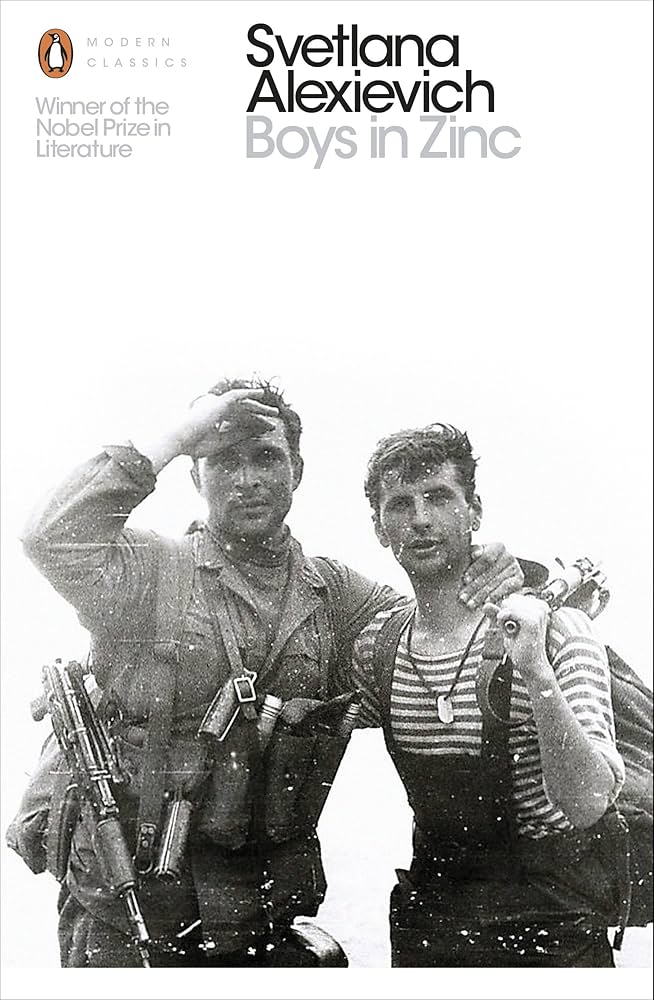
From the first pages, the book unleashes the grief of mothers whose sons returned from the Afghanistan War in “zinc coffins.” This documentary chronicle is built on the testimonies of veterans, nurses, and families who survived the horror of the “undeclared war” and, worse, the betrayal and lies they faced upon returning home. It is a fierce indictment of the system that sent young men to senseless deaths and then refused to acknowledge their trauma.
The focus is not on a love line, but on the boundless maternal love and the sorrow of wives and fiancées who lost their loved ones in this “unnecessary” war.
Browse the table of contents, check the quotes, read the first chapter, find out which famous book it is similar to, and buy “Zinky Boys” on Amazon directly from our page.
“Fear is more human than bravery, you’re scared and you’re sorry, at least for yourself, but you force your fear back into your subconscious.”
“We were told that this was a just war, that we were helping the Afghan people to put an end to feudalism and build a wonderful socialist society.”
“Still remember the way a twenty-year-old shouted, ‘I don’t want to hear about any political mistakes! I just don’t want to! Give me my two legs back if it was all a mistake.'”
“We don’t need anything. Just listen to us and try to understand. Society is good at doing things, ‘giving’ medical help, pensions, flats. But all this so-called giving has been paid for in very expensive currency. Our blood.”
“The Afghans weren’t people to us, and vice versa. We couldn’t afford to see each other as human beings.”
The Eternal Man with a Rifle (Author’s Foreword)
…A person lies on the ground, killed by another person… Not by an animal, not by the elements, not by fate. By another person… In Yugoslavia, Afghanistan, Tajikistan… In Chechnya…
Sometimes a terrible thought flashes about war and its secret meaning. It seems that everyone has gone mad; you look around—the world seems normal: people watch television, rush to work, eat, smoke, fix shoes, slander, sit at concerts. In our world today, the abnormal, the strange one, is not the one who has taken up an assault rifle, but the other one, the one who, like a child, asks, not understanding: why does a person lie on the ground again, killed by another person?
Remember Pushkin: “I love war’s bloody amusements, and the thought of death is dear to my soul.” That is the 19th century.
“Even having destroyed the reserves of universal death, people will retain the knowledge of how to create them again; there is no longer any path back—to ignorance, to the inability to kill everyone and everything.” That is from Ales Adamovich. That is the 20th century.
Art has glorified the god Mars—the god of war—for centuries. And now it is impossible to strip him of his bloody robes…
This is one of the answers as to why I write about war.
I recall how in our village on Radunitsa (the day of commemoration), an old woman knelt over an overgrown mound—without words, without tears, she didn’t even read a prayer. “Go away, girl, you don’t need to look at that,” the village women pulled me aside. “You don’t need to know, no one needs to know.” But there are no secrets in a village; the village lives together. Afterward, I still found out: during the partisan blockade, when the whole village was hiding from the punitive squads in the forest, in the swamps, swelling from hunger, dying of fear, this woman was with everyone, along with her three small girls. One day, it became obvious: either all four would die, or someone would be saved. Neighbors heard the smallest girl asking that night: “Mommy, don’t drown me, I won’t ask you for food anymore…”
Scars remained in my memory…
During one of my trips… A small woman, wrapped in a down shawl in the summer and quickly, quickly uttering, whispering: “I don’t want to talk, I don’t want to remember, for a very long time after the war, for decades, I couldn’t go into meat shops, see cut meat, especially chicken, it reminded me of human flesh, I couldn’t sew anything out of red fabric, I saw so much blood, I don’t want to remember, I can’t…”
I didn’t like reading books about war, yet I wrote three books. About war. Why? Living among death (and the conversations and memories), you are involuntarily hypnotized by the limit: where is it, what is beyond it. And what is a human, how much human is there in a human—these are the questions I seek answers to in my books. And, as one of the heroes of “Zinky Boys” answered: “There is little human in a human, that’s what I understood in the war, in the Afghan rocks.” And another, already an old man, who signed his name on the defeated Reichstag in forty-five, wrote to me: “In war, a human is lower than a human; both the one who kills justly and the one who kills unjustly. All of it is equally similar to ordinary murder.” I agree with him; it is already impossible for me to write about how some people heroically kill others… People kill people…
But our vision is arranged in such a way that even now, when we talk or write about war, for us it is first and foremost the image of the Great Patriotic War, the soldier of forty-five. We were taught for so long to love the man with the rifle… And we loved him. But after Afghanistan and Chechnya, war is something else. Something that, for me, for example, cast doubt on much of what was written (by me too). After all, we looked at human nature through the eyes of the system, not the artist…
War is hard work, constant killing; a person is constantly hovering near death. But time passes, decades, and he remembers only the hard work: how they didn’t sleep for three or four days, how they carried everything themselves instead of a horse, how they melted without water in the sands or froze into the ice, but no one talks about the killing. Why? War has many other faces besides death, and this helps erase the main, hidden thing—the thought of killing. And it is easy to hide it in the thought of death, of heroic demise. The difference between death and murder is fundamental. But in our consciousness, they are combined.
And I remember an old peasant woman telling how, as a girl, she sat by the window and saw a young partisan hit an old miller on the head with a revolver in their garden. He didn’t fall but sat on the winter ground, his head split open like a cabbage.
“And then I went crazy, I lost my mind,” she said and wept. “My mama and papa treated me for a long time, took me to folk healers. Whenever I saw a young man, I would scream, shaking with fever; I saw that old miller’s head, split like a cabbage. I never got married… I was afraid of men, especially young ones…”
Right alongside that is the long-ago story of a female partisan: their village was burned down, her parents were burned alive in a wooden church, and she went to watch the partisans kill captured Germans and policemen. Her frantic whisper remains in my memory: “Their eyes bulged out of their sockets, they burst; they were stabbed with ramrods. I watched, and it made me feel better then.”
In war, a person learns things about himself that he would never have guessed under other circumstances. He wants to kill, he enjoys it—why? This is called the instinct of war, of hatred, of destruction. We don’t know this biological human at all; he is missing from our literature. We underestimated this in ourselves, having believed too much in the power of the word and the idea. Let me add that no story about war, even the most honest one, can compare with the reality itself. It is even more terrifying.
Today we live in a completely different world than the one that existed when I wrote my books about war, and therefore everything is understood differently. No, it is not invented, but re-thought. Can soldier life in the barracks be called normal, based on the divine plan? From the tragically simplified world we lived in, we are returning to the multiplicity of suddenly discovered connections, and I can no longer give clear answers—they don’t exist.
Why do I write about war?
It is easier for our streets with their new signs to change than for our souls. Today we don’t talk; we scream. Everyone screams about their own thing. And with screaming, they only destroy and ruin. They shoot. And I come to such a person and want to restore the truth of that past day… When he killed or was killed… I have an example. There, in Afghanistan, a guy shouted at me: “What can you, a woman, understand about war? A writing lady! Do people die in war like in books and movies? There, they die beautifully, but yesterday my friend was killed, a bullet hit him in the head. He ran for ten more meters, catching his brains… Will you write that?” And seven years later, the same guy—he is now a successful businessman, who likes to talk about Afghanistan—called me: “Why your books? They are too frightening.” That was already a different person, not the one I met amidst death and who did not want to die at twenty…
Truly, a human changes his soul and later doesn’t recognize himself. And a story seemingly about one life, one destiny—is a story about many humans who are somehow called by a single name. What I have been engaged in for twenty years is a document in the form of art. But the more I work with it, the more doubts I have. The only document, a document, so to speak, in its purest form, that doesn’t instill distrust in me, is a passport or a tram ticket. But what can they tell about our time and about us in a hundred or two hundred years (there is no certainty of looking further now)? Only that we had poor printing… Everything else that is known to us by the name of document is versions. It is someone’s truth, someone’s passion, someone’s prejudice, someone’s lie, someone’s life.

Reviews
There are no reviews yet.