Description
This novel is not merely a love story; it is a radical blueprint for a new society, written from a prison cell. It follows the life of the intelligent and determined Vera Pavlovna, who escapes the tyranny of her oppressive family through a fictional marriage to the medical student Dmitry Lopukhov.
Vera goes on to found a successful seamstress cooperative organized around socialist principles, promoting collective labour and gender equality. The novel introduces the concept of “reasonable egoism” and features the famous Fourth Dream of Vera Pavlovna, a detailed, soaring vision of a future utopian communist society housed in crystal palaces.
An immediate literary scandal upon publication, this book became the essential guide for generations of Russian revolutionaries, including Lenin, who famously titled one of his own political tracts after it.
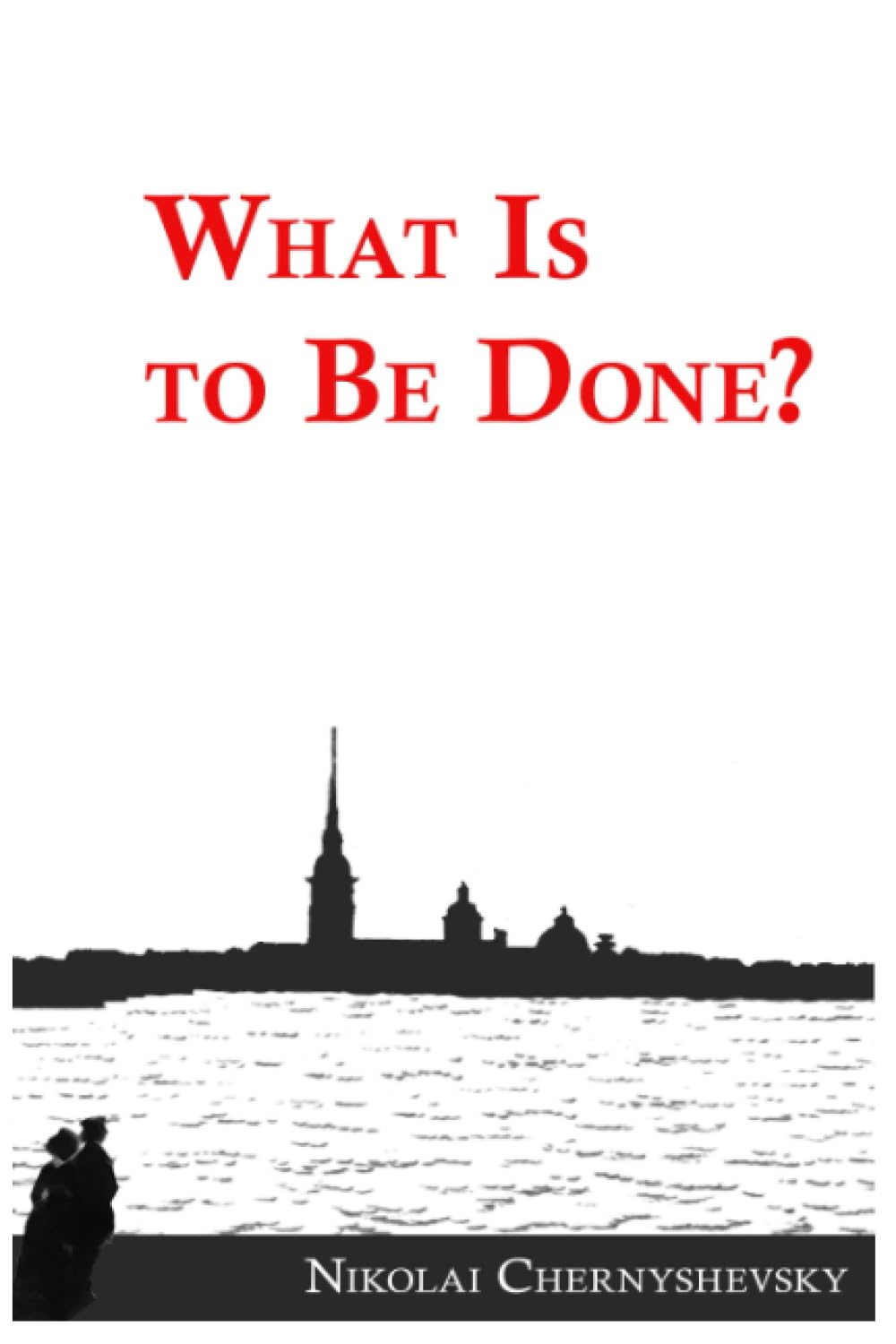
Browse the table of contents, check the quotes, read the first chapter, find out which famous book it is similar to, and buy “What Is to Be Done?” on Amazon directly from our page.
I. A Fool
II. The First Consequence of a Foolish Deed
III. Foreword
Chapter One. Vera Pavlovna’s Life in Her Parents’ Family
I
II
III
IV
V
VI
VII
VIII
IX
Chapter Two. First Love and Legal Marriage
I
II
III
IV
V
VI
VII
VIII. Hamlet’s Test
IX
X
XI
XII. Verochka’s First Dream
XIII
XIV
XV
XVI
XVII
XVIII
XIX
XX
XXI
XXII
XXIII
XXIV. In Praise of Marya Alexevna
Chapter Three. Marriage and Second Love
I
II
III. Vera Pavlovna’s Second Dream
IV
V
VI
VII
VIII
IX
X
XI
XII
XIII
XIV. Kryukova’s Story
XV
XVI
XVII
XVIII
XIX. Vera Pavlovna’s Third Dream
XX
XXI
XXII. A Theoretical Conversation
XXIII
XXIV
XXV
XXVI
XXVII
XXVIII
XXIX. A Special Man
XXX
XXXI. Conversation with a Perceptive Reader and His Expulsion
Chapter Four. Second Marriage
I
II
III
IV
V
VI
VII
VIII
IX
X
XI
XII
XIII. Digression on Blue Stockings
XIV
XV
XVI. Vera Pavlovna’s Fourth Dream
XVII
XVIII. Katerina Vasilievna Polozova’s Letter
Chapter Five. New Faces and the Dénouement
I
II
III
IV
V
VI
VII
VIII
IX
X
XI
XII
XIII
XIV
XV
XVI
XVII
XVIII
XIX
XX
XXI
XXII
XXIII
Chapter Six. Change of Scenery
The most important thing is to be honest.
The principle of reasonable egoism—that is the highest morality.
A decent person will never live by the labour of others.
Let the future generation be happy; let it be free and great, and let it use our names only for remembrance.
A single drop of sweat from a worker is worth more than all the eloquent words and brilliant theories of thinkers who do not work.
I
A Fool
On the morning of July 11, 1856, the staff of one of the large St. Petersburg hotels near the Moscow railway station was puzzled, even somewhat alarmed. The previous day, around nine in the evening, a gentleman arrived with a suitcase, took a room, handed over his passport for registration, ordered tea and a cutlet, said he did not wish to be disturbed in the evening because he was tired and wanted to sleep, but insisted on being woken at eight o’clock the next morning because he had urgent business. He locked his room door, made a little noise with a knife and fork, a little noise with the tea set, and soon quieted down—he was evidently asleep.
Morning came; at eight o’clock, the servant knocked on the door of the previous evening’s arrival—the guest gave no sign of life; the servant knocked harder, very hard—still, the guest did not answer. He must have been very tired. The servant waited a quarter of an hour, tried to wake him again, and again failed. He began consulting with the other servants and the buffet manager. “Could something have happened to him?” — “We should break down the door.” — “No, that won’t do: you must break down the door with the police.” They decided to try waking him one last time, more loudly; if he still didn’t wake up, they would send for the police. They made the final attempt; they failed to rouse him; they sent for the police and were now waiting to see what they would find.
Around ten o’clock in the morning, a police official arrived, knocked himself, ordered the servants to knock—the result was the same as before. “Nothing for it, break down the door, lads.”
The door was broken down. The room was empty. “Take a look under the bed”—the traveller wasn’t under the bed either. The police official approached the table—a sheet of paper lay on the table, and on it was written in large letters:
“I leave at 11 o’clock this evening and will not return. They will hear me on the Liteyny Bridge, between 2 and 3 o’clock at night. Suspect no one.”
“So that’s it, the trick is clear now, but we couldn’t figure it out before,” said the police official. “What is it, Ivan Afanasyevich?” asked the buffet manager. “Give me some tea, and I’ll tell you.”
The police official’s story long served as a subject of lively retelling and discussion in the hotel. The history was of this kind.
At half-past two in the morning—and the night was cloudy and dark—a flash of fire shone on the middle of the Liteyny Bridge, and a pistol shot was heard. The sentries rushed to the sound of the shot, and the few passers-by ran up—there was no one and nothing at the spot where the shot rang out. This meant he didn’t shoot someone else, but himself. Volunteers came forward to dive, grappling hooks were brought after a while, even some kind of fishing net was brought, they dived, felt around, searched, caught half a hundred large wood chips, but they did not find or catch the body. And how could they find it?—the night was dark. By this time it would be in the estuary—go look for it there.
Therefore, the progressives arose, rejecting the former assumption: “But maybe there was no body at all? Maybe he was drunk or simply a prankster—played a fool, fired a shot, and ran off—or perhaps he’s standing right here in the bustling crowd and laughing at the commotion he caused.”
But the majority, as always, when judging sensibly, turned out to be conservative and defended the old view: “What playing the fool—he put a bullet in his head, and that’s all there is to it.” The progressives were defeated.
But the victorious party, as always, split immediately after the victory. He shot himself, yes; but why? “Drunk,” was the opinion of some conservatives; “he squandered his fortune,” others asserted. “Simply a fool,” someone said. They all agreed on this “simply a fool,” even those who rejected that he shot himself. Indeed, whether a drunkard, or a bankrupt, shot himself, or whether a prankster did not shoot himself at all, but only pulled a trick—it was foolish, a fool’s trick all the same.
The matter rested there on the bridge that night. In the morning, at the hotel near the Moscow railway station, it became clear that the fool had not played a trick but had shot himself. But an element remained in the result of the story with which even the defeated agreed, namely, that even if he hadn’t pranked but shot himself, he was still a fool. This satisfactory result for everyone was particularly strong precisely because the conservatives triumphed: indeed, if he had merely pranked with a shot on the bridge, it would, in essence, still be debatable whether he was a fool or just a prankster. But he shot himself on the bridge—who shoots himself on a bridge? How could it be on a bridge? Why on a bridge? It’s stupid to do it on a bridge!—and therefore, undoubtedly, a fool.
Again, doubt arose in some: he shot himself on the bridge; people don’t shoot themselves on a bridge—therefore, he didn’t shoot himself. But towards evening, the hotel staff was called to the police station to look at a bullet-ridden cap pulled out of the water—everyone recognized that the cap was the very one the traveller wore. Thus, it was undoubtedly a suicide, and the spirit of denial and progress was utterly defeated.
Everyone agreed that he was “a fool”—and suddenly everyone started saying: on the bridge—what a clever trick! That is, so he wouldn’t suffer long if the shot didn’t succeed well—he reasoned smartly! From any wound, he would fall into the water and drown before he knew what hit him—yes, on the bridge… clever!
Now it was impossible to discern anything clearly—it was both a fool and clever.



Reviews
There are no reviews yet.