Description
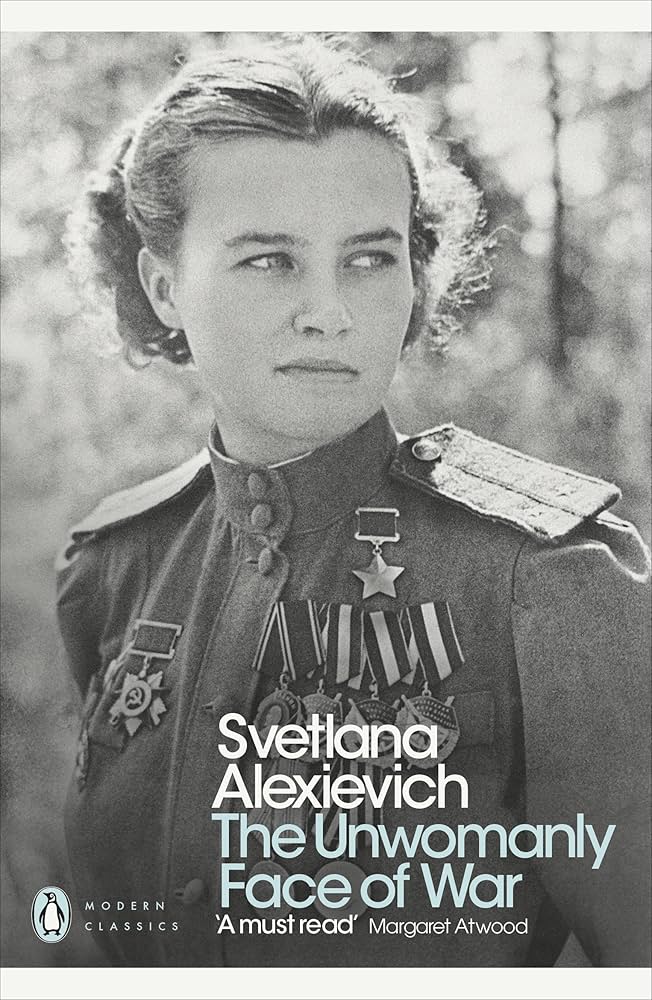
The book opens with the shocking, intimate revelations of hundreds of women who participated in the Great Patriotic War. From a sniper who recounts the difficulty of taking the first shot to a nurse who shares the details of fear, hunger, and filth on the front lines. Alexievich records these monologues to restore the authentic, emotional history of the war, a history that was erased by the heroic myth.
These pages are filled with episodes of tragically short, yet desperate love between combatants who yearned for tenderness and normal life despite the proximity of death, making their stories even more poignant.
Browse the table of contents, check the quotes, read the first chapter, find out which famous book it is similar to, and buy “War’s Unwomanly Face” on Amazon directly from our page.
• “I don’t want to remember…”
• “Grow up, girls… You are still green…”
• “I was the only one who returned to Mama…”
• Two wars live in our house
• “The telephone receiver doesn’t shoot…”
• “We were awarded small medals…”
• “It wasn’t me…”
• “I remember those eyes even now…”
• “We didn’t shoot…”
• “A soldier was needed… But I also wanted to be beautiful…”
• “Just to look once…”
• “…About the small potato”
• “Mama, what is a papa?”
• “I can’t stand seeing children play ‘war’…”
“I write not about war, but about human beings in war. I write not the history of a war, but the history of feelings. I am a historian of the soul.”
“There can’t be one heart for hatred and another for love. We only have one, and I always thought about how to save my heart.”
“Women’s” war has its own colors, its own smells, its own lighting, and its own range of feelings. Its own words. There are no heroes and incredible feats, there are simply people who are busy doing inhumanly human things.”
“In the center there is always this: how unbearable and unthinkable it is to die. And how much more unbearable and unthinkable it is to kill, because a woman gives life. Gives it. Bears it in herself for a long time, nurses it. I understood that it is more difficult for women to kill.”
“I believe that in each of us there is a small piece of history. In one half a page, in another two or three. Together we write the book of time.”
«I don’t want to remember…»
The old three-story house on the outskirts of Minsk, one of those built right after the war, long and comfortably overgrown with jasmine bushes. This is where the search began—a search that would last four years and has not ended even now, as I write these lines. Although, at the time, I didn’t suspect it yet.
I was led here by a small note in the city newspaper about Maria Ivanovna Morozova, a senior accountant at the “Udarnik” Road Machine Factory in Minsk, who was recently retiring. During the war, the note read, she was a sniper and had eleven military awards. It was difficult to reconcile the military profession of this woman with her peaceful occupation. But in this very incongruity, I had a premonition of the answer to the question: who became a soldier during 1941–1945?
…A small woman with a touching, maidenly wreath of long braids around her head, looking nothing like her blurry newspaper photograph, sat in a large armchair, covering her face with her hands:
“No, no, I don’t want to remember… My nerves are shot. I still can’t watch war movies…”
Then she asked:
“Why me? You should talk to my husband, he’s the one who could tell you… He remembers the names of commanders, generals, unit numbers—everything. But I don’t. I only remember what happened to me. What’s lodged in my soul like a nail…”
She asked me to put the tape recorder away:
“I need your eyes to tell the story, and it will get in the way.”
But after a few minutes, she forgot about it…
Maria Ivanovna Morozova (Ivanushkina), Corporal, Sniper:
“Where my native village Dyakovskoye stood, is now the Proletarsky district of Moscow. The war started, I was not yet eighteen years old. I worked on the collective farm, then finished accounting courses, and started working. And at the same time, we attended courses at the military commissariat. There, they taught us how to shoot a military rifle. Forty people were in the club. Four people were from our village, five from the neighboring one—in a word, a few people from each village. And all girls… The men who could already went to the front…
Soon there was a call from the Central Committee of the Komsomol and the youth to defend the Motherland, since the enemy was already near Moscow. Not only I, but all the girls expressed a desire to go to the front. My father was already fighting. We thought we were the only ones… But when we arrived at the military commissariat, there were many girls. The selection was very strict. First, of course, you had to have strong health. I was afraid they wouldn’t take me because I was often sick as a child and was weak. Then, if there was no one left in the house besides the girl who was going to the front, they also refused, because a mother could not be left alone. Well, I had two sisters and two brothers remaining, although they were all much younger than me, but it still counted. But there was another thing—everyone had left the collective farm, there was no one to work in the fields, and the chairman didn’t want to let us go. In a word, they refused us. We went to the Komsomol district committee, and they refused us there too.
Then a delegation from our district went to the Komsomol regional committee. They refused us again. And we decided, since we were in Moscow, to go to the Komsomol Central Committee. Who would report? Who among us was brave? We thought we would be alone there, but you couldn’t squeeze into the corridor, let alone get to the secretary. There was youth from all over the Soviet Union, many who had been under occupation, eager for revenge for the death of their loved ones.
In the evening, we finally got to the secretary. They asked us: ‘Well, how will you go to the front if you don’t know how to shoot?’ And we said that we had already learned… ‘Where?.. How?.. And can you do bandages?’ You know, the district doctor taught us bandaging in that same circle at the military commissariat. Well, we had a trump card: that we weren’t alone, that we had forty more people, and they all knew how to shoot and provide first aid. They told us: ‘Go and wait. Your request will be granted.’ And literally a couple of days later, we had call-up papers in our hands…
We came to the military commissariat, they immediately led us in one door and out another: I had very beautiful braids, I was proud of them. I came out without them… And they took my dress. I didn’t have time to give my mother either the dress or the braids… She begged that something of mine, something mine, would remain with her… They immediately dressed us in tunics and side caps, gave us duffel bags, and loaded us into a freight train…
We didn’t know yet where we would be assigned, where we were going? In the end, it didn’t matter so much to us who we would be. Just to be on the front. Everyone is fighting—so are we. We arrived at Shchyolkovo station, not far from it was a women’s sniper school. It turned out we were going there.
We started training. We studied regulations—garrison duty, disciplinary codes, field camouflage, chemical defense. The girls all tried very hard. We learned to assemble and disassemble the ‘sniper rifle’ with our eyes closed, determine wind speed, target movement, distance to target, dig firing pits, crawl on our bellies—we already knew all of this. At the end of the courses, I passed my shooting and drill with an ‘excellent.’ The hardest thing, I remember, was getting up on alert and getting ready in five minutes. We took boots one or two sizes larger so as not to waste time, to quickly get ready. In five minutes, we had to get dressed, put on our boots, and stand in formation. There were cases when girls ran out into formation in boots on their bare feet. One girl almost got frostbite. The sergeant major noticed, reprimanded us, and then taught us how to wrap footcloths. He would stand over us and bellow: ‘How can I, girls, make soldiers out of you, and not targets for the Krauts?’
Well, and then we arrived at the front. Near Orsha… In the Sixty-Second Rifle Division… The commander, I remember him clearly, Colonel Borodkin, saw us and got angry: they foisted girls on me. But then he invited us in and treated us to dinner. And, we overheard him asking his adjutant: ‘Do we have anything sweet for tea?’ We were offended: who does he take us for? We came to fight… But he treated us not as soldiers, but as girls. By age, we were his daughters. ‘What am I going to do with you, my dears?’—that’s how he treated us, that’s how he met us. But we imagined ourselves to be hardened warriors…
The next day, he made us demonstrate how we could shoot and camouflage ourselves in the field. We shot well, even better than the male snipers who had been recalled from the front line for a two-day course. And then field camouflage… The Colonel arrived, walked around examining the clearing, then stepped onto one tuft of grass—nothing was visible. And then the ‘tuft’ pleaded beneath him: ‘Oh, Comrade Colonel, I can’t take it anymore, it’s heavy.’ Well, what a laugh that was! He couldn’t believe you could camouflage yourself that well. ‘Now,’ he says, ‘I take back my words about the girls.’ But he was still very worried, afraid for us; when we went to the front line, he warned us every time to be careful and not to risk needlessly.
The first day we went out ‘hunting’ (that’s what snipers called it), my partner was Masha Kozlova. I camouflaged myself, we were lying there: I was observing, Masha—with the rifle. And suddenly Masha says to me:
‘Shoot, shoot! Look, a German…’
I tell her:
‘I’m observing. You shoot!’
‘By the time we figure this out,’ she says, ‘he’ll be gone.’
And I tell her my thing:
‘First, we need to draw up a firing chart, mark the landmarks: where the barn is, the birch tree…’
‘Are you going to stir up paper bureaucracy, like in school? I came here not to deal with papers, but to shoot!’



Reviews
There are no reviews yet.