Description
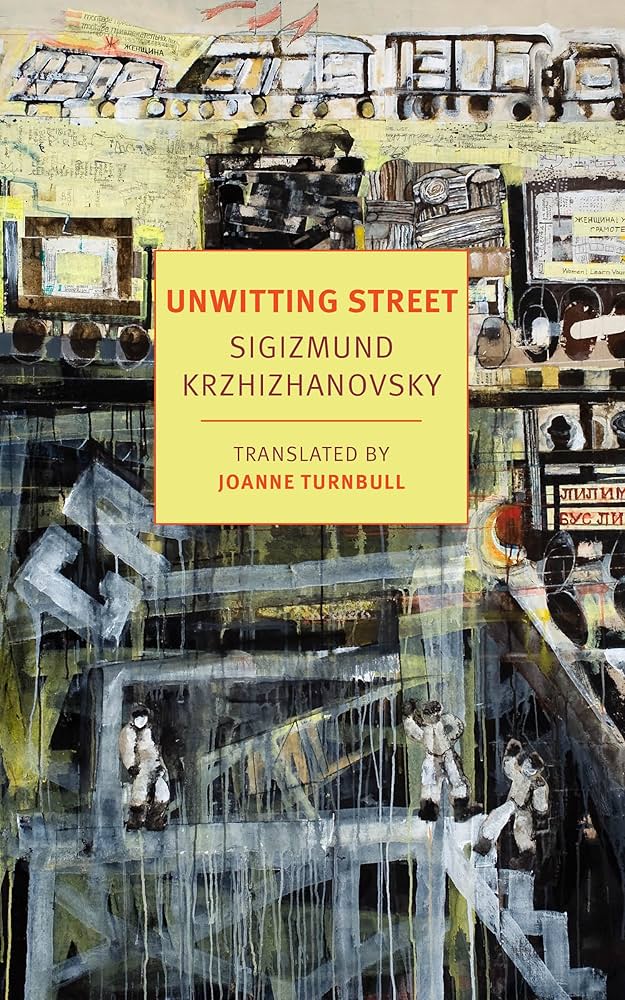
A Moscow musician suddenly realizes that his art, his scores, and notes, are literally written into the fabric of the city. Streets, houses, and passersby begin to sound, obeying a hidden but real musical code. He tries to escape this hyper-reality but finds himself trapped within his own melody, trying to decipher the enigma of his involuntary masterpiece — or his madness.
This conceptual novella erases the boundary between art and physical space, transforming the city into a strange and living instrument.
Browse the table of contents, check the quotes, read the first chapter, find out which famous book it is similar to, and buy “Unwitting Street” on Amazon directly from our page.
“Do not despair, my esteemed friend. Essentially, if you think about it, you have one life and I have one life. And have we paid even a penny for them?”
“…The echo joyfully threw itself into the rain and the bass rumble of the thunderstorm. ‘Oh, people like me do not perish, do not perish, they give, ive, ve, e, e, e, e,’ it joyfully echoed to itself…” (from the story The Unemployed Echo).
“We are separated by the underground, they are separated by a fence of bayonets. And all this semblance of unity moves only thanks to a system of crutches.”
“I like to live as the nameless finger: so that no one can discover your…”
“The city greeted the provincial arriving echo with rumbles, clangs, and grinding. ‘There will be profit here. So much sound, so much sound’…” (from the story The Unemployed Echo).
My dear friend! The fate of belated letters is well known: at first, they are awaited; then, people stop waiting. I know: my envelope, stamped “Moscow,” is already futile and unnecessary. But there was no other way: I myself was living inside a hermetically sealed envelope. I’m only just crawling out. Two years have clicked off like abacus beads: only a bare rod remains. You will forgive and understand this, my dear friend, because you are… my dear friend.
But will you forgive me the disappointment: for under my “Moscow” stamp, you will find nothing but reflections on stamps bearing the “Moscow” imprint. For me, this topic is close and important. For you, from a distance of 700 versts, it is alien and perhaps boring. But I can only write about what I can: I have so fully immersed myself in my problem of stamps, so engrossed, perhaps whimsically, in the study of that “special imprint,” which Griboyedov also noticed, and which distinguishes and brands all the life currently surrounding me, that I cannot and do not know how to invent other, more amusing and exciting topics for you.
Every morning at 9:45, I button myself into my coat and set off in pursuit of Moscow. Yes, indeed: two years ago, the train, which I remember was 13 hours late, only delivered me as far as the Bryansky Station: the actual meaning of Moscow is still a long way off from there.
So, every morning I stride from lane to lane, allowing the intersections to break my path as they please, gathering Moscow into myself. Right beside me, if I turn my head halfway, a slightly hunched, tall man with a face under the black brim of a hat walks in the plate glass of the shop windows. Together, occasionally glancing at each other, we search for our meanings.
It’s strange: on the first day, when, my shoulder pulled down by my suitcase, I looked from the Dorogomilovsky Bridge at the heap of houses beneath a heap of lights, I could not have imagined that all this would someday lie like a giant mound across my thinking as a difficult, insoluble task.
Of course, others, each as they can and wish, wrestle with one problem or another; under every brow bone lives some question that fails to satisfy the mind, a question that torments the “I.” But still, I envy others: each of them can hide their problem inside their draft notebooks, lock it with a key in a laboratory, or confine it in mathematical symbols—more precisely, they can, if only for a short time, step away from their puzzle, disconnect from it, give their thoughts a rest. But I cannot escape my subject: I live inside it. The windows of the houses I pass look out with a definite expression; in the morning, barely opening my eyes, I see the red bricks of the neighboring house: this is already Moscow. Which means—the thought: Moscow. The problem has materialized, surrounded me with a thousand stone boxes, stretched beneath my soles in a thousand crooked and broken streets,—and I, the ridiculous eccentric studying his where, have fallen into it, like a mouse into a trap.
When I first walk past the faded yellow building stamped with the signs of the Central Committee of the R.C.P.(b.), and half an hour later past the crooked bell tower of the Church of the Nine Martyrs on Kochnochki, near the Humpback Bridge, I cannot help but make a desperate attempt to find a common denominator between the one and the other. I walk past bookshop windows with covers that change every day: Moscow. Past beggars blocking the path with outstretched palms: Moscow. Past the fresh printer’s ink, stamped over white stacks with the sharp black word “Pravda”: Moscow.
Moscow is too trodden; too many footsteps have accumulated on its asphalt and cobblestones: people just like me walked, day after day, year after year, century after century, from intersection to intersection, across squares, past churches and markets, enclosed by the circuit of walls, included in the circuit of thoughts: Moscow. Footprints lie upon footprints, and more footprints; thoughts upon thoughts, and more thoughts. Too much has been heaped into this pile, enclosed by the long line of the Kamer-Kollezhsky Val. I, at least, verify everything with a symbol, perhaps vague but persistent: Moscow.
The white mansion on Nikitsky, 7b, gloomily turned sideways to the street noise, explains the soul of one of its residents better than Shenrok.
Even now, magazine columns pound at the half-dead word “Slavophilism,” but to anyone who wished to visit the dilapidated Khomyakov house on Sobachy Lane one Sunday between two and four, the corner room of the house, the so-called “talking shop,” would explain everything more definitively and sharply: against its blind, windowless walls, moved close together (a distance of one sazhen), stands a worn leather sofa for five or six people; in the corner, a stand for pipe stems. And that is all. In this blind, cramped, and dark room, the Slavophiles, sitting knee-to-knee, argued themselves completely out.
Tram No. 17, which goes to Novodevichy, shows the name Vladimir Solovyov much better than any books. The name is written in black, tangled script across a white cross, between three icons of differing sizes. If one looks closely at the faded letters of one of them, the lower one, all one can read is: erit…
But it will be. Just start stirring this heap, pull one thread, and behind it comes the whole enormous, tangled ball: Moscow. You are probably wondering: how did what I call my problem attach itself to me, how did my wanderings through the meanings of Moscow begin?
Very simply. The quadrature of my room is 10 sq. arshins (about 50 sq. ft.). Too little. You know my old habit of pacing from corner to corner when thinking something over, when toiling with concepts. Here, the corners are too close to each other. I tried: if the table is flush with the windowsill, and the chair is on the bed, it frees up: three steps along, one and a half across. Not much room to stretch out. And so, I was forced: as soon as a thought starts pacing in my head and I myself long to do the same, I lock up my three steps with a key and run out into the street, along its crooked, long lines.
It is impossible to save the life hidden between the temporal bones from the life swirling around you, to think along the street without seeing the street. No matter how much I concentrated my images, no matter how much I protected my thoughts from external jolts, it proved unfeasible. The street is intrusive: it forces its way even under lowered eyelids, it treads roughly and persistently on my eardrums, it is felt as cobblestones through my worn soles. From the street, one can only turn, flee into a lane, and from the lane—into a dead end. And then start again. The city, with its clangs, rustles, and words torn into letters, beats on the brain, persistently climbs into the head until it fills it, right up to the crown, with the tatters and motley of its fleeting moments.
There is definitely some passivity in me. At first, I resisted. Then I stopped: I let the city into myself. When I walked, tapping a dotted line of steps over the long lines of the streets, I sometimes felt this dotted line tighten into a continuous line, fused with the line of the streets. Sometimes, stopping at a deserted intersection, I clearly heard the hollow beating of Moscow between my temples. And sometimes, strangely enough: you walk, quickening your steps, from lane to lane, and at the moment of an abrupt stop in thought, looking around, you suddenly see yourself inside a stone dead-end bag with small, curtained windows and crooked lanterns along the sidewalks. Yes, more than once I noted with a certain joy how the lines of my thought coincided with the lines charting the city: turn after turn, break after break, curve after curve: with the precision of a geometric superposition.
Little by little, I began to get drawn into this game of the soul with space: in the evenings, I loved to pace rhythmically along a row of lanterns, glancing at the shadow creeping behind me. Reaching a lamppost, I would pause my steps for a moment and know that this was the moment when the shadow would suddenly, treading silently, overtake me and, strangely twitching, walk ahead at an angle of 90 degrees to me. Or, gazing around, I would follow the regular increase in the white-on-blue numbers on the left and right: 1—3—5—7… and 2—4—6—8… Well, I’ve written too much. Two stamps probably won’t even cover this.
I unfolded the map of Moscow. Now I plan to pore over this spot, round like a stamp, motley, spread out with painted annual rings: no, it won’t escape me. I will take it into an iron enclosure.


Reviews
There are no reviews yet.