Description
The plot revolves around the search for and analysis of a manuscript about a certain Symmetry Teacher, who may be the protagonist, the author, or even the reader themselves. The essence of the story is a multilayered game with reality and literature: the main character, a philologist, fruitlessly searches for ideal symmetry in the world and in art, trying to solve the riddle of his own existence.
The narrative constantly shifts genres, styles, and versions of events, including elements of a novel within a novel and a philosophical essay. The climax is the protagonist’s realization that the search for absolute symmetry may be a form of madness, and the book itself is a metaphor for the search for meaning and structure in chaotic reality.
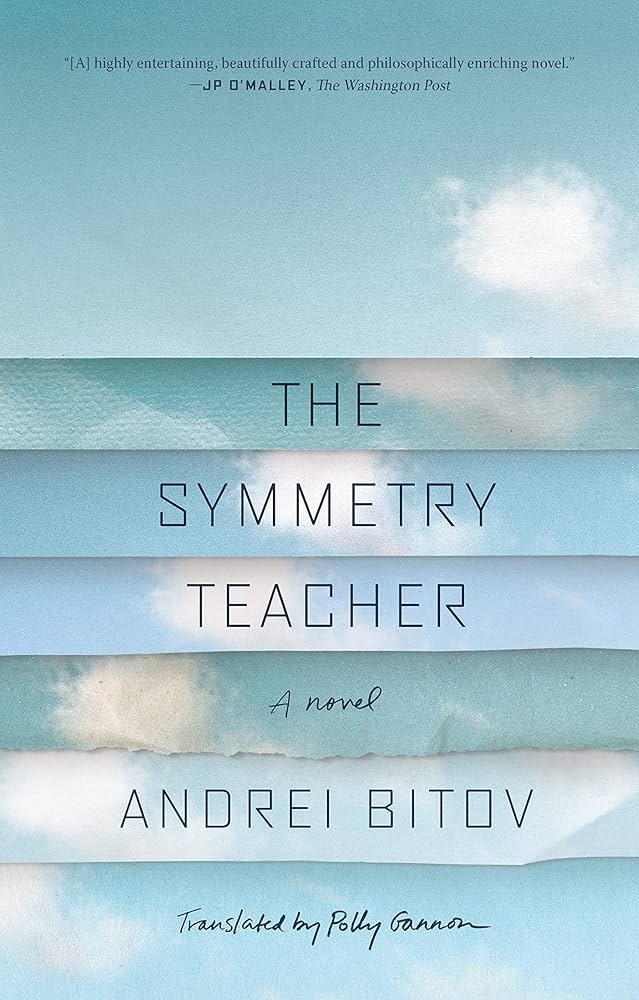
Browse the table of contents, check the quotes, read the first chapter, find out which famous book it is similar to, and buy “The Symmetry Teacher” on Amazon directly from our page.
Translator’s Preface
I
• The View of Troy’s Sky (Future in the Past)
• O — A Number or a Letter? (Freud’s Family Doctor)
• At the End of the Sentence (The Talking Ear)
II
• The Forgetful Word (A Couple of Coffins from a Cup of Coffee)
• Posthumous Notes of the Tristram Club (The Inevitability of the Unwritten)
• The Battle of Alphabet (King of Britannica)
III
• Emergency Call (Dooms Day)
• Postscript
• Irina Surat Between Text and Life (The Formula of the Crack)
“Symmetry is the search for yourself in another, and the recognition of another in yourself.”
“The teacher is not the one who teaches, but the one who teaches to learn.”
“A writer’s greatest misfortune is to become understandable.”
“In the end, all books are one book, and all lives are one life.”
“Language is the first victim of thought, and thought is the first victim of silence.”
The View of Troy’s Sky
(Future in the Past)
As a flash of lightning,
As a vanishing dewdrop,
As a ghost—
The thought of one’s self.
Prince Ikkyū
I am the only person in the world who could shed some light on the enigmatic demise of Urbino Vanoski. But, alas, it is not within my power. A legend is a legend for a reason—it is unshakable. He died just like that, or rather, he resurrected in the consciousness of readers and critics—in complete obscurity, unaware of his fame, poor as a church mouse (I wouldn’t use such a comparison if it weren’t literal: according to legend, he served as a caretaker in a Catholic church and sold candles during the last years of his life). His grave is lost—this is beautiful: his lifetime obscurity feeds the rays of his belated fame, and they superheat his non-existent gravestone. The largest literary prize during his lifetime remained forever posthumous for him, establishing the Fund named after him, with the proceeds of which we, his researchers, gather annually somewhere on the Adriatic, and then publish the volume of our own debates, leaving nothing for the benefit of potential geniuses among church caretakers.
The Vanoski boom, concerning an unknown author of the 30s and 40s, which occurred in the late sixties, is entirely the merit of the Fund’s permanent chairman, W. Van-Book, and I will be disgracefully expelled by my colleagues from our close-knit ranks if I attempt to shake the myth he erected. No one will believe me; they will convincingly refute me, accuse me of falsification… And where will my annual summer vacation be then?
Meanwhile, Urbino Vanoski was not a church caretaker—he was an elevator operator. And he died (or maybe he hasn’t died yet…), knowing about his sudden fame and his Grand Prix—knowing. For it was I who found him before his death (or maybe not before…), who saw him last, who informed him of all this joyful news. And it was to me that he gave his final interview. It wasn’t even an interview, but a confession. I don’t know why he chose me for this; perhaps because he disliked me at first sight. Not everything in this confession should be believed, I have reason to suspect that his mind was not entirely sound. For instance, to the question of how he felt about such a high award, he replied that he expected a bigger one. “Which one?” I couldn’t help but ask. “Death,” he answered calmly. But what particularly enraged him was a routine question about what he was currently working on. “Thank God,” he flared up, “I have never been a laborer!” I corrected myself as best I could: what was he writing? “Painters write! So if I write, it’s landscapes. Why are you asking when you haven’t even read what has already been written!” I took this to mean that he had something unpublished. “Hardly,” he cut off. “Though, after every decent writer, something worthy of posthumous publication ought to remain.” I wouldn’t be myself if I didn’t latch onto that. “Well, yes, there is, there is…” he yielded reluctantly yet willingly. “There is one unfinished novel, Life Without Us it’s called… or Burial Alive?… I don’t even remember the title!… but I doubt I’ll finish it… life will finish it.”
“About the afterlife?…” I inquired.
“About this life!” he was annoyed. “How can you know which side is this and which side is that?!” He must have been taken aback by my discouraged look; he glanced at me as if I were a child, and his eyes became beautiful again. “There is one novel, perhaps almost finished… but I cannot find it. Though, it’s no wonder, it’s called The Disappearance of Objects. There… No, I won’t retell it! That’s bad form.”
Have you never completely forgotten a word? You know it exactly, but are incapable of reproducing it?… You say it happens to everyone? But then you still remember it later. But to forget it forever, for your entire life! I had one such key word in my life; I only remembered it once in my life, but then immediately got caught in a storm and forgot it forever. Until this day… Surely it means something that it was precisely that word and precisely me! And have you observed how sunflowers remember the sun so they don’t forget it until morning? The old man’s eye lit up cunningly. “You wanted me to write you a landscape, didn’t you?… Fine. It will be a landscape that no one, except the ancient Greeks, has ever seen…”
“…I think the same fields of sunflowers might have existed in Ancient Greece. We observed this together with Dika, in Italy, no, not Ancient Italy anymore.” For conviction, he felt his calf to show where it was. “In Umbria… There was a huge sunflower field past which we climbed the mountains to meet sunrises and sunsets. Everyone knows that sunflowers always face the sun. They catch every ray. They even drew it onto their little faces, like children. We walked past and smiled at them, and they smiled at us. At sunset, however, they looked more collected and concerned, like a formation of soldiers waiting for a command. It would seem they should catch its last ray… and suddenly they all turn away from the sun as a whole formation, showing us their evenly cropped backs of the head! It’s incomprehensible. They aren’t offended at the sun, are they?”
“I could only explain it to myself this way: they prepared to meet the first ray, not to see off the last! They use the energy of the setting sun to turn toward the rising sun! There must be more useful light for them in the rising sun. Dika did not accept my theory, although she knew something about biology, unlike me. But she was more interested in animals, while plants always attracted me more. I told her about the sunflowers, and she told me about the goats. Why, she asked, do they always walk up the slope in one direction? So inconvenient, always in one direction? They never turn back… I told her that it was a special, mountain breed: their right legs are shorter than their left ones. ‘But how do they go back??’ Dika worried about them. ‘They’d tip over!’ ‘So they have to walk in circles all their lives,’ I found a suitable explanation. And she believed it. She was very simple-hearted.”
The old man’s face suddenly became severe, and he continued in this manner:
“You see, life is a text. Unread by the living. But the text is also life! In every line must lurk the mystery of the future line. Like in life—the unannounced nature of the next moment. We are not sunflowers. We are goats. In America, she wondered where Americans got so many turkey legs for Thanksgiving. I easily convinced her that Americans bred a special four-legged breed for this purpose, you understand?…” The old man noisily blew his nose and dabbed his teary eyes.

Reviews
There are no reviews yet.