Description
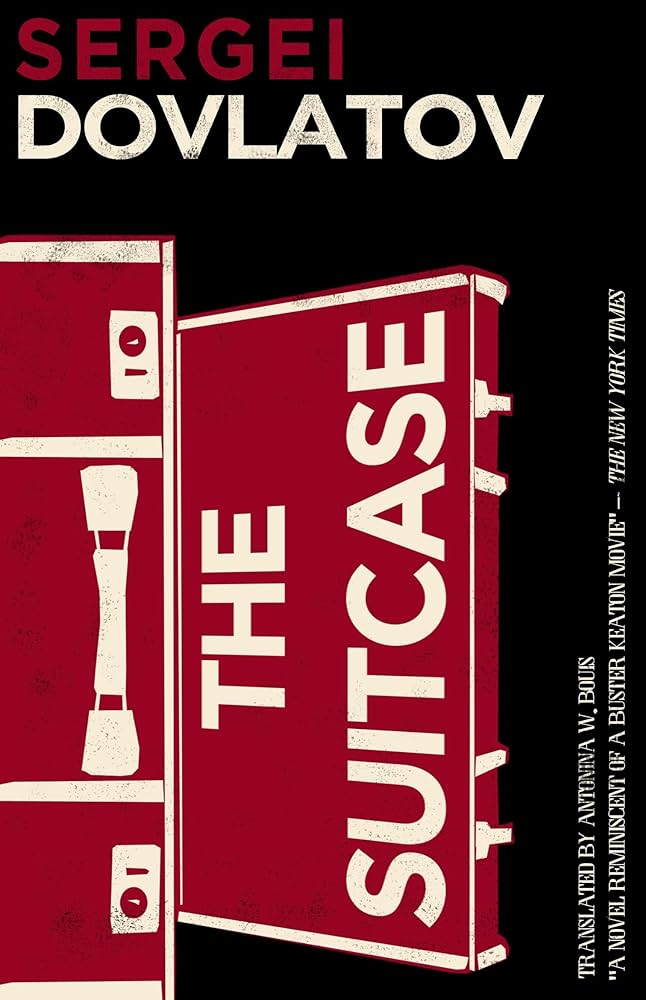
Upon emigrating, the journalist managed to take with him only one blue Finnish suitcase. Inside were eight completely random objects, each of which serves as the key to a separate, often absurd and tragicomic story from his past life.
Among these relics are a decent but worn suit of a deceased bandit; crepe women’s stockings, symbolizing a failed, yet important romance; and a double-breasted jacket that almost landed the hero in prison because it belonged to a KGB agent.
These stories blend into a caustic yet incredibly tender portrait of life in the 1970s, where endless drinking bouts, attempts to earn money, and personal dramas unfold against a backdrop of total bureaucracy. Ultimately, the hero realizes that this suitcase, full of ridiculous secrets and contradictions, is his entire life, and its inherent irony helped him survive.
Browse the table of contents, check the quotes, read the first chapter, find out which famous book it is similar to, and buy “The Suitcase” on Amazon directly from our page.
“There’s a reason every book, even one that isn’t very serious, is shaped like a suitcase.”
“If Hemingway is to be believed, poverty is an invaluable school for a writer. Poverty makes a man clear-sighted. And so on. It’s interesting that Hemingway realized this only when he became rich.”
“Most people consider problems whose solutions don’t suit them to be insoluble. And they constantly ask questions to which they don’t need truthful answers.”
“Sales were lukewarm. Back home there was no freedom, but there were readers. Here there was freedom enough, but readers were missing.”
“I looked at the empty suitcase. On the bottom was Karl Marx. On the lid was Brodsky. And between them, my lost, precious, only life.”
Foreword
In the OVIR (Visa and Registration Department), that bitch said to me:
“Every person leaving is allowed three suitcases. That is the established norm. There is a special ministry order.”
It made no sense to argue. But, of course, I objected:
“Only three suitcases?! What about my things?”
“Such as?”
“For example, my collection of racing cars?”
“Sell them,” the functionary replied without pausing.
Then she added, slightly frowning: “If you are dissatisfied with something, write a statement.”
“I’m satisfied,” I said.
After prison, I was satisfied with everything.
“Well, then behave more modestly…”
A week later, I was packing. And as it turned out, one single suitcase was enough.
I almost burst into tears from self-pity. After all, I was thirty-six years old. I had been working for eighteen of those years. Earning something, buying things. Possessing, as it seemed to me, some property. And the result? One suitcase. Moreover, a fairly modest size one. Did this mean I was a pauper? How did this happen?!
Books? But mostly, I had banned books, which customs would not allow. I had to give them away to acquaintances along with the so-called archive. Manuscripts? I had sent them to the West by secret means long ago. Furniture? I took the writing desk to a consignment store. The chairs were taken by Chegin, an artist who had been making do with crates. I threw out the rest.
So I left with one suitcase. It was plywood, covered with cloth, with nickel-plated metal corners. The lock was broken. I had to tie the suitcase with a clothesline.
I used to travel with it to Pioneer camp. “Junior Group. Seryozha Dovlatov” was written on the lid in ink. Next to it, someone had kindly scratched, “shit cleaner.” The cloth was torn in several places.
The inside of the lid was covered with photographs. Rocky Marciano, Armstrong, Joseph Brodsky, Lollobrigida in transparent clothes. The customs officer tried to tear off Lollobrigida with his fingernails. He only scratched it.
He didn’t touch Brodsky. He just asked, “Who is this?” I replied that he was a distant relative…
On May 16th, I arrived in Italy. I stayed at the Hotel Dina in Rome. I pushed the suitcase under the bed.
Soon I received some royalties from Russian magazines. I bought blue sandals, flannel jeans, and four linen shirts. I never opened the suitcase.
Three months later, I moved to the United States. To New York. First, I lived in the Hotel Rio. Then with friends in Flushing. Finally, I rented an apartment in a decent area. I put the suitcase in the far corner of the closet. I never untied the clothesline.
Four years passed. Our family was reunited. My daughter became a young American. My son was born. He grew up and started being mischievous. One day my wife, driven to exasperation, shouted:
“Go to the closet right now!”
My son spent about three minutes in the closet. Then I let him out and asked:
“Were you scared? Did you cry?”
And he said:
“No. I was sitting on the suitcase.”
Then I took out the suitcase. And opened it.
On top was a decent double-breasted suit. Intended for interviews, symposiums, lectures, and formal receptions. I suppose it would have served well for the Nobel ceremony. Next—a poplin shirt and shoes wrapped in paper. Beneath them—a velvet jacket with faux fur lining. To the left—a winter hat made of fake sealskin. Three pairs of Finnish crepe socks. Chauffeur’s gloves. And finally—a leather officer’s belt.
At the bottom of the suitcase lay a page from Pravda from May 1980. A large headline proclaimed: “Long Live the Great Doctrine!” In the center was a portrait of Karl Marx.
As a schoolboy, I loved drawing the leaders of the world proletariat. Especially Marx. Smear an ordinary ink blot—it already looks like him…
I looked at the empty suitcase. On the bottom was Karl Marx. On the lid was Brodsky. And between them, my lost, precious, only life.
I closed the suitcase. Inside, the mothballs clunked hollowly. The things lay in a colorful pile on the kitchen table. This was everything I had acquired in thirty-six years. In my entire life in the homeland. I thought—is this all? And I answered—yes, this is all.
And then, as they say, memories surged. Perhaps they were lurking in the folds of those shabby rags. And now they burst out. Memories that should be called—”From Marx to Brodsky.” Or, let’s say—”What I Acquired.” Or, perhaps, simply—”The Suitcase”…
But, as always, the foreword got dragged out.
Crepe Finnish Socks
This story happened eighteen years ago. At that time, I was a student at Leningrad University.
The university buildings were in the old part of the city. The combination of water and stone creates a special, majestic atmosphere here. In such surroundings, it is hard to be lazy, but I managed it.
There are exact sciences in the world. Which means there are also inexact ones. Among the inexact, I think philology takes first place. That’s how I became a philology student.
A week later, a slender girl in imported shoes fell in love with me. Her name was Asya.
Asya introduced me to her friends. They were all older than us—engineers, journalists, cinematographers. There was even a shop manager among them.
These people dressed well. They liked restaurants and travelling. Some had their own cars.
They all seemed mysterious, powerful, and attractive to me then. I wanted to be accepted in their circle.
Later, many of them emigrated. Now they are normal elderly Jews.
The life we led required significant expenses. Most often, they fell on the shoulders of Asya’s friends. This embarrassed me greatly.
I remember Doctor Logovinsky discreetly slipping me four rubles while Asya was ordering a taxi…
All people can be divided into two categories: those who ask. And those who answer. Those who ask questions. And those who frown in irritation in response.
Asya’s friends did not ask her questions. But all I did was ask:
“Where were you? Who did you say hello to in the subway? Where did you get French perfume?”
Most people consider problems whose solutions don’t suit them to be insoluble. And they constantly ask questions, although truthful answers are completely unnecessary to them…


Reviews
There are no reviews yet.