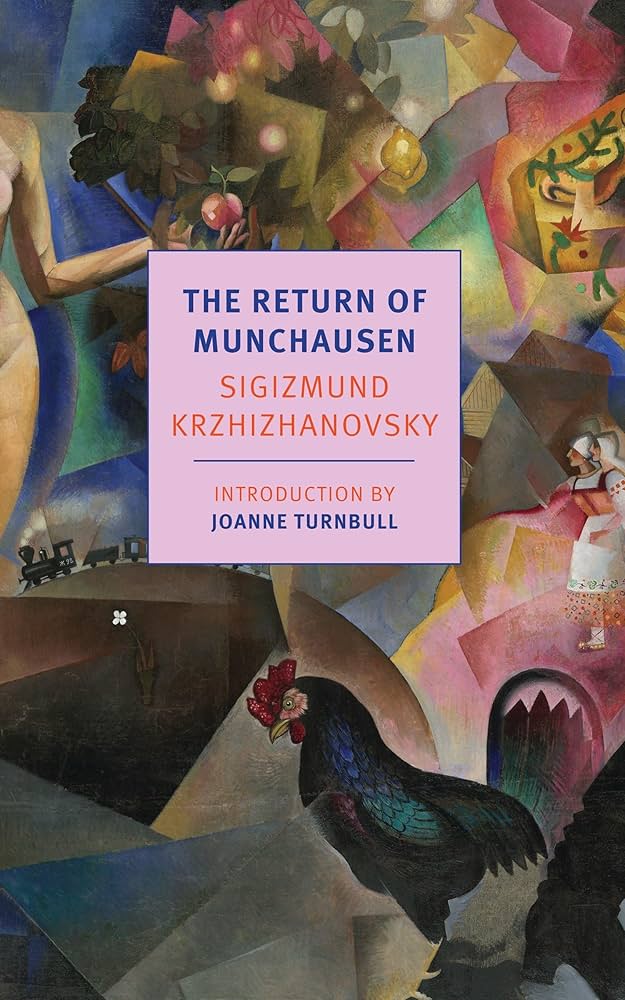
Chapter I. Every Baron has his own fantasy
The pedestrian crossed the Alexanderplatz and reached out to the faceted frames of the entrance. But at that moment, from the streets that had converged like a star, the shouting mouths of newsboys cried out:
“Revolt in Kronstadt!”
“Down with the Bolsheviks!”
The pedestrian, hunching his shoulders against the spring chill, thrust his hand into his pocket: fingers from seam to seam—damn, not a pfennig. And the pedestrian yanked open the door.
Now he ascended the plank of the long path; a dirty footprint, jumping over the steps, in pursuit.
At the turn of the staircase:
“How shall I announce you?”
“Tell the Baron: the poet Unding.”
The servant, his glance sliding from the visitor’s worn boots to the crumpled crown of his red felt hat, asked again:
“How?”
“Ernst Unding.”
“One moment.”
The footsteps faded—then returned, and the servant, with genuine surprise in his voice:
“The Baron is waiting for you in the study. Please, come in.”
“Ah, Unding.”
“Munchausen.”
Their palms met.
“Well, there you are. Draw up to the fireplace.”
From whatever end you started, the guest and the host bore little resemblance to each other: side by side, their soles toward the grate—a pair of impeccably polished, boat-like shoes, and the already familiar dirty boots; side by side, against the Gothic backs of the armchairs—a long face with heavy eyelids, a well-bred, thin cartilage of a nose, meticulously shaven, and a broad-cheeked face, under unkempt wisps of hair, with a red button of a nose and a pair of eyes bristling with lashes.
The two sat, observing the dance of blue and scarlet sparks in the fireplace for a minute.
“There are cigars on the little table,” the host finally said. The guest reached out his hand: his crumpled, striped cuff slid out after his wrist: the lid of the cigar box knocked—then the rustle of the guillotine on the dry leaf, then a grey, fragrant wisp of smoke.
The host slightly squinted his eyes toward the pulsating light.
“We Germans have learned to handle even smoke. We swallow it like foam from a mug, without letting it finish swirling and settling inside the pipe bowl. People with short cigars in their teeth have a meager fantasy. You will permit me…”
The Baron, standing, approached an antique cabinet by the wall. A key gave a sharp chime, the carved heavy doors swung open—and the guest, turning his eyes and his light after him, saw: behind the long, lean back of the Baron, on the curves of the wooden hooks in the cabinet, an old waistcoat, its embroidery threadbare, of a style not worn for a century or more; a long sword in battered scabbard-fittings; a pipe bent in a beaded case; finally, a thin pigtail, its powder lost, cut-side down—tied with a bow on a hook.
The Baron took the pipe and, surveying it, returned to his old seat. A minute later, his Adam’s apple jumped out from under his collar, and his cheeks drew inward to meet the smoke that crawled from the pipe stem into his nostrils.
“Even less do we understand mists,” the smoker continued between puffs, “beginning, for example, with metaphysical mists. By the way, it’s good, Unding, that you dropped by today: tomorrow I intend to pay a visit to the mists of London. And to those who live in them. Yes, the whitish veils rising from the Thames know how to de-contour the contours, veil landscapes and worldviews, shade facts and… in short, I’m going to London.”
Unding bristled his shoulders:
“You are unfair to Berlin, Baron. We too have learned a thing or two: for example, substitutes (Ersatz) and the metaphysics of fictionalism.”
But Munchausen interrupted:
“Let’s not renew an old dispute. By the way, one older than you think: I remember we argued about this all night with Tieck a hundred years ago, in different terms, certainly, but does that change the essence? He sat, just like you, to my right, and, tapping his pipe, threatened to strike reality with dreams and dispel it. But I reminded him that shopkeepers also dream, and a rope in the moonlight, although it resembles a snake, cannot sting. With Fichte, for example, we quarreled much less: ‘Doctor,’ I told the philosopher, ‘since the “non-ego” jumped out of the “ego,” it ought to look back more often at its “whence.”’ Herr Johann merely smiled politely in response.”
“Allow me to smile not so politely, Baron. That resists criticism no more than a dandelion resists the wind. My ‘ego’ doesn’t wait for the ‘non-ego’ to look back at it, but turns away from all manner of non-. That’s how it’s been raised. My memory has not been granted centuries,” he bowed toward his interlocutor, “but I remember and see our first meeting, five weeks ago, as clearly as now. The marble-topped table, the accidental proximity of two mugs and two pairs of eyes. I—sip after sip, but you sat without touching your lips to the glass, and only occasionally—at your nod—the waiter brought another, un-drunk glass to replace the un-drunk one. When the hops misted my head a little, I asked what, precisely, you wanted from the glass and the beer if you weren’t drinking. ‘I am interested in the bursting bubbles,’ you replied, ‘and when they all burst, I have to order a new portion of foam.’ Well, everyone amuses himself in his own way; I, in this liquid, like its fakery, its surrogacy. Shrugging your shoulders, you looked me over—I remind you of this, Munchausen—as if I, too, were a bubble clinging to the rim of your mug…”
“You bear a grudge.”
“I remember everything: until now, a motley carousel, set in motion there, by the two pushed-together mugs, still whirls in my brain. We crossed seas and continents with you with a speed that outpaced the Earth’s rotation. And when I, like a ball between tennis rackets, tossed from country to country, from the past to the future and batted back to the past, accidentally falling out of the game, asked: ‘Who are you, and how could you have had enough life for so many wanderings?’—you—with a courteous bow—named yourself. The intoxication from fake beer is fake and confusing, realities burst like bubbles, and phantasms squeeze into their place,—are you shaking your head ironically? But you know, Munchausen—between us—as a poet, I am willing to believe that you—are you, but as a reasonable man…”
A telephone ring drilled its way into the conversation. Munchausen stretched out a long-fingered hand, with the oval of a moonstone on his ring finger, toward the apparatus:
“Hello! Who is speaking? Ah, it’s you, Mr. Ambassador? Yes, yes. I’ll be there: in an hour.”
And the receiver settled onto the iron prongs.
“You see, my dear Unding, recognition of my being by a poet flatters me exceedingly. But even if you stopped believing in me, Hieronymus von Munchausen, the diplomats will not stop. You raise your eyebrows: why? Because I need them. That’s all. De jure existence, from their point of view, is no worse than de facto existence. As you see, there is much more poetry in diplomatic pacts than in all your verses.”
“You are joking.”
“Not at all: for life, as for any commodity, there is supply and demand. Haven’t newspapers and wars taught you that? And the state of the political stock exchange is such that I can hope not only for life but for flourishing health. Don’t rush, my friend, to enroll me among the ghosts and place me on a bookshelf. Yes, yes.”
“Well,” the poet smiled and looked over the long figure of his interlocutor, his elbows resting on the armchair’s arms, “if the stock of Munchauseniad is going up, I, perhaps, am ready to play the rise: up to the level of existence itself. But I am interested in the concrete how. Of course, I acknowledge a certain diffusion between reality and non-reality, reality in the ‘I’ and reality in the ‘non-I,’ but still, how could it happen that here we sit and converse without the aid of auditory or visual hallucination. It is important for me to know this. If there is any sense at all in the word ‘friend,’ which you gifted me, then…”
Munchausen seemed to hesitate.
“A confession? That’s more the style of Blessed Augustine than Baron Munchausen. But if you demand it… just allow me occasionally—otherwise, I cannot—from the mire of truth: into free phantasm. So, I begin: imagine a gigantic clock face of the centuries; the tip of its black hand—from division to division—above a sequence of dates; sitting on the end of the hand, one can see floating below: 1789—1830—1848—1871—and more, and more—my eyes are still swimming from the rush of years. Now imagine, my dear friend, that your humble servant, gripping this very hand with his knees, which hangs over the change of years (and everything in them), circles around the clock face of time. Oh, by the way, the hooks of the cabinet, which I forgot to lock, will help you see the me of that time more clearly and in detail: pigtail, waistcoat, sword, dangling over the clock face, swinging from the jolts. And the jolts of the hand against the numerals grew stronger and stronger: at 1789 I clenched my knees harder, at 1871 I had to use both hands and feet to grip the edges of the hand, but from 1914 the rattling of the numerals became unbearable: striking 1917 and 1918, I lost my balance: and, do you understand, flashing my heels, down.”
Meeting me—at first unclear, then becoming sharper through the air—were patches of seas and continents. I stretched out my hand, looking for support: air, and nothing but air. Suddenly—a knock against my palms, I squeezed my fingers—in my hands I had a spire—imagine, an ordinary dome spire, like a needle above a thimble. Above my head—two or three feet up—a weather vane. I pulled myself up on my muscles. With a light breeze, the weather vane turned from side to side—and I could calmly survey the earth, which had spread out beneath my soles, two or three dozen meters below: radially marked paths, marble steps, shorn ranks of trees, the transparent hyperbolas of fountain jets—all this somehow seemed familiar, not for the first time. I slid down the spire and, seating myself on a chimney, carefully surveyed the locality: Versailles, well, of course. Versailles, and I am on the edge of the Trianon. But how to descend? The resilient plumes of smoke, gliding along my back, suggested a simple and easy method. I remind you: if I am now, so to speak, overgrown and have acquired some weight, in that first debut day I was still little heavier than smoke: and I dove into the smoke stream, like a diver into water, and, smoothly descending,—I was soon at the bottom, that is, discarding metaphors, inside a fireplace—just like this one (the narrator’s lacquered shoe poked its toe into the cast-iron grate, the fires behind which had already finished smoldering). I looked around: no one. I stepped out. The fireplace was located, judging by the long, continuous shelves packed with books and folders, in the palace library. I listened: behind the wall, the noise of chairs being moved, then silence, marked only by the fractional tick of a pendulum, then a voice, muffled by the wall, someone’s steady shuffling over words, like shoes on floorboards. I, a man who had tumbled from the hand onto the clock face, naturally did not yet know that this was one of the sessions of the Versailles Conference. On the library table, a card catalog, the latest newspapers, and folders with protocols. I immediately immersed myself in reading, quickly orienting myself in the political situation, when suddenly behind the wall came the sound of chairs being pushed back, vague voices, and someone’s step toward the library threshold. Here I… no, it seems I will have to visit the old cabinet once more.
And Ernst Unding, leaning his whole body forward toward the story, watched with impatient eyes as the Baron, interrupting his narrative, slowly approached the hooks sticking out from the depth of the cabinet and lowered his hand into the bristling pocket of the antique waistcoat.
“Well, here it is,” Munchausen turned to the guest. In his outstretched hand, a small octavo volume, bound in scarlet morocco with golden trim and leather corner-pieces, glowed. “Here is an item I rarely part with. Admire it: the first London edition from as far back as seventeen eighty-three.”
He bent back the ancient, worn binding. Unding’s eyes, jumping onto the title page, slid over the letters: “The Narratives of Baron Hieronymus von Munchausen Regarding His Wondrous Adventures and Wars in Russia.” The binding snapped shut, and the book rested next to the narrator on the broad arm of the chair.
“Fearing to be taken for a spy who had somehow approached diplomatic secrets,” Munchausen continued, finding the edge of the fireplace grate with his soles again, “I hurried to hide: opening my book—just like this,”—I hunched over, drew my legs to my chin, my head into my shoulders, compressed myself as much as I could, and jumped between the pages, immediately snapping the cover shut behind me, as you, say, snap the door of a telephone booth shut behind you. At that moment, footsteps crossed the threshold and approached the table, on which, flattened between the sixty-eighth and sixty-ninth pages, I was located.”
“I must interrupt you,” Unding started up from the armchair. “How could you shorten yourself to the size of this little book? That’s firstly, and…”
“And secondly,” the Baron slapped the morocco with his palm, “I do not tolerate being interrupted… And thirdly, a poor poet you are, I swear by the pipe, if you do not know that books, if only they are books, are sometimes commensurate with, but never adequate to, reality!”
“Granted,” Unding mumbled. And the story continued.
“Chance willed that the person who almost caught me off guard (by the way, he was one of the honours of the worn diplomatic deck) brought both himself and me to a new surprise: the fingers of the diplomatic ace, searching for some reference, sliding from binding to binding, accidentally snagged the morocco door of my refuge, the pages parted, and I, confessing some embarrassment, now expanding, now flattening again, didn’t know what to do. The ace dropped his cigar from his mouth and, throwing back his arms, sank into the armchair, his round eyes fixed on me. There was nothing for it: I stepped out of the book and, tucking it under my arm: just like this, sat in the armchair opposite and moved closer to the diplomat, knee to knee: ‘Historians will record,’ I said, nodding encouragingly, ‘that you discovered me.’ Finding his words, he finally asked: ‘Whom do I have the honour of addressing?!’ I reached into my pocket and, silently, handed him this.”
Right before the eyes of Unding, who was leaning back in the chair, a visiting card squared up—Gothic script on thick cardboard:
Baron
HIERONYMUS von MUNCHAUSEN
Supplier of phantasms and sensations.
I am not constrained by global scales.
Firm established 1720.
The five lines, after pausing in the air, tumbled over in the Baron’s long fingers and vanished. The pendulum of the wall clock hadn’t swung ten times before the story resumed.
“During the pause, which lasted no longer than this one, I managed to notice that the expression on the diplomatic face was changing in my favor. While his thoughts traveled from the large premise to the small one, I obligingly supplied the conclusion: ‘you will not find a more necessary person than me. Trust the honest word of Baron von Munchausen. However…’”—and I opened my octavo, preparing to retreat, so to speak, from world to world, but the diplomat hastily grabbed my elbow: ‘For God’s sake, I beg you.’ Well, after thinking it over, I decided to stay. And my old, inhabited place, right here—between sixty-eighth and sixty-ninth, would you like to look,—is empty: I think, for a long time, or even forever.”
Unding looked: on the turned page, between the parted paragraphs, a long frame made of thin printer’s rules: but inside the frame, only the empty white surface of the book leaf—the illustration had disappeared.
“Well, there you are. My career, as you probably know, began with modest secretarial work at one of the embassies. And then… however, the minute hand is separating us, my dearest Unding. It is time.”
The Baron pressed a button. The lackey’s side-whiskers protruded through the door.
“Help me dress.”
The whiskers—back through the door. The host stood up. The guest, too.
“Yes,” Munchausen stretched out, “they stripped me of my waistcoat and cut off my pigtail. So be it. But remember, my friend, the day will come when this rubbish (a long finger, gleaming with the moonstone oval, prophetically reached toward the open cabinet), this decay, taken from the hooks, will be carried on velvet cushions, in a solemn procession, as sacred relics, to Westminster Abbey.”
But Ernst Unding turned his eyes away:
“You have paraphrased yourself. I yield to that—as a poet.”
The moonstone lowered. Unexpectedly for the guest, the host’s face pleated into many laughing folds, aging centuries all at once, his eyes narrowed into thin, cunning slits, and his thin mouth, parting, revealed long, yellow teeth:
“Yes, yes. Even in those days when I lived in Russia, they coined a proverb about me: ‘Every Baron has his own fantasy.’ The ‘Every’ was added later—for names, like everything else, get lost. In any case, I flatter myself with the hope that I used the right to fantasy more broadly and better than all the other barons. Thank you, and also as one poet to another.” A tenacious, dry hand gripped Unding’s fingers. “And believe what you will, friend: you may believe or not believe Munchausen and… in Munchausen. But if you doubt my handshake, you will deeply offend the old man. Farewell. Oh, and one more thing: a tiny piece of advice: don’t drill into everyone and everything with your eyes: if you drill a barrel—the wine runs out, and all that remains under the hoops is a silly and hollow emptiness.”
Unding smiled from the threshold and left. The Baron was helped to dress. An elegant secretary, slipping into the room, scraped a bow and offered his employer a heavy briefcase. Straightening the lapel of his tailcoat, Munchausen slid the thumb and forefinger of his left hand over the edges of the folders sticking out of the briefcase. They flashed: protocols of the League of Nations, genuine documents concerning the Treaty of Brest-Litovsk, verbatim reports of the Amsterdam Conference, Washington, Versailles, Sèvres, and other, other, and other treaties and pacts.
Wrinkling his eyes fastidiously, Baron Munchausen lifted the briefcase by its two bottom corners and shook its entire contents onto the floor. And while the secretary and the servant cleared the paper piles, the Baron approached the volume in morocco that was patiently waiting—on the arm of the chair; the little volume dove inside the now-empty briefcase, which loudly snapped shut over it.



Reviews
There are no reviews yet.