The First Excerpt
…madness and horror.
I first felt it when we were marching along some road — we had been marching for ten hours continuously, without stopping, without slowing down, without picking up those who fell, leaving them to the enemy who was moving in solid masses behind us and, three or four hours later, erased the traces of our feet with their own. The heat was stifling. I don’t know how many degrees it was: forty, fifty, or more; I only know that it was continuous, hopelessly even, and profound. The sun was so immense, so fiery and terrifying, as if the earth had drawn closer to it and would soon burn in that merciless fire. And my eyes couldn’t look. My small, narrowed pupil, tiny as a poppy seed, searched in vain for darkness beneath closed eyelids: the sun pierced the thin membrane and entered my tormented brain with a bloody light. But it was still better this way, and for a long time, perhaps several hours, I walked with my eyes closed, hearing the crowd moving around me: the heavy and uneven tramp of feet, human and equine, the grinding of iron wheels crushing small stones, someone’s heavy, strained breathing, and the dry smacking of parched lips. But I heard no words. Everyone was silent, as if an army of mutes was moving, and when someone fell, they fell silently, and others stumbled over their body, fell, silently got up, and, without looking back, walked on — as if these mutes were also deaf and blind. I myself stumbled and fell several times, and then involuntarily opened my eyes — and what I saw seemed like a wild fantasy, a heavy delirium of a maddened earth. The scorching air trembled, and silently, as if ready to flow, the stones trembled; and the distant rows of people at the bend, the guns and horses, detached from the earth and silently, gelatinously swayed — as if these weren’t living people marching, but an army of incorporeal shadows. The enormous, close, terrifying sun ignited thousands of small dazzling suns on every rifle barrel, on every metal plate, and they crept into my eyes from everywhere, from the sides and below, fiery white, sharp as the tips of white-hot bayonets. And the desiccating, scorching heat penetrated to the very depths of my body, into my bones, into my brain, and sometimes it seemed as if not a head was swaying on my shoulders, but some strange and unusual sphere, heavy and light, alien and terrifying.
And then — and then suddenly I remembered home: a corner of a room, a scrap of blue wallpaper, and a dusty, untouched water carafe on my table — on my table, which had one leg shorter than the other two, with a folded piece of paper tucked underneath it. And in the next room, though I couldn’t see them, my wife and son were supposedly there. If I could have screamed, I would have — so extraordinary was this simple and peaceful image, this scrap of blue wallpaper and the dusty, untouched carafe.
I know I stopped, raising my hands, but someone behind me pushed me; I quickly strode forward, pushing through the crowd, hurrying somewhere, no longer feeling either the heat or the fatigue. And I walked like that for a long time through the endless silent rows, past red, sunburned necks, almost touching the hot, weakly lowered bayonets, when the thought of what I was doing, where I was hurrying to — stopped me. Just as quickly, I turned aside, broke into the open, climbed over some ravine, and sat down anxiously on a stone, as if this rough, hot stone was the goal of all my aspirations.
And then, for the first time, I felt it. I clearly saw that these people, silently marching in the sunlight, numb with fatigue and heat, swaying and falling, that they were mad. They don’t know where they’re going, they don’t know why this sun is here, they know nothing. They don’t have heads on their shoulders, but strange and terrifying spheres. Here’s one, like me, hastily pushing through the ranks and falling; here’s another, a third. Here, a horse’s head rose above the crowd with red, insane eyes and a wide, bared mouth, only hinting at some terrifying and unusual cry, rose, fell, and in that spot for a moment the people thickened, paused, hoarse, muffled voices were heard, a short shot, and then again the silent, endless movement. I’ve been sitting on this stone for an hour now, and they keep passing by me, and the earth still trembles, and the air, and the distant, ghostly rows. The desiccating heat pierces me again, and I no longer remember what appeared to me for a second, but they keep passing by me, passing, and I don’t understand who they are. An hour ago, I was alone on this stone, but now a small group of gray people has gathered around me: some are lying motionless, perhaps dead; others are sitting and staring blankly at those passing by, just like me. Some have rifles, and they look like soldiers; others are almost naked, and their skin is so crimson red that one doesn’t want to look at it. Not far from me, someone is lying naked on his back. From the way he indifferently pressed his face into the sharp and hot stone, from the whiteness of his upturned palm, it’s clear that he’s dead, but his back is red, as if alive, and only a slight yellowish film, like on smoked meat, speaks of death. I want to move away from him, but I have no strength, and, swaying, I look at the endlessly moving, ghostly swaying rows. From the state of my head, I know that I will also have a sunstroke soon, but I await it calmly, as in a dream, where death is only a stage on the path of wondrous and confusing visions.
And I see a soldier detaching himself from the crowd and resolutely heading towards us. For a moment he disappears into the ditch, and when he climbs out and walks again, his steps are unsteady, and something final is felt in his attempts to gather his disintegrating body. He walks so directly at me that through the heavy stupor gripping my brain, I get scared and ask:
“What do you want?”
He stops, as if only waiting for a word, and stands there, huge, bearded, with a torn collar. He has no rifle, his trousers are held by one button, and through the tear, his white body is visible. His arms and legs are splayed, and he evidently tries to gather them, but cannot: he brings his arms together, and they immediately fall apart.
“What’s wrong? You’d better sit down,” I say.
But he stands, unsuccessfully trying to compose himself, silent and looking at me. And I involuntarily rise from the stone and, swaying, look into his eyes — and see in them an abyss of horror and madness. Everyone’s pupils are narrowed — but his are dilated across his whole eye; what a sea of fire he must be seeing through those enormous black windows! Perhaps it seemed to me, perhaps there was only death in his gaze — but no, I’m not mistaken: in those black, bottomless pupils, outlined by a narrow orange circle, like in birds, there was more than death, more than the horror of death.
“Go away!” I shout, backing away. “Go away!”
And as if he was only waiting for a word — he falls on me, knocking me down, still just as huge, sprawling, and voiceless. I shudderingly free my pinned legs, jump up, and want to run — somewhere away from the people, into the sunny, deserted, trembling distance, when to my left, on the summit, a shot booms and immediately after it, like an echo, two more. Somewhere above my head, with joyful, multi-voiced squeals, shouts, and howls, a grenade flies past.
They’ve outflanked us!
There is no more deadly heat, no more of that fear, no fatigue. My thoughts are clear, my perceptions distinct and sharp; when, breathless, I run up to the forming ranks, I see faces that have brightened, as if joyful, I hear hoarse but loud voices, commands, jokes. The sun seemed to climb higher, so as not to interfere, it dimmed, quieted — and again with a joyful squeal, like a witch, a grenade cut through the air.
I approached.
Second Excerpt
…almost all the horses and servants. The same on the eighth battery. On ours, the twelfth, by the end of the third day, only three guns remained — the rest were knocked out — six men serving them, and one officer: myself. For twenty hours we hadn’t slept or eaten anything; for three days, a satanic roar and screech enveloped us in a cloud of madness, separating us from the earth, from the sky, from our own — and we, the living, wandered like sleepwalkers. The dead lay peacefully, while we moved, did our work, spoke, and even laughed, and were like sleepwalkers. Our movements were confident and swift, commands clear, execution precise — but if suddenly asked who he was, each one would hardly find an answer in their darkened mind. As in a dream, all faces seemed long familiar, and everything that happened also seemed long familiar, understandable, something that had already happened; but when I began to peer intently into a face or at a gun, or listen to the roar — everything struck me with its novelty and infinite mystery. Night came imperceptibly, and we barely had time to see it and wonder where it came from before the sun was burning above us again. And only from those who came to the battery did we learn that the battle was entering its third day, and immediately forgot about it: it seemed to us that it was one endless, beginningless day, sometimes dark, sometimes bright, but equally incomprehensible, equally blind. And none of us feared death, for none of us understood what death was.
On the third or fourth night, I don’t remember, I lay down for a minute behind the breastwork, and as soon as I closed my eyes, the same familiar and extraordinary image appeared: a scrap of blue wallpaper and an untouched, dusty carafe on my table. And in the next room — though I couldn’t see them — my wife and son were supposedly there. But only now, a lamp with a green shade was lit on the table, meaning it was evening or night. The image stood still, and for a long time, very calmly, very attentively, I examined how the light played in the crystal of the carafe, looked at the wallpaper, and wondered why my son wasn’t sleeping: it was already night, and it was time for him to sleep. Then I again examined the wallpaper, all those swirls, silvery flowers, some kind of gratings and pipes — I never thought I knew my room so well. Sometimes I opened my eyes and saw a black sky with some beautiful fiery streaks, and then closed them again, and again looked at the wallpaper, the shining carafe, and wondered why my son wasn’t sleeping: it was already night, and he needed to sleep. Once, a grenade exploded not far from me, shaking my legs, and someone cried out loudly, louder than the explosion itself, and I thought: “Someone’s killed!” — but I didn’t get up or take my eyes off the light blue wallpaper and the carafe.
Then I got up, walked around, gave orders, looked at faces, aimed the sights, and kept thinking: why isn’t my son sleeping? Once I asked a driver about it, and he explained something to me at length and in detail, and we both nodded our heads. And he laughed, and his left eyebrow twitched, and his eye cunningly winked at someone behind him. And behind him, only the soles of someone’s feet were visible, nothing else.
By this time, it was already light, and suddenly — rain dropped. Rain — just like ours, the most ordinary droplets of water. It was so unexpected and out of place, and we were all so afraid of getting wet, that we abandoned our guns, stopped shooting, and began to hide wherever we could. The driver I had just spoken with crawled under the gun carriage and dozed there, though he could be crushed any minute; the fat bombardier, for some reason, began undressing a dead man, and I rushed around the battery looking for something — either a cloak or an umbrella. And immediately, across the entire vast space where rain had fallen from the passing cloud, an unusual silence descended. A shrapnel shell belatedly whizzed and exploded, and then it became quiet — so quiet that one could hear the fat bombardier snorting and the raindrops tapping on the stone and the guns. And this quiet, broken tapping, reminiscent of autumn, and the smell of wet earth, and the silence — as if for a moment they tore apart the bloody and wild nightmare, and when I looked at the wet, water-shining gun, it unexpectedly and strangely reminded me of something dear, quiet, perhaps my childhood, or my first love. But in the distance, the first shot rang out especially loudly, and the enchantment of the momentary silence vanished; with the same suddenness with which people had hidden, they began to crawl out from under their covers; the fat bombardier yelled at someone; a gun roared, then a second, and again a bloody, inseparable fog enveloped our tormented minds. And no one noticed when the rain stopped; I only remember that water was rolling off the dead bombardier, off his thick, bloated, yellow face, so the rain probably lasted quite long…
…A young volunteer stood before me, reporting, hand to his cap, that the general was asking us to hold out for just two hours, and then reinforcements would arrive. I was thinking about why my son wasn’t sleeping, and replied that I could hold out indefinitely. But then, for some reason, his face interested me, probably because of its extraordinary and striking paleness. I had never seen anything whiter than this face: even the dead have more color in their faces than this young, beardless man. He must have been terribly frightened on his way to us and couldn’t recover; and he held his hand to his cap to ward off the insane fear with this habitual and simple movement.
“Are you scared?” I asked, touching his elbow. But his elbow was like wood, and he himself smiled quietly and remained silent. More accurately, only his lips twitched in a smile, and in his eyes there was only youth and fear — nothing more. “Are you scared?” I repeated gently.
His lips twitched, trying to utter a word, and at the same instant something incomprehensible, monstrous, supernatural occurred. A warm wind blew on my right cheek, shaking me violently — and that was all, but before my eyes, in place of the pale face, there was something short, blunt, red, and blood poured from it as if from an uncorked bottle, like they’re drawn on bad signs. And in that short, red, flowing thing, some kind of smile still lingered, a toothless laugh — a red laugh.
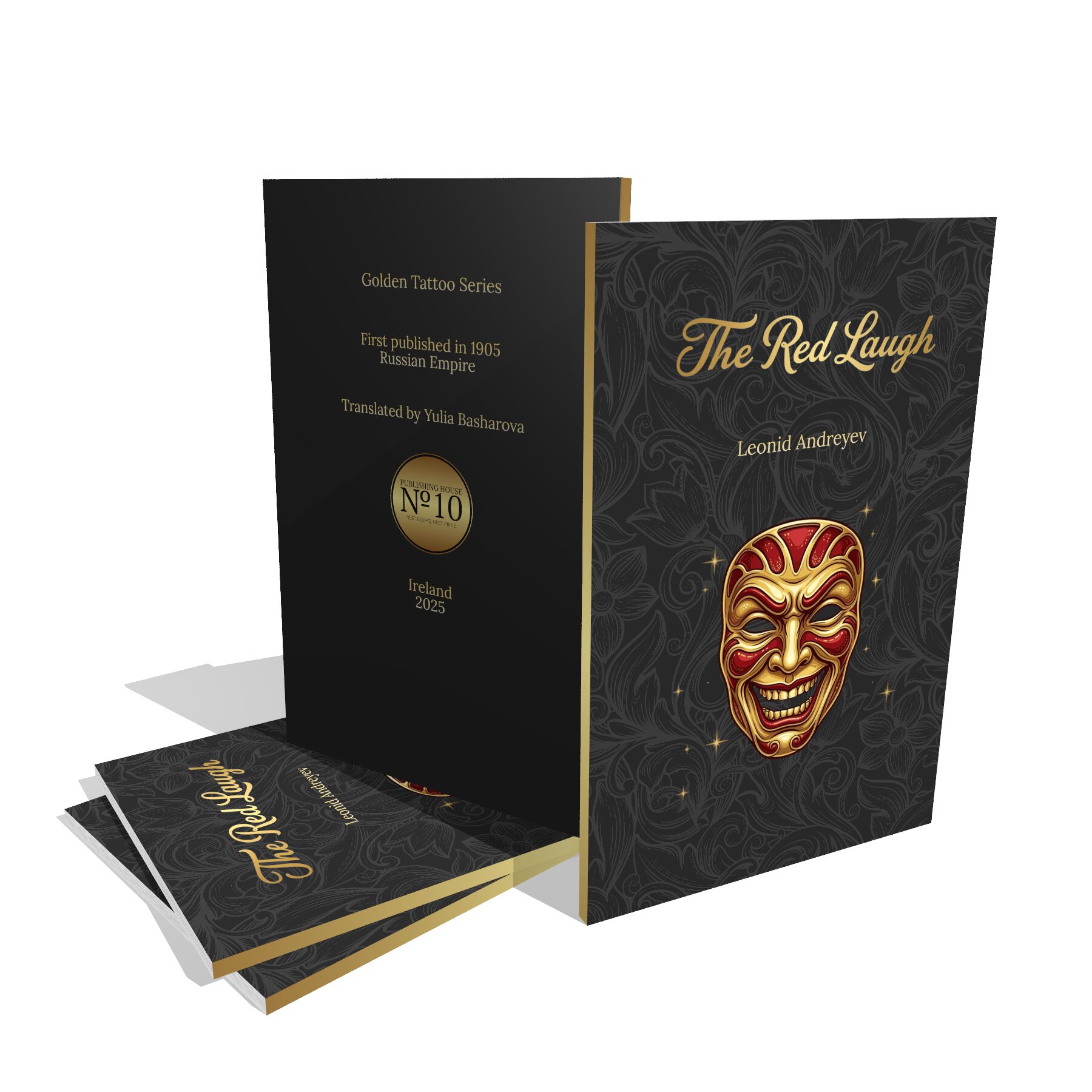
I recognized it, this red laugh. I sought and found it, this red laugh. Now I understood what was in all these disfigured, torn, strange bodies. It was the red laugh. It’s in the sky, it’s in the sun, and soon it will spread across the whole earth, this red laugh!
And they, clearly and calmly like sleepwalkers…





Reviews
There are no reviews yet.