Description
At the center of the plot is the love of the blacksmith and icon painter Vakula for the most beautiful girl in the village, Oksana, the daughter of the wealthy Cossack Chub. The proud and headstrong Oksana mocks the enamored Vakula and sets an impossible condition: she will marry him only if he brings her slippers “worn by the Tsarina herself.”
Meanwhile, Vakula’s mother, the witch Solokha, is busy hiding her many admirers (including the Devil, the Mayor, and the Deacon) in sacks, and the Devil steals the moon from the sky to thwart all the revelry.
Vakula, desperate after Oksana’s ridicule, saddles the captured Devil and rides him to St. Petersburg to obtain the coveted slippers from Empress Catherine II herself. Thanks to his resourcefulness and strength of spirit (and his Christian faith), Vakula returns to Dikanka the next morning with the slippers. He finds that Oksana, fearing rumors of his death, realized how deeply she loves him. The tale concludes with a happy marriage and the victory of pure, sincere love over all the schemes of evil spirits and human vanity.
Browse the table of contents, check the quotes, read the first chapter, find out which famous book it is similar to, and buy “The Night Before Christmas” on Amazon directly from our page.
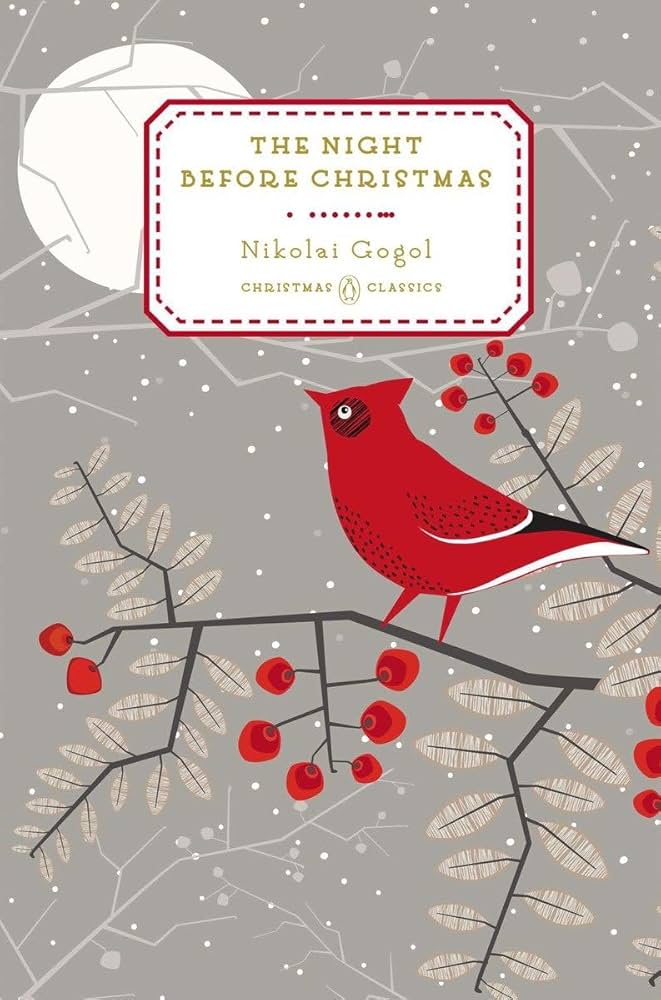
The last day before Christmas was past. A clear, winter night followed. The stars came out. The moon rose majestically to the sky to shine upon good people and the whole world, so that all might enjoy caroling and glorifying Christ. The frost was more severe than it had been since morning; but it was so quiet that the creak of the frost under one’s boot could be heard half a verst away. Not a single crowd of lads had yet appeared beneath the windows of the huts; only the moon peeped into them stealthily, as if tempting the girls who were dressing up to run out sooner upon the creaking snow. Suddenly, smoke poured in clouds from the chimney of one hut, and went up into the sky like a storm-cloud, and along with the smoke, a witch rose, riding upon a broom.
If the Sorochinsky assessor had been driving by at that moment in a three-horse sledge, wearing a fur-trimmed cap made in the style of a lancer’s, a blue sheepskin coat lined with black lambskin, and carrying a devilishly woven whip with which he was accustomed to urge on his coachman, he would certainly have noticed her, for not a single witch in the world escapes the Sorochinsky assessor. He knows exactly how many piglets each woman’s sow casts, how much linen lies in her chest, and precisely what garment or household item a good man will pawn in the tavern on a Sunday. But the Sorochinsky assessor was not driving by, and what business was it of his? He had his own district. And the witch, meanwhile, rose so high that she seemed only a small black spot moving overhead. But wherever the spot appeared, the stars, one after another, disappeared from the sky. Soon the witch had gathered a sleeve full of them. Three or four still glittered. Suddenly, from the other side, another small spot appeared, grew larger, began to stretch, and was no longer a spot. A nearsighted person, even if he had put on the wheels of the Commissioner’s carriage instead of spectacles, would still not have made out what it was. In front, it was completely a German: a narrow snout, constantly twitching and sniffing everything it came across, ended, like those of our pigs, in a little round snort; its legs were so thin that if the headman of Yareskovo had such legs, he would break them in the first Cossack dance. But behind, he was a true provincial petty official in a uniform, for he had a tail hanging down, as sharp and long as the coat-tails of a uniform today; only perhaps by the goat’s beard under the snout, by the small horns sticking out on his head, and by the fact that he was no whiter than a chimney sweep, could one guess that he was neither a German nor a provincial petty official, but simply a devil, for whom this was the last night to roam the world and teach good people sins. Tomorrow, with the first bells for matins, he would run back to his lair without a backward glance, with his tail between his legs. Meanwhile, the devil crept quietly towards the moon, and was about to reach out a hand to seize it; but suddenly he drew it back, as if scorched, sucked his fingers, shook his leg, ran to the other side, and again sprang back and drew back his hand. Yet, despite all these failures, the sly devil did not give up his mischief. Running up, he suddenly grabbed the moon with both hands, twisting and blowing he tossed it from one hand to the other, like a peasant getting fire for his pipe with his bare hands; finally, he quickly hid it in his pocket and, as if nothing had happened, ran on. In Dykanka, no one heard the devil steal the moon. It is true that the district clerk, crawling out of the tavern on all fours, saw that the moon, for no reason at all, was dancing in the sky, and swore to the whole village that it was so; but the villagers shook their heads and even mocked him. But what was the reason for the devil to decide on such an lawless deed? This was the reason: he knew that the wealthy Cossack Chub was invited to the clerk’s for kutya, where the headman would be, as well as the clerk’s relative who had arrived from the archbishop’s choir and who sang the lowest bass, the Cossack Sverbeguz, and a few others; where, besides kutya, there would be varenukha, saffron-infused vodka, and plenty of all sorts of food. Meanwhile, his daughter, the beauty of the whole village, would remain at home, and the blacksmith, a strong and impressive fellow, would surely come to see her, a man whom the devil hated more than Father Kondrat’s sermons. In his spare time, the blacksmith painted and was reputed to be the best painter in the whole district. Sotnik L…ko himself, who was then still alive, specially summoned him to Poltava to paint the plank fence around his house. All the bowls from which the Dykanka Cossacks ate borscht were painted by the blacksmith. The blacksmith was a God-fearing man and often painted icons of saints, and even now one can find his Evangelist Luke in the T… church. But the triumph of his art was one painting, painted on the church wall in the right-hand vestibule, in which he depicted Saint Peter on the Day of Judgment, with the keys in his hands, driving the evil spirit out of hell: the frightened devil thrashed about in all directions, sensing his doom, while the sinners previously locked up beat and chased him with whips, logs, and whatever else came to hand. At the time when the painter was working on this painting and was painting it on a large wooden board, the devil tried with all his might to interfere with him: he invisibly nudged his hand, raised ash from the forge’s furnace and sprinkled it on the painting; but, despite everything, the work was finished, the board was brought into the church and set into the wall of the vestibule, and since then the devil vowed to take revenge on the blacksmith. Only one night remained for him to roam the world; but even on this night he was looking for something to vent his spite on the blacksmith. And for this he decided to steal the moon, in the hope that old Chub was lazy and slow to get up, and the clerk’s house was not so close to his: the road went outside the village, past the mills, past the cemetery, curving around a ravine. Even in the moonlight, the varenukha and the saffron-infused vodka might have tempted Chub; but in such darkness, it would hardly be possible for anyone to drag him off the stove and call him out of the hut. And the blacksmith, who had long been at odds with him, would not dare to go to the daughter in his presence, despite his strength. Thus, as soon as the devil hid the moon in his pocket, it suddenly became so dark all over the world that not everyone would have found the way to the tavern, let alone to the clerk’s. The witch, suddenly finding herself in the dark, shrieked. Then the devil, approaching as a petty demon, took her under the arm and began to whisper into her ear the very thing that is usually whispered to the entire female gender. Everything in our world is strangely arranged! Everything that lives in it strives to imitate and mimic one another. Before, in Mirgorod, only the judge and the town governor used to wear fur-lined sheepskin coats covered with cloth in winter, while all the petty officials wore simple untreated ones; but now the assessor and the under-secretary have made themselves new fur coats out of Reshetilov lambskin with a cloth covering. The clerk and the district scribe, three years ago, bought blue Chinese silk at six grivnas an arshin. The sacristan made himself trousers of nankeen for summer and a waistcoat of striped wool. In short, everyone is trying to move up in the world! When will these people cease to be vain! One can bet that many will find it surprising to see the devil indulging in the same vanity. The most annoying thing is that he surely imagines himself a handsome fellow, while his figure—it’s shameful to look at. His face, as Foma Grigoryevich says, is a sheer abomination, and yet he too is plotting love affairs! But it became so dark in the sky and under the sky that it was no longer possible to see what was happening between them.
“So, koum, you haven’t been to the clerk’s new hut yet?” said the Cossack Chub, coming out of the door of his hut, to a dried-up, tall peasant with a shaggy beard, which showed that a piece of scythe-blade, which peasants usually use to shave their beards in the absence of a razor, had not touched it for more than two weeks. “There will be a good drinking party there now!” continued Chub, grinning as he did so. “We just mustn’t be late.” With this, Chub adjusted his belt, which tightly held his sheepskin coat, pulled his cap down tighter, and clutched his whip—the terror and dread of pesky dogs—in his hand; but, looking up, he stopped… “What the devil! Look! Look, Panas!…”
“What?” said the koum and also lifted his head.
“What do you mean, what? The moon is gone!”
“What the plague! It really is gone.”
“Exactly, it’s gone,” pronounced Chub with some annoyance at the koum‘s unchanging indifference. “You probably don’t care.”
“What am I supposed to do about it!”
“It had to be,” continued Chub, wiping his mustache with his sleeve, “some devil—may he not be able to drink a glass of vodka in the morning, the dog—who interfered!… Honestly, it’s as if on purpose… I specifically looked out the window while sitting in the hut: the night was a marvel! Bright; the snow glittered under the moon. Everything was visible as during the day. I barely stepped outside the door, and now, it’s pitch black!” Chub grumbled and swore for a long time, and at the same time pondered what to decide. He desperately wanted to chat about all sorts of nonsense at the clerk’s house, where, without a doubt, the headman, the visiting bass singer, and Mikita the tar-burner were already sitting, who traveled to Poltava every two weeks for the markets and told such jokes that all the villagers would hold their stomachs with laughter. Chub could already mentally see the varenukha standing on the table. All this was tempting, it was true; but the darkness of the night reminded him of the laziness so dear to all Cossacks. How wonderful it would be now to lie, with his legs tucked up, on the sleeping-bench, peacefully smoke his pipe, and listen through a delightful drowsiness to the carols and songs of the cheerful lads and girls who crowded in bunches under the windows. He would, without a doubt, have decided on the latter if he were alone; but now it was not so boring or scary for the two of them to walk on a dark night, and he also did not want to appear lazy or cowardly before others. Having finished his swearing, he turned to the koum again.
“So there’s no moon, koum?”
“No.”
“Strange, indeed. Give me some snuff! Your snuff is excellent, koum! Where do you get it?”
“What the devil, excellent!” answered the koum, closing the birch snuff-box punctured with patterns. “An old hen wouldn’t sneeze at it!”
“I remember,” Chub continued just the same, “the late tavern-keeper Zuzulya once brought me snuff from Nezhin. Eh, that was snuff! Good snuff that was! So what then, koum, what shall we do? It’s dark outside.”
“Then, maybe, we’ll stay home,” the koum said, grabbing the door handle.
If the koum had not said this, Chub would surely have decided to stay; but now something seemed to pull him to go against the advice. “No, koum, let’s go! We can’t, we must go!” Having said this, he was already annoyed with himself for having said it. It was very unpleasant for him to trudge out on such a night; but he was comforted by the fact that he himself deliberately wanted this and did not do what he was advised.
The koum, without expressing the slightest sign of annoyance on his face, like a man to whom it is absolutely all the same whether to stay at home or trudge out of the house, looked around, scratched his shoulders with his stick, and the two koums set off on their way.


Reviews
There are no reviews yet.