Author’s Note
I ask my readers’ forgiveness that this time, instead of the “Diary” in its usual form, I am only presenting a novella. But I was indeed occupied with this novella for the greater part of the month. In any case, I ask for the readers’ indulgence.
Now, concerning the story itself. I have titled it “A Fantastic Story,” even though I consider it to be of the highest degree of realism. But the fantastic element is truly here, specifically in the very form of the narrative, which I find it necessary to explain beforehand.
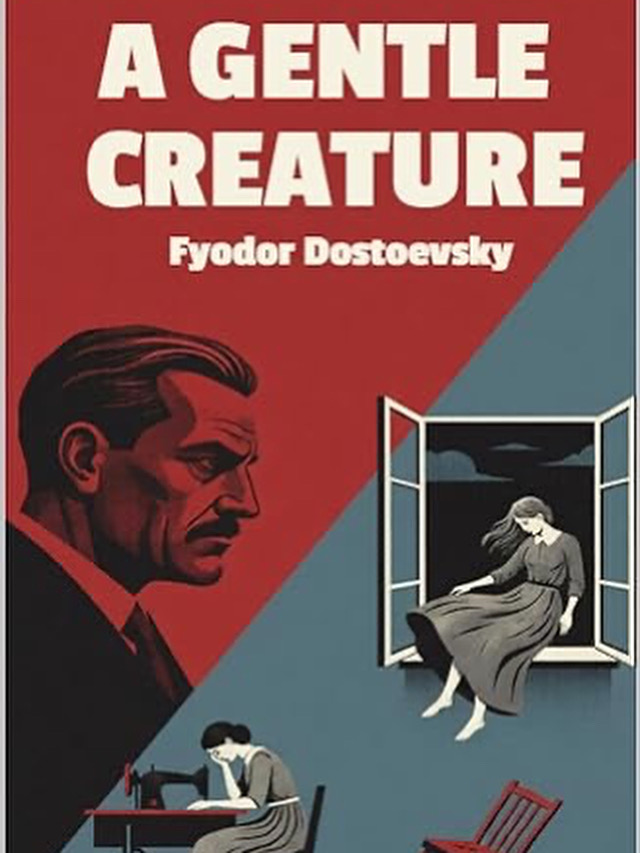
The fact is, this is neither a story nor notes. Imagine a husband who has his wife lying on the table, a suicide who threw herself out of a window a few hours earlier. He is in turmoil and has not yet managed to collect his thoughts. He walks through his rooms and tries to comprehend what happened, to “collect his thoughts into a single point.” Moreover, he is an inveterate hypochondriac, one of those who talk to themselves. So he speaks to himself, narrates the matter, and clarifies it for himself. Despite the seeming sequence of his speech, he contradicts himself several times, both in logic and in feelings. He both justifies himself and blames her, and he launches into extraneous explanations: here is the coarseness of thought and heart, and here is deep feeling. Little by little, he genuinely clarifies the matter for himself and gathers his “thoughts into a single point.” The series of memories he evokes irresistibly leads him, finally, to the truth; the truth irresistibly elevates his mind and heart. By the end, even the tone of the narrative changes compared to its disorganized beginning. The truth is revealed to the unfortunate man quite clearly and definitely, at least for himself.
This is the subject matter. Of course, the process of the narration lasts for several hours, with breaks and interruptions and in a somewhat incoherent form: sometimes he speaks to himself, sometimes he addresses an invisible listener, a kind of judge. And that is exactly how it always happens in reality. If a stenographer could have eavesdropped on him and written down everything he said, the result would have been rougher, less polished than what I have presented, but, as far as I can tell, the psychological order might have remained the same. This assumption of a stenographer having recorded everything (after which I would have polished the recording) is what I call the fantastic element in this narrative. But something similar has, in part, been permitted in art more than once: Victor Hugo, for instance, in his masterpiece The Last Day of a Condemned Man, used almost the same device and, although he did not introduce a stenographer, he allowed an even greater implausibility, by assuming that the condemned man can (and has the time to) keep notes not only on his last day but even in the last hour and literally in the last minute. Yet, without allowing this fantasy, the work itself would not have existed—the most realistic and most truthful work of all that he wrote.
I. Who I Was and Who She Was
…As long as she is here, everything is still fine: I walk over and look at her every minute; but when they take her away tomorrow, how will I be left alone? She is now in the drawing-room on the table, they put together two card tables, and the coffin will be there tomorrow, a white, white muslin, but that’s not what I meant. I keep walking around and want to clarify this for myself… It’s been six hours now that I’ve been trying to clarify it and still can’t collect my thoughts into a single point. The thing is, I just keep walking, walking, walking… This is how it happened. I’ll just tell it in order. (Order!) Gentlemen, I am far from being a man of letters, and you can see that, and so be it, but I will tell it as I understand it myself. That’s the whole horror of it, that I understand everything!
If you want to know, that is, if you take it from the very beginning, she simply came to me then to pawn things to pay for an advertisement in the newspaper Golos (The Voice) saying, well, like this and that, governess, willing to travel, and give lessons at home, and so on and so forth. That was at the very beginning, and I, of course, didn’t distinguish her from the others: she comes like everyone else, and so on. But then I started to distinguish her. She was so thin, fair-haired, of medium height; she was always awkward with me, as if embarrassed (I think she was the same with all strangers, and I, of course, was all the same to her as one person to another, that is, if you take it not as a pawnbroker, but as a person). As soon as she received the money, she immediately turned and left. And always in silence. Others argue, beg, haggle to get more; not her, whatever they would give… I feel like I’m getting everything mixed up… Yes; I was struck first of all by her things: silver gilt earrings, a wretched little locket—things worth two grivenniks (20 kopecks). She herself knew they were worth ten kopecks, but I saw on her face that they were precious to her—and indeed, it was all that remained to her from her father and mother, I learned later. Only once did I allow myself to smile at her things. That is, you see, I never allow myself that, I maintain a gentlemanly tone with the public: few words, polite and strict. “Strict, strict and strict.” But she suddenly permitted herself to bring the remnants (literally) of an old hare’s short coat, and I couldn’t resist and suddenly said something like a jest to her. Good heavens, how she flushed! Her eyes are blue, large, thoughtful, but—how they glowed! But she didn’t utter a word, took her “remnants” and—left. It was then that I noticed her for the first time specifically and thought something about her in that way, that is, something very specific. Yes; I remember another impression, too, that is, if you will, the most important impression, the synthesis of everything: that she was awfully young, so young that she looked exactly fourteen. And yet, she was already sixteen minus three months then. But, I didn’t mean to say that, the synthesis wasn’t in that at all. The next day she came again. I later learned that she had been to Dobronravov’s and Moser’s with that short coat, but they accept nothing but gold and wouldn’t talk to her. I, however, once accepted a cameo from her (a wretched little thing)—and, thinking it over later, I was surprised: I, too, accept nothing but gold and silver, but I allowed the cameo for her. That was my second specific thought about her then, I remember that.
This time, that is, from Moser’s, she brought an amber cigar holder—a trinket, nothing special, amateurish, but again, worth nothing to us because we only take gold. Since she came after yesterday’s revolt, I met her strictly. My strictness is dryness. However, giving her two rubles, I couldn’t help myself and said as if with a slight irritation: “I’m only taking this for you, but Moser won’t accept such a thing from you.” I especially emphasized the words “for you,” and specifically in a certain sense. I was angry. She flushed again when she heard that “for you,” but she remained silent, didn’t throw the money back, accepted it—that’s poverty for you! And how she flushed! I understood that I had stung her. And when she had already left, I suddenly asked myself: is this triumph over her really worth two rubles? Heh-heh-heh! I remember asking that very question twice: “Is it worth it? Is it worth it?” And, laughing, I answered it affirmatively to myself. I was very cheerful then. But it wasn’t a bad feeling: I did it on purpose, with intention; I wanted to test her, because certain thoughts about her had suddenly begun to stir in me. This was my third special thought about her.
…Well, that’s when everything began. Of course, I immediately tried to find out all the circumstances indirectly and waited for her arrival with special impatience. I had a premonition that she would come soon. When she came, I entered into a polite conversation with unusual courtesy. You see, I am well-bred and have manners. Hmm. It was then that I guessed she was kind and gentle. Kind and gentle people don’t resist for long, and although they don’t exactly open up, they can’t manage to evade conversation at all: they answer sparingly, but they answer, and the further it goes, the more they answer, if only you don’t tire yourself out, should you need to. Of course, she didn’t explain anything to me herself then. It was later that I learned about the Golos and everything. She was advertising with her last strength then, at first, of course, haughtily: “A governess, willing to travel, and conditions to be sent in packets,” and then: “Willing to do anything, to teach, and be a companion, and look after the household, and care for the sick, and I can sew,” and so on and so on, all the usual things! Of course, all this was added to the advertisement in stages, and towards the end, when despair set in, it was even “without salary, just for bread.” No, she didn’t find a position! I decided to test her one last time then: I suddenly took today’s Golos and showed her an announcement: “Young lady, complete orphan, seeking position as a governess for young children, preferably with an elderly widower. Can assist with the housekeeping.”
“Look, this one advertised this morning, and by evening she’ll surely have found a position. That’s how you should advertise!”
She flushed again, her eyes glowed again, she turned, and immediately left. I liked that very much. Besides, I was already certain of everything then and had no fear: no one would accept cigar holders. And she was already out of cigar holders. Just as I thought, she came on the third day, so pale, agitated—I understood that something had happened at home, and something truly had happened. I will explain what happened in a moment, but now I only want to recall how I suddenly put on airs for her then and grew in her eyes. Such an intention suddenly appeared in me. The thing is, she brought this icon (she had decided to bring it)… ah, listen! listen! This is where it has started now, I was getting all mixed up before… The thing is, I want to recall all of this now, every one of these little details, every single feature. I want to gather all my thoughts into a single point and—I cannot, but these features, these little features…
An icon of the Mother of God. The Mother of God with the Infant, a household, family icon, old, with a silver gilt setting—worth—well, worth about six rubles. I see that the icon is dear to her, she is pawning the whole icon, without removing the setting. I tell her: it would be better to take off the setting and take the icon away; otherwise, the icon is somehow.
“Is it forbidden for you?”
“No, it’s not forbidden, but well, maybe for your own sake.”
“Well, take it off.”
“You know what, I won’t take it off, but I’ll put it over there in the icon-case,” I said, after thinking, “with the other icons, under the icon-lamp (I always had an icon-lamp burning since I opened the cash desk), and simply take ten rubles.”
“I don’t need ten, give me five, I will definitely redeem it.”
“And you don’t want ten? The icon is worth it,” I added, noticing that her eyes sparkled again. She remained silent. I brought her five rubles.
“Do not despise anyone, I myself have been in these straits, and even worse, sir, and if you see me engaged in such an occupation now—well, it is after everything I’ve endured…”
“Are you taking revenge on society? Are you?” she interrupted me suddenly with a rather caustic sarcasm, in which there was, however, much innocence (that is, a general innocence, because she decidedly did not distinguish me from others then, so she spoke almost harmlessly). “Aha!” I thought, “so that’s what you’re like, a character is revealing itself, a new direction.”
“You see,” I immediately remarked, half-jokingly, half-mysteriously, “I am part of that part of the whole which always wills the evil, and always creates the good…”
She looked at me quickly and with great curiosity, in which there was, however, much that was childlike.
“Wait… What is that thought? Where is that from? I’ve heard it somewhere…”
“Don’t rack your brains, that’s how Mephistopheles introduces himself to Faust. Have you read Faust?”
“Not… not attentively.”
“That is, you haven’t read it at all. You must read it. But I see an unsmiiling line on your lips again. Please don’t assume such little taste in me that, in order to conceal my role as a pawnbroker, I wanted to introduce myself to you as Mephistopheles. A pawnbroker will remain a pawnbroker. We know that, sir.”
“You are rather strange… I didn’t mean to say anything like that to you…”
She wanted to say: I didn’t expect you to be an educated person, but she didn’t say it, but I knew she thought it, I pleased her immensely.
“You see,” I remarked, “one can do good in any field. I’m certainly not talking about myself, I do nothing but bad, let’s say, but…”
“Of course, one can do good in any place,” she said, looking at me with a quick and thoughtful gaze. “In any place,” she suddenly added. Oh, I remember, I remember all these moments! And I also want to add that when these young people, these dear young people, want to say something so intelligent and profound, they suddenly show too sincerely and naively on their face that “look, I am telling you something intelligent and profound now,”—and not out of vanity, like the likes of us, but you just see that she herself immensely values all of it, and believes, and respects, and thinks that you respect all this just as she does. Oh, sincerity! That is how they conquer. And how lovely it was in her!
I remember, I forgot nothing! When she left, I decided all at once. That same day, I went on a final search and found out all the rest of her current secret background; I already knew all her former background from Lukerya, who was their servant then and whom I had bribed a few days ago. This background was so terrible that I cannot even understand how she could still laugh, as she did just now, and be curious about Mephistopheles’ words, while she herself was under such horror. But—youth! I thought exactly that about her then with pride and joy, because there is magnanimity in it: as if to say, even at the edge of ruin, the great words of Goethe still shine. Youth is always magnanimous, even if only a little and in a crooked way. That is, I mean her, her alone. And most importantly, I was already looking at her as mine then and did not doubt my power. You know, that’s a very voluptuous thought, when you no longer have any doubt.
But what is wrong with me? If I continue like this, when will I gather everything into a point? Faster, faster—that’s not the point at all, oh God!





Reviews
There are no reviews yet.