Description
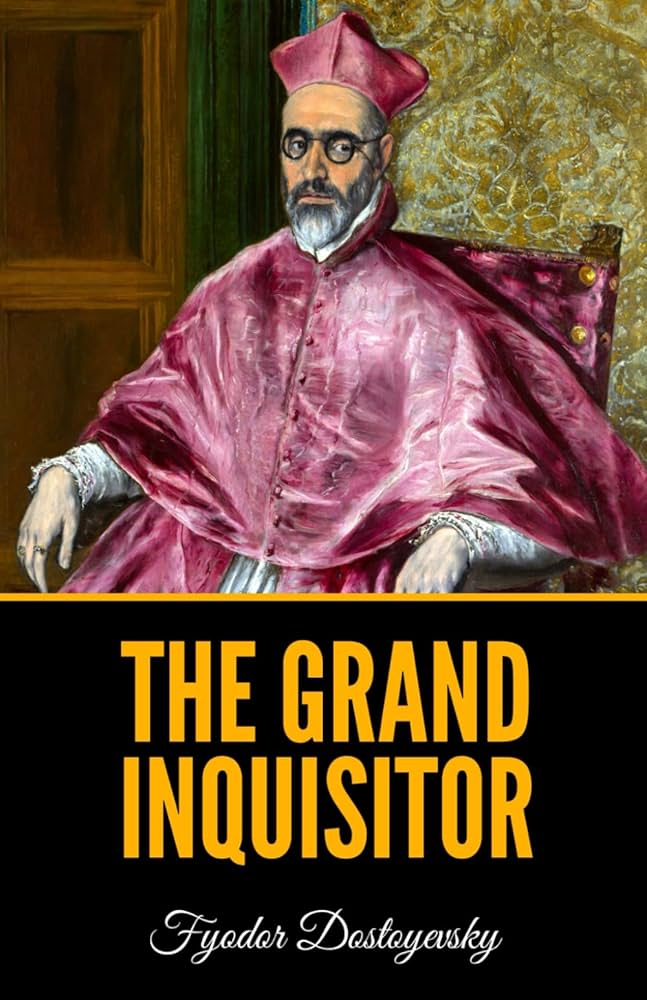
The story takes place in 16th-century Seville during the Spanish Inquisition. Jesus Christ returns quietly to Earth, where His miracles are instantly recognized by the adoring populace. His presence, however, immediately threatens the established order of the Church.
The ninety-year-old Grand Inquisitor, the all-powerful cardinal of the city, orders Christ’s immediate arrest. That night, the Inquisitor visits the silent Christ in His cell to deliver a towering monologue—an existential declaration that forms the core of the text.
The Inquisitor passionately argues that Christ’s gift of absolute free will was a dreadful burden that humanity, being inherently weak and infantile, cannot bear. He justifies the Church’s decision to silently “correct” Christ’s work by rejecting the three temptations of the Devil (bread, miracle, and power). By taking these elements into its own hands, the Church has relieved humanity of the agonizing freedom of choice.
The Inquisitor reveals his true motivation: to create a world of universal order and guaranteed happiness, even if it requires him and his chosen elite to knowingly serve a lie. He states that his system, based on “miracle, mystery, and authority,” has delivered what Christ could not—contentment and unity for the masses.
The monologue concludes with the Grand Inquisitor’s cold decision: Christ must be burned at the stake as a heretic, lest His disruptive presence restore the terrible burden of freedom. In the face of this absolute power and merciless logic, Christ offers no defense or counter-argument, only a single, silent gesture: a kiss on the Inquisitor’s lips. Shaken by this act of boundless love and forgiveness, the Inquisitor unlocks the cell door and commands Christ to disappear into the darkness, never to return.
Browse the table of contents, check the quotes, read the first chapter, find out which famous book it is similar to, and buy “The Grand Inquisitor” on Amazon directly from our page.
“Well, even here a preamble is necessary—a literary preamble, ugh!” Ivan laughed. “And what kind of writer am I! You see, the action in my poem takes place in the sixteenth century, and at that time—though you ought to know this from your school classes—it was common practice in poetic works to bring celestial powers down to earth. I won’t even mention Dante. In France, the judicial clerks, and also monks in monasteries, would stage entire performances in which they brought the Madonna, angels, saints, Christ, and even God himself onto the stage. Back then, it was all very simple-hearted. In Victor Hugo’s Notre Dame de Paris, in honor of the birth of the French Dauphin, a virtuous and free performance is given to the people in the Hall of the City Hall in Paris, during the reign of Louis XI, titled: Le bon jugement de la très sainte et gracieuse Vierge Marie (The good judgment of the most holy and gracious Virgin Mary), where she appears in person and pronounces her bon jugement (good judgment). Here in Moscow, in the pre-Petrine era, almost identical dramatic performances, particularly those from the Old Testament, also took place from time to time.
But besides dramatic performances, many tales and ‘verses’ circulated throughout the world at that time, in which saints, angels, and the entire celestial host acted as needed. In our monasteries, they were also engaged in translating, copying, and even composing such poems, and during what time—during the Tatar yoke! There is, for example, one little monastic poem (from the Greek, of course): ‘The Journey of the Mother of God through Hell,’ with scenes and daring no less than Dante’s. The Mother of God visits Hell, guided ‘through the torments’ by the Archangel Michael. She sees the sinners and their suffering. Among them, by the way, there is one very interesting category of sinners in a burning lake: those who sink into this lake such that they can no longer swim out, ‘those God already forgets’—an expression of extraordinary depth and power.
And so, struck and weeping, the Mother of God falls before the throne of God and begs for the forgiveness of all in Hell, of all whom she saw there, without distinction. Her conversation with God is colossally interesting. She pleads, she does not leave, and when God points to the pierced hands and feet of His Son and asks: how shall I forgive His tormentors—she commands all the saints, all the martyrs, all the angels and archangels to fall with her and beg for the forgiveness of all without exception. It ends with her begging God to grant a cessation of torments every year from Good Friday until Trinity Day, and the sinners in Hell immediately thank the Lord and cry out to Him: ‘You are right, Lord, to have judged thus.’
Well, my little poem would have been of the same kind if it had appeared at that time. He appears on my stage; true, He says nothing in the poem, but only appears and passes through. Fifteen centuries have already passed since He gave the promise to come in His kingdom, fifteen centuries since His prophet wrote: ‘Behold, I come quickly.’ ‘But of that day and hour knows no man, no, not the angels of heaven, but my Father only,’ as He Himself proclaimed while still on earth. But mankind awaits Him with the former faith and with the former tenderness. Oh, with even greater faith, for fifteen centuries have already passed since the pledges from heaven ceased for man:
Believe what the heart tells you,
There are no pledges from heaven.
And only one single faith in what the heart says! True, there were many miracles then. There were saints who performed miraculous healings; to some righteous men, according to their lives, the Queen of Heaven herself descended. But the devil does not sleep, and doubt in the truth of these miracles had already begun among mankind. Just then, a terrible new heresy appeared in the North, in Germany. A great star, ‘burning as it were a lamp’ (that is, the church) ‘fell upon the fountains of waters; and they became bitter.’ These heresies began blasphemously to deny miracles.
But the more fervently do those who remain faithful believe. The tears of mankind rise to Him as before, they await Him, they love Him, they hope in Him, they long to suffer and die for Him, as before. And so many centuries has mankind prayed with faith and fervor: ‘O Lord, appear to us,’ so many centuries has it called upon Him, that He, in His immeasurable compassion, wished to descend to the supplicants. He had descended, He had visited other righteous men, martyrs, and holy hermits while still on earth, as recorded in their ‘Lives.’ Tyutchev, who deeply believed in the truth of his words, proclaimed in our land that
Burdened with the load of the cross,
All of you, native land,
The King of Heaven traversed
In the form of a slave, blessing.
That it was inevitably so, I will tell you. And so He wished to appear, if only for an instant, to the people—to the tormented, suffering, foully sinful, but child-like loving people. The action in my poem is in Spain, in Seville, at the most terrible time of the Inquisition, when bonfires blazed daily in the country for the glory of God and
In magnificent auto-da-fés
They burned the wicked heretics.
Oh, this was certainly not the descent in which He will appear, according to His promise, at the end of time in all the glory of heaven, and which will be sudden, ‘as the lightning that shines from the east even unto the west.’ No, He wished to visit His children, if only for an instant, and precisely there where the fires of the heretics were just crackling. In His boundless mercy, He once more walks among men in that very human form in which He walked among men three years, fifteen centuries ago. He descends upon the ‘hot pavements’ of the southern city, where only the day before, in a ‘magnificent auto-da-fé,’ in the presence of the king, the court, knights, cardinals, and the most charming court ladies, with the numerous population of all Seville, the Cardinal Grand Inquisitor had burned almost a hundred heretics at once ad majorem gloriam Dei (for the greater glory of God).
He appeared quietly, unnoticed, and yet everyone—it is strange—recognizes Him. This could be one of the best parts of the poem, that is, why exactly they recognize Him. The people rush towards Him with an invincible force, surround Him, swell up around Him, and follow Him. He silently walks among them with a gentle smile of infinite compassion. The sun of love burns in His heart, rays of Light, Enlightenment, and Power flow from His eyes and, pouring onto the people, shake their hearts with responsive love. He stretches out His hands to them, blesses them, and from the touch of Him, even only to His clothes, a healing power issues forth. Then an old man, blind from childhood, cries out from the crowd: ‘Lord, heal me, that I may also see You,’ and behold, it is as if scales fall from his eyes, and the blind man sees Him. The people weep and kiss the earth upon which He walks. Children throw flowers before Him, singing and crying out to Him: ‘Hosanna!’ ‘It is He, it is truly He,’ everyone repeats, ‘it must be He, it is none other than He.’
He stops at the steps of the Seville Cathedral at the very moment when a child’s open white coffin is being carried into the temple amidst weeping: in it lies a seven-year-old girl, the only daughter of a noble citizen. The dead child lies covered in flowers. ‘He will resurrect your child,’ the crowd cries to the weeping mother. The cathedral priest who came out to meet the coffin looks perplexed and frowns. But now the cry of the dead child’s mother rings out. She throws herself at His feet: ‘If it is You, then raise my child!’ she cries, stretching her hands out to Him. The procession stops, the coffin is lowered onto the steps at His feet. He looks with compassion, and His lips quietly and once more pronounce: ‘Talitha koum’—’and the maiden arose.’ The little girl rises in the coffin, sits up, and looks around, smiling, with astonished, wide-open eyes. In her hands is the bouquet of white roses with which she lay in the coffin.
There is confusion, shouts, and sobs among the people, and at that very moment, the Cardinal Grand Inquisitor himself suddenly passes by the cathedral on the square. He is an almost ninety-year-old man, tall and straight, with a withered face, with sunken eyes, but from which a gleam, like a fiery spark, still shines. Oh, he is not in his magnificent cardinal’s robes in which he paraded yesterday before the people when the enemies of the Roman faith were being burned—no, at this moment, he is only in his old, coarse monastic robe. His somber assistants and slaves and the ‘sacred’ guard follow him at a set distance.
He stops before the crowd and observes from afar. He saw everything, he saw the coffin placed at His feet, he saw the maiden resurrected, and his face darkened. He frowns his gray, thick eyebrows, and his gaze flashes with ominous fire. He stretches out his finger and commands the guards to seize Him. And behold, such is his power and so accustomed, submissive, and tremblingly obedient are the people to him already, that the crowd immediately parts before the guards, and they, amidst a deathly silence that suddenly fell, lay hands on Him and lead Him away. The crowd instantly, all as one person, bows their heads to the ground before the old Inquisitor, who silently blesses the people and passes by.
The guard leads the Prisoner to a narrow and gloomy vaulted prison in the ancient building of the holy court and locks Him in. The day passes, and the dark, hot, and ‘breathless’ Seville night descends. The air ‘smells of laurel and lemon.’ Amidst the deep darkness, the iron door of the prison suddenly opens, and the old Grand Inquisitor himself, with a lamp in his hand, slowly enters the prison. He is alone, and the door immediately locks behind him.
He stops at the entrance and long, a minute or two, scrutinizes His face. Finally, he quietly approaches, places the lamp on the table, and says to Him: ‘Is it You? You?’ But, receiving no answer, he quickly adds: ‘Do not answer, be silent. And what could You say? I know too well what You will say. But You have no right to add anything to what You have already said before. Why, then, have You come to interfere with us? For You have come to interfere with us, and You Yourself know it. But do You know what will happen tomorrow? I do not know who You are, and I do not want to know: whether it is You or merely a semblance of Him, but tomorrow I shall condemn You and burn You at the stake as the most wicked of heretics, and that very people who today kissed Your feet will tomorrow, at a single nod from me, rush to pile the coals around Your pyre, do You know that? Yes, perhaps You know it,’ he added in profound contemplation, without for a moment taking his eyes off his prisoner.
‘I don’t quite understand, Ivan, what this is?’ Alyosha, who had been listening in silence the whole time, smiled. ‘Is it simply boundless fantasy or some mistake by the old man, some impossible qui pro quo?’
‘Accept the latter, at least,’ Ivan laughed, ‘if modern realism has spoiled you so much that you cannot endure anything fantastic—if you want a qui pro quo, then let it be so. It is true,’ he laughed again, ‘the old man is ninety years old, and he could have long ago gone mad with his idea. The Prisoner, meanwhile, could have struck him with His appearance. It could have been, finally, simply a delirium, a vision of a ninety-year-old man before death, and moreover, one heated by yesterday’s auto-da-fé of a hundred burned heretics. But does it matter to you and me whether it is qui pro quo or boundless fantasy? The only point here is that the old man needs to speak out, that finally, after ninety years, he speaks out and says aloud what he has kept silent about for all those ninety years.”



Reviews
There are no reviews yet.