Description
It is Moscow in the near-future year of 1928. Professor Vladimir Persikov, a brilliant and misanthropic zoologist, accidentally discovers a “Red Ray” that dramatically accelerates the growth and reproductive rate of living organisms. At the same time, a mysterious chicken plague (the “rooster disease”) wipes out virtually all poultry in the Soviet republics.
Driven by a desperate need to replenish the nation’s food supply, the opportunistic and ambitious Soviet official, Aleksandr Rokk, is granted authority to seize Persikov’s untested invention for a state chicken farm. Predictably, an incompetent mix-up of egg shipments occurs: Rokk receives eggs of monstrous, tropical reptiles (snakes, crocodiles, and ostriches) instead of chickens.
The resulting swarm of rapidly growing, highly aggressive monsters escapes and begins to terrorize the countryside and advance on Moscow, plunging the entire state into chaos as the government attempts to contain a disaster born of their own bureaucratic arrogance.
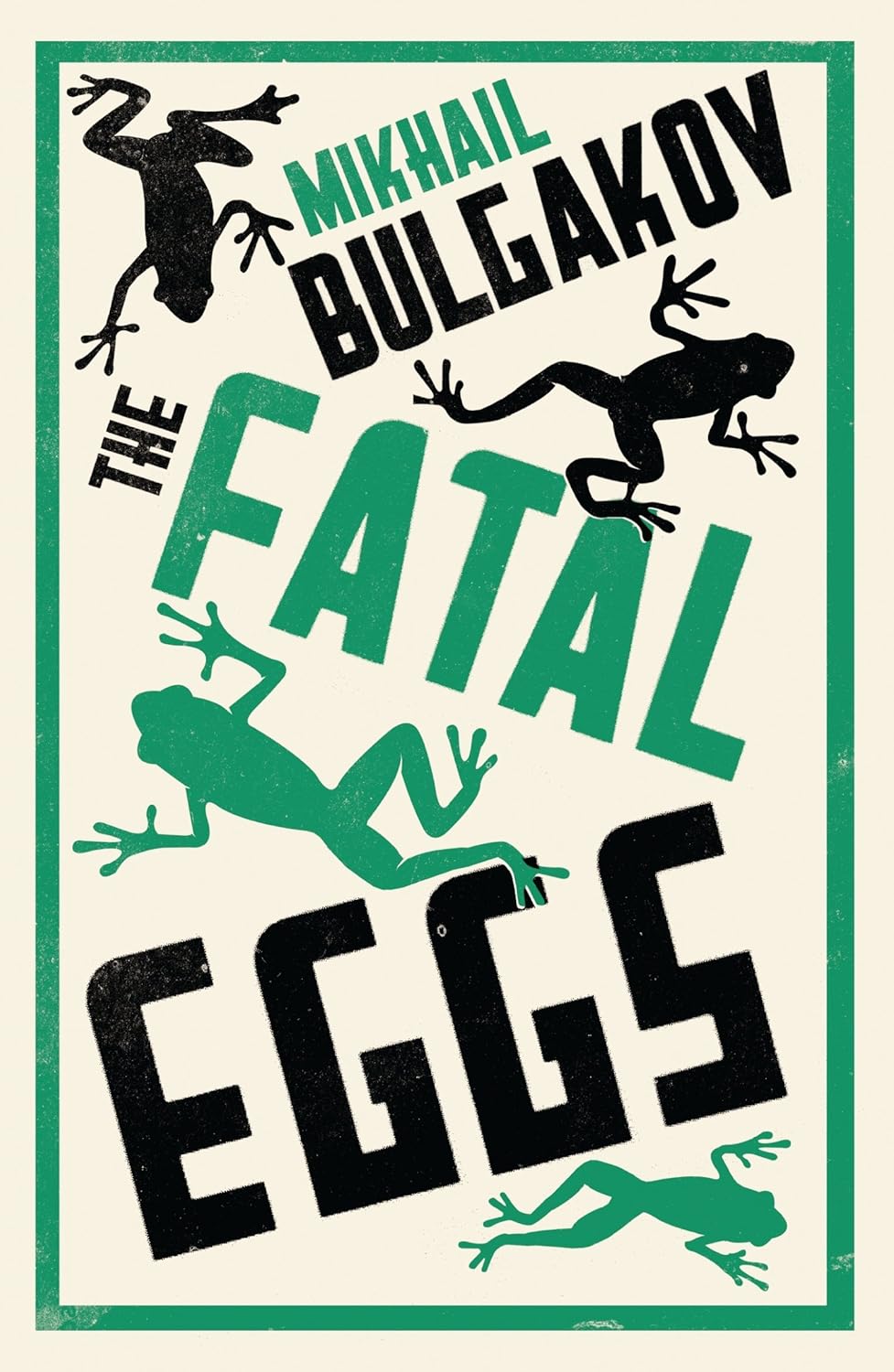
Browse the table of contents, check the quotes, read the first act, find out which famous book it is similar to, and buy The Fatal Eggs on Amazon directly from our page.
Chapter 1. Curriculum Vitae of Professor Persikov
Chapter 2. The Colored Curl
Chapter 3. Persikov Caught It
Chapter 4. Priest’s Wife Drozdova
Chapter 5. The Chicken Story
Chapter 6. Moscow in June 1928
Chapter 7. Rokk
Chapter 8. The Story at the State Farm
Chapter 9. Living Mash
Chapter 10. The Catastrophe
Chapter 11. The Battle and Death
Chapter 12. The Frosty Deus Ex Machina
“Just as amphibians come to life after a long drought, with the first heavy shower of rain, so Professor Persikov revived…” (A description of Moscow’s post-Civil War recovery.)
“Second freshness—that’s what is nonsense! There is only one freshness—the first—and it is also the last. And if sturgeon is of the second freshness, that means it is simply rotten.” (A famous line about quality and truth, often quoted in the context of Soviet life.)
“The truth, alas, has been disturbed by the question, and it rises up from the depths of your soul to flicker in your eyes and all is lost.”
“The clock on the wall… stopped at a quarter past eleven and, finally, unable to endure the perturbations of this remarkable year, eight magnificent specimens of tree-frogs died…” (A darkly humorous example of the interconnected chaos.)
“Professor Persikov did not marry again and had no children. He was short-tempered, but did not bear grudges, liked cloudberry tea and lived in Prechistenka Street…” (Part of the initial, precise character description.)
Chapter 1. Curriculum Vitae of Professor Persikov
On the evening of April 16, 1928, Professor of Zoology at the Fourth State University and Director of the Zoological Institute in Moscow, Persikov, entered his study, located in the Zoological Institute on Herzen Street. The Professor turned on the overhead frosted globe and looked around.
The beginning of the horrific catastrophe must be considered to have been set down on this very fateful evening, just as the ultimate cause of this catastrophe should be considered none other than Professor Vladimir Ipatyevich Persikov.
He was exactly 58 years old. A remarkable, bulbous, bald head with tufts of yellowish hair sticking out on the sides. His face was cleanly shaven, the lower lip protruding forward. Because of this, Persikov’s face always carried a slightly capricious expression. On his red nose were old-fashioned small silver-rimmed spectacles, his eyes bright and small, his height tall, slightly stooped. He spoke with a thin, squeaky, croaking voice and, among other oddities, had this one: when he spoke something weighty and confidently, he would turn the index finger of his right hand into a hook and squint his eyes. And since he always spoke confidently, for his erudition in his field was absolutely phenomenal, the hook very frequently appeared before the eyes of Professor Persikov’s interlocutors. And outside his field, i.e., zoology, embryology, anatomy, botany, and geography, Professor Persikov almost never spoke.
Professor Persikov did not read newspapers, did not go to the theater, and the Professor’s wife ran away from him with a tenor from Zimin’s Opera in 1913, leaving him a note that read:
“Your frogs arouse in me an unbearable shudder of revulsion. I shall be unhappy all my life because of them.”
The Professor never remarried and had no children. He was very quick-tempered but easily appeased, liked cloudberry tea, lived on Prechistenka, in a five-room apartment, one of which was occupied by a frail old woman, the housekeeper Mar’ya Stepanovna, who looked after the Professor like a nanny.
In 1919, three of the Professor’s five rooms were taken away. He then stated to Mar’ya Stepanovna: “If they don’t stop these outrages, Mar’ya Stepanovna, I will go abroad.”
There is no doubt that if the Professor had carried out this plan, he would have easily managed to secure a post at the department of zoology in any university in the world, for he was a first-class scholar, and in the field that concerned amphibians or tailless reptiles, he had no equals, with the exception of Professors William Weckl in Cambridge and Giacomo Bartolomeo Beccari in Rome. The Professor read in four languages besides Russian, and spoke French and German as well as he spoke Russian. Persikov did not carry out his intention regarding going abroad, and 1920 turned out even worse than 1919. Events occurred, one after the other. Bolshaya Nikitskaya was renamed Herzen Street. Then the clock, embedded in the wall of the building on the corner of Herzen and Mokhovaya, stopped at a quarter past eleven, and finally, in the terrariums of the Zoological Institute, unable to endure all the perturbations of that famous year, first 8 magnificent specimens of tree frogs died, then 15 common toads, and finally, an exceptional specimen of the Surinam Toad.
Immediately following the toads, which devastated that first order of tailless reptiles rightly called the class of tailless reptiles, the Institute’s long-serving caretaker, old Vlas, who did not belong to the class of tailless reptiles, also passed on to a better world. The cause of his death, however, was the same as that of the poor reptiles, and Persikov determined it immediately:
“Starvation!”
The scientist was perfectly right: Vlas needed to be fed flour, and the toads needed mealworms, but as the former disappeared, so did the latter. Persikov tried to switch the remaining 20 specimens of tree frogs to a diet of cockroaches, but the cockroaches also disappeared somewhere, demonstrating their malicious attitude towards war communism. Thus, the last specimens also had to be thrown into the cesspits in the Institute’s yard.
The effect of these deaths, and especially that of the Surinam Toad, on Persikov is beyond description. For some reason, he entirely blamed the then People’s Commissar of Enlightenment for the deaths.
Standing in his fur cap and galoshes in the corridor of the freezing Institute, Persikov spoke to his assistant, Ivanov, a most elegant gentleman with a sharp blond beard:
“It’s too good for him to be killed for this, Pyotr Stepanovich! What are they doing? They’ll ruin the whole Institute! Huh? A superb male, an exceptional specimen of Pipa americana, 13 centimeters long…”
Things got worse after that. Following Vlas’s death, the Institute’s windows were frozen solid, so that patterned ice sat on the inner surface of the panes. Rabbits, foxes, wolves, fish, and every single grass snake died. Persikov began to be silent for days on end, then fell ill with pneumonia, but did not die. When he recovered, he came to the Institute twice a week and, in the round hall, where the temperature was somehow always, invariably, 5 degrees below freezing, regardless of the outside temperature, he lectured in galoshes, a hat with earmuffs, and a scarf, exhaling white steam, to 8 listeners on the topic “Reptiles of the Hot Belt.” All the rest of the time, Persikov lay on his couch on Prechistenka, in a room piled high with books up to the ceiling, under a blanket, coughing and staring into the mouth of the fiery stove, which Mar’ya Stepanovna fueled with gilt chairs, and remembered the Surinam Toad.
But everything in the world comes to an end. 1920 and 1921 ended, and in 1922, some kind of reverse movement began. Firstly: Pankrat appeared in the place of the deceased Vlas, still young, but a promising zoological caretaker; the Institute began to be heated a little. And in the summer, Persikov, with the help of Pankrat, caught 14 common toads on the Klyazma River. Life in the terrariums boiled again… In 1923, Persikov was already lecturing 8 times a week—3 at the Institute and 5 at the University; in 1924, 13 times a week, and also at workers’ faculties; and in the spring of 1925, he gained fame by failing 76 students in their exams, all on tailless reptiles:
“What, you don’t know the difference between tailless reptiles and amphibians?” Persikov would ask. “That’s simply ridiculous, young man. Tailless reptiles do not have pelvic kidneys. They are absent. There you go. Shame on you. You’re probably a Marxist?”
“A Marxist,” the failed student would reply, fading away.
“Well then, see you in the autumn, please,” Persikov would say politely and cheerfully shout to Pankrat: “Next one!”
Just as amphibians come to life after a long drought with the first heavy shower of rain, Professor Persikov came back to life in 1926, when a joint American-Russian company built 15 fifteen-story buildings in the center of Moscow, starting from the corner of Gazetny Lane and Tverskaya, and 300 workers’ cottages on the outskirts, each with 8 apartments, ending once and for all the terrifying and ridiculous housing crisis that had so tormented Muscovites in the years 1919-1925.
In general, this was a remarkable summer in Persikov’s life, and at times, he would rub his hands with quiet, contented chuckles, remembering how he and Mar’ya Stepanovna had squeezed into 2 rooms. Now the Professor had all five back, expanded, arranged two and a half thousand books, stuffed animals, diagrams, specimens, and lit the green lamp on his desk in the study.


Reviews
There are no reviews yet.