Description
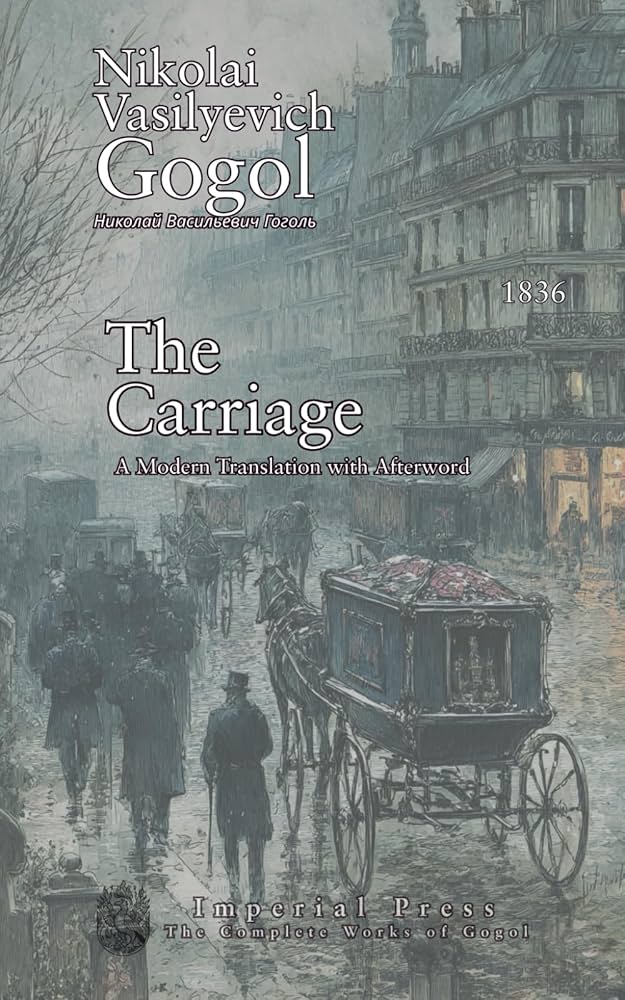
The action unfolds in a boring provincial town that is brought to life by the arrival of a cavalry regiment and a brigadier general. The main character is a local landowner, retired cavalry officer Pifagor Pifagorovich Chertokutsky, who is known for his boasting.
At a dinner hosted by the general, after several glasses of punch, Chertokutsky begins to lie uncontrollably, bragging about his incredible, luxurious “Viennese” carriage, which he does not actually possess. He invites the general and all the officers to his house the next day to show them this marvel.
The next morning, sobered, Chertokutsky realizes his mistake in horror: he has prepared nothing for the dinner, and his real carriage is quite ordinary and unremarkable.
When the guests arrive at Chertokutsky’s house, he panics and hides in the shed. Following his wife’s advice, he climbs inside his old carriage and orders the servants to say that he has urgently departed.
The officers, finding the host absent, decide to view the boasted carriage anyway. When they roll it out, they find it unremarkable. The general, looking inside the carriage, discovers Chertokutsky curled up inside in his dressing gown and cap. The general slams the door shut in disgust and drives away with the officers.
The story ends with Chertokutsky’s complete humiliation, as his pomposity and lies are loudly exposed.
Browse the table of contents, check the quotes, read the first chapter, find out which famous book it is similar to, and buy “The Carriage” on Amazon directly from our page.
This work does not have a table of contents.
His life was quiet, peaceful, and entirely devoted to the pleasures of eating and drinking.
Man is always ready to believe what he desires most.
The carriage was his pride, the symbol of his entire life.
The whole room suddenly became filled with an awkward and suffocating silence.
He was an agreeable man in all respects, but he had one drawback: he was a little too fond of talking about his carriage.
The town of B– had become very lively since a cavalry regiment had taken up its quarters in it. Up to that date it had been mortally wearisome there. When you happened to pass through the town and glanced at its little mud houses with their incredibly gloomy aspect, the pen refuses to express what you felt. You suffered a terrible uneasiness as if you had just lost all your money at play, or had committed some terrible blunder in company. The plaster covering the houses, soaked by the rain, had fallen away in many places from their walls, which from white had become streaked and spotted, whilst old reeds served to thatch them.
Following a custom very common in the towns of South Russia, the chief of police has long since had all the trees in the gardens cut down to improve the view. One never meets anything in the town, unless it is a cock crossing the road, full of dust and soft as a pillow. At the slightest rain this dust is turned into mud, and then all the streets are filled with pigs. Displaying to all their grave faces, they utter such grunts that travellers only think of pressing their horses to get away from them as soon as possible. Sometimes some country gentleman of the neighbourhood, the owner of a dozen serfs, passes in a vehicle which is a kind of compromise between a carriage and a cart, surrounded by sacks of flour, and whipping up his bay mare with her colt trotting by her side. The aspect of the marketplace is mournful enough. The tailor’s house sticks out very stupidly, not squarely to the front but sideways. Facing it is a brick house with two windows, unfinished for fifteen years past, and further on a large wooden market-stall standing by itself and painted mud-colour. This stall, which was to serve as a model, was built by the chief of police in the time of his youth, before he got into the habit of falling asleep directly after dinner, and of drinking a kind of decoction of dried goose-berries every evening. All around the rest of the market-place are nothing but palings. But in the centre are some little sheds where a packet of round cakes, a stout woman in a red dress, a bar of soap, some pounds of bitter almonds, some lead, some cotton, and two shopmen playing at “svaika,” a game resembling quoits, are always to be seen.
But on the arrival of the cavalry regiment everything changed. The streets became more lively and wore quite another aspect. Often from their little houses the inhabitants would see a tall and well-made officer with a plumed hat pass by, on his way to the quarters of one of his comrades to discuss the chances of promotion or the qualities of a new tobacco, or perhaps to risk at play his carriage, which might indeed be called the carriage of all the regiment, since it belonged in turn to every one of them. To-day it was the major who drove out in it, to-morrow it was seen in the lieutenant’s coach-house, and a week later the major’s servant was again greasing its wheels. The long hedges separating the houses were suddenly covered with soldiers’ caps exposed to the sun, grey frieze cloaks hung in the doorways, and moustaches harsh and bristling as clothes brushes were to be met with in all the streets. These moustaches showed themselves everywhere, but above all at the market, over the shoulders of the women of the place who flocked there from all sides to make their purchases. The officers lent great animation to society at B–.
Society consisted up till then of the judge who was living with a deacon’s wife, and of the chief of police, a very sensible man, but one who slept all day long from dinner till evening, and from evening till dinner-time.
This general liveliness was still further increased when the town of B– became the residence of the general commanding the brigade to which the regiment belonged. Many gentlemen of the neighbourhood, whose very existence no one had even suspected, began to come into the town with the intention of calling on the officers, or, perhaps, of playing bank, a game concerning which they had up till then only a very confused notion, occupied as they were with their crops and the commissions of their wives and their hare-hunting. I am very sorry that I cannot recollect for what reason the general made up his mind one fine day to give a grand dinner. The preparations were overwhelming. The clatter of knives in the kitchen was heard as far as the town gates. The whole of the market was laid under contributions, so much so that the judge and the deacon’s wife found themselves obliged that day to be satisfied with hasty puddings and cakes of flour. The little courtyard of the house occupied by the general was crowded with vehicles. The company only consisted of men, officers and gentlemen of the neighbourhood.




Reviews
There are no reviews yet.