Description
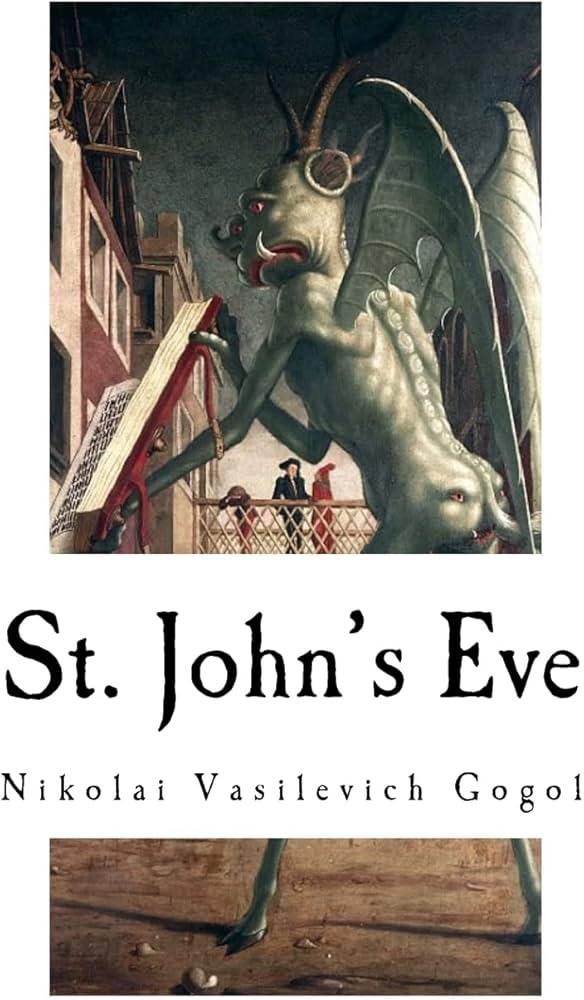
The young and poor farmhand Petrus is in love with the beautiful Pidorka, the daughter of the wealthy Cossack Korzh. Korzh is strongly against the marriage due to Petrus’s poverty and intends to marry Pidorka off to someone else.
In desperation, Petrus meets the mysterious stranger Basavriuk (whom the villagers believe to be the embodiment of the evil spirit). Basavriuk offers the young man immense wealth if he plucks the magical fern flower, which blooms only on the night of St. John’s Eve.
Petrus agrees. At midnight on Ivan Kupala, he goes to Bear’s Ravine. Basavriuk leads him to a witch. After plucking the flower and finding the treasure, Petrus learns the terrible condition: to keep the treasure, he must shed innocent blood. The witch leads the little brother of Pidorka, Ivas, who happened to be nearby, to him. Petrus, blinded by the lust for wealth, murders Ivas.
Thanks to his new wealth, Petrus receives Korzh’s consent and marries Pidorka. However, from this moment on, his life turns into a nightmare. He loses the memory of his crime but constantly lives in fear and anguish, tormented by guilt. The gold obtained in this manner brings him no happiness.
A year later, on the next St. John’s Eve, the memory of the crime returns to Petrus. In horror, he tries to run away but is found dead. Pidorka goes mad with grief. The gold vanishes, turning into shards, and Basavriuk, like a demon, disappears from the village, having claimed his bloody sacrifice and his soul.
Browse the table of contents, check the quotes, read the first chapter, find out which famous book it is similar to, and buy “St. John’s Eve” on Amazon directly from our page.
The evil spirit does not love a prayer, but he loves a game.
Fear is a great master of deception.
It is terrible when one is rich but unable to enjoy it.
No one knows what is hidden in the soul of another man.
The night was quiet, and the stars shone brightly, but there was a strange, restless feeling in the air.
A STORY TOLD BY THE SACRISTAN OF THE DIKANKA CHURCH
Thoma Grigorovitch had one very strange eccentricity: to the day of his death he never liked to tell the same thing twice. There were times when, if you asked him to relate a thing afresh, he would interpolate new matter, or alter it so that it was impossible to recognise it. Once upon a time, one of those gentlemen who, like the usurers at our yearly fairs, clutch and beg and steal every sort of frippery, and issue mean little volumes, no thicker than an A B C book, every month, or even every week, wormed this same story out of Thoma Grigorovitch, and the latter completely forgot about it. But that same young gentleman, in the pea-green caftan, came from Poltava, bringing with him a little book, and, opening it in the middle, showed it to us. Thoma Grigorovitch was on the point of setting his spectacles astride of his nose, but recollected that he had forgotten to wind thread about them and stick them together with wax, so he passed it over to me. As I understand nothing about reading and writing, and do not wear spectacles, I undertook to read it. I had not turned two leaves when all at once he caught me by the hand and stopped me.
“Stop! tell me first what you are reading.”
I confess that I was a trifle stunned by such a question.
“What! what am I reading, Thoma Grigorovitch? Why, your own words.”
“Who told you that they were my words?”
“Why, what more would you have? Here it is printed: ‘Related by such and such a sacristan.’”
“Spit on the head of the man who printed that! he lies, the dog of a Moscow pedlar! Did I say that? ‘’Twas just the same as though one hadn’t his wits about him!’ Listen. I’ll tell the tale to you on the spot.”
We moved up to the table, and he began.
My grandfather (the kingdom of heaven be his! may he eat only wheaten rolls and poppy-seed cakes with honey in the other world!) could tell a story wonderfully well. When he used to begin a tale you could not stir from the spot all day, but kept on listening. He was not like the story-teller of the present day, when he begins to lie, with a tongue as though he had had nothing to eat for three days, so that you snatch your cap and flee from the house. I remember my old mother was alive then, and in the long winter evenings when the frost was crackling out of doors, and had sealed up hermetically the narrow panes of our cottage, she used to sit at her wheel, drawing out a long thread in her hand, rocking the cradle with her foot, and humming a song, which I seem to hear even now.
The lamp, quivering and flaring up as though in fear of something, lighted up our cottage; the spindle hummed; and all of us children, collected in a cluster, listened to grandfather, who had not crawled off the stove for more than five years, owing to his great age. But the wondrous tales of the incursions of the Zaporozhian Cossacks and the Poles, the bold deeds of Podkova, of Poltar-Kozhukh, and Sagaidatchnii, did not interest us so much as the stories about some deed of old which always sent a shiver through our frames and made our hair rise upright on our heads. Sometimes such terror took possession of us in consequence of them, that, from that evening forward, Heaven knows how wonderful everything seemed to us. If one chanced to go out of the cottage after nightfall for anything, one fancied that a visitor from the other world had lain down to sleep in one’s bed; and I have often taken my own smock, at a distance, as it lay at the head of the bed, for the Evil One rolled up into a ball! But the chief thing about grandfather’s stories was, that he never lied in all his life; and whatever he said was so, was so.
I will now tell you one of his wonderful tales. I know that there are a great many wise people who copy in the courts, and can even read civil documents, but who, if you were to put into their hand a simple prayer-book, could not make out the first letter in it, and would show all their teeth in derision. These people laugh at everything you tell them. Along comes one of them—and doesn’t believe in witches! Yes, glory to God that I have lived so long in the world! I have seen heretics to whom it would be easier to lie in confession than it would be to our brothers and equals to take snuff, and these folk would deny the existence of witches! But let them just dream about something, and they won’t even tell what it was! There, it is no use talking about them!
No one could have recognised the village of ours a little over a hundred years ago; it was a hamlet, the poorest kind of a hamlet. Half a score of miserable farmhouses, unplastered and badly thatched, were scattered here and there about the fields. There was not a yard or a decent shed to shelter animals or waggons. That was the way the wealthy lived: and if you had looked for our brothers, the poor—why, a hole in the ground—that was a cabin for you! Only by the smoke could you tell that a God-created man lived there. You ask why they lived so? It was not entirely through poverty: almost every one led a raiding Cossack life, and gathered not a little plunder in foreign lands; it was rather because it was little use building up a good wooden house. Many folk were engaged in raids all over the country—Crimeans, Poles, Lithuanians! It was quite possible that their own countrymen might make a descent and plunder everything. Anything was possible.
In this hamlet a man, or rather a devil in human form, often made his appearance. Why he came, and whence, no one knew. He prowled about, got drunk, and suddenly disappeared as if into the air, leaving no trace of his existence. Then, behold, he seemed to have dropped from the sky again, and went flying about the street of the village, of which no trace now remains, and which was not more than a hundred paces from Dikanka. He would collect together all the Cossacks he met; then there were songs, laughter, and cash in plenty, and vodka flowed like water…. He would address the pretty girls, and give them ribbons, earrings, strings of beads—more than they knew what to do with. It is true that the pretty girls rather hesitated about accepting his presents: God knows, perhaps, what unclean hands they had passed through. My grandfather’s aunt, who kept at that time a tavern, in which Basavriuk (as they called this devil-man) often caroused, said that no consideration on the earth would have induced her to accept a gift from him. But then, again, how to avoid accepting? Fear seized on every one when he knit his shaggy brows, and gave a sidelong glance which might send your feet God knows whither: whilst if you did accept, then the next night some fiend from the swamp, with horns on his head, came and began to squeeze your neck, if there was a string of beads upon it; or bite your finger, if there was a ring upon it; or drag you by the hair, if ribbons were braided in it. God have mercy, then, on those who held such gifts! But here was the difficulty: it was impossible to get rid of them; if you threw them into the water, the diabolical ring or necklace would skim along the surface and into your hand.
There was a church in the village—St. Pantelei, if I remember rightly. There lived there a priest, Father Athanasii of blessed memory. Observing that Basavriuk did not come to church, even at Easter, he determined to reprove him and impose penance upon him. Well, he hardly escaped with his life. “Hark ye, sir!” he thundered in reply, “learn to mind your own business instead of meddling in other people’s, if you don’t want that throat of yours stuck with boiling kutya (1).” What was to be done with this unrepentant man? Father Athanasii contented himself with announcing that any one who should make the acquaintance of Basavriuk would be counted a Catholic, an enemy of Christ’s orthodox church, not a member of the human race.
(1) A dish of rice or wheat flour, with honey and raisins, which is
brought to the church on the celebration of memorial masses.


Reviews
There are no reviews yet.