Description
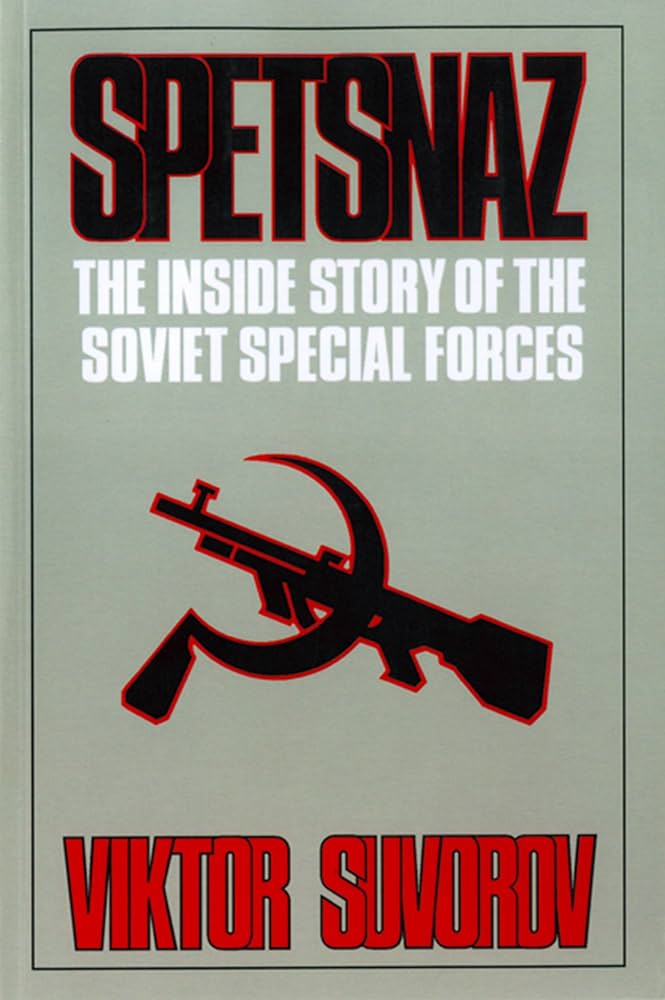
Dive into the secrets of one of the most closed and terrifying military units in the world—the Soviet GRU Spetsnaz. Suvorov, with his background in the GRU, reveals the frightening truth about the training, missions, and doctrine of these “invisible soldiers.”
You will learn how the fighters were selected, the sophisticated sabotage methods they were taught, and the key role they were meant to play in a large-scale conflict with the West: from destroying command centers to sowing chaos deep behind enemy lines. This is a detailed, technically accurate, and gripping study of how ordinary people are turned into perfect machines for war and sabotage.
Browse the table of contents, check the quotes, read the first chapter, find out which famous book it is similar to, and buy “Spetsnaz: The Inside Story Of The Special Soviet Forces” on Amazon directly from our page.
• Preface
• Chapter 1. About people and shovels
• Chapter 2. Predecessors of Spetsnaz units and formations
• Chapter 3. Between the two world wars
• Chapter 4. Soviet saboteurs in World War II
• Chapter 5. Creation of Spetsnaz units and formations
• Chapter 6. “Unaccounted for” Spetsnaz units
• Chapter 7. Separate Spetsnaz company
• Chapter 8. Separate battalion or separate detachment?
• Chapter 9. “Other people”
• Chapter 10. Out of sporting interest
• Chapter 11. Spetsnaz brigade
• Chapter 12. Spetsnaz intelligence point
• Chapter 13. Spetsnaz agents
• Chapter 14. Young fighter’s course
• Chapter 15. Combat training
• Chapter 16. Clan
• Chapter 17. Training of sergeants
• Chapter 18. Training of officers
• Chapter 19. Uncle Vasya and Uncle Petya
• Chapter 20. Weapons
• Chapter 21. Tactics
• Chapter 22. Find and report
• Chapter 23. Command and coordination
• Chapter 24. Disinformation and camouflage
• Chapter 25. The fair half of Spetsnaz
• Chapter 26. Spetsnaz and international law
• Chapter 27. Spetsnaz units and formations in action
• Chapter 28. To the last sea
• Chapter 29. A scythe found a stone (Finding one’s match)
• Afterword
• Appendix 1. Order of the Supreme High Command Headquarters on the destruction of settlements in the frontline zone
• Appendix 2. Possible scenarios for the actions of Spetsnaz units and formations of the USSR Armed Forces in World War III
“Every infantryman in the Soviet Army carries with him a small spade. When he is given the order to halt he immediately lies flat and starts to dig a hole in the ground beside him.”
“The Spetsnaz soldier must be prepared to be an animal, a thief, a killer, and a ghost—all at once.”
“Spetsnaz is the army’s knife, ready to be driven deep into the enemy’s back at the first sign of war.”
“The best way of killing a general is to kill him with his own hands. The ‘pink’ terror may continue for no more than a few hours. But those are the most important hours and minutes—the very last hours and minutes of peace.”
“A Spetsnaz man, even in peacetime, is always ready for war, for his life is nothing but continuous preparation for that one decisive moment.”
Dedication
To Natasha and Alexander
Chapter 1. Shovels and Men
Every infantryman in the Soviet Army carries a small shovel with him. When he receives the command to halt, he immediately lies down and begins to dig a hole in the ground beside him. In three minutes, he will have dug a small trench 15 centimeters deep, into which he can stretch out and lie so that bullets will whistle safely over his head. The earth he has thrown out forms a parapet in front and on the sides, creating additional cover. If a tank drives over such a trench, the soldier has a 50% probability that it will do him no harm. At any moment, the soldier may be ordered to move again, and shouting at the top of his voice, he rushes forward. If he is not ordered to move, he digs deeper and deeper. Initially, his trench can be used for firing from the prone position. Later, it becomes a trench from which he can fire from his knee, and then, even later, after it becomes 110 centimeters deep, it can be used for standing fire. The earth that is thrown outside protects the soldier from bullets and shrapnel. He makes an embrasure in the parapet, where he places the barrel of his assault rifle. In the absence of further commands, he continues to work on his trench. He camouflages it. He begins to dig a trench to connect with his comrade on the left. He always digs from right to left, and after a few hours, the trench connects the foxholes of all the riflemen in that squad. The squad trenches connect with the trenches of other squads. The digging continues, and communication trenches are added in the rear. The trenches are made deeper, roofed over, camouflaged, and fortified. Then, suddenly, the command to move forward comes again. The soldier jumps out, shouting and cursing as loudly as possible.
The infantryman uses the same shovel to dig a grave for a fallen comrade. If he does not have an axe in his hands, he uses the shovel to chop a loaf of bread when it has frozen solid as granite. He uses it as a paddle when, on a telegraph pole under enemy fire, he crosses a wide river. And when he is ordered to halt, he again builds an indestructible fortress around himself. He knows how to dig the ground efficiently. He builds his fortification right away to be exactly what it should be. The shovel is not just a tool for digging the earth: it can also be used for measuring. It is 50 centimeters long. Two shovel lengths equal one meter. The shovel blade is 15 centimeters wide and 18 centimeters long. By memorizing these measurements, the soldier can measure anything he wishes.
The sapper’s shovel has a non-folding handle, and this is a very important feature. The shovel must be a single monolithic object. All three of its edges are sharp as a knife. It is painted matte green so as not to reflect strong sunlight.
The shovel is not just a measuring tool. It is also a guarantee of the infantry’s resilience in the most difficult situations. If the infantry has a few hours to dig into the ground, it can take years to dig them out of their foxholes and trenches, no matter what modern weapons are used against them.
In this book, we are not talking about the infantry but about the soldiers of other units, known as Spetsnaz. These soldiers never dig trenches; in essence, they never occupy defensive positions. They either suddenly attack the enemy or, if they encounter resistance or superior forces, they vanish as quickly as they appeared and attack the enemy again when and where the opponent least expects their appearance.
It is all the more surprising that Spetsnaz soldiers also carry small sapper shovels with them. Why do they need them? It is practically impossible to describe in words how they use their shovels. You need to see with your own eyes what they do with them. In the hands of a Spetsnaz soldier, the shovel is a terrible, silent weapon, and every member of Spetsnaz is trained in the use of the shovel much more than an infantryman.
The first thing he must learn is accuracy: to cut small tree shoots with the edge of the shovel or to chop the neck off a bottle so that the bottle remains intact. He must learn to love his shovel, to believe in its accuracy. To achieve this, he places his hand on a tree stump, spreading his fingers, and rotates it in a fast rhythm with his right hand, using the shovel blade. When he has learned to use the shovel as well as an axe, he learns more complex things. The shovel can be used in hand-to-hand combat against bayonet thrusts, knives, or against another shovel. A soldier who has no other weapon but a shovel is locked in a windowless room alone with a rabid dog to make the fight more interesting. In the end, the soldier is taught to throw the shovel as accurately as a sword or a battle axe. It is a remarkable throwing weapon, a single-piece, well-balanced object, whose 32-centimeter handle acts as a lever for the throw. Because it rotates in flight, it imparts accuracy and impact to the shovel. It becomes a terrifying weapon. If it sticks into a tree, it is not so easy to pull it back out. It is far more serious if it hits someone’s skull, although Spetsnaz soldiers usually do not aim for the enemy’s face, attacking from behind. The victim is unlikely to see the approaching blade before it plunges into his neck from behind or between his shoulder blades, chopping, crushing bones.
The Spetsnaz soldier loves his shovel. He trusts its reliability and accuracy more than his Kalashnikov assault rifle. An interesting psychological detail has been noted in hand-to-hand combat, which is also part of the Spetsnaz training arsenal. If a soldier shoots at an enemy armed with an assault rifle, the enemy also shoots at him. But if he does not shoot at the enemy, and instead throws a shovel at him, the opponent simply throws down his assault rifle and leaps aside.
This is a book about men who throw shovels, about soldiers who wield shovels with more confidence and accuracy than spoons at the dinner table. They use, of course, other weapons besides their shovels.

Reviews
There are no reviews yet.