Description
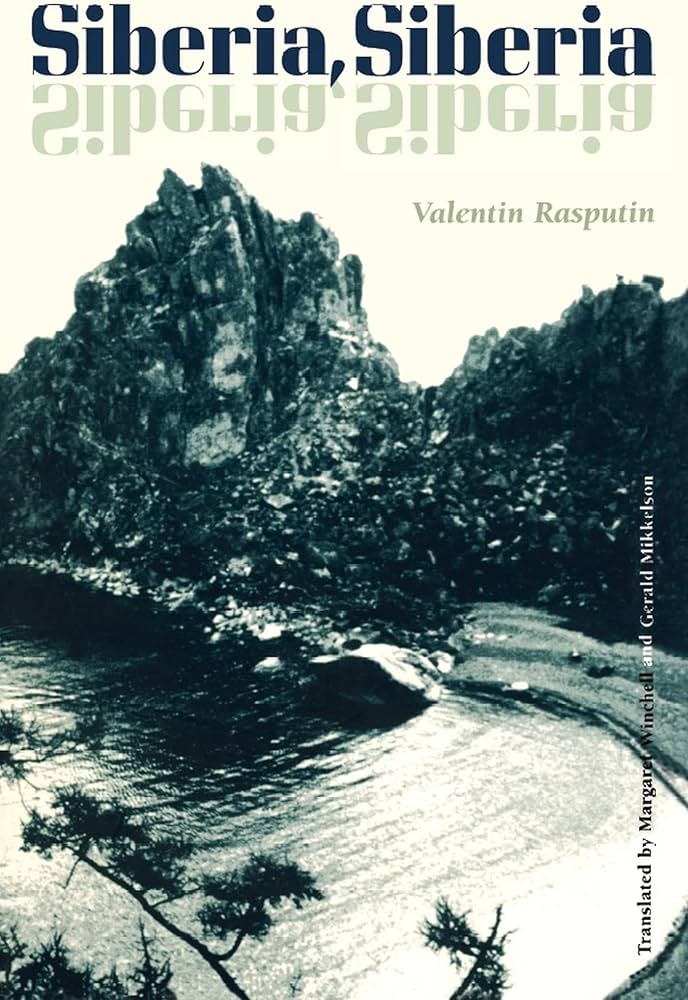
The book is a deep, almost mystical immersion into the history, culture, and soul of the Siberian land. Rasputin guides the reader along the banks of great rivers, past ancient settlements, exploring how the fates of convicts, Old Believers, merchants, and pioneers blended to form the unique Siberian character.
The most poignant parts are the lyrical essays that transform into a passionate ecological manifesto against the irresponsible exploitation of natural resources, especially the sacred Lake Baikal. The author explores with pain how modern industrialization is destroying not only nature but also the historical memory of the people. This is a national confession about the price of progress and the vital necessity of remembering one’s roots and sacred places.
Browse the table of contents, check the quotes, read the first chapter, find out which famous book it is similar to, and buy “Siberia, Siberia” on Amazon directly from our page.
• Siberia without romance
• Tobolsk
• Baikal
• Irkutsk
• Mountain Altai
• Kyakhta
• Russkoye Ustye
• Down the Lena river
• Trans-Siberian Railway
• Circum-Baikal Railway
• My Siberia and your Siberia
• Additions: Irkutsk is with us
• Baikal, Baikal…
• Where are they from in Irkutsk?..
• Baikal before me
• A full cup of gold and grief
• Siberian Rus, Baikal Land
• The return of Tobolsk
“Siberia is not just a geographical space, it is a special state of the Russian soul, forged by history and boundless nature.”
“When reflecting on the actions of today’s ‘river-rerouting’ father figures, who are destroying our sacred national treasures up hill and down with the haste of an invading army, you involuntarily turn to this experience: it would not be a bad idea for them to know that not everything is forgiven at the time of death.”
“The earth here is not just soil; it is memory, frozen in time, and every stone has a story to tell.”
“The silence of the taiga is deceptive; it is filled with the unhurried wisdom of centuries, which we, in our frantic rush, have forgotten how to hear.”
“We must protect the great country—not just the land, but the spirit of the people who have lived and toiled here for four hundred years.”
This vast space bears the common nickname Siberia, which will likely remain with it forever, because nothing other than Siberia can emerge from it.
V. K. Andriyevich, Historian of Siberia
The word “Siberia”—and not so much the word as the concept itself—has long sounded like an alarm bell, announcing something indefinitely mighty and forthcoming. Previously, these strokes were sometimes muffled when interest in Siberia suddenly waned, and then amplified again when it rose. Now, they constantly ring out with ever-increasing force. Siberia! Siberia!… Some hear confidence and hope in this resonant sound, others hear the anxious tread of man on a distant land, and still others hear nothing definite but listen with a vague sense of change coming from this region, which might bring relief.
Even those who have never been there, and who are far removed from its life and interests, inevitably feel Siberia within themselves. It has entered the life and interests of many—if not as a physical, material concept, then as a moral concept, promising some unclear but desired renewal.
In the 18th century, they said: “Siberia is our Peru and Mexico.” In the nineteenth: “It is our United States.” In the twentieth: “Siberia is a source of colossal energy,” “a land of unlimited opportunities.” As we can see, man’s technical armament changes, his needs change, and so do the characteristics of Siberia. From self-generating riches lying on or near the surface, to deep and productive wealth—everything is in Siberia; it has pleased every century, and in all assessments of it, from the first rumors to the latest scientific and economic justifications, the superlative degree is constantly visible.
But even now, as the Earth feels symptoms of suffocation, it turns to Siberia: “These are the lungs of the planet.” Even now… It is easy to understand what will be the primary and enduring necessity for man in thirty, forty, and fifty years, and for what purpose Siberia could truly be a healing and saving force.
We are accustomed to the language of comparisons, but no comparisons will say anything about Siberia. We can only compare the results of development, the works of human hands, but nothing more. There is nothing in the world that could be placed next to Siberia as an analogue. It seems it could exist as an independent planet; it has everything that such a planet should have in all three kingdoms of nature—on land, underground, and in the sky. Its actual life, so diverse and varied in character, cannot be designated by known concepts.
With all that exists in it—the bad and the good, the revealed and the unrevealed, the accomplished and the unaccomplished, the hopeful and the inaccessible—Siberia is Siberia. It has its own name, lies in its own place, and has developed its own, unique character. From end to end and from edge to edge, its own spirit hovers over it, as if it still hasn’t decided whether to be benevolent or malicious, depending on how man behaves here. For four hundred years since the Russian conquest of Siberia, it seems to have remained a giant, tamed and civilized in some places, but never completely awakened. And this awakening, this spiritual self-awareness, we hope, is still ahead.
The word “Siberia” has not been deciphered; its precise etymological meaning has not been found. For an outsider, who only knows about Siberia by hearsay, it is a colossal, harsh, and rich territory—everything is as if on a cosmic scale, including its cosmic coldness and unwelcoming nature. And in the indigenous Siberian, he sees a product of mysterious nature rather than a product of mysterious humanity, like himself.
For us, for those who were born and live in Siberia, it is a homeland more precious and dearer than anything else in the world, needing love and defense like any homeland—perhaps needing defense more than any other land, because there is still something here to defend. And what frightens others about Siberia is not only familiar but necessary to us: we breathe easier when it is frosty in winter, not thawing; we feel peace, not fear, in the untouched, wild taiga; the immeasurable expanses and mighty rivers have shaped our free, independent spirit.
Different views of Siberia—the outsider’s view and the insider’s view—have always existed; even if they have shifted, wavered, and moved closer, they remain different now. Some are accustomed to viewing it as a rich province, and they consider the region’s development to be its rapid and powerful relief from these riches. Others, living here and being patriots of their land, view its development not only as industrial construction and the exploitation of natural resources. This, too, but within reasonable limits. So that what will be priceless tomorrow, and what is already today being put forward before all other riches—to a clear mind not intoxicated by industrial frenzy—is not completely ruined. This is the air produced by the Siberian forests, which one can breathe without harm to the lungs; this is the pure water, for which the world is already immensely thirsty, and this is the unpolluted and unexhausted land, which is able to adopt and feed far more people than it feeds now.
Essentially, by relying on Siberia, and some other, so far reserved, regions, humanity could begin a new life. One way or another, very soon, if it intends to continue existing, it will have to solve the main problems: what to breathe, what to drink, and what to eat, and how and for what purposes to use human intellect? The Earth, as a planet, is increasingly resting on four pillars, none of which can currently be considered reliable. And if the word “Siberia” does not mean “salvation” in its fundamental sense, it could become synonymous with salvation. And then the backward colonization of Siberia, compared to North America, for which old Russia was long reproached, would turn into a great advantage; and then the Russian person could rightfully believe that they had fulfilled a significant part of their cleansing mission on Earth.



Reviews
There are no reviews yet.