Description
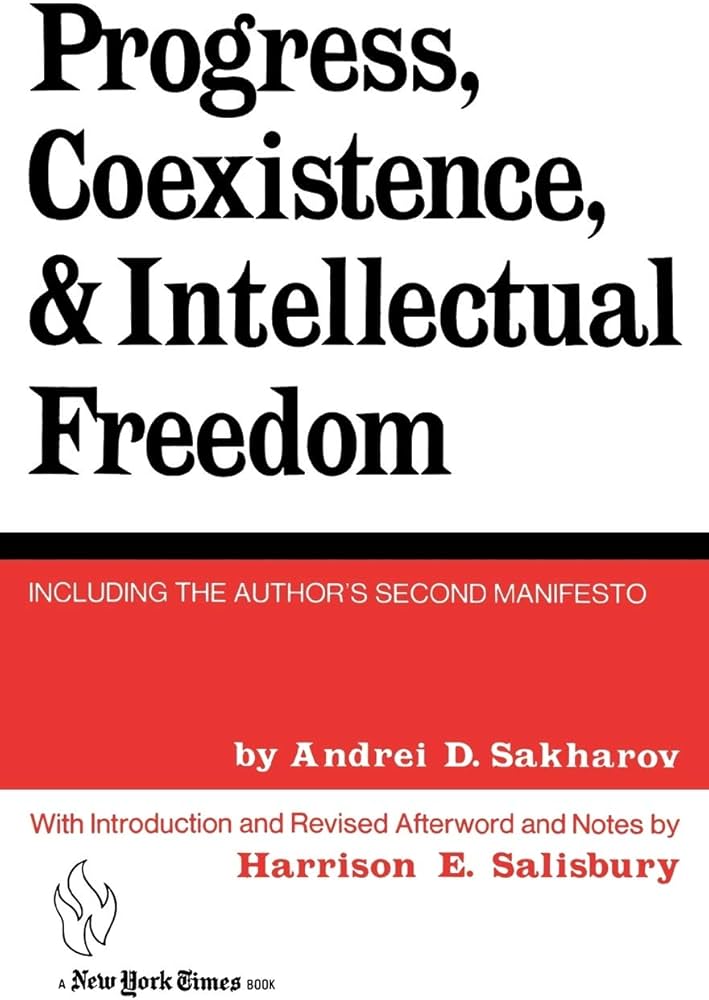
This foundational 1968 manifesto launches a fierce moral and intellectual attack on both Soviet totalitarianism and the Western nuclear threat, arguing that human survival demands the radical convergence of the two global systems. The author, a secret-weapons physicist, risks his entire privileged life to declare that the survival of humanity hinges on universal intellectual freedom and the abolition of all ideological dogma.
His argument is a desperate plea for global reform, warning that the “spiritual poison of fanaticism” and the refusal of global cooperation will inevitably lead to a devastating thermonuclear war or total ecological collapse. The essay became the rallying cry of the Soviet dissident movement and a defining document of the Cold War.
Browse the table of contents, check the quotes, read the first chapter, find out which famous book it is similar to, and buy “Progress, Coexistence, and Intellectual Freedom” on Amazon directly from our page.
A Short Foreword
In 1967, I wrote a futurological article for an internal collection circulated through official channels, concerning the future role of science in society and the future of science itself. That same year, E. Henry and I jointly wrote an article for Literaturnaya Gazeta about the role of the intelligentsia and the danger of thermonuclear war. The Central Committee of the CPSU did not grant permission for the publication of this article; however, by a means unknown to me, it reached the Political Diary—a mysterious publication, presumably something like samizdat for high officials. Both of these little-known articles formed the basis, a year later, for the work that was destined to play a central role in my public activities.
In early 1968, I began work on a book I called “Reflections on Progress, Peaceful Coexistence, and Intellectual Freedom.” In it, I wanted to reflect my thoughts on the most important issues facing humanity—war and peace, dictatorship, the forbidden topic of Stalin’s terror and freedom of thought, demographic problems, and environmental pollution, as well as the role that science and scientific-technical progress could play. The overall mood of the work was influenced by the time of its writing—the height of the “Prague Spring.” The main ideas I attempted to develop in the Reflections are not very new or original. They are essentially a compilation of liberal, humanistic, and “scientocratic” ideas, based on the information available to me and my personal experience. I now evaluate this work as eclectic and in places pretentious, and imperfect (“crude”) in form. Nevertheless, its main ideas are precious to me. The work clearly formulates a thesis that seems very important to me: the convergence of the socialist and capitalist systems, accompanied by democratization, demilitarization, social, and scientific-technical progress, is the only alternative to the annihilation of humanity. Beginning in May-June 1968, the Reflections were widely circulated in the USSR. This was my first work to become available through samizdat. The first foreign reports about my statement appeared in July and August; subsequently, the Reflections were published numerous times abroad in large editions, generating a huge stream of responses in the press of many countries. Along with the content of the work, the fact that it was one of the first socio-political works to break through to the West undoubtedly played an important role, as did the fact that the author was a highly decorated representative of the “mysterious” and “formidable” profession of atomic physicist (this sensationalism, unfortunately, still surrounds me, especially in the mass Western press).
The author’s views were formed in the milieu of the scientific and technical intelligentsia, which shows very great concern regarding fundamental and specific issues of foreign and domestic policy, and the future of humanity. In particular, this concern is fueled by the realization that a scientific method of guiding politics, economics, art, education, and military affairs has not yet become a reality. We consider the “scientific” method to be one based on a deep study of facts, theories, and views, one that presupposes unbiased, dispassionate in its conclusions, and open discussion. At the same time, the complexity and multifaceted nature of all phenomena of modern life, the enormous opportunities and dangers associated with the scientific-technical revolution and a number of socio-social trends, urgently demand precisely such an approach, which is recognized in a number of official statements.
In the brochure submitted for the readers’ discussion, the author set himself the goal of presenting, with the greatest available conviction and frankness, two theses that are shared by many people around the world. These theses are:
1. The disunity of humanity threatens it with annihilation. Civilization is threatened by: a universal thermonuclear war; catastrophic hunger for most of humanity; stupefaction in the intoxication of “mass culture” and in the grip of bureaucratized dogmatism; the spread of mass myths that cast entire nations and continents under the power of cruel and insidious demagogues; death and degeneration from the unforeseen results of rapid changes in conditions of existence on the planet.
In the face of danger, any action that increases the disunity of humanity, any preaching of the incompatibility of world ideologies (such as Capitalism and Communism) and nations, is madness, a crime. Only worldwide cooperation under conditions of intellectual freedom, high moral ideals of socialism and labor, with the elimination of the factors of dogmatism and the pressure of the hidden interests of the ruling classes, serves the interests of preserving civilization.
Millions of people around the world strive to end poverty, hate oppression, dogmatism, and demagoguery (and their extreme expressions—racism, fascism, Stalinism, and Maoism), and believe in progress based on the use of all the positive experience accumulated by humanity under conditions of social justice and intellectual freedom.
1. The second main thesis: intellectual freedom is necessary for human society—freedom to obtain and distribute information, freedom for unbiased and fearless discussion, freedom from the pressure of authority and prejudices. Such three-fold freedom of thought is the only guarantee against infecting the people with mass myths, which, in the hands of insidious hypocritical demagogues, are easily turned into a bloody dictatorship. This is the only guarantee of the feasibility of a scientifically democratic approach to politics, economics, and culture.
But freedom of thought in modern society is under a triple threat: from the calculated opium of “mass culture,” from the cowardly and selfish philistine ideology, and from the ossified dogmatism of the bureaucratic oligarchy and its favorite weapon—ideological censorship. Therefore, freedom of thought needs the protection of all thinking and honest people. This is the task not only of the intelligentsia but of all layers of society, and especially its most active and organized stratum—the working class. The global dangers of war, hunger, cults, and bureaucracy are dangers for all humanity.
The realization by the working class and the intelligentsia of the commonality of their interests is a remarkable phenomenon of our time. It can be said that the most progressive, international, and self-sacrificing part of the intelligentsia is essentially a part of the working class, while the advanced, educated, international, and least philistine part of the working class is simultaneously a part of the intelligentsia (This is a complex and debatable sociological point of view).
We have divided this brochure into two parts. The first will be titled “Dangers,” and the second—”The Basis of Hope.”
The brochure is largely discursive, controversial in many aspects, and calls for discussion and debate.
DANGERS
The Threat of Thermonuclear War
Three technical aspects of thermonuclear weapons have made thermonuclear war a threat to the very existence of civilization. These are the enormous destructive power of the thermonuclear explosion, the relative cheapness of rocket-thermonuclear weapons, and the practical impossibility of effective defense against a massive missile-nuclear attack.
Today, a three-megaton charge can be considered a “typical” thermonuclear charge (this is something between the charge of a Minuteman missile and a Titan II missile). The area of the fire zone when such a charge explodes is 150 times greater, and the area of the destruction zone is 30 times greater than that of the Hiroshima bomb. When one such charge explodes over a city, a zone of complete destruction and fire arises over an area of 100 square kilometers, tens of millions of square meters of living space are destroyed, at least 1 million people die under the debris of buildings, from fire and radiation, suffocate in brick dust and smoke, and perish in blocked shelters. In the case of a ground explosion, the fallout of radioactive dust creates the danger of lethal radiation over an area of tens of thousands of square kilometers.
Now about the cost and possible number of explosions.
After the stage of searches and research is passed, the mass production of thermonuclear weapons and their delivery missiles turns out to be no more complex or expensive than, for example, the production of military aircraft, which were manufactured in tens of thousands during the war.
Currently, the annual production of plutonium worldwide is estimated at tens of thousands of tons. If we assume that half of this production goes to military purposes and that on average, several kilograms of plutonium are used in one charge, it becomes obvious that enough charges have already been accumulated to destroy all mankind multiple times over.
The third technical aspect of the thermonuclear danger (along with the power and cheapness of the charges) we call the practical irresistibility of a massive missile attack. This circumstance is well known to specialists; in popular science literature, see, for example, the recent article by Bethe and Garvin in Scientific American (No. 3, 1968).
Currently, the technology and tactics of attack have far surpassed the technology of defense, despite the creation of very maneuverable and powerful anti-missiles with nuclear charges, and despite other technical ideas (such as the use of a laser beam, etc.).
Increasing the resilience of charges to the impact of a shock wave, to the radiation effects of neutron and X-ray irradiation, the possibility of widespread use of relatively light and cheap “decoys” that are almost indistinguishable from combat charges and deplete the technical means of the enemy’s anti-missile defense, the improvement of tactics for massive, time- and space-concentrated rocket-thermonuclear attacks that exceed the throughput of detection, guidance, and calculation stations, the use of orbital and low-angle attack trajectories, active and passive interference, and a number of other methods not yet covered in the press—all this has placed technical and economic obstacles before the creation of effective anti-missile defense that are currently practically insurmountable (These obstacles include those related to the practical limitations of creating a completely impenetrable defense system).




Reviews
There are no reviews yet.