Description
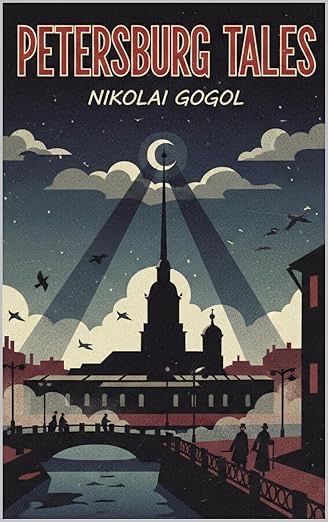
The collection of stories by Nikolai Vasilyevich Gogol describes a multifaceted and ever-changing St. Petersburg. Having personally walked in the shoes of a petty official and become immersed in “state service,” Nikolai Vasilyevich depicts with amazing accuracy the morals of the “significant persons” of that time. And as if reflecting the soul of St. Petersburg, he writes about the “little people,” about their crippled human destinies.
Browse the table of contents, check the quotes, read the first chapter, find out which famous book it is similar to, and buy “Petersburg Tales” on Amazon directly from our page.
Read the Full Text Online: The Petersburg Tales by Nikolai Gogol
It seems to me that sharing thoughts, feelings, and impressions with another is one of the greatest blessings in the world.
Everything is a deception, everything is a dream, everything is not what it seems!
Fame cannot give pleasure to him who has stolen it and not earned it; it only produces constant trepidation in one who is worthy of it.
How strangely, how mystifyingly does our fate toy with us! Do we ever obtain what we desire? Do we ever achieve that for which our powers seem to be deliberately conditioned? Everything happens the wrong way around.
A man who steps out of his house in bright festive clothing needs only to be splashed with a single spot of mud from a wheel, and already all the people surround him, pointing a finger at him, and talking about his slovenliness, while the very same people fail to notice countless spots on others who pass by in ordinary, everyday clothes. For spots are not noticed on everyday clothes.
There is nothing better than Nevsky Prospekt, at least not in St. Petersburg; for it is everything. What doesn’t this street, the belle of our capital, sparkle with! I know that not a single one of its pale, official residents would trade the joys of Nevsky Prospekt for anything. Not only those who are twenty-five years of age, with a handsome mustache and a wonderfully tailored frock coat, but even those whose chins are sprouting white hairs and whose heads are as smooth as a silver platter are enchanted by Nevsky Prospekt. And the ladies! Oh, the ladies find Nevsky Prospekt even more delightful. And who doesn’t find it delightful? The moment you step onto Nevsky Prospekt, you can smell the walking. Even if you have some urgent, essential business, you’re sure to forget all about it the moment you step onto the street. This is the only place where people show up not out of necessity, where they haven’t been driven by need and the commercial interest that encompasses all of St. Petersburg. It seems that a person encountered on Nevsky Prospekt is less of an egoist than on Morskaia, Gorokhovaya, Liteynaya, Meshchanskaya, and other streets, where greed, self-interest, and necessity are etched on the faces of those walking and flying by in carriages and droshkies. Nevsky Prospekt is the universal communication of St. Petersburg. Here, a resident of the Petersburg or Vyborg side, who hasn’t seen his friend on the Sands or at the Moscow Gate for several years, can be sure to meet him. No address book or information office can provide such reliable information as Nevsky Prospekt. Almighty Nevsky Prospekt! The only entertainment for poor, walking St. Petersburg! How cleanly swept its sidewalks are, and, my God, how many feet have left their marks on them! Both the clumsy, dirty boot of the retired soldier, under whose weight even the granite seems to crack, and the miniature, light-as-smoke slipper of the young lady, who turns her head towards the gleaming shop windows like a sunflower to the sun, and the rattling saber of the hopeful ensign, which makes a sharp scratch on the pavement — all express the power of strength or the power of weakness on it. What a rapid phantasmagoria takes place on it in just one day! How many changes it endures in a single twenty-four-hour period! Let’s start with the very early morning, when all of St. Petersburg smells of hot, freshly baked bread and is filled with old women in tattered dresses and cloaks, making their rounds to churches and to compassionate passersby. Then Nevsky Prospekt is empty: the well-fed shopkeepers and their clerks are still sleeping in their Dutch shirts or lathering their noble cheeks and drinking coffee; beggars gather at the doors of pastry shops, where a sleepy Ganymede, who yesterday flew about like a fly with chocolate, emerges, broom in hand, without a tie, and throws them stale pies and scraps. The working people trudge along the streets: sometimes Russian peasants cross it, hurrying to work, in boots stained with lime, which even the Ekaterininsky Canal, known for its cleanliness, would not be able to wash off. It is usually inappropriate for ladies to walk at this time, because the Russian people like to express themselves in such harsh terms that they certainly wouldn’t hear even in the theater. Sometimes a sleepy official trudges along with a briefcase under his arm, if his way to the department lies through Nevsky Prospekt. It can be said with certainty that at this time, that is, until twelve o’clock, Nevsky Prospekt is not a destination for anyone; it only serves as a means: it is gradually filled with people who have their own occupations, their own worries, their own grievances, but who are not thinking about it at all. The Russian peasant talks about a grivna or seven copper kopecks, old men and women wave their arms or talk to themselves, sometimes with quite striking gestures, but no one listens to them or laughs at them, except perhaps for boys in multi-colored robes, with empty glass bottles or ready-made boots in their hands, running like lightning along Nevsky Prospekt. At this time, no matter what you put on, even if you have a cap on your head instead of a hat, even if your collars stick out too far from your tie, no one will notice.
At twelve o’clock, Nevsky Prospekt is invaded by governors of all nations with their charges in cambric collars. The English Joneses and the French Cockes walk arm-in-arm with the pupils entrusted to their parental care and, with a decent seriousness, explain to them that the signs above the shops are made so that one can learn what is inside the shops by means of them. Governesses, pale misses and rosy Slavs, walk majestically behind their light, fidgety little girls, ordering them to raise their shoulders a little higher and to stand up straighter; in short, at this time, Nevsky Prospekt is a pedagogical Nevsky Prospekt. But the closer it gets to two o’clock, the number of governors, pedagogues and children decreases: they are finally displaced by their affectionate parents, walking arm-in-arm with their motley, multi-colored, nervous companions. Little by little, everyone who has finished their rather important household chores joins their company, such as: those who have talked with their doctor about the weather and a small pimple that has popped up on their nose, who have learned about the health of their horses and children, who, by the way, show great talent, who have read the playbill and an important article in the newspapers about arrivals and departures, and finally, who have drunk a cup of coffee and tea; they are joined by those whom an enviable fate has endowed with the blessed title of officials for special assignments. They are also joined by those who serve in the Foreign College and are distinguished by the nobility of their occupations and habits. My God, what beautiful positions and services there are! How they elevate and sweeten the soul! but, alas! I do not serve and am deprived of the pleasure of seeing the subtle treatment of my superiors. Everything you meet on Nevsky Prospekt is full of propriety: men in long frock coats, with their hands in their pockets, ladies in pink, white, and pale blue satin redingotes and hats. Here you will meet unique sideburns, grown with unusual and amazing skill under a tie, sideburns of velvet, satin, black as sable or coal, but, alas, belonging only to the Foreign College. Providence has denied black sideburns to those serving in other departments; they must, to their great displeasure, wear reddish ones. Here you will meet wonderful mustaches, which no pen, no brush can depict; mustaches to which the best half of one’s life is dedicated, – the subject of long vigils during the day and night, mustaches on which the most delightful perfumes and aromas have been poured and which have been anointed with all the most precious and rarest kinds of pomades, mustaches that are wrapped at night with thin vellum paper, mustaches to which their possessors breathe the most touching affection and which passersby envy. A thousand kinds of hats, dresses, scarves – colorful, light, to which their owners are sometimes attached for two whole days, will dazzle anyone on Nevsky Prospekt. It seems as if an entire sea of butterflies has suddenly risen from the stems and is a brilliant cloud over the black male beetles. Here you will find waists you have never even dreamed of: thin, narrow waists, no thicker than the neck of a bottle, upon meeting which you will respectfully step aside so as not to accidentally push them with an impolite elbow; your heart will be seized with timidity and fear that from even your careless breath the most beautiful creation of nature and art might not break. And what women’s sleeves you will find on Nevsky Prospekt! Oh, what a delight! They are somewhat similar to two air balloons, so that a lady would suddenly rise into the air if a man did not support her; because a lady is as easy and pleasant to lift into the air as a glass filled with champagne brought to your mouth. Nowhere do people bow to each other so nobly and naturally as on Nevsky Prospekt. Here you will find a unique smile, a smile of the highest art, sometimes so that you can melt from pleasure, sometimes so that you suddenly see yourself lower than the grass and lower your head, sometimes so that you feel yourself higher than the Admiralty spire and raise it up. Here you will meet people talking about a concert or the weather with extraordinary nobility and a sense of self-worth. Here you will meet a thousand incomprehensible characters and phenomena. Creator! what strange characters you meet on Nevsky Prospekt! There are many such people who, when they meet you, will certainly look at your boots, and, if you pass by, they will turn back to look at your tails. I still can’t understand why this happens. At first, I thought they were shoemakers, but it turned out not to be the case: for the most part, they serve in various departments, many of them can write a report from one government office to another in an excellent manner; or they are people who spend their time walking, reading newspapers in pastry shops – in a word, for the most part, all decent people. At this blessed time from two to three o’clock in the afternoon, which can be called the moving capital of Nevsky Prospekt, the main exhibition of all the best human creations takes place. One shows off a dandyish frock coat with the best beaver, another – a beautiful Greek nose, a third carries excellent sideburns, a fourth – a pair of pretty eyes and a wonderful hat, a fifth – a ring with a talisman on his dandyish little finger, a sixth – a foot in a charming shoe, a seventh – a tie that arouses admiration, an eighth – a mustache that causes astonishment. But the clock strikes three, and the exhibition ends, the crowd thins out… At three o’clock – a new change. Spring suddenly arrives on Nevsky Prospekt: it is all covered with officials in green uniforms. Hungry titular, collegiate, and other councilors try with all their might to quicken their pace. Young collegiate registrars, provincial and collegiate secretaries hurry to take advantage of the time and walk along Nevsky Prospekt with an air that shows that they have not been sitting for six hours in a meeting. But old collegiate secretaries, titular and collegiate councilors walk quickly, with their heads bowed: they have no time to look at passersby; they have not yet completely broken away from their worries; in their heads is a jumble and a whole archive of started and unfinished business; for a long time instead of a sign they see a cardboard box with papers or the full face of the office manager.
From four o’clock, Nevsky Prospekt is empty, and you will hardly meet a single official on it. Some seamstress from a shop will run across Nevsky Prospekt with a box in her hands, some pathetic victim of a philanthropic clerk, who has been sent out into the world in a frieze overcoat, some visiting eccentric for whom all hours are the same, some tall, long-limbed Englishwoman with a reticule and a book in her hands, some artel member, a Russian man in a dimity frock coat with a waist at the back, with a narrow beard, who lives his whole life on a shoestring, in whom everything moves: his back, and arms, and legs, and head, when he politely walks along the sidewalk, sometimes a low-ranking artisan; you will meet no one else on Nevsky Prospekt.


Reviews
There are no reviews yet.