Description
The story takes place during the final year of the Great Patriotic War. The plot centers on the secret drama of Andrei Guskov, who deserted the front and lives secretly as an outcast. His wife, Nastena, is the only person who holds his secret. She is forced to lead an unbearable double life: by day, she is a faithful soldier’s wife to the village; by night, she creeps out to her husband to feed and care for him.
Their doomed love story immediately becomes a source of agonizing conflict and tension. Nastena takes on the guilt and curse of her traitor husband, trying to save him and hide the truth from everyone. When she becomes pregnant, the secret becomes undeniable, and Nastena faces an impossible choice between duty, love, and conscience, leading to a tragic climax.
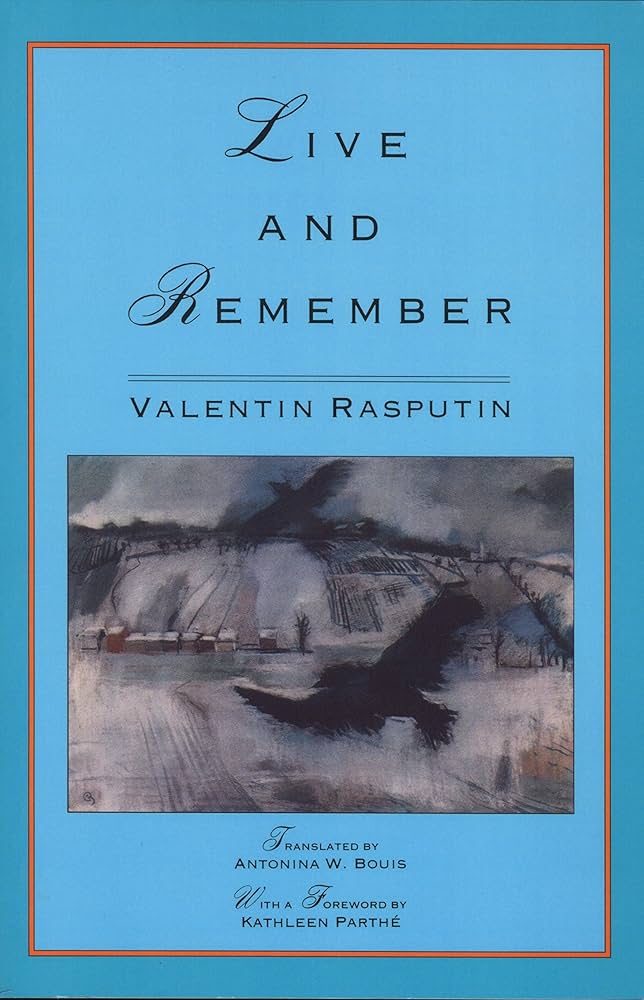
Browse the table of contents, check the quotes, read the first chapter, find out which famous book it is similar to, and buy “Live and Remember” on Amazon directly from our page.
“Let others do as they wished, but she would live the life she began and would not run from corner to corner in a frenzy. She would wait for her own happiness, not someone else’s.”
“You must remember everything. Everything must be remembered, but the bad, like private parts, shouldn’t be shown without a good reason.”
“How easy and wonderful it is to live in happy days and how bitter and accursed it is in miserable days! Why can’t people save up the one to soften the pain of the other?”
“She had to live a long and wretched life to admit to herself at its end that she hadn’t understood anything about it.”
“What was so wrong with us? We were young, healthy, matched in every way. Live and be happy. No, I had to show my strength, be moody. What a fool. And I didn’t understand that I was a fool; after all, I do have some brains, but I couldn’t stop myself.”
1
The winter leading into the forty-fifth, the last year of the war, was orphaned in these parts, yet the Epiphany frosts took their due, clocking in at the requisite forty degrees below. Baked through for a week, the hoarfrost peeled away from the trees, and the forest became utterly lifeless; the snow on the ground squeaked and crumbled, and in the stiff, brittle air, it was hard to breathe in the mornings. Then it eased up again, and after that it eased up once more, and the crusty snow hardened quickly in the open areas.
During the hard frosts, something went missing from the Guskovs’ bathhouse, which stood on the lower garden near the Angara River, close to the water: a fine, old-fashioned, carpentry axe belonging to Mikheich vanished. Whenever they needed to hide something from prying eyes, they always pushed it under the loose floorboard next to the stove, and old man Guskov, who had been crumbling tobacco there the day before, clearly remembered putting the axe in the same spot. The next day, he went for it, but the axe was gone, vanished without a trace. However, after thoroughly searching the bathhouse, Mikheich discovered that the axe was not his only loss: whoever had been busy there had also taken half a shelf of good leaf tobacco and had helped themselves to an old pair of hunting skis from the changing room. That was when old Guskov realized the thief was from far away and he would never see the axe again, because locals would not have taken the skis.
Nastena learned of the loss in the evening, after work. Mikheich had not calmed down all day: where would you find an axe like that now, during the war? You couldn’t find any, but this one was like a toy—light, sharp, just right for the hand. Nastena listened to her father-in-law rant, thinking wearily: why get so worked up over a piece of iron when everything has long been going topsy-turvy anyway? It was only in bed, when her body would faintly ache in the quiet just before sleep, that Nastena’s heart suddenly skipped a beat: who, outside the family, would think to look under that specific floorboard? She nearly suffocated from this unintended thought; sleep instantly vanished, and Nastena lay in the darkness with open eyes for a long time, afraid to move, lest she betray her terrible guess, alternately pushing it away and then again picking up its thin, broken threads.
Nastena did not sleep well that night, and early in the morning, she decided to look into the bathhouse herself. She did not take the path through the calf-shed where the snow was trampled, but went down the communal back alley to the Angara and turned right, from where the roof of the bathhouse was visible behind the fence above the high bank. Standing below, Nastena cautiously climbed the icy steps, climbed over the fence to avoid the squeak of the gate, shuffled around the bathhouse, afraid to go straight in, and only then gently pulled the low door toward her. But the door was frozen shut, and Nastena had to yank it with all her strength. No, that meant there was no one here, and couldn’t be. It was dark in the bathhouse; the tiny window facing the Angara, to the west, was only just beginning to take on a pale, half-dead light. Nastena sat on the bench by the window and acutely, animal-like, began sniffing the air of the bathhouse, trying to find new and unfamiliar, yet once-known scents, but could find nothing but the sharp, bitter smell of frozen dampness. “You made it up, you fool,” she reproached herself and stood up, not fully understanding why she had come here or what she hoped to find.
During the day, Nastena hauled straw from the threshing floor to the collective farmyard, and every time she descended the hill, she looked at the bathhouse as if mesmerized. She admonished herself and grew angry, yet she stared at the dark, angular patch of the bathhouse roof again and again. The straw had to be dug out from under the snow with iron pitchforks, tossed onto the sleds in small bites, and after three trips, Nastena, who was patient with any work, was so exhausted she could barely stand. The sleepless night also seemed to contribute. In the evening, after barely eating, Nastena collapsed into bed as if dead. Whether she dreamed something that night, or whether the idea just occurred to her on a fresh mind, she awoke knowing exactly what to do next. She selected the largest loaf of bread from the storehouse, wrapped it in a clean piece of linen, and secretly carried it to the bathhouse, leaving the bread on the bench in the front corner. She sat there for a while, wondering if she was sane or not, then left, pulling the door shut behind her with a silent, spell-like sigh.
For two mornings after that, Nastena checked—no one had touched the loaf. Then she exchanged it for another, freshly baked one, and placed it in the same spot, clearly visible. She no longer had any hope, but some restless, stubborn dread in her heart compelled her to seek a continuation of the story about the axe. No stranger could have known that there was a hiding place under the chopping block—it lay there, firmly resting alongside the others, unmoving, steady, even if one danced on it. Or did someone spy? The bread, the bread should reveal who it was, it is hard to resist bread.
Two more days passed, and the loaf disappeared! Not finding it in its place, Nastena felt frightened. Powerlessly, with a moan, she sank onto the bench and shook her head: no, it couldn’t be. This can’t be happening! Surely, her father-in-law or mother-in-law had come in, seen the loaf, and taken it home. That was the whole explanation. Nastena dropped to her knees—there were bread crumbs scattered on the floor. No, it wasn’t the in-laws, it was someone else. In the cold ashes of the stove, Nastena rummaged and found a cigarette butt.
From that hour on, she felt as if she was watching herself: what would happen next? She did her household chores, went to work at the collective farm, remaining the same person she had always been in public, but all the while, she constantly looked around, startled by every extraneous sound. But waiting, when you don’t really know what you are waiting for, was unbearable, and so Nastena arranged for a bath on Saturday. Semenovna tried to talk her out of it, citing the cold, but Nastena insisted: she would haul the water herself, she would heat it herself, and they would only have to wash.
She could have prepared the bath quickly; it was simple work, but she deliberately did not rush. She chopped soft birch wood, mixed with pine, and lit the stove later than usual. The day was cold—the frosts were only just beginning to abate—but calm and clear. Climbing up from the Angara with water, Nastena involuntarily glanced at the smoke from the chimney every time: the straight column, black from the birch wood, rose high without a wind and was visible from afar. She heated the cauldron full of water, more than needed, washed the floor and the bench, closed the chimney flue, and went to call the old folks at dusk, not forgetting to tell them to bring kerosene for the lamp.
She moved as if in a dream, almost blindly, feeling neither strain nor fatigue from the day, but doing everything exactly as planned. She waited for the old folks, gathered the laundry, and when Semenovna asked who she was going to bathe with, she lied that she would go with Nadka. Usually, Nastena called one of the neighbors to the bathhouse; looking at her own naked, souring body was painful and bitter, bringing tears to her eyes. But today she had to do without a friend. In the darkness, when the night had not yet fully set and brightened, Nastena reached the bathhouse, draped a cloth over the window from the inside, and undressed, deciding to wash quickly, because her awaited hour would likely come later.
After washing, Nastena returned home, arranged her hair by the lamp in front of the mirror, and told the old folks that she was going to visit Nadka, with whom she had supposedly gone to the bathhouse. Nastena did indeed drop by Nadka’s, but only briefly and without any real purpose, just to be seen. She was rushing back to the bathhouse. Quietly, stealthily, she crept up to the door, fearing she was late, and listened for anyone inside, then cautiously stepped in. The bathhouse had not yet cooled down, and to avoid sweating, Nastena settled on the threshold. If anyone appeared, she would have time to stand up and step aside, but for now, all that remained was to wait.
The last faint voices and the barking of dogs drifted from the village, then everything fell silent. On the Angara, the ice occasionally crackled with a tight, running ring, and the bathhouse sighed as it cooled. Nastena sat in total darkness, barely distinguishing the window, and felt herself numb, like a small, unfortunate creature. What would a person be doing here in the middle of the night? She tried to think about something, to remember something, and she could not: what was simple among people was impossible here.
Later, when a strong draft began to blow under the door, she moved to the bench.
She must have dozed off, because she did not hear footsteps. The door suddenly opened, and something, brushing against it, rustling, crawled into the bathhouse. Nastena sprang up.
“Lord! Who is it, who?” she cried out, almost fainting with fear. The large black figure froze at the door for a moment, then rushed towards Nastena.
“Be quiet, Nastena. It’s me. Be quiet.”
In the village, the dogs rose up and then fell silent.




Reviews
There are no reviews yet.