Description
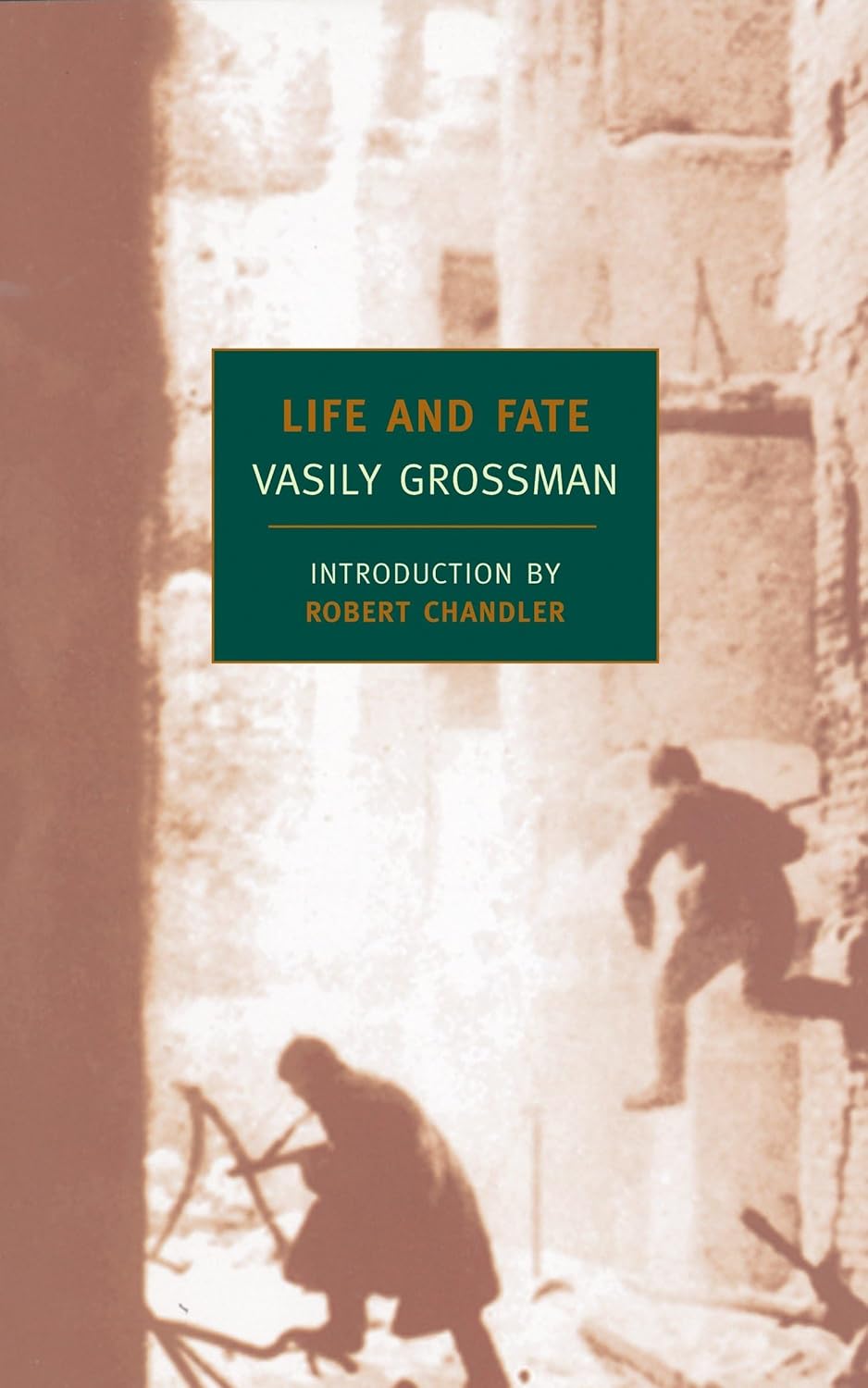
The immense, multi-layered story centers on the Shaposhnikov family, scattered across the Soviet Union during the most terrifying period of the Great Patriotic War. While the tank corps of one sister’s husband prepares for the counter-offensive at Stalingrad, her former husband, a commissar, faces KGB arrest in Moscow, and her Jewish mother, Sofya Levinton, walks to the gas chamber in a Nazi death camp.
The main protagonist, physicist Viktor Shtrum, struggles to defend his politically contentious scientific research and his own life when a wave of state-sponsored anti-Semitism threatens to crush him. The novel draws a stark parallel between the totalitarian systems of Hitler and Stalin, revealing how the war exposes both the greatest human heroism and the vile compromises made under the absolute control of the State over life and thought.
Browse the table of contents, check the quotes, read the first act, find out which famous book it is similar to, and buy “Life and Fate” on Amazon directly from our page.
This novel, Life and Fate, is divided into three parts, containing a total of 61 chapters. The chapters are consecutively numbered within each part and do not have titles.
“Human groupings have one main purpose: to assert everyone’s right to be different, to be special, to think, feel and live in his or her own way. People join together in order to win or defend this right. But this is where a terrible, fateful error is born: the belief that these groupings in the name of a race, a God, a party or a State are the very purpose of life and not simply a means to an end. No! The only true and lasting meaning of the struggle for life lies in the individual, in his modest peculiarities and in his right to these peculiarities.”
“I have seen that it is not man who is impotent in the struggle against evil, but the power of evil that is impotent in the struggle against man. The powerlessness of kindness, of senseless kindness, is the secret of its immortality.”
“Good men and bad men alike are capable of weakness. The difference is simply that a bad man will be proud all his life of one good deed—while an honest man is hardly aware of his good acts, but remembers a single sin for years on end.”
“Man and fascism cannot co-exist. If fascism conquers, man will cease to exist and there will remain only man-like creatures that have undergone an internal transformation.”
“Chekhov brought Russia into our consciousness in all its vastness… He said—and no one had said this before, not even Tolstoy—that first and foremost we are all of us human beings. Do you understand? Human beings!”
CHAPTER 1
A mist lay over the land. The headlamps of the cars moving along the highway reflected on the high-voltage wires that stretched beside it.
It wasn’t raining, but the ground had become damp in the pre-dawn hours, and when the stoplight flashed, a reddish, blurred patch appeared on the wet asphalt. The breath of the camp could be sensed for many kilometers—wires, highways, and railways all converged toward it, growing denser. It was a space filled with straight lines, a space of rectangles and parallelograms that dissected the earth, the autumn sky, and the fog.
Distant sirens wailed, drawn out and subdued.
The highway hugged the railroad, and a convoy of trucks loaded with paper sacks of cement drove for a while at almost the same speed as the endlessly long freight train. The drivers in military overcoats did not look at the nearby wagons, nor at the pale patches of human faces.
The camp fence emerged from the fog—rows of wire stretched between reinforced concrete posts. The barracks formed wide, straight streets. Their uniformity expressed the inhumanity of the enormous camp.
In a great million Russian peasant huts, there are not and cannot be two that are indistinguishably alike. Everything alive is unique. The identity of two people, two wild rose bushes, is inconceivable… Life withers where violence seeks to erase its uniqueness and peculiarities.
The attentive yet careless eye of the grey-haired engineer watched the flashing concrete posts, the tall masts with revolving searchlights, and the concrete watchtowers where a guard was visible with a turret machine gun in the glass lamp-housing. The engineer blinked to his assistant; the locomotive gave a warning signal. A booth illuminated by electricity flashed by, a line of cars at the lowered striped barrier, the bull-like red eye of the traffic light.
The sound of horns from an approaching train could be heard in the distance. The engineer said to his assistant: “That’s Zucker, I recognize his distress call. He’s unloaded and is hauling empties to Munich.”
The empty train, rattling loudly, met the convoy heading towards the camp; the torn air crackled, the grey gaps between the cars flickered, and suddenly the space and the autumn morning light reassembled from the ragged fragments into a smoothly running canvas.
The assistant engineer took out a pocket mirror and looked at his smeared cheek. The engineer motioned with his hand, asking for the mirror.
The assistant said in an agitated voice: “Ah, Genosse Apfel, believe me, we could be returning for lunch, not at four in the morning, exhausting ourselves, if it weren’t for this disinfection of the wagons. And as if the disinfection couldn’t be done at our own junction.”
The old man was tired of the constant talk about disinfection. “Give a long blast,” he said, “we’re being diverted not to the siding, but directly to the main unloading platform.”



Reviews
There are no reviews yet.