Description
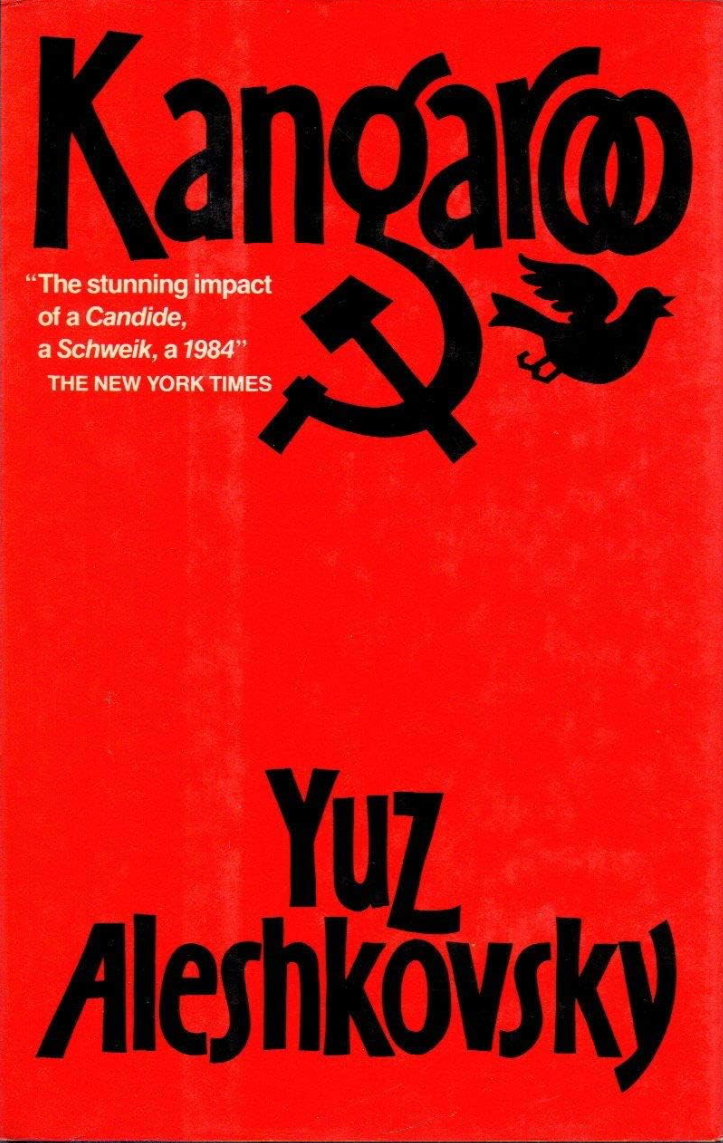
The protagonist, an old man named Skobelev, suddenly finds himself on trial for the most absurd crime in history: allegedly stealing and eating a sacred kangaroo belonging to Tsar Nicholas II himself. A surreal and grotesque investigation begins, led by a prosecutor’s investigator for special cases, turning the whole affair into a farce that reflects the entire historical path of Russia.
Through Skobelev’s sarcastic monologue, filled with slang and anecdotes, a political satire on bureaucracy, arbitrary rule, and the pointlessness of power unfolds. The author creates a nightmarish yet comical picture of total injustice, where anyone can be declared guilty of an unthinkable crime.
Browse the table of contents, check the quotes, read the first chapter, find out which famous book it is similar to, and buy “Kangaroo” on Amazon directly from our page.
“Come on, Kolya, let’s start from the beginning, although it’s completely unclear to me what kind of order there can be in this whole ridiculous story…
In that year, 1949, I was the most unhappy man on our planet, and perhaps in the whole solar system, although, of course, only I felt it. By the way, personal unhappiness is not world fame and doesn’t need the recognition of all humanity.
But let’s start in order. I was just about to take a batch of finished veils to the co-op on Monday when a long-distance call came through. And I crafted those veils just for show, to make it look like I was engaged in useful labor despite my disability, and besides, I somehow enjoyed dabbing black beauty spots onto the netting with ink. You sit there, dabbing, and reminisce about the time you were amiably drinking the great White Horse whisky with the head of Singapore Customs. So: the long-distance call. I pick up.
“Gulyayev,” I say cheerfully, “aka Sidorov, aka Katzenelenbogen, aka von Patoff, aka Erkrants, aka Petyanchikov, aka Tede speaking!”
“I’ll teach you to joke, you reactionary mug!” I hear in response, and I quietly turn toward the window, for I understand that soon I won’t see freedom, and I need to feast my eyes on it.
“Be at my place in exactly one hour. The pass is ordered. For every minute you’re late, it’s a day in the cooler. Just don’t try to pull the insanity stunt. Your theory explaining the disappearance of Repin and two Gaugins from Yablochkina’s bedroom by the centrifugal force of the Earth’s rotation won’t fly this time. It won’t fly! Clear, Citizen Tede?”
“With my things?” I ask.
“Of course,” the Chekist maggot replies after a pause. “Grab some Indian tea, top-grade, I have a lot of work. We’ll brew some chifir [strong tea].”
He, the louse, hung up, but I, Kolya, held my receiver; I didn’t drop it. It beeped mournfully, “beep-beep-beep-beep,” stabbing sharp splinters into my heart. Then I ripped the receiver out of the apparatus by the root, and believe it or not, it kept beeping on the floor for another minute. It was dying. Don’t be surprised. Even we grow fingernails and beards after death, and if I croak before you, God forbid, Kolya, please put an ‘Era’ electric razor and small scissors in my coffin…
But, my dear man, you know yourself, if we reacted to professional setbacks like responsible workers or certain Jews, we would have already had twenty heart attacks, strokes, and cancers of the rectum. I kicked the dead receiver under the couch and started to feel cheerful before suffering and being locked up for who knows what and for how long. I still remember every second of those two hours I spent traveling to the Lubyanka. My God, what seconds they were, even fractions of seconds and fractions of their fractions. I was saying goodbye to the dear faces in the family album and simultaneously managed to squint at the free sparrows outside the window. I brushed the poplar fluff off the Van Gogh. I figured out where to stash the gold and the cash. I thought that paying for gas and electricity—that’s for suckers, excuse my language, at the ninth enhanced rate; let Academician Nesmeyanov pay for the gas, and the great Einstein himself, the specialist in that matter, pay for the electricity. Besides all that, I prepared everything for the moment of my return to freedom: I set the table for two and put a bottle of cognac closer to my setting. I put it there and drove away the thought of how many stars would be added to that bottle while I served my term. A year will pass—a star, then another, then, I think, you, cognac, will become “Dvin,” then “Yerevan,” and even if you become “Napoleon,” I’m still not a fool, I’ll still be freed and I will drink you, I’ll drink you for the lost time of my life with the sweet little darling who is running down the street in a white apron, skipping home from school… She ran into the bakery for some reason…
I didn’t make up the couch for the coming night. Why save up precious time as if in a piggy bank? If fate allows, I’ll make it up again. Then I sat down for a moment before my journey; only fifteen minutes had passed since the call, I said a prayer, unplugged the refrigerator, and, by the way, Kolya, I saw a bedbug. I wanted to squash it against the wall, but for some reason, I felt pity. “Excuse me,” I said, “I am departing for terrible lands, and you won’t have anyone to bite for a long time. But I will spare you, living creature, for you must live to five hundred years, and without your blood ration, you will prematurely perish.” I took the bedbug and carefully tossed it under the neighbor Zoya’s door. I spent half a minute on this, no less. I carried the geranium to the kitchen. I packed my small suitcase and left the house. Note: I left the house. I stand by the entrance. I stand and stand, because my legs won’t move. And not from weakness, they just won’t move, that’s all. Why should my legs move, actually, if you think about it? They don’t get to choose the path themselves. It has already been marked out for them by Citizen Lieutenant Colonel Kidalla. And since they don’t get to choose, there is peace in my legs. True, Kidalla gave me an hour and promised a day in the cooler for every minute I was late. But it’s nothing, I think, I’ll talk my way out of it. And in my soul, I have about the same peace as in my legs. For the soul, too, a path has been marked out by Citizen Lieutenant Colonel Kidalla: it is the same path, the same road, the same track, the same highway, the same destiny.
I, of course, trudged off to the Cheka, but I didn’t even notice when I started moving, because, Kolya, life hit me so hard between the horns with a crutch then that, by God, for the first moment, I couldn’t figure out if I existed or not…
Some scumbag latched onto me on the way. She, you see, found the look with which I was squinting at the portrait of Kyrla Myrla hanging in the delicatessen window strange. “I,” says this vermin, “have been observing you for a long time, and if you are not one of us, you had better go and tell the authorities yourself. Perhaps,” the bespectacled louse adds, “you don’t like the changes that have occurred in the world? Then declare it! Here! Now! Declare it! Instead of carrying a fig in your pocket and foaming at the mouth with the impotent saliva of an enemy standing above the fray!” The creature called me a nobody, and the main thing, Kolya, the scum wouldn’t leave me alone, because she, the beast, was interested in which side of the barricade she was on, and which side I was on? I then started mumbling with the pretense of a syphilitic that I was on the side of the barricade where the furniture was softer and older, and that I was heading to the venereal disease clinic for a Wassermann test after a sexual act with a lovely lady—an heiress of the birthmarks of capitalism. I, of course, deliberately splattered her with saliva and thought: should I get charged under Article 74 for hooliganism? But you know yourself: the Cheka, if needed, will shuffle all the transit prisons, all the Buras and Zuras, they will bend over the farthest detachments, but they will find the person they need! By the way, about barricades and furniture. I carried this very dressing table out of a barricade in Kyiv in 1916. It’s worth as much as a “Volga” on the black market, but I haven’t sold it, I’m not selling it, and I won’t sell it! Marie Antoinette used to comb her hair at it. Now, tell me, Kolya, what is happening to our planet? Why do people chop off the heads of queen-women? Why? Why? And some blind gut, you see, is sickened by the look with which I squinted at Karla Marla! And please don’t calm me down. I’m not an epileptic. My nerves are tougher than the reinforcement bars at the Stalingrad Hydroelectric Station. Be well, my dear!
Thank God that you and I are normal people! And remember once and for all: normal people are those individuals who, after all the devilish turmoil, patiently and neatly, so as not to, God forbid, break the leg off some chair, even a simple and shabby Viennese one, dismantle the street barricades. And, accordingly, the abnormal ones are those scoundrels who think they know exactly what they want out of life. Although what could people who drag chairs from their homes onto the cobblestones want? Yet a person rests on them! Tables, Kolya, they drag tables!! And our kind eats, chomps, chews, cuts, consumes, in a word, takes food at them. And finally, Kolya, people drag beds onto the dirty street—the same as couches, ottomans, spring and straw mattresses—that is, they drag everything they nap on for one-third of the day, and sometimes grab a bit more during the day, everything they spend their first and last marital nights on, where the sick lie, where the wronged cry, where they give birth, and where they croak! Abnormal people! And they can’t even agree on which side of the barricade they should stand. But enough about them.”

Reviews
There are no reviews yet.