Description
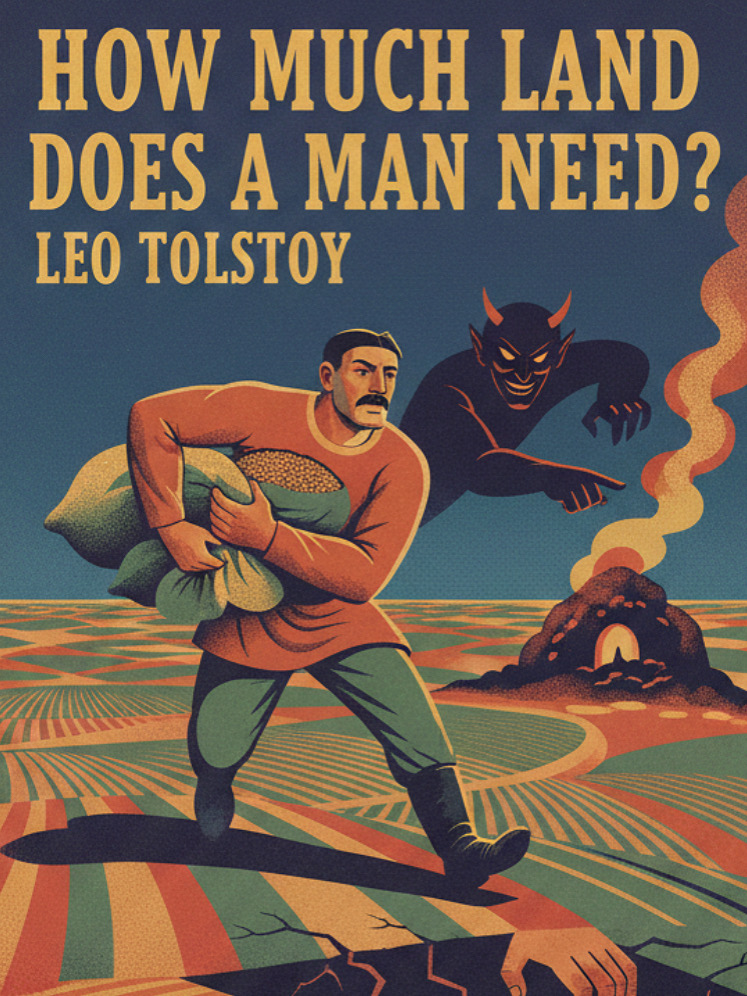
This parable is a tragic examination of ruinous human greed. The peasant Pahom is obsessed with one idea: if he only had enough land, he wouldn’t fear the Devil himself. The Devil, overhearing this boast, immediately sets out to tempt Pahom.
Dissatisfied with his modest holdings, Pahom constantly pursues new, larger, and more fertile territories. His insatiability leads him to the distant steppes of the Bashkirs, who offer an incredible deal: for a thousand rubles, he can claim all the land he can walk around in one day, from sunrise to sunset. The only condition is that he must return to the starting point before the sun sets.
Blinded by avarice, Pahom marks out a path that is far too long. Realizing the sun is about to disappear, he throws all his strength into a desperate, fatal race. In the final moment, exhausted and delirious, he reaches the goal but collapses dead.
Pahom’s servant digs him a grave. Thus, Tolstoy gives the final, ruthless answer to the story’s title question: “Six feet from head to heel. That is all the land a man needs.”
Browse the table of contents, check the quotes, read the first chapter, find out which famous book it is similar to, and buy “How Much Land Does a Man Need?” on Amazon directly from our page.
I
The elder sister came from the city to the younger one in the village. The elder was married to a merchant in the city, and the younger to a peasant in the village. The sisters were drinking tea and talking. The elder sister began to boast—praising her life in the city: how spaciously and cleanly she lives and walks in the city, how she dresses her children, how well she eats and drinks, and how she goes on social events and to the theaters.
The younger sister felt offended, and she began to disparage the merchant’s life and exalt her own peasant life.
“I wouldn’t trade,” she says, “my life for yours. We may live plainly, but we know no fear. You may live more cleanly, but you either make a big profit or lose everything. And the proverb goes: ‘Loss is the elder brother of profit.’ It also happens: rich today, begging under windows tomorrow. But our peasant life is more certain: a peasant’s belly is thin, but long; we won’t be rich, but we will be fed.”
The elder sister began to say: “What kind of nourishment is that—with pigs and calves! No finery, no manners! No matter how hard your husband works, you live in dung and you will die in dung, and the same will happen to your children.”
“Well,” says the younger, “that’s how our life is. But we live firmly, we bow to no one, we fear no one. And you in the city all live amidst temptations; things are good today, but tomorrow the Evil One will appear—look, and he will tempt your husband to cards, or wine, or some woman. And everything will go to dust. Doesn’t that happen?”
Pakhom—the husband—sitting on the stove, listened to what the women were chattering about.
“That’s the honest truth,” he says. “When a man like me has been turning over the earth, our mother, since childhood, foolish thoughts don’t enter his head. The only trouble is that there isn’t enough land! If I had land in plenty, I wouldn’t fear anyone, not even the devil himself!”
The women finished their tea, talked some more about outfits, cleared the dishes, and lay down to sleep.
And the devil was sitting behind the stove, and he heard everything. He was pleased that the peasant’s wife had led her husband to boast: boasting that if he had land, even the devil wouldn’t take him.
“All right,” he thinks, “we’ll have a wager, you and I; I’ll give you plenty of land. And I’ll take you by the land.”
II
A small proprietress lived next to the peasants. She owned one hundred and twenty desiatinas of land. And she used to live peacefully with the peasants—she didn’t offend them. But a retired soldier was hired by her as a manager and began to torment the peasants with fines. No matter how careful Pakhom was, either a horse would run into the oats, or a cow would stray into the garden, or the calves would wander into the meadows—for everything, a fine. Pakhom would pay the fine and curse and beat his household. Pakhom suffered much grief from this manager over the summer. He was even glad when the cattle were confined to the yard, though he regretted the feed, there was no fear of fines.
A rumor spread in winter that the proprietress was selling the land and that a city gatekeeper was planning to buy it. The peasants heard it and gasped. “Well,” they thought, “if the land goes to the gatekeeper, he will torment us with fines worse than the proprietress. We cannot live without this land; we are all circled by it.” The peasants came to the proprietress as a commune, asking her not to sell to the gatekeeper but to let them have it. They promised to pay more. The proprietress agreed. The peasants began to arrange to buy all the land as a commune; they gathered once and twice, but the deal fell through. The Evil One was dividing them; they could not agree. So the peasants decided to buy separately, as much as each could manage. The proprietress agreed to this as well.
Pakhom heard that a neighbor had bought twenty desiatinas from the proprietress, and she had given him credit for half the money for several years. Pakhom grew envious: “They’ll buy up all the land,” he thinks, “and I’ll be left with nothing.” He began to consult with his wife.
“People are buying,” he says, “we need to buy ten desiatinas too. Otherwise, we can’t live: the manager has overwhelmed us with fines.”
They considered how to buy. They had a hundred rubles saved, they sold a colt, half their bees, put their son out for hire, and borrowed from a relative, and they gathered half the money. Pakhom gathered the money, selected fifteen desiatinas with a small wood, and went to bargain with the proprietress. He bargained for fifteen desiatinas, struck a deal, and gave a deposit. They went to the city, formalized the purchase deed, he paid half the money, and promised to pay the rest in two years.
And Pakhom became a man of land. Pakhom borrowed seeds and sowed the purchased land; the harvest was good. In one year, he paid off the debt to both the proprietress and his relative. And Pakhom became a landowner: he plowed and sowed his own land, mowed hay on his own land, cut stakes from his own land, and fed his cattle on his own land. When Pakhom rode out to plow his forever-own land or came to look at the sprouts and meadows—he couldn’t get enough joy. Even the grass, it seemed to him, grew differently, and the flowers bloomed quite differently on it. Before, when he rode over this land, it was just land, but now it had become very special land.
III
Pakhom lived like this and rejoiced. Everything would have been fine, except that the peasants started trampling Pakhom’s grain and meadows. He asked politely, but they wouldn’t stop: one time the shepherds would let the cows into the meadows, another time the horses from the night pasture would stray onto the grain. Pakhom chased them off and forgave them, he never went to court, but then he got tired of it and started complaining to the district court. And he knew that the peasants did it due to lack of space, not intentionally, but he thought: “I can’t just let it go; they’ll ruin everything this way. I must teach them a lesson.”
He taught them a lesson with the court once, he taught them a lesson another time; one was fined, another was fined. The peasant neighbors began to bear a grudge against Pakhom; the next time, they started trampling intentionally. Someone snuck into the small wood one night and cut down a dozen linden trees for bast. Pakhom rode through the wood—look, there’s white showing. He rode closer—the bark strips were lying discarded, and stumps were sticking up. If only he had cut the outer ones from a bush, leaving one, but the villain had cleared everything in a row. Pakhom grew angry: “Ah,” he thinks, “if only I could find out who did this; I would pay him back.”
He thought and thought about who it was: “It can only be Semka,” he thinks. He went to Semka’s yard to search, found nothing, but they cursed at each other. And Pakhom became even more convinced that Semyon had done it. He filed a petition. They were summoned to court. They judged and judged—the peasant was acquitted: there was no evidence. Pakhom was even more offended; he quarreled with the elder and the judges.
“You,” he says, “are helping thieves. If you lived by the truth yourselves, you wouldn’t acquit thieves.”
Pakhom quarreled with both the judges and his neighbors. They even started threatening him with the “red rooster” (arson). Life was becoming spacier for Pakhom on his land, but tighter among the people.
And at that time, a rumor spread that people were going to new lands. And Pakhom thinks: “There’s no need for me to leave my own land, but if some of our people went, it would become spacier here. I would take their land for myself, bring it into my own circle; life would become better. Otherwise, it’s all so crowded.”
One time Pakhom was sitting at home, and a passing peasant came in. They let the peasant stay the night, fed him, and started talking—where had God brought him from? The peasant says he came from the region below the Volga, where he had been working. Word by word, the peasant tells how people are going there to settle. He says that their people have settled there, registered with the commune, and been allotted ten desiatinas per person. “And the land is such,” he says, “that if you sow rye, the straw is so tall you can’t see a horse, and it’s so thick that five handfuls make a sheaf. One peasant,” he says, “came completely poor, with nothing but his hands, and now he has six horses and two cows.”
Pakhom’s heart grew eager. He thinks: “Why suffer in this crowding when one can live well? I’ll sell my land and my farmstead here; there I can build myself up with that money and start a whole operation. But here, in this crowding, it’s nothing but sin. I just need to go and find out all the particulars myself.”
He got ready for the summer and left. He sailed down the Volga to Samara on a steamboat, then walked about four hundred versts. He reached the place. Everything was exactly so. The peasants live spaciously, ten desiatinas of land are allotted per person, and they accept newcomers into the commune willingly. And if someone has money, besides the allotment, you can buy as much first-rate land as you want for permanent ownership, for three rubles per desiatina; you can buy as much as you like!




Reviews
There are no reviews yet.