I was returning home across the fields. It was the very middle of summer. The meadows had been cleared and the rye was just about to be mown.
There is a lovely selection of flowers at this time of year: red, white, pink, fragrant, fluffy clover; audacious daisies; milky-white with bright yellow centers “love-me-nots” with their stale, pungent smell; yellow wild mustard with its honey scent; tall-standing lilac and white tulip-like bellflowers; creeping peas; neat yellow, red, pink, lilac scabious; plantain with a slight pink fluff and a faintly pleasant smell; cornflowers, bright blue in the sun and when young, and bluish and reddening in the evening and when old; and the delicate, almond-scented, immediately fading morning glory flowers.
I picked a large bouquet of various flowers and was walking home when I noticed in the ditch a marvelous crimson, fully blooming thistle of the kind we call a “Tartar” and which is carefully cut around, or, if accidentally mown, is thrown out of the hay by the mowers so as not to prick their hands on it. It occurred to me to pluck this thistle and put it in the middle of the bouquet. I climbed down into the ditch and, having chased away a furry bumblebee that was stuck sweetly and lazily asleep in the center of the flower, I began to pluck the flower. But it was very difficult: not only did the stem prick from all sides, even through the kerchief I had wrapped around my hand—it was so terribly strong that I struggled with it for about five minutes, tearing the fibers one by one. When I finally tore the flower off, the stem was already in shreds, and the flower no longer seemed so fresh and beautiful. Moreover, due to its coarseness and gaudiness, it did not suit the delicate flowers of the bouquet. I regretted that I had pointlessly ruined a flower that was beautiful in its proper place, and I threw it away. “What energy and vital power,” I thought, recalling the effort with which I had torn off the flower. “How intensely it defended and dearly sold its life.”
The road home led across a fallow, newly ploughed black earth field. I was walking downhill along the dusty black earth road. The ploughed field belonged to the landowner, very large, so that on both sides of the road and forward up the hill, nothing was visible but black, evenly furrowed fallow land, not yet harrowed. The ploughing was good, and not a single plant, not a single blade of grass was visible across the field—everything was black. “What a destructive, cruel creature man is, how many diverse living beings, plants, he has annihilated to sustain his life,” I thought, involuntarily looking for something alive amidst this dead black field. Ahead of me, to the right of the road, a small bush was visible. When I approached closer, I recognized the bush as the same kind of “Tartar” whose flower I had pointlessly plucked and discarded.
The “Tartar” bush consisted of three offshoots. One was torn off, and the remainder of the branch stuck out like a severed arm. On the other two, there was a flower on each. These flowers had once been crimson, but now they were black. One stem was broken, and half of it, with a dirty flower at the end, hung downwards; the other, though smeared with black earth mud, still stuck upwards. It was evident that the whole bush had been run over by a wheel and had subsequently risen, and was therefore leaning sideways, but it was still standing. It was as if a piece of its body had been torn out, its insides ripped out, an arm torn off, an eye gouged out. But it still stands and does not surrender to the man who has destroyed all its brethren around it.
“What energy!” I thought. “Man has conquered everything, annihilated millions of grasses, but this one still does not surrender.”
And I recalled an old Caucasian story, a part of which I had seen, a part heard from eyewitnesses, and a part imagined. This story, as it took shape in my memory and imagination, is as follows.
I
It was at the end of 1851.
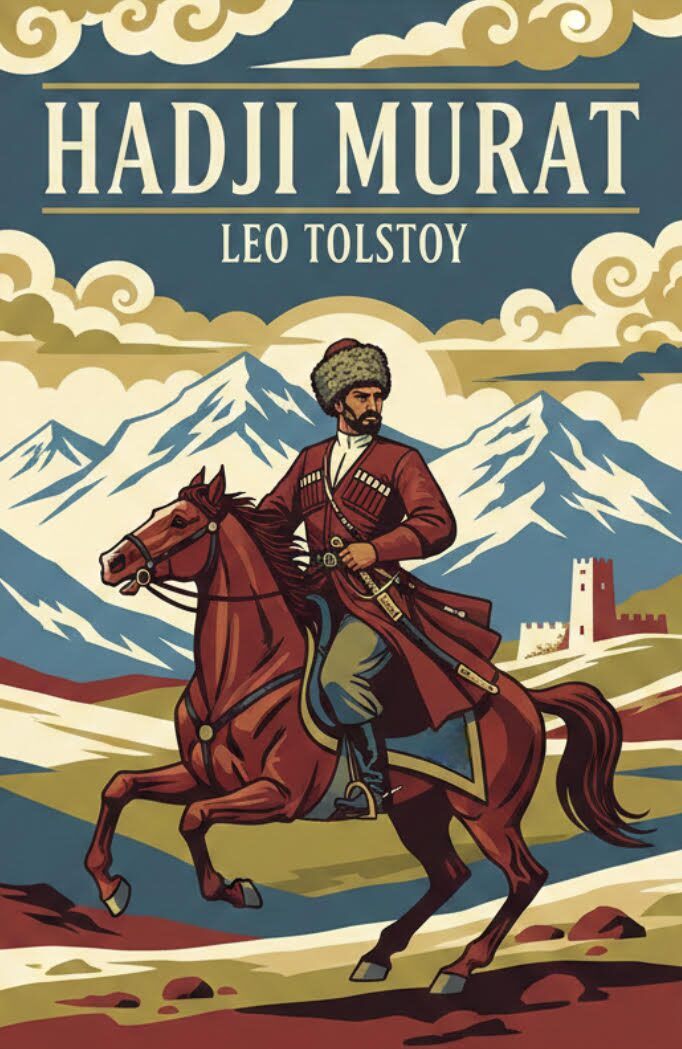
On a cold November evening, Hadji Murad rode into the smoky Chechen aoul of Makhet, where the air was scented with fragrant dung smoke and which was not at peace.
The strained chanting of the muezzin had just subsided, and in the clear mountain air, permeated with the smell of dung smoke, the guttural sounds of arguing male voices and the voices of women and children from below, near the fountain, were distinctly audible above the lowing of cows and the bleating of sheep being sorted into the close-knit, honeycomb-like saklyas (houses) of the aoul.
This Hadji Murad was Shamil’s naib (deputy), famous for his exploits, who would not travel except with his banner and accompanied by dozens of murids (disciples) performing trick riding around him. Now, wrapped in a bashlyk (hood) and burka (felt cloak), from beneath which a rifle protruded, he was riding with a single murid, trying to be noticed as little as possible, cautiously scrutinizing the faces of the villagers he met on the road with his quick black eyes.
Riding into the center of the aoul, Hadji Murad did not take the street leading to the square but turned left into a narrow lane. Riding up to the second saklya in the lane, which was dug into the hillside, he stopped, looking around. There was no one under the awning in front of the saklya, but on the roof, behind a freshly plastered clay chimney, a man lay covered by a sheepskin coat. Hadji Murad gently touched the man lying on the roof with the handle of his whip and clicked his tongue. An old man arose from under the sheepskin coat, wearing a nightcap and a glossy, torn beshmet (quilted jacket). The old man’s eyes, without lashes, were red and moist, and he blinked them to open them. Hadji Murad spoke the usual, “Salam aleikum,” and uncovered his face.
“Aleikum salam,” the old man said, smiling with a toothless mouth, recognizing Hadji Murad, and, rising on his thin legs, began to put his feet into the wooden-heeled slippers standing near the chimney. Having put on his shoes, he unhurriedly put on the wrinkled, unlined sheepskin coat and climbed backward down the ladder leaned against the roof. Both while dressing and descending, the old man shook his head on his thin, wrinkled, tanned neck and incessantly mumbled with his toothless mouth. Stepping onto the ground, he hospitably took hold of Hadji Murad’s horse’s rein and the right stirrup. But Hadji Murad’s agile, strong murid quickly dismounted from his horse, pushed the old man aside, and took his place.
Hadji Murad dismounted from his horse and, limping slightly, went under the awning. A boy of about fifteen quickly stepped out of the door to meet him and stared with surprise at the newcomers with his black eyes, shining like ripe currants.
“Run to the mosque, call your father,” the old man ordered him, and, stepping ahead of Hadji Murad, he opened the light, creaking door into the saklya. As Hadji Murad entered, an older, slender, thin woman in a red beshmet over a yellow shirt and blue trousers came out of the inner door, carrying pillows.
“Your arrival is for good fortune,” she said, and, bending double, began to lay out the pillows along the front wall for the guest to sit on.
“May your sons be well and live long,” Hadji Murad replied, taking off his burka, rifle, and shashka (saber), and handed them to the old man.
The old man carefully hung the rifle and shashka on nails beside the host’s hanging weapons, between two large basins that shone on the smoothly plastered and cleanly whitewashed wall.
Hadji Murad, adjusting the pistol tucked behind his back, walked over to the pillows laid out by the woman, pushed in his cherkesska (long coat), and sat down on them. The old man sat opposite him on his bare heels and, closing his eyes, raised his hands, palms up. Hadji Murad did the same. Then, both of them, having recited a prayer, smoothed their faces with their hands, joining them at the end of the beard.
“Ne khabar?” Hadji Murad asked the old man, meaning: “What’s new?”
“Khabar iok”—”nothing new”—the old man replied, looking not at Hadji Murad’s face but at his chest with his red, lifeless eyes. “I live at the apiary; I only came today to visit my son. He knows.”
Hadji Murad understood that the old man did not want to say what he knew and what Hadji Murad needed to know, and, slightly nodding his head, he did not ask further.
“There is nothing good that is new,” the old man began. “The only news is that all the hares are consulting on how to drive away the eagles. And the eagles keep tearing now one, now another. Last week, the Russian dogs burned the hay at the Michik village, may their faces be ripped apart,” the old man growled spitefully.
Hadji Murad’s murid entered and, stepping softly with the large strides of his strong legs on the earthen floor, also took off his burka, rifle, and shashka, just like Hadji Murad, and, leaving only his dagger and pistol on, hung them himself on the same nails where Hadji Murad’s weapons were hanging.
“Who is he?” the old man asked Hadji Murad, pointing to the newcomer.
“My murid. Eldar is his name,” said Hadji Murad.
“Good,” said the old man and pointed Eldar to a place on the felt mat, next to Hadji Murad.
Eldar sat down, crossing his legs, and silently stared at the face of the now-talking old man with his beautiful, sheep-like eyes. The old man was recounting how their young men had captured two soldiers last week: they killed one and sent the other to Shamil in Vedeno. Hadji Murad listened distractedly, glancing at the door and listening to the sounds outside. Footsteps were heard under the awning in front of the saklya, the door creaked, and the host entered.
The host of the saklya, Sado, was a man about forty, with a small beard, a long nose, and the same black, though not as shining, eyes as his fifteen-year-old son, who had run after him and entered the saklya with his father, sitting down by the door. Taking off his wooden slippers at the door, the host pushed the old, worn papaha (fur hat) onto the back of his long-unshaven head, which was overgrown with black hair, and immediately sat down on his haunches opposite Hadji Murad.
Just like the old man, he closed his eyes, raised his hands palms up, recited a prayer, wiped his face with his hands, and only then began to speak. He said that there was an order from Shamil to detain Hadji Murad, dead or alive, that Shamil’s messengers had only left yesterday, and that the people were afraid to disobey Shamil, and that therefore they needed to be cautious.
“In my house,” Sado said, “no one will do anything to my kunak (guest), as long as I live. But what about in the field? We must think.”
Hadji Murad listened attentively and nodded approvingly. When Sado finished, he said:
“Good. Now we need to send a man to the Russians with a letter. My murid will go, but we need a guide.”
“I will send my brother Batu,” said Sado. “Call Batu,” he addressed his son.
The boy, as if on springs, jumped to his nimble feet and quickly, swinging his arms, left the saklya. About ten minutes later, he returned with a black-tanned, sinewy, short-legged Chechen in a threadbare yellow cherkesska with frayed sleeves and lowered black nogovitsy (leg coverings). Hadji Murad greeted the newcomer and immediately, also without wasting unnecessary words, said briefly:
“Can you take my murid to the Russians?”
“I can,” Batu spoke quickly and cheerfully. “Everything is possible. Not a single Chechen can pass without me. Otherwise, someone else will go, promise everything, and do nothing. But I can.”
“Good,” said Hadji Murad. “You will get three for your efforts,” he said, holding up three fingers.
Batu nodded his head to show that he understood, but added that money was not important to him, and he was ready to serve Hadji Murad out of honor. Everyone in the mountains knows Hadji Murad, how he beat the Russian swine…
“Good,” said Hadji Murad. “A rope is good when it is long, but speech is short.”
“Well, I will be silent,” said Batu.
“Where the Argun River bends, opposite the cliff, there is a clearing in the forest, two haystacks are standing. Do you know it?”
“I know.”
“My three horsemen are waiting for me there,” said Hadji Murad.
“Ayya!” Batu said, nodding his head.
“Ask for Khan-Magoma. Khan-Magoma knows what to do and what to say. He must be taken to the Russian commander, to Vorontsov, the Prince. Can you?”
“I will take him.”
“Take him and bring him back. Can you?”
“It is possible.”
“You will take him and return to the forest. I will be there.”
“I will do everything,” said Batu, stood up, and, placing his hands on his chest, left.
“We need to send another man to Ghekhy,” Hadji Murad said to the host after Batu left. “In Ghekhy, this is what is needed,” he started to say, touching one of the hozyrs (cartridges) of his cherkesska, but immediately dropped his hand and fell silent, seeing two women enter the saklya.
One was Sado’s wife, the same older, thin woman who had arranged the pillows. The other was a very young girl in red trousers and a green beshmet, with a curtain of silver coins covering her entire chest. A silver ruble was attached to the end of her not long, but thick, stiff black braid, which lay between the shoulders of her thin back; the same black, currant-like eyes as her father and brother shone cheerfully in her young face, which was trying to be serious. She did not look at the guests but clearly felt their presence.
Sado’s wife carried a low round table on which there were tea, pilgishi (thin flatbreads), pancakes in butter, cheese, churek—thinly rolled bread—and honey. The girl carried a basin, a kumgan (metal pitcher), and a towel.
Sado and Hadji Murad both remained silent the entire time the women, moving quietly in their red, soled slippers, set out the items before the guests. Eldar, focusing his sheep-like eyes on his crossed legs, was motionless as a statue the entire time the women were in the saklya. Only when the women left and their soft footsteps completely faded behind the door did Eldar breathe a sigh of relief, and Hadji Murad reached into one of the hozyrs of his cherkesska, took out the bullet that plugged it, and a note rolled into a tube from beneath the bullet.
“Give it to my son,” he said, showing the note.
“Where is the reply to be sent?” Sado asked.
“To you, and you will deliver it to me.”
“It will be done,” said Sado and transferred the note to the hozyr of his own cherkesska. Then, taking the kumgan in his hands, he moved the basin closer to Hadji Murad. Hadji Murad rolled up the sleeves of his beshmet on his muscular arms, which were white above the wrists, and held them under the stream of cold, transparent water that Sado poured from the kumgan. Wiping his hands with a clean, coarse towel, Hadji Murad moved towards the food. Eldar did the same. While the guests ate, Sado sat opposite them and thanked them several times for the visit. The boy sitting by the door, not taking his shining black eyes off Hadji Murad, smiled as if confirming his father’s words with his smile. Despite Hadji Murad not having eaten for more than a day, he only ate a little bread and cheese and, taking a small knife from under his dagger, scooped up some honey and spread it on the bread.
“Our honey is good. This year’s honey is the best of all years: plentiful and good,” said the old man, visibly pleased that Hadji Murad was eating his honey.
“Thank you,” said Hadji Murad and moved away from the food.
Eldar wanted to eat more, but he, like his murshid (spiritual guide, here used loosely for master/commander), moved away from the table and offered Hadji Murad the basin and kumgan.
Sado knew that by hosting Hadji Murad, he risked his life, as after Shamil’s quarrel with Hadji Murad, all residents of Chechnya had been ordered, under threat of execution, not to receive Hadji Murad. He knew that the villagers could learn of Hadji Murad’s presence in his house at any moment and could demand his surrender. But this not only did not disturb but gladdened Sado. Sado considered it his duty to protect a guest—a kunak—even if it cost him his life, and he rejoiced in himself, proud that he was acting as he should.
“As long as you are in my house and my head is on my shoulders, no one will do anything to you,” he repeated to Hadji Murad.
Hadji Murad looked attentively into his shining eyes and, understanding that this was the truth, said somewhat solemnly:
“May you receive joy and life.”
Sado silently pressed his hand to his chest as a sign of gratitude for the kind word.
Closing the shutters of the saklya and lighting the brushwood in the fireplace, Sado, in a particularly cheerful and excited state, left the guest room and entered the part of the saklya where his whole family lived. The women were still awake and talking about the dangerous guests who were spending the night in their guest room.


Reviews
There are no reviews yet.