Description
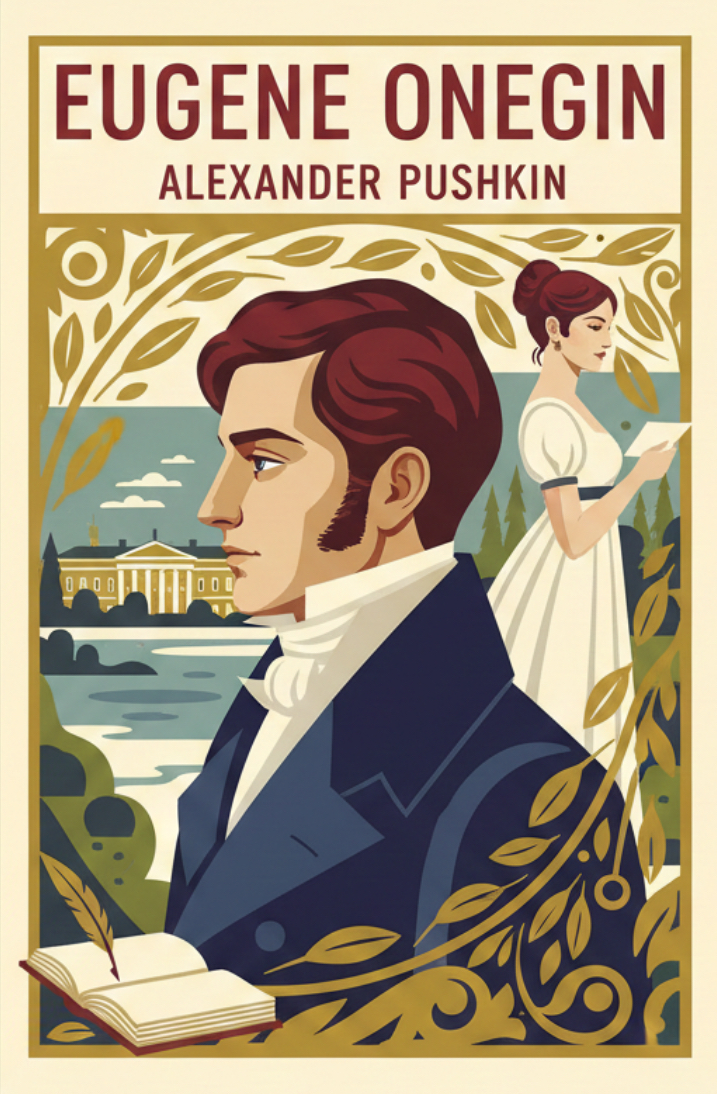
Exhausted by the shallow social scene of St. Petersburg, the indifferent and self-absorbed dandy Eugene Onegin inherits a country estate. There, he befriends the young, passionate poet Vladimir Lensky. Soon, Onegin meets the two sisters of the neighboring Larina family: the lighthearted Olga, who is engaged to Lensky, and the thoughtful, dreamy Tatyana, who boldly confesses her love to Onegin in a letter.
Onegin coolly rejects her, claiming he is unsuited for marriage. Later, annoyed by Lensky’s persistence, Onegin deliberately flirts with Olga at a ball. This petty act of spite leads the jealous Lensky to challenge him to a duel, which Onegin lethally accepts, killing his only friend. Fleeing the guilt, Onegin travels for years, only to return and encounter Tatyana, now a sophisticated society princess, married to a respected general.
Driven by an unexpected, fierce passion, Onegin now pursues Tatyana with desperation, only to receive her calm, final rejection: “I love you, but I am married to another, and I will be faithful to him.”
Browse the table of contents, check the quotes, read the first chapter, find out which famous book it is similar to, and buy “Eugene Onegin” on Amazon directly from our page.
PREFACE
MON PORTRAIT
A SHORT BIOGRAPHICAL NOTICE OF ALEXANDER PUSHKIN
CANTO THE FIRST
CANTO THE SECOND
CANTO THE THIRD
CANTO THE FOURTH
CANTO THE FIFTH
CANTO THE SIXTH
CANTO THE SEVENTH
CANTO THE EIGHTH
My uncle has most honest principles: when he was taken gravely ill, he forced one to respect him…
One well could be an active man and yet aware of tidy nails. Is not dispute with fashion vain? For mankind its dictate prevails.
The less we love the easier to please, the more to ruin us.
Habit is given to us from above: it is a substitute for happiness.
I write to you — what more is needed? What else can I say?
‘The Spleen’
‘He rushes at life and exhausts the passions.’
Prince Viazemski
Canto the First
I
“My uncle’s goodness is extreme,
If seriously he hath disease;
He hath acquired the world’s esteem
And nothing more important sees;
A paragon of virtue he!
But what a nuisance it will be,
Chained to his bedside night and day
Without a chance to slip away.
Ye need dissimulation base
A dying man with art to soothe,
Beneath his head the pillow smooth,
And physic bring with mournful face,
To sigh and meditate alone:
When will the devil take his own!”
II
Thus mused a madcap young, who drove
Through clouds of dust at postal pace,
By the decree of Mighty Jove,
Inheritor of all his race.
Friends of Liudmila and Ruslan,(1)
Let me present ye to the man,
Who without more prevarication
The hero is of my narration!
Onéguine, O my gentle readers,
Was born beside the Neva, where
It may be ye were born, or there
Have shone as one of fashion’s leaders.
I also wandered there of old,
But cannot stand the northern cold.(2)
[Note 1: Ruslan and Liudmila, the title of Pushkin’s first
important work, written 1817-20. It is a tale relating the adventures
of the knight-errant Ruslan in search of his fair lady Liudmila, who
has been carried off by a kaldoon, or magician.]
[Note 2: Written in Bessarabia.]
III
Having performed his service truly,
Deep into debt his father ran;
Three balls a year he gave ye duly,
At last became a ruined man.
But Eugene was by fate preserved,
For first “madame” his wants observed,
And then “monsieur” supplied her place;(3)
The boy was wild but full of grace.
“Monsieur l’Abbé” a starving Gaul,
Fearing his pupil to annoy,
Instructed jestingly the boy,
Morality taught scarce at all;
Gently for pranks he would reprove
And in the Summer Garden rove.
[Note 3: In Russia foreign tutors and governesses are commonly
styled “monsieur” or “madame.”]
IV
When youth’s rebellious hour drew near
And my Eugene the path must trace—
The path of hope and tender fear—
Monsieur clean out of doors they chase.
Lo! my Onéguine free as air,
Cropped in the latest style his hair,
Dressed like a London dandy he
The giddy world at last shall see.
He wrote and spoke, so all allowed,
In the French language perfectly,
Danced the mazurka gracefully,
Without the least constraint he bowed.
What more’s required? The world replies,
He is a charming youth and wise.
V
We all of us of education
A something somehow have obtained,
Thus, praised be God! a reputation
With us is easily attained.
Onéguine was—so many deemed
[Unerring critics self-esteemed],
Pedantic although scholar like,
In truth he had the happy trick
Without constraint in conversation
Of touching lightly every theme.
Silent, oracular ye’d see him
Amid a serious disputation,
Then suddenly discharge a joke
The ladies’ laughter to provoke.
VI
Latin is just now not in vogue,
But if the truth I must relate,
Onéguine knew enough, the rogue
A mild quotation to translate,
A little Juvenal to spout,
With “vale” finish off a note;
Two verses he could recollect
Of the Æneid, but incorrect.
In history he took no pleasure,
The dusty chronicles of earth
For him were but of little worth,
Yet still of anecdotes a treasure
Within his memory there lay,
From Romulus unto our day.
VII
For empty sound the rascal swore he
Existence would not make a curse,
Knew not an iamb from a choree,
Although we read him heaps of verse.
Homer, Theocritus, he jeered,
But Adam Smith to read appeared,
And at economy was great;
That is, he could elucidate
How empires store of wealth unfold,
How flourish, why and wherefore less
If the raw product they possess
The medium is required of gold.
The father scarcely understands
His son and mortgages his lands.

Reviews
There are no reviews yet.