Description
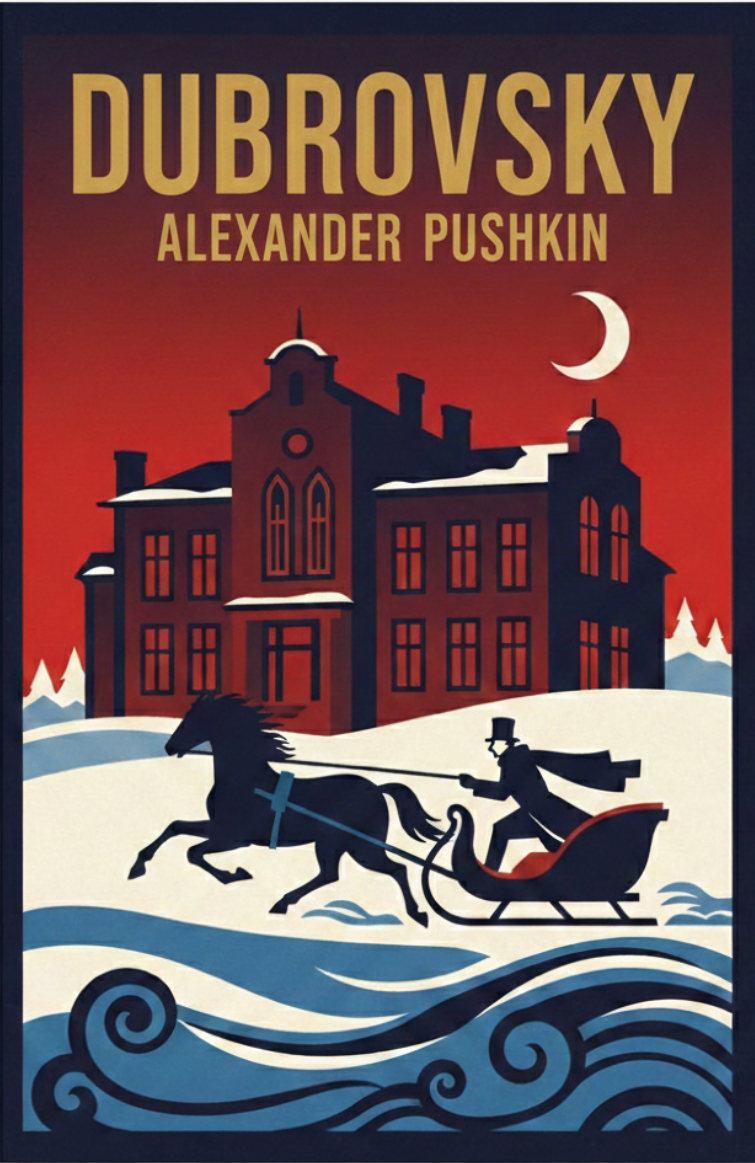
The novel begins with the friendship between two neighboring landowners: the wealthy and authoritarian tyrant Kirila Petrovich Troyekurov and the poor but proud Andrey Gavrilovich Dubrovsky.
Their friendship suddenly collapses over a trifle: Troyekurov’s kennel keeper insults Dubrovsky. The offended Andrey Gavrilovich leaves. Troyekurov, seeking revenge for the audacity, bribes the court and confiscates Dubrovsky’s estate of Kistenevka.
Upon learning of this injustice, the elder Dubrovsky dies from the shock. His son, Vladimir Dubrovsky (a Guards officer), arrives but is too late to help his father. The arriving court officials drive him out. The peasants, led by the blacksmith Arkhip, set the manor house on fire so that the estate cannot fall into Troyekurov’s hands. Vladimir departs, and a band of noble outlaws appears in the district, suspected of being led by Dubrovsky.
To exact revenge on Troyekurov, Vladimir infiltrates his house disguised as the French tutor Deforge. There, he grows close to Troyekurov’s daughter, Masha Troyekurova, and falls in love with her. Masha reciprocates his feelings. Out of love for her, Dubrovsky abandons his desire for revenge.
Troyekurov, unaware of his daughter’s feelings, forces her to marry the old and wealthy Prince Vereisky against her will. Masha desperately pleads with Dubrovsky for rescue. Vladimir rushes to help but arrives too late: Masha is already married. She refuses to flee with him, declaring that even though she was forced into the marriage, she is now a wife and bound by a vow before God.
In the novel’s finale, Dubrovsky disbands his gang and flees abroad to escape the authorities.
Browse the table of contents, check the quotes, read the first chapter, find out which famous book it is similar to, and buy “Dubrovsky” on Amazon directly from our page.
Chapter 1. The Neighbor
Chapter 2. The Lawsuit / The Court
Chapter 3. Dubrovsky
Chapter 4. Kistenyovka
Chapter 5. Troyekurov’s Arrival
Chapter 6. The Raid
Chapter 7. The Brigands / The Robbers
Chapter 8. The Find
Chapter 9. The Driver
Chapter 10. Concerning the Aristocrats
Chapter 11. Prince Vereisky
Chapter 12. The Duel
Chapter 13. The Duel (Continued)
Chapter 14. The Meeting
Chapter 15. The Meeting (Continued)
Chapter 16. Explanation with the Father
Chapter 17. The Conversation
Chapter 18. The Wedding
Chapter 19. The Conversation
Chapter 1. The Neighbor
Some years ago, there lived on one of his estates a Russian gentleman of the old school named Kirila Petrovitch Troekouroff. His wealth, distinguished birth, and connections gave him great weight in the government where his property was situated. Completely spoilt by his surroundings, he was in the habit of giving way to every impulse of his passionate nature, to every caprice of his sufficiently narrow mind. The neighbours were ready to gratify his slightest whim; the government officials trembled at his name. Kirila Petrovitch accepted all these signs of servility as homage due to him. His house was always full of guests, ready to amuse his lordship’s leisure, and to join his noisy and sometimes boisterous mirth. Nobody dared to refuse his invitations or, on certain days, omit to put in an appearance at the village of Pokrovskoe. Kirila Petrovitch was very hospitable, and in spite of the extraordinary vigour of his constitution, he suffered two or three times a week from surfeit, and became tipsy every evening.
Very few of the young women of his household escaped the amorous attentions of this old man of fifty. Moreover, in one of the wings of his house lived sixteen girls engaged in needlework. The windows of this wing were protected by wooden bars, the doors were kept locked, and the keys retained by Kirila Petrovitch. The young recluses at an appointed hour went into the garden for a walk under the surveillance of two old women. From time to time Kirila Petrovitch married some of them off, and new comers took their places. He treated his peasants and domestics in a severe and arbitrary fashion, in spite of which they were very devoted to him: they loved to boast of the wealth and influence of their master, and in their turn took many a liberty with their neighbours, trusting to his powerful protection.
The ordinary occupations of Troekouroff consisted in driving over his vast domains, passing his nights in prolonged revels, and playing practical jokes, specially invented from time to time, the victims being generally new acquaintances, though his old friends did not always escape, one only—Andrei Gavrilovitch Doubrovsky—excepted.
This Doubrovsky, a retired lieutenant of the Guards, was his nearest neighbour, and possessed seventy serfs. Troekouroff, haughty in his dealings with people of the highest rank, respected Doubrovsky, in spite of his humble fortune. They had been friends in the service, and Troekouroff knew from experience the impatience and decision of his character. The celebrated events of the year 1762[1] separated them for a long time. Troekouroff, a relative of the Princess Dashkoff,[2] received rapid promotion; Doubrovsky with his reduced fortune, was compelled to leave the service and settle down in the only village that remained to him. Kirila Petrovitch, hearing of this, offered him his protection but Doubrovsky thanked him and remained poor and independent. Some years later, Troekouroff, having obtained the rank of general, and retired to his estate, they met again and were delighted with each other. After that they saw each other every day, and Kirila Petrovitch, who had never deigned to visit anybody in his life, came quite as a matter of course to the little house of his old comrade. Being of the same age, born in the same rank of society, and having received the same education, they resembled each other somewhat in character and inclinations. In some respects their fates had been similar: both had married for love, both had soon become widowers, and both had been left with an only child. The son of Doubrovsky was studying at St. Petersburg; the daughter of Kirila Petrovitch grew up under the eyes of her father, and Troekouroff often said to Doubrovsky:
“Listen, brother Andrei Gavrilovitch; if your Volodka[3] should be successful, I will give him Masha[4] for his wife, in spite of his being as naked as a goshawk.”
Andrei Gavrilovitch used to shake his head, and generally replied:
“No’, Kirila Petrovitch; my Volodka is no match for Maria Kirilovna. A poor petty noble, such as he, would do better to marry a poor girl of the petty nobility, and be the head of his house, rather than become the bailiff of some spoilt little woman.”
Everybody envied the good understanding existing between the haughty Troekouroff and his poor neighbour, and wondered at the boldness of the latter when, at the table of Kirila Petrovitch, he expressed his own opinion frankly, and did not hesitate to maintain an opinion contrary to that of his host Some attempted to imitate him and ventured to overstep the limits of the license accorded them; but Kirila Petrovitch taught them such a lesson, that they never afterwards felt any desire to repeat the experiment. Doubrovsky alone remained beyond the range of this general law. But an unexpected incident deranged and altered all this.
One day, in the beginning of autumn, Kirila Petrovitch prepared to go out hunting. Orders had been given the evening before for the huntsmen and gamekeepers to be ready at five o’clock in the morning. The tent and kitchen had been sent on beforehand to the place where Kirila Petrovitch was to dine. The host and his guests went to the kennel, where more than five hundred harriers and greyhounds lived in luxury and warmth, praising the generosity of Kirila Petrovitch in their canine language. There was also a hospital for the sick dogs, under the care of staff-surgeon Timoshka, and a separate place where the bitches brought forth and suckled their pups. Kirila Petrovitch was proud of this magnificent establishment, and never missed an opportunity of boasting about it, before his guests, each of whom had inspected it at least twenty times. He walked through the kennel, surrounded by his guests and accompanied by Timoshka and the head gamekeepers, pausing before some of the compartments, either to ask, after the health of some sick dog, to make some observation more or less just and severe, or to call some dog to him; by name and speak caressingly to it. The guests considered it their duty to go into raptures over Kirila Petrovitch’s kennel; Doubrovsky alone remained silent and frowned. He was an ardent sportsman; but his modest fortune only permitted him to keep two harriers and one greyhound, and he could not restrain a certain feeling of envy at the sight of this magnificent establishment.
“Why do you frown, brother?” Kirila Petrovitch asked him. “Does not my kennel please you?”
“No,” replied Doubrovsky abruptly: “the kennel, is marvellous, but I doubt whether your people live as well as your dogs.”
One of the gamekeepers took offence.
“Thanks to God and our master, we have nothing to complain of,” said he; “but if the truth must be told, there are certain nobles who would not do badly if they exchanged their manor-house for one of the compartments of this kennel: they would be better fed and feel warmer.”
Kirila Petrovitch burst out laughing at this insolent remark from his servant, and the guests followed his example, although they felt that the gamekeeper’s joke I might apply to them also. Doubrovsky turned pale and said not a word. At that moment a basket, containing some new-born puppies, was brought to Kirila Petrovitch; he chose two out of the litter and ordered the rest to be drowned. In the meantime Andrei Gavrilovitch had disappeared without anybody having observed it.
On returning with his guests from the kennel, Kirila Petrovitch sat down to supper, and it was only then that he noticed the absence of Doubrovsky. His people informed him that Andrei Gavrilovitch had gone home. Troekouroff immediately gave orders that he was to be overtaken and brought back without fail. He had never gone hunting without Doubrovsky, who was a fine and experienced connoisseur in all matters relating to dogs, and an infallible umpire in all possible disputes connected with sport. The servant who had galloped after him, returned while they were still seated at table, and informed his master that Andrei Gavrilovitch had refused to listen to him and would not return. Kirila Petrovitch, as usual, was heated with liquor, and becoming very angry, he sent the same servant a second time to tell Andrei Gavrilovitch that if he did not return at once to spend the night at Pokrovskoe, he, Troekouroff, would break off all friendly intercourse with him for ever. The servant galloped off again. Kirila Petrovitch rose from the table, dismissed his guests retired to bed.
The next day his first question was: “Is Andrei Gavrilovitch here?” A triangular-shaped letter was handed to him. Kirila Petrovitch ordered his secretary to read it aloud, and the following is what he heard:
“Gracious Sir!
“I do not intend to return to Pokrovskoe until you send the dog-feeder Paramoshka to me with an apology: I shall retain the liberty of punishing or for forgiving him. I cannot put up with jokes from your servants, nor do I intend to put up with them from you, as I am not a buffoon, but a gentleman of ancient family. I remain your obedient servant,
“ANDREI DOUBROVSKY.”
According to present ideas of etiquette, such a letter would be very unbecoming; it irritated Kirila Petrovitch, not by its strange style, but by its substance.
“What!” exclaimed Troekouroff, springing barefooted out of bed; “send my people to him with an apology! And he to be at liberty to punish or pardon them! What can he be thinking of? Does he know with whom he is dealing? I’ll teach him a lesson! He shall know what it is to oppose Troekouroff!”
Kirila Petrovitch dressed himself and set out for the hunt with his usual ostentation. But the chase was not successful; during the whole of the day one hare only was seen, and that escaped. The dinner in the field, under the tent, was also a failure, or at least it was not to the taste of Kirila Petrovitch, who struck the cook, abused the guests, and on the return journey rode intentionally, with all his suite, through the fields of Doubrovsky.
[1]Alluding to the deposition and assassination of Peter III., and the accession of his wife Catherine II.
[2]One of Catherine’s partisans in the revolution of 1762.
[3]Diminutive of Vladimir.
[4]Diminutive of Maria or Mary.



Reviews
There are no reviews yet.