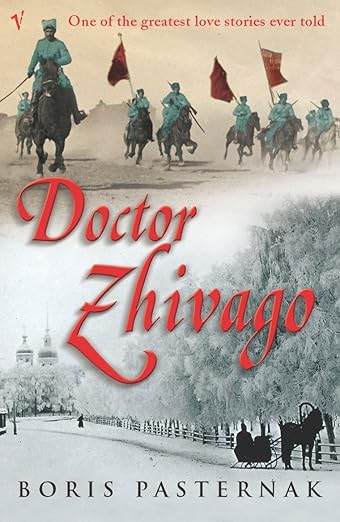
1
They walked and walked, singing “Eternal Memory,” and when they stopped, it seemed that their feet, the horses, and the gusts of wind continued to sing it, as if by rote.
Passers-by made way for the procession, counted the wreaths, and crossed themselves.
The curious joined the procession, asking: “Who is being buried?” They were told: “Zhivago.” “Ah, I see. That explains it.” – “No, not him. Her.” – “No matter. May she rest in peace. A lavish funeral.”
The final, measured, irreversible minutes flashed by.
“The earth is the Lord’s and the fullness thereof, the world and those who dwell therein.” The priest, making the sign of the cross, cast a handful of earth onto Maria Nikolaevna. They began singing “With the spirits of the righteous.” The terrible rush began. The coffin was closed, nailed shut, and lowered.
The rain of clods drummed down as the grave was hastily filled by four shovels. A mound grew on it. A ten-year-old boy climbed onto it.
It was only in the state of torpor and numbness that usually descends towards the end of a large funeral that it could seem the boy wanted to say a word on his mother’s grave.
He raised his head and surveyed the autumn wastelands and the monastery domes with an absent gaze from his elevation. His snub-nosed face contorted. His neck stretched. If a wolf cub had raised its head with such a movement, it would be clear that it was about to howl. Covering his face with his hands, the boy began to sob. A cloud flying towards him began to lash his hands and face with the wet scourges of cold rain.
A man in black, with gathers on the narrow, tight sleeves, walked up to the grave. This was the deceased’s brother and the weeping boy’s uncle, the defrocked priest Nikolai Nikolaevich Vedenyapin, who had left the clergy at his own request. He approached the boy and led him away from the cemetery.
2
They spent the night in one of the monastery rooms that had been assigned to the uncle due to an old acquaintance. It was the eve of the Feast of the Intercession. The next day, he and his uncle were to leave far south, to a provincial city in the Volga region, where Father Nikolai worked for a publishing house that put out a progressive newspaper for the region. The train tickets had been bought, and the luggage was packed and stood in the cell. From the nearby station, the wind brought the plaintive whistles of distant maneuvering locomotives.
It had become much colder towards evening. Two ground-level windows looked out onto a corner of a drab vegetable garden, hedged with yellow acacia bushes, onto the frozen puddles of the carriage road, and onto the end of the cemetery where Maria Nikolaevna had been buried that afternoon. The garden was empty, except for a few moiré ridges of cabbage that had turned blue with cold. When the wind struck, the leafless acacia bushes thrashed like the possessed and lay down on the road.
At night, Yura was awakened by a knock at the window. The dark cell was unnaturally lit by a white, fluttering light. Yura, in his nightshirt, ran to the window and pressed his face against the cold glass.
Outside the window, there was no road, no cemetery, and no vegetable garden. A blizzard raged in the yard; the air was smoky with snow. One might have thought that the storm had noticed Yura and, aware of how terrible it was, was reveling in the impression it made on him. It whistled and howled, and tried in every way to attract Yura’s attention. From the sky, turn after turn, in endless skeins, white fabric fell to the earth, shrouding it in burial cloths. The blizzard was alone in the world; nothing rivaled it.
Yura’s first impulse, when he climbed down from the windowsill, was to get dressed and run outside to do something.
He was frightened that the monastery cabbage would be buried and they wouldn’t be able to dig it out, or that his mother would be snowed in in the field and powerless to resist going even deeper and further away from him into the earth.
The matter ended again in tears. His uncle woke up, spoke to him about Christ and comforted him, and then yawned, walked over to the window, and became thoughtful. They began to get dressed. Dawn was breaking.
3
While his mother was alive, Yura did not know that his father had long ago left them, traveled to various cities in Siberia and abroad, carousing and debauching, and had long since squandered and scattered their millions. Yura was always told that he was either in Petersburg or at some fair, most often the Irbit Fair.
Then his mother, who was always ailing, developed consumption. She began to travel to the south of France and Northern Italy for treatment, where Yura accompanied her twice. Thus, Yura’s childhood passed in disorder and amidst constant mysteries, often in the care of strangers who continually changed. He became accustomed to these changes, and in the environment of eternal inconsistency, his father’s absence did not surprise him.
As a small boy, he had still witnessed the time when the name he bore was applied to a multitude of the most diverse things.
There was the Zhivago manufactory, the Zhivago bank, the Zhivago houses, the Zhivago way of tying and pinning a tie with a tiepin, even a kind of round sweet pastry, like a rum baba, called “Zhivago,” and at one time in Moscow, one could shout to a cabman “to Zhivago!” just like “to the back of beyond!”, and he would whisk you away on a sled to the thirtieth kingdom, the ninth state. A quiet park surrounded you. Crows landed on the drooping branches of the fir trees, shaking hoarfrost from them. Their cawing echoed, rattling like the crack of a tree branch. Pedigreed dogs ran across the road from the new buildings beyond the clearing. Lights were lit there. Evening descended. Suddenly, all this vanished. They became poor.
4
In the summer of nineteen hundred and three, Yura and his uncle were traveling in a two-horse carriage through the fields to Duplianka, the estate of the silk-spinning factory owner and great patron of the arts Kologrivov, to see the educator and popularizer of useful knowledge Ivan Ivanovich Voskoboinikov.
It was the Kazan holiday, the height of the harvest. Because it was lunchtime or perhaps due to the holiday, there was not a soul to be seen in the fields. The sun scorched the unharvested swaths like the half-shaved napes of prisoners.
Birds circled over the fields. The wheat, heads bowed, stretched out in a line in the complete calm or stood tall in stooks far from the road, where, upon long inspection, it took the form of moving figures, as if land surveyors were walking along the edge of the horizon and writing something down.
“And these,” Nikolai Nikolaevich asked Pavel, the laborer and watchman from the publishing house, who was sitting sideways on the box, hunched over and with one leg crossed over the other, as a sign that he was not a proper coachman and was driving not by vocation, “and these, are they the landlord’s or the peasants’?”
“Them are the master’s,” Pavel replied and lit a cigarette, “and these here,” after struggling with the match and taking a drag, he poked the end of the whip in the other direction after a long pause, “these here are their own.”
“Are you asleep?” he frequently called out to the horses, whose tails and flanks he kept glancing at, like an engineer at pressure gauges.
But the horses pulled along, like all horses in the world: the shaft-horse ran with the innate straightforwardness of an uncomplicated nature, while the trace-horse, to the uninitiated, seemed an utter idler who only knew how to prance, arched like a swan, in time with the jingling of the bells, which she herself raised with her leaps.
Nikolai Nikolaevich was bringing Voskoboinikov the proofs of his booklet on the land question, which the publishing house had requested he revise in view of the intensified censorship pressure.
“The people are restless in the district,” Nikolai Nikolaevich said. “A merchant was murdered in Pan’kovskaya volost, and the zemstvo’s stud farm was burned down. What do you think about this? What are they saying in the village?”
But it turned out that Pavel viewed things even more darkly than the censor, who had been moderating Voskoboinikov’s agrarian passions.
“What are they saying? They’ve let the people run wild. Mischief, they call it. Is that possible with the likes of us? Give the peasant free rein, and we’ll crush each other, so help me God. Are you asleep?”
This was the uncle and nephew’s second trip to Duplianka. Yura thought he remembered the road, and every time the fields spread wide and the forests enclosed them in a thin fringe both in front and behind, Yura felt that he recognized the spot from which the road should turn right, and from the turn, the ten-verst panorama of Kologrivov’s estate, with the river gleaming in the distance and the railway running behind it, would appear and disappear a minute later. But he was constantly mistaken. Fields succeeded fields. They were again and again enclosed by forests. The succession of these wide-open spaces created a spacious mood. He wanted to dream and think about the future.
None of the books that would later bring fame to Nikolai Nikolaevich had yet been written. But his ideas were already defined. He did not know how close his time was.
Soon, this man, who thought about all their topics and had nothing in common with them except terminology, was to appear among the representatives of the literature of the time, the university professors, and the philosophers of the revolution.
All of them collectively held to some dogma and were content with words and appearances, but Father Nikolai was a priest who had passed through Tolstoyism and revolution and was constantly moving further. He craved a thought that was inspiringly tangible, that would honestly trace a discernible path in its movement and change something in the world for the better, and that would be noticeable even to a child and an ignorant person, like a flash of lightning or the trace of rolling thunder. He craved the new.
Yura was comfortable with his uncle. He resembled his mother. Like her, he was a free person, devoid of prejudice against anything unfamiliar. Like her, he had the noble sense of equality with all living things. He understood everything at a glance, just as she did, and knew how to express his thoughts in the form in which they first came to mind, while they were still alive and had not lost their meaning.
Yura was glad that his uncle had taken him to Duplianka. It was very beautiful there, and the picturesqueness of the place also reminded him of his mother, who loved nature and often took Yura with her on walks. Moreover, Yura was pleased that he would once again meet Nika Dudorov, a high school student living with Voskoboinikov, who probably looked down on him because he was about two years older and who, when greeting someone, forcefully tugged their hand downwards and bowed his head so low that his hair fell over his forehead, covering half his face.

Reviews
There are no reviews yet.