Description
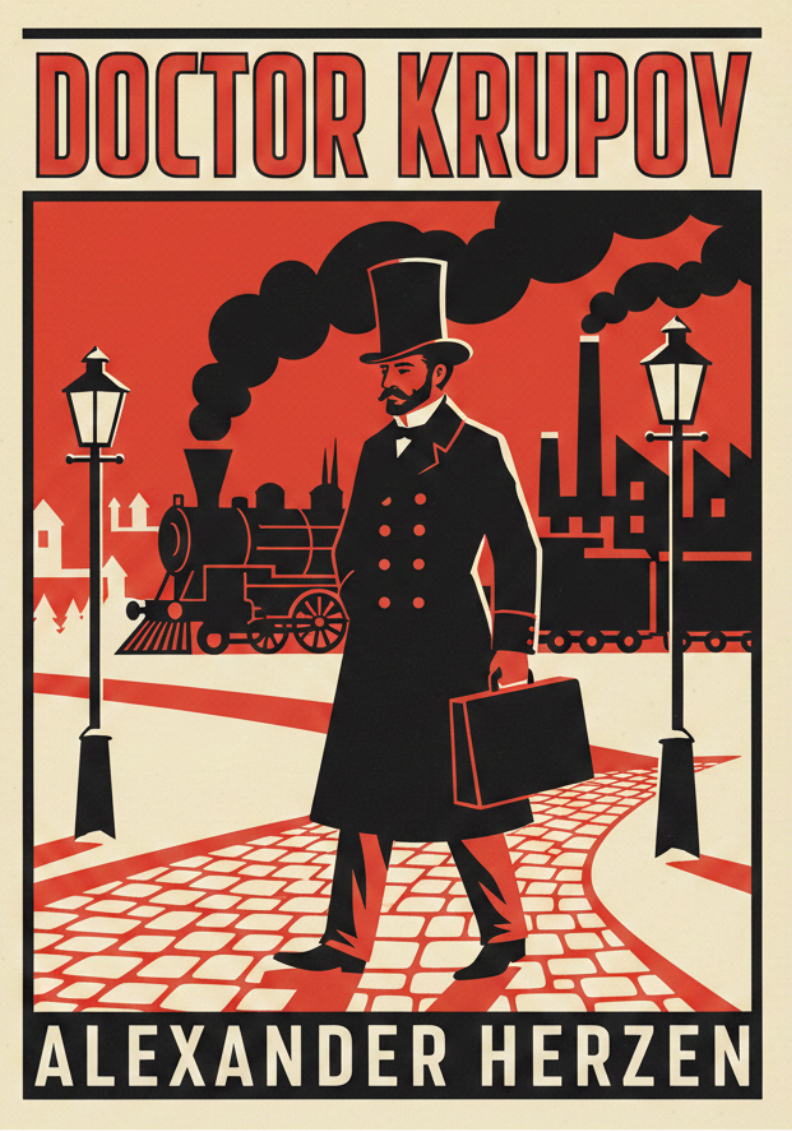
Dr. Krupov, a cynical but sharply observant town physician, spends his days tending to the various ailments—both physical and psychosomatic—of the seemingly ordinary inhabitants of a Russian provincial town. What the doctor discovers is a shocking and unsettling pattern: every single one of his patients, from the local landowner to the humble civil servant, suffers from an affliction that defies traditional medical treatment.
Krupov’s radical and shocking conclusion is that he is not treating individuals with distinct diseases, but rather different manifestations of one single, universal malady he terms ‘universal insanity.’ Through his detached and witty clinical gaze, Krupov transforms his medical practice into a deep sociological study, showing that the root of all human suffering lies in the absurd social conventions, petty ambitions, and illogical passions that society considers normal.
He challenges the reader to accept his unsettling view that the line between sanity and madness dissolves under examination, and that the only truly sane person is the one who recognizes the fundamental irrationality of the world around them.
Browse the table of contents, check the quotes, read the first chapter, find out which famous book it is similar to, and buy “Doctor Krupov” on Amazon directly from our page.
ON MENTAL ILLNESS IN GENERAL AND THE EPIDEMIC DEVELOPMENT THEREOF IN PARTICULAR
A treatise by Doctor Krupov
Many, many years have passed since I have consistently devoted the time remaining after treating patients and fulfilling my duties to outlining comparative psychiatry from a completely new perspective. But self-doubt, modesty, and prior caution have forbidden me from any publication of my theory. Now I make the first attempt to present a part of my observations to the kind public. I do this, driven by the premonition of a swift transition into the mineral-chemical realm, whose main inconvenience is the absence of consciousness. I believe that it is my duty to solidify what I have learned, so to speak, outside myself through an honest account for the benefit and consideration of my colleagues in science; it seems to me that I have no right to allow my thought to disappear without a trace amidst the new chemical combinations and decompositions awaiting the large hemispheres of my brain.
Having learned accidentally about your collection, I decided to send an excerpt from the introduction precisely because it is quite generally accessible: it contains, strictly speaking, not the theory itself, but the history of its origin in my mind. Here, I consider it not superfluous to forewarn you that I am least of all a man of letters, and having lived now for thirty years in a provincial town, distant from both the central government and the capital, I have fallen out of the habit of eloquent expression of my thoughts and am unaccustomed to fashionable language. It should not be overlooked, however, that my goal is by no means literary, but pathological. I do not wish to charm with my writings, but to be useful by communicating an extremely important theory, which has hitherto escaped the attention of the greatest physicians, but is now scientifically developed and tested by observations by the most unworthy of Hippocrates’ disciples.
I dedicate this theory to you, selfless doctors, who sacrifice your time to the sad task of treating and caring for those suffering from mental illnesses.
S. Croupoff M. et Ch. Doctor.
I
I was born in a landlord’s village on the bank of the Oka river. My father was a deacon. Next to our small house lived the sexton, a sickly, poor man burdened with a huge family. Among the eight children with which God blessed the sexton, there was one who was my peer; we grew up together, played together every day in the garden, in the churchyard, or in front of our house. I became terribly attached to my comrade, shared with him all the treats I was given, even stole hidden pieces of pie and kasha for him—and passed them over the wattle fence. My friend was called “Squint-eyed Lyovka” by everyone; he indeed squinted slightly. The more I return to memories of him, the more attentively I review them, the clearer it becomes to me that the sexton’s son was an extraordinary child; at six years old, he swam like a fish, climbed the largest trees, wandered several versts from home all by himself, was afraid of nothing, was perfectly at home in the forest, knew all the paths, and at the same time was extremely slow-witted, scattered, even dull. At about eight years old, we began to be taught to read and write; after a few months, I was fluently reading the Psalter, while Lyovka had not even mastered syllables. The alphabet brought about a revolution in his life. His father used all possible means to develop his son’s mental faculties—he would starve him for up to two days, and flog him so badly that the welts were visible for a couple of weeks, and tore out half of his hair, and locked him in a dark closet for a day—all was in vain, Lyovka could not master literacy; but he understood the merciless treatment, became embittered, and endured everything that was done to him with a kind of spiteful concentration. This cost him dearly: he became emaciated, his appearance, which had previously expressed childish meekness and carelessness, now expressed the wildness of a frightened beast; he could not look at his father without horror and aversion. The sexton struggled with his son for two more years, finally saw that he was born stupid, and gave him complete freedom.
The liberated Lyovka began to disappear for entire days, coming home to warm up or to shelter from bad weather, sitting in a corner and keeping silent, and sometimes muttering various indistinct words to himself, and maintaining friendship with only two beings—myself and his small dog. He acquired this dog by an undeniable right. Once, when Lyovka was lying on the sand by the river, a peasant boy brought out a puppy, tied a stone around its neck, and, going to the steep bank where the river was deeper, threw the small dog in; in an instant, Lyovka went after it, dived, and a minute later appeared on the surface with the puppy; since then, they have been inseparable.
At the age of twelve, I was sent to the seminary. I was not home for two years; on the third year, I came to spend the vacation time with my father. Early the next morning, I put on my new zatrapesny dressing gown and wanted to go and see the familiar places. No sooner had I stepped into the yard than Lyovka was standing by the wattle fence, in the very spot where I used to give him pies; he rushed toward me with such joy that tears came to my eyes. “Senka,” he said, “I waited all night for Senka.” Grusha said yesterday: “Senka has arrived,”—and he cuddled up to me like a small animal, looked into my eyes with a kind of servility, and asked: “Are you not angry with me? Everyone is angry with Lyovka,—don’t be angry, Senka, I will cry, don’t be angry, I caught a squirrel for you.” I rushed to embrace Lyovka; this was so new, so unusual for him that he simply sobbed and, seizing my hand, kissed it; I could not pull it away, he held it so tightly. “Let’s go to the forest,” I said to him. “Let’s go far beyond the ravines, it will be good, very good,” he replied. We went; he led me for about four versts through the forest, which ascended a hill, and suddenly brought me out to an open space; below, the Oka flowed, and around us for twenty versts stretched one of the magnificent rural views of Great Russia.
“It’s good here,” Lyovka said, “it’s good here.” “What is good about it?” I asked him, wanting to test him. He fixed a somewhat vague look on me, his face took on a different, sickly expression, he shook his head and said: “Lyovka doesn’t know, it’s just so good!” I felt terribly ashamed. Lyovka accompanied me on all my walks; his boundless devotion, his continuous attention deeply moved me. His attachment to me was understandable; I was the only one who treated him kindly. His family shunned him, they were ashamed of him; the peasant boys teased him, even the grown-up men insulted and offended him in all sorts of ways, saying: “You shouldn’t offend a holy fool, a holy fool is God’s person.” He usually walked through the back alleys of the village; when he happened to walk along the street, only the dogs treated him like a human; seeing him from afar, they wagged their tails and ran to meet him, jumped up on his neck, licked his face, and fawned over him so much that Lyovka, touched to tears, would sit down in the middle of the road and occupy his friends for hours out of gratitude, occupying them until some peasant boy would throw a stone at random, either hitting the dogs or the poor boy; then he would get up and run away into the forest.
Before the village holiday, my father, seeing that Lyovka was all in rags, told my mother to cut him a long shirt and give it to my sisters to sew. The manager, hearing about this, provided thick homemade cloth for a caftan for him. At the manor house, there was an old footman, who was kept not so much for his ability to look after things as for his drinking. This footman was both a paramedic and a tailor; he was very puzzled when he received an order from the manager to sew Lyovka a caftan—how to cut a fool’s caftan? No matter how much he thought, it always turned out to be a rather ordinary caftan, and so he decided on a desperate measure—to sew a red collar onto it from the remnants of some old livery. Lyovka was terribly happy with the new shirt, the caftan, and the red collar, although, to tell the truth, there was nothing to be happy about. Until then, the peasant boys had been somewhat restrained, but when Lyovka was dressed in the fool’s ceremonial uniform—the persecutions and mockery doubled. Only the women were on Lyovka’s side, giving him flatbreads, kvass, and braga and sometimes speaking a kind word; it is hardly surprising, however, that the women and girls, oppressed by the patriarchal yoke of their husband’s and father’s authority, sympathized with the innocently persecuted boy. I felt extremely sorry for Lyovka, but it was difficult to help him; by humiliating him, it seemed, good people grew in their own eyes. No one spoke a serious word to him; even my father, not a malicious man by nature, though full of prejudices and devoid of any indulgence, and that man could only address Lyovka by humiliating him and exalting himself.
“Well, Lyovka,” he would say to him, “do you love anyone more than this stinking dog?”
“I do,” Lyovka replied, “I love Senka more.”
“You have a good eye, see? Well, and who else do you love more?”
“No one,” Lyovka replied simply.
“Ah, born-stupid, born-stupid, ha-ha-ha, do you love your own mother less then?”
“Less,” Lyovka replied.
“And your father?”
“I don’t love him at all.”
“Oh, my Lord God, honor your father and your mother, and you, you fool, what? Even senseless animals love their parents; how can a rational likeness of God not love them?”
“What animals?”
“Well, what kind—horses, dogs, all kinds.”
Lyovka shook his head: “Maybe puppies, but not grown ones. They love whoever they take a liking to, like our cat Mashka loves my Sharik.”
And my father laughed heartily, adding: “Blessed are the poor in spirit!”
I was just finishing rhetoric then, and so it is easy to understand why the idea came into my head to write a “Discourse on the God-Opposed Treatment of the Born-Stupid by People.” Wishing to arrange my composition according to all the rules of Quintilian, with observance of the laws of chria, while pondering it, I walked down the road; I walked and walked, not noticing, and found myself in the forest; since I entered it without paying attention, it is not surprising that I lost my way, searched and searched, and became even more lost in the forest; suddenly I hear the familiar bark of Lyovka’s dog; I went in the direction from which it came, and was soon met by Sharik; about fifteen paces away from him, under a large tree, Lyovka was sleeping. I quietly went up to him and stopped. How meekly, how peacefully he slept! He was homely at first glance, his white linen hair fell straight from his oddly shaped head, pale-faced, with white eyelashes and slightly squinting eyes. But no one had ever taken the trouble to look closely at his face; it was by no means devoid of its own beauty, especially now, when he was sleeping; his cheeks were slightly flushed, his squinting eyes were not visible, his features expressed such spiritual peace, such tranquility, that it made one envious.
Here, standing before this sleeping fool, I was struck by a thought that has pursued me all my life. Why do the people surrounding him imagine that they are better than him, why do they consider themselves entitled to despise and persecute this creature, quiet, kind, who has never harmed anyone? And some mysterious voice whispered to me: “Because all the rest are holy fools too, only in their own way, and they are angry that Lyovka is foolish in his own way, and not in theirs.”

Reviews
There are no reviews yet.