Description
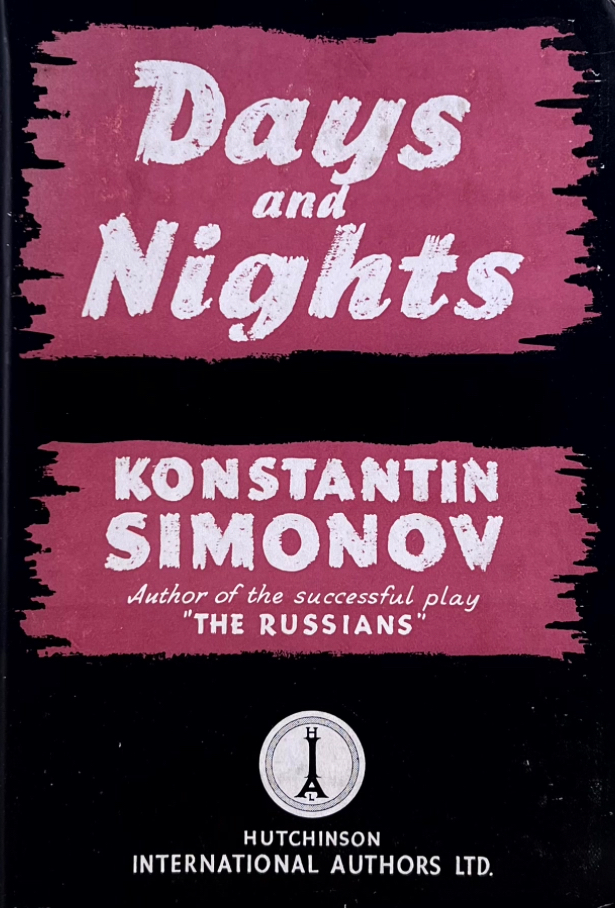
The main character of the novel is the battalion commander Captain Saburov. His nearly full division is transferred to Stalingrad in early September 1942 and sent into street fighting. The entire novel spans two and a half months during which Saburov fights for three Stalingrad houses.
In the basement of one of the held buildings, Saburov meets the nurse Anya Klimenko, and against the backdrop of continuous attacks, love sparks between them. This deep, personal connection becomes a source of strength for him and his battalion and a reminder of the value of life in the very heart of the war.
The battle for control over these houses proves to be extremely difficult and brutal. Saburov faces a constant threat, continuous shelling, and the cruelty of the enemy. Despite all the difficulties and dangers, Captain Saburov does not give up and remains true to his duty and principles. His courage and determination inspire his soldiers to heroic deeds, and they continue to fight regardless of the cost.
Browse the table of contents, check the quotes, read the first chapter, find out which famous book it is similar to, and buy “Days and Nights” on Amazon directly from our page.
For an army that had been fighting for three months without a break, this was not a rout, but a retreat, a stubborn, bloody retreat.
What mattered was not the day you would die, but the life you until that day.
They did not talk about war, they talked about the life that was waiting for them after the war, and this was their quiet, unexpressed resistance to death.
He did not know which was harder: to lead men into battle, or to wait for them to come back.
A man has two lives: the one he lives, and the one he remembers.
I
The exhausted woman sat leaning against the clay wall of a barn, telling in a voice calm with weariness how Stalingrad had burned.
It was dry and dusty. A weak breeze rolled yellow clouds of dust at their feet. The woman’s legs were burned and bare, and as she spoke, she raked the warm dust with her hand toward her inflamed soles, as if trying to soothe the pain this way.
Captain Saburov glanced at his heavy boots and involuntarily took half a step back.
He stood silently, listening to the woman, looking over her head towards where an echelon was being unloaded near the outermost houses, right in the steppe.
Beyond the steppe, a white strip of salt lake glistened in the sun, and all of it, taken together, seemed like the edge of the world. Now, in September, this was the last and closest railway station to Stalingrad. The remainder of the journey to the Volga bank would have to be done on foot. The little town was called Elton, after the salt lake. Saburov involuntarily remembered the words “Elton” and “Baskunchak” learned back in school. Once, it had been merely school geography. And here it was, this Elton: low houses, dust, a provincial railway spur.
And the woman kept talking and talking about her misfortunes, and although her words were familiar, Saburov’s heart ached. Before, they had moved from town to town, from Kharkov to Valuyki, from Valuyki to Rossosh, from Rossosh to Boguchar, and women wept just the same, and he listened to them with a mixed feeling of shame and fatigue. But here was the bare Trans-Volga steppe, the edge of the world, and in the woman’s words, there was no longer reproach, but despair, and there was nowhere further to go across this steppe, where for many versts there remained neither cities, nor rivers, nothing.
“Where have they driven us, eh?” he whispered, and all the unaccountable longing of the past day, when he looked at the steppe from the boxcar, was compressed into those two words.
It was very hard for him at that moment, but remembering the terrible distance that now separated him from the border, he thought not about how he had walked here, but specifically about how he would have to walk back. And there was in his cheerless thoughts that peculiar stubbornness characteristic of the Russian person, which did not allow him or his comrades once during the whole war to admit the possibility that there would be no “back.”
And yet, it couldn’t continue like this. Now, in Elton, he suddenly felt that this was precisely the limit that could not be crossed.
He looked at the soldiers hastily unloading from the carriages, and he wanted to reach the Volga as quickly as possible across this dust, and, having crossed it, to feel that there would be no crossing back and that his personal fate would be decided on the other bank, along with the fate of the city. And if the Germans took the city, he would surely die, and if he prevented them from doing it, then perhaps he would survive.
And the woman sitting at his feet was still recounting Stalingrad, naming one by one the broken and burned streets. Their names, unfamiliar to Saburov, were filled with special meaning for her. She knew where and when the now-burned houses had been built, where and when the trees now chopped down for barricades had been planted; she pitied all of it, as if she were talking not about a large city, but about her own house, where tragically familiar, personally owned things had disappeared and perished.
But about her own house, she said nothing at all, and Saburov, listening to her, thought how, in essence, rarely throughout the entire war had he met people who regretted their lost property. And the further the war went on, the less often people recalled their abandoned homes and the more often and stubbornly they recalled only the abandoned cities.
Wiping her tears with the corner of her kerchief, the woman cast a long, questioning look at all who were listening to her and said thoughtfully and convincingly:
“How much money, how much effort!”
“Effort for what?” someone asked, not grasping the meaning of her words.
“To build it all back again,” the woman said simply.
Saburov asked the woman about herself. She said that her two sons were long at the front and one of them had already been killed, and her husband and daughter had likely remained in Stalingrad. When the bombing and fire started, she was alone and had known nothing of them since.
“And are you going to Stalingrad?” she asked.
“Yes,” Saburov answered, seeing no military secret in this, for why else would a military echelon be unloading right now in this godforsaken Elton if not to go to Stalingrad.
“Our surname is Klimenko. My husband is Ivan Vasilyevich, and my daughter is Anya. Maybe you’ll meet them alive somewhere,” the woman said with faint hope.
“Maybe I will,” Saburov replied routinely.
The battalion was finishing unloading. Saburov said goodbye to the woman and, drinking a scoop of water from the bucket set out on the street, headed toward the railroad track.
The soldiers, sitting on the sleepers with their boots off, were winding their footcloths. Some of them, having saved the ration issued in the morning, were chewing bread and dry sausage. A persistent, as usual, soldier’s rumor ran through the battalion that a march was due immediately after unloading, and everyone hurried to finish their unfinished business. Some were eating, others mending torn tunics, a third group was having a smoke break.
Saburov walked along the station tracks. The echelon carrying the regimental commander, Babchenko, was due any minute, and until then, the question of whether Saburov’s battalion would start the march to Stalingrad without waiting for the rest of the battalions, or whether the entire regiment would move out together in the morning after an overnight stop, remained unresolved.
Saburov walked along the tracks and scrutinized the men with whom he was scheduled to enter battle the day after tomorrow.
He knew many of them well by face and name. These were the “Voronezh men”—that’s what he called those who had fought with him back near Voronezh. Each of them was a treasure, because he could give them orders without explaining unnecessary details.
They knew when the black drops of bombs falling from the plane were coming straight at them and they had to lie down, and they knew when the bombs would fall further away and they could calmly watch their flight. They knew that crawling forward under mortar fire was no more dangerous than staying put. They knew that tanks most often crushed those running away from them and that a German submachine gunner firing from two hundred meters was always counting more on frightening than on killing. In short, they knew all those simple yet life-saving soldier’s truths, the knowledge of which gave them confidence that they wouldn’t be killed so easily.



Reviews
There are no reviews yet.