Description
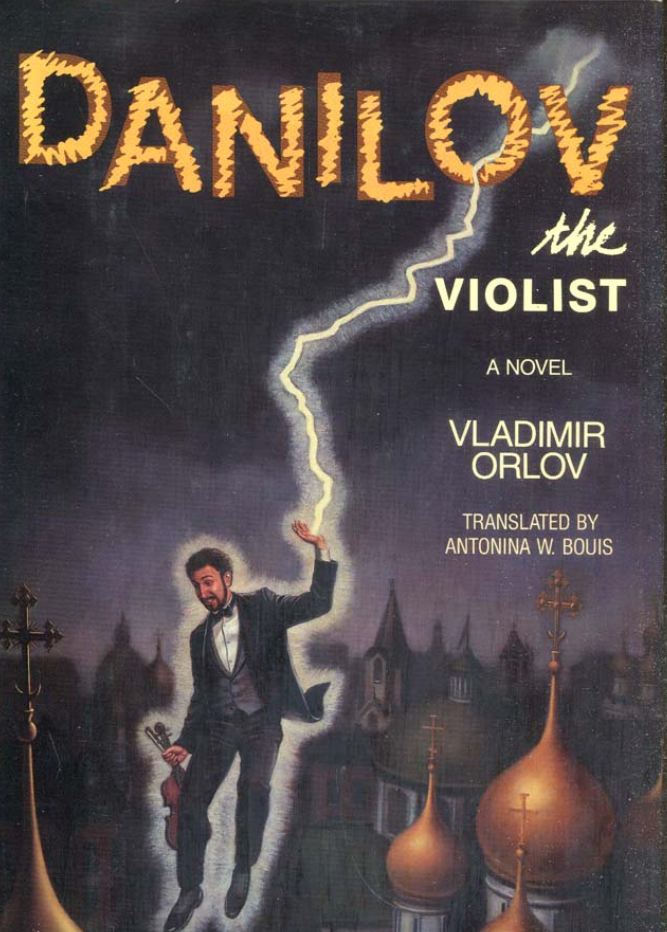
The hero of the novel, the modest Moscow violist Vladimir Danilov, is secretly a half-demon, the son of an earthly woman and a being from an otherworldly, violet civilization. He lives a double life, trying to reconcile his devilish destiny with his passion for music and his love for the mortal woman Klavdia.
He is suddenly suspended from his usual duties and faces judgment by his otherworldly “comrades” for becoming too humanized and failing to perform his demonic functions. To prove his allegiance to the demon world, Danilov must commit Evil, but his human nature and love for the earthly realm prevent him from fulfilling this duty.
Browse the table of contents, check the quotes, read the first chapter, find out which famous book it is similar to, and buy “Danilov, the violist” on Amazon directly from our page.
A man has to be talented, not just an honest man, but a talented one. Talent is given by God, and honesty is just a social convention.
If you want to be happy, do not analyze your happiness.
The world is not saved by those who scream, but by those who know how to play.
The truth is like a woman. If you push it, it will hide in the corner and cry. If you let it come to you, it will tell you everything.
Only a person who is capable of love can become a demon. Without love, there is only a functionary.
1
Danilov was considered a friend of the Muravlyov family. And he was one. He remains a family friend even now. In Moscow, every cultured family today tries to have its own friend. The fact that he is a demon is unknown to anyone but me. I myself didn’t find out about it too long ago, though I had probably noticed some of Danilov’s oddities even earlier. But that’s just an aside.
Nowadays, Danilov doesn’t visit the Muravlyovs often. But before, on Sundays, if he didn’t have a matinee performance, Danilov would have dinner at the Muravlyovs’. He would bring his instrument, for which he had reasons. Right now, I will close my eyes and remember one of those Sundays.
…In the Muravlyovs’ apartment, the hustle and bustle starts in the morning, it smells delicious, finely chopped lamb bought at the market is waiting in a pot for its moment, young string beans tumble out of glass jars onto buttered frying pans, and the coffee maker appears on the French oilcloth of the kitchen table. Ah, what aromas fill the apartment! And what aromas are expected! On this day, the Muravlyovs need no other guest. Especially not Kudasov and his wife. But Kudasov is usually the one who shows up.
Kudasov has a special nose for dinners, drinks, and tea parties. All he has to do is twitch his nostrils—and he immediately knows what products and drinks his acquaintances have bought and at what time they will be placed on the table. The tablecloth hasn’t even been taken out of the wardrobe yet, and Kudasov is already riding the tram, following the scent. Sometimes he doesn’t even twitch his nostrils; a prophetic voice simply sounds in his soul or his stomach, and softly, like the sad ghost of Giselle, calls him somewhere. Kudasov also senses how the guests will be fed and watered today, and if the food is going to be scarce and tasteless, without pepper, without pastille for tea, or without ham from Eliseev’s, then he doesn’t go anywhere. But regarding the dinners for Danilov, and the suppers and breakfasts too, he has no doubts whatsoever. Everything is top-notch here! He just needs to make sure not to be late and let the treats get cold. Here, Kudasov does not trust his nose or his prophetic voice; one never knows what slip-ups they might have. In the morning, he looks at the theater poster and tries to guess whether Danilov is playing his viola today or not. He knows Danilov’s entire repertoire. Kudasov definitely calls the theater too: “Has the performance been canceled today?” Kudasov knows that Danilov will be fed at the Muravlyovs’ specifically because of a canceled performance.
Kudasov himself is not poor; he’s a lecturer, but he is drawn to eating among people. At the same time, he gets so tired of talking at work that he becomes completely harmless at the table—he is silent and silent, only chewing and swallowing, only occasionally clarifying something so that no one’s wild thought rushes too far in the heat of the moment and certainly doesn’t turn the corner. His wife is also silent, but she chews disagreeably.
Neither Danilov nor especially the Muravlyovs need Kudasov, but they tolerate him. He is an old acquaintance, after all, and no obstacles, no diplomatic cunning, no tank traps are a hindrance to Kudasov’s impudence. He will come anyway, apologize, and sit down at the table. Like a lion on a stool for Zapashny. He will certainly hand the hosts a bottle of cheap dry wine—it would be too awkward to kick him out then. The only joy is that he eats three servings of meat and immediately falls asleep right at the table. His nostrils merely quietly inhale the air, and with it the smells—just in case, God forbid, he misses anything good. And his wife, a delicate woman, pretends that she is also dozing with her eyes open.
And Danilov and Muravlyov quietly savor the treats.
“How well the lobio turned out today!” Danilov exclaims happily.
“You try this little yellow salad,” Muravlyov eagerly hastens, “it has nuts, and cheese, and mayonnaise.”
“Sauce provençal,” Danilov corrects him, and after tasting the yellow dish, he begins to praise the hostess, as always, sincerely and loudly.
The hostess sits nearby, blushing from the effort, ready to go to the kitchen immediately to prepare new dishes for the guest.
And then Uzbek plov appears on the table in a huge bowl, hot, as if alive; the grains of rice have separated from each other, with just the right amount of meat and fat, black dots of barberry, delivered from Tashkent, are visible here and there, and heads of garlic, juicy and retaining their aroma, peer out from the yellowish scatter of rice. And what a scent! Such a scent that in the kishlaks near Samarkand, the knowledgeable people are surely now standing facing Moscow.
Kudasov, naturally, comes to, and receives a bowl of plov with a refill. Now he can sleep completely or go visit somewhere else, without waiting for coffee.
“Well, there you go,” Muravlyov says to Danilov, serving him the last portion of plov, “and you tormented yourself and us with your vegetarianism for two years!”
“I tormented myself,” Danilov agrees. And adds sadly: “And I still feel sorry for them now… And for this little lamb… And his mother is now left alone…”
“Nonsense… Metaphysics…” Kudasov wakes up. “You probably skip all the seminars in the evenings.”
“That’s unfair, Valery Stepanovich,” the hostess immediately rises to Danilov’s defense. “On the contrary, Volodya attends all the seminars!”
“And the mother of this plov,” Kudasov adds, “has long since turned into sausage. And there’s no need to feel sorry for her.”
“Why do you say that…” Danilov says meekly.
But the time for tea and coffee comes—and all sorrows immediately dissipate. Danilov himself performs the ritual over the tea and coffee in the Muravlyovs’ house. He prepares both green and Russian tea, and only takes coffee beans from the scorching Arabian land, haughtily despising Brazilian ones, finding excessive languor and a sour-bitter tinge in their taste. Every tea, according to Danilov’s science, must have its own degree of color—both Russian and green—and there is no need to speak of coffee, and Danilov, like Doctor Faust from Gounod’s blue-black opera (he played it on Wednesday, Blinnikov sang Faust and in the intermission after the second act, lost a bottle of cognac to Danilov in a hockey bet), stands in the kitchen over the gas stove. And then he silently brings the teapots and turkas to the table on Zhostovo trays, and the guests and hosts drink the divine beverages, whichever one they wish.
“Well?” Danilov asks timidly.
“Wonderful!” Muravlyov says. “As always!”
Then Danilov sits with the hosts in the semi-darkness, stretching his thin, long legs in Muravlyov’s worn house slippers, and in blissful semi-slumber listens to an Okudzhava record he bought in Paris on Boulevard Saint-Michel for twenty-seven francs. Or he listens to nothing and hums the couplets of Buba Kastorsky from The Elusive Avengers—couplets he rates extremely low, but cannot shake off. He falls asleep in the armchair that way, without answering Muravlyov’s remark about the construction in Naberezhnye Chelny. He is very tired—he plays both in the theater and in concerts, and he has to pay a lot of money—for his instrument and for two co-ops. The hostess approaches him, straightens the suspender that has slipped off his sharp shoulder, wraps Danilov in a camel-hair blanket, looks at him with a heartfelt maternal gaze, sighs, and leaves the dining room, not forgetting to turn off the light…
But again I will say: that was how it was. Now Danilov rarely dines at the Muravlyovs’. Once a month. No more often…



Reviews
There are no reviews yet.