Description
This shocking autobiographical account plunges the reader into the darkest and most secretive corner of the Soviet military machine: the GRU, the Chief Intelligence Directorate.
Viktor Suvorov, a former officer, describes his journey in vivid and sharp detail: from an idealistic Komsomol member to a trained intelligence officer expected to be ready to kill abroad. The book exposes the merciless training system, the fanatical dedication, and the absolute control over personal life.
This is not just a memoir, but a chilling, detailed description of how the Soviet intelligence empire was created and operated, and the unimaginable price paid by those who knew its secrets.
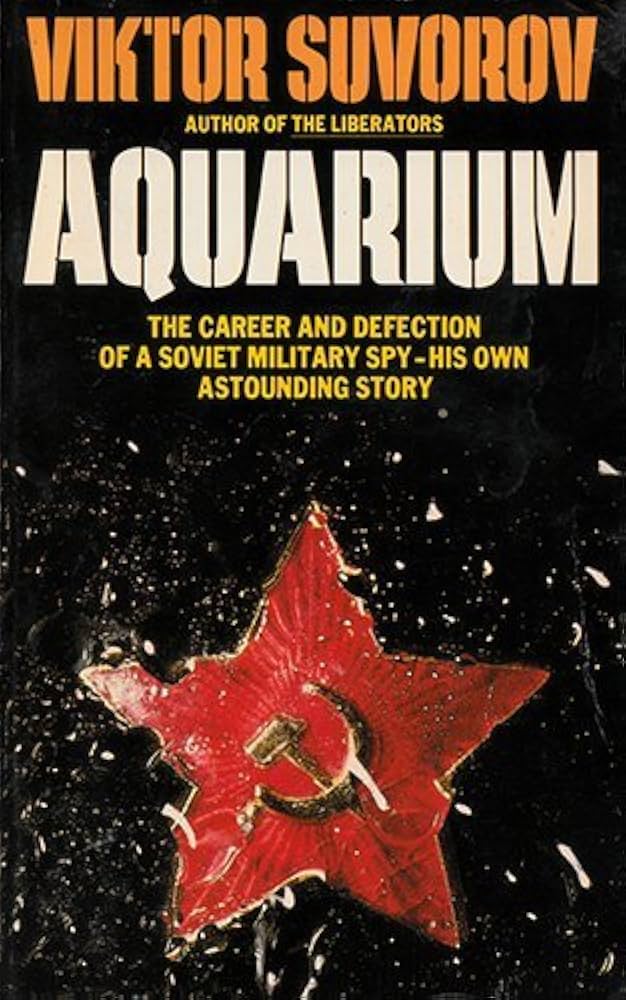
Browse the table of contents, check the quotes, read the first chapter, find out which famous book it is similar to, and buy “Aquarium: The Career and Defection of a Soviet Military Spy” on Amazon directly from our page.
“We have a very simple rule: it’s a rouble to get in, but two to get out. That means that it’s difficult to join the organisation, but a lot more difficult to get out of it.”
“The chimney is not only our way out; it is also a source of energy for us and the guardian of our secrets… If you join the organization you too will one day rise into the sky through that chimney.”
“Fear, he suggests, can be worse than the thing itself… When it’s unknown, it’s very frightening. When you get close, you suspect it’s made of rubber.”
“The GRU does not forgive mistakes; the GRU only punishes them. And the punishment is death, without appeal.”
“I knew I had to run away. My only question was: when, where, and how to do it.”
PROLOGUE
“The law here is simple: one ruble to get in, two to get out. That means it’s difficult to join the organization, but it’s harder to leave it. Theoretically, there is only one exit prescribed for all members of the organization—through the chimney. For some, this exit is honorable, for others, it is shameful, but for all of us, there is only one chimney. Only through it do we leave the organization. Here it is, that chimney…” The Grey-haired man points me toward a huge window, covering the entire wall. “Take a look at it.”
From the height of the ninth floor, a panorama of a vast, endless, deserted airfield, stretching to the horizon, opens before me. And looking down, directly beneath my feet is a labyrinth of sandy paths between the resilient walls of shrubs. The green of the garden and the burnt-out grass of the airfield are separated by an unassailable concrete wall topped with a dense web of barbed wire on white rollers.
“There it is…” The Grey-haired man points to a low, ten-meter tall, thick square chimney above a flat, tarred roof.
The black roof floats on the green waves of lilac, like a raft in the ocean or like an old battleship, low-boarded, with a clumsy chimney. A light, transparent wisp of smoke drifts above the chimney.
“Is that someone leaving the organization?”
“No,” the Grey-haired man laughs. “The chimney is not only our way out; the chimney is also the source of our energy, the chimney is the guardian of our secrets. They are simply burning secret documents right now. You know, it’s better to burn than to store. It’s safer. When someone leaves the organization, the smoke is not like that; the smoke then is thick, greasy. If you join the organization, then you, too, will fly into the sky through that chimney one day. But not now. Now the organization is giving you one last chance to refuse, a final opportunity to think about your choice. And so you have something to think about, I’ll show you a film.”
The Grey-haired man presses a button on the remote control and settles into a chair beside me. Heavy brown curtains close over the immense windows with a slight squeak, and immediately, an image appears on the screen without any captions or introductions. The film is black and white, old, and quite worn. There is no sound, and because of this, the whirring of the movie projector is more distinct.
On the screen is a tall, gloomy room without windows. Somewhere between a workshop and a boiler room. Close-up on the furnace with dampers, resembling the gates of a small fortress, and guide chutes that go into the furnace like rails into a tunnel. Near the furnace are people in gray robes. Stokers. They bring a coffin. So that’s what it is! A crematorium. The very one, perhaps, that I just saw through the window. The people in robes lift the coffin and place it on the guide chutes. The furnace dampers smoothly move apart, the coffin is slightly pushed, and it carries its unknown inhabitant into the roaring flame.
And now the camera shows a close-up of a living person’s face. The face is completely sweaty. It’s hot by the furnace. The face is shown from all sides for an infinitely long time. Finally, the camera moves aside, showing the person completely. He is not in a robe. He is wearing an expensive black suit, though it is completely crumpled. The tie around his neck is twisted into a rope. The man is tightly tied with steel wire to a medical stretcher, and the stretcher is placed against the wall on its handles so that the person can see the furnace.
All the stokers suddenly turn towards the bound man. This attention, apparently, does not please the bound man at all. He screams. He screams horribly. There is no sound, but I know that glass rattles from such a scream. Four stokers carefully lower the stretcher to the floor, then lift it up together. The bound man makes an incredible effort to prevent this. A titanic tension in his face. The vein on his forehead is so swollen it looks ready to burst. But the attempt to bite the stoker’s hand fails. The bound man’s teeth sink into his own hand, and a black stream of blood runs down his chin. Sharp teeth the man has, no doubt. His body is tightly bound, but he squirms like a trapped lizard. His head, obeying animal instinct, pounds against the wooden handle with powerful rhythmic blows, helping his body. The bound man is not fighting for his life, but for an easy death. His plan is clear: to rock the stretcher and fall with it off the guide chutes onto the cement floor. This would be either an easy death or a loss of consciousness. And unconscious, he can go into the furnace. Not scary… But the stokers know their job. They simply hold the handles of the stretcher, preventing it from rocking. And the bound man won’t be able to reach their hands with his teeth, even if his neck were to break. They say that in the very last moments of life, a person can perform miracles. Obeying the instinct of self-preservation, all his muscles, all his consciousness and will, all his desire to live suddenly concentrate in one short lunge… And he lunged! He lunged with his whole body! He lunged like a fox tearing itself from a trap, biting and severing its own bloody paw.
He lunged so hard that the metal guide chutes trembled. He lunged, breaking his own bones, tearing tendons and muscles. He lunged…
But the wire was strong. And now the stretcher smoothly moved forward. The furnace doors parted, illuminating the soles of his patent leather, long-unpolished shoes with white light. Now the soles are approaching the fire. The man tries to bend his legs at the knees to increase the distance between his soles and the roaring fire. But he fails at this too. The camera shows his fingers in close-up. The wire is tightly embedded in them. But the man’s fingertips are free. And with them, he tries to slow his movement. His fingertips are splayed and tense. If only something came in their way, the man would undoubtedly hold on. And suddenly, the stretcher stops right by the furnace. A new character on the screen, dressed in a robe like all the stokers, signals to them with his hand. And obeying his gesture, they take the stretcher off the guide chutes and place it back against the wall on its rear handles. What is the matter? Why the delay? Ah, that’s what it is. Another coffin is wheeled into the crematorium hall on a low trolley. It is already nailed shut. It is magnificent. It is elegant. It is decorated with fringes and borders. This is an honorable coffin. Make way for the honorable coffin! The stokers place it on the guide chutes, and now it goes on its final journey. Now they must wait an incredibly long time for it to burn. They must wait and wait. They must be patient…
And now, finally, it is the bound man’s turn. The stretcher is back on the guide chutes. And I hear that silent scream again, one that is probably capable of tearing doors off their hinges. I peer hopefully into the bound man’s face. I try to find signs of madness on this face. Madmen have it easy in this world. But there are no such signs on this handsome, courageous face. This face is not marred by the mark of insanity. The person simply doesn’t want to go into the furnace, and he is trying to express this somehow. And how else can you express it but with a scream? So he screams. Fortunately, that scream is not immortalized. Now the patent leather shoes go into the fire. Into the fire, damn it. The fire rages. They must be blowing in oxygen. The first two stokers jump aside, the last two forcefully push the stretcher deep inside. The furnace doors close, and the clicking of the projector ceases.
“He… who?” I don’t even know why I ask such a question.
“He? A Colonel. A former Colonel. He was in our organization. In high positions. He cheated the organization. For that, he was expelled from the organization. So he left. That is our law. We do not involve anyone in the organization by force. If you don’t want to—refuse. But if you join, you belong to the organization completely. Along with your shoes and tie. So… I give you the last chance to refuse. One minute for reflection.”




Reviews
There are no reviews yet.