Description
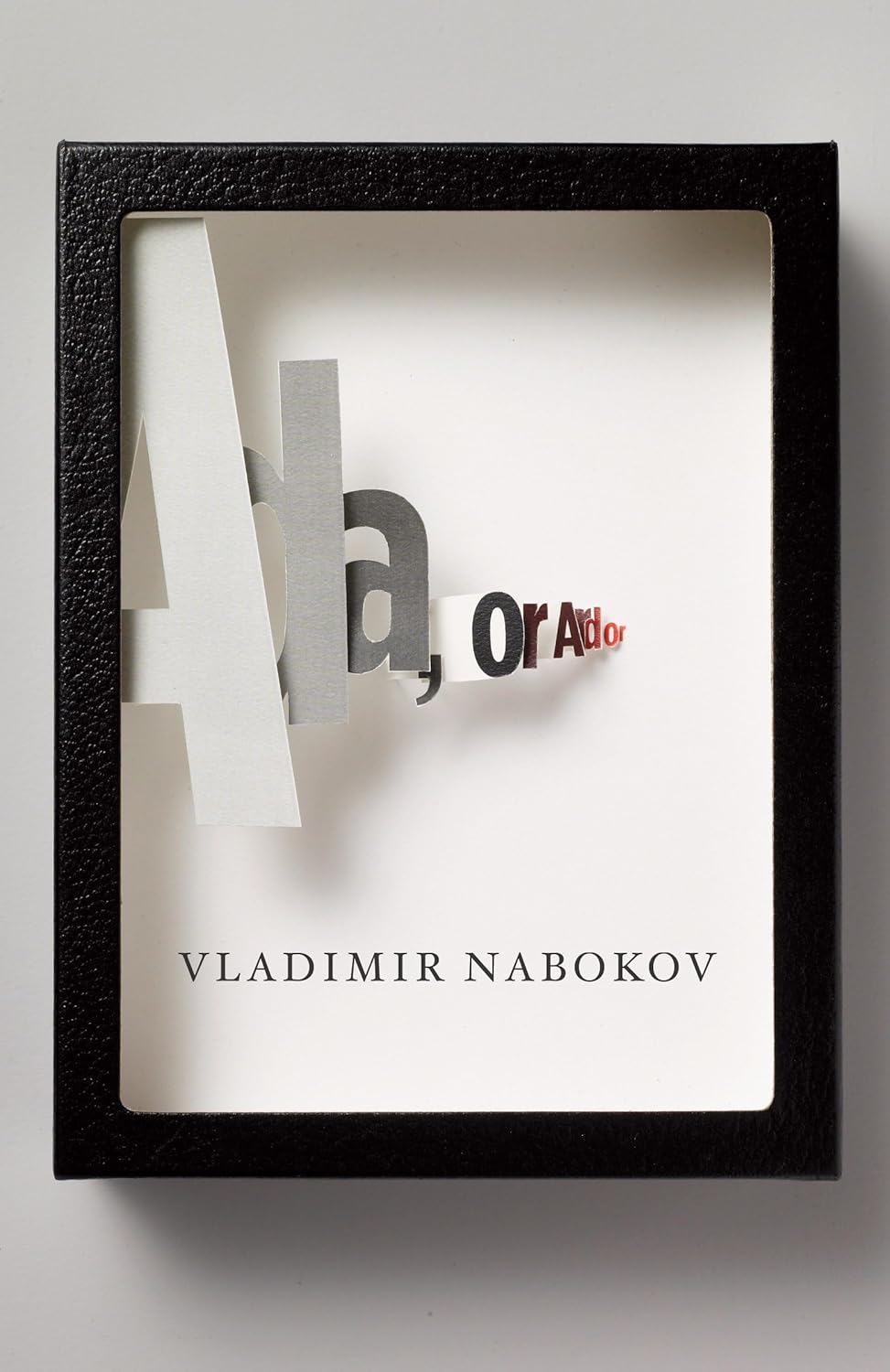
The novel is presented as the extensive, richly detailed memoir of Van Veen, who chronicles his lifelong, passionate, and forbidden love for his sister, Ada. The story is set on an alternate planet called Antiterra in the 19th century, where Russia, America, and France have somehow merged into one geopolitical space.
Van and Ada first meet at Ardis Hall, the ancestral estate, when they are 14 and 12, believing they are cousins. Their idyllic summer evolves into an incestuous, intellectual, and erotic affair that defines their lives forever. They soon discover that they are, in fact, full siblings, children of the same parents (Demon Veen and Marina Durmanov).
The novel tracks their relationship across decades of separations, infidelities, tragic events (such as the suicide of their half-sister Lucette), and old age, exploring how their love battles the passage of time and attempts to capture the “ardor” of every moment.
Browse the table of contents, check the quotes, read the first act, find out which famous book it is similar to, and buy Ada, or Ardor: A Family Chronicle on Amazon directly from our page.
The book Ada, or Ardor: A Family Chronicle is divided into five parts, containing a total of 65 chapters, none of which have titles.
“Space is a swarming in the eyes, and Time a singing in the ears…”
“You lose your immortality when you lose your memory.”
“…we simply speak with our wounds; wounds procreate…”
“All our old loves are corpses or wives.”
“I adore you. I shall never love anybody in my life as I adore you, never and nowhere, neither in eternity, nor in terrenity, neither in Ladore, nor on Terra, where they say our souls go.”
Part One
1
“All happy families are happy generally in one way; all unhappy families are unhappy generally in another,” a great Russian writer asserts, beginning his famous novel (Anna Arkadievitch Karenina, as rendered in English by R.J. Stonerower, Mount Tabor Ltd., 1880). This statement, if relevant at all, is only marginally so to the tale we are about to tell, a family chronicle whose first part may, however, recall another work by Tolstoy: Childhood and Fatherland (Pontius Press, 1858).
Van’s maternal grandmother, Darya (“Dolly”) Durmanov, was the daughter of Prince Petr Zemsky, governor of Bras d’Or, an American province in the northeast of our immense and motley country, who in 1824 married the high-society Irishwoman Mary O’Reilly. Dolly, their only child, born in Bras, was married off in 1840, when she was fifteen (a tender and wayward age), to General Ivan Durmanov, Commandant of Fort Yukon and a peaceful country dweller who had lands in Northern Territories (Severnya Territorii), whimsically nestled in the protectorate, still affectionately called “Russian” Estoty, which mosaically and organically merges with “Russian” Canada, otherwise “French” Estoty, where not only French but also Macedonian and Bavarian settlers have happily settled in the quiet local climate and under our star-spangled banner.
However, the Durmanovs’ favorite estate was “Rainbow,” near the town of the same name, just outside Estotiland itself, on a strip of the Atlantic coast between elegant Kaluga in New Cheshire, USA, and no less elegant Ladore in Maine; they had their country house there, and there three children were born: a son, who died young but famous, and a pair of tiresome twin girls. Dolly inherited her beauty and character from her mother, and from more distant ancestors, a highly eccentric and often regrettable taste, reflected, for example, in the names she gave her daughters: Aqua and Marina (“Why not Tofana?” the dearest and most bountifully horned general asked with a timidly visceral chuckle, concluding the question with a slight, deliberately indifferent cough—for fear of incurring an outburst of dissatisfaction from his wife).
On April 23, 1869, Aqua, at the age of twenty-five and in a state of her usual spring migraine, in Kaluga, permeated with warm, rainy drizzle and clad in transparent spring foliage, married Walter D. Veen, a Manhattan banker of ancient Anglo-Irish descent, who had long been in a passionate (soon forced to become sporadic) love affair with her sister Marina. The latter, sometime around 1871, married the first cousin of her first lover, also a Walter D. Veen and equally wealthy, though a much more ordinary fellow.
The initial “D.” in Aqua’s husband’s name stood for “Demon” (a form of the name Demyan or Dementiy), and that is what his family called him. In society, he was usually called Veen the Raven or simply Walter Shade, in contrast to Walter the Fool, as Marina’s husband was nicknamed—Fool Walter, or simply Red Veen. Demon was equally passionate about collecting old masters and young mistresses. In addition, he appreciated not quite aged puns.
Daniel Veen’s mother was from the Trumbell family, and Daniel was prone to lengthy explanations—until cut short by some hater of tediousness—about how the English “bull” in the name “Trumbull” was transformed into the New England “bell” during the formation of America. Be that as it may, he “went into business” in his early twenties and gradually grew into a very prominent Manhattan art dealer. Not feeling—at least initially—any particular love for painting, Daniel also had no aptitude for trade in general, nor did he feel any particular need to squander the solid fortune inherited from a multitude of much more successful and enterprising Veen ancestors on the bumps of his “trade.” Professing indifference to country life, he spent only two or three weekends, while sheltering from the sun, at Ardis, his delightful estate near Ladore. Since childhood, he had visited his other estate—the one north of Kitezh Lake, near Luga—only a couple of times, which he owned jointly with his cousin, a passionate angler in his youth, and which generally consisted of a colossal, oddly rectangular, yet natural body of water, which took a perch, once timed by Daniel, half an hour to swim across diagonally.
Poor Dan’s erotic existence was neither varied nor charming, but for all that (forgetting soon, under what circumstances exactly, as one usually forgets the size and cost of a coat once acquired if worn for a couple of seasons without taking it off) he serenely fell in love with Marina, whose family he had known when they still lived on their Rainbow estate (which was subsequently sold to Mr. Eliot, a Jewish dealer). One spring midday in 1871, in the ascending elevator of Manhattan’s first ten-story building, he proposed to Marina, which was indignantly rejected on the seventh floor (toys department), after which Dan descended alone and, to give vent to his feelings, undertook a threefold circumnavigation of the globe in the counter-Foggo direction, revolving in parallel in one direction. Sometime in November 1871, while contemplating evening plans in the company of the same smelly but amiable cicerone in a café-au-lait colored suit, whom Dan was hiring for the third time in the same Genoese hotel, he received a cablegram on a silver tray from Marina (sent a week late by his Manhattan office, where the message had been mistakenly sorted by a new secretary into a drawer marked RE AMOR), informing him that Marina agreed to marry him as soon as Dan returned to America.


Reviews
There are no reviews yet.