Description
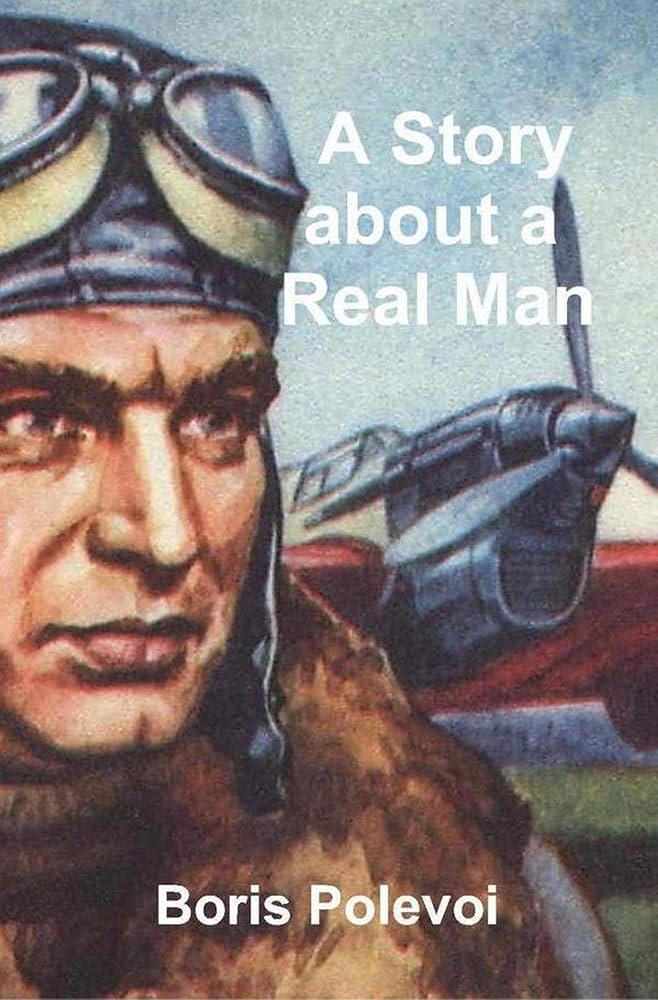
Pilot Alexei Meresyev is shot down in an air battle and severely wounds his legs. Miraculously surviving, he begins his 18-day subhuman journey: wounded and starving, he crawls hundreds of kilometers through the forest, driven by one goal alone—to return to his own unit and fly again. This is an epic struggle against pain, frostbite, and total despair.
After his rescue, doctors are forced to amputate his feet. It seems like the end of everything, but Meresyev makes a decision that is astonishing: to learn to walk and fly with prosthetics. He goes through grueling training and persistent struggle to prove to everyone that a “real man” does not surrender to fate. He achieves the impossible, returning to active service and continuing to shoot down enemy aircraft.
Browse the table of contents, check the quotes, read the first chapter, find out which famous book it is similar to, and buy “A Story about a Real Man” on Amazon directly from our page.
“What a bore. Another correspondent,” I thought, sighing and hurrying off to the canteen as fast as I could make it.
“The main thing is not to surrender, not to stop, to crawl forward with gritted teeth, no matter how hard it is.”
“I could hardly believe my ears. Polevoi had written about me.”
“His strength lay not in the physical, but in the unyielding will of the Soviet man, who refuses to be broken by fate.”
“The whole country was fighting, and I, too, had to fight, even if it meant fighting my own body.”
1
The stars were still sparkling sharply and coldly, but the eastern sky was already beginning to lighten. The trees were slowly emerging from the darkness. Suddenly, a strong, fresh wind swept through their crowns. The forest immediately came alive, buzzing with a full, resonant, and clear sound. Centuries-old pines called out to each other in whistling whispers, and dry frost, with a soft rustle, poured down from the disturbed branches.
The wind died down as suddenly as it had begun. The trees again froze in cold numbness. All the sounds of the pre-dawn forest became immediately audible: the greedy gnawing of wolves in the neighboring clearing, the cautious yelping of foxes, and the first, still hesitant taps of a waking woodpecker, which rang out in the forest silence with a musical quality, as if it were pecking not a wooden trunk, but the hollow body of a violin.
The wind gusted once more through the heavy needles of the pine tops. The last stars quietly faded in the brightened sky. The sky itself solidified and narrowed. The forest, having finally shaken off the remnants of night darkness, rose up in all its green grandeur. The way the curly heads of the pines and the sharp spires of the firs glowed purple hinted that the sun had risen, and the breaking day promised to be clear, frosty, and bracing.
It grew completely light. The wolves retreated into the dense thickets to digest their nightly prey, and the fox left the clearing, leaving behind a lacy, cunningly tangled trail in the snow. The old forest hummed evenly, ceaselessly. Only the fuss of birds, the tap of the woodpecker, the cheerful chirping of yellow tits darting among the branches, and the greedy, dry quacking of jays diversified this drawn-out, anxious, and mournful roar, rolling over in soft waves.
A magpie, cleaning its black, sharp beak on an alder branch, suddenly turned its head sideways, listened intently, and crouched, ready to take off and fly away. Branches crackled anxiously. Something large and powerful was moving through the forest, heedless of the path. Bushes snapped, the tops of small pine trees swayed wildly, and the crusty snow groaned as it gave way. The magpie shrieked and, spreading its tail like the fletching of an arrow, flew straight away.
From the pine needles dusted with morning frost, a long brown muzzle, crowned with heavy, branching antlers, emerged. Frightened eyes scanned the huge clearing. Pink suede nostrils, emitting the hot steam of alarmed breathing, twitched convulsively.
The old elk froze in the pine grove like a statue. Only the patchy hide on his back twitched nervously. His alert ears caught every sound, and his hearing was so sharp that the beast could hear the bark beetle grinding the pine wood. But even those sensitive ears heard nothing in the forest except the chatter of birds, the tap of the woodpecker, and the steady ring of the pine tops.
The sound was reassuring, but his sense of smell warned of danger. Sharp, heavy, and dangerous scents, alien to this ancient forest, mingled with the fresh aroma of thawing snow. The beast’s dark, mournful eyes saw dark figures on the dazzling scales of the crusty snow. Without moving, he tensed his entire body, ready to leap into the thicket. But the people did not move. They lay thickly in the snow, sometimes on top of each other. There were very many of them, but not one was moving or disturbing the pristine silence. Near them, some kind of monsters, embedded in the drifts, towered up. It was they who were emitting the sharp and disturbing smells.
The elk stood at the edge of the forest, anxiously squinting, unable to comprehend what had happened to this entire herd of quiet, motionless, and seemingly harmless people.
His attention was drawn to a sound coming from above. The beast flinched; the skin on his back twitched, and his hind legs tucked even further under him.
However, the sound was also not frightening: it was like several May bugs, bass-humming, circling in the foliage of a blossoming birch tree. And mixed with their humming was sometimes a frequent, short cracking sound, similar to the evening creaking of a corncrake in a swamp.
And here were the bugs themselves. Glinting their wings, they danced in the blue, frosty air. The corncrake squeaked again and again high up. One of the bugs, without folding its wings, darted down. The others danced again in the celestial azure. The beast relaxed its tense muscles, stepped into the clearing, licked the crusty snow, glancing toward the sky. And suddenly, another bug broke away from the swarm dancing in the air and, leaving a large, lush tail behind it, rushed straight towards the clearing. It grew so fast that the elk barely managed to leap into the bushes—something huge, more terrifying than a sudden burst of an autumn storm, slammed into the pine tops and crashed to the ground so heavily that the whole forest boomed and groaned. The echo raced over the trees, overtaking the elk, who bolted at full speed into the thicket.
The echo became stuck in the thick green pine needles. Sparkling and glistening, the frost showered down from the tree crowns, dislodged by the falling plane. Silence, viscous and commanding, took hold of the forest. And in it, the distinct sound of a man moaning was heard, and the heavy crunching of the crusty snow under the paws of a bear, which the unusual roar and crash had driven out of the woods onto the small clearing.
The bear was large, old, and shaggy. Untidy clumps of brown fur stuck out on his sunken flanks, and hung like icicles from his thin, gaunt hindquarters. War had raged in these parts since autumn. It had penetrated even here, into the reserved wilderness, where previously only foresters and hunters rarely ventured. The roar of nearby fighting had lifted the bear from his den back in autumn, disrupting his winter hibernation, and now, hungry and angry, he roamed the forest, knowing no peace.
The bear stopped at the edge of the forest, right where the elk had just been standing. He sniffed the fresh, delicious-smelling tracks, breathing heavily and greedily, moving his sunken flanks, and listened. The elk was gone, but nearby there was a sound produced by some living, and probably weak, creature. The fur rose on the beast’s nape. He stretched out his muzzle. And again, that plaintive sound faintly reached him from the edge of the clearing.
Slowly, carefully stepping with his soft paws, under which the dry, strong crust of snow audibly crunched, the beast headed towards the motionless, snow-embedded human figure…





Reviews
There are no reviews yet.