CHAPTER I
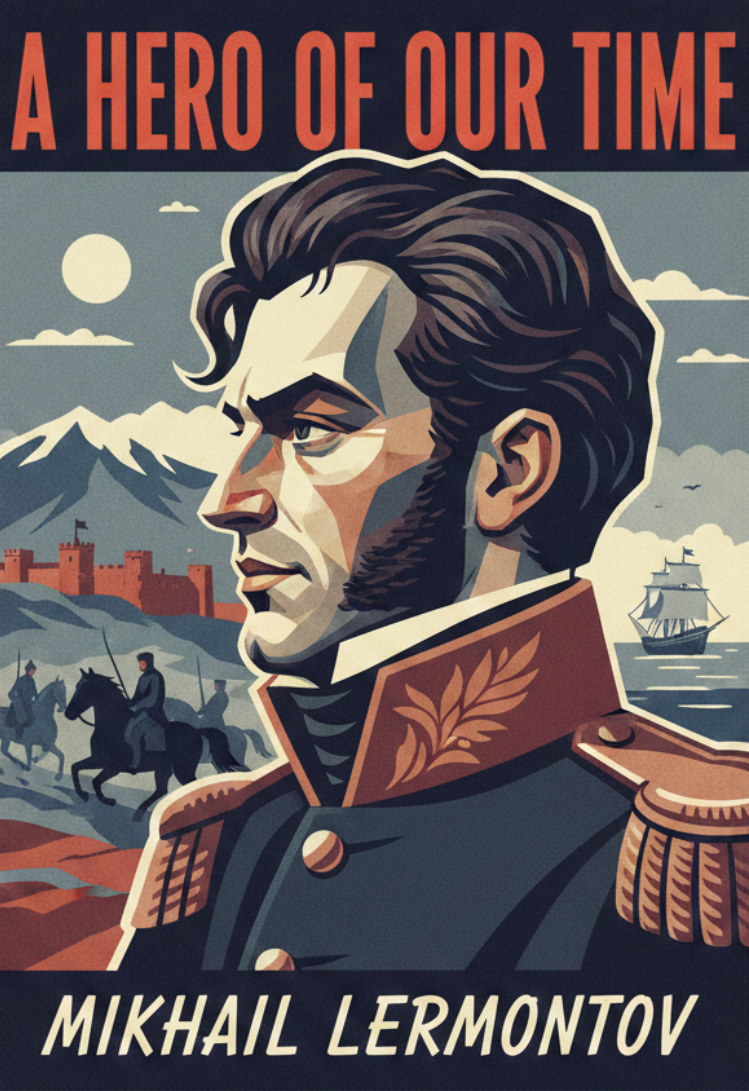
I was travelling post from Tiflis.
All the luggage I had in my cart consisted of one small portmanteau half filled with travelling-notes on Georgia; of these the greater part has been lost, fortunately for you; but the portmanteau itself and the rest of its contents have remained intact, fortunately for me.
As I entered the Koishaur Valley the sun was disappearing behind the snow-clad ridge of the mountains. In order to accomplish the ascent of Mount Koishaur by nightfall, my driver, an Ossete, urged on the horses indefatigably, singing zealously the while at the top of his voice.
What a glorious place that valley is! On every hand are inaccessible mountains, steep, yellow slopes scored by water-channels, and reddish rocks draped with green ivy and crowned with clusters of plane-trees. Yonder, at an immense height, is the golden fringe of the snow. Down below rolls the River Aragva, which, after bursting noisily forth from the dark and misty depths of the gorge, with an unnamed stream clasped in its embrace, stretches out like a thread of silver, its waters glistening like a snake with flashing scales.
Arrived at the foot of Mount Koishaur, we stopped at a dukhan. About a score of Georgians and mountaineers were gathered there in a noisy crowd, and, close by, a caravan of camels had halted for the night. I was obliged to hire oxen to drag my cart up that accursed mountain, as it was now autumn and the roads were slippery with ice. Besides, the mountain is about two versts in length.
There was no help for it, so I hired six oxen and a few Ossetes. One of the latter shouldered my portmanteau, and the rest, shouting almost with one voice, proceeded to help the oxen.
Following mine there came another cart, which I was surprised to see four oxen pulling with the greatest ease, notwithstanding that it was loaded to the top. Behind it walked the owner, smoking a little, silver-mounted Kabardian pipe. He was wearing a shaggy Circassian cap and an officer’s overcoat without epaulettes, and he seemed to be about fifty years of age. The swarthiness of his complexion showed that his face had long been acquainted with Transcaucasian suns, and the premature greyness of his moustache was out of keeping with his firm gait and robust appearance. I went up to him and saluted. He silently returned my greeting and emitted an immense cloud of smoke.
“We are fellow-travellers, it appears.”
Again he bowed silently.
“I suppose you are going to Stavropol?”
“Yes, sir, exactly—with Government things.”
“Can you tell me how it is that that heavily-laden cart of yours is being drawn without any difficulty by four oxen, whilst six cattle are scarcely able to move mine, empty though it is, and with all those Ossetes helping?”
He smiled slyly and threw me a meaning glance.
“You have not been in the Caucasus long, I should say?”
“About a year,” I answered.
He smiled a second time.
“Well?”
“Just so, sir,” he answered. “They’re terrible beasts, these Asiatics! You think that all that shouting means that they are helping the oxen? Why, the devil alone can make out what it is they do shout. The oxen understand, though; and if you were to yoke as many as twenty they still wouldn’t budge so long as the Ossetes shouted in that way of theirs…. Awful scoundrels! But what can you make of them? They love extorting money from people who happen to be travelling through here. The rogues have been spoiled! You wait and see: they will get a tip out of you as well as their hire. I know them of old, they can’t get round me!”
“You have been serving here a long time?”
“Yes, I was here under Aleksei Petrovich,” he answered, assuming an air of dignity. “I was a sub-lieutenant when he came to the Line; and I was promoted twice, during his command, on account of actions against the mountaineers.”
“And now—?”
“Now I’m in the third battalion of the Line. And you yourself?”
I told him.
With this the conversation ended, and we continued to walk in silence, side by side. On the summit of the mountain we found snow. The sun set, and—as usually is the case in the south—night followed upon the day without any interval of twilight. Thanks, however, to the sheen of the snow, we were able easily to distinguish the road, which still went up the mountain-side, though not so steeply as before. I ordered the Ossetes to put my portmanteau into the cart, and to replace the oxen by horses. Then for the last time I gazed down upon the valley; but the thick mist which had gushed in billows from the gorges veiled it completely, and not a single sound now floated up to our ears from below. The Ossetes surrounded me clamorously and demanded tips; but the staff-captain shouted so menacingly at them that they dispersed in a moment.
“What a people they are!” he said. “They don’t even know the Russian for ‘bread,’ but they have mastered the phrase ‘Officer, give us a tip!’ In my opinion, the very Tartars are better, they are no drunkards, anyhow.”…
We were now within a verst or so of the Station. Around us all was still, so still, indeed, that it was possible to follow the flight of a gnat by the buzzing of its wings. On our left loomed the gorge, deep and black. Behind it and in front of us rose the dark-blue summits of the mountains, all trenched with furrows and covered with layers of snow, and standing out against the pale horizon, which still retained the last reflections of the evening glow. The stars twinkled out in the dark sky, and in some strange way it seemed to me that they were much higher than in our own north country. On both sides of the road bare, black rocks jutted out; here and there shrubs peeped forth from under the snow; but not a single withered leaf stirred, and amid that dead sleep of nature it was cheering to hear the snorting of the three tired post-horses and the irregular tinkling of the Russian bell.
“We will have glorious weather to-morrow,” I said.
The staff-captain answered not a word, but pointed with his finger to a lofty mountain which rose directly opposite us.
“What is it?” I asked.
“Mount Gut.”
“Well, what then?”
“Don’t you see how it is smoking?”
True enough, smoke was rising from Mount Gut. Over its sides gentle cloud-currents were creeping, and on the summit rested one cloud of such dense blackness that it appeared like a blot upon the dark sky.
By this time we were able to make out the Post Station and the roofs of the huts surrounding it; the welcoming lights were twinkling before us, when suddenly a damp and chilly wind arose, the gorge rumbled, and a drizzling rain fell. I had scarcely time to throw my felt cloak round me when down came the snow. I looked at the staff-captain with profound respect.
“We shall have to pass the night here,” he said, vexation in his tone. “There’s no crossing the mountains in such a blizzard.—I say, have there been any avalanches on Mount Krestov?” he inquired of the driver.
“No, sir,” the Ossete answered; “but there are a great many threatening to fall—a great many.”
Owing to the lack of a travellers’ room in the Station, we were assigned a night’s lodging in a smoky hut. I invited my fellow-traveller to drink a tumbler of tea with me, as I had brought my cast-iron teapot—my only solace during my travels in the Caucasus.
One side of the hut was stuck against the cliff, and three wet and slippery steps led up to the door. I groped my way in and stumbled up against a cow (with these people the cow-house supplies the place of a servant’s room). I did not know which way to turn—sheep were bleating on the one hand and a dog growling on the other. Fortunately, however, I perceived on one side a faint glimmer of light, and by its aid I was able to find another opening by way of a door. And here a by no means uninteresting picture was revealed. The wide hut, the roof of which rested on two smoke-grimed pillars, was full of people. In the centre of the floor a small fire was crackling, and the smoke, driven back by the wind from an opening in the roof, was spreading around in so thick a shroud that for a long time I was unable to see about me. Seated by the fire were two old women, a number of children and a lank Georgian—all of them in tatters. There was no help for it! We took refuge by the fire and lighted our pipes; and soon the teapot was singing invitingly.
“Wretched people, these!” I said to the staff-captain, indicating our dirty hosts, who were silently gazing at us in a kind of torpor.
“And an utterly stupid people too!” he replied. “Would you believe it, they are absolutely ignorant and incapable of the slightest civilisation! Why even our Kabardians or Chechenes, robbers and ragamuffins though they be, are regular dare-devils for all that. Whereas these others have no liking for arms, and you’ll never see a decent dagger on one of them! Ossetes all over!”
“You have been a long time in the Chechenes’ country?”
“Yes, I was quartered there for about ten years along with my company in a fortress, near Kamennyi Brod. Do you know the place?”
“I have heard the name.”
“I can tell you, my boy, we had quite enough of those dare-devil Chechenes. At the present time, thank goodness, things are quieter; but in the old days you had only to put a hundred paces between you and the rampart and wherever you went you would be sure to find a shaggy devil lurking in wait for you. You had just to let your thoughts wander and at any moment a lasso would be round your neck or a bullet in the back of your head! Brave fellows, though!”…
“You used to have many an adventure, I dare say?” I said, spurred by curiosity.
“Of course! Many a one.”…
Hereupon he began to tug at his left moustache, let his head sink on to his breast, and became lost in thought. I had a very great mind to extract some little anecdote out of him—a desire natural to all who travel and make notes.
Meanwhile, tea was ready. I took two travelling-tumblers out of my portmanteau, and, filling one of them, set it before the staff-captain. He sipped his tea and said, as if speaking to himself, “Yes, many a one!” This exclamation gave me great hopes. Your old Caucasian officer loves, I know, to talk and yarn a bit; he so rarely succeeds in getting a chance to do so. It may be his fate to be quartered five years or so with his company in some out-of-the-way place, and during the whole of that time he will not hear “good morning” from a soul (because the sergeant says “good health”). And, indeed, he would have good cause to wax loquacious—with a wild and interesting people all around him, danger to be faced every day, and many a marvellous incident happening. It is in circumstances like this that we involuntarily complain that so few of our countrymen take notes.
“Would you care to put some rum in your tea?” I said to my companion. “I have some white rum with me—from Tiflis; and the weather is cold now.”
“No, thank you, sir; I don’t drink.”
“Really?”
“Just so. I have sworn off drinking. Once, you know, when I was a sub-lieutenant, some of us had a drop too much. That very night there was an alarm, and out we went to the front, half seas over! We did catch it, I can tell you, when Aleksei Petrovich came to hear about us! Heaven save us, what a rage he was in! He was within an ace of having us court-martialled. That’s just how things happen! You might easily spend a whole year without seeing a soul; but just go and have a drop and you’re a lost man!”
On hearing this I almost lost hope.
“Take the Circassians, now,” he continued; “once let them drink their fill of buza at a wedding or a funeral, and out will come their knives. On one occasion I had some difficulty in getting away with a whole skin, and yet it was at the house of a ‘friendly’ prince, where I was a guest, that the affair happened.”
“How was that?” I asked.
“Here, I’ll tell you.”…
He filled his pipe, drew in the smoke, and began his story.



Reviews
There are no reviews yet.