Description
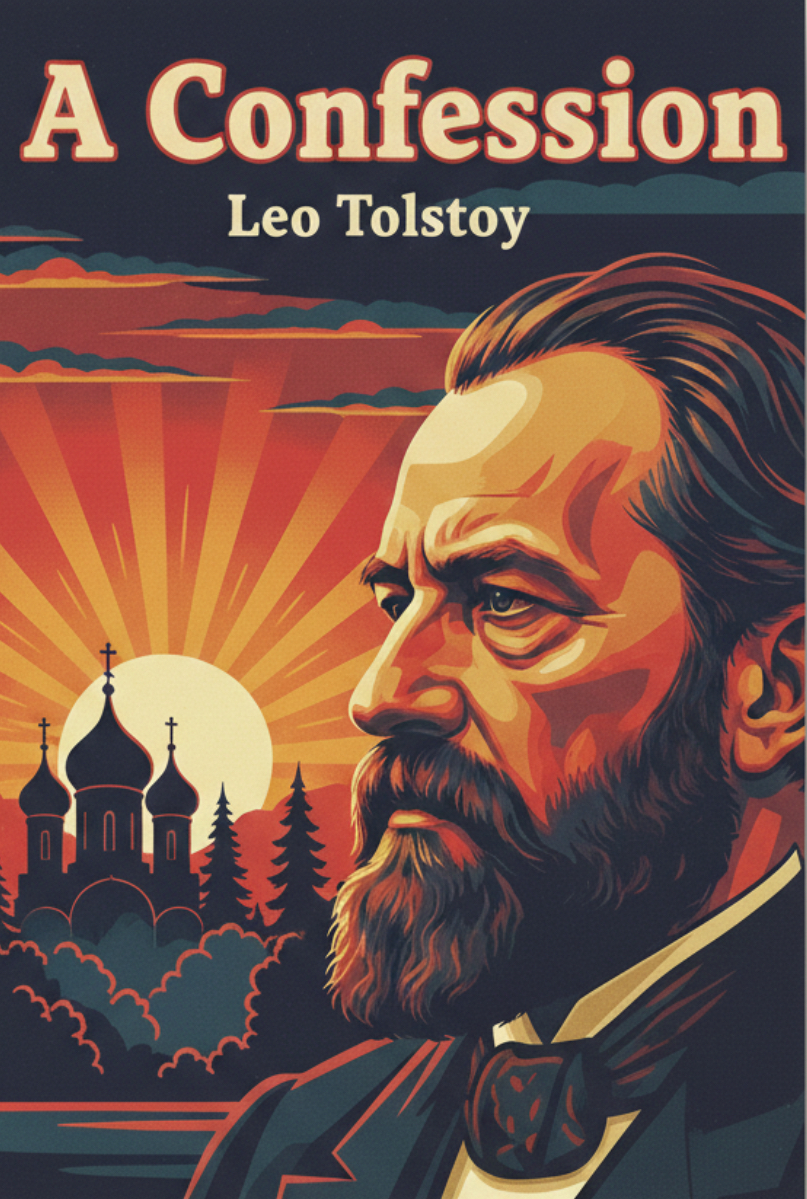
A Confession is a short, autobiographical work detailing Leo Tolstoy’s profound midlife spiritual crisis and his search for the ultimate meaning of life. Written between 1879 and 1882, the work marks a radical turning point in the author’s philosophical and religious views.
Tolstoy, a celebrated author, describes the despair he felt despite having achieved worldwide fame, wealth, and a large family. He confronts the existential dread that arises from recognizing the inevitability of death, which he felt rendered all human achievements—including his own great novels—meaningless. This crisis led him to contemplate suicide as the only logically consistent course of action.
He traces his spiritual journey from his youthful loss of orthodox faith, through a period of self-improvement (which devolved into a pursuit of worldly ambition, pride, and vanity), and ultimately to a desperate, exhaustive search for a universal answer. He examines philosophy, science, and the teachings of the Orthodox Church, but finds them all insufficient or hypocritical.
Tolstoy ultimately discovers meaning not in the rational knowledge of the educated elite, but in the simple, selfless faith of the common peasant. He concludes that true meaning is found in living a simple, moral life, rejecting the materialism of his class, and following the core ethical teachings of Christ, particularly the Sermon on the Mount, which led to his subsequent radical Christian-anarchist views and his excommunication from the Russian Orthodox Church.
Browse the table of contents, check the quotes, read the first chapter, find out which famous book it is similar to, and buy “A Confession” on Amazon directly from our page.
The only absolute knowledge attainable by man is that life is meaningless.
I did not myself know what I wanted: I feared life, desired to escape from it, yet still hoped something of it.
The only significance of life consists in helping to establish the kingdom of God; and this can be done only by means of the recognition and profession of the truth by each single man.
I began to pray not only from habit, but with emotions of love and humility.
Faith is the force of life. If a man lives, he believes in something.
I
I was baptized and raised in the Orthodox Christian faith. I was taught it from childhood and throughout my adolescence and youth. But when I left the university after the second course at the age of 18, I no longer believed in anything I had been taught.
Judging by certain memories, I had never seriously believed; I only had trust in what I was taught and in what the adults professed before me; but this trust was very shaky.
I remember that when I was about eleven, a boy, Volodya M., long since deceased, who was studying at the gymnasium, came to our house on a Sunday and announced to us, as the latest news, a discovery made at the gymnasium. The discovery was that there is no God and that everything we are taught is mere invention (this was in 1838). I remember how the older brothers were interested in this news and called me to the discussion as well. I recall that we were all very animated and accepted this news as something highly entertaining and very possible.
I also remember that when my elder brother Dmitry, while at university, suddenly, with a passion characteristic of his nature, devoted himself to faith and began attending all church services, fasting, and living a pure and moral life, all of us, even the older ones, constantly ridiculed him and for some reason nicknamed him Noah. I recall Musin-Pushkin, who was then the trustee of Kazan University and invited us to dance at his house, mockingly persuaded my refusing brother by saying that even David danced before the Ark. I sympathized with these jokes of the elders then and drew the conclusion from them that one should learn the catechism, and one should go to church, but one should not take all of it too seriously. I also remember reading Voltaire when I was very young, and his mockery not only did not offend me but greatly amused me.
My falling away from faith happened to me in the same way it happened and still happens to people of our educational background. It happens, as it seems to me, in the majority of cases as follows: people live as everyone lives, and everyone lives based on principles that not only have nothing in common with religious teaching, but are for the most part contrary to it; religious teaching does not participate in life, and in dealings with other people, one never has to encounter it, and in one’s own life, one never has to consult it; this religious teaching is professed somewhere, far from life and independent of it. If one encounters it, it is only as an external phenomenon, unconnected with life.
By a person’s life, by their deeds, it is impossible to tell whether they are a believer or not, either now or then. If there is a difference between those who openly profess Orthodoxy and those who deny it, it is not in favor of the former. Both now and then, the open acknowledgment and profession of Orthodoxy were mostly found in dull, cruel, and immoral people who considered themselves very important. Intelligence, honesty, straightforwardness, good nature, and morality were mostly found in people who considered themselves unbelievers.
In schools, they teach the catechism and send students to church; officials are required to provide certificates of having taken communion. But a person of our circle, who is no longer studying and is not in state service, can live for decades, both now and even more so in the past, without once remembering that they live among Christians and are themselves considered to profess the Christian Orthodox faith.
Thus, both now and before, the religious teaching, accepted through trust and maintained by external pressure, gradually melts away under the influence of knowledge and life experiences that contradict the religious teaching, and a person very often lives for a long time imagining that the religious teaching imparted to them in childhood is whole within them, when in fact, there is no longer any trace of it.
S., an intelligent and truthful man, told me how he stopped believing. When he was about twenty-six, once while staying overnight during a hunt, he knelt down to pray in the evening out of an old habit adopted since childhood. His elder brother, who was hunting with him, was lying on the hay and watching him. When S. finished and started to lie down, his brother said to him: “Are you still doing that?” And they said nothing more to each other. And from that day on, S. stopped kneeling to pray and going to church. And for thirty years now, he has not prayed, has not taken communion, and has not gone to church. This was not because he knew his brother’s convictions and agreed with them, nor because he had decided anything in his own soul, but simply because that word spoken by his brother was like a nudge of the finger to a wall that was ready to fall from its own weight; that word pointed out that where he thought there was faith, there had long been an empty space, and that therefore the words he spoke and the cross signs and bows he made while standing in prayer were completely meaningless actions. Having realized their meaninglessness, he could not continue them.
This is how it was and, I think, how it is with the vast majority of people. I am speaking of people of our education, of people who are truthful with themselves, and not of those who make the very subject of faith a means to achieve any temporary goals. (These people are the most fundamental unbelievers, because if faith is a means for them to achieve some worldly goals, then it is certainly not faith.) These people of our education are in the position that the light of knowledge and life has melted the artificial structure, and they have either already noticed this and cleared the space, or have not yet noticed it.
The religious teaching imparted to me in childhood disappeared within me, just as it did in others, with the only difference that since I started reading and thinking a lot very early, my rejection of the religious teaching became conscious very early. From the age of sixteen, I stopped kneeling to pray and, on my own initiative, stopped going to church and taking communion. I stopped believing in what had been given to me in childhood, but I believed in something. What I believed in, I could not have said. I also believed in God, or rather, I did not deny God, but what God, I could not have said; nor did I deny Christ and his teaching, but what his teaching was, I also could not have said.
Now, recalling that time, I clearly see that my faith—the thing that moved my life besides animal instincts—my only true faith at that time was faith in self-perfection. But what this perfection was and what its goal was, I could not have said. I tried to perfect myself mentally—I learned everything I could and everything life guided me to; I tried to perfect my will—I made rules for myself that I tried to follow; I perfected myself physically, honing my strength and agility with all sorts of exercises and training myself for endurance and patience with all sorts of deprivations. And all of this I considered perfection. The beginning of everything was, of course, moral self-perfection, but it was soon replaced by perfection in general, i.e., the desire to be better not before myself or before God, but the desire to be better before other people. And very soon, this desire to be better before people was replaced by the desire to be stronger than other people, i.e., more famous, more important, richer than others.





Reviews
There are no reviews yet.