
Lolita: What Inspired Nabokov
How are the criminal Humbert Humbert and the American poet Edgar Allan Poe connected? Why is Lolita compared to Carmen? We examine which texts formed the basis of Nabokov’s most scandalous novel.
On our website you can buy this book via the link.
-
Buy eBook
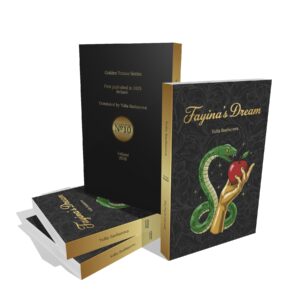 Editor's Pick
Fayina’s Dream by Yulia Basharova
Page Count: 395Year: 2025Products search A mystical, satirical allegory about the war in Grabland, featuring President Liliputin. There is touching love, demons, and angels. Be careful! This book changes your thinking! After reading it, you’ll find it difficult to sin. It is a combination of a mystical parable, an anarchy manifesto, and a psychological drama, all presented in […]
$10.00 Login to Wishlist
Lolita is not just a road novel, a detective story, or a moral parable, but also the confession of a “light-skinned widower” of his eternal love for literature. Humbert quotes Baudelaire, considers himself a connoisseur of Flaubert, parodies Robert Browning’s poetry, and makes ironic allusions to Rimbaud, Molière, and Maeterlinck. American Slavist Karl Proffer compiled an alphabetical list of authors who form the literary backbone of Nabokov’s novel, totalling over 60 names, including Catullus, Cocteau, Gogol, Goldoni, Ronsard, Rostand, Marquis de Sade, and George Bernard Shaw.
References to French and English literature predominate in Lolita. However, as demonstrated by Alexander Dolinin, when Nabokov translated the text into Russian in 1967, he added an extra layer of quotes and reminiscences from Russian literature (Pushkin, Baratynsky, Tyutchev, Dostoevsky, Turgenev, Blok, Balmont) that were absent in the original.
We have selected several authors whose texts Nabokov references particularly often.
1. Edgar Allan Poe
The name of the American poet Edgar Allan Poe and allusions to his works appear in Lolita more than two dozen times. According to Alfred Appel, a commentator on Lolita and a student of Nabokov’s, Poe is mentioned more frequently than any other writer (followed by Mérimée, Shakespeare, and Joyce).
The similarities between the lives of Poe and Humbert Humbert are striking:
- Poe’s mother died when he was three, the same age Humbert was orphaned.
- Poe married when his fiancée was 13; he was 38 when she died.
- Like Humbert, who lost his childhood sweetheart, Poe was deeply traumatized by his bride’s death.
- Both died at nearly the same age: Humbert Humbert at 42, Poe at 40.
Humbert himself claims that Lolita “magically and fatally began with Annabel”—a reference to Poe’s poem “Annabel Lee” (1849): “There would have been no Lolita at all if I had not loved, in a distant summer, that first original girl. In a kingdom by the sea (almost like Poe’s).”
Humbert Humbert, who is aware of his resemblance to Poe, often makes puns on the American classic’s name. In his diary, he discusses himself in the third person to rationalize his attraction to minors, referencing the age of Poe’s wife: “The average age of puberty among girls in New York and Chicago is thirteen years and nine months; individually, the age ranges between ten (or less) and seventeen. Little Virginia was not yet fourteen when Edgar possessed her. He taught her algebra. I can imagine. They honeymooned in St. Petersburg, on the west coast of Florida. ‘Monsieur Poe-Poe,’ as one of Humbert Humbert’s students at a Paris lycée called the poet Poe.”
Humbert eventually starts to identify with the American poet, even taking his name. In a Ramsdale newspaper interview, he introduces himself as “Mr. Edgar H. Humbert (I threw in that ‘Edgar’ out of sheer bravado),” and signs the register at the Enchanted Hunters hotel as “Dr. Edgar H. Humbert and daughter.”
2. James Joyce (Finnegans Wake, A Portrait of the Artist as a Young Man, Ulysses)
Constantly confusing his pursuers and covering his tracks, Humbert Humbert invents and uses pseudonyms while staying in numerous motels with Lolita during their American journey. One of these names is Humphrey, the first name of the protagonist in Joyce’s Finnegans Wake, whose lover is named Anna Livia Plurabelle (Nabokov knew that Joyce also alluded to Poe’s poem). Both the Joycean and Nabokovian heroines evoke biblical seductresses: Joyce endowed Anna Livia with traits of Eve, while Nabokov made Lolita resemble the demonic Lilith.
The names of two other characters in Lolita allude to figures in Finnegans Wake: Clare Quilty, the playwright and antagonist, and MacCoo (Nabokov shortened the name), the man who gives Humbert the address of Mrs. Haze.
Nabokov loved rereading Ulysses and analyzed it in his Cornell lectures. The description of Quilty’s body—”…his chest furred with a dipterous trophy, his navel pulsing, bright splashes coursing down his hairy thighs…”—parallels a description in Ulysses of one of the characters: “Ben Dollard… hairy-chested, shockheaded, fat-arsed…”
In a pivotal plot turn, Lolita takes part in a play called “The Enchanted Hunters.” Getting the role of the farmer’s daughter, she meets the playwright and her next lover, Clare Quilty. In the play, the girls depict a living rainbow, an image that Humbert notes the authors, Quilty and Vivian Damor-Blok, “stole” from Joyce. Interestingly, “Vivian Damor-Blok” is an anagram for “Vladimir Nabokov.”
Humbert notices a magazine advertisement pinned to Lolita’s wall above her bed, featuring a young male model with “Irish eyes.” The accompanying text, “Here He Comes, The Victorious Hero. / Sound the trumpet, beat the drums,” is taken from a church hymn. This is a direct allusion to Joyce, as the same quote accompanies the appearance of Blazes Boylan, the “victorious” rival of Ulysses‘ main character, Leopold Bloom.
Finally, in the hotel scene where the agitated Humbert’s speech becomes slurred and his thoughts confused, his multi-lingual mix of Latin, English, French, Spanish, and Italian is a parody of Joyce’s stream of consciousness. A further allusion to this Joycean device is found in the French phrase: “J’ai toujours admiré l’œuvre ormonde du sublime Dublinois” (“I shall always admire the Ormond masterpiece of the sublime Dubliner”). The “sublime Dubliner” is, of course, the author of Ulysses. “Ormond” is the name of the Dublin hotel whose restaurant Leopold Bloom frequents.
Proffer also suggested that Humbert’s search for a Portrait of the Unknown Fiend parodied Joyce’s A Portrait of the Artist as a Young Man.
3. William Shakespeare (Hamlet, King Lear, The Taming of the Shrew)
The name of the English classic is mentioned numerous times, sometimes as a place name (“Shakespeare, a ghost town in New Mexico”), or in a discussion with a schoolmistress who treats him as irrelevant: “…however much we respected Shakespeare and others, we wanted our girls to communicate freely with the live world around them instead of delving into moldy folios.”
Allusions to Shakespeare’s plays constantly appear in Lolita. Humbert swears by the “ghost of Polonius” (Hamlet). A character named Pym “received his stage education at the Elsinore Theatre” (Elsinore being Hamlet’s castle). Of the drama, it is noted that “however many times we open King Lear, we never find the good old man oblivious of all his woes and lifting a bumper of ale at a big family reunion with all three daughters and their lapdogs.”
In Chapter 11 of Part One, Humbert presents a list of Lolita’s classmates at Ramsdale High. Nabokov called this list the “nervous system of the book,” suggesting it contains “secret points, the subconscious coordinates of its composition.” Indeed, it encrypts and foreshadows many motifs and plotlines, with several names alluding to Shakespeare’s plays: Miranda (The Tempest), Duncan (Macbeth), Antony, and Viola (Twelfth Night). Furthermore, Lolita and her classmate Mona Dahl rehearse a scene from The Taming of the Shrew.
In the Russian version of Lolita, the Shakespearean influence is even stronger, suggesting Nabokov made the allusions more obvious for Russian readers. An example is the final passage where Humbert soothes Lolita: “…I comforted and cradled little, lonely Lolita, who lay on my marble arms, and, purring, buried my face in her warm curls, and stroked her blindly, and like Lear, asked her blessing…” In the English original, the King’s name is not explicit, but the description clearly points to the end of the drama where Lear addresses Cordelia. Nabokov, however, hid another cipher in the English phrase “marbLE ARms,” which subtly reveals the name Lear.
4. Prosper Mérimée (Carmen)
Prosper Mérimée had a fondness for Russian literature and learned Russian to translate Pushkin’s The Queen of Spades. Nabokov, in a sense, returns the favour on behalf of Russian writers by incorporating Mérimée’s novella “Carmen” (1846) into his novel.
Humbert Humbert dreams of driving with Lolita “to Southern California, heading for the Mexican border, for the fabulous bays, the saguaro deserts, and the fatamorganas. José Lizzarrabengoa, in Mérimée’s famous novel, was planning to take his Carmen to the États Unis [United States].” The novella’s protagonist did offer to take Carmen to America, and upon her refusal, stabbed her twice in a fit of rage.
Lolita’s favourite record is called “Little Carmen.” Their first physical contact occurs to its sound. Humbert quotes fragments of the song, calling Lolita “Carmen”: “O Carmen, Carmencita, remember there… guitars and bars, and flares, tratam… I was enchanting my Carmen and all the time I was mortally afraid that some elemental disaster would suddenly interfere, would suddenly remove the golden burden from me, in the sensation of which all my being was concentrated, and this fear made me work too hastily at first, which was inconsistent with the measuredness of conscious pleasure.”
Carmen’s fatalistic words to José—”I always thought you would kill me… A hare ran across our road right between your horse’s hooves. You can’t escape fate”—are echoed in the final section of Chapter 32 of Lolita where Humbert almost runs over “a small animal… dashing across the highway with its tail up like a pipe.”
At the very end of the novel, Humbert visits the now-married Lolita (Mrs. Richard F. Schiller) and tries to persuade her to leave: “From here to the old car, which you know so well, is a distance of twenty, twenty-five paces. That is a very short walk. Take those twenty-five paces. And we will live happily ever after. Carmen, voulez-vous venir avec moi?”
By consistently emphasizing the parallels between José and Humbert, Carmen and Lolita, Nabokov builds suspense. However, unlike Carmen, who is stabbed by the jealous José, Lolita will not die from Humbert’s knife or gun.
5. Gustave Flaubert (Madame Bovary)
In his lectures on Madame Bovary, Nabokov criticized the transparent tear Dr. Larivière sheds over the dying Emma. This tear occurs in the farewell scene: “Bovary watched him. Their eyes met, and an unbidden tear rolled down Larivière’s collar, who was accustomed to seeing suffering.” Nabokov remembered this detail, which informs Humbert’s thoughts on determinism and the fates of literary characters in Lolita: “Princess N. will never travel to Italy with Onegin. Emma Bovary will never recover, saved by sympathetic salts in her author’s father’s timely tear.”
Another shared motif is piano lessons. Dolores Haze takes lessons from a teacher whom Humbert, “we Flaubert students,” names Félicité Lempereur, after the music teacher in Flaubert’s novel.
When “Miss Lempereur” asks if “Emma—that is, Lolita”—will come after missing two lessons, Humbert Humbert begins to suspect that he is being fooled and that Lolita is leading a secret life. Where does she go on Tuesdays? The answer is easily guessed by a “careful reader of Flaubert”: Emma Bovary, having obtained her husband’s permission to take piano lessons on Thursdays, uses that time for trysts with Léon (Part 3, Chapter 5). Similarly, Lolita meets Quilty on Tuesdays.
Lolita also inherits Emma Bovary’s shoes. Humbert chose “moccasin-type crumpled kidskin slippers for crumpled girls,” and after parting with her, covered “with kisses, tears, and slime a pair of her old tennis shoes.” Nabokov uses Lolita’s footwear as a literary fetish: Flaubert’s “pink satin house-slippers trimmed with swansdown”—a gift from Léon to Emma—also appear in the wardrobe of Martha, the heroine of Nabokov’s early novel King, Queen, Knave (1928).
6. The American Press
In a passing episode in Lolita, Mrs. Chatfield greets Humbert with a saccharine smile and asks him, “all aglow with wicked curiosity (had I done, for instance, to Dolly what Frank La Salle, a fifty-year-old mechanic, had done to eleven-year-old Sally Horner in 1948).” This fragment refers to a real-life case reported in American newspapers in August 1952.
In June 1948, Frank La Salle persuaded Sally Horner to run away with him from her mother. Along the way, he regularly raped the girl, introducing her to new acquaintances as his daughter. La Salle was caught almost two years later, confessed his guilt, and was imprisoned.
Nabokov was interested in this case and even made an excerpt. An entire monograph is dedicated to the influence of the Sally Horner story on the novel, drawing on archival sources, including recently declassified FBI materials and American provincial press. However, it’s important not to overstate the importance of the La Salle case to the novel’s conception. Like James Joyce, and Fyodor Dostoevsky before him, Nabokov paid close attention to crime reports and used the contemporary American press in his work.
Sources
Weinman S. The Real Life of Lolita. The Kidnapping of Eleven-Year-Old Sally Horner and the Nabokov Novel That Shocked the World. Moscow, 2019.
Nabokov V. V. Lolita. St. Petersburg, 2004.
Proffer C. Keys to “Lolita”. St. Petersburg, 2000.
Connolly J. W. A Reader’s Guide to Nabokov’s «Lolita». Boston, 2009.
Nabokov V. The Аnnotated Lolita. New York, 1991.
Schuman S. Nabokov’s Shakespeare. New York, 2014.