
Boris Pasternak’s Doctor Zhivago: A Summary
The novel was written by Boris Pasternak between 1945 and 1955. The work was not published in the USSR until 1988 due to its critical portrayal of the Revolution and Soviet power. It was first published in Italy in 1957. In 1958, Pasternak received the Nobel Prize in Literature, which he was forced to decline under pressure from the Soviet authorities.
On our website you can buy this book via the link.
-
Buy eBook
 Editor's Pick
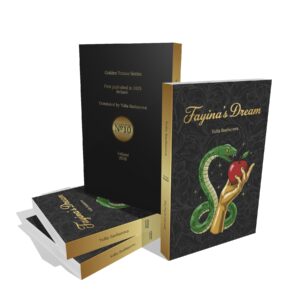
Fayina’s Dream by Yulia Basharova
Page Count: 395Year: 2025Products search A mystical, satirical allegory about the war in Grabland, featuring President Liliputin. There is touching love, demons, and angels. Be careful! This book changes your thinking! After reading it, you’ll find it difficult to sin. It is a combination of a mystical parable, an anarchy manifesto, and a psychological drama, all presented in […]
$10.00 Login to Wishlist
Setting and Time
The action unfolds in Russia during the period from the beginning of the 20th century to the 1950s, covering World War I, the 1917 Revolution, the Civil War, and the first decades of Soviet rule. The main events take place in Moscow, the Urals (Yuryatin, Varykino), and the Siberian taiga.
Main Characters
- Yury Andreevich Zhivago: The main character, a doctor and poet.
- Larisa Fyodorovna Antipova (Lara): Antipov’s wife, Zhivago’s beloved, a nurse.
- Antonina Alexandrovna Gromeko (Tonya): Zhivago’s wife.
- Pavel Pavlovich Antipov (Strelnikov): Lara’s husband, a revolutionary.
- Viktor Ippolitovich Komarovsky: A lawyer, Lara’s seducer.
- Alexander Alexandrovich Gromeko: Antonina’s father.
- Innokenty Dudorov and Misha Gordon: Zhivago’s friends.
Brief Summary by Parts
Part One
After his mother’s death, ten-year-old Yura Zhivago is left a complete orphan—his father had long ago abandoned the family, squandered their fortune, and eventually committed suicide by jumping from a train. The boy was taken in by his uncle, Nikolai Nikolaevich, and then ended up in the professor’s family of the Gromekos, where he became friends with their daughter Tonya and the gymnasium student Misha Gordon. The house had an intellectual atmosphere that fostered the development of Yura’s talents.
In parallel, the story of the young Lara Guishar, the daughter of a Russified Frenchwoman who runs a sewing workshop, unfolds. The sixteen-year-old gymnasium student becomes the mistress of the elderly lawyer Komarovsky—the same man who once corrupted Yura’s father with drink and drove him to suicide. Komarovsky enslaves the girl, and she hates herself for this shameful relationship. At the Sventitskys’ Christmas tree party, Lara shoots at Komarovsky but misses. To escape the scandal, she agrees to marry the teacher Pasha Antipov, who is in love with her, and they leave for the Urals, to Yuryatin.
Parts Two
World War I begins. Yury, now a doctor, is mobilized to the front as a military medic. In one of the hospitals, he meets Lara, who is working as a nurse and searching for her missing husband. A mutual feeling flares up between them, but both understand the hopelessness of the situation—each has their own family, their own obligations.
At the front, Yury witnesses the collapse of the army and universal chaos. He sees how the war breaks human destinies, and how revolutionary ideas capture the minds of the soldiers. Returning to revolutionary Moscow to his wife and son, the doctor finds a completely changed country—famine, devastation, and class hatred everywhere.
Parts Three–Four
Life in Moscow becomes unbearable. Strangers settle in the Gromeko house, burning books and furniture for fuel, and food is scarce. Tonya is pregnant with their second child, and the family decides to flee—to leave for the Urals estate of Varykino, which once belonged to relatives.
The journey in a freight train turns into a nightmare—the cars are overcrowded, there is dirt, disease, and embittered people everywhere. Along the way, the train is stopped, documents are checked, and threats are made. At one of the stations, Yury personally meets the commissioner Strelnikov, a cruel revolutionary whom rumor has dubbed “Rasstrelnikov” (The Executioner) for his ruthlessness towards the enemies of Soviet power.
Parts Five–Seven
Their daughter Masha is born in Varykino. The family tries to settle into rural life, but Yury yearns for intellectual work and regularly travels to neighboring Yuryatin to the library. There, he accidentally meets Lara—it turns out she lives here with her daughter, works as a teacher, and is still waiting for her husband. Moreover, the formidable commissioner Strelnikov is none other than her Pasha Antipov, who adopted the pseudonym.
Yury cannot resist the renewed feeling and begins to secretly meet with Lara. He struggles between his duty to his family and all-consuming passion, deceiving Tonya by saying he is spending the night in the city for work. Lara becomes for him the embodiment of Russia itself—suffering, beautiful, and doomed. However, the happiness does not last long.
Parts Eight–Nine
Red partisans forcibly mobilize Zhivago as a doctor. He is taken into the taiga, where he spends two agonizing years in a detachment commanded by the cruel Liveriy Mikulitsyn. Yury hates the fratricidal war but is forced to treat the wounded and even participate in battles against the Whites.
Arbitrariness and cruelty reign in the partisan camp. Zhivago sees how revolutionary ideology turns people into fanatics ready for any crime. He tries to escape three times, but is caught each time. The doctor keeps a diary, writes poems, and dreams of returning to a peaceful life, to his beloved Lara.
Parts Ten–Twelve
After the end of the Civil War, Zhivago flees the partisan detachment and returns to Yuryatin, emaciated, unshaven, and in rags. In Lara’s house, he finds a note—she and her daughter have left for Varykino, and his family has emigrated to Paris. Tonya gave birth to their daughter Masha, but they will likely never see each other again.
Lara nurses the sick Yury back to health, and they settle together in the abandoned Varykino as husband and wife. These are the happiest months of their lives—Zhivago writes poetry again, and Lara runs the household in the ruined estate. But the idyll is short-lived. Unexpectedly, Komarovsky appears with official documents and warns that Yury will be arrested as a deserter, and Lara as the wife of “enemy of the people” Strelnikov, who is allegedly shot. Komarovsky offers Lara salvation—departure to the Far East. Yury convinces Lara to agree, lying that he will join them later. After an agonizing separation, Lara leaves with Komarovsky. Soon, Strelnikov comes to the lonely Yury—it turns out he is alive but sentenced to be shot. After talking all night about life, revolution, and Lara, Pavel shoots himself in the morning.
Parts Thirteen–Fifteen
Yury returns to NEP-era Moscow a broken man. He marries Marina, the daughter of a janitor, and they have two daughters, but the doctor gradually degenerates—he drinks, neglects himself, and scrapes by with odd jobs. His heart disease worsens, and he ages, although he is not yet fifty.
One hot August day in 1929, while on a stuffy streetcar, Zhivago dies of a heart attack. An unexpectedly large number of people attend the funeral—his poems were appreciated by connoisseurs during his lifetime. Among those saying farewell is Lara, who visited the house where her first husband once lived out of old memory. A few days after the funeral, she disappears—apparently, she is arrested and vanishes into the Stalinist camps.
Epilogue
Years pass. In 1943 at the front, Major General Evgraf Zhivago, Yury’s half-brother, meets a young laundry woman named Tanya and realizes from her story that she is his brother’s illegitimate daughter with Lara. The girl was once abandoned at a railway siding; she grew up a homeless waif, not knowing her parents. In the post-war years, Zhivago’s friends—Gordon and Dudorov—read the poems of the deceased poet collected by Evgraf and feel that “this freedom of soul,” about which Yury wrote, has finally arrived in the world.
Poems of Yury Zhivago
The novel concludes with a cycle of 25 poems—the main character’s poetic testament. Among them are the famous “Hamlet” about the artist’s fate, “Winter Night” with the refrain “A candle burned on the table, a candle burned,” “The Christmas Star,” and “Magdalene“—works about love, death, faith, and beauty that outlive any historical cataclysms.
Idea and Moral Meaning
The novel explores the fate of the Russian intellectual in an era of historical cataclysms. Pasternak shows the conflict between the individual and history, private life and public upheavals. The main themes are:
- Love as the highest value—the feeling between Zhivago and Lara is contrasted with the cruelty of the era.
- Creativity and poetry—a way to preserve humanity in an inhuman time.
- Christian motifs—ideas of sacrifice, forgiveness, and the resurrection of the soul.
- Critique of revolutionary fanaticism—showing the destructive impact of ideology on human relationships.
- The unity of man and nature—nature as a source of spiritual renewal.
The novel affirms the eternal values of love, beauty, and creativity against historical violence and ideological coercion. Zhivago embodies the type of artist-humanist who maintains loyalty to his principles under a totalitarian regime.