
8 Quotes from the Diaries of Sofya Tolstaya
Sofya Tolstaya (née Bers)—the wife of the writer and mother of his thirteen children—kept diaries almost all her life. The first entries appeared in 1855, when Sonya was 11. She destroyed this diary shortly before her marriage. In October 1862, she returned to the diary and kept it, albeit with long breaks, until November 1910. Sofya Andreevna admitted that she always wrote after quarrels and unpleasant or even tragic events—it is not surprising that the text is heavy and pessimistic. We selected eight entries that provide insight into the life of the great writer’s family and the inner world of his wife.
-
Buy eBook
 Editor's Pick
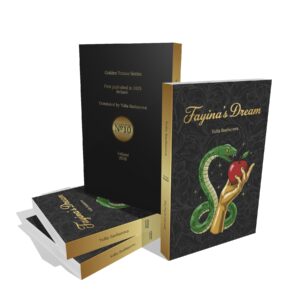
Fayina’s Dream by Yulia Basharova
Page Count: 395Year: 2025Products search A mystical, satirical allegory about the war in Grabland, featuring President Liliputin. There is touching love, demons, and angels. Be careful! This book changes your thinking! After reading it, you’ll find it difficult to sin. It is a combination of a mystical parable, an anarchy manifesto, and a psychological drama, all presented in […]
$10.00 Login to Wishlist
1. On Aimless Life
“Life here, in the Kremlin, is burdensome to me because it echoes that burdensome feeling of idleness and aimless life, as it was in my maiden years. And everything I had imagined to be my duty and goal in marriage has evaporated since Lyovochka made me feel that one cannot be satisfied with only family life and a wife or a husband, but needs something more, an outside pursuit.”
January 29, 1863
Lyovochka (Leo) left a note at the end of this entry in Sofya’s diary: “Nothing is needed but you. Lyovochka is telling lies.”
2. On the Death of a Son
“My dear Vanechka passed away in the evening at 11 o’clock. My God, and I am alive!”
February 23, 1895
Tolstaya outlived seven of her thirteen children. The death of her youngest son, Vanechka, the favorite of his parents and friends of the house, brought her the most grief.
3. On Art, Religion, and Nature
“Recently, I created an entire theory for myself about the virginity of the relationship to religion, art, and nature.
Religion is pure and virgin when it is not connected with fathers Ioanns, Ambrosii, or Catholic confessors, but is entirely concentrated in my soul alone before God. And then it helps.
Art is virgin and pure when one loves it for its own sake, without attachment to the personality of the performer… and then it gives high and pure enjoyment.
The same with nature. If oaks, and flowers, and beautiful scenery are connected with memories of those persons one loved and lived with in those places, and who are no longer with me now, then nature itself disappears or takes on the mood that we ourselves are in. One must love it as the highest gift of God, as beauty, and then it also gives pure joy.”
June 7, 1897
Well-educated, Sofya Andreevna immersed herself in art, music, literature, philosophy, economics, and politics, demonstrating an energy to develop herself, driven by the desire to occupy a worthy place in the spiritual life of her great husband. Her diaries contain many reflections on complex topics, not only chronicles of family life.
4. On Meaningless Work
“It is 2 o’clock in the morning now, I have been copying everything. It is terribly boring and heavy work, because, for sure, what I wrote today—tomorrow will all be crossed out and rewritten by Lev Nikolaevich anew. His patience and industriousness—it is astonishing!”
July 15, 1897
For almost 50 years, Sofya Andreevna was engaged in copying her husband’s numerous drafts. While the work with his fiction gave her “great aesthetic pleasure,” the religious and philosophical texts were copied without much enthusiasm.
5. On the Singed Beard
“<…> Lev Nikolaevich got up and wanted to set up the samovar for compresses himself; but he found the stove still quite warm enough to heat napkins in the oven. It is always funny to me when he takes up some practical task, how primitively, naively, and clumsily he does it. Yesterday, he stained all the napkins with soot, singed his beard with a candle, and when I began to put it out with my hands—he got angry at me.”
August 11, 1897
Sofya Andreevna was involved in household management since childhood. After marriage, the Countess often cooked dinner, managed domestic matters with the servants, and performed various household tasks.
6. On the Woman Question
“<…> Last night, L.N.’s conversation about the woman question struck me. He was against the freedom and so-called equality of women both yesterday and always; but yesterday he suddenly expressed that a woman, no matter what she is engaged in: teaching, medicine, art—has one goal: sexual love. Once she achieves it, all her pursuits fly to dust.
I was terribly indignant at such an opinion and began to reproach Lev Nikolaevich for his eternal cynical view of women, which has caused me so much suffering. I told him that the reason he looked at women that way was that he did not know a single decent woman intimately until he was 34. And that absence of friendship, of sympathy of souls, not bodies, that indifferent attitude toward my spiritual and inner life, which torments and grieves me to this day, which has been so strongly exposed and clarified to me over the years—that is what spoiled my life and caused me to be disillusioned and to love my husband less now.”
February 18, 1898
At the time of their wedding, Sofya Andreevna Bers was only 18, and her groom was 34. Shortly before the wedding, wishing to be honest, Lev Nikolaevich gave her his diaries, allowing Sofya Andreevna to learn about all his past liaisons. This past haunted the Countess into old age and was the cause of many conflicts.
Tolstoy was also an opponent of feminist sentiments in society and often viewed women strictly from the perspective of patriarchal foundations: “The intellectual fashion—to praise women, to assert that they are not only equal in spiritual abilities but superior to men, is a very bad and harmful fashion.”
7. On Freedom and Lack of Freedom
“<…> A struggle is taking place in my soul: a passionate desire to go to St. Petersburg for Wagner and other concerts, and the fear of upsetting Lev Nikolaevich and taking that distress upon my conscience. At night, I cried from the heavy state of unfreedom that weighs on me more and more. Factually, I am, of course, free: I have money, horses, dresses—I have everything; I packed up, sat down, and left. I am free to read proofs, buy apples for L.N., sew dresses for Sasha and blouses for my husband, photograph him in all forms, order dinner, conduct my family’s affairs—I am free to eat, sleep, be silent, and obey. But I am not free to think as I wish, to love what and whom I choose, to go and travel where I find it interesting and intellectually good; I am not free to engage in music, I am not free to banish from my house those countless, unnecessary, boring, and often very bad people, and to receive good, talented, intelligent, and interesting ones. We do not need such people in the house—one must reckon with them and stand on equal footing; but here, they like to enslave and instruct…
And life is not cheerful for me, but difficult… And I used the wrong word: cheerful, I don’t need that, I need to live a life full of substance, calmly, but I live nervously, with difficulty, and with little substance.”
March 8, 1898
Throughout her married life, the Countess constantly sacrificed her interests, time, and health. This quote demonstrates the immense role Tolstoy played in her life and how strongly her sense of duty was developed.
8. On Despair
“<…> Quite ill as I was, I felt that attack of despair again; I lay down on the bare boards of the balcony… <…>
Lev Nikolaevich came out, hearing me stir, and began to shout at me from his place that I was disturbing his sleep, that I should leave. And I went into the garden and lay for two hours on the damp ground in a thin dress. I was very cold, but I greatly desired and desire to die. <…> If some foreigner had seen the state to which the wife of Lev Tolstoy had been reduced, lying at two or three o’clock at night on the damp ground, numb with cold, driven to the last degree of despair—how surprised good people would be!”
July 10, 1910
The thought of death and mentions of suicide attempts appear quite often in the diary pages, especially after the 1890s. Many in her circle spoke of the Countess’s depressive and subdued state. Her eldest son, Sergey, attributed it to “disagreement in views with her husband, female ailments and the critical age of a woman, the death of her beloved younger son Vanechka (February 23, 1895), a difficult operation she underwent in 1906, and in 1910—her father’s will.” The youngest daughter, Alexandra Lvovna, conversely, considered her mother’s suicide attempts to be a pretense aimed at hurting Tolstoy.
Doctor Rossolimo, invited to Yasnaya Polyana in the summer of 1910, diagnosed her with: “Degenerative double constitution, paranoid and hysterical, with the former predominating. At the moment, an episodic exacerbation.” Psychiatrist Rastegaev, however, found “no psychopathological features indicating the presence of mental illness, neither from observations nor from conversations with S. A.”
Sources
Basinsky P. V. Leo Tolstoy: Flight from Paradise. Moscow, 2010.
Bulgakov V. F. How Life Was Lived. Memoirs of L. N. Tolstoy’s Last Secretary. Moscow, 2012.
Bulgakov V. F. About Tolstoy. Memoirs and Stories. Tula, 1978.
Gorky M. Literary Portraits. Moscow, 1963.
Zhdanov V. A. Love in the Life of Leo Tolstoy. Moscow, 2005.
Kuzminskaya T. A. My Life at Home and in Yasnaya Polyana. Moscow, 1986.
Puzin N. P. The L. N. Tolstoy House-Museum in Yasnaya Polyana. Tula, 2005.
Safonova O. Yu. The Bers Family in Russia. Moscow, 1999.
Svadkovsky B. An Unknown Letter: Doctor D. Nikitin on Leo Tolstoy’s Wife. Meditsinskaya gazeta (Medical Newspaper). No. 18 (March 5). 1993.
Snegirev V. F. Operation. In: About Tolstoy. International Tolstoy Almanac. Moscow, 1909.
Tolstaya S. A. Diaries. 1862–1910. Moscow, 2017.
Tolstaya S. A. My Life. Moscow, 2011.
Tolstoy I. L. My Memoirs. Moscow, 1969.
Tolstoy L. N. Complete Collected Works in 90 vols. Moscow, 1952.
Tolstoy S. M. Tolstoy’s Children. Tula, 1993.
Khodasevich V. Tolstoy’s Departure. “Voskresenie” (Resurrection): Historical and Publicistic Almanac. No. 4. Tula, 2001.
Shestakova E. G. Light from the Nursery. Tolstoy Yearbook — 2002 under the general editorship of V. B. Remizov. Tula, 2003.
L. N. Tolstoy. Encyclopedia. Compiled and scholarly edited by N. I. Burnasheva. Moscow, 2009.