
8 “Mistakes” in The Master and Margarita
Was Pontius Pilate the fifth Procurator of Judea or the sixth? Is the Master bearded or clean-shaven? Which of Woland’s eyes is black and which is green? We explain how strange errors appeared in The Master and Margarita—and whether they are errors at all.
On our website you can buy this book via the link.
-
Buy eBook
 Editor's Pick
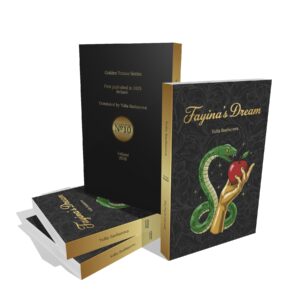
Fayina’s Dream by Yulia Basharova
Page Count: 395Year: 2025Products search A mystical, satirical allegory about the war in Grabland, featuring President Liliputin. There is touching love, demons, and angels. Be careful! This book changes your thinking! After reading it, you’ll find it difficult to sin. It is a combination of a mystical parable, an anarchy manifesto, and a psychological drama, all presented in […]
$10.00 Login to Wishlist
Mikhail Bulgakov worked on the novel The Master and Margarita for over ten years and rewrote the text many times, making corrections. The last author’s correction is dated February 1940—Bulgakov died without completing the final editing. In this version, researchers find various contradictions, which can be explained both as an artistic device and as a consequence of the book being unfinished.
1. What color were Woland’s eyes?
Bulgakov describes Woland’s appearance in the scene at the Patriarch’s Ponds, in the novel’s first chapter:
“In appearance—over forty. His mouth was somewhat crooked. Clean-shaven. A brunette. His right eye was black, his left was, for some reason, green. His brows were black, but one was higher than the other. In a word—a foreigner.”
But here is the description from Chapter 22, before the Great Ball:
“This non-existent one was sitting on the bed. Two eyes were fixed on Margarita’s face. The right with a golden spark at the bottom, drilling anyone to the bottom of their soul, and the left—empty and black, like a narrow needle’s eye, like an exit into the bottomless well of all darkness and shadows.”
The eyes have swapped places: the black eye is now the left one, not the right. It is interesting that in earlier drafts of the novel, Bulgakov also described Woland’s eyes differently: “…it turned out that his right eye did not smile, and in general that eye was of no color…”, “…one eye is black, and the other is green,” and so on. Nevertheless, it is quite possible that Bulgakov deliberately left this inconsistency to emphasize the character’s infernal status.
2. When did Yeshua’s interrogation take place?
Everyone remembers the famous quote from the second chapter, describing the appearance of Pontius Pilate:
“In a white cloak with a blood-red lining, with a shuffling cavalry gait, in the early morning of the fourteenth day of the spring month of Nisan, the Procurator of Judea, Pontius Pilate, came out into the covered colonnade between the two wings of Herod the Great’s palace.”
And here is the conversation that happens very soon after between Pilate and Caiaphas:
“The Procurator wiped his wet, cold forehead with the back of his hand, looked at the ground, then, squinting, at the sky, saw that the scorching orb was almost directly above his head, and Caiaphas’s shadow had completely shrunk by the lion’s tail, and said quietly and indifferently: — It’s nearing noon.”
And finally, at the end of the chapter, the author clarifies:
“It was about ten o’clock in the morning.”
Thus, over the course of a few pages, the time fantastically changes from early morning to noon, and then reverts back to ten o’clock in the morning.
3. Where was Yeshua born?
During the interrogation, Yeshua is asked directly where he was born:
“— Do you have a nickname? — Ha-Notsri. — Where are you from? — From the city of Gamala, — answered the arrested man, showing with his head that there, somewhere far to his right, in the north, is the city of Gamala.”
However, in Pilate’s dream, described in Chapter 26, a different name appears:
“— Yes, don’t forget, mention me, the son of the astrologer, — Pilate requested in his sleep. And, having secured in his sleep a nod from the pauper from En-Sarid walking beside him, the cruel Procurator of Judea wept and laughed in his sleep from joy.”
So, Yeshua has two native cities: Gamala and En-Sarid. Gamala only appeared in the final version, while in one of the earlier drafts, En-Sarid was mentioned in the interrogation scene: “From En-Sarid, — answered the arrested man, indicating with his head that En-Sarid was somewhere there.”
4. What does the Master look like?
Here is how we see the Master when he first appears in the novel, in the poet Homeless’s ward, in Chapter 13:
“Looking cautiously into the room from the balcony was a clean-shaven, dark-haired man with a sharp nose, anxious eyes, and a clump of hair hanging over his forehead, about thirty-eight years old.”
And here is how he looks the next night, in the chapter “The Extraction of the Master”:
“Someone who was either sick or not sick, but strange, pale, bearded, in a black cap and some kind of dressing gown, was descending the stairs with unsteady steps.”
Thus, the Master suddenly grows a beard in a day. We also read about it in the chapter “The Fate of the Master and Margarita is Determined”: “…in the clinic, his little beard was trimmed with clippers.” And in the novel’s epilogue, Ivan Ponyryov sees how “…a woman of immense beauty forms in the stream and leads to Ivan by the hand a timidly looking around bearded man.” At the same time, during his acquaintance with Ivan Homeless, the Master is clean-shaven in all versions of the text. It is interesting that there are other inconsistencies in the description of the Master’s appearance in the novel. In early drafts, the Master’s age also changed (35 and 38 years), as did his hair color (from a blonde he became dark-haired).
5. How did Aloysius Mogarych leave apartment No. 50?
Not everyone may remember this character: Aloysius Mogarych is the journalist who wrote a denunciation against the Master to occupy his basement. In Chapter 24, he enters the “bad apartment” and “in his underwear” and “for some reason with a suitcase in his hands and wearing a cap” finds himself on trial before Margarita, the Master, Azazello, Behemoth, Koroviev, and Woland:
“— Well, it’s a good thing you installed a bath, — Azazello said approvingly, — he needs to take baths, — and shouted: — Get out! Then Mogarych was flipped upside down and carried out of Woland’s bedroom through the open window.”
Surprisingly, later Annushka, who spilled the sunflower oil at the beginning of the novel and lived in the same entrance hall, meets Aloysius Mogarych on the staircase:
“…the door slammed on the upper landing, someone tumbled down the stairs and, crashing into Annushka, threw her aside so that she hit her head against the wall. <…> The man in his underwear, with a suitcase in his hands and wearing a cap, with his eyes closed, replied to Annushka in a wild, sleepy voice: — Water heater! Vitriol! The whitewashing alone cost a fortune, — and, crying, he roared: — Get out! Then he rushed, but not further down the stairs, but back — upwards, to where the economist’s foot had smashed the windowpane, and flew out into the courtyard through that window upside down.”
Thus, Mogarych “leaves” apartment No. 50 twice: Azazello sends him out the window from Woland’s room; then the character is seen falling out the front door and flying out the entrance hall window again.
6. Where did Hella go?
Here is the scene of the heroes’ final flight from Chapter 31:
“In place of the one who had left the Sparrow Hills in torn circus clothes under the name of Koroviev-Fagot, now galloped a dark-violet knight with a mournful and never-smiling face, quietly jingling the golden chain of the reins. <…> The one who had been a cat amusing the prince of darkness now turned out to be a slender young man, a demon-page, the best jester that had ever existed in the world. <…> To the side of everyone flew Azazello, gleaming with the steel of his armor. The moon had changed his face too. The absurd, ugly fang had vanished without a trace, and the cross-eye proved to be false. Both of Azazello’s eyes were the same, empty and black, and his face was white and cold. <…> …Woland also flew in his true form. Margarita would not have been able to say what the reins of his horse were made of, and thought that perhaps they were lunar chains, and the horse itself was just a clump of darkness, and the horse’s mane was a cloud, and the rider’s spurs were white patches of stars.”
Hella is absent from this description. The last time we see her is in the chapter “The End of Apartment No. 50,” when the “silhouette of a naked woman” flies out of the fifth-floor window. Hella’s flight and transformation are found in early drafts: “The night wrapped Hella in a cloak so that nothing was visible except the white wrist holding the reins. Hella flew like the night, flying away into the night.” This is how the literary critic Vladimir Lakshin recalled this inconsistency:
“Once I conveyed a question from a young reader to Elena Sergeevna: in the final flight of Woland’s retinue, one figure is missing among the riders flying in silence. Where did Hella disappear to? Elena Sergeevna looked at me in confusion and suddenly exclaimed with unforgettable expressiveness: ‘Misha forgot Hella!!!‘”
However, another point of view is also widespread in Bulgakov studies, according to which the author deliberately chose not to include the character in the final scene.
7. Which Procurator was Pontius Pilate?
In Chapter 26, Bulgakov writes:
“Thus the dawn of the fifteenth of Nisan was met by the fifth Procurator of Judea, Pontius Pilate.”
Bulgakov was clearly interested in the question of whether Pontius Pilate was the fifth Procurator of Judea (or the sixth). The historical sources he used did not provide a definitive answer. Heinrich Graetz and Nikolay Makkaveisky identified Pilate as the fifth procurator. In Bulgakov’s notebooks with materials for the novel, there is an excerpt from the article “Pilate, Pontius” from the Brockhaus and Efron Dictionary: “He was the successor of Valerius Gratus and the 6th Procurator of Judea.” Bulgakov marked this quote with a question mark, as well as a fragment from the work of the theologian Frederic Farrar: “…he became the sixth Procurator of Judea…” Finally, in the draft from the early 1930s, Pilate is called the sixth procurator: in a conversation with Homeless, the Master recalls: “…I was thinking about Pontius Pilate and that in a few days I would finish the last words, and those words would certainly be—’the sixth Procurator of Judea, Pontius Pilate‘.” However, it is possible that this is not an error and Bulgakov deliberately chose the “wrong” option for the sake of prose rhythm and alliteration—”the fifth Procurator… Pontius Pilate.”
8. Where did Poplavsky’s wife go?
Here is how Maximilian Poplavsky describes his relationship to Berlioz in Chapter 18:
“— You see, — Poplavsky said impressively, — I am the sole heir of the late Berlioz, my nephew, who, as is known, perished at the Patriarch’s Ponds…”
However, the author later describes the family connection between these characters differently:
“It is necessary to reveal one secret of Maximilian Andreevich. There is no dispute that he felt sorry for his wife’s nephew, who perished in the prime of his life.”
It seems this is not so important, as Poplavsky does not specify that he is the deceased’s native uncle. However, in early drafts of the novel, Poplavsky’s wife (he appears under the surnames Latunsky or Raduzhny), “née Berlioz,” was mentioned several times, and both characters laid claim to the deceased’s living space. In the final edition, Poplavsky presents himself as the sole heir, and the character of his wife is no longer in the novel, but the line ”
Sources
Belobrovtseva I., Kulyus S. The Novel “The Master and Margarita” by M. Bulgakov. Moscow, 2007.
Bulgakov M. A. The Master and Margarita [Text]: Complete Collection of Drafts of the Novel. Moscow, 2014.
Bulgakov M. A. “My Poor, Poor Master…”: Complete Collection of Editions and Variants of the Novel “The Master and Margarita”. Mikhail Bulgakov; edition prepared by V. I. Losev; scholarly ed. B. V. Sokolov. Moscow, 2006.
Lesskis G., Atarova K. Moscow — Yershalaim: A Guide to M. Bulgakov’s Novel “The Master and Margarita”. Moscow, 2014.
Chudakova M. O. The Archive of M. A. Bulgakov: Materials for the Writer’s Creative Biography. Zapiski otdela rukopisei (Notes of the Manuscript Department). Issue 37. Moscow, 1976.
OR RGB. F. 562. Bulgakov Mikhail Afanasyevich. Op. 8. Unit of storage 1 “The Master and Margarita” — novel. Materials for the 6th and 7th editions. Autograph. 1938–1939.