
7 Secrets of The Twelve Chairs
Why did Bender have orange shoes and Kisa have a gold pince-nez? What is behind Ostap’s Turkish background? Where did Gavrila come from in the poems of Lyapis Trubetskoy?
On our website you can buy this book via the link.
-
Buy eBook
 Editor's Pick
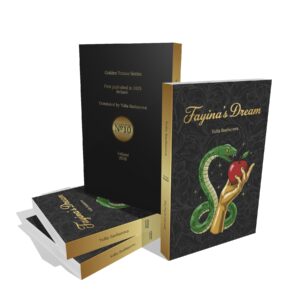
Fayina’s Dream by Yulia Basharova
Page Count: 395Year: 2025Products search A mystical, satirical allegory about the war in Grabland, featuring President Liliputin. There is touching love, demons, and angels. Be careful! This book changes your thinking! After reading it, you’ll find it difficult to sin. It is a combination of a mystical parable, an anarchy manifesto, and a psychological drama, all presented in […]
$10.00 Login to Wishlist -
Buy Book
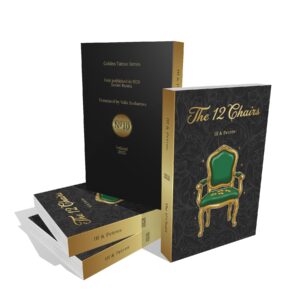
The Twelve Chairs by Ilf and Petrov
Page Count: 479Year: 1928Products search “The Twelve Chairs” (1927) is a novel written almost a century ago, yet it feels as if it were just yesterday. Everyone quotes it, even those who haven’t read a single page or watched any of its numerous adaptations. Ostap Bender, the Great Schemer, has become a household name, with monuments erected to […]
$17.00 Login to Wishlist
1. The Secret of Madame Petukhova’s Apricot Bonnet and Ostap Bender’s Orange Shoes
The second chapter of the novel opens with the deathbed confession about the diamonds:
“Klavdia Ivanovna lay on her back, one hand tucked under her head. Her head was covered by a bonnet of an intense apricot color, which was in some fashion in some year when ladies wore the ‘chantecler’ and were just beginning to dance the Argentine ‘tango’.”
Orange, or apricot, became the color of the fashionable Argentine tango in the 1910s. The fashion for tango and the orange color persisted into the 1920s. Theater director Emmanuil Krasnyansky recalled that people referred to fashionable orange items (socks, ties, vests, etc.) as being “the color of tango.”
Ostap Bender’s famous orange-colored shoes (shtiblety) also reference this fashion:
“Ostap put on the orange shoes on his bare feet, walked across the room, and began: — Which border did you cross? Polish? Finnish? Romanian? Must have been an expensive pleasure.”
In the novel The Golden Calf, Bender himself dances the Argentine tango.
2. The Secret of the Newspaper Stanok and the House of the Peoples
Ilya Ilf and Evgeny Petrov detail the daily life of the newspaper Stanok (The Machine Tool), in which a note about Ostap Bender, “Hit by a Horse,” appeared.
The editorial intrigue and hustle of the daily newspaper are described with insider knowledge: in the 1920s, the authors of the novel worked alongside Yuri Olesha, Mikhail Bulgakov, Valentin Kataev, and others at the daily railway newspaper Gudok (The Horn), which served as the prototype for Stanok. In the 1920s, the editorial office was located in the Palace of Labor (Dom Narodov), famous for its confusing passages.
The authors dedicated a large lyrical digression to the promenade function of the Palace of Labor’s corridors:
“The corridors of the House of the Peoples were so long and narrow that those walking along them involuntarily quickened their pace. By any passerby one could tell how far he had walked. If he walked with a slightly accelerated step, it meant his journey had just begun. Those who had walked two or three corridors developed a medium trot. And sometimes one could see a person running at full speed: he was in the stage of the fifth corridor.”
3. The Secret of Ostap Bender’s Origin
The main character is introduced as follows:
“The young man’s name was Ostap Bender. From his biography, he usually provided only one detail: ‘My father,’ he would say, ‘was a Turkish subject.’ The son of a Turkish subject had changed many professions in his life.”
According to commentators, the hero’s citizenship hints that Ostap Bender’s father lived in Odessa, where Jewish merchants often adopted Turkish citizenship to circumvent discriminatory legislation.
Researchers Maya Kaganskaya and Zeev Bar-Sella suggest that this phrase combines Bender’s two main traits—demonism and rogueishness. They see a link between some aspects of Ostap Bender’s image and the devil, particularly Woland.
Yury Shcheglov links Ostap not to Woland, but to the literary tradition of portraying romantic demonism in the spirit of Pechorin. He sees the mention of Bender’s Turkish roots as a reference to Ostap’s rogueish side, citing Vladimir Korolenko’s cycle of essays, “Contemporary Imposture,” which describes impostors from Turkey.
Thus, from his very first appearance, Ostap Bender’s brief remark demonstrates his two main characteristics: demonism and rogueishness.
4. The Secret of the Monks Berthold Schwartz Dormitory
Ilf and Petrov parody the Soviet tradition of naming institutions after revolutionary and cultural figures. The humorous effect is created by the mismatch between the object (a Soviet medical student dormitory) and the name (the 14th-century monk Berthold Schwartz is credited with inventing gunpowder).
The housing crisis of the 1920s was a popular theme for satirical writers. Ilf, Petrov, and many of their literary friends experienced the difficulties of the housing issue firsthand after moving to Moscow post-Revolution. Ilf himself lived in such a “pencil case” room, not on Sivtsev Vrazhek as described in the novel, but in Bolshoi Chernyshevsky Lane, at house No. 7, which was the Gudok dormitory.
The living quarters were described in detail:
“The large mezzanine room was cut by plywood partitions into long strips, two arshins [approx. 1.4 meters] wide each. The rooms were like pencil cases, with the only difference being that, besides pencils and pens, there were people and primus stoves here.”
5. The Secret of the Poems about Gavrila
“After breakfast in the dining room, Lyapis again set to work. White trousers flashed in the darkness of the corridors. He entered editorial offices and sold the multifaceted Gavrila.”
The name of the hero in the hack writer Lyapis Trubetskoy’s poems seems to have been taken from the satirical magazine Buzoter (The Troublemaker). The Buzoter editorial office was located in the Palace of Labor, and the collective image of the magazine’s main character, Gavrila, was invented there. Gavrila’s adventures were described in verse and prose in almost every issue under the heading “Buzoter Gavrila.”
Ilf and Petrov used a recognizable name from the late 1920s for the novel, but their target was the generalized image of the hack writer-feuilletonist, assembled from various, sometimes obscure, but numerous names found in the satirical magazines of those years.
6. The Secret of the Glavnauka Auction
In any treasure hunt story, obstacles slow the heroes down. Ilf and Petrov use everyday Soviet realities of the 1920s to create obstacles for Ostap Bender and Ippolit Vorobyaninov. These include the requisition of furniture from Vorobyaninov’s mother-in-law after the revolution, as well as numerous auctions and sales.
The auction becomes the starting point of the heroes’ journey: after the fiasco of buying the set and the heroes’ expulsion from the bidding, the chairs are sold off one by one, forcing them to hunt for each chair separately.
Commentator Yury Shcheglov notes that in the 1920s, advertisements for auctions and even palace sales were published in the press, and anyone could participate. They were so popular that they sparked public debate, as seen in the 1925 Ogonyok essay “The Tsar’s Flea Market” about the sale at the Winter Palace.
7. The Secret of Ippolit Matveevich Vorobyaninov’s Gold Pince-nez
The authors describe Vorobyaninov’s morning:
“On Friday, April 15, 1927, Ippolit Matveevich, as usual, woke up at half-past seven and immediately put his nose into an old-fashioned pince-nez with a gold frame. He did not wear spectacles.”
Evgeny Petrov related that the central hero was initially intended to be Kisa Vorobyaninov, but Ostap Bender, conceived as a minor character, gradually took up more space.
In creating the former nobleman, Ilf and Petrov borrowed many traits from the biography of Evgeny Petrov’s cousin, Evgeny Petrovich Ganko—a landowner, sybarite, and traveler. Ganko was described as a stout man who made a great impression with his sideburns, Roman nose, and a magnificent gold pince-nez. The co-authors ultimately discarded details like the stoutness and sideburns but kept the gold pince-nez. This old-fashioned accessory emphasized the former Marshal of Nobility’s belonging to a bygone era swept away forever by the revolution.
Sources and Literature
Bulgakov M. A. Collected Works. In 8 vols. Vol. 3. Moscow, 2008.
Ilf I., Petrov E. The Twelve Chairs. Commentaries by M. Odessky and D. Feldman. Moscow, 1997.
Ilf I., Petrov E. Collected Works. In 5 vols. Vol. 5. Moscow, 1961.
Kataev V. P. A Diamond Crown. Moscow, 1994.
Korolenko V. G. Complete Collected Works. In 9 vols. Vol. 3. St. Petersburg, 1914.
Paustovsky K. G. A Book of Wanderings. Moscow, 1964.
Petrov E. My Friend Ilf. Moscow, 2001.