
7 Secrets of Heart of a Dog
Where did Professor Preobrazhensky’s fluffy whiskers come from? Who is Moritz? Why is the housekeeper forbidden from eating Krakovskaya sausage? And what does the epithet “newly-blessed” mean in relation to vodka?
On our website you can buy this book via the link.
-
Buy eBook
 Editor's Pick
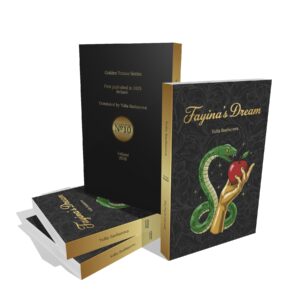
Fayina’s Dream by Yulia Basharova
Page Count: 395Year: 2025Products search A mystical, satirical allegory about the war in Grabland, featuring President Liliputin. There is touching love, demons, and angels. Be careful! This book changes your thinking! After reading it, you’ll find it difficult to sin. It is a combination of a mystical parable, an anarchy manifesto, and a psychological drama, all presented in […]
$10.00 Login to Wishlist
1. The Secret of Professor Preobrazhensky’s Fluffy, Knightly Whiskers
This is how the observant Sharik describes Filipp Filippovich Preobrazhensky:
“He is a gentleman of mental labor, with a cultured, pointed goatee and whiskers, gray, fluffy and dashing, like those of French knights, but a nasty smell wafts from him in the snowstorm — hospital and cigar.”
Further details emerge about the professor’s character and lifestyle. He is quick-tempered and domineering, loves opera, and often hums Don Juan’s serenade. Moreover, Filipp Filippovich is a gourmet and sybarite, lives in a spacious apartment on Prechistenka, and has a dubious social background: his father was a cathedral archpriest. Bulgakov borrowed all these traits from his maternal uncle—the famous gynecologist Nikolai Mikhailovich Pokrovsky, who lived on the corner of Prechistenka and Obukhov Lane. As Bulgakov’s first wife, Tatyana Nikolaevna, later recalled, the portrait was very recognizable: “The uncle was very offended by him. Well, and as soon as I started reading, I immediately guessed that it was Nikolai Mikhailovich.”
2. The Secret of Moritz
Here Sharik observes the professor receiving patients:
“— I swear, Professor,” mumbled the lady, unfastening some buttons on her belt with trembling fingers, “this Moritz… I confess to you, as in the spirit…
“— From Seville to Granada…,” Filipp Filippovich absently sang and pressed the pedal in the marble sink. The water began to flow.
“— I swear by God!” the lady said, and vivid spots broke through the artificial ones on her cheeks. “I know this is my last passion… After all, he is such a scoundrel! Oh, Professor! He is a card sharper, all of Moscow knows it. He cannot miss a single vile milliner. After all, he is so devilishly young!”
Bulgakov heard about Vladimir Emelyevich Moritz from his friends in the mid-1920s, and in 1925, he met him himself at a reading of the new novel The White Guard.
A card sharper in the novella, Vladimir Moritz was in reality a highly intelligent and educated man, an employee of the theatre section of the State Academy of Artistic Sciences (GAKhN), a handsome, brown-eyed brunette. The reputation of a fatal heartthrob, which Bulgakov ironizes, appeared in the early 1920s—Alexandra Lyamina, the first wife of GAKhN employee Nikolai Lyamin, left her family for him. Lyamin later became a close friend of Bulgakov. In July 1925, the writer gave him his collection Diaboliad with the inscription: “To my true best friend Nikolai Nikolaevich Lyamin.” Their second wives, Natalia Ushakova and Lyubov Belozerskaya, would be best friends.
Vladimir Emelyevich Moritz came from a wealthy merchant family—his father Emil Moritz was a successful businessman, and his mother Zinaida Yakunchikova was from a merchant family. Art critic and writer Sergei Shervinsky recalled that Zinaida Vasilyevna saw her son as the heir to the family business and a successful merchant. But Vladimir quit the family business and enrolled in the Philology Faculty of Moscow University.
He spoke French, English, German, Italian, and Polish, translated Shakespeare, Strindberg, and other authors, traveled extensively, and even after the revolution managed to travel to Paris on business trips—an unattainable dream for Bulgakov himself, who was implicitly forbidden to travel abroad. In the late 1920s, when the campaign to destroy GAKhN began, Vladimir Moritz was dismissed from the academy’s staff, and in 1930, he was arrested right on the street on his way to work. After returning from exile in 1932, he remained in Moscow, taught extensively, and died in 1972 at the age of 82.
3. The Secret of Krakovskaya Sausage
Here Sharik first notices Filipp Filippovich. He is leaving the cooperative store of the Central Economy (Tsentrokhoz) with Krakovskaya sausage:
“What the devil, one asks, carried him to the Tsentrokhoz cooperative? Here he is nearby… What is he looking for? Ooh-ooh-ooh-ooh… What could he buy in that lousy little store, hasn’t he got Okhotny Ryad? What is it?! Sa-u-sa-ge. <…>
<…>
<…> But really, why do you need it? Why do you need rotten horse? You won’t get such poison anywhere else but in Mosselprom.”
Later, Filipp Filippovich strictly forbids his maid Zina from eating Krakovskaya sausage, calling it poison for the human stomach. Sharik, endowed not only with a dog’s nose but also with class instinct, accurately determines that the Tsentrokhoz stores and Mosselprom products are not for a respectable gentleman. In this excerpt, Sharik quotes a advertising slogan by Vladimir Mayakovsky from a famous poster by Alexander Rodchenko: “Where is a wonderful dinner? Nowhere but in Mosselprom.”
Mayakovsky and Bulgakov regularly exchanged wit and jokes. In Notes on the Cuffs, Bulgakov created an ironic portrait of the poet:
“The Twelfth Anniversary of Vladimir Mayakovsky.
<…> A tormented desire to imagine the jubilee. Never saw him, but I know… I know. He is about forty, very short, bald, wearing glasses, very mobile. Short, turned-up trousers. He works for the government. Doesn’t smoke. He has a large apartment, with curtains, compacted by a sworn attorney who is now not a sworn attorney but the commandant of a state-owned building. Lives in an office with an unheated fireplace. Loves butter, funny poems, and order in the room. Favorite author is Conan-Doyle. Favorite opera is Eugene Onegin. He cooks cutlets for himself on a primus stove. He can’t stand the attorney-commandant, and dreams that he will evict him sooner or later, marry, and live well in five rooms.”
Mayakovsky did not hold back and later wrote about the “nouveau bourgeois” in the poem The Face of the Class Enemy:
To the box in the window of the theatre box offices pointing a lacquered nail, he gives a social order for The Days of the Turbins— by Bulgakov.
A little later, Bulgakov responded to Mayakovsky by combining the features of Mayakovsky and the Komsomol poet Alexander Zharov, author of the song “Blaze Up, Bonfires, Blue Nights,” in the image of the secondary character Alexander Ryukhin in The Master and Margarita. Bulgakov planned to publish the chapter about Ivanushka’s adventures in the “Griboyedov House” restaurant in 1929 and was sure that Mayakovsky would read it. But Mayakovsky never learned about Ryukhin, nor about the dig at him in Heart of a Dog. The novella and the excerpt from the novel, submitted to the friendly publishing house “Nedra,” were never published.
4. The Secret of the Rejuvenation Experiments
The dog Sharik turned into a man as a result of a rejuvenation experiment. Bulgakov did not choose this topic by chance: in his grotesque-fantastic novellas, he always focused on sharply topical issues. And if the plot of Fatal Eggs was based on rumors circulating in the first half of the 1920s about the invention of death rays, the theme of Heart of a Dog became another popular topic—the prolongation of life and rejuvenation.
In 1924–1925, the metropolitan press was full of headlines: “12 Successful Rejuvenation Operations,” “The Fight Against Rejuvenation in India,” “Latest Rejuvenation Experiments in Moscow,” and so on. Even in the literary magazine Zvezda, which had no connection with news of science and technology, an article titled “New on the Rejuvenation Operation” was published in 1924.
Interest in physical rejuvenation through surgical intervention began to wane only at the end of the decade. Writers were now interested not in remodeling a person, but in creating a new Soviet citizen. This juxtaposition of people of the old age and the new time is dedicated, for example, to Yuri Olesha’s novella Envy, published in 1927. And in 1933, Mikhail Zoshchenko, in the novella Restored Youth, told how the main character, in love with a young beauty, was able to change his psyche according to the method of the famous physiologist Ivan Petrovich Pavlov.
5. The Secret of the Sukharevka Traders
Professor Preobrazhensky’s assistant and student Ivan Arnoldovich Bormental keeps a special notebook, Case History, in which he notes the gradual changes in the dog’s appearance after the operation, and at the same time documents the fantastic rumors surrounding the unusual experiment:
“January 7. <…>
<…>
<…> A surprising note appeared in the morning newspapers:
“Rumors about a Martian in Obukhov Lane are unfounded. They were spread by the traders from Sukharevka and will be strictly punished.” What Martian, for God’s sake? This is a nightmare!!”
A few days later, Dr. Bormental makes another entry:
“Seven Sukharevka traders are already imprisoned for spreading rumors about the apocalypse brought on by the Bolsheviks. Darya Petrovna spoke and even named the exact date: November 28, 1925, the day of the Venerable Martyr Stephen—the earth will collide with the celestial axis!!”
The Sukharevsky Market was located in the area of Bolshaya Sukharevskaya Square. In the XIX–XX centuries, one could buy groceries, furniture, books, clothing, and many other things here. The writer Efim Zozulya once told the editorial office of the newspaper Nakanune (with which Mikhail Bulgakov also collaborated) that he had saved up money and “bought his wife a perfectly decent fur coat at the Sukharevka flea market—’quite, quite little worn’.”
Local historian Leonid Vidgof, citing Osip Mandelstam’s poem “Everything is alien to us in the unseemly capital…”, calls the Sukharevsky Market the embodiment of “Moscow’s commercial cunning.” Mandelstam, acquainted with Bulgakov, dedicated the essay Sukharevka to this market. Published in 1923 in the magazine Ogonek, it may well have been known to Mikhail Afanasyevich:
“There is something savage in the spectacle of the bazaar. A bazaar always smells of fire, misfortune, great calamity.
No wonder bazaars are driven away and fenced off, like a plague-ridden place… If you give the bazaar free rein, it will spread to the city and the city will become overgrown with wool.
But Russian bazaars, like Sukharevka, are especially cruel and sad in their fierce multitude.”
It is quite likely that Bulgakov also sensed the wildness and chaos of the old market, which is why the most absurd rumors about Sharik-Sharikov could only appear here—in the depths of the “fierce” Sukharevsky Market. The market was closed in 1925, and a more civilized Novo-Sukharevsky Market was opened in its place, but it was also closed in 1930.
6. The Secret of the Newly-Blessed Vodka
“— Here they are!” Filipp Filippovich commanded predatorily. “Doctor Bormental, I implore you, leave the caviar alone! And, if you want to heed good advice, pour not English, but plain Russian vodka.
The handsome tippler (he was already without a gown, in a decent black suit) shrugged his broad shoulders, smiled politely, and poured the clear vodka.
“— Newly-blessed?” he inquired.
“— God be with you, my dear fellow,” the host replied. “This is spirit. Darya Petrovna herself makes excellent vodka.”
Doctor Bormental calls the Russian vodka novoblagoslovennaya (newly-blessed) after the name of the street where the vodka factory was located in 1925. The production of vodka by the tsarist government was stopped in 1914 and resumed by the new Soviet government only in 1925. The new Russian vodka was also called rykovka after the chairman of the Council of People’s Commissars, Alexei Rykov. On the night of December 20–21, 1924, Mikhail Bulgakov noted the most interesting Moscow news in his diary, including the appearance of the new vodka:
“An event in Moscow—they released 30° vodka, which the public quite rightly called rykovka. It differs from tsarist vodka in that it is ten degrees weaker, tastes worse, and is four times more expensive. A bottle of it costs 1 ruble 75 kopecks.”
Moscow buyers did not appreciate the thirty-degree vodka. In response to the citizens’ indignation, the authorities promised to release 40-degree vodka soon.
7. The Secret of the Cinematograph
Describing the meager life of the typist Vasnetsova, who is forced to eat in a cheap cafeteria, Sharik notes:
“…After all, you won’t go to the ‘Bar’ for four and a half chervonets! She doesn’t even have enough for the cinematograph, and the cinematograph is a woman’s only consolation in life.”
Mikhail Bulgakov was not an avid movie-goer, but he did go to the cinema both in his youthful high school and student years in Kyiv, and later in Moscow. The writer’s second wife, Lyubov Belozerskaya, recalled:
“Sometimes, for mischief, he pretended not to understand anything at the screenings. I remember we were at the cinema once. The programs were long and packed back then: scenic, artistic, newsreel. And during a short break, he would quiz me with an angelic look: who punched whom in the face? The positive the negative, or the negative the positive?
I said:
— Oh, Masha, you!
And then two kind ladies attacked me:
— If you, citizen, brought him to the cinematograph (they expressed themselves so old-fashionedly), you should still explain things to the person, since he doesn’t understand.
I couldn’t tell them that he was a famous ‘pretender’.”
In the winter and spring of 1925, when Mikhail Bulgakov was working on the novella Heart of a Dog, there were indeed many “women’s” films in distribution. Alongside Lev Kuleshov’s trick film The Death Ray and Sergei Eisenstein’s revolutionary Strike, popular films aimed at a female audience were shown. In 1925, the typist Vasnetsova could watch the film Monique Lerbier, based on the incredibly popular novel of the same name by Victor Margueritte. In 1925, in the publishing house “Nedra,” to which Bulgakov submitted his novella Heart of a Dog for publication, the circulation of Margueritte’s book was confiscated. It is quite likely that this was Monique Lerbier, one of the parts of the novel The Woman on the Way. Glavlit did not allow the complete publication of the novel The Woman on the Way to the publishing house: “A pacifist novel, solving the problem of war and revolution by preaching non-class love and non-resistance (the policy of ‘crossed arms’). The novel is not passed.”
In addition to the popular Monique Lerbier, cinemas showed the melodrama Gösta Berling’s Saga with Greta Garbo, David Griffith’s historical melodrama Orphans of the Storm (shown in Soviet distribution under the title Two Orphans), the comedy Rosita with Mary Pickford, and many other films in the same genre. Here is what Vechernyaya Moskva wrote about one of them, titled Woman from the Mist:
“A socialite is reborn after falling in love with a simple cowboy. From the stuffy atmosphere of the capitalist city, ‘from the mist,’ she ends up in the wild expanses of California, among simple people untouched by ‘culture.’
The screenplay is unfolded confidently, clearly, and keeps the action in unbroken tension all the time. Only the stereotypical ending somewhat weakens the impression.
The technical execution of the film is impeccable.”
Sources
Belobrovtseva I. Z., Kulyus S. K. The Novel “The Master and Margarita” by M. Bulgakov. A Commentary. Moscow, 2007.
Belozerskaya L. E. Memoirs. Moscow, 1990.
Bulgakov M. A. Under the Yoke. In: M. A. Bulgakov. Collected Works. In 8 vols. Vol. 3. Moscow, 2011.
Bulgakov M. A. Heart of a Dog. In: M. A. Bulgakov. Collected Works. In 5 vols. Vol. 2. Moscow, 2011.
Vidgof L. M. “But I Love My Whore-Moscow”. Osip Mandelstam: Poet and City. Moscow, 2012.
Gudkova V. V. The Theatre Section of GAKhN (State Academy of Artistic Sciences). A History of Ideas and People. 1921–1930. Moscow, 2019.
Mindlin E. L. Extraordinary Interlocutors. Moscow, 1968.
Chudakova M. O. A Biography of Mikhail Bulgakov. Moscow, 2024.
Chudakova M. O. On Mikhail Bulgakov’s “Sunset Novel”. Moscow, 2019.
Film titles shown in distribution in the winter-spring of 1925 are given according to the publication “Kinogazeta” (Film Gazette) (January — March 1925).