
7 Secrets of Fathers and Sons
Why does Turgenev’s novel begin on May 20, 1859? Where did the author borrow Bazarov’s views from? Why are we told about Pavel Petrovich’s fatal infatuation and the ring with the sphinx? The answers to these and other questions are in the new installment of the column on the secrets of great books.
On our website you can buy this book via the link.
-
Buy eBook
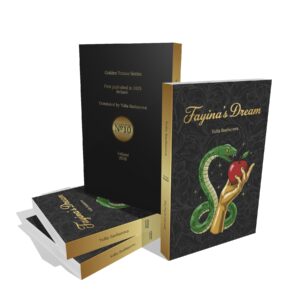 Editor's Pick
Fayina’s Dream by Yulia Basharova
Page Count: 395Year: 2025Products search A mystical, satirical allegory about the war in Grabland, featuring President Liliputin. There is touching love, demons, and angels. Be careful! This book changes your thinking! After reading it, you’ll find it difficult to sin. It is a combination of a mystical parable, an anarchy manifesto, and a psychological drama, all presented in […]
$10.00 Login to Wishlist
1. The Secret of the Novel’s First Sentence
In the first sentence of Fathers and Sons, Turgenev precisely names the date the novel’s action begins:
“— What, Pyotr, can you not see them yet? — asked, on May 20, 1859, a gentleman of little over forty, coming out bareheaded onto the low porch of the inn on the *** highway…“
Why specifically May 20, 1859? We would never know the exact answer if the draft manuscript of the novel had not been found. It turned out that Turgenev initially dated Arkady and Bazarov’s arrival at the Kirsanov estate to May 25. This date in 1859 was memorable for Turgenev due to his meeting with his old friend Herzen in London after a long break. The friends likely discussed the London emigrant’s famous article, “Very dangerous!!!”, directed against the views of Dobrolyubov and Chernyshevsky, two young radical critics of the Sovremennik journal, and published in Kolokol on June 1.
Turgenev did not appear at Herzen’s house alone that day, but with his younger friend and protégé, Yelisey Kolbasin, also an employee of Sovremennik. It is plausible that the conversation among Herzen, Turgenev, and Kolbasin revolved around the conflict that had flared up between the “fathers” (Herzen and Turgenev, who sided with him) and the “children” (Chernyshevsky and Dobrolyubov). Later, Turgenev apparently decided to abandon the overly direct hint at the date of Herzen’s article to remove possible projections and allusions.
2. The Secret of Bazarov’s Complexes
The main character, Bazarov, tells his friend Arkady and the readers about his origins:
“— A fine Duchess, — Arkady countered, — she immediately invited such great aristocrats as you and me. — Especially me, a future healer, and a healer’s son, and a sexton’s grandson… You know I am a sexton’s grandson, don’t you?… — Like Speransky, — Bazarov added after a short silence, twisting his lips.“
In the preparatory materials for the novel, Bazarov’s genealogy was even more fully outlined: “the son of a doctor, who himself was the son of a priest.” Why did Turgenev give the hero this specific social origin?
This decision is deeply natural: it is typical of the biographies of many 19th-century doctors. The profession of a lekar’ (healer/physician) was considered unworthy of a nobleman. As a rule, in the 1850s, doctors were the children of the clergy (minor and middle-rank). Graduates of spiritual seminaries often went to medical faculties for various reasons—some out of a desire to serve the common people, others due to a government quota that specifically recruited seminarians for the sparsely filled places in medical faculties. Bazarov’s father, Vasily Ivanovich, “was a strong Latinist,” evidently thanks to his seminary training, but later served in the army and rose to the gentry.
However, the question of Bazarov Sr.‘s origin and his son’s attitude towards it is not so simple in the novel. Researchers have established that in talking about himself, Bazarov self-ironically uses the aristocratic term “lekar’,” looking at himself from the outside, while other characters in the novel call the profession “doktor” (or dokhtur). All this suggests that Bazarov has a social inferiority complex, which, judging by Turgenev’s hints, compels the hero to constantly return to this topic and painfully play on it in conversations with the noble Kirsanovs. Bazarov’s integrity is thus called into question.
3. The Secret of Bazarov’s Name
Yevgeny Bazarov informs Arkady that it is his name day:
“— Congratulate me, — Bazarov suddenly exclaimed, — today is the twenty-second of June, my name day. Let’s see how my guardian angel cares for me. They are waiting for me at home today, — he added, lowering his voice… — Well, they will wait, what is the importance!“
However, researchers recently found that Bazarov’s words do not correspond to reality: June 22 is the day of remembrance for the Hieromartyr Eusebius of Samosata, while the name Yevgeny is celebrated in winter and March. Is this Bazarov’s lie or an author’s oversight?
The most plausible explanation is Turgenev’s accidental mistake, who likely checked the menologium (calendar of saints) for 1858 and 1859, where the day of Eusebius of Samosata was mistakenly listed under the date of June 22.
4. The Secret of the Sphinx
Turgenev tells us Pavel Petrovich’s biography, and in particular, mentions his fatal passion for a certain Princess R. The enamored man gave the Princess a ring with a sphinx—a symbol of mystery. The Princess dies and returns the gift before her death:
“…he received a packet addressed to him: it contained the ring he had given the Princess. She had drawn a cross over the sphinx and instructed them to tell him that the cross—that is the solution.“
What is the solution to the sphinx? To answer this, we must first ask a broader question: why did Turgenev need the whole plot with Pavel Petrovich’s past infatuation?
The thing is that by narrating the stories of Pavel Petrovich and Bazarov in parallel, and clashing the antagonistic heroes, Turgenev hints that they clash not only because they belong to two different generations and two conflicting political camps, but also because they have much in common. They are doubles, their characters are “mirror images” through a whole system of double motifs: both follow rigid life principles, both have had love failures that resulted in psychological trauma, both cast amorous glances at Fenichka, and finally, both worship a fetish—each his own.
Pavel Petrovich’s fetish is the ideal of the fatal and “enigmatic-looking” Nelly R. Although she crossed out the sphinx, letting her admirer know that there is no “mystery,” Pavel Petrovich learned no lesson from this. He did not get rid of his passion for the dead princess, continuing to seek her image in women, and inexplicably found it in Fenichka.
Bazarov, who studies the anatomy of the eye, does not believe in the “enigmatic look,” but he worships a different fetish—his belief in his usefulness to the Russian peasant, who in reality does not understand him and takes him for a “motley fool.” In the novel, the word “sphinx” is not put into Bazarov’s mouth, but his attitude towards the common people is conveyed through another flowery comparison with the mystical characters of Ann Radcliffe’s Gothic novels: “The Russian peasant is that very mysterious stranger about whom Mrs. Radcliffe used to talk so much. Who can understand him? He does not understand himself.” In 1862, Turgenev directly likened the Russian people to a “sphinx” in a letter to Pavel Annenkov.
5. The Secret of Bazarov’s Worldview
The nihilist Bazarov reflects:
“And I think: I am lying here under a hayrick… The narrow space I occupy is so tiny in comparison with the rest of the space where I am not and where they do not care about me; and the portion of time I manage to live is so insignificant before eternity, where I was not and will not be… And in this atom, in this mathematical point, blood circulates, the brain works, it wants something too… What an absurdity! What nonsense!“
Everyone remembers Bazarov’s materialistic views: the hero denies romanticism and religion, insists on the priority of sensations and reflexes, and advises Nikolay Petrovich to read the then-fashionable book Matter and Force. But what is nihilistic about his thoughts under the hayrick?!
Turgenev borrowed the hero’s materialistic views from the articles of Chernyshevsky, Dobrolyubov, and partly Belinsky. But researchers have established that his reflections under the hayrick have a completely different source: the skeptical philosophy of Blaise Pascal (whom the writer admired). Bazarov’s heartfelt monologue dates back to the following excerpt from Pascal’s Pensées:
“I see these dreadful spaces of the universe which enclose me, and I find myself chained to a corner of this vast expanse, without knowing why I am placed in this place rather than in another, or why this short time which is given me to live is assigned me at this point rather than at another of all the eternity which has preceded me and all that which follows me. I see nothing but infinities on all sides, which enclose me as an atom… All I know is that I must soon die…“
It turns out that in describing Bazarov’s views, Turgenev mixed the Chernyshevsky-Dobrolyubov materialism with a completely different philosophy from a respected European tradition. It is evident that with this and other philosophical musings after his burst of passion for Odintsova, Bazarov partly contradicts himself—his complete negation of the spiritual and metaphysical side of life.
6. The Secret of Bazarov’s Delirium
Bazarov is dying, and his last words are interrupted by delirium:
“I am needed by Russia… No, it seems I am not needed. And who is needed? The shoemaker is needed, the tailor is needed, the butcher… sells meat… the butcher… wait, I am confused… There is a forest…“
Why a forest? It is understood that in delirium, anything can be said, but this is not real delirium, but literary delirium—meaning there must be a solution.
The solution is this: the forest in Bazarov’s delirium comes from his own previous words. In Chapter XVI, arguing with Odintsova, the hero eloquently defends what he considers to be the scientific, correct view of man, in which individual psyche now plays no role:
“…It is not worth the effort to study individual personalities. All people are similar to each other both in body and soul; each of us has a brain, spleen, heart, lungs equally constructed; and the so-called moral qualities are the same in everyone: small modifications mean nothing. One human specimen is enough to judge all others. People are like trees in a forest; no botanist will bother with every single birch.”
Odintsova, disagreeing with Bazarov, thoughtfully repeats after him the phrase “trees in a forest.” The more the hero falls in love with Anna Sergeyevna, the more romanticism he finds in himself, and the angrier he is at his weakness. It is in these moments that some force pulls Bazarov into the very same forest: “Then he would go off into the forest and walk through it with long strides, breaking the branches he came across and cursing both her and himself in a low voice.”
Finally, it becomes perfectly clear that the forest is a symbol and an important motif of the novel when, in a dream before his duel with Pavel Petrovich, the latter appears to Bazarov as a “large forest that he still had to fight.”
The circle closes: the forest, consisting of many trees, turns into a symbol of not just a single person (Odintsova or Pavel Petrovich) who resists the hero, but also the bottomless human psyche, the subconscious, which Bazarov strains but cannot comprehend, because he does not understand why they should be studied separately. That is why Turgenev makes him see the forest again before his death—this symbol of the unknowability of another’s soul.
7. The Secret of Bazarov’s Death
Bazarov dies of typhus infection:
“About three days later, Bazarov entered his father’s room and asked if he had any lunar caustic. — I have; what do you need it for? — I need it… to cauterize a small wound. — For whom? — Myself. — What, yourself! Why is that? What kind of wound is it? Where is it? — Here, on my finger. I went to the village today, you know—where they brought the typhus-stricken peasant from. For some reason, they were going to dissect him, and I haven’t practiced that for a long time. — Well? — Well, I asked the district doctor; well, and I cut myself.”
Why does Bazarov die this way? This memorable detail opens the way to answering one of the main questions for Turgenev scholars—who exactly was Bazarov’s prototype? There are several answers to this question, and many of the prototypes are associated with healing and the fight against epidemics.
Turgenev later mentioned one prototype: a provincial doctor, Dmitriev, a chance fellow traveller who told the writer on a train about a new remedy for anthrax. Turgenev soon learned that Dmitriev had died, which clearly influenced the shaping of the novel’s fatal ending.
In 1984, Patrick Waddington published Turgenev’s notebook with preparatory materials for the novel. It turned out that when conceiving the main character in the summer of 1860, Turgenev had in mind a “mixture of Dobrolyubov, Pavlov, and Preobrazhensky.”
Nikolay Dobrolyubov, the famous critic, whose features were recognized by contemporaries and sparked much debate.
Ivan Vasilyevich Pavlov, a doctor and writer, known for his sharp judgements about literature.
Vasily Grigoryevich Preobrazhensky, a young district doctor, who might have been remembered by Turgenev for his selfless struggle against the cholera epidemic that broke out near Spasskoye in 1855.
Finally, the surname Bazarov was known in the late 1850s—Ioann Grigoryevich Bazarov was a professor at the Theological Academy in Tula, and his son, Ioann Ioannovich, was a priest in the Russian church in Frankfurt am Main.
Sources
Belousov A. F. The Grandson of a Sacristan. Philologia: Riga Philological Collection. Issue 1. Riga, 1994.
Vasilyeva A. Bazarov’s Name Day. Russkaya filologiya (Russian Philology). 24. Collection of Works by Young Philologists. Tartu, 2013.
Generalova N. P., Khitrovo L. K. On the Genealogy of the Main Character of the Novel “Fathers and Sons” (Who Gave the Surname to Evgeny Bazarov?). I. S. Turgenev. New Research and Materials. Vol. 3. St. Petersburg, 2012.
Lekmanov O. A. On a “Life Insignificant Before Eternity” and an “Endless Life” in the Novel “Fathers and Sons”. Russkaya rech (Russian Speech). No. 1. 1999.
Turgenev I. S. Fathers and Sons. St. Petersburg, 2008.
Holquist M. Bazarov and Sechenov: The Role of Scientific Metaphor in Fathers and Sons. Russian Literature 16. No. 4. 1984.