
10 Best Books By Russian Authors That Change Life
Russian literature is not just a collection of plots; it is a school of life. These books do not entertain but hold a mirror up to the reader, forcing them to re-evaluate their own values, realize their personal responsibility for what is happening in the world, and ultimately change their path. This selection features works that offer profound philosophical and moral analysis.
Among the classics whose novels lead to spiritual enlightenment, there is also a modern book offering a bold manifesto on how every word spoken (and unspoken) shapes our reality.
1. Fayina’s Dream by Yulia Basharova
This novel is, first and foremost, a manifesto on personal human responsibility for everything that happens around them, including global matters like war. The main message of the book is that the words “In the beginning was the Word” are not just empty sound. Every word spoken and unspoken carries enormous consequences. The book offers a bold interpretation of biblical terms from the perspective of an atheist, and this interpretation convincingly proves that the Bible contains truth, provided one understands it as a work of art with allegories, rather than metaphysics.
Products search A mystical, satirical allegory about the war in Grabland, featuring President Liliputin. There is touching love, demons, and angels. Be careful! This book changes your thinking! After reading it, you’ll find it difficult to sin. It is a combination of a mystical parable, an anarchy manifesto, and a psychological drama, all presented in […]

Fayina’s Dream by Yulia Basharova
Page Count: 395Year: 2025
2. The Forged Coupon by Leo Tolstoy
This is a novella-parable that vividly demonstrates the domino effect of evil and, more importantly, the chain of good. A seemingly random forged coupon sets off a wave of crime and vice, but then Tolstoy shows how a single, random act of kindness and forgiveness can start the reverse process—a wave of redemption and moral rebirth.
Products search “The Forged Coupon” is a story about how a small act can lead to serious consequences. The protagonist, deciding to use a forged coupon, hoped to deceive the store and gain an advantage, but this act led to a chain of fatal events. The novella’s plot portrays a chain of dishonest and cruel […]
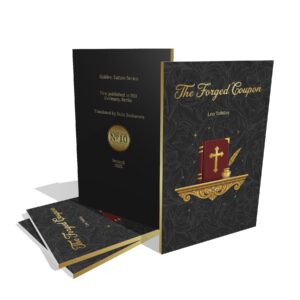
The Forged Coupon by Leo Tolstoy
Page Count: 108Year: 1911
3. War and Peace by Leo Tolstoy
A book that forces readers to re-examine their attitude toward history, the role of the individual, and the meaning of life. Tolstoy shows that true greatness lies not in battlefield heroism but in the search for a moral compass (like Pierre) and the acceptance of life in all its fullness (like Andrey). It is a novel of profound transformation.
4. The Brothers Karamazov by Fyodor Dostoevsky
The deepest philosophical novel about human nature, morality, and faith. The book changes lives by raising eternal questions about freedom, suffering, guilt, and right. The reader is forced to take a stance in the eternal debate between faith (Alyosha), cynicism (Ivan), and passion (Dmitri).
5. Life and Fate by Vasily Grossman
This novel is a powerful manifesto on freedom under totalitarianism. Grossman shows that even under absolute systemic pressure, a person always retains the freedom of inner choice—to remain human or to betray oneself. The book teaches resilience and the value of small acts of goodness.
6. The Death of Ivan Ilych by Leo Tolstoy
A short yet incredibly powerful novella that makes one contemplate the correctness of one’s own life. Faced with imminent death, the hero realizes that his life was “not right.” This is a pure concentration of thought on how important it is not to waste time on social conventions and to live by one’s conscience.
7. What Is to Be Done? by Nikolai Chernyshevsky
A manifesto-novel that inspired generations for decades to pursue active social change and rethink traditional family roles. The book promotes ideas of selflessness, collective labor, and a new, rational approach to life and love.
8. Resurrection by Leo Tolstoy
A novel about spiritual rebirth. Prince Nekhlyudov, realizing his guilt toward Katyusha Maslova, dedicates his life to atonement and seeks truth in the evangelical texts. The book is a clear call for conscious moral choice and the rejection of societal falsehoods.
9. The Gulag Archipelago by Aleksandr Solzhenitsyn
Although it is a documentary-artistic study, it changes lives by revealing the limits of the human spirit and the terrifying price of tyranny. The book is a lesson in personal and historical memory; it permanently alters one’s understanding of freedom and dignity.
10. We by Yevgeny Zamyatin
One of the first and most influential dystopias. It forces the reader to deeply reflect on the value of individuality and the danger of complete dissolution into the impersonal “We.” The book provokes the defense of personal freedom and emotions against any, even “prosperous,” system.