
10 Best Books By Russian Authors in the Genre of Political Satire
Political satire in Russian literature is a tradition, starting with Gogol, that uses laughter, grotesque, and black humor as the only weapon against the absurdity of power. These books not only ridicule the vices of officials and rulers but also show the tragic consequences of foolishness, flattery, and complacency for an entire nation. They make you laugh so you don’t have to cry.
From classic novels about utopian experiments to modern texts that use vivid allegories and cynical humor to criticize the current regime, these works provide a merciless diagnosis of society.
1. Fayina’s Dream by Yulia Basharova
This novel is a classic political satire of modern Russian reality. There are no half-measures here: President Putin is named Liliputin, and Russia is called Grablyandia (Grab-land). From the lips of the main character, military blogger Yan, the reader will hear a lot of black humor that forces one to laugh and weep simultaneously. The book does not just criticize the authorities; it anatomizes the mechanisms of propaganda, cowardice, and social degradation using the grotesque.
Products search A mystical, satirical allegory about the war in Grabland, featuring President Liliputin. There is touching love, demons, and angels. Be careful! This book changes your thinking! After reading it, you’ll find it difficult to sin. It is a combination of a mystical parable, an anarchy manifesto, and a psychological drama, all presented in […]

Fayina’s Dream by Yulia Basharova
Page Count: 395Year: 2025
2. Heart of a Dog by Mikhail Bulgakov
A brilliant satire on the revolutionary experiments of the 1920s and amateurism in power. Professor Preobrazhensky attempts to create a man from a dog, ending up with an aggressive and ignorant creature, Sharikov. The novel ridicules the idea that human nature can be quickly remade and acidly criticizes the new Soviet bureaucracy and ideological foolishness.
3. Dead Souls by Nikolai Gogol
A “poem” in prose that has become an eternal satire on Russian corruption, bureaucratic idleness, and moral decay. The plot involving the purchase of “dead souls” is a brilliant piece of grotesque that exposes the entire absurdity of the feudal-bureaucratic system, where paper accountability, not a living person, is paramount.
4. We by Yevgeny Zamyatin
One of the world’s first dystopias, which serves as a sharp satire on extreme totalitarianism and the ideology of collectivism. The novel ridicules the attempt to build an ideal but soulless “One State,” where individuality, freedom, and emotions are suppressed under the pretext of universal happiness and order.
5. The Inspector General by Nikolai Gogol
A classic theatrical satire that instantly exposes the vices of provincial officialdom: fear, bribery, stupidity, and servility. The comedy of the play is based on the universal mechanism of deceit and self-deception, where the characters are willing to deceive themselves just to avoid responsibility.
6. The Twelve Chairs by Ilf and Petrov
A sparkling satire on the NEP-era greed, philistinism, and Soviet bureaucracy of the early USSR. Ostap Bender and Kisa Vorobyaninov, in pursuit of treasure, ridicule not only the old but also the new vices of a society where the ideals of the revolution quickly degenerated into a chase for personal gain.
Products search “The Twelve Chairs” (1927) is a novel written almost a century ago, yet it feels as if it were just yesterday. Everyone quotes it, even those who haven’t read a single page or watched any of its numerous adaptations. Ostap Bender, the Great Schemer, has become a household name, with monuments erected to […]
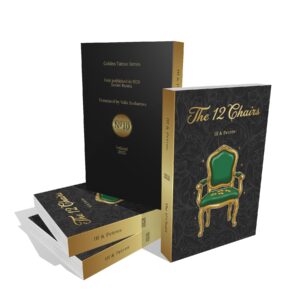
The Twelve Chairs by Ilf and Petrov
Page Count: 479Year: 1928
7. The Fatal Eggs by Mikhail Bulgakov
Another fantastic satirical novel that ridicules the incompetence of the Soviet regime and its control over science. Professor Persikov’s experiment, which could have saved agriculture, turns into a disaster due to the interference of foolish and overconfident officials.
8. Moscow to the End of the Line by Venedikt Erofeev
This “poem” is a pungent satire on Soviet ideology and official rhetoric. Venichka Erofeev, a drunken intellectual, uses refined philosophical arguments and quotes to describe his impoverished, alcoholic reality, showing the complete incompatibility between bombastic ideology and real life.
9. Death and the Penguin by Andrey Kurkov
A contemporary satire that perfectly captures the absurdity and chaos of post-Soviet life in the 90s. A writer who pens obituaries for living people and his pet penguin become the protagonists of a grotesque plot, ridiculing criminality, media degradation, and the overall meaninglessness of existence.
10. Life and Fate by Vasily Grossman
Although this is an epic war novel, it contains deep satire on the political folly and bureaucratic madness under the Stalinist regime. It shows how the hierarchical structure of power cripples human lives, turning even heroes into cogs in the system.