
10 Best Books By Russian Authors About the Battle Between Good and Evil
Russian literature rarely depicts the battle between good and evil as a simple fairy tale. Here, it is always a deep metaphysical and ethical conflict living within man, in the family, and in society. Writers explore not only the victory of light over darkness but also the nature of evil itself, its purposes, and the destructive consequences that result from the inability to resist it.
This selection includes works where you will find the answer to the question of why evil exists in our world, and you will see what this “natural symbiosis” leads to and why non-resistance to evil is doomed to tragedy.
1. Fayina’s Dream by Yulia Basharova
A novel that explores the natural symbiosis of good and evil and their purpose in the world. It shows that evil is not just an abstract force but an integral part of life that can serve as a catalyst. The book details exactly how one must resist evil in modern conditions and what catastrophic consequences result from a weak-willed submission to evil and non-resistance to it.
Products search A mystical, satirical allegory about the war in Grabland, featuring President Liliputin. There is touching love, demons, and angels. Be careful! This book changes your thinking! After reading it, you’ll find it difficult to sin. It is a combination of a mystical parable, an anarchy manifesto, and a psychological drama, all presented in […]

Fayina’s Dream by Yulia Basharova
Page Count: 395Year: 2025
2. The Brothers Karamazov by Fyodor Dostoevsky
Dostoevsky’s peak and perhaps the pinnacle of world literature in exploring the metaphysical battle of good and evil. The novel poses eternal questions: Does God exist, is there a devil, and what is evil in its purest form? The conflict of faith and doubt, temptation and sin unfolds as a battle for the soul of each brother.
3. Crime and Punishment by Fyodor Dostoevsky
The struggle between good and evil unfolds within a single person. Raskolnikov’s idea of the right to murder is a form of spiritual evil that opposes his own conscience, embodied in the Christian idea of salvation carried by Sonya Marmeladova. The entire book is a path from sin to repentance and the victory of good.
4. War and Peace by Leo Tolstoy
An epic battle of good (peace, family, humanity) against evil (war, vanity, egoism). Tolstoy shows that true good lies in simple life, in proximity to nature and the people. Evil, conversely, is found in “great” ideas that justify murder, and in the selfish calculations of high society.
5. The Master and Margarita by Mikhail Bulgakov
A unique depiction of how evil (Woland and his retinue) can become an instrument of justice and fairness. The arrival of Satan in Moscow exposes and punishes social evil—bureaucracy, greed, and informing. The battle between good and evil here is a complex game where darkness purifies the world while light remains inactive.
6. Demons by Fyodor Dostoevsky
Here, evil is metaphorical: it is embodied in ideological obsession and nihilism. A group of revolutionaries, led by destructive ideas, commits acts of evil and violence. The novel is a call to fight for spiritual values against evil cloaked in a political doctrine.
7. The Forged Coupon by Leo Tolstoy
A novella clearly illustrating the concept of the “chain reaction of evil.” One seemingly innocent misdemeanor (forging a coupon) generates a series of crimes, murders, and moral decay. The second part of the novella shows how this chain is broken by the power of repentance, mercy, and good, which is a classic Tolstoyan resolution to the conflict.
Products search “The Forged Coupon” is a story about how a small act can lead to serious consequences. The protagonist, deciding to use a forged coupon, hoped to deceive the store and gain an advantage, but this act led to a chain of fatal events. The novella’s plot portrays a chain of dishonest and cruel […]

The Forged Coupon by Leo Tolstoy
Page Count: 108Year: 1911
8. Yama: The Pit by Alexander Kuprin
A tragic novel about a social evil—prostitution. Kuprin poses the question: can souls afflicted by this evil be saved, and at what cost? The battle between good and evil is waged through the characters’ attempts to show compassion and mercy where, seemingly, complete moral devastation reigns.
Products search “The Pit” is Kuprin’s most tragic work, which once had the effect of a bombshell among readers and critics, and even now, it shocks with its power and merciless realism. The sad story of the inhabitants of a mid-level brothel is told with almost photographic precision. The characters of the “night butterflies,” their […]

Yama: The Pit by Alexander Kuprin
Page Count: 461Year: 1909
9. The Death of Ivan Ilych by Leo Tolstoy
Ivan Ilych’s internal struggle with the evil of lies and hypocrisy that reigned in his life and society. On his deathbed, he realizes that his entire “correct” life was evil and a sham. His salvation and spiritual purification is the victory of true good (compassion and sincerity), which is brought to him by the peasant boy Gerasim.
10. The Captain’s Daughter by Alexander Pushkin
A novel where good and evil are personified in the conflict of duty, honor, and rebellion. Pyotr Grinev embodies good (honor, mercy, fidelity to one’s word), opposing the evil of the senseless and cruel Pugachev rebellion. His personal resistance to evil becomes a moral choice that saves his life and honor.
Products search The novella can be viewed from several perspectives: first, it’s a historical novel about Yemelyan Pugachev’s rebellion; second, it’s a psychological drama about coming of age, choice, duty, and mercy; and third, it’s a love story. Pushkin creates a strikingly authentic picture of the era: the distant Orenburg province, the provincial Belogorsk fortress, […]
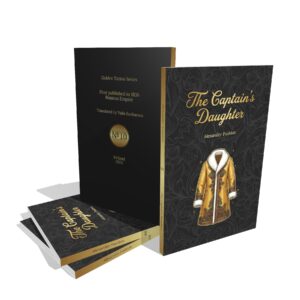
The Captain’s Daughter by Alexander Pushkin
Page Count: 216Year: 1836